Cardano Price Forecast for August 2026: Will ADA Triangle Breakout Happen Before or After the CLARITY Act Deadline?

cryptonews.ruPublished on 2026-07-30Last updated on 2026-07-30

Abstract

Cardano (ADA) is trading at $0.1642, testing the apex of a symmetrical triangle pattern on the daily chart, which signals an impending directional move. Technical analysis identifies key resistance at the 20-day EMA ($0.1650) and the triangle's upper trendline. A breakout above could target the 50-day EMA at $0.1732, with a cup-and-handle pattern potentially forming. Support lies at the SuperTrend indicator ($0.1536) and the June low of $0.1386. Historically, August has been a weak month for ADA, with a median return of -12.8%. A weekly forecast outlines a volatile month influenced by the imminent August 8th deadline for the U.S. CLARITY Act vote, potential SEC regulatory action, and renewed geopolitical tensions following Iran's missile strike. Key bullish catalysts include the potential passage of the CLARITY Act and a major upgrade integrating Cardano's developer documentation and tools into AI coding assistants like Claude, which could significantly boost developer adoption. On-chain data also shows whale accumulation, a potential Wyckoff accumulation signal. The price forecast presents two scenarios: a bullish breakout above $0.1650 targeting $0.17-$0.1732 if the CLARITY Act passes and AI integration fuels momentum, or a bearish break below $0.1536 toward $0.1386 if the bill fails, seasonal weakness persists, and risk appetite diminishes.

Cardano is trading at $0.1642 on July 30, up 1.42%, holding at the apex of a triangle that forces a directional decision, while Iran violated a five-day truce with a ballistic missile strike on a US base in Jordan, and the hawkish FOMC stance raised the probability of a September rate hike to 72%.

$ADA is at Triangle Apex, SuperTrend is Last Bullish Signal
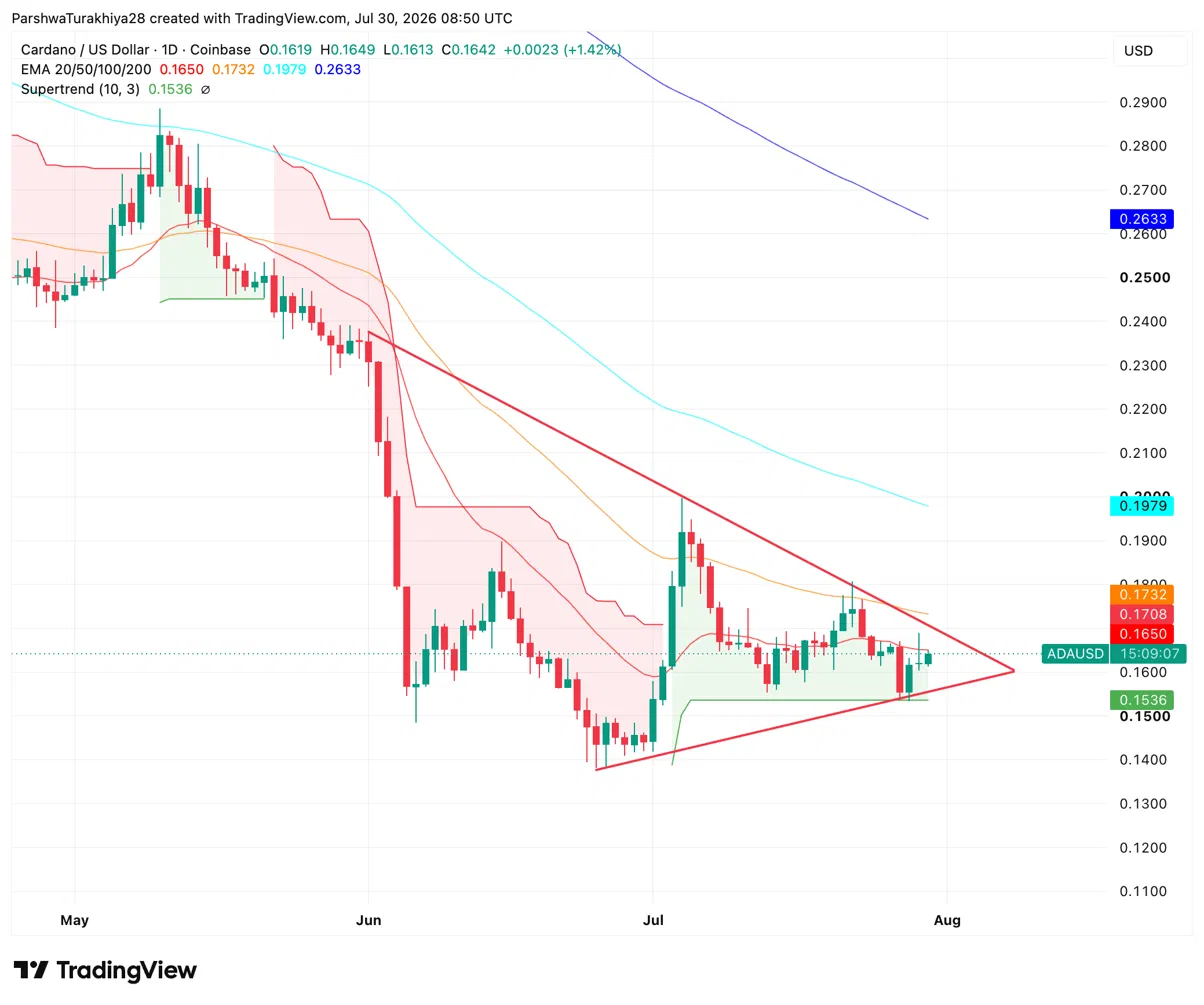
$ADA 1D Price Movement (Source: TradingView)

The daily chart shows $ADA at the converging apex of a triangle formed between a descending trendline from the May peak and an ascending line from the June low around $0.1386. The 20-day EMA at $0.1650 is just above the current price and almost exactly aligns with the upper trendline, making this cluster a key resistance that needs to break for a bullish triangle resolution. The SuperTrend at $0.1536 remains bullish below the price, staying as the sole trend-following indicator on the buyers' side.

Related: Bitcoin Price Forecast for August 2026: Four Analysts Read the Same Fed Decision and Reached Four Different Conclusions

The next ceiling above is the 50-day EMA at $0.1732, followed by the 100-day at $0.1979 and the 200-day at $0.2633. LuckSide Crypto noted that $ADA might be building control for a potential cup and handle structure, targeting a move towards $0.17 if the upper trendline breaks. Below, the SuperTrend at $0.1536 and the June low at $0.1386 define the floor.

What are the Key Support and Resistance Levels for $ADA in August?

Resistance Levels

  1. $0.1650 — 20-day EMA and upper triangular trendline need a close above for a breakout
  2. $0.1732 — 50-day EMA, the next significant ceiling
  3. $0.1979 — 100-day EMA, an extended recovery target
  4. $0.2633 — 200-day EMA, long-term ceiling

Support Levels

  1. $0.1536 — SuperTrend, the last bullish signal below price
  2. $0.1500 — Round number and recent support zone
  3. $0.1386 — June low and Fibonacci zero point, the last line of defense

Has August Historically Been Strong for $ADA?
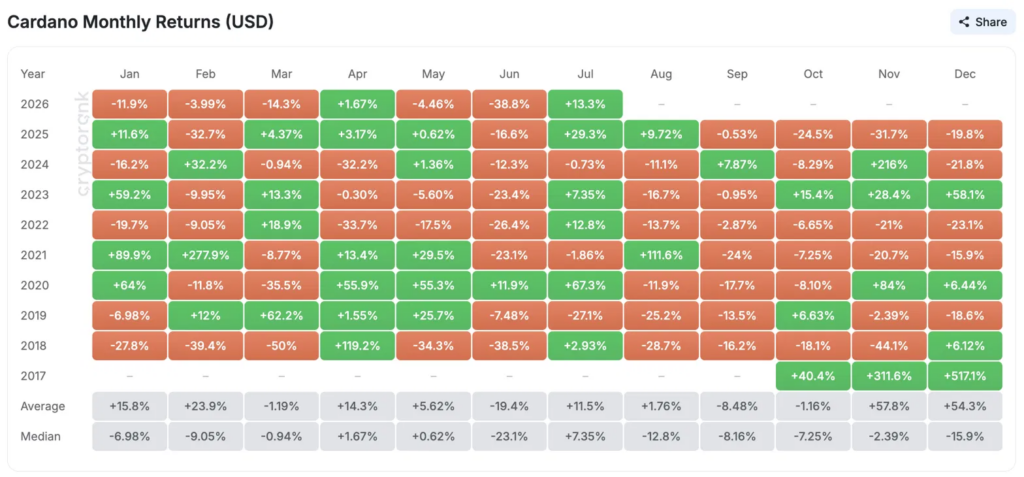
$ADA Monthly Return Analysis (Source: CryptoRank)

The Cardano monthly returns chart speaks directly to this question. The median return for August across all available years is -12.8%, making it the worst-performing month on the $ADA calendar.

August has closed in the red in six of eight years with data, including -28.7% in 2018, -25.2% in 2019, -13.7% in 2022, -11.1% in 2024, with +9.72% in 2025 being the only notable exception.

Related: Pi Network Price Forecast for August 2026: Will the August 11 Node Receiving Deadline Act as a Catalyst for Recovery?

The average stands at +1.76%, lifted by an extraordinary +111.6% in 2021, which masks how consistently negative August has been outside of that outlier year.

Weekly $ADA Forecast for August 2026

Period Price Range Outlook
Aug 1-8 $0.155 — $0.175 Final CLARITY Act window, Iran escalation risk, FOMC reassessment, hawkish pivot
Aug 9-20 $0.150 — $0.185 Post-deadline period, SEC alternative if CLARITY Act fails
Aug 21-31 $0.145 — $0.195 September FOMC pricing grows, seasonal weakness historically peaks

CLARITY Act: 10 Democratic Votes, SEC Backup Plan, and Days Left

Democratic Votes That Could Push It Over

Bloomberg reported that up to 10 Democrats may vote for the CLARITY Act, enough to surpass the 60-vote threshold needed to advance the bill. LuckSide Crypto called this the most encouraging development in weeks, noting significant concessions have been made in the bill's wording to bring those votes onboard. The voting window before the Senate's August 8 recess is now days, not weeks.

SEC Backup That Changes Risk Profile

Separately, the SEC announced it's prepared to establish crypto regulations on its own if Congress doesn't pass the CLARITY Act. LuckSide called this a massive shift from the 2022–2023 crackdown era, arguing it removes the binary risk of total legislative failure, creating a regulatory backstop. The market hasn't reacted as sharply as he expected, but the practical takeaway is that regulatory clarity is coming one way or another—just at a different time if the bill misses the August 8 window.

Cardano Developer Skills Now Available in Claude and Codex

Cardano developer documentation, tools, and workflow guidance are now available natively in Claude, Codex, and other AI coding agents, replacing outdated training data that previously made AI-assisted Cardano development more difficult than Ethereum or Solana.

LuckSide Crypto flagged this as a potentially significant adoption catalyst. AI-assisted development has become a standard part of builders' workflows, and removing the friction of outdated docs could trigger a wave of new Cardano projects. The update directly addresses one of the most persistent criticisms regarding working with Cardano versus competitors, where AI-based coding support has been more comprehensive for years.

What the AI Coding Update Means for Cardano

Before After
Outdated Cardano training data in AI tools Current documentation, tools, and workflows available natively
AI-assisted Cardano development harder than ETH/SOL Now comparable across all three ecosystems
Friction for new builders Friction removed—AI agents can directly guide Cardano development

Iran Violates Truce, Whale Accumulation Shifts

Iran launched ballistic missiles at a US military base in Jordan overnight, ending a five-day ceasefire and pushing US oil up 5% for the session. The escalation reintroduces the geopolitical risk premium that had been gradually fading since the ceasefire signal, and LuckSide Crypto noted this adds uncertainty to an already volatile week for risk assets.

Related: AEON Price Forecast: Rising Open Interest Signals Larger Moves After 22% Daily Spike

On the positive side, on-chain data cited by LuckSide shows Bitcoin wallets held by whales and sharks have accumulated nearly 19,700 BTC over the last eight days as retail buying subsided from July peaks. LuckSide presented this as a Wyckoff Phase C signal, where smart money absorbs supply at depressed prices ahead of the next markup phase. $ADA's own whale accumulation data showed a similar trend in June and July.

$ADA Price Forecast for August 2026: Upside and Downside Targets

  • Bullish Case: Triangle breaks above the 20-day EMA at $0.1650, CLARITY Act passes before August 8, AI coding adoption sparks new developer interest in Cardano, and $ADA targets the 50-day EMA at $0.1732 as the cup and handle structure outlined by LuckSide begins to validate towards $0.17 and beyond.
  • Bearish Case: August's seasonal weakness repeats its historical pattern, CLARITY Act fails to reach a vote before the recess, Iran escalation dampens risk appetite, and $ADA loses the SuperTrend at $0.1536 towards the June low at $0.1386 as the triangle breaks lower, not higher.
end-content

Trending Cryptos

Related Questions

QAccording to the article, what are the main reasons for Cardano (ADA) to be at a decision point regarding price direction in late July 2026?

ACardano's price is at the converging apex of a symmetrical triangle pattern, trading around $0.1642 on July 30, 2026. This technical pattern forces a directional decision. Key fundamental factors adding pressure include the impending August 8th deadline for the CLARITY Act vote in the U.S. Senate, Iran breaking a ceasefire with a ballistic missile strike (introducing geopolitical risk), and a hawkish FOMC stance increasing the probability of a September rate hike to 72%.

QBased on the article's technical analysis, what are the key resistance levels for ADA that need to be broken for a bullish move in August 2026?

AThe key resistance levels for a bullish breakout, according to the article, are: 1) $0.1650 - the 20-day EMA and the upper triangle trendline. A close above this cluster is crucial. 2) $0.1732 - the 50-day EMA. 3) $0.1979 - the 100-day EMA. 4) $0.2633 - the 200-day EMA, representing the long-term ceiling.

QWhat is the historical performance trend for Cardano (ADA) in the month of August, according to the data presented?

AHistorically, August has been Cardano's weakest month. The median return for ADA in August across all available years is -12.8%. It has closed in the red (negative) in six out of the eight years with data, including significant losses in 2018 (-28.7%) and 2019 (-25.2%). The average is skewed to +1.76% solely due to an exceptional +111.6% gain in 2021, which masks the consistently poor performance in other years.

QWhat two potential paths are presented for the future of cryptocurrency regulation in the U.S., and how does this relate to the CLARITY Act deadline of August 8, 2026?

AThe article presents two paths for U.S. crypto regulation: 1) The primary path is the passage of the CLARITY Act, which had a critical voting window before the Senate's August 8th recess. 2) The backup path is the SEC announcing its readiness to establish cryptocurrency regulation independently if Congress fails to pass the CLARITY Act. This shift reportedly removes the 'binary risk' of total legislative failure, ensuring regulatory clarity will arrive eventually, just on a different timeline if the bill misses the August 8th window.

QAccording to the article, what recent development could act as a significant catalyst for Cardano adoption, specifically for developers?

AA significant catalyst mentioned is that Cardano's developer documentation, tools, and workflow guides are now natively available in AI coding agents like Claude and Codex. This update replaces outdated training data that previously made AI-assisted Cardano development more difficult compared to Ethereum or Solana. The article suggests this removal of friction could potentially trigger a wave of new Cardano projects by making development comparable across these major ecosystems.

Related Reads

Saeed Al-Marri: How Tokenization Unlocks New Opportunities for Shipping Funds

Said Al-Marri: How Tokenization Opens New Opportunities for Shipping Funds For centuries, commercial shipping has been a capital-intensive asset class limited to institutional funds and shipping dynasties. Said bin Saleh Al-Marri, CEO of Ethra Invest and Ethra Ship, aims to break down these barriers by combining Real World Asset (RWA) tokenization with conservative private equity principles. This bridges decentralized finance (DeFi) with the physical realities of global trade. Tokenization allows fractional ownership of ships on a blockchain, giving smaller investors access to previously inaccessible markets. However, Al-Marri warns it is not a regulatory loophole or a cure for asset illiquidity. The core physical risks are isolated in Special Purpose Vehicles (SPVs) for qualified investors. While tokenization enhances transparency and ownership record-keeping, Al-Marri stresses that a liquid secondary market depends on transparent asset valuation and must not interfere with ship operations managed by professionals. Regarding legal enforcement, smart contracts cannot physically seize a ship. Legal recourse still relies on traditional maritime courts, ship mortgages, and flag state laws, with blockchain records needing to mirror legal ownership in the SPV perfectly. Beyond ownership, the industry faces administrative hurdles like paper-based bills of lading. Al-Marri argues the bottleneck is legal and operational standardization, not technology. He advocates for a hybrid model combining digital trade documents and programmable settlements with support from regulated financial institutions, rather than a full crypto replacement for tools like Letters of Credit. A major challenge is decarbonizing the global fleet by 2050. Transitioning to green fuels requires massive upfront investment. Al-Marri emphasizes a conservative, holistic approach to underwriting these projects, evaluating technology, fuel availability, safety, and resale value. Investments must be justified under conservative forecasts, not just optimistic ones. By combining pragmatic risk management with digital infrastructure, leaders like Al-Marri show that the evolution of maritime finance is about mobilizing capital to build a modernized and sustainable global fleet, not just putting ships on a blockchain.

cryptonews.ru7m ago

Saeed Al-Marri: How Tokenization Unlocks New Opportunities for Shipping Funds

cryptonews.ru7m ago

Six Years Later, UNI Finally Welcomes Its Own "Buyback Bull"

After years of debate, Uniswap's UNI token has finally entered a 'buyback bull' phase following the long-awaited activation of its fee-switch mechanism. The UNIfication proposal, executed in December 2025, redirected a portion of protocol fees from select pools and Unichain sequencer revenue into a treasury (TokenJar) dedicated to buying back and permanently burning UNI. Initial market reaction was muted due to modest early burn rates. A significant shift occurred in July 2026 with the launch of Robinhood Chain. Uniswap's immediate deployment there skyrocketed trading volume, making it a top fee-generator. Subsequently, governance votes extended the fee mechanism to v4 pools and Robinhood Chain, causing protocol revenue to nearly triple. Daily funds directed to UNI burns rose sharply, with Robinhood Chain contributing over half. This transitioned UNI's narrative from a governance token to a cash-flow asset backed by a perpetual automatic buyer. UNI's price, which had languished around $2.30 in early June, nearly doubled to approach $4.60 by late July. Analysts credit this to the tangible cash flow from fees rather than mere speculation. Unlike many newer projects where buybacks are offset by large investor unlocks, UNI's six-year history has resulted in a widely distributed and relatively clean supply, allowing the buyback pressure to effectively impact the secondary market. The key test will be whether trading activity, particularly on Robinhood Chain, sustains after its initial gas subsidies expire.

marsbit12m ago

Six Years Later, UNI Finally Welcomes Its Own "Buyback Bull"

marsbit12m ago

Only 153 Venture Capital Firms Invested in July: Is the Crypto VC Industry Experiencing a 'Mass Extinction'?

In July 2026, only 153 unique venture capital firms participated in disclosed crypto funding rounds, marking the lowest monthly count since November 2020. This figure represents an 87% decline from the peak of 1,177 firms in 2022. Overall, the first seven months of 2026 saw crypto projects raise approximately $11.78 billion across 481 rounds. This crypto VC contraction contrasts sharply with the broader venture capital landscape, where global VC investment reached a record $560.4 billion in H1 2026, heavily fueled by major AI company financings. This shift in capital allocation has drawn funds away from the crypto sector. Within crypto, funding is highly concentrated. Trading platforms, prediction markets, and payment sectors absorbed 53% of the total capital. While early-stage deals remain frequent, the largest sums flow to a few late-stage rounds and mergers & acquisitions, which surged to $7.23 billion in Q2 2026. The market is consolidating around top funds like a16z crypto and Dragonfly, which successfully raised new multi-billion dollar funds, while many smaller firms have retreated. Analysts describe this as a "great extinction" for crypto VCs, where capital is becoming more selective, favoring proven business models and assets over early-stage speculation. This raises the bar for project quality, funding efficiency, and viable exit paths.

marsbit33m ago

Only 153 Venture Capital Firms Invested in July: Is the Crypto VC Industry Experiencing a 'Mass Extinction'?

marsbit33m ago

Trading

Spot

Hot Articles

Discussions

Welcome to the HTX Community. Here, you can stay informed about the latest platform developments and gain access to professional market insights. Users' opinions on the price of ADA (ADA) are presented below.

活动图片