May 8, 2026, is destined to be written into the development history of China's AIoT industry. Multiple national-level ministries dropped two strategic anchors concerning the next decade on the same day.
The first one is the "Implementation Opinions on the Standardized Application and Innovative Development of Intelligent Agents" jointly issued by the Cyberspace Administration of China, the National Development and Reform Commission, and the Ministry of Industry and Information Technology. For the first time, it defines intelligent agents from a national policy perspective as intelligent systems with capabilities of autonomous perception, memory, decision-making, interaction, and execution. It proposes 19 typical application scenarios around scientific research, industrial development, stimulating consumption, people's livelihood and well-being, and social governance.

The second one is the series of national standards "Intelligence Grading for Artificial Intelligence Terminals" (GB/Z 177—2026) jointly released by the Ministry of Industry and Information Technology, the State Administration for Market Regulation, the Ministry of Commerce, and other departments. It establishes a four-level capability ladder from L1 (responsive) to L4 (collaborative), with the first batch covering seven categories: mobile phones, computers, TVs, glasses, automotive cockpits, speakers, and earphones.
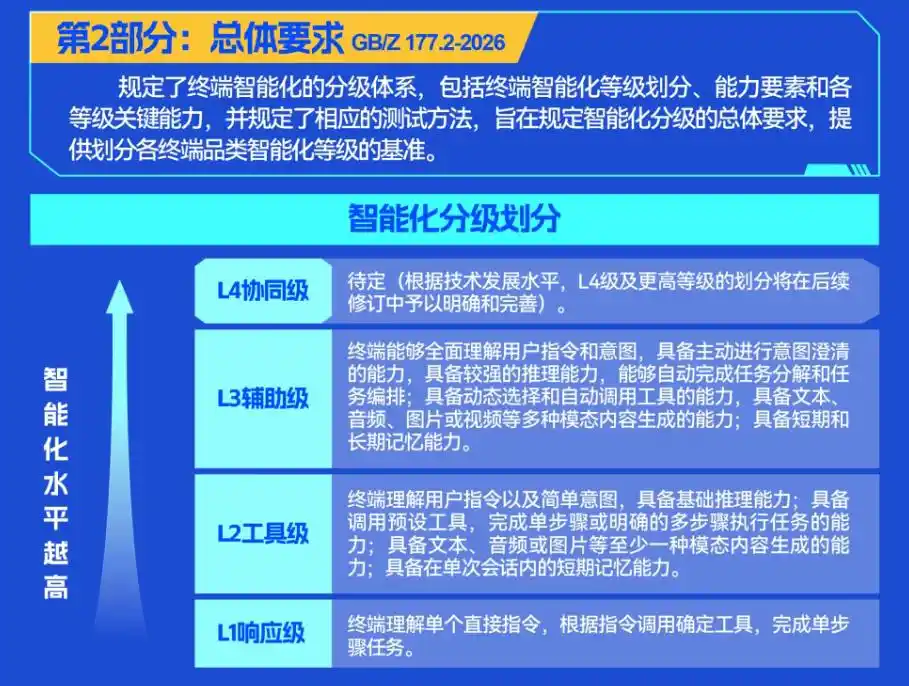
Image source: Ministry of Industry and Information Technology Weibo
The simultaneous release of these two documents is by no means a coincidence. This is a policy-level mutual pursuit: intelligent agents move downward, seeking physical carriers; intelligent terminals move upward, seeking intelligent cores. One defines the intelligent software agent, the other defines the intelligent hardware carrier, together constituting a "dual-track" top-level design of "spirit and body."
This leads to the core judgment of this article: China is defining AIoT as a new type of infrastructure—intelligent infrastructure—whose importance is on the same order of magnitude as historically defining electricity and the internet as infrastructure.
Regarding this already-begun industrial race, this article will share three progressively deepening observations:
What exactly do the two standards reveal (seeing the signal)?
What does L4 truly mean (understanding the paradigm)?
How should AIoT companies proceed next (grasping the window)?
Dual-Track Standard Setting: The World's Unique Top-Level Design for AIoT
What landed on May 8th were not two policies, but a dual-axis coordinate system. The "Implementation Opinions on the Standardized Application and Innovative Development of Intelligent Agents" defines the "spirit," and the "Intelligence Grading for Artificial Intelligence Terminals" defines the "body." Understanding this coordinate system is key to understanding the next decade of China-style AIoT.
This design has three layers of industrial meaning.
The first layer: AI capabilities have been reduced from conceptual vocabulary to engineering indicators for the first time.
Over the past two years, the biggest pain point in the AIoT industry has been conceptual generalization, parameter stacking, and a disconnect between marketing and user experience. The Grading standard uses the L1 to L4 capability ladder to transform intelligence from a vague adjective into a measurable, comparable, and certifiable product attribute. This is essentially issuing the entire industry a unified "physical examination form," bidding farewell to pseudo-intelligence and parameter involution, and providing a basis for judgment.
The second layer: Intelligent agents are positioned as a product form, not an application-layer add-on.
The Implementation Opinions clearly define intelligent agents as an important form of artificial intelligence products and services, and emphasize guiding manufacturers of complete machines, software, etc., to develop products and services based on intelligent agents. The policy implications of these two sentences are extremely important: intelligent agents are no longer functional modules attached to hardware but are primary industrial entities on par with PCs and smartphones. This repositions the power structure of the entire AIoT industry chain.
The third layer: The drafting units themselves present a map of the industry's deployment.
The main drafting units of the Grading standard include industry players like Huawei, Honor, Xiaomi, OPPO, Vivo, Lenovo, Unisoc... all hardware players. In contrast, the implementation path outlined in the Implementation Opinions simultaneously involves large model manufacturers, open-source communities, chip manufacturers, and operating system manufacturers. This means that in the next five years, the key bargaining nodes in the AIoT industry chain will emerge at two intersecting points: how hardware players become carriers for intelligent agents, and how intelligent agent players penetrate hardware operating systems.
Viewed from a global perspective, the uniqueness of this dual-track standard-setting approach becomes even clearer.
The U.S. follows a market competition path, neither defining what an intelligent agent is nor grading AI terminal capabilities, leaving it entirely to leading enterprises like OpenAI, Anthropic, Apple, and Google to compete at the product level. The European Union follows a risk regulation path. The AI Act regulates only by risk level of use case, not touching product form. Japan and South Korea follow corporate ecosystems.
China has chosen a third way, establishing a coordinate system for both the software agent and the hardware carrier using national standards. This practice of simultaneously setting standards for both software and hardware is unique in the global AI policy landscape of the same period.
Historically, the most compelling parallel is China's dual-credit policy for new energy vehicles. Released in 2017 and implemented in 2018, the dual-credit policy seemed like just a technical industry management measure. However, by simultaneously binding the production and sales targets for new energy vehicles with fuel consumption targets for conventional vehicles—one hand setting standards, the other creating pressure—it directly reshaped the competitive dimensions of the entire Chinese automotive industry. A decade later, China's new energy vehicle production and sales have ranked first globally for many consecutive years, transforming from an industry follower to a global leader.
The AIoT dual-standards of May 8th are highly similar in policy design philosophy to the dual-credit policy. Both use a combination of soft and hard measures, capability and direction, to leverage the overall leap forward of a trillion-level industry. The difference is that this time, it's not just about leveraging one industry but a new type of infrastructure.
Intelligent Action of All Things: How L4 is Rewriting the Value Anchor of AIoT
Within the four-level capability ladder provided by "Intelligence Grading for Artificial Intelligence Terminals," the L4 collaborative level is deliberately left blank. The standard explicitly states it will be further clarified and improved in subsequent revisions based on industrial development levels. What seems like a technical blank space is, in reality, a very sober acknowledgment by policymakers: L4 is not yet clear, but it is certainly coming.
This unclear level is precisely the biggest variable for the future of the entire AIoT industry.
Looking back at the value evolution path of AIoT, a clear curve can be drawn.
The core value of IoT 1.0 was connectivity, with device networking enabling data backhaul and remote control.
The core value of AIoT 2.0 was cognition, with devices possessing local AI capabilities for recognition, judgment, and response.
The core value of AIoT 3.0 is assistance, corresponding to L2 to L3, where devices have multimodal understanding and contextual judgment, upgrading from passive tools to proactive assistants. This is where current AI PCs and AI phones are positioned.
The core value of AIoT 4.0 will be collaboration, corresponding to L4, where devices become extensions of users in the physical world, actively perceiving scenarios, coordinating across devices, and autonomously executing tasks.
I summarize the endpoint of this curve in four words: Intelligent Action of All Things.
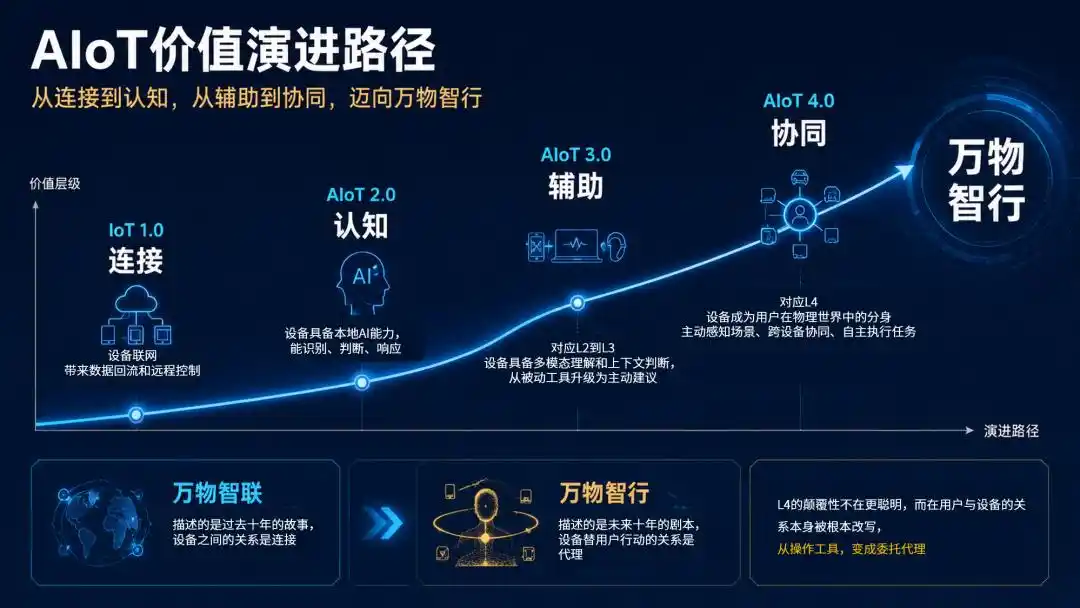
"Intelligent Connectivity of All Things" describes the story of the past decade, where the relationship between devices was connection. "Intelligent Action of All Things" describes the script for the next decade, where the relationship of devices acting on behalf of users is that of agency.
The disruptiveness of L4 lies not in being smarter, but in fundamentally rewriting the relationship between the user and the device itself—from operating a tool to delegating to an agent.
This paradigm shift is happening simultaneously in both the C-end and B-end, but in different forms.
For the C-end, the shift is from operating tools to delegating to agents.
The product logic from L1 to L3 is selling hardware with intelligence added. The product logic for L4 is selling agency capability, with hardware merely being an access point. The Grading standard explicitly mentions in the description of the highest-level capabilities that it should rely on personal large models and knowledge bases to achieve autonomous learning and continuous evolution of terminals. This means whoever masters the user's personal large model masters the user's long-term value.
Lenovo launching the Tianxi AI Personal Intelligent Agent and Huawei continuously upgrading Xiao Yi toward an Agent are essentially preempting positions at the L4 level.
Industrial chain power will shift from terminal brands to intelligent agent service providers. The business model will evolve from one-time hardware sales to a tripartite structure of hardware entry points, capability subscriptions, and data assets.
For the B-end, the shift is from data dashboards to autonomous execution.
Industrial Internet over the past decade primarily solved connectivity and visualization: sensors collected data, sent it to the cloud to generate dashboards, while decision-making and execution still relied on humans. With the introduction of intelligent agents, the logic has fundamentally reversed.
The Implementation Opinions explicitly propose the research and development of production management intelligent agents to dynamically optimize production scheduling, resource allocation, and process coordination. It also promotes the integration of intelligent agents with CNC machine tools, industrial robots, and automated production lines. Combined with the deployment for forward-looking layout in areas like multi-agent collaboration and intelligent internet, the smart factories of the future will no longer be assembly lines but rather an intelligent agent society composed of scheduling Agents, quality inspection Agents, and logistics Agents. They will autonomously negotiate, dynamically allocate resources, and collaboratively complete complex tasks.
The center of value gravity in the B-end is comprehensively shifting from data collection and PaaS platforms to vertical industry "Intelligent Agent as a Service."
The forms of transformation in the C-end and B-end differ, but they share the same singularity logic: manufacturers crossing the L4 threshold will define the rules for intelligent agents and occupy the value center; those failing to cross it will become the execution endpoints of intelligent agent rules, reduced to value channels.
This scene has been previewed once in history, right next door in the automotive industry. Before the emergence of the L0 to L5 autonomous driving classification, intelligent driving was just a concept, with each company claiming to be smarter. After the classification appeared, industry order, product positioning, consumer expectations, and liability division were all rewritten. Capital flow shifted from fragmentation to being highly concentrated around the L-levels.
Today's AIoT is replaying the same script, only this time the stage covers all device forms.
Based on this judgment, two clear industrial predictions can be made: Within the next 12 to 18 months, the first batch of L3-level nationally certified products will be launched intensively. The L-level will gradually replace computing power TOPS and parameter counts to become the new core yardstick for next-generation AIoT products. Within the next 18 to 24 months, L4 reference implementations will appear in flagship products from leading manufacturers, and personal intelligent agents will move from concept to scale.
L4 is not just a technical level; it is the singularity point of the AIoT industry.
Breaking Through with Four Leverages: The 18-Month Window for AIoT Companies to Position Themselves
The dual-track standard-setting plus scenario-driven path chosen by China opens up a globally unique strategic window for domestic AIoT companies. However, the validity period of this window may only be 18 to 24 months.
The key to understanding this path is to see that it is an overlay of three maps.
The Capability Map is the L1 to L4 grading of terminals, the yardstick on the supply side.
The Risk Map is the categorized and graded governance framework clarified in the Implementation Opinions. For sensitive fields and key industries, open scenarios are determined by the cyberspace administration in conjunction with competent industry authorities, implementing management measures such as filing, testing, and recall of problematic products. For low-risk fields like entertainment and daily office work, efficient governance is achieved through compliance self-testing, information reporting, distribution platform management, and industry self-regulation. This is the boundary on the demand side.
The Direction Map consists of 19 typical application scenarios plus the subsidy tilt for consumer goods trade-ins, serving as the guiding force on the industrial side.
The meaning of these three overlapped maps is that the state has already drawn clear boundaries for the game rules, leaving the track open for companies to run on.
The uncertainty of the U.S. path lies in market competition. The uncertainty of the EU path lies in the scope of regulation. The certainty of the Chinese path lies in the clear policy direction; companies only need to decide which position to secure. This is a paradigm shift from finding opportunities within policy uncertainty to seizing positions within policy certainty.
Next, all AIoT companies will be forced to answer a three-choice track question.
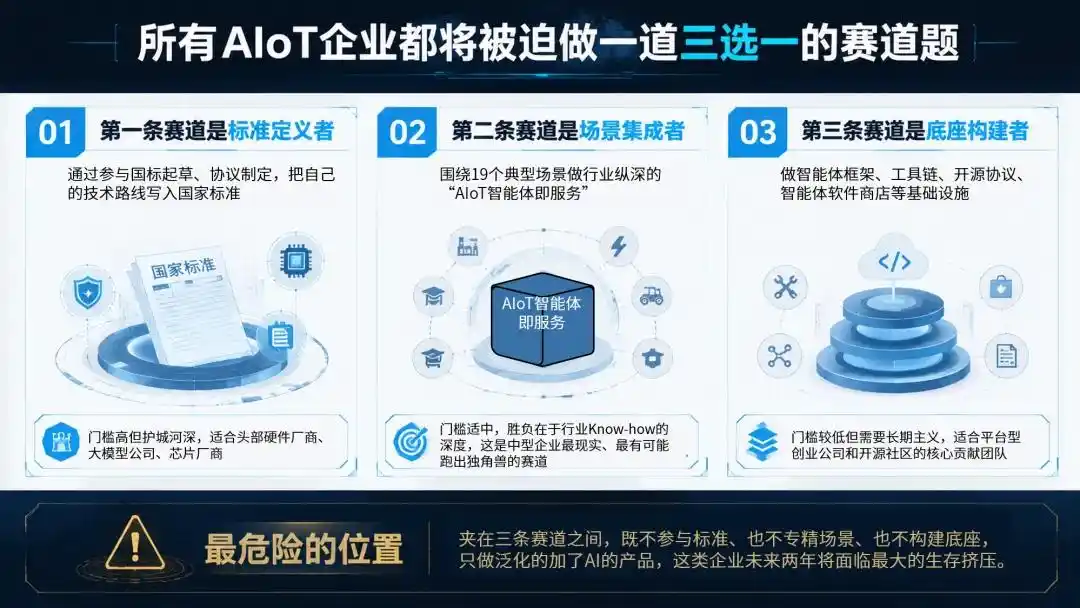
The first track is Standard Definers, writing their technical roadmaps into national standards by participating in the drafting of national standards and protocol formulation. The threshold is high, but the moat is deep, suitable for leading hardware manufacturers, large model companies, and chip manufacturers.
The second track is Scenario Integrators, focusing on providing "AIoT Intelligent Agent as a Service" with industry depth around the 19 typical scenarios. The threshold is moderate, and victory lies in the depth of industry know-how. This is the most realistic track for medium-sized enterprises and the one most likely to produce unicorns.
The third track is Base Builders, working on intelligent agent frameworks, toolchains, open-source protocols, intelligent agent software stores, and other infrastructure. The threshold is lower but requires a long-term approach, suitable for platform-type startups and core contributor teams of open-source communities.
The most dangerous position is being caught between the three tracks—neither participating in standard setting, nor specializing in scenarios, nor building the base, only making generalized products with AI added. Such enterprises will face the greatest survival pressure in the next two years.
After selecting a track, there are four common tactical levers worth immediately incorporating into strategic planning for the next 18 to 24 months. I summarize it as the "Four Leverages" strategy.
The first leverage is Leveraging Standards. The L-level national standards are essentially a super endorsement prepared by policy for enterprises. Companies that first achieve L3 and sprint towards L4 will gain triple benefits: consumer subsidy tilts, priority in government procurement, and consumer premium pricing. For leading manufacturers, the next competition is about the speed of L4 reference implementation. For small and medium-sized manufacturers, the real opportunity lies in achieving an L-level first benchmark in a specific niche category, such as the first L3 for AI glasses or the first L3 for AI home appliances. Instead of competing comprehensively across the seven major categories, it's better to achieve an L-level benchmark in one niche category.
The second leverage is Leveraging Scenarios. The 19 typical scenarios are not policy slogans but a directional blueprint for subsidy tilts, pilot openings, and procurement priorities in the next three years. Among them, the direction of intelligent manufacturing and the integration of intelligent agents with CNC machine tools/industrial robots is the most certain because China's manufacturing data foundation and application foundation are globally leading. The most crucial insight is: rather than ranking in the top ten in ten scenarios, aim to be in the top three in one scenario.
The third leverage is Leveraging Open Source. The Implementation Opinions explicitly call for conducting compatibility and adaptation of intelligent agents with open-source chips, open-source operating systems, and open-source large models. This is essentially issuing a collective cost-reduction coupon to AIoT entrepreneurs. However, a deeper insight gap exists: using open source reduces costs, but contributing to open source secures position. The value of a contributor identity is an order of magnitude higher than that of a user identity. Medium-sized and larger enterprises should reverse-contribute to open source to gain ecosystem leadership.
The fourth leverage is Leveraging Trends. Protocol ecosystems are becoming the new battlefield in global AIoT competition. Anthropic's MCP, Google's A2A, as well as ANP, ACP, etc., have already formed the first tier internationally. Chinese AIoT companies need a two-legged approach: one leg outward, actively participating in international protocol communities to occupy front-row seats; one leg inward, validating protocols through China's advantageous scenarios like industrial internet and smart homes, and then feeding them back into international standards.
Final Thoughts
The dual standards of May 8th are not the end of policy but the starting gun for a decade-level industrial race.
Looking back at the path of China's communications industry, from 1G blank, 2G followership, 3G/4G parallel running to 5G leadership, it took thirty years to complete the reversal of standard discourse power. Today's path of L-level plus protocol ecosystem for the AIoT industry has the opportunity to complete a leap of even greater magnitude in a shorter time. The protagonists of this leap are not nations but enterprises.
The nation has paved the track, drawn the starting line, and fired the gun. The remaining question is only one: As enterprises, which track are we on, and what stance do we use to start the race?
"Intelligent Connectivity of All Things" was the story of the past decade. "Intelligent Action of All Things" is the script for the next decade.
This article is from the WeChat public account "IoT Think Tank" (ID: iot101), author: Peng Zhao