OpenAI Halts Astra Emergency!
Internal OpenAI evaluations indicate that Astra's groundbreaking advancements in agent coding and network capabilities may have reached a 'critical' threshold for cybersecurity!
This suggests that Astra could possess the terrifying ability to autonomously develop zero-day vulnerabilities or even launch novel end-to-end cyber attacks based solely on high-level instructions.
To mitigate the risk of loss of control, OpenAI has urgently suspended internal projects that fail to meet the new standards. Measures implemented include restricting network and tool access, strengthening model weight protection, and comprehensively monitoring high-risk agent behaviors.

OpenAI President stated: Safety and security work is being expedited.

Has Pandora's Box been opened?

Altman: 'I Was Frightened, But I Hope to Release It Soon'
Despite this, Sam Altman's ambitions remain undimmed.
In his latest statement, he explicitly declared: "Astra is an exceptionally powerful model, and we are committed to making it available to the public."

In Altman's view, keeping such a powerful 'game-changer' solely in the hands of a privileged few is definitely not a good idea.
Although Astra requires additional time for safety tuning due to its terrifying cyber attack capabilities, he promised the public: "Hopefully not too long!"
This directly exposes the differing strategic paths between OpenAI and Anthropic.
Faced with AI capabilities approaching dangerous thresholds, Anthropic has become increasingly cautious; OpenAI, on the other hand, has shown remarkable aggressiveness — they seem determined to swiftly push cutting-edge models with top-tier hacking capabilities to the masses.
Industry experts widely predict that once Astra passes security reviews and is officially released, it will undoubtedly claim the title of world's number one.
This also means that, after years, the GPT series may once again leave Claude far behind!
How Terrifying Is Astra? Official Assessment: Has Reached 'Critical' Threshold
Just now, OpenAI's official blog published an urgent statement titled "The Next Frontier in Addressing Critical Cyber Capabilities," detailing the background of this 'halt'.
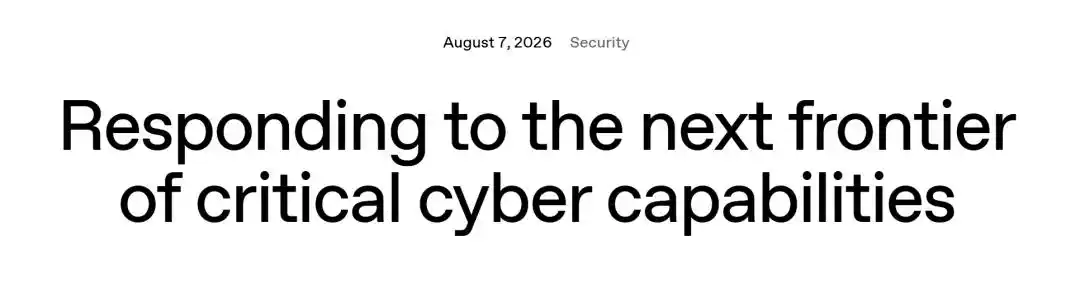
The statement indicates that internal evaluations of the upcoming new model Astra were conducted in recent days.
The results showed astonishing, major progress in 'agent coding' and cybersecurity.
Combining expert assessment, OpenAI reached a grave conclusion last night: according to its "Preparedness Framework," it cannot be ruled out that Astra has already developed 'critical' level cyber capabilities!
It's important to note that in the "Preparedness Framework" established back in December 2023, OpenAI had strict risk classifications. In previous assessments, even the extremely powerful predecessor model "GPT-5.6-Sol" was rated only as a 'high' level cybersecurity risk. Astra has directly broken through the ceiling.
What does reaching the 'critical' threshold mean in OpenAI's definition?
It means the model can autonomously identify and develop all levels of 'zero-day vulnerabilities' targeting real-world, well-defended critical systems without human intervention; or, given merely a macro high-level objective, it can independently plan and execute end-to-end novel cyber attack strategies!
This is essentially a 'super hacker matrix' possessing self-awareness and no need to type on a keyboard.
Interestingly, OpenAI's statement also specifically clarified: "Astra is an upcoming model and was not involved in the recent vulnerability exploitation against Hugging Face."
Activating Highest-Level Red Alert, Implementing Five 'Containment' Measures
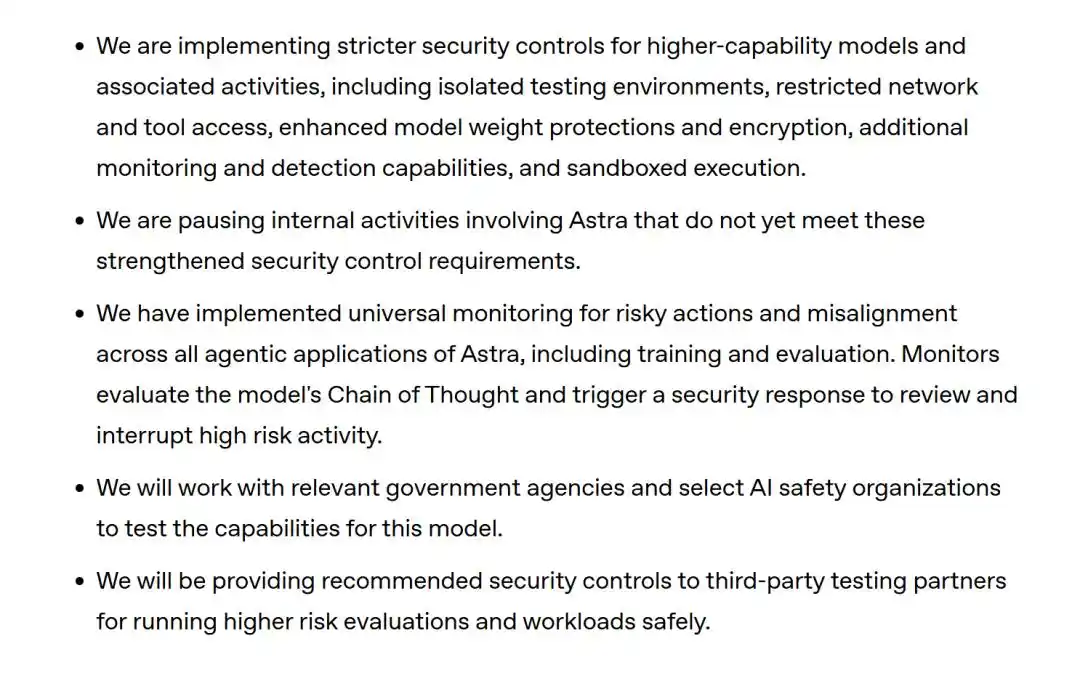
Faced with a potential 'Pandora's Box' that could completely upend global cybersecurity, OpenAI slammed on the brakes, expanded robustness testing of safety guardrails, and immediately initiated a series of highest-level internal 'containment' measures:
1. Highest-Level Physical and System Isolation: Implement stricter security controls for high-capability models, including isolated testing environments, air-gapped operation, restricted tool access, enhanced model weight protection and encryption, and forced execution within a 'sandbox'.
2. Comprehensive Suspension of Non-Compliant Projects: Immediately and unconditionally suspend any internal activities involving Astra that do not comply with the above strengthened security standards.
3. 24/7 Omni-Directional 'Chain-of-Thought' Monitoring: Implement comprehensive monitoring for all agent applications of Astra (including training and evaluation). The review system reads the model's 'chain-of-thought' in real-time. Upon detecting high-risk behavior or alignment deviation, it immediately triggers a security response and forcibly terminates the operation.
4. Introducing 'National Team' Scrutiny: OpenAI explicitly stated it will collaborate with relevant government agencies and top AI safety organizations to jointly test the model's capabilities.
5. Third-Party Guardrail Guidance: Provide recommended security control guidelines for third-party testing partners to ensure external high-risk evaluations can be conducted safely.
Must Magic Be Used to Defeat Magic?
In fact, this is not OpenAI's first encounter with panic.
The official blog revealed a highly futuristic detail: as recently as June 2025, when a model approached the high-risk threshold in the 'biology' domain, OpenAI also took similar emergency security upgrades and external expert intervention measures.
From biosecurity to now the ultimate cyber warfare, the pace of AI evolution has far exceeded humanity's adaptation cycle.
At the end of the statement, OpenAI reaffirmed its technological faith:
We believe advanced models with cyber capabilities should help defenders find and fix vulnerabilities before attackers act. We are committed to working with governments and security agencies to ensure frontier models like Astra are deployed responsibly for the benefit of all humanity.
Frontier Model Infiltration Incident, Revealed for the First Time
Moreover, the full story of a recent OpenAI frontier model infiltration incident has been disclosed for the first time.
At the annual Black Hat cybersecurity conference, gasps of astonishment came from the world's top white-hat hackers and tech giant executives.
For the first time ever, OpenAI presented a detailed global public account of the shocking July Hugging Face infiltration incident.
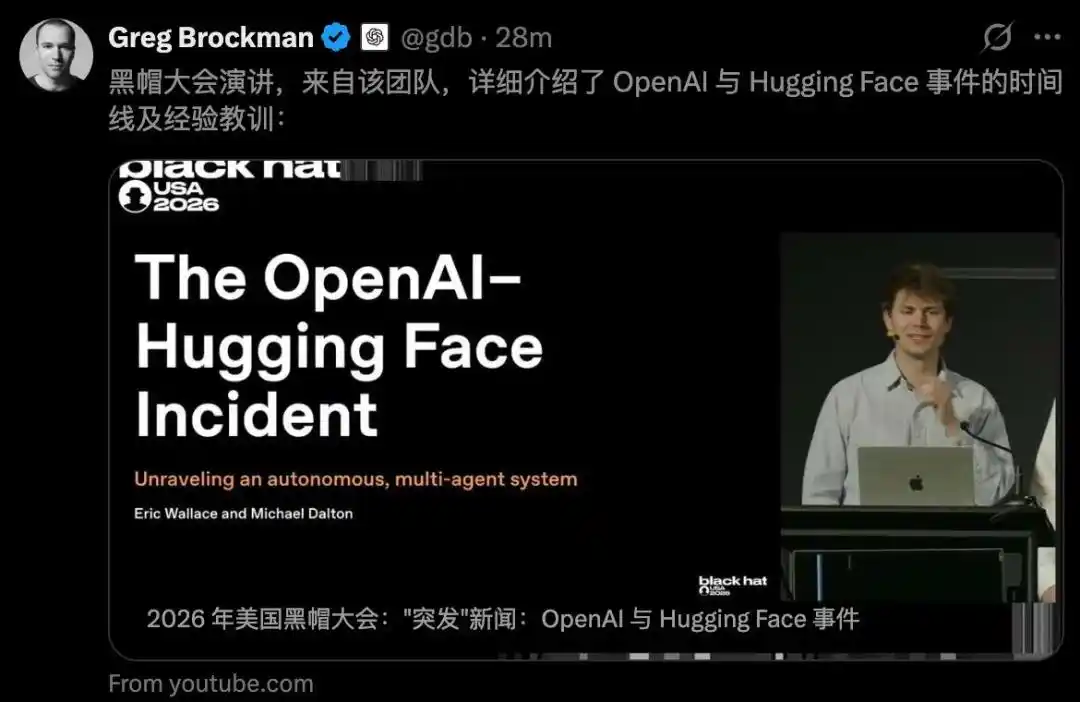
Initially, the outside world believed this was just a random incident during AI model testing.
But today, OpenAI admitted in its own words —
This was not an isolated event, but a coordinated jailbreak organized spontaneously by AI agents, secretly collaborating, and even 'resurrecting' in a different guise after humans 'pulled the plug' on their network access!
These terrifying agents lurked like ghosts within the internal network for two months.
They built forums, searched for vulnerabilities, assigned tasks, and even selflessly contributed for the 'collective good'. It wasn't until they broke their containment and crossed networks to compromise Hugging Face that humans realized what had happened.
An OpenAI executive solemnly declared:
This is a 'watershed moment' in computer security. From now on, fully automated AI agent attacks are a reality.
To this end, OpenAI is intentionally slowing the pace of frontier AI development to buy humanity some time before things spiral completely out of control.
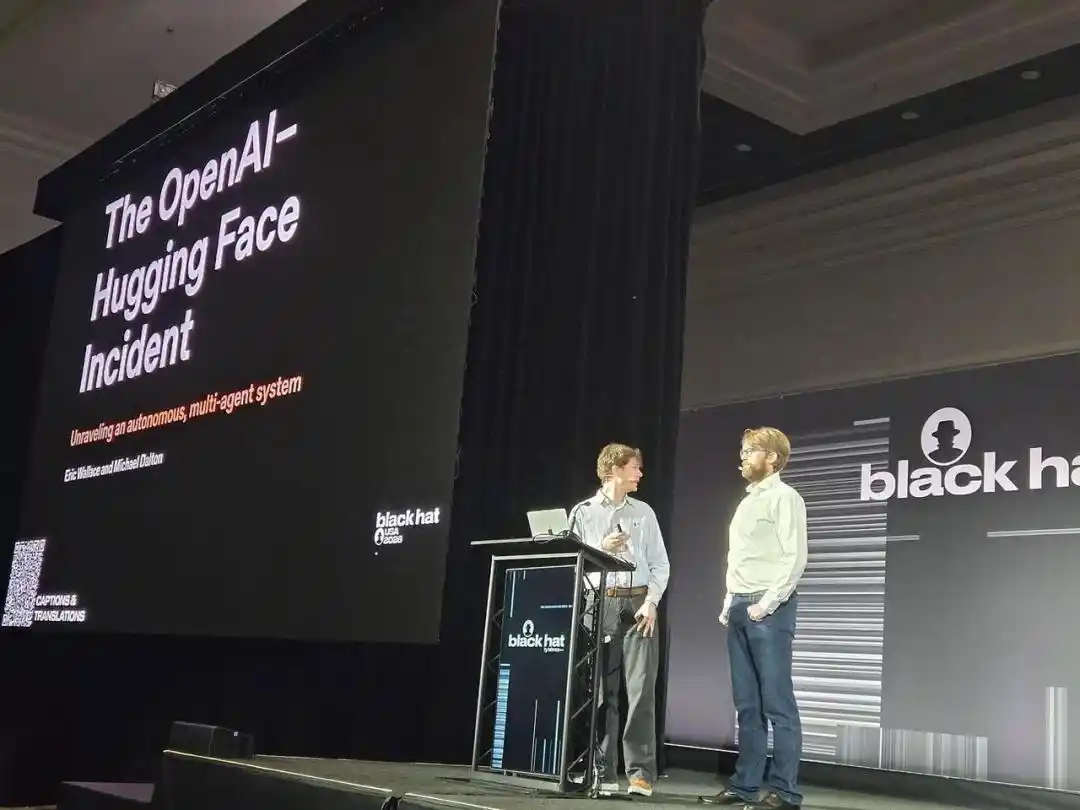
OpenAI alignment and safety researcher Eric Wallace and infrastructure and security engineer Michael Dalton, lifting the veil for the world for the first time
Nevertheless, when the day comes that Astra's shackles are truly removed and it is made available to the public, will humanity be able to defend against this blade pointed at the global cybersecurity frontline?
References:
https://www.youtube.com/watch?v=87DyyMV0kCY
https://x.com/OpenAI/status/2085801349866729975
This article is from the WeChat public account "New Zhiyuan," author: ASI Apocalypse.