What Are the Odds: Only 6% of Solana Meme Traders Made a Profit Over 90 Days

cryptonews.ruPublished on 2026-08-19Last updated on 2026-08-19

Abstract

Memecoin Trading on Solana: Only 6% Turn a Profit in 90 Days A new dashboard tracking Solana memecoin traders reveals that only 6.25% were profitable over the last 90 days. Out of 304,161 active traders, just 19,003 made a profit, with the average trader losing $120. Realized losses across the sector totaled $1.26 billion, and among profitable traders, 88% earned less than $100. Only 25 wallets gained over $10,000, indicating a shift from high-yield opportunities to a peer-to-peer transfer of losses. Despite poor profitability compared to other crypto speculation, memecoin activity remains high, driven by incentives like copy-trading, influencer tokens, and point farming. Platforms like Pump.fun are seeing record fee revenue, exceeding $4.4 million daily. The model persists partly because launches are fully on-chain, bypassing centralized exchange listings and pre-launch hype. New applications like FOMO, which features social copy-trading, have attracted novice users who often incur immediate losses. Similarly, a platform launched by influencer Ansem uses airdrops to drive engagement, though trading there typically leads to losses as well. The trend suggests that while memecoins continue to draw in new participants, the vast majority end up losing money.

Meme token traders remain active, but only a few are profitable. Over the past 90 days, meme tokens have primarily attracted profit from the crypto space.

According to statistics, only 6.25% of traders holding meme tokens have been profitable over the last 90 days. A new dashboard monitoring Solana meme traders shows that most of them are losing money.

Over the past 90 days, on active Solana DEXs worked . Among them, only 19,003 made a profit, but the average trader lost $120. 304,161 traders

The biggest problem for meme token traders is the overall loss of value. According to on-chain research, meme token traders have collectively lost $1.26 billion in realized value. Of all profitable traders, 88% made less than $100.

The metrics track realized profit and loss, not paper token value. In most cases, meme tokens have low liquidity, even if their market capitalization is high.

Only 25 Solana Meme Traders Earned Over $10,000

Only 25 wallets earned more than $10,000, indicating that the meme space has lost its ability to generate high profits and has instead turned into a P2P-attracting market.
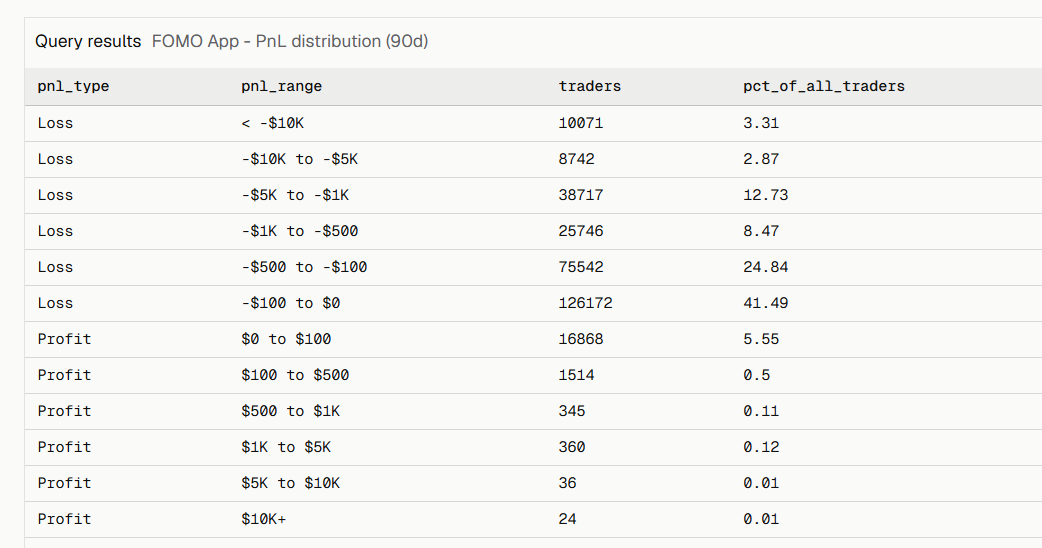
Traders using the FOMO app for meme tokens showed a similar pattern: only 25 wallets achieved a realized profit of over $10,000. | Source: Dune Analytics

The current profitability of meme tokens is even lower compared to betting or prediction platforms, or even regular speculative crypto trading. Despite this, the meme token model remains attractive due to incentives like copy trading, influencer tokens, and points farming.

The meme model has also changed: very few memes have longevity. New memes have an extremely short lifecycle and do not aim to build a community.

Meme-related activity has also pushed Pump.fun into the top three by fee volume. As of August 19th, the platform generates over $4.4 million in daily fees, the highest since January.

Meme Tokens Persist Despite Loss Risks

Despite the overall slowdown in the crypto market, meme tokens remain one of the viable models. The reason is that meme launches occur entirely on-chain, free from the constraints and expectations of centralized exchange listings.

On-chain token creation also partially solves the problem of inflated prices for selected tokens created by market makers. Meme tokens with new applications allow for instant connection to the system. New users also bypass BTC and blue-chip tokens, which are now closer to traditional financial instruments.

Robinhood increased its meme token usage by offering quick launches. Up to 51% of activity on Robinhood was related to meme tokens. As of August 19th, the trend is starting to shift, and Robinhood memes lost 10% of their value overnight, with losses over the past week exceeding 30%

Another factor contributing to meme activity growth was the launch of the FOMO app, which saw another wave of widespread adoption. The app attracted many newcomers just starting to explore meme trading, leading to almost immediate losses. The social trading feature in the FOMO app allowed users to copy influencer trades, leading to inflated valuations for a number of memes.

Meme tokens also attract new users through the latest platform launched by crypto influencer Ansem. In this case, platform usage is incentivized by airdrops, although the trading itself can lead to similar losses. As on other launchpads, users wait for new entrants while incurring losses in more than 99% of meme token launches.

end-content

Trending Cryptos

Related Questions

QWhat percentage of Solana meme token traders made a profit over the last 90 days?

AOnly 6.25% of Solana meme token traders made a profit over the last 90 days.

QWhat was the average loss in USD for traders dealing with meme tokens on Solana during that period?

AThe average trader lost $120 over the last 90 days.

QHow many wallets earned more than $10,000 trading Solana meme tokens, according to the article?

AOnly 25 wallets earned more than $10,000 trading Solana meme tokens.

QWhat platform's high fee volume is cited as evidence of continued meme token activity?

APump.fun is cited, which was earning over $4.4 million in daily fees as of August 19th.

QAccording to the article, what is a key reason meme tokens remain a viable model despite high losses?

AA key reason is that meme token launches happen entirely on-chain, without the constraints or expectations of being listed on centralized exchanges.

Related Reads

13F Reveals New Signal: AI Has Not Faded, Wall Street Is Just Getting 'Pickier'

Title: 13F New Signal: AI Is Not Receding, Wall Street Just Became "Selective" Analysis of 13F filings from the second quarter of 2026, which disclose institutional holdings, reveals a key trend: the AI investment theme persists, but Wall Street is now scrutinizing opportunities more selectively rather than chasing the sector broadly. While nearly 44% of the 6,371 institutions analyzed reduced holdings in the "Magnificent Seven" tech giants, semiconductors saw net buying from 48% of institutions. This indicates the core AI infrastructure thesis remains intact. However, significant internal shifts are occurring as major funds prioritize "risk-reward" or "betting odds" over simple sector exposure. Four prominent investors exemplify this new selectivity: 1. **Berkshire Hathaway** made a major new bet on Alphabet, valuing its strong cash flow and core businesses despite AI-related uncertainties. 2. **Tiger Global** reduced crowded mega-cap tech positions (e.g., Alphabet, NVIDIA) but increased exposure to other AI-related names like AMD and semiconductor manufacturing, rebalancing within the theme. 3. **Third Point** fully exited several first-wave AI winners (NVIDIA, Broadcom) to lock in gains, reallocating to names like Alphabet and Taiwan Semiconductor, and diversifying into media and industrials. 4. **Duquesne Family Office** (Stanley Druckenmiller) also sold some semiconductor holdings while buying others (e.g., Taiwan Semiconductor), focusing on individual companies' valuation and expectation gaps rather than the sector beta. Key conclusions from the filings: * **Alphabet is becoming a "divisive asset"** with significant institutional disagreement, representing a potential source of alpha. * The **"buy any chip stock" phase is over**. Semiconductor investing is now an alpha game, requiring stock-specific analysis over blanket sector bets. * **Non-AI assets are reappearing** in portfolios (e.g., airlines, homebuilders, media) as diversification and correlation-management tools. In summary, the AI investment cycle has not ended, but the phase of easy, broad-based gains is concluding. The next phase will be defined by selective stock-picking and precise calculation of risk versus reward within the AI ecosystem.

marsbit18m ago

13F Reveals New Signal: AI Has Not Faded, Wall Street Is Just Getting 'Pickier'

marsbit18m ago

Bitcoin 'Whale Investors' Increase Their Holdings by 43,000 BTC, Ending a Months-Long Selling Wave

Large Bitcoin holders, defined as non-exchange and non-mining pool wallets, have accumulated approximately 43,000 BTC (worth around $2.9 billion) over the past 60 days. This marks a significant reversal from a several-month period where this same group were net sellers, contributing to downward pressure on Bitcoin's price following its October 2025 all-time high. The accumulation began when Bitcoin fell to around $60,000, a level that seemingly attracted large holders who had stayed on the sidelines during the sharper phase of the decline. Bitcoin has since recovered to trade in a narrower range between $62,000 and $65,000. This renewed demand is not limited to the largest "whale" wallets. Balances of so-called "dolphin" holders also increased in the same period, indicating a broader accumulation trend beyond just a handful of mega-wallets. This activity occurs against a backdrop of declining overall market activity, with August spot trading volumes hitting their lowest monthly level since August 2021, meaning the whale purchases represent a disproportionately large share of total market activity. This buying shift contrasts with the dominant selling trend seen for much of 2026 from other major entities. Looking ahead, a key factor to watch is whether this large-investor activity persists as Bitcoin approaches the upper bound of its recent $62k-$65k trading range.

cryptonews.ru23m ago

Bitcoin 'Whale Investors' Increase Their Holdings by 43,000 BTC, Ending a Months-Long Selling Wave

cryptonews.ru23m ago

Bitcoin (BTC) Enters a Bear Market, BlackRock Remains Optimistic! Here's Why and the Latest Statements

Bitcoin (BTC) has entered a bear market since October 2025, dropping over 50% from its all-time high of $126,000 to test support at $57,000. It is currently trading sideways around $63,000. In its latest analysis, asset management giant BlackRock stated that this severe correction does not invalidate the long-term investment case for the leading cryptocurrency. BlackRock attributes the decline primarily to market deleveraging, position shifts, capital rotation from Bitcoin into AI investments, weakening capital inflows, and a slowdown in digital asset purchases. It highlighted that open cryptocurrency futures positions exceeding $90 billion, with about 80% being perpetual futures outside the CME, were a significant contributor to the downturn. Additional selling pressure came from digital asset management firms and large Bitcoin holders, alongside net outflows from spot Bitcoin ETFs. Despite these challenges, BlackRock maintains its long-term bullish stance on Bitcoin. The firm reiterates that Bitcoin's limited supply and its potential to behave differently from traditional financial assets make it a viable tool for portfolio diversification and a potential hedge against fiat currency depreciation. BlackRock concludes that the sharp correction signals a market rebalancing of leverage and capital flows rather than a breakdown of Bitcoin's fundamental investment thesis.

cryptonews.ru34m ago

Bitcoin (BTC) Enters a Bear Market, BlackRock Remains Optimistic! Here's Why and the Latest Statements

cryptonews.ru34m ago

Trading

Spot

Hot Articles

Discussions

Welcome to the HTX Community. Here, you can stay informed about the latest platform developments and gain access to professional market insights. Users' opinions on the price of MEME (MEME) are presented below.

活动图片