Bitcoin Holds at $64,000 as Solana Leads Gains with 7% Increase Amidst Decline in Korean Chipmaker Stocks

cryptonews.ruPublished on 2026-08-19Last updated on 2026-08-19

Abstract

Bitcoin held steady around $64,250 on Wednesday, posting slight daily gains and a 1% weekly increase. The cryptocurrency market was largely unaffected by a global sell-off in semiconductor stocks. Solana led major cryptocurrencies with a 2% gain to nearly $77 (almost 1% for the week). Ethereum rose 1% to over $1,900, leading weekly gains at 1.5%. XRP recovered nearly 1% to just under $1 but was still down 2% weekly. BNB fell slightly to over $600, down 2% for the week. Hyperliquid (HYPE) dropped over 1% but led weekly performance among majors with a 7% gain. In contrast, semiconductor stocks slumped. Samsung Electronics and SK Hynix shares fell over 7% in Seoul, dragging South Korea's Kospi index down more than 6%. The Asian semiconductor index fell over 3%, following a 5% drop in the Philadelphia Semiconductor Index. The bond market sell-off pushed the U.S. 30-year yield to its highest since 2007, raising borrowing costs for AI infrastructure investments. U.S. Treasury prices stabilized Wednesday, with the 10-year yield dipping slightly. Gold rose 0.6%. Markets await the Fed's July meeting minutes and Chair Kevin Warsh's speech next week. A Reuters poll shows most economists expect rates to remain unchanged in September.

On Wednesday, Bitcoin remained around $64,250, slightly rising for the day and up 1% for the week, while the global sell-off in chipmaker stocks had virtually no impact on the cryptocurrency market.

To date, Solana showed the strongest growth among major cryptocurrencies, rising 2% to nearly $77 and almost 1% for the week. Ethereum gained 1% to just over $1900, leading weekly gains at 1.5%. XRP recovered nearly 1% to just under $1, though it is still down 2% for the week. Tron rose 0.5% to 33 cents, and Dogecoin rose to 7 cents.

BNB decreased slightly to just over $600, falling 2% for the week. Hyperliquid (HYPE) fell more than 1% to just over $58, but still leads all major cryptocurrencies for the week with a 7% gain.

Samsung Electronics (005930) and SK Hynix (000660) stocks fell more than 7% in Seoul, causing the Korean Kospi index to drop more than 6% and the MSCI Asia Pacific index to fall 2%.

The Asian semiconductor company index fell more than 3% after the Philadelphia Semiconductor Index dropped 5% on Tuesday, marking its worst session since late July. Futures pointed to further declines in Europe and the US.

Behind this is the bond market. The global sell-off pushed the yield on US 30-year bonds to its highest level since 2007, and the 10-year bond yield approached levels seen at the beginning of 2025, raising borrowing costs for companies heavily investing in artificial intelligence infrastructure.

Meanwhile, US Treasury bond prices stabilized on Wednesday: the yield on 10-year bonds fell by about one basis point to 4.69%, and gold rose 0.6% above $4360 per ounce after falling nearly 2% on Tuesday.

The minutes of the July Federal Reserve meeting are scheduled to be released at 2:00 PM Eastern Time, and Chairman Kevin Warsh will speak at the Jackson Hole symposium next week.

A Reuters poll showed that 94 out of 104 economists expect interest rates to remain at 3.5%-3.75% in September, with markets pricing in about a 68% probability of no change.

end-content

Trending Cryptos

Related Questions

QWhat was the main factor that pushed the yield of the 30-year U.S. Treasury bond to its highest level since 2007?

AThe main factor was the global bond market sell-off.

QWhich cryptocurrency showed the strongest weekly gain among the major ones mentioned, and what was the gain?

AHyperliquid (HYPE) showed the strongest weekly gain among the major cryptocurrencies mentioned, with a gain of 7%.

QHow did the stocks of Samsung Electronics and SK Hynix perform, and what broader market index was impacted?

AThe stocks of Samsung Electronics and SK Hynix fell by more than 7% in Seoul. This caused the Korean Kospi index to decline by over 6%.

QWhat upcoming events related to the Federal Reserve are highlighted in the article?

AThe article highlights the upcoming release of the Federal Reserve's July meeting minutes and a speech by Chair Kevin Warsh at the Jackson Hole Symposium the following week.

QAccording to a Reuters poll, what do most economists expect the Federal Reserve to do with interest rates in September?

AAccording to the Reuters poll, 94 out of 104 economists expect the Federal Reserve to keep interest rates unchanged in the range of 3.5%-3.75% in September.

Related Reads

SEC Proposal a ‘Significant’ Step Forward From ‘Ill-Suited’ Crypto Rules: Commissioner Peirce

A U.S. Securities and Exchange Commission (SEC) commissioner, Hester M. Peirce, has called a new SEC proposal a significant improvement over what she termed a "misfit" set of crypto rules. Peirce stated that a whole generation has struggled due to the SEC's insistence on applying unsuitable regulations to cryptocurrencies, but the new proposal moves toward "clear, sensible, and enforceable rules for crypto offerings." SEC Chairman Paul S. Atkins also welcomed the initiative, noting in a separate statement that the agency's previous enforcement-heavy approach had driven investment overseas, limiting investor protections domestically. The proposal, announced on Tuesday, outlines new rules aimed at creating a clear and purposeful framework for certain investment contracts involving crypto assets, designed to allow organizations to raise capital while protecting investors. This move comes shortly after the U.S. Senate failed to advance the comprehensive Digital Asset Market Clarity (CLARITY) Act. Atkins had previously stated the SEC was prepared to develop rules for digital assets if the Senate could not pass the CLARITY Act. Meanwhile, Galaxy Digital has lowered its estimated odds of the CLARITY Act passing by 2026 to just 10%, citing numerous unresolved policy questions and the Senate's limited time—only about two to three weeks after reconvening on September 14—to pass it.

cryptonews.ru25m ago

SEC Proposal a ‘Significant’ Step Forward From ‘Ill-Suited’ Crypto Rules: Commissioner Peirce

cryptonews.ru25m ago

13F Reveals New Signal: AI Has Not Faded, Wall Street Is Just Getting 'Pickier'

Title: 13F New Signal: AI Is Not Receding, Wall Street Just Became "Selective" Analysis of 13F filings from the second quarter of 2026, which disclose institutional holdings, reveals a key trend: the AI investment theme persists, but Wall Street is now scrutinizing opportunities more selectively rather than chasing the sector broadly. While nearly 44% of the 6,371 institutions analyzed reduced holdings in the "Magnificent Seven" tech giants, semiconductors saw net buying from 48% of institutions. This indicates the core AI infrastructure thesis remains intact. However, significant internal shifts are occurring as major funds prioritize "risk-reward" or "betting odds" over simple sector exposure. Four prominent investors exemplify this new selectivity: 1. **Berkshire Hathaway** made a major new bet on Alphabet, valuing its strong cash flow and core businesses despite AI-related uncertainties. 2. **Tiger Global** reduced crowded mega-cap tech positions (e.g., Alphabet, NVIDIA) but increased exposure to other AI-related names like AMD and semiconductor manufacturing, rebalancing within the theme. 3. **Third Point** fully exited several first-wave AI winners (NVIDIA, Broadcom) to lock in gains, reallocating to names like Alphabet and Taiwan Semiconductor, and diversifying into media and industrials. 4. **Duquesne Family Office** (Stanley Druckenmiller) also sold some semiconductor holdings while buying others (e.g., Taiwan Semiconductor), focusing on individual companies' valuation and expectation gaps rather than the sector beta. Key conclusions from the filings: * **Alphabet is becoming a "divisive asset"** with significant institutional disagreement, representing a potential source of alpha. * The **"buy any chip stock" phase is over**. Semiconductor investing is now an alpha game, requiring stock-specific analysis over blanket sector bets. * **Non-AI assets are reappearing** in portfolios (e.g., airlines, homebuilders, media) as diversification and correlation-management tools. In summary, the AI investment cycle has not ended, but the phase of easy, broad-based gains is concluding. The next phase will be defined by selective stock-picking and precise calculation of risk versus reward within the AI ecosystem.

marsbit49m ago

13F Reveals New Signal: AI Has Not Faded, Wall Street Is Just Getting 'Pickier'

marsbit49m ago

Bitcoin 'Whale Investors' Increase Their Holdings by 43,000 BTC, Ending a Months-Long Selling Wave

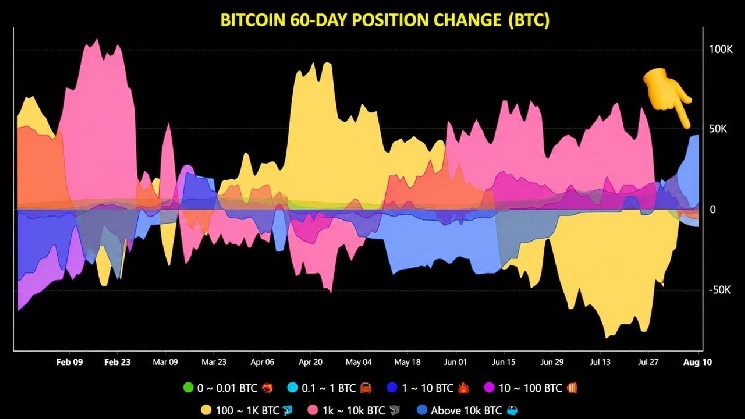
Large Bitcoin holders, defined as non-exchange and non-mining pool wallets, have accumulated approximately 43,000 BTC (worth around $2.9 billion) over the past 60 days. This marks a significant reversal from a several-month period where this same group were net sellers, contributing to downward pressure on Bitcoin's price following its October 2025 all-time high. The accumulation began when Bitcoin fell to around $60,000, a level that seemingly attracted large holders who had stayed on the sidelines during the sharper phase of the decline. Bitcoin has since recovered to trade in a narrower range between $62,000 and $65,000. This renewed demand is not limited to the largest "whale" wallets. Balances of so-called "dolphin" holders also increased in the same period, indicating a broader accumulation trend beyond just a handful of mega-wallets. This activity occurs against a backdrop of declining overall market activity, with August spot trading volumes hitting their lowest monthly level since August 2021, meaning the whale purchases represent a disproportionately large share of total market activity. This buying shift contrasts with the dominant selling trend seen for much of 2026 from other major entities. Looking ahead, a key factor to watch is whether this large-investor activity persists as Bitcoin approaches the upper bound of its recent $62k-$65k trading range.

cryptonews.ru55m ago

Bitcoin 'Whale Investors' Increase Their Holdings by 43,000 BTC, Ending a Months-Long Selling Wave

cryptonews.ru55m ago

Trading

Spot

Hot Articles

What is $BITCOIN

DIGITAL GOLD ($BITCOIN): A Comprehensive Analysis Introduction to DIGITAL GOLD ($BITCOIN) DIGITAL GOLD ($BITCOIN) is a blockchain-based project operating on the Solana network, which aims to combine the characteristics of traditional precious metals with the innovation of decentralized technologies. While it shares a name with Bitcoin, often referred to as “digital gold” due to its perception as a store of value, DIGITAL GOLD is a separate token designed to create a unique ecosystem within the Web3 landscape. Its goal is to position itself as a viable alternative digital asset, although specifics regarding its applications and functionalities are still developing. What is DIGITAL GOLD ($BITCOIN)? DIGITAL GOLD ($BITCOIN) is a cryptocurrency token explicitly designed for use on the Solana blockchain. In contrast to Bitcoin, which provides a widely recognized value storage role, this token appears to focus on broader applications and characteristics. Notable aspects include: Blockchain Infrastructure: The token is built on the Solana blockchain, known for its capacity to handle high-speed and low-cost transactions. Supply Dynamics: DIGITAL GOLD has a maximum supply capped at 100 quadrillion tokens (100P $BITCOIN), although details regarding its circulating supply are currently undisclosed. Utility: While precise functionalities are not explicitly outlined, there are indications that the token could be utilized for various applications, potentially involving decentralized applications (dApps) or asset tokenization strategies. Who is the Creator of DIGITAL GOLD ($BITCOIN)? At present, the identity of the creators and development team behind DIGITAL GOLD ($BITCOIN) remains unknown. This situation is typical among many innovative projects within the blockchain space, particularly those aligning with decentralized finance and meme coin phenomena. While such anonymity may foster a community-driven culture, it intensifies concerns about governance and accountability. Who are the Investors of DIGITAL GOLD ($BITCOIN)? The available information indicates that DIGITAL GOLD ($BITCOIN) does not have any known institutional backers or prominent venture capital investments. The project seems to operate on a peer-to-peer model focused on community support and adoption rather than traditional funding routes. Its activity and liquidity are primarily situated on decentralized exchanges (DEXs), such as PumpSwap, rather than established centralized trading platforms, further highlighting its grassroots approach. How DIGITAL GOLD ($BITCOIN) Works The operational mechanics of DIGITAL GOLD ($BITCOIN) can be elaborated on based on its blockchain design and network attributes: Consensus Mechanism: By leveraging Solana’s unique proof-of-history (PoH) combined with a proof-of-stake (PoS) model, the project ensures efficient transaction validation contributing to the network's high performance. Tokenomics: While specific deflationary mechanisms have not been extensively detailed, the vast maximum token supply implies that it may cater to microtransactions or niche use cases that are still to be defined. Interoperability: There exists the potential for integration with Solana’s broader ecosystem, including various decentralized finance (DeFi) platforms. However, the details regarding specific integrations remain unspecified. Timeline of Key Events Here is a timeline that highlights significant milestones concerning DIGITAL GOLD ($BITCOIN): 2023: The initial deployment of the token occurs on the Solana blockchain, marked by its contract address. 2024: DIGITAL GOLD gains visibility as it becomes available for trading on decentralized exchanges like PumpSwap, allowing users to trade it against SOL. 2025: The project witnesses sporadic trading activity and potential interest in community-led engagements, although no noteworthy partnerships or technical advancements have been documented as of yet. Critical Analysis Strengths Scalability: The underlying Solana infrastructure supports high transaction volumes, which could enhance the utility of $BITCOIN in various transaction scenarios. Accessibility: The potential low trading price per token could attract retail investors, facilitating wider participation due to fractional ownership opportunities. Risks Lack of Transparency: The absence of publicly known backers, developers, or an audit process may yield skepticism regarding the project's sustainability and trustworthiness. Market Volatility: The trading activity is heavily reliant on speculative behavior, which can result in significant price volatility and uncertainty for investors. Conclusion DIGITAL GOLD ($BITCOIN) emerges as an intriguing yet ambiguous project within the rapidly evolving Solana ecosystem. While it attempts to leverage the “digital gold” narrative, its departure from Bitcoin's established role as a store of value underscores the need for a clearer differentiation of its intended utility and governance structure. Future acceptance and adoption will likely depend on addressing the current opacity and defining its operational and economic strategies more explicitly. Note: This report encompasses synthesised information available as of October 2023, and developments may have transpired beyond the research period.

2.0k Total ViewsPublished 2025.05.13Updated 2025.05.13

What is $BITCOIN

Discussions

Welcome to the HTX Community. Here, you can stay informed about the latest platform developments and gain access to professional market insights. Users' opinions on the price of BTC (BTC) are presented below.

活动图片