Ether breaks the $1.9K resistance: Is $2.1K the next target for ETH bulls?

cointelegraphPublished on 2026-07-27Last updated on 2026-07-27

Abstract

Ether (ETH) surpassed $1,950 for the first time in seven weeks, gaining 29% from its June low and triggering $62 million in liquidations. This rise mirrored a broader market recovery. However, weak on-chain activity presents a cautionary signal; Ethereum's decentralized applications' weekly revenue hit its lowest since September 2024, and DEX volumes remain muted at $7.2 billion weekly. Despite this, a record 34% of ETH supply is now staked, reducing potential sell pressure. Analysts note that for ETH to reach $2,100, it likely requires stronger external catalysts, such as positive corporate earnings (e.g., from Alphabet) to bolster overall market confidence and overcome the current trader skepticism from the prolonged bear market.

Key takeaways:

  • Despite ETH’s price gains, weak onchain activity and low DEX volumes signal trader caution.
  • Record Ethereum staking at 34% reduces sell pressure, yet sustained upside needs external catalysts.

Ether (ETH) tested the $1,950 mark for the first time in seven weeks on Tuesday, triggering $62 million in liquidations across leveraged bearish positions. The move delivered 29% gains from the $1,500 low on June 26 and aligned with the broader risk-on mood that drove Bitcoin (BTC) above $66,500. Can ETH push through to $2,100?
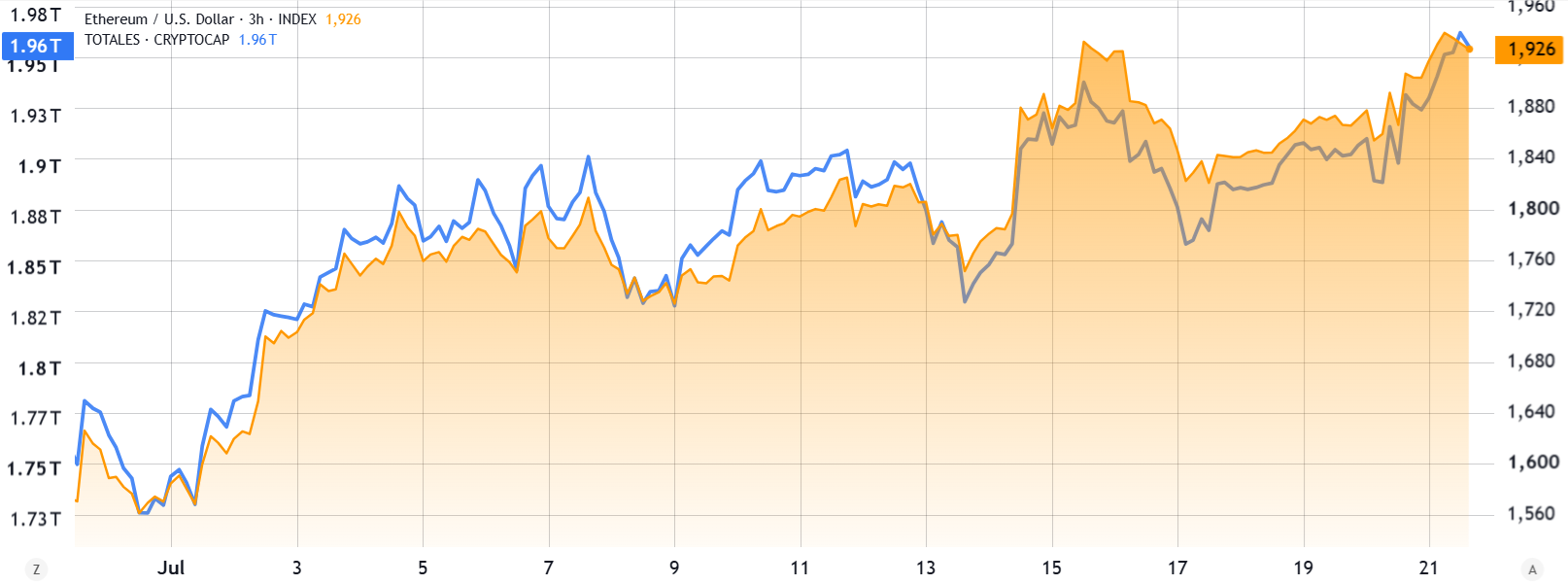
Total crypto market capitalization (left) vs. ETH/USD. Source: TradingView

Ether’s price largely tracked the overall crypto market trend, which shifted to positive momentum in July. Tuesday’s gains in the US stock market helped ease investor worries about stretched valuations after the artificial intelligence stock rally. Traders expect solid corporate earnings after 3M Company (MMM US) reported results Tuesday morning.

Google’s parent, Alphabet, is expected to report quarterly results on Wednesday after US stock markets close. Investors look for 64% growth in cloud services revenue amid heavy AI investments. Strong earnings could restore confidence and help push the cryptocurrency market past the $2 trillion total capitalization mark.

Weak Ethereum onchain metrics and muted ETH derivatives persist

Despite recent ETH price gains, Ethereum onchain metrics show stagnation. Demand for blockchain processing has not recovered to levels seen six months ago, partly because traders are showing less interest in memecoins and utility tokens. Some of Ethereum’s top projects posted losses of 50% or more year-to-date, including Ethena (ENA), Mantle (MNT) and Arbitrum (ARB).
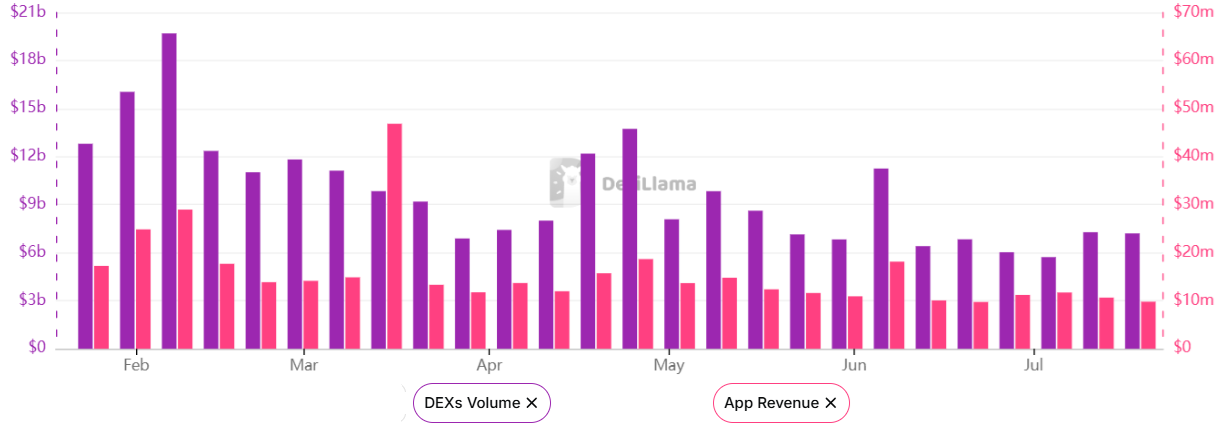
Ethereum network weekly DEX volumes & DApps revenues, USD. Source: DefiLlama

Weekly revenue for Ethereum’s decentralized applications (DApps) fell to the lowest levels since September 2024, hitting $9.8 million. Among the strongest performers are Sky (formerly MakerDAO) at $3.2 million in weekly revenue and Chainlink, which brought in $1.2 million over the same period. Overall, decentralized exchange (DEX) volumes dropped to $7.2 billion per week.

Ethereum’s weak onchain data mirrors the subdued mood in derivatives markets.
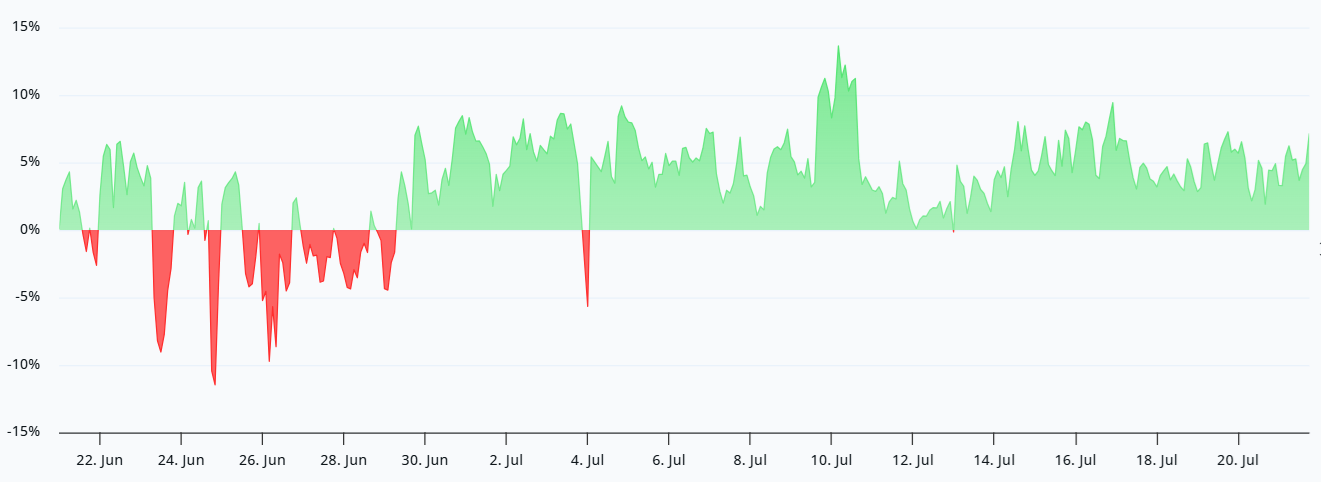
ETH perpetual futures annualized funding rate. Source: Laevitas

The annualized funding rate on ETH perpetual futures has struggled to remain within the neutral 6%-12% range over the past month. Still, sentiment has improved from the negative rates seen in late June, which reflected heavy bearish demand. Rising interest in Ethereum staking has likely boosted trader expectations for price gains and reduced downside risks.
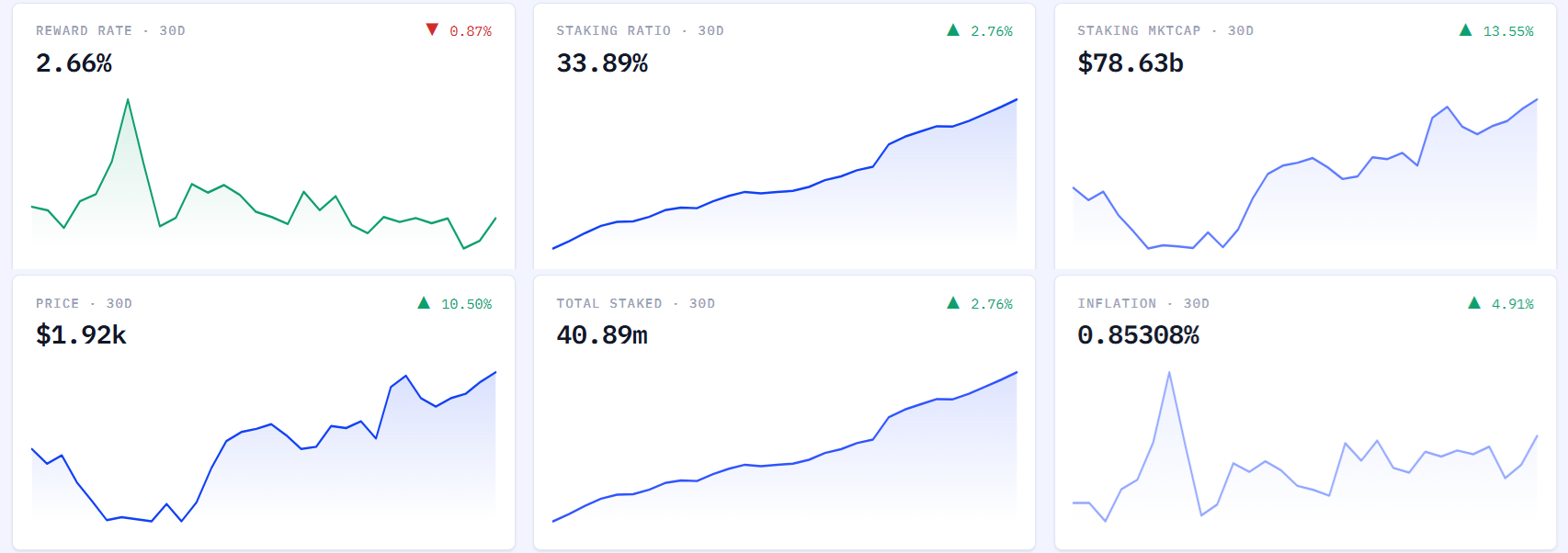
Ethereum staking data. Source: StakingRewards

According to Staking Rewards data, a record-high 34% of all ETH supply is now staked, up from 33% one month earlier. Analysts expect reduced sell pressure as long-term holders keep accumulating supply, including Tom Lee’s Bitmine Immersion (BMNR US), which added 156,719 ETH over the past month. The company now controls 4.8% of available supply.

ETH price is 61% below the all-time high from August 2025, which helps explain why bulls lack enthusiasm in derivatives markets. The soft on-chain metrics and six-month bear market have left traders skeptical about sustained upside.

Ether’s path to $2,100 likely depends on reduced risk aversion across markets, which makes Google’s revenue guidance on Wednesday especially important.



Trending Cryptos

Related Reads

The 800x Golden Dog, "Gacha" Saves NFT Trading

Title: 800x Golden Dog: How 'Gacha' Mechanics Are Rescuing NFT Trading In the past month, the on-chain TCG (Trading Card Game) narrative, centered around "gacha" or loot box mechanics, has emerged as a major crypto-native revenue generator, second only to platforms like Hyperliquid and pump.fun. Recently, this trend hit Ethereum with Fake World Assets (FWA). Within just over a week, FWA generated approximately $1.3 million in revenue, ranking 15th in the past week's crypto app earnings. Its token, $FWA, surged from an initial market cap of ~$47,550 to a peak of ~$38.8 million—an 800x gain. Meanwhile, Collector Cards' token $CARDS declined significantly from its previous highs. FWA, developed by the team behind "PunkStrategy," operates as an NFT gacha system with a built-in token flywheel. Users deposit NFTs paired with ETH as liquidity into pools. Each deposit creates a personal pool; more ETH deposited lowers the chance of the NFT being "won" in a draw. Players spend ETH to "draw" (gacha). If they get an undesirable NFT, they can instantly sell it back to the original depositor at an 85% discount, generating income for the depositor. A 1% fee is taken on each draw and on depositor earnings when an NFT is kept. The key to FWA's momentum is its token $FWA. It cannot be bought directly externally. The primary way to acquire it is by playing the gacha and choosing to receive $FWA (instead of ETH) when selling back an unwanted NFT. This mechanism creates constant buy pressure for $FWA as players engage, especially during its price ascent. Early participants who held $FWA benefited massively from subsequent inflows. This contrasts with projects like Collector Cards, which, despite strong revenues, suffer from perceived low token utility beyond buybacks. In conclusion, while FWA's flywheel design—linking speculative token gains directly to NFT trading activity—has driven rapid growth, its sustainability is questionable. The model relies heavily on continuous $FWA price appreciation to offset the inherent negative expectancy of each draw. When price momentum stalls, activity will likely decline. The case highlights that in crypto markets, pure profitability narratives can be fleeting; understanding the relationship between attention, token buy pressure, and sustainable mechanics is crucial to avoid speculative pitfalls.

marsbit19m ago

The 800x Golden Dog, "Gacha" Saves NFT Trading

marsbit19m ago

The Quantum Computing Threat Approaches, Cryptocurrency May Be Exposed to Risks Before Banks

Quantum computing poses a significant threat to all cryptographic systems, including banks and governments, but decentralized cryptocurrencies with public ledgers like Bitcoin are likely the first practical target. Experts warn that a cryptographically relevant quantum computer (CRQC), capable of running Shor's algorithm to break the elliptic curve cryptography securing most crypto wallets, could emerge around 2029. Recent research shows the required quantum resources for such attacks are shrinking dramatically, potentially enabling key extraction in minutes. The core vulnerability for cryptocurrencies is not the cryptography itself—post-quantum standards are being developed—but the slow, decentralized governance required to implement upgrades. Unlike centralized banks that can swiftly transition, Bitcoin needs near-unanimous consensus among its global network, a historically difficult process as seen in past upgrades. Estimates suggest migrating all vulnerable Bitcoin funds could take at least 76 days of dedicated network time, and it must be completed before a CRQC exists to prevent "now-or-never" attacks on exposed keys. The threat is not binary; it begins when a quantum computer can decrypt data before it loses value, not necessarily in real-time. A significant portion of Bitcoin (estimated at millions of coins) already has public keys permanently exposed on-chain, making them vulnerable to eventual "static attacks." While technical solutions exist, the race is against time for decentralized networks to coordinate a defensive transition, serving as an early warning for the broader financial system.

marsbit30m ago

The Quantum Computing Threat Approaches, Cryptocurrency May Be Exposed to Risks Before Banks

marsbit30m ago

On the First Day of Listing, Changxin Technology's Market Value Exceeds 3 Trillion Yuan, Which Securities Firm Has the Largest Floating Profit?

On July 27th, Changxin Technology, the largest-ever IPO on China's STAR Market, debuted with its share price soaring 465.82% to close at 49 yuan. Its market capitalization reached 3.28 trillion yuan, instantly making it the most valuable A-share company. The stellar performance delivered substantial gains for involved securities firms, primarily through equity investments rather than underwriting fees. China Merchants Securities emerged as the biggest winner. Its direct investment subsidiary, Zhaozheng Investment, alone holds a 0.54% pre-issue stake, translating to a paper profit exceeding 155 billion yuan based on the first-day closing price—surpassing the firm's entire 2025 net profit of 123.5 billion yuan. Other major beneficiaries include Huaan Securities, with an estimated profit of around 123 billion yuan from its 0.44% stake, and the lead underwriters, CICC and CITIC Securities, which each gained approximately 46 billion yuan from mandatory follow-on investments. Firms like Founder Securities, Haitong Securities, and GF Securities also reported significant holdings valued in the billions. Despite these paper gains, shares of some brokerages like Huaan and China Merchants fell on the listing day, reflecting broader market pressures. Analysts remain bullish on Changxin's long-term prospects, citing the AI-driven demand surge for DRAM (Dynamic Random-Access Memory) and a supportive supply-demand dynamic with projected shortages through 2028. As China's largest and most advanced integrated DRAM designer and manufacturer, Changxin is poised to capture growth from domestic substitution and global market shifts, potentially challenging the current "big three" oligopoly (Samsung, SK Hynix, Micron). The IPO proceeds, focused on capacity upgrades and R&D, are expected to accelerate China's semiconductor self-sufficiency.

marsbit59m ago

On the First Day of Listing, Changxin Technology's Market Value Exceeds 3 Trillion Yuan, Which Securities Firm Has the Largest Floating Profit?

marsbit59m ago

Will Changxin Technology Continue to Rise Today?

Changxin Technology made a historic debut on the stock market, with its share price soaring 465.82% to close at 49 yuan. Its market capitalization reached 3.28 trillion yuan, surpassing Industrial and Commercial Bank of China to become the largest company by market cap on the A-share market. Daily trading volume exceeded 140 billion yuan, a first in A-share history. This created a moment of realization for 7.7 million investors who won the lottery for its shares. On the first day, investor strategies varied: some sold immediately and later regretted missing intraday highs, others secured profits to avoid future volatility, while a third group held or even bought more shares, betting on long-term growth. The staggering IPO, massive public enthusiasm, and debut during a peak industry cycle led some to compare Changxin to PetroChina's 2007 listing, which was followed by a long decline. Key similarities noted include comparable fundraising scales (approx. 666 billion yuan for Changxin vs. 668 billion for PetroChina) and both companies listing at a perceived high point in their respective commodity cycles (oil then, memory chips now). However, analysts caution against over-simplifying the comparison. They highlight core differences: Changxin operates in the high-growth semiconductor sector with strong "domestic substitution" tailwinds. Brokerages like Huaxi Securities project significant revenue and profit growth from 2026 to 2028, driven by DDR5 adoption, product mix optimization, and economies of scale. Nomura Securities issued a "buy" rating with a 116 yuan target price, citing AI-driven demand for DRAM, tight supply as major players shift to HBM production, and Changxin's vast room for market share growth. Some analysts position the current memory cycle, fueled by AI, as just beginning, contrasting with the mature energy cycle PetroChina entered. The article concludes that for investors, monitoring the memory cycle's progression and Changxin's breakthroughs in high-end technologies like HBM will be crucial, rather than relying on superficial historical parallels.

marsbit1h ago

Will Changxin Technology Continue to Rise Today?

marsbit1h ago

Trading

Spot

Hot Articles

Discussions

Welcome to the HTX Community. Here, you can stay informed about the latest platform developments and gain access to professional market insights. Users' opinions on the price of ETH (ETH) are presented below.

活动图片