Will Changxin Technology Continue to Rise Today?

marsbitPublished on 2026-07-28Last updated on 2026-07-28

Abstract

Changxin Technology made a historic debut on the stock market, with its share price soaring 465.82% to close at 49 yuan. Its market capitalization reached 3.28 trillion yuan, surpassing Industrial and Commercial Bank of China to become the largest company by market cap on the A-share market. Daily trading volume exceeded 140 billion yuan, a first in A-share history. This created a moment of realization for 7.7 million investors who won the lottery for its shares. On the first day, investor strategies varied: some sold immediately and later regretted missing intraday highs, others secured profits to avoid future volatility, while a third group held or even bought more shares, betting on long-term growth. The staggering IPO, massive public enthusiasm, and debut during a peak industry cycle led some to compare Changxin to PetroChina's 2007 listing, which was followed by a long decline. Key similarities noted include comparable fundraising scales (approx. 666 billion yuan for Changxin vs. 668 billion for PetroChina) and both companies listing at a perceived high point in their respective commodity cycles (oil then, memory chips now). However, analysts caution against over-simplifying the comparison. They highlight core differences: Changxin operates in the high-growth semiconductor sector with strong "domestic substitution" tailwinds. Brokerages like Huaxi Securities project significant revenue and profit growth from 2026 to 2028, driven by DDR5 adoption, product mix optimizat...

On its first day of listing, Changxin Technology set multiple records. Its stock price closed up 465.82% at 49 yuan per share, surpassing Industrial and Commercial Bank of China with a market capitalization of 3.28 trillion yuan to become the A-share market cap "top dog". The full-day trading volume exceeded 140 billion yuan, making it the first A-share stock in history to break the 100-billion-yuan mark in single-day turnover.

At the same time, 7.7 million investors who won the lottery for Changxin Technology also welcomed their moment to cash in.
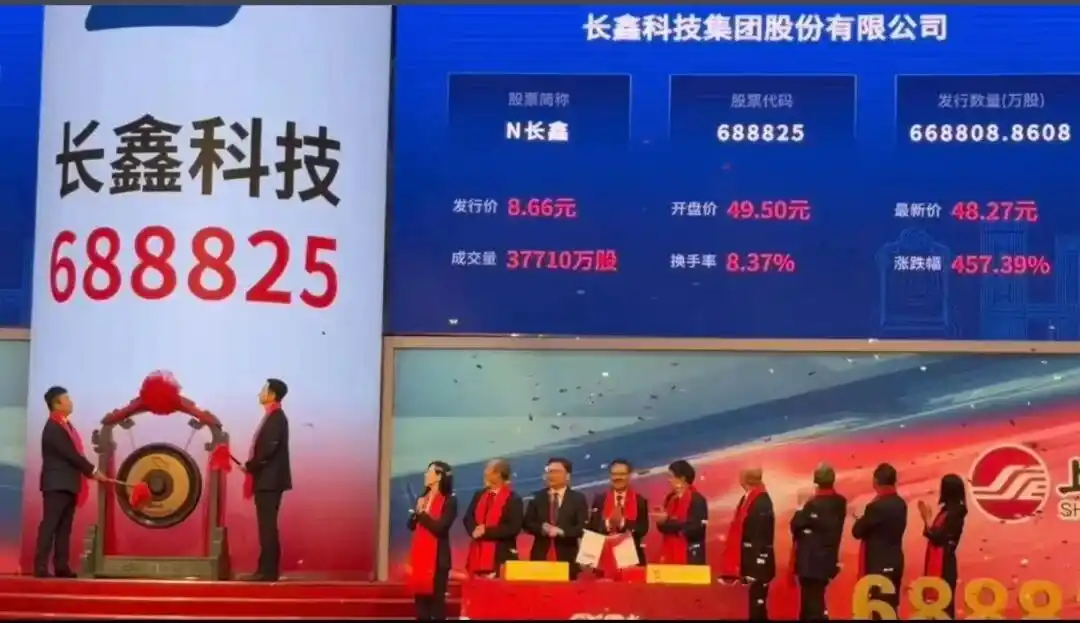
Picture shows the bell-ringing ceremony for Changxin Technology's listing. Source: Internet

On the first day of listing, the mentality of winning investors varied: some sold and exited immediately at the open, watching the intraday high slip away and later filled with regret; some chose to take profits and refused to gamble on future price fluctuations; yet there were also those who refused to sell and even added to their positions in Changxin.

Meanwhile, questions like "Will Changxin become the second PetroChina?" also appeared in major investment communities. How Changxin Technology will perform in the future has become a hot topic.

01 Investors who didn't sell at the peak are full of regret

The火爆程度 of Changxin Technology's first day far exceeded expectations. Some investors reported that trading soon after the open experienced lag, making transactions impossible and orders un-cancelable, with service gradually resuming around 10 am.
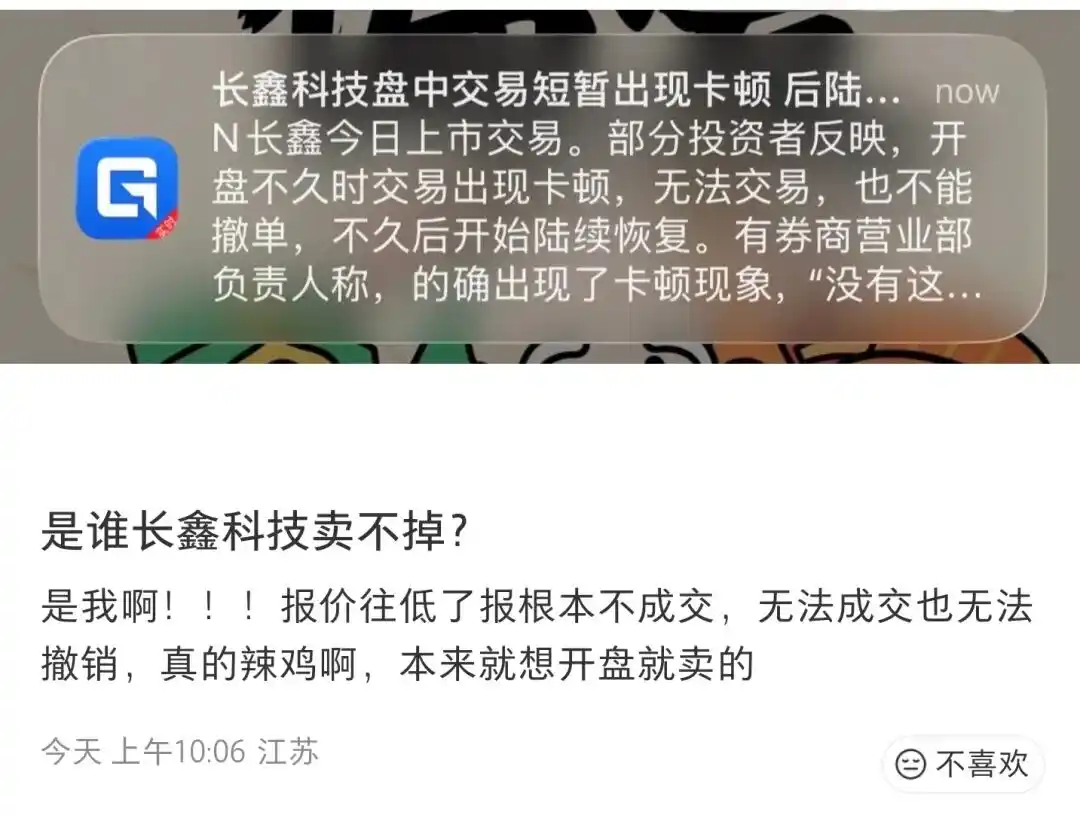
Source: Internet

The last time a new stock listing caused widespread system lag and inability to cancel orders was on October 15, 2020, when the A-share food giant COFCO Fortune landed on the ChiNext board. As the largest IPO by fundraising scale on ChiNext at that time, it opened up 90.51%. In the morning session, funds集中涌入 the Shenzhen Stock Exchange channel, causing system lag across all brokerages market-wide.
Source: Internet

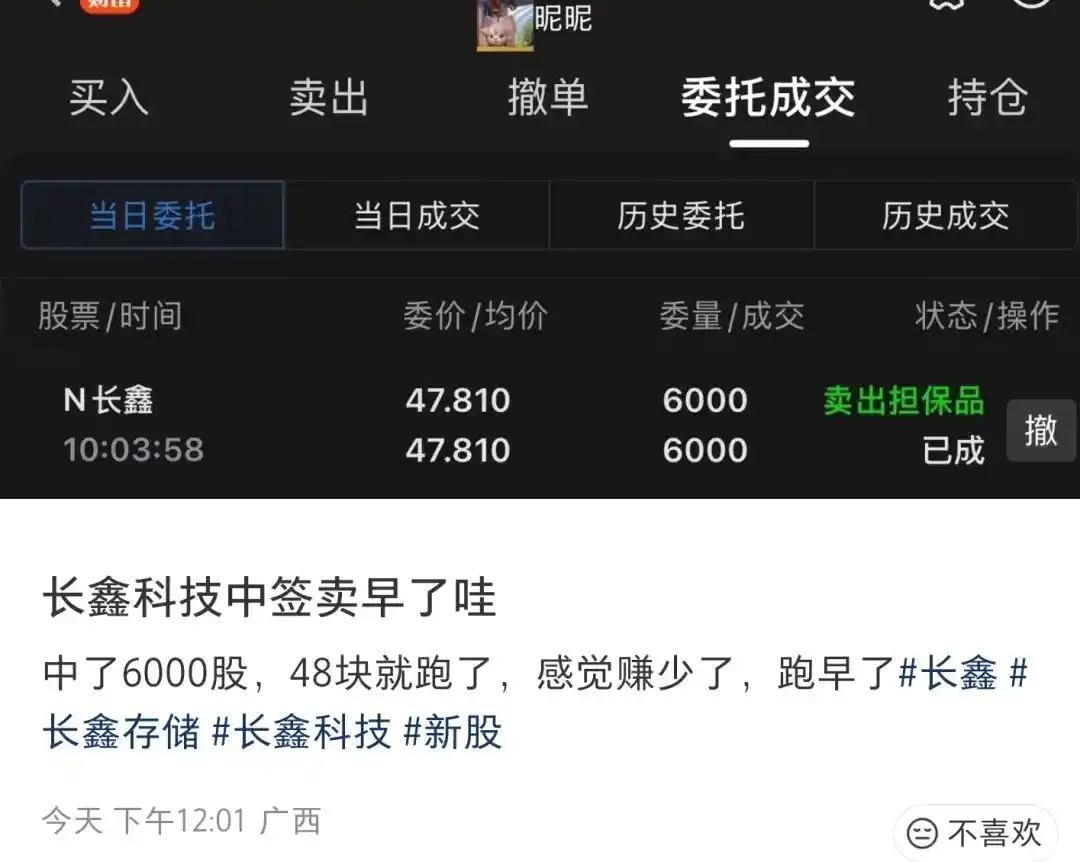
Many winning investors sold after their brokerage systems returned to normal, but then felt regret as Changxin's stock price hit a new intraday high just before the lunch break ended.
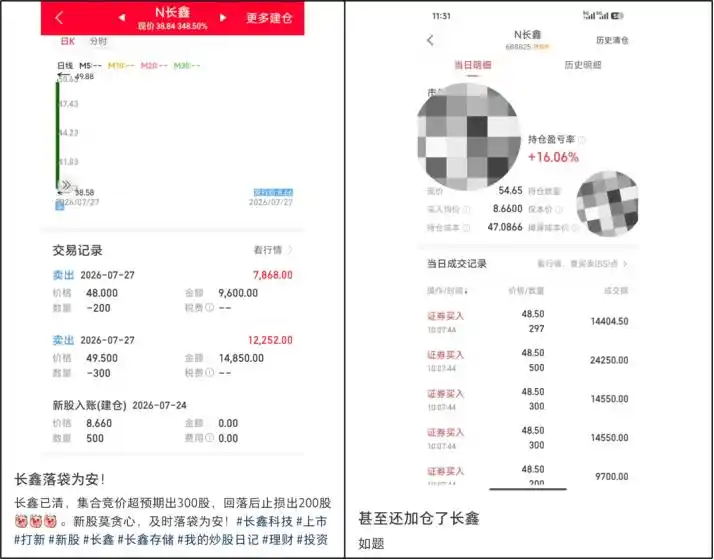
Picture shows investors' buy/sell situations. Source: Internet

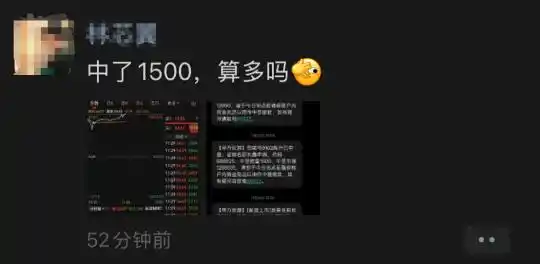
There were also many conservative winning investors who chose to sell all their shares on the first day, taking profits and refusing to gamble on future volatility. Conversely, some investors看好长期价值, not only holding all shares but also buying more during intraday pullbacks, betting on the long-term growth potential of Changxin Technology as a domestic memory chip leader.
Source: Internet

Thanks to Changxin Technology's high lottery-winning rate of 0.4714%, the coverage of this IPO was significantly broader. Scrolling through social media, one could often see friends晒出持仓, sharing the joy of making big profits on the first day.

Whether they sold at the intraday peak or not, for investors holding the shares, Changxin Technology's first-day performance was a real盈利盛宴.

02 Will Changxin Technology's trend become the second PetroChina?

Amid the wealth-creation狂欢, many investors began to worry about short-term speculation泡沫 and周期见顶 risks.

A 3 trillion yuan market cap at opening,全民追捧, and the scenario of a超级IPO reminded many veteran investors of PetroChina's listing in 2007.

Because people found that data in certain aspects between the two were高度相似.

Firstly, the fundraising规模几乎持平. PetroChina's 2007 A-share issuance raised 66.8 billion yuan; Changxin Technology, after full exercise of the绿鞋, raised 66.607 billion yuan. Both were A-share巨无霸 IPOs, raising concerns about market资金分流.

Secondly, the狂热氛围 in the secondary market on the first day also reminded people of PetroChina.
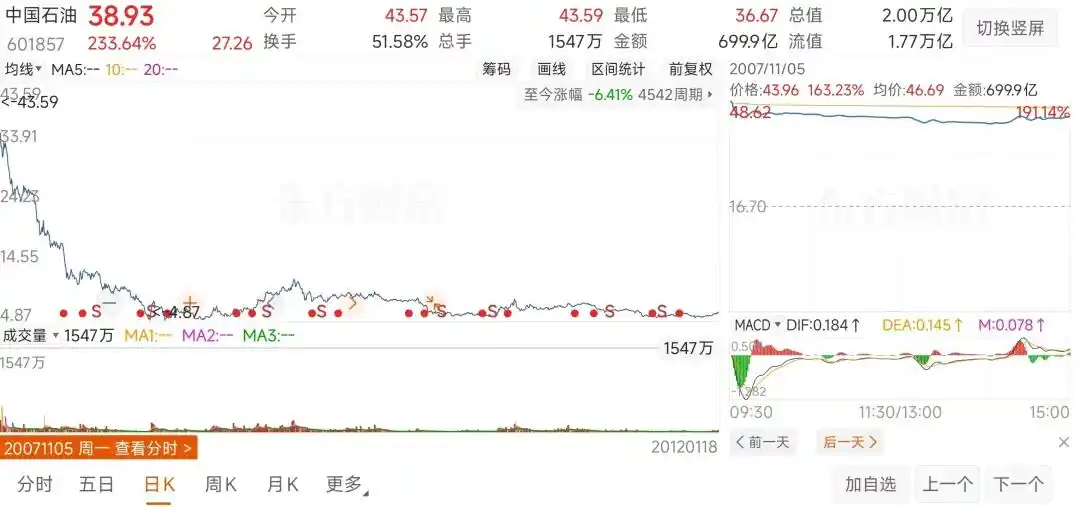
Picture shows PetroChina's post-listing trend in 2007. Source: Internet

At that time, PetroChina's发行价 was 16.7 yuan. After opening, it quickly rose to 48.6 yuan, a gain of 191%. Its total market cap briefly突破8 trillion, topping global market value rankings. Changxin Technology's发行价 is 8.66 yuan, today's opening price was 49.5 yuan, a gain of 471.59%. With a 3.2 trillion yuan market cap, it instantly surpassed ICBC to become the A-share market value leader.
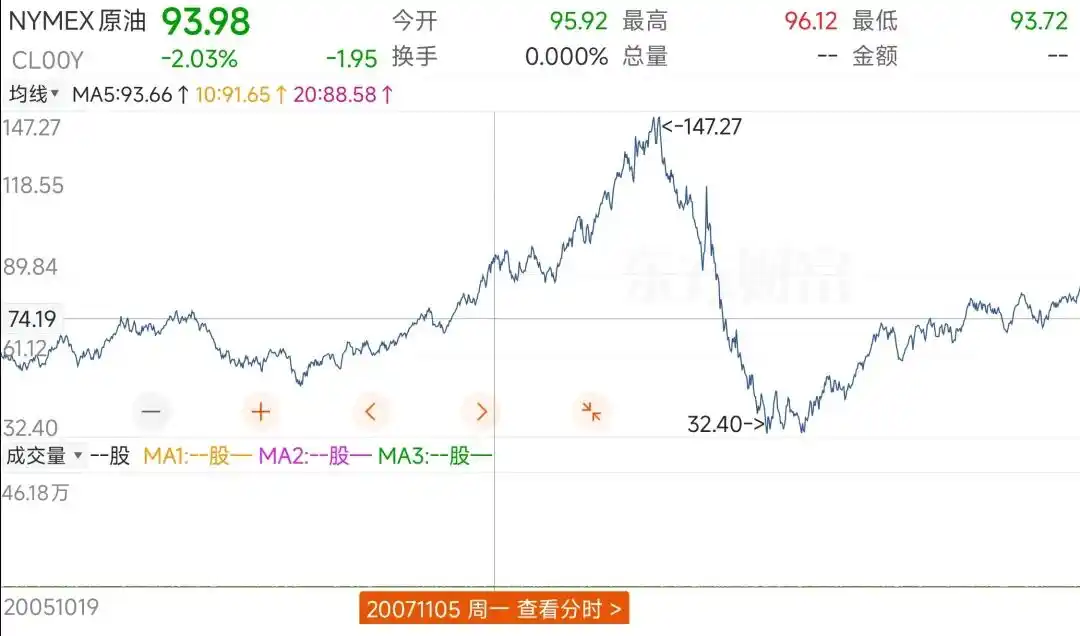
Picture shows international oil prices in 2007. Source: Internet

Lastly, at the time of listing, both were in industry景气周期. When PetroChina listed, international oil prices were at historical highs, around $90 per barrel, and the market was unanimously看好能源长期红利. Changxin's listing also coincides with a暴涨周期 in memory chip prices. Its H1 2026 net profit is预计同比暴涨 over 22 times. Therefore, the market worries that the current point might be the peak of the memory cycle, and the stock price could weaken once the cycle ends.

However,综合券商研报及分析师观点来看, equating Changxin Technology simply to PetroChina only sees the surface commonalities of "巨无霸 IPO, listing at cycle peak,全民炒作", while忽略成长赛道、国产替代以及业绩增速的核心差异.

Analyst Wang Fang from Zhongtai Securities believes that this round of memory涨价大周期 started in 25Q2, with涨价幅度持续超预期 in 25Q4 and 26Q1. It is预计 that DRAM供需仍持续紧张 in 2026, and prices有望继续上涨.

Regarding业绩成长性, Huaxi Securities believes that with the continuous放量 of high-generation products like DDR5, continuous optimization of product structure, and the gradual release of规模效应, future业绩增长空间有望进一步打开. They provided盈利数据预判 for Changxin,预计 2026-2028 company营业收入分别为 2776.90/3917.94/5726.94 billion yuan,归母净利润为 1244.05/1821.17/2906.02 billion yuan.

In terms of comparison标的, the post-listing trends of A-share Sci-Tech Innovation Board semiconductor leaders might be more suitable作为长鑫股价参照物.

The domestic chip自主可控赛道长期享有估值溢价. For example, SMIC (晶圆制造龙头), as the当时国内晶圆代工唯一平台, experienced short-term冲高回落 after listing but maintained a high valuation long-term based on国产替代 logic, with a 2026 consensus PE约150倍.

Some institutions extremely看好产业长期红利 have given Changxin Technology极具想象空间的估值天花板.
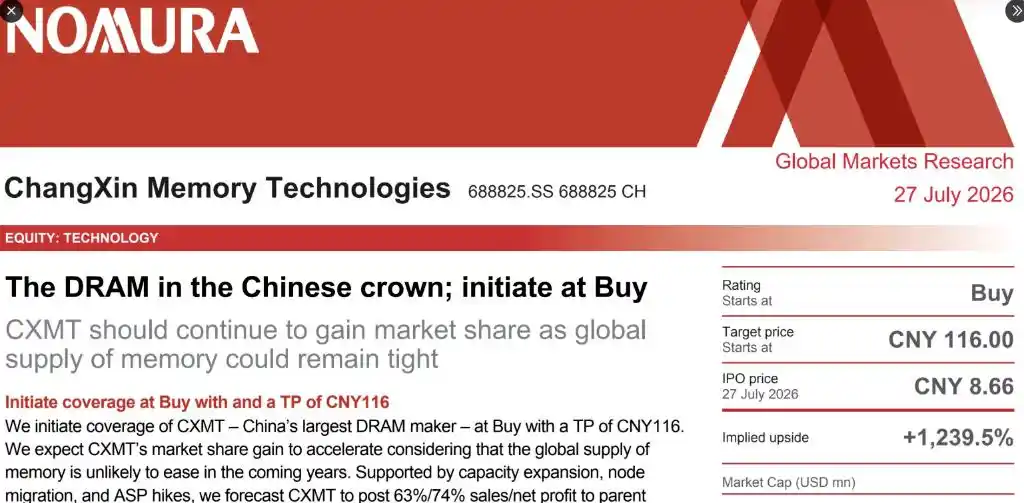
Picture shows Nomura Securities research report. Source: Internet

Nomura Securities directly gave a Buy rating and a target price of 116 yuan, corresponding to a market cap of 7.76 trillion yuan, representing upside potential of over 12 times from the发行价.

Nomura Securities判断 that the爆发 of AI算力带来 DRAM需求指数级增长. Overseas memory giants纷纷转产 HBM, compressing supply of通用内存, leading to持续偏紧 industry供需格局. Changxin's current global份额仅8%, leaving ample国产替代提升空间.叠加成熟制程扩产不受 EUV限制, once HBM技术落地, the company will open a全新增长曲线. Therefore, valuation is based on a 2028预期 PE of 20倍.

从历史周期维度看, the memory industry has天然周期波动 of 3-4 years. But Guojin Securities stated that the开启 of each major memory cycle (e.g., 2008, 2016) is driven by emerging technologies promoting product upgrades and innovation,进而催生 new products'总量、渗透率和存储器价值量的提升, pushing the memory market规模上升一个台阶. With AI driving需求提升, 当下我们走在新一轮存储大周期的起点. They看好模型和应用落地后对存储需求长期且大量的拉动.

For ordinary investors,持续关注存储周期的发展阶段与 breakthroughs in高端存储技术 like HBM才是关键.

This article is from the WeChat public account "Phoenix.com Finance", author: Company Research Institute


Related Questions

QWhat was the closing price of Changxin Technology on its first trading day?

AChangxin Technology closed at 49 yuan per share on its first trading day.

QWhy are some investors comparing Changxin Technology to PetroChina?

ASome investors are comparing Changxin Technology to PetroChina due to similarities in large-scale IPO fundraising, frenzied market sentiment on the first trading day, and both companies going public during a peak in their respective industry cycles.

QWhat is Nomura Securities' price target for Changxin Technology and the corresponding market capitalization?

ANomura Securities gave a buy rating with a price target of 116 yuan, which corresponds to a market capitalization of 7.76 trillion yuan.

QWhat are the projected revenues and net profits for Changxin Technology from 2026 to 2028 according to Huaxi Securities?

AAccording to Huaxi Securities, Changxin Technology's projected revenues from 2026 to 2028 are 277.69 billion yuan, 391.794 billion yuan, and 572.694 billion yuan, respectively, with projected net profits of 124.405 billion yuan, 182.117 billion yuan, and 290.602 billion yuan, respectively.

QHow did the subscription lottery success rate for Changxin Technology affect investor coverage?

AThe high lottery success rate of 0.4714% for Changxin Technology significantly broadened investor coverage, allowing many individual investors to win shares and participate in the first-day gains.

Related Reads

Coinbase Vice President: The Wars Over Cryptocurrency Regulation Are Over

Coinbase's new Vice President, Ryan VanGrak, declared that regulatory wars in the cryptocurrency sector are over. Since taking office on July 9, 2026, he has shifted the company's approach from litigation and sanctions to focusing on growth and innovation. The industry can now concentrate on development rather than fighting for its right to exist. He highlighted that the Digital Asset Market Clarity Act (CLARITY Act), which aims to establish a clear federal regulatory framework dividing oversight between the SEC and CFTC, has gained significant momentum. This framework is intended to provide proper supervision, investor protection, and maintain U.S. leadership in digital assets. VanGrak's appointment marks a strategic shift from a "wartime" to a "peacetime" advisor, replacing former Chief Legal Officer Paul Grewal, who oversaw major litigation, including a dismissed 2023 SEC lawsuit. With his background at Citadel Securities and the SEC, VanGrak brings deep regulatory and institutional finance expertise as Coinbase expands beyond a simple exchange into a broader financial services provider, offering stocks, futures, prediction markets, and AI tools. For investors, bipartisan support for crypto legislation like the CLARITY Act represents a major shift from the enforcement-focused environment of 2023-2024. Lawmakers are now focused on *how* to regulate crypto, not *if* it should exist. However, risks remain, as the bill's passage is not yet guaranteed.

cryptonews.ru32m ago

Coinbase Vice President: The Wars Over Cryptocurrency Regulation Are Over

cryptonews.ru32m ago

Deep Dive into FWA: An Intriguing Experiment Turning NFTs into "On-Chain Gachapon"

A Deep Dive into FWA: The “On-Chain Gacha” Experiment for NFTs Fake World Assets (FWA), created by TokenWorks, introduces an innovative “NFT gacha machine” fully operating on-chain. Users can deposit eligible NFTs paired with ETH (called Backing) to create a Position, acting as a prize pool. Others can then pay a uniform Acquisition Price for a chance to win a random NFT from the pool. The core mechanism features a reverse probability system: Positions with lower Backing have a higher chance of being selected, serving as common prizes, while high-Backing Positions are rare “jackpots.” The acquisition price is calculated based on the harmonic mean of all Backings, keeping entry costs low. When a Position is won, the purchaser must choose: keep the NFT or accept the Standing Bid (85% of the Backing, claimable in ETH or $FWA tokens), returning the NFT to the original depositor. The protocol involves two main roles. Depositors provide liquidity (NFT + ETH), earning a share of fees from each draw, distributed equally per active Position, plus potential $FWA rewards. Purchasers pay to spin the gacha, receiving $FWA rewards for participation. A special “Crown” reward goes to the Position with the highest Backing. The $FWA token has a fixed supply and is initially obtainable only through protocol participation (depositing or purchasing), with external buying disabled early on to reduce sell pressure. Its value is supported by a built-in buy pressure: when purchasers opt for the $FWA settlement on a Standing Bid, the protocol uses the backing ETH to buy $FWA from the market. Revenue for the protocol comes from a 1% fee on each draw, a 1% settlement fee when an NFT is kept, and the 15% discount from Standing Bid settlements (currently allocated to the protocol). The design cleverly blends Uniswap-style liquidity provision, gacha mechanics, and tokenomics to create a novel, self-regulating marketplace for NFT liquidity and engagement.

marsbit47m ago

Deep Dive into FWA: An Intriguing Experiment Turning NFTs into "On-Chain Gachapon"

marsbit47m ago

10,000 Scientists Get 1 Year of Free Access: OpenAI Brings the Scientific Research Pipeline into ChatGPT

OpenAI has launched the "ChatGPT for Academic Researchers" program, offering free one-year access to its flagship models for 100,000 university researchers globally, with 10,000 spots available this summer. Selected institutions include prestigious centers like ENS Paris and the IAS at Princeton. The initiative provides an integrated research workspace within ChatGPT, bundling tools like ChatGPT, ChatGPT Work, and Codex, along with expanded Deep Research capabilities, higher usage limits, and specialized tools for life sciences. The suite connects to platforms like Zotero and GitHub, aiming to streamline the entire research workflow from literature review and coding to data analysis and manuscript drafting. OpenAI notes that about 1.3 million people already use ChatGPT weekly for advanced science and math. The program targets building long-term user dependency by embedding these tools into daily research habits. However, access comes with limitations: it does not include API credits or model weights, and eligibility is restricted to verified academic researchers from supported countries. This approach contrasts with Anthropic's "AI for Science" program, which offers API credits but not an integrated workspace. Both companies emphasize preventing misuse by withholding model weights, a point of contention for AI researchers seeking transparency. The core strategy remains clear: provide a powerful, integrated environment to foster user reliance ahead of the post-free period.

marsbit52m ago

10,000 Scientists Get 1 Year of Free Access: OpenAI Brings the Scientific Research Pipeline into ChatGPT

marsbit52m ago

What's Going On with Gigadevice? Major Shareholder Cashes Out 44 Billion, Then Announces 20 Billion Buyback

Gigadevice Innovation, a leading Chinese memory chip company, has executed a controversial financial maneuver. The company's controlling shareholder and chairman, Zhu Yiming, sold approximately 44 billion RMB worth of his shares between early May and mid-June 2026, capitalizing on a soaring stock price that peaked at 846.66 RMB on June 29th. Following a subsequent stock crash—plummeting to around 350 RMB in 22 trading days and erasing over 330 billion RMB in market value—Zhu announced a combined "market rescue" plan on July 29th. This plan includes his personal commitment to buy back at least 1 billion RMB in shares and a company proposal to repurchase 1 to 2 billion RMB worth of stock. This sequence of high-selling followed by a low-buying plan has confused and unsettled many of the company's 240,000 retail investors. The stock's dramatic decline was attributed to several factors: the successful IPO of its sister company, Changxin Technologies, which ended Gigadevice's status as a primary investment proxy for the domestic memory sector; a Morgan Stanley report warning of a potential peak in the memory chip cycle; and a severe loss of market confidence triggered by the chairman's massive sell-off. While the sell-off was procedurally compliant, its timing has been criticized. The company's fundamentals appear strong, with preliminary H1 2026 results showing revenue up 177% year-on-year to 11.5 billion RMB and net profit skyrocketing 1099% to 6.9 billion RMB, driven by a boom in memory chips and MCU demand. However, a significant portion (2.05 billion RMB) of this profit came from non-recurring gains like securities investment, and the memory industry is notoriously cyclical. Analysts highlight the company's role in the domestic substitution of niche DRAM and NOR Flash memory, with some maintaining bullish price targets. Yet, the recent events underscore key risks: its fabless model creates dependency on foundries like Changxin, and the chairman's actions have raised serious questions about management's alignment with minority shareholders. The promised buybacks cannot commence until December 13th due to a mandatory six-month cooling-off period following an insider sale, leaving the stock vulnerable in the interim.

marsbit52m ago

What's Going On with Gigadevice? Major Shareholder Cashes Out 44 Billion, Then Announces 20 Billion Buyback

marsbit52m ago

Trading

Spot
活动图片