Bitmine nears 5% of Ethereum supply despite $8.4B in unrealized losses

cointelegraphPublished on 2026-08-17Last updated on 2026-08-17

Abstract

Bitmine Immersion Technologies has resumed purchasing Ethereum, acquiring an additional 9,926 ETH last week. This brings its total holdings to approximately 5.82 million ETH, representing 4.8% of the circulating supply and nearing its goal of owning 5% of all ETH. Despite an $11 billion portfolio value at current prices, the company faces significant challenges, sitting on over $8.4 billion in unrealized losses as much of its ETH was bought at higher prices during the bear market. Nevertheless, Bitmine continues its accumulation strategy, which began in June 2025. The company also stakes over 5 million ETH, valued at around $9.6 billion, generating an estimated $287 million in annualized rewards and providing a yield independent of price volatility.

Tom Lee’s Bitmine Immersion Technologies, an Ethereum treasury company, resumed its Ether purchases last week, bringing it closer to a key business target of owning 5% of the second-biggest cryptocurrency’s supply despite challenging market conditions.

The company disclosed Monday that it acquired 9,926 Ether (ETH) during the week ending Aug. 16, bringing its total holdings to roughly 5.82 million ETH, or about 4.8% of Ethereum’s circulating supply. At an ETH reference price of $1,893, Bitmine’s Ether holdings were valued at roughly $11 billion. However, much of the company’s ETH was acquired at significantly higher prices.

Ether’s price was little changed on Monday, sitting just above $1,900.

The latest purchase puts Bitmine within striking distance of its long-term “Alchemy of 5%” target of holding 5% of the total ETH supply.

Bitmine’s conviction has been tested by a prolonged bear market for Ether, which has sharply eroded the value of its digital asset treasury. The company is sitting on more than $8.4 billion in unrealized losses on its ETH holdings, according to industry data.
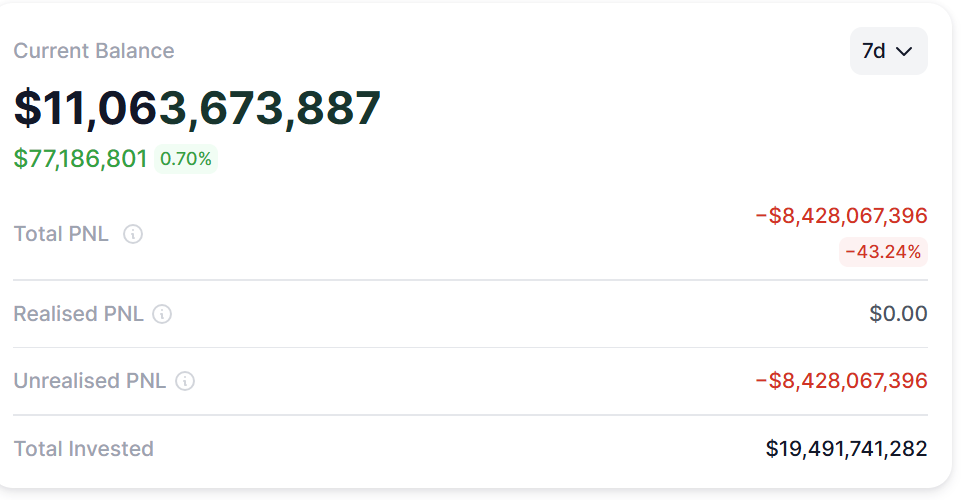
With a portfolio value of more than $11 billion, BitMine’s unrealized losses are around 43%. Source: DropsTab

Still, Bitmine has continued accumulating Ether, making purchases every week since launching its ETH treasury strategy in June 2025.

Related: Ethereum devs to narrow 66 proposals tied to Hegotá upgrade

Bitmine’s staked Ether approaches $10 billion in value

Although Bitmine is sitting on large unrealized losses on its Ether holdings, its staking operations continue to generate yield. The company said it is staking more than 5 million ETH, worth roughly $9.6 billion at current prices.

That staking has enabled Bitmine to earn protocol rewards for helping secure the Ethereum network, providing a predictable source of yield regardless of short-term ETH price movements. Based on a seven-day staking yield of 2.61%, Bitmine projects annualized staking rewards of roughly $287 million, according to Lee.


Related: Crypto Biz: Bitcoin’s $116M self-custody wake-up call

Trending Cryptos

Related Reads

Trump-Backed Company World Liberty Financial Partners with Chinese AI Company of Limited Access to Provide Artificial Intelligence Services

According to a Reuters report, Trump-backed cryptocurrency company World Liberty Financial is linked to WorldClaw, a Hong Kong-based platform providing access to Chinese AI models that the U.S. government has flagged as security threats. WorldClaw's platform features AI models from Chinese companies like Alibaba, Baidu, Z.ai, DeepSeek, and Moonshot, some of which are designated by U.S. entities as tied to the Chinese military or subject to export restrictions. The connection is facilitated by World Liberty's dollar-pegged stablecoin, $USD1, which is accepted for payment on WorldClaw. The Trump family benefits from interest generated by the stablecoin's reserves, and token sales have earned them over $1.4 billion. A World Liberty executive previously advised WorldClaw on integrating $USD1. Security experts warn that using these Chinese AI models could expose users to surveillance or malicious code. WorldClaw claims over 10,000 users and processes 50 million queries daily, partly due to the lower cost of Chinese models. Both companies and the White House deny any conflict of interest, stating the platform helps American AI firms access international markets and that listing models does not imply endorsement. External critics, however, argue it is hypocritical to profit from Chinese AI tools while the U.S. government aims to counter the rise of Chinese AI.

cryptonews.ru18m ago

Trump-Backed Company World Liberty Financial Partners with Chinese AI Company of Limited Access to Provide Artificial Intelligence Services

cryptonews.ru18m ago

Moscow's Mining Ban Takes Effect: What Will Be the Consequences?

Mining has been banned in Moscow, the Moscow region, and parts of the Kursk region from August 15, with the prohibition set to last until December 31, 2032. The measure, requested by regional authorities, aims to prevent electricity shortages caused by energy-intensive mining equipment. This follows the legalization of cryptocurrency mining in Russia in November 2024, with restrictions now in place across 16 regions. Initially a blanket ban, an exception was introduced in March 2025 for miners using their own power generation, such as gas piston units or diesel generators, independent of the national grid. Major industry players had already begun shifting to on-site gas generation near gas fields to bypass grid limitations. While a trend emerged in 2025 to combine mining with AI computing infrastructure, this was complicated by authorities granting data centers (with a ban on mining inside them) preferential status as communication facilities. Experts state the new Moscow-area ban will significantly reshape Russia's mining geography but have a minimal global impact on Bitcoin's hash rate. The primary consequence will be a stronger industry shift to regions with energy surpluses, clear connection terms, and willingness to handle such loads. Moscow was already a contentious location due to high competition for power from data centers, industry, and urban infrastructure. For the Kursk region, the ban is also linked to infrastructure stability in border areas. The ban accelerates a market split. Large, legal operators will relocate equipment or seek sites with self-generation, while smaller or semi-legal miners operating in urban or industrial networks face higher costs and potential displacement into illegality. Industry participants note that post-2024 legalization had an unintended effect, with some major companies closing due to financial issues. Russian miners also face global pressures like low Bitcoin prices relative to mining costs, rising electricity prices, and the approaching 2028 halving, forcing some to shut down equipment.

cryptonews.ru22m ago

Moscow's Mining Ban Takes Effect: What Will Be the Consequences?

cryptonews.ru22m ago

Trading

Spot

Hot Articles

Discussions

Welcome to the HTX Community. Here, you can stay informed about the latest platform developments and gain access to professional market insights. Users' opinions on the price of ETH (ETH) are presented below.

活动图片