Competitors Going Public, Kimi Can't Sit Still

marsbitPublished on 2026-05-28Last updated on 2026-05-28

Abstract

Competitors Go Public, Kimi Feels the Pressure Yue Zhi An Mian (Moonshot AI), the company behind the AI assistant Kimi, has begun dismantling its VIE and red-chip structure, clearing a key obstacle for a potential Hong Kong IPO. This marks a significant shift from six months ago when founder Yang Zhilin stated the company was in "no hurry" to list. The move comes as rivals like Zhipu AI and MiniMax have successfully listed on the Hong Kong Stock Exchange in early 2026, experiencing massive surges in market value. This has reset valuation logic for AI companies, turning "going public" from an end goal into a competitive necessity. Analysts suggest Kimi is both seizing a favorable market window and responding to competitive pressure. Kimi's valuation has skyrocketed from around $3 billion at its 2023 founding to over $20 billion by May 2026. Capital is betting on its potential as a future AI platform and gateway, though some caution this "emotional valuation" depends on sustained technological leadership and successful commercialization. Traditionally focused on core model R&D over user growth, Kimi has recently pivoted strategy. While its monthly active users declined through 2025, it shifted focus to Agent development and reducing marketing spend. The release of its K2.5 model in early 2026 reportedly generated substantial revenue, with annual recurring revenue reaching $200 million by April, driven by subscriptions and API services. A $2 billion D-round financing in May ...

Recent reports indicate that Moonshot AI has notified its shareholders, officially initiating the dismantling of its VIE and red chip structure to clear obstacles for a Hong Kong IPO.

Just half a year ago, Moonshot AI founder Yang Zhilin reiterated in an internal letter that the company was "in no hurry to go public in the short term."

"This step is more like clearing structural hurdles before an IPO, meaning the company has seriously entered the IPO preparation phase. But several hurdles remain: equity structure, regulatory communication, domestic filing, security review, HKEX materials, financial audits, and market timing," said Huang Lichong, President of Huisheng International Capital. Dismantling VIE and red chip structures essentially clarifies the positions of control rights, responsible entities, and regulatory boundaries. If smooth, the window could be six months to a year; if complex due to regulations, shareholders, tax, or foreign capital arrangements, it might take longer.

Phoenix WEEKLY Finance inquired with Moonshot AI regarding the IPO, but received no reply by the time of publication.

Regarding expectations, the capital market has already given its answer in advance. When founded in 2023, Moonshot AI's valuation was approximately $3 billion; by May 2026, this figure had surpassed $20 billion.

In reality, with the successive listings of Zhipu AI and MiniMax on the Hong Kong stock market, the valuation logic of the secondary market for large model companies has suddenly been unlocked. The long-term reliance on narratives to support valuations in the primary market has become a thing of the past. "Going public" itself is also shifting from an outcome to a competitive method.

"Moonshot AI's move considers both seizing the golden window for a Hong Kong listing and is forced by industry competition prompting proactive layout," said Zhang Yi, CEO of iiMedia Consulting Group.

Perhaps for Moonshot AI, the real question is no longer "whether to go public," but rather, when other competitors have already entered the next round, Moonshot AI cannot afford to stand still.

$20 Billion Valuation May Be Tinged with Capital Market Sentiment

Since the beginning of 2026, the capital "atmosphere" in the large model industry has rapidly heated up.

Over the past three years, Chinese AI startups have undergone a transformation from being neglected to becoming darlings of capital. However, what truly turned the industry sentiment around was the successive Hong Kong listings of Zhipu AI and MiniMax earlier this year.

On January 8, 2026, Zhipu AI took the lead in listing on the HKEX with an issue price of HK$116. On its first trading day, the stock closed at HK$131.5 per share, up 13.17%, with a total market capitalization reaching HK$57.89 billion. In the following months, Zhipu AI's stock price continued to rise. As of the close on May 26, its total market capitalization had exceeded HK$599.6 billion, nearly a tenfold increase from its initial listing.

On January 9, MiniMax followed suit, listing on the HKEX with an issue price of HK$165. On its first trading day, the stock closed at HK$345 per share, a surge of 109% from the issue price, with a total market capitalization surpassing HK$106.7 billion. Currently, its total market capitalization exceeds HK$241.1 billion.

This provided the entire industry with pricing benchmarks. Since then, AI is no longer seen as just a technological story but as the next platform-level opportunity.

With such precedents, Moonshot AI's valuation also rapidly climbed.

In November 2025, Moonshot AI's valuation was $4.3 billion; by May 2026, it had exceeded $20 billion. In just half a year, its valuation nearly quadrupled, with cumulative financing exceeding $3.2 billion. Moonshot AI has also completed a rare capital leap for a domestic large model startup.

"Revenue is the foundation. Capital pricing mainly focuses on three things: first, foundational model capabilities; second, user access and developer ecosystem; third, the imaginative space for future platformization," Huang Lichong believes. For companies like Moonshot AI, capital is buying not today's profit statement, but a scarce ticket in the Chinese large model race. Whoever can become the next-generation AI gateway may gain access to new profit pools like search, office work, developer tools, enterprise services, and Agent execution.

This year, information about unofficial financing shares not from Kimi has even frequently appeared in the market.

In April, Kimi publicly refuted rumors, stating, "Recently, false financing information purporting to be from 'Moonshot AI' has appeared in the market. We hereby remind investors that all financing activities are directly handled by Moonshot AI. Any so-called 'investment shares' circulated through unofficial channels carry significant risks."
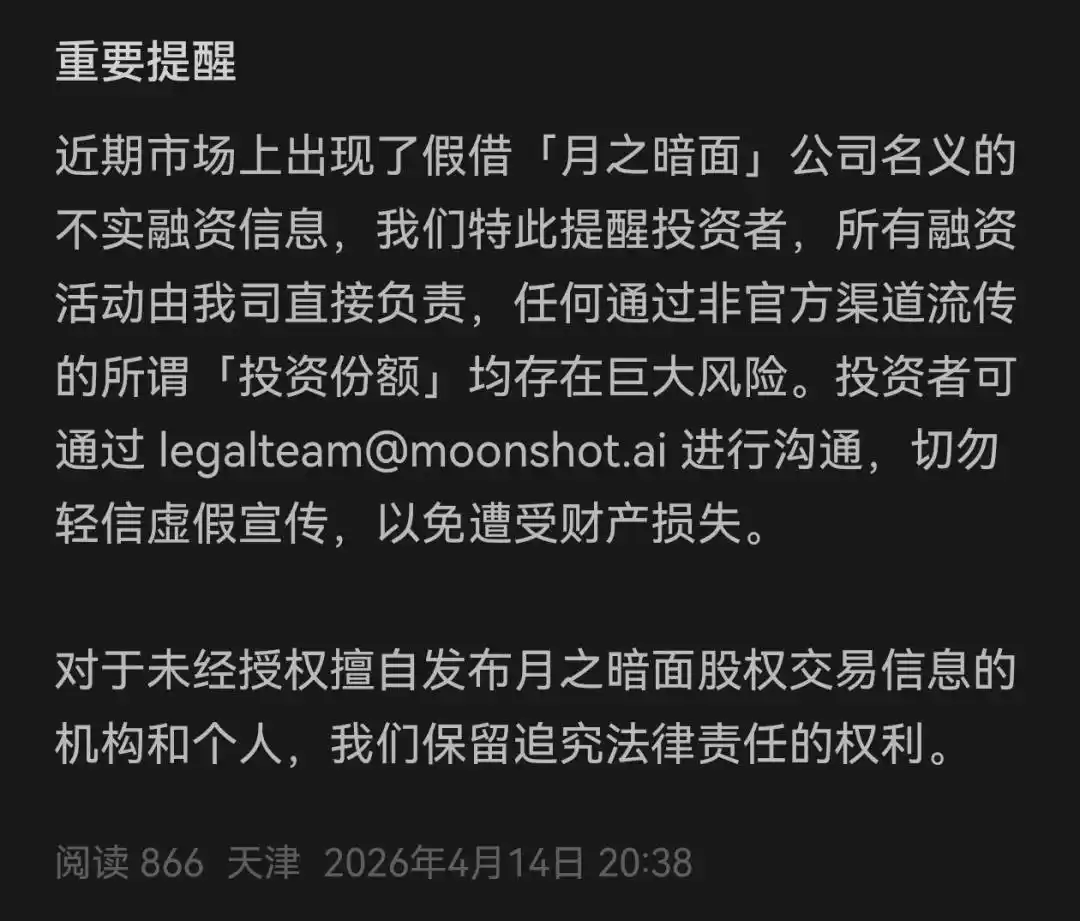
Screenshot of Kimi's response.

When capital frantically searches for the "next Zhipu AI" or "next MiniMax," it's difficult for Moonshot AI to keep capital at bay.

"A $20 billion valuation seems more like an advance payment on the future," Zhang Yi believes, attributing it to the capital market pricing in growth dividends ahead of time.

Huang Lichong stated, "This valuation only holds up if three things materialize: continued model leadership, sustained commercialization scaling, and declining unit inference costs. Otherwise, it's just sentiment-driven valuation."

R&D Pace May Be Constrained, Commercialization Moves to the Forefront

Among domestic large model startups, Moonshot AI is an "outlier."

For a long time, Yang Zhilin has been one of the most typical "tech-focused" representatives among domestic AI entrepreneurs. Compared to traffic competition and commercial expansion, he emphasizes foundational model capabilities, organizational efficiency, and long-term R&D investment. This has long positioned Moonshot AI as one of the domestic teams closest to the routes of OpenAI and Anthropic.

QuestMobile data shows that the monthly active user (MAU) count for the Kimi App dropped from 21.653 million in Q1 2025 to 9.027 million in Q4 2025.

In his year-end all-staff letter in 2025, Yang Zhilin clarified the direction of this round of adjustment: focus on Agents, not targeting absolute user numbers, persistently pursuing intelligence limits and productivity value, and significantly cutting annual advertising spending, shifting to technology-driven commercialization.

In January 2026, Kimi released its flagship model K2.5. According to multiple media reports, less than a month after the model's release, the company's revenue over nearly 20 days had already exceeded its total revenue for the entire year of 2025; as of April 2026, the company's Annual Recurring Revenue (ARR) exceeded $200 million, with paid subscriptions and API revenue gradually becoming new growth engines.

Moonshot AI is attempting to prove to the outside world that despite reduced MAU, Kimi's commercial capabilities remain intact.

Qichacha shows that in May this year, Moonshot AI completed another $2 billion Series D financing round, led by Meituan Longzhu, with participation from institutions like China Mobile and CPE, which may indicate capital's approval of Kimi's adjustments in its business model.
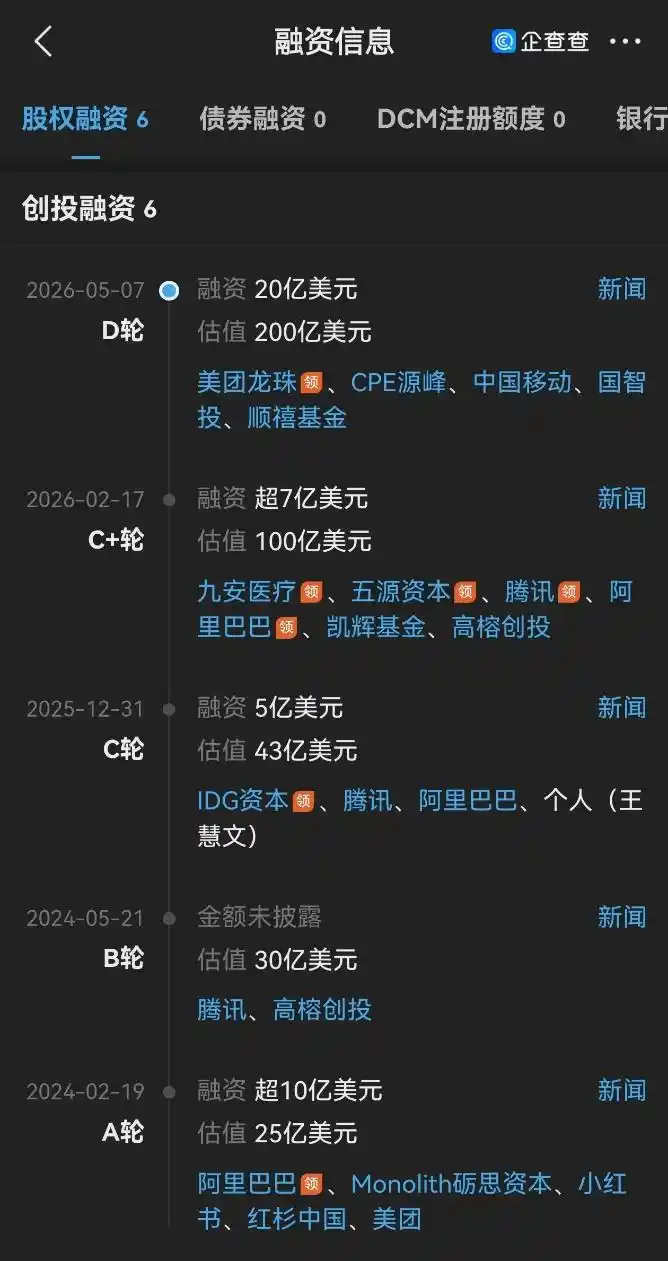
Screenshot of Moonshot AI's $2 billion Series D financing.

However, post-financing, AI companies cannot avoid the continuous investment race. Training compute, inference costs, data resources, and talent reserves all imply massive capital consumption.

If entering the secondary market, the rules begin to change. Beyond investment, investors will also demand corresponding returns.

Huang Lichong predicts significant changes for Moonshot AI post-IPO. First, the organization will become heavier. Financial disclosure, internal controls, compliance, model safety, and data governance will become institutionalized. Second, the R&D pace will be more constrained. In the past, it could focus solely on model breakthroughs; post-IPO, it must explain input-output ratios, compute expenses, loss boundaries, and commercialization paths. Third, commercialization will be brought to the forefront. Investors won't pay for "model leadership" indefinitely; they will look at subscriptions, APIs, enterprise clients, Agent revenue, and gross margins.

"Only raising funds without model leadership will eventually be disproven. Only making models without capital and commercialization won't survive to the end," in Huang Lichong's view. The real test for Moonshot AI post-IPO is whether it can transform "technological scarcity" into "sustainable revenue" and "explainable valuation."

(Image source: Moonshot AI official)

This article is from the WeChat public account "Phoenix WEEKLY Finance", author: Wang Han

Related Questions

QAccording to the article, what is the primary purpose of Kimi's parent company, Moonshot AI, dismantling its VIE and red-chip structure?

ATo clear structural obstacles for its planned IPO in Hong Kong, officially entering the IPO preparation phase.

QWhat significant change in valuation logic for large model companies does the article mention after the IPOs of Zhipu AI and MiniMax?

AThe IPOs have shifted the valuation logic from a primary market reliance on narrative to a secondary market focus on concrete financial performance, turning 'listing' itself from an end result into a competitive method.

QHow does the article characterize the $20 billion valuation of Moonshot AI as of May 2026?

AAnalysts in the article suggest the $20 billion valuation may be inflated by capital market sentiment, representing a premium paid for a 'scarce ticket' in the Chinese large model race and a pricing that anticipates future growth. Its sustainability depends on continued model leadership, commercialization scale-up, and reduced unit inference costs.

QWhat key strategic shift in Kimi's focus did founder Yang Zhilin outline in late 2025, according to the article?

AYang Zhilin outlined a shift in focus towards Agent (intelligent agent) development, prioritizing intelligence limits and productivity value over absolute user numbers. The company also significantly reduced annual advertising spending to rely more on technology-driven commercialization.

QWhat are the three major changes that capital market expert Huang Lichong predicts for Moonshot AI after its potential IPO?

AHuang Lichong predicts post-IPO changes will include: 1) A heavier organization with more formalized financial disclosure, internal controls, and compliance. 2) More constrained R&D节奏 (rhythm/pace), requiring justification for inputs, outputs, and commercialization paths. 3) Commercialization being brought to the forefront, with investors demanding to see revenue from subscriptions, APIs, enterprise clients, and agent services, along with gross margins.

Related Reads

Six Complaints from an Ethereum Developer

A disgruntled early Ethereum developer and token holder presents six core criticisms of the project's trajectory, contrasting it with Solana's rise. 1. **Premature Complacency**: The Ethereum Foundation shifted from a "building" to an "infrastructure" mindset too soon, adopting a passive, "retired chairman" posture before securing market dominance, reflected in ETH's ~65% decline against BTC post-Merge. 2. **Misguided Messaging**: The Merge was marketed primarily on ESG (99.95% energy reduction) rather than user benefits like speed or yield, appealing to internal ideals instead of market demands. 3. **Delayed Execution**: Proof-of-Stake, on the roadmap since 2015, took seven years to launch, ceding critical narrative and development windows. Competitors like Solana built entire ecosystems in that time. 4. **Poor Native Staking UX**: Years after the Merge, there is still no first-party, user-friendly staking application, forcing reliance on centralized services like Lido and undermining ETH's "sound money" narrative. 5. **Managed Decline**: The rollup-centric roadmap deliberately weakens the base layer's fee capture, outsourcing value and profitability to L2s like Arbitrum and Base, which issue their own tokens and fragment capital. 6. **Ideology Over Product**: Ethereum culture prioritizes philosophical purity ("credible neutrality," "public goods") over competitive product delivery that meets user demands (e.g., financialization), while Solana's ecosystem focuses on coordinated execution. The diagnosis is accumulated execution debt, not a coordination failure. Ethereum possessed a structural advantage in 2021 but spent years in governance debates, while Solana efficiently executed. The current market cap reflects these specific strategic failures, not abstract theory.

marsbit1h ago

Six Complaints from an Ethereum Developer

marsbit1h ago

Six Complaints from an Ethereum Developer

Six Grievances from an Ethereum Developer The author, an early investor and developer still building on Ethereum, expresses deep frustration with its trajectory and declining ETH/BTC price since the merge. The core argument is that Ethereum's current market position stems from concrete failures in execution and strategy, not abstract coordination problems. The first grievance targets a shift in the Ethereum Foundation's mentality from builders to "infrastructure," adopting a premature posture of a retired victor. Second, marketing the Merge around ESG (99.95% energy reduction) is seen as talking to its own conscience rather than the market, which prioritizes user experience and yield. Third, the seven-year delay in delivering Proof-of-Stake (PoS) ceded critical narrative and development time to competitors like Solana. Fourth, three years post-merge, there is still no user-friendly first-party staking application, forcing reliance on centralized services like Lido and undermining ETH's monetary narrative. Fifth, the rollup-centric roadmap has strategically surrendered base-layer fee capture to L2s, fragmenting value within the ecosystem while Solana demonstrates an integrated L1's value accrual. Finally, the author criticizes an institutional culture that prioritizes philosophical ideals (credible neutrality, pluralism) over competitive product delivery focused on what users actually want. The diagnosis is "accumulated execution debt." Ethereum possessed a structural advantage in 2021 but spent years in governance debates, while Solana's ecosystem coordinated efficiently to deliver and capture the next wave of value. The conclusion is that Ethereum's market cap reflects its abandonment of the fight for asset appreciation.

链捕手1h ago

Six Complaints from an Ethereum Developer

链捕手1h ago

Token Budget Wars: Enterprise AI Enters the 'Accounting Era'

Token Budget Wars: Enterprise AI Enters the "Accounting Era" Enterprise AI is shifting from the question of "whether to adopt" to "how to account for it." As AI inference costs evolve from experimental budgets into ongoing operational expenses, CEOs and CFOs are demanding proof of value: what tangible results does each dollar spent on tokens deliver? The core of "Token Budget Wars" is not simply about reducing AI bills, but about intelligently allocating compute resources. It involves determining which business processes warrant more computational power, which tasks can use cheaper models, which can be outsourced or handled manually, and which are merely inefficient consumption. A key insight is that AI usage (token consumption) does not equal value. While SaaS usage indicated software adoption, AI token usage only indicates the "meter is running." The same workflow can cost vastly different amounts due to factors like prompt quality, context, model choice, and retries. The critical metric for scaling is "marginal token utility"—the business value created per additional dollar of inference cost. However, this is difficult to measure due to challenges like the long tail of retries, context inflation (where costs can scale quadratically with context length), and inefficient model routing (defaulting to the most powerful model for all tasks). The competition for token allocation is intensifying because, in the AI era, influence is tied to how much intelligence one can command, not just team size. AI spending is essentially competing with labor costs, whether for replacing external BPOs, internal staff, or generating new revenue. BPO contracts provide a clearer benchmark as they are priced per completed unit. The missing layer is attribution from tokens to business outcomes. Companies need a system that connects inference spending to completed work and results, capturing the agent's decision trajectory—what it saw, retrieved, tried, and why it succeeded or failed. This recorded rationale becomes a valuable asset. Ultimately, those who master token-to-outcome attribution will control the allocation of AI resources within enterprises, deciding which workflows get more compute, which are capped, or which revert to humans. The first phase of enterprise AI proved models could do the work. The next phase will determine how much of that work is worth paying for.

marsbit1h ago

Token Budget Wars: Enterprise AI Enters the 'Accounting Era'

marsbit1h ago

Trading

Spot
Futures

Hot Articles

Discussions

Welcome to the HTX Community. Here, you can stay informed about the latest platform developments and gain access to professional market insights. Users' opinions on the price of AI (AI) are presented below.

活动图片