Galaxy Weighs Theories After $8.3M Bitcoin Burn Mystery

bitcoinistPublished on 2026-05-28Last updated on 2026-05-28

Abstract

Galaxy Research is investigating a mysterious Bitcoin transaction where approximately 107 BTC (worth $8.3 million) was deliberately sent to a provably unspendable "burn" address. The primary question is the motive behind destroying such a large sum. Galaxy proposed several theories, including a tax-loss strategy (though deemed unlikely for old coins), a religious or ideological act, an attempt to dispose of illicit funds, or coercion. The firm suggested a plausible explanation could be an automated error, where a trading system mistakenly sent funds to a known burn address labeled "Counterparty" instead of the intended recipient. Galaxy acknowledged all theories are speculative, and the true reason may never be known.

Galaxy Research is trying to explain one of the stranger Bitcoin transactions of the year after five addresses sent roughly 107 BTC, worth about $8.3 million, to an old burn address, making the coins provably unspendable.
The move, flagged by Galaxy in a thread on X, immediately raised the question that sits at the center of the episode: why would anyone deliberately destroy a large amount of Bitcoin rather than sell it, move it, donate it, or leave it dormant?

“ACTUAL ONCHAIN BOATING ACCIDENT?” Galaxy Research wrote. “On Monday, 5 bitcoin addresses sent ~107 BTC ($8.3m) to an old burn address, making the coins provably unspendable. Why would someone do this? The Galaxy Research team’s best theories are in the thread below (spoiler: none are very good).”

The burn address in question is not merely a wallet whose owner lost a key. Galaxy said the address, 1111111111111111111114oLvT2, corresponds to a Hash160 value of twenty zero bytes. Encoding that with Bitcoin’s P2PKH version byte produces the address. In practical terms, spending coins from it would require finding a public key whose Hash160 is all zeros, an outcome Galaxy framed as computationally out of reach.

That makes the transaction different from a mistaken transfer to an exchange address, a wallet controlled by an unknown counterparty, or an address whose private key may exist somewhere. The coins were not simply moved into obscurity. They were sent to a destination designed to be unspendable.

Theories Why Someone Burns $8.3 Million In Bitcoin

Galaxy’s first theory was tax-related, but the firm appeared skeptical of its own explanation. A sender could have been attempting to create a tax loss by destroying the coins, the team wrote, but that logic weakens if the Bitcoin was acquired long ago. “Most are very old, so selling them would produce gains, not losses,” Galaxy said.

The thread then moved into more speculative territory. Galaxy suggested the burn could have been motivated by religious reasons, citing traditions in which adherents renounce possessions. But it also noted that giving assets away, rather than destroying them, is the more typical pattern. That distinction matters: a donation or transfer would move wealth to another party, while a burn removes it from circulation entirely.

Another possibility raised by Galaxy was that the coins were tied to illicit activity and that the sender concluded there was no viable path to launder or spend them. In that scenario, destruction would function less as a financial decision than as a risk-management act, eliminating the asset rather than attempting to move it through traceable channels.

Galaxy also floated darker explanations involving coercion. “Perhaps the sender was under some form of duress, such as torture or threat of kidnapping or bodily harm, and instead of making him spend the coins to the attacker, the attacker is sick and twisted and instead demanded the victim destroy his wealth. We sincerely hope it is not this one.” The firm added a related theory in which proof-of-burn was demanded as an initiation ritual for a club or cult.

The most striking theory, and the one Galaxy described as “perhaps among the most likely,” was not human ideology or criminal pressure but an automated error. The team imagined a large trading or Bitcoin operation using an agentic system to execute transfers. “Say you are running a big agentic trading or bitcoin operation, and you recently onboarded a new counterparty,” Galaxy wrote. “You instruct your agent to ‘send the counterparty 107 BTC’ and the [agent] accidentally sends it to the Countparty (Burn Address) instead of your counterparty.”

The typo-like logic behind that theory is notable. “Counterparty” is also associated with one of Bitcoin’s older burn mechanisms, and the address used here has long been known as a burn destination. If an automated system confused a real counterparty with a burn address label, the result could be catastrophic: an irreversible transfer with no recovery path.

Galaxy did not claim to have identified the sender, and the thread made clear that each theory remains conjecture. “We may never know who sent the 107 BTC or why, but these are the best we can come up with,” the firm wrote, inviting other explanations.

At press time, BTC traded at $72,828.
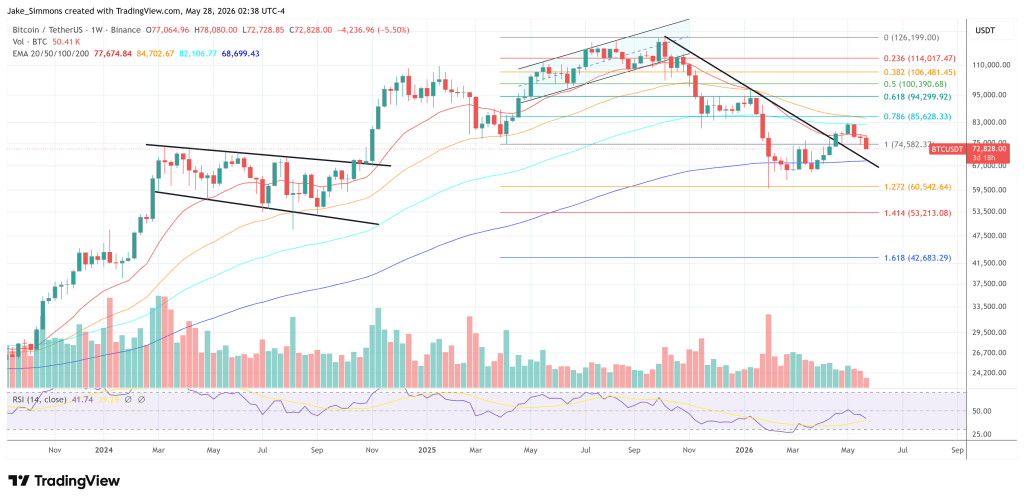
Bitcoin falls below the 1.0 Fib again, 1-week chart | Source: BTCUSDT on TradingView.com

Trending Cryptos

Related Questions

QWhat is the unusual Bitcoin transaction described in the article, and why is it puzzling?

AThe transaction involved five addresses sending approximately 107 BTC (worth about $8.3 million) to an old burn address, making the coins provably unspendable. This is puzzling because it represents a deliberate destruction of a large amount of value, raising the question of why someone would do this instead of selling, moving, donating, or simply holding the assets.

QWhat makes the specific burn address used in the transaction uniquely unspendable?

AThe burn address (1111111111111111111114oLvT2) corresponds to a Hash160 value of twenty zero bytes. Spending coins from it would require finding a public key whose Hash160 is all zeros, which Galaxy Research describes as computationally out of reach. This is different from a transfer to a lost wallet, as it was designed from the start to be unspendable.

QWhat were some of the theories proposed by Galaxy Research to explain why someone might burn $8.3 million in Bitcoin?

AGalaxy proposed several theories: 1) A tax-loss motivation, though this is weak if the Bitcoin was acquired long ago. 2) Religious reasons involving renouncing possessions. 3) The coins were tied to illicit activity with no viable laundering path. 4) Coercion or duress forcing the destruction. 5) An automated error, such as an agentic system confusing a real counterparty with the burn address labeled 'Countparty'.

QWhich theory did Galaxy Research consider 'perhaps among the most likely'?

AGalaxy Research considered the automated error theory as perhaps among the most likely. They suggested a scenario where an agentic trading system, instructed to send Bitcoin to a new counterparty, accidentally sent it to the burn address (known historically as a 'Countparty' burn mechanism) due to a typo-like confusion.

QAccording to the article, what key distinction did Galaxy make between destroying assets and giving them away?

AThe key distinction is that a donation or transfer moves wealth to another party, while a burn removes it from circulation entirely. This matters because destroying assets, unlike giving them away, eliminates the value completely rather than redistributing it.

Related Reads

STAR 50 Soars 10.73%, Why Did A-Shares Stage a "V-Shaped Reversal"?

After a prolonged decline, the Chinese A-share market staged a strong rally on July 21. The STAR 50 index surged 10.73%, its largest single-day gain in nearly a year, leading a broad-based "V-shaped" reversal. The Shanghai Composite Index rose 1.79%, the Shenzhen Component Index gained 4.81%, and the ChiNext Index jumped 7.05%. Total market turnover reached 2.97 trillion yuan, an increase of 256.1 billion yuan from the previous session, with over 3,100 stocks advancing. The semiconductor sector spearheaded the rebound, with related ETFs posting significant gains. Analysts attribute the surge to three converging factors. First, coordinated capital inflows from "national team" institutions, insurance funds, listed company buybacks, and fund house self-purchases have bolstered market liquidity and confidence. Second, supportive policy signals, including commitments from regulators to ensure stable market operations, provided a favorable backdrop. Third, a stabilization and recovery in overseas markets, notably South Korea, created a positive external environment. Institutions suggest the most severe panic selling phase for the tech sector has likely passed, following a significant digestion of crowded positions and leveraged funds. While short-term volatility may persist, the medium to long-term outlook remains underpinned by enduring trends like AI computing demand expansion and semiconductor localization. The market's focus now shifts to the sustainability of supportive fund flows, earnings reports, and upcoming catalysts from the global AI industry chain.

marsbit3m ago

STAR 50 Soars 10.73%, Why Did A-Shares Stage a "V-Shaped Reversal"?

marsbit3m ago

U.S. Tech Momentum Stocks Post Largest Single-Day Gain Ever, But Is the Plunge Over?

US tech momentum stocks staged a sharp rebound on Tuesday (July 21st). Morgan Stanley's TMT Momentum Factor surged over 12%, marking its largest single-day gain on record, exceeding even peaks from the 2000 dot-com bubble. Key momentum indices from Goldman Sachs also posted their strongest daily performances in years. The rally was led by semiconductors, with the Philadelphia Semiconductor Index jumping 4.6%. This rebound followed three consecutive down days and a cumulative 33% plunge in momentum stocks, one of the steepest drawdowns since the dot-com era. Analysts attribute the surge largely to a short squeeze. Heavy selling had pushed high-beta momentum stocks into deeply oversold territory, forcing many short sellers, particularly in Asia, to cover their positions, creating a self-reinforcing buying spiral. However, the rebound's internals appear weak. Trading volume was notably low, and advancing stocks still lagged decliners on the S&P 500, indicating a narrow, concentrated rally rather than broad market participation. Diverging views emerge on the outlook. BTIG warns the bounce has hit key resistance and recommends selling into strength, citing extreme volatility and historical parallels to past market tops. Conversely, Goldman Sachs and UBS believe the momentum unwind is nearing its end, suggesting it may be time to gradually add exposure, as positioning has been significantly reduced. They caution, however, that high volatility warrants a measured approach, potentially using defined-risk strategies. The upcoming earnings season, particularly reports from major tech firms like Alphabet, is seen as a critical test for the rally's sustainability. Simultaneously, bond markets flashed a warning, with yields rising partly due to spiking oil prices. Analysts note that if long-term Treasury yields break decisively higher, it could pose a significant headwind for equities, especially growth stocks.

marsbit10m ago

U.S. Tech Momentum Stocks Post Largest Single-Day Gain Ever, But Is the Plunge Over?

marsbit10m ago

U.S. Tech Momentum Stocks Record Largest Single-Day Gain Ever, but Has the Rout Ended?

U.S. tech momentum stocks staged a dramatic rebound on Tuesday, July 21st. Key momentum indices like the Morgan Stanley TMT Momentum Factor and Goldman Sachs' High Beta Momentum Long Index posted historic or near-historic single-day gains, fueled largely by semiconductor stocks. This sharp rally followed a severe three-day sell-off that saw momentum stocks plunge 33%, marking one of the steepest pullbacks since the dot-com bubble. Analysts attribute the bounce primarily to a short squeeze, as forced covering from over-leveraged traders, particularly in Asia, created a buying spiral. However, the rally's health is questioned due to weak market breadth—overall trading volume was low, and decliners outnumbered advancers in the S&P 500 despite the index's gain—suggesting a narrow, concentrated surge rather than broad recovery. Opinions on the sustainability diverge. BTIG strategists warn the rebound has hit key resistance levels, citing extreme volatility and historic stock dispersion as signs of an ongoing broader correction, and recommend selling into strength. Conversely, Goldman Sachs and UBS view the aggressive momentum unwinding as nearing its end, noting reduced positioning and a lack of new fundamental catalysts. They suggest the sell-off presents a selective opportunity to add exposure, albeit cautiously and gradually using defined-risk strategies. The immediate trajectory hinges on the ongoing earnings season, with market focus on Alphabet's capital expenditure guidance for AI investment clarity. Meanwhile, bond markets present a risk, with rising Treasury yields—potentially heading toward 5.5%—and widening credit spreads for mega-cap tech companies posing a threat to equity valuations. The combination of technical factors, earnings results, and macro conditions leaves the durability of the rebound in doubt.

链捕手13m ago

U.S. Tech Momentum Stocks Record Largest Single-Day Gain Ever, but Has the Rout Ended?

链捕手13m ago

Long-Divided Must Unite, Long-United Must Divide: When L1 Becomes Its Own Rollup, What Is Ethereum's Endgame?

"The Inevitable Cycle: When L1 Becomes Its Own Rollup – What is Ethereum's Endgame?" For years, the Ethereum community grappled with concerns that L2s were fragmenting the ecosystem and eroding L1's value. While L2s provided cheaper execution, they also splintered liquidity and the unified user experience of a single chain. This has prompted a fundamental reassessment of the relationship between L1 and L2. Ethereum's roadmap is evolving. The "Scale" initiative merges L1 and L2 expansion into a holistic framework. L1 itself is advancing with higher gas limits, statelessness, and zkEVM verification, no longer content to be just a low-throughput settlement layer. Consequently, the primary value proposition of L2s is shifting from merely providing cheap blockspace to offering L1 cannot easily provide: application-specific optimizations, privacy features, and flexible governance models. L2s are becoming a spectrum of execution environments with varying degrees of security inheritance from Ethereum. A critical challenge in this multi-chain future is interoperability. The vision is to make Ethereum "feel like one chain again." This relies on advancements in native account abstraction (like EIP-7702) and intent-based architectures (Open Intents Framework), where users declare desired outcomes, and solvers handle the complex cross-chain execution. Furthermore, shortening Ethereum's finality time from minutes to seconds is crucial, as it underpins trust between chains for bridges, stablecoins, and cross-chain applications. Perhaps the most provocative idea is that Ethereum L1 itself could become a form of "its own Rollup." As zkEVM and proof systems mature, high-performance nodes could execute transactions and generate validity proofs. Regular validators would then verify these proofs instead of re-executing all transactions. This blurs the traditional L1/L2 hierarchy, making "Rollup" more of a general execution-verification architecture. Native Rollup aims to integrate L2 validation more directly into the Ethereum protocol, allowing L2s to inherit L1's security more fully and move away from reliance on security councils. In the end, L2s are not destined to replace L1 or be made obsolete by it. The likely future is a unified system where diverse execution environments—each optimized for specific use cases like DeFi, gaming, or privacy—coexist. They will share a common foundation of security, liquidity, and verifiable state, seamlessly connected to restore a cohesive user experience. The next phase for Ethereum is not just about scaling through separation, but about intelligently reintegrating what was separated back into a coherent whole.

链捕手29m ago

Long-Divided Must Unite, Long-United Must Divide: When L1 Becomes Its Own Rollup, What Is Ethereum's Endgame?

链捕手29m ago

Trading

Spot

Hot Articles

What is $BITCOIN

DIGITAL GOLD ($BITCOIN): A Comprehensive Analysis Introduction to DIGITAL GOLD ($BITCOIN) DIGITAL GOLD ($BITCOIN) is a blockchain-based project operating on the Solana network, which aims to combine the characteristics of traditional precious metals with the innovation of decentralized technologies. While it shares a name with Bitcoin, often referred to as “digital gold” due to its perception as a store of value, DIGITAL GOLD is a separate token designed to create a unique ecosystem within the Web3 landscape. Its goal is to position itself as a viable alternative digital asset, although specifics regarding its applications and functionalities are still developing. What is DIGITAL GOLD ($BITCOIN)? DIGITAL GOLD ($BITCOIN) is a cryptocurrency token explicitly designed for use on the Solana blockchain. In contrast to Bitcoin, which provides a widely recognized value storage role, this token appears to focus on broader applications and characteristics. Notable aspects include: Blockchain Infrastructure: The token is built on the Solana blockchain, known for its capacity to handle high-speed and low-cost transactions. Supply Dynamics: DIGITAL GOLD has a maximum supply capped at 100 quadrillion tokens (100P $BITCOIN), although details regarding its circulating supply are currently undisclosed. Utility: While precise functionalities are not explicitly outlined, there are indications that the token could be utilized for various applications, potentially involving decentralized applications (dApps) or asset tokenization strategies. Who is the Creator of DIGITAL GOLD ($BITCOIN)? At present, the identity of the creators and development team behind DIGITAL GOLD ($BITCOIN) remains unknown. This situation is typical among many innovative projects within the blockchain space, particularly those aligning with decentralized finance and meme coin phenomena. While such anonymity may foster a community-driven culture, it intensifies concerns about governance and accountability. Who are the Investors of DIGITAL GOLD ($BITCOIN)? The available information indicates that DIGITAL GOLD ($BITCOIN) does not have any known institutional backers or prominent venture capital investments. The project seems to operate on a peer-to-peer model focused on community support and adoption rather than traditional funding routes. Its activity and liquidity are primarily situated on decentralized exchanges (DEXs), such as PumpSwap, rather than established centralized trading platforms, further highlighting its grassroots approach. How DIGITAL GOLD ($BITCOIN) Works The operational mechanics of DIGITAL GOLD ($BITCOIN) can be elaborated on based on its blockchain design and network attributes: Consensus Mechanism: By leveraging Solana’s unique proof-of-history (PoH) combined with a proof-of-stake (PoS) model, the project ensures efficient transaction validation contributing to the network's high performance. Tokenomics: While specific deflationary mechanisms have not been extensively detailed, the vast maximum token supply implies that it may cater to microtransactions or niche use cases that are still to be defined. Interoperability: There exists the potential for integration with Solana’s broader ecosystem, including various decentralized finance (DeFi) platforms. However, the details regarding specific integrations remain unspecified. Timeline of Key Events Here is a timeline that highlights significant milestones concerning DIGITAL GOLD ($BITCOIN): 2023: The initial deployment of the token occurs on the Solana blockchain, marked by its contract address. 2024: DIGITAL GOLD gains visibility as it becomes available for trading on decentralized exchanges like PumpSwap, allowing users to trade it against SOL. 2025: The project witnesses sporadic trading activity and potential interest in community-led engagements, although no noteworthy partnerships or technical advancements have been documented as of yet. Critical Analysis Strengths Scalability: The underlying Solana infrastructure supports high transaction volumes, which could enhance the utility of $BITCOIN in various transaction scenarios. Accessibility: The potential low trading price per token could attract retail investors, facilitating wider participation due to fractional ownership opportunities. Risks Lack of Transparency: The absence of publicly known backers, developers, or an audit process may yield skepticism regarding the project's sustainability and trustworthiness. Market Volatility: The trading activity is heavily reliant on speculative behavior, which can result in significant price volatility and uncertainty for investors. Conclusion DIGITAL GOLD ($BITCOIN) emerges as an intriguing yet ambiguous project within the rapidly evolving Solana ecosystem. While it attempts to leverage the “digital gold” narrative, its departure from Bitcoin's established role as a store of value underscores the need for a clearer differentiation of its intended utility and governance structure. Future acceptance and adoption will likely depend on addressing the current opacity and defining its operational and economic strategies more explicitly. Note: This report encompasses synthesised information available as of October 2023, and developments may have transpired beyond the research period.

970 Total ViewsPublished 2025.05.13Updated 2025.05.13

What is $BITCOIN

Discussions

Welcome to the HTX Community. Here, you can stay informed about the latest platform developments and gain access to professional market insights. Users' opinions on the price of BTC (BTC) are presented below.

活动图片