Stanford HAI (Human-Centered Artificial Intelligence Institute) has just released the 2026 AI Index Report, the most authoritative annual check-up for the AI field. Over the past year, Stanford researchers, through a series of observations, reached a core conclusion: AI is being adopted globally at a pace surpassing that of the PC and the internet, but human society's institutions, job markets, and measurement tools are lagging behind comprehensively.
AI is sprinting, while humanity is still looking for its shoes. Ten charts show you where AI is running faster than humans.
1
The Tests Used to Measure AI Are Themselves Useless
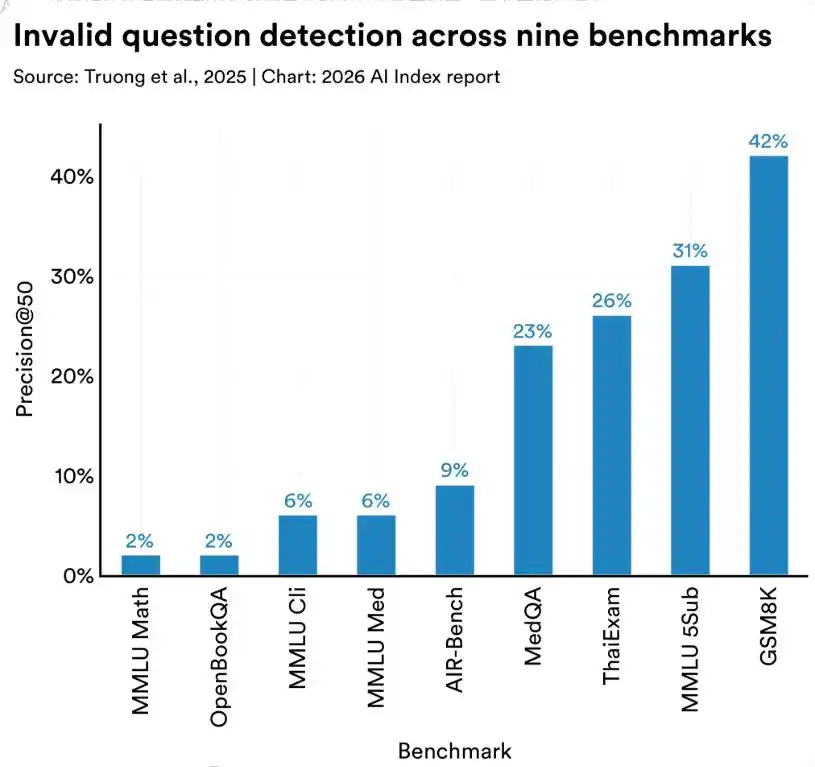
Headlines like "AI Surpasses Humans" are all based on the credibility of benchmarks. But the Stanford report found that nearly 42% of the questions in the widely used math benchmark GSM8K are invalid. Other tests are also suspected of being "gamed"; models can score high after being trained on the test data, but that doesn't mean they've gotten smarter. Many companies refuse to disclose relevant benchmark results. Gil, one of the report's authors, said: "The refusal to disclose results might itself say something."
2
The Substantial US-China Gap Disappeared, Only 2.7% Difference
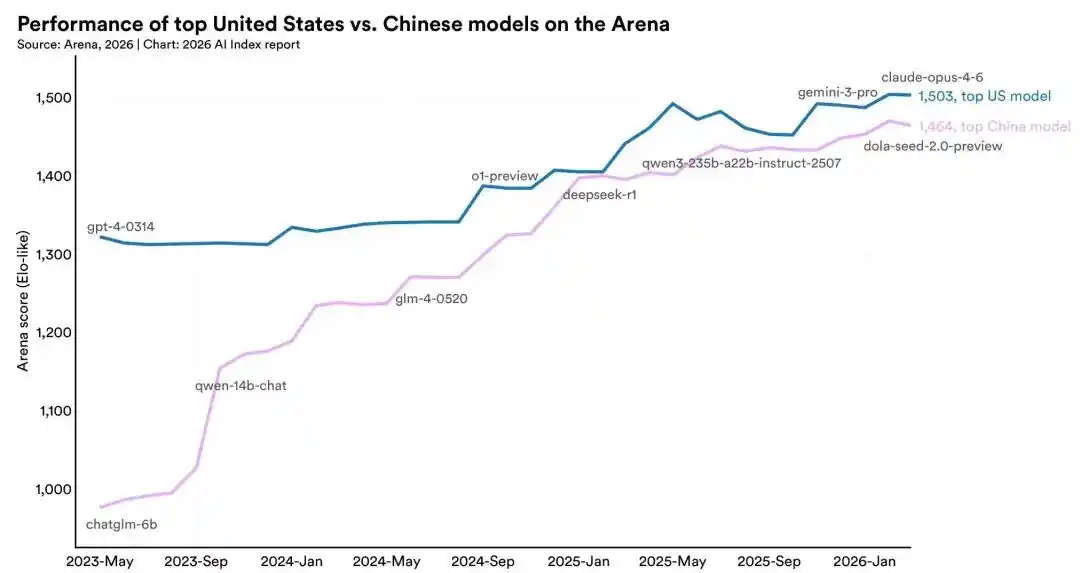
As of March 2026, the Elo rating of the US's strongest model, Claude Opus 4.6, is 1503, with China's strongest model close behind, a gap of only 2.7%. Over the past year, the models from the two countries have taken the lead multiple times. In February 2025, DeepSeek R1 once caught up to the US's strongest model.
However, the AI advantages of the two countries are completely different. The US has stronger models, more capital, and owns 5,427 data centers, more than 10 times that of any other country. China leads in AI research papers, patents, and robot deployment. Simply put, the US wins in computing power and money, China wins in research and manufacturing.
3
Frontier Models Converge, Intelligence Levels Comparable
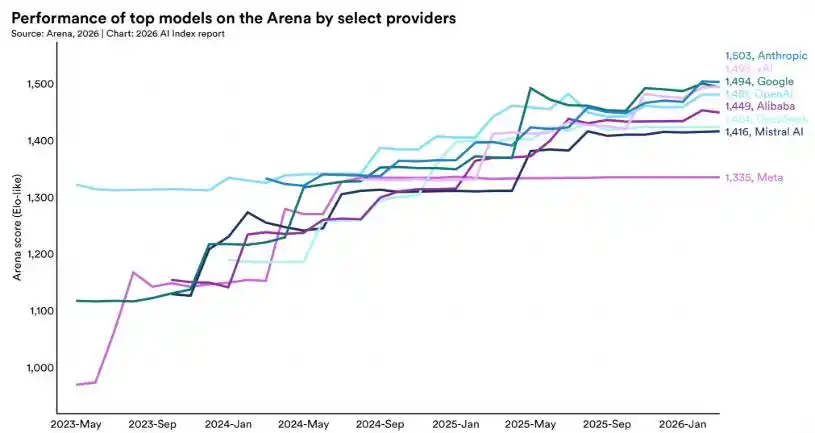
As of March 2026, Anthropic (1503), xAI (1495), Google (1494), and OpenAI (1481) are squeezed into an extremely narrow range. This means "whose model is stronger" is no longer the focus of competition. The focus of competition is shifting to cost, reliability, and optimization for specific domains—this also explains why Anthropic is working on Advisor Tools (to reduce costs), Google is buying Wiz (cloud security), and OpenAI is buying various application-layer companies (to expand scenarios). As the models' own performance converges in intelligence, differentiation must be created elsewhere.
4
Employment for 22-25 Year Old Developers Drops Nearly 20%
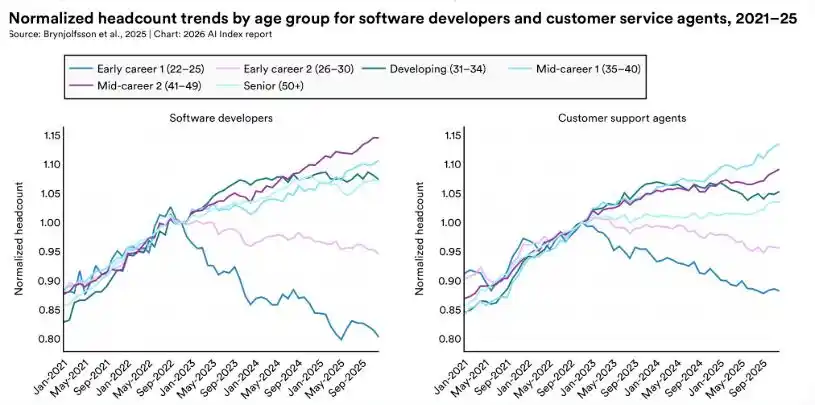
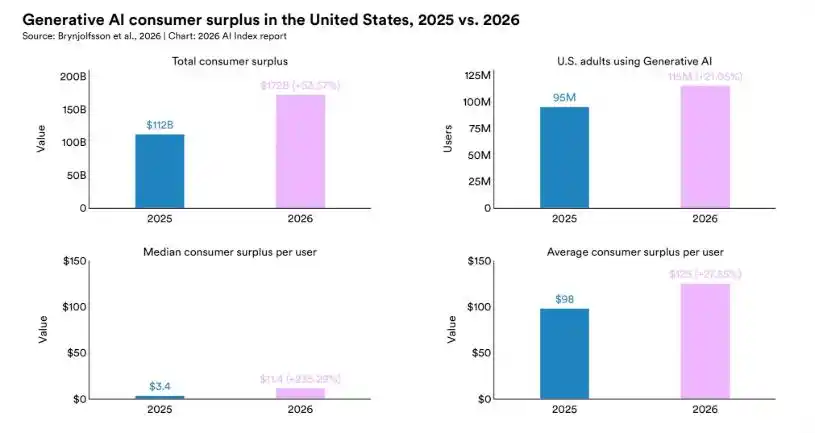
Generative AI achieved an adoption rate of over 53% at the population level within three years, and 88% of organizations are already using AI. But the employment impact is not even. A 2025 study by Stanford economists found that employment of software developers aged 22-25 has fallen by nearly 20% since 2022, while older demographics are still growing. A McKinsey 2025 survey showed that 1/3 of organizations expect to reduce staff due to AI in the next year, with cuts concentrated in service operations, supply chain, and software engineering.
Overall data does not yet show mass unemployment, but this is enough to show that the job market is like a frog in slowly heating water; the crisis is growing gradually.
5
Adoption Speed Surpasses PC and Internet, US Ranks Only 24th
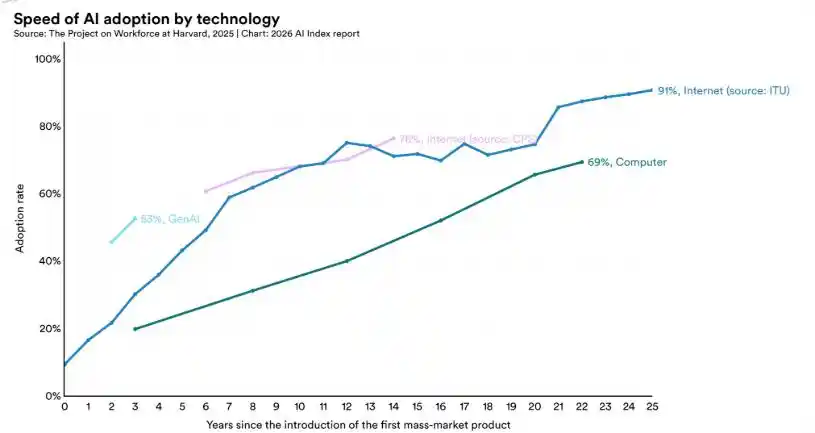
Generative AI reached a 53% population-level adoption rate within three years, a speed that surpassed the personal computer and the internet. But the most counterintuitive data point is: The US leads the world in AI investment and model development, but its population adoption rate is only 28.3%, ranking 24th globally. UAE 64%, Singapore 60.9%. The country that spends the most, uses it the least.
6
Global AI Investment $581.7B, US is 23 Times China's, But...
Global corporate AI investment reached $581.7 billion in 2025, a year-on-year increase of 129.9%. US private AI investment was $285.9 billion, 23 times that of China and 48.5 times that of the UK. California alone accounts for over 75% of the US total. Large deals are also dense: OpenAI raised $40 billion, valuation $300 billion; Anthropic raised $13 billion, valuation $183 billion; Cursor raised $2.3 billion at a $29.3 billion valuation.
However, there is a hidden piece of information: Domestically (in China), state-owned funds injected approximately $184 billion into AI companies between 2000 and 2023; this money was not counted in the private investment statistics. Adding this part, the funding gap between the US and China might be much smaller than the numbers on paper suggest.
7
AI Agent: From Chatting to Doing, But Still Has 1/3 Failure Rate
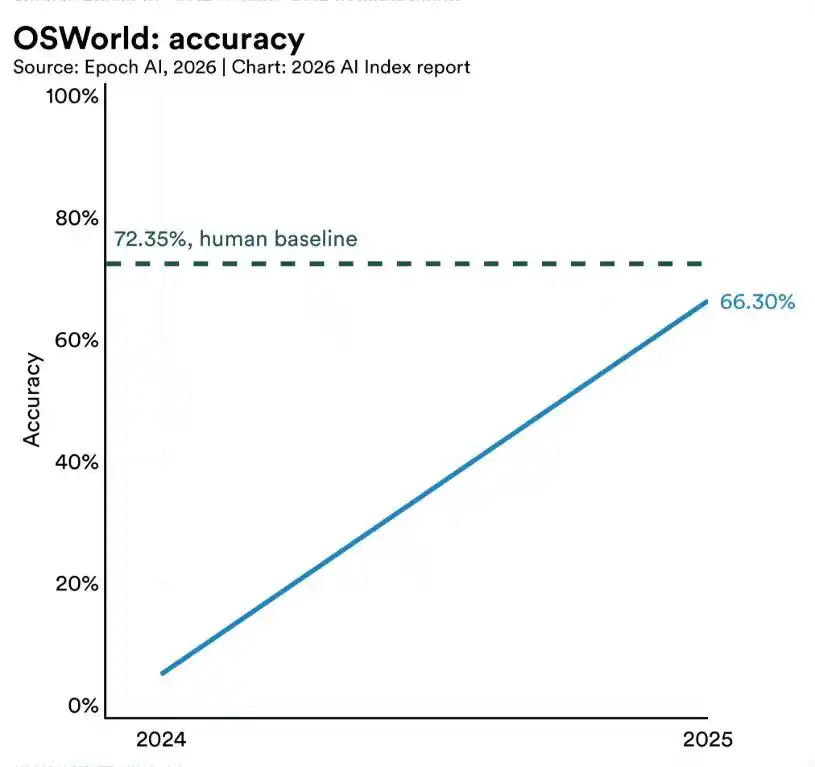
2025 was the year of the AI Agent. Accuracy on OSWorld (testing AI's ability to complete tasks on an operating system) soared from 12% to 66.3%, only 6 percentage points away from human performance. WebArena reached 74.3%, Cybench (cybersecurity tasks) surged from 15% to 93%.
But overall, Agents still have about a 1/3 failure rate. And actual enterprise deployment is still in the single digits—in most business scenarios, over 2/3 of respondents said they do not use AI Agents at all. There is still a big gap between progress on benchmarks and actual deployment.
8
89% of Robots Live in the Lab
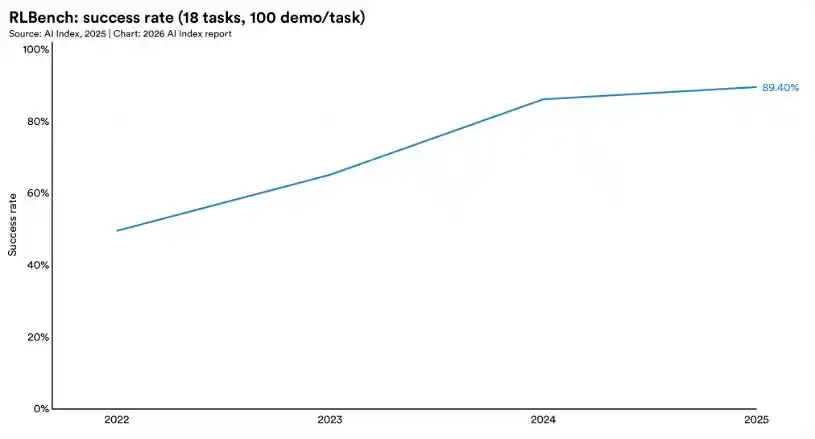
AI is already very strong in the virtual world, but still very weak in the physical world. The success rate for robot manipulation in software simulation environments is 89.4%, but the success rate for real-world household tasks is only 12.4%. One is a clean lab, the other is a messy home; in the latter kind of real environment, robot participation is still negligible.
However, autonomous driving is an exception: Waymo has about 450,000 trips per week, Apollo Go completed about 11 million fully driverless trips in 2025.
9
Experts vs Public: 73% vs 23% Cognitive Divide
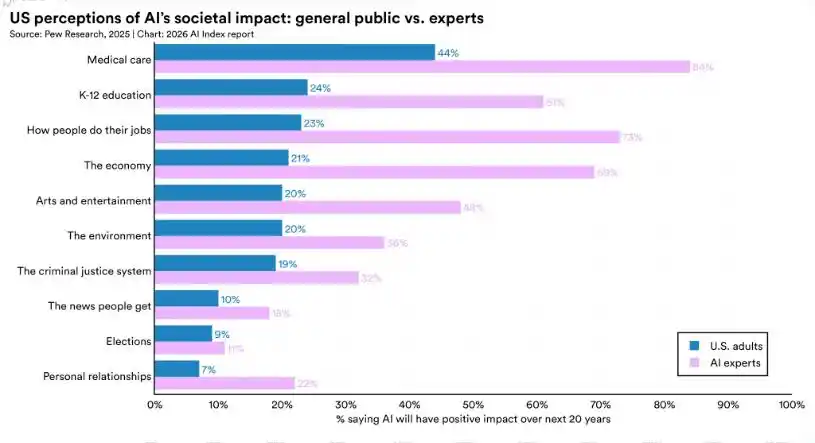
A Pew survey cited in the report reveals a startling divide: 73% of AI experts believe AI will have a positive impact on jobs, but only 23% of the American public thinks so—a complete polarization.
Another interesting data point: Among all countries surveyed, Americans have the lowest trust in government regulation of AI. Experts are also more optimistic about AI's prospects in education and healthcare, but both sides believe AI will harm elections and interpersonal relationships.
10
GPT-4o Uses Water for Over 12M People Annually, Electricity Could Power Entire New York State
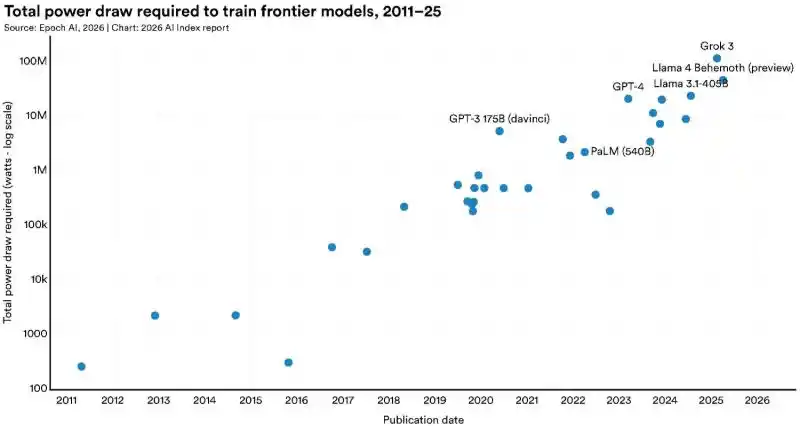
AI's progress comes at an environmental cost. Global AI data centers can now draw 29.6 GW of power, an amount sufficient to power the entire state of New York during peak usage. The annual water consumption of OpenAI's GPT-4o model alone could exceed the drinking water needs of over 12 million people.
These massive consumptions are injected into model training after model training, yet the chip supply chain behind the models is extremely fragile. The US owns most of the world's AI data centers, but almost every cutting-edge AI chip is manufactured by a single company, Taiwan's TSMC. All the computing power, all the investment, all the model progress, is built on this physical foundation.
The above is just the tip of the iceberg of the report, but it is enough to see that we are "embracing" a technology we don't fully understand at the fastest speed in history.
The full report covers more dimensions including AI safety, regulatory dynamics, research trends, and more. Highly recommended for interested friends to read the full original report. Link 👉🏻: https://hai.stanford.edu/ai-index
This article is from the WeChat public account "APPSO", author: APPSO Discovering Tomorrow's Products