Original Author: @BlazingKevin_, Blockbooster Researcher
In the spring of 2026, the U.S. cryptocurrency regulatory framework stands at a historic turning point. The legislative window for the "Clarity Act" (CLARITY Act) is in its final countdown, the compliance requirements of the "GENIUS Act" are profoundly reshaping the stablecoin market structure, and the financial disclosure of Federal Reserve Chair candidate Kevin Warsh, revealing a crypto investment portfolio exceeding $100 million, signals an unprecedented shift in the U.S. monetary policy and digital asset regulatory cognition. These three intertwined threads constitute the most significant institutional variable for the crypto industry in 2026.
We systematically analyze five core issues: 1) The political economy of the CLARITY Act; 2) The prudential regulatory logic and market impact of the GENIUS Act; 3) The essence, compromise, and direction of the stablecoin yield war; 4) The interest structure of the four-party game; 5) The global chain reaction of passage or failure—aiming to provide a comprehensive analytical map for researchers, practitioners, and policy observers.
Three Key Conclusions
1 A Window Not to Be Missed: If the CLARITY Act fails to be marked up by the Senate Banking Committee by the end of April, its probability of passing in 2026 plummets to a very low level. The bill could be shelved for up to four years, during which the global crypto regulatory competitive landscape would solidify without U.S. participation.
2 Compliance as Core Competitiveness: The AML/CFT mandatory requirements of the GENIUS Act will inevitably drive the stablecoin market towards concentration among leading compliant enterprises. USDC and Tether's newly launched USAT will be the biggest beneficiaries, while USDT's space in the U.S. institutional market will be structurally compressed.
3 A Generational Leap in Regulatory Cognition: Officials like Kevin Warsh, with deep crypto investment backgrounds, if they lead the Federal Reserve, will bring about the most digital asset-friendly macro policy environment to date—not just regulatory loosening, but a strategic acceptance of crypto assets into mainstream financial infrastructure.
1 Background: From Regulatory Vacuum to Legislative Endgame
1.1 Historical Roots of Regulatory Chaos
Over the past decade, U.S. crypto regulation has been mired in deep structural dilemmas: the SEC强行 applied the securities framework of the "Howey Test," the CFTC advocated for commodity attributes, and the模糊 regulatory boundaries between the two agencies left companies unable to determine their own compliance—until they were sued. This "Regulation by Enforcement" model accumulated a large number of legal uncertainties, keeping conservative institutional capital from pension funds, insurance companies, etc., on the sidelines.
1.2 Legislative Evolution: From the GENIUS Act to the CLARITY Act
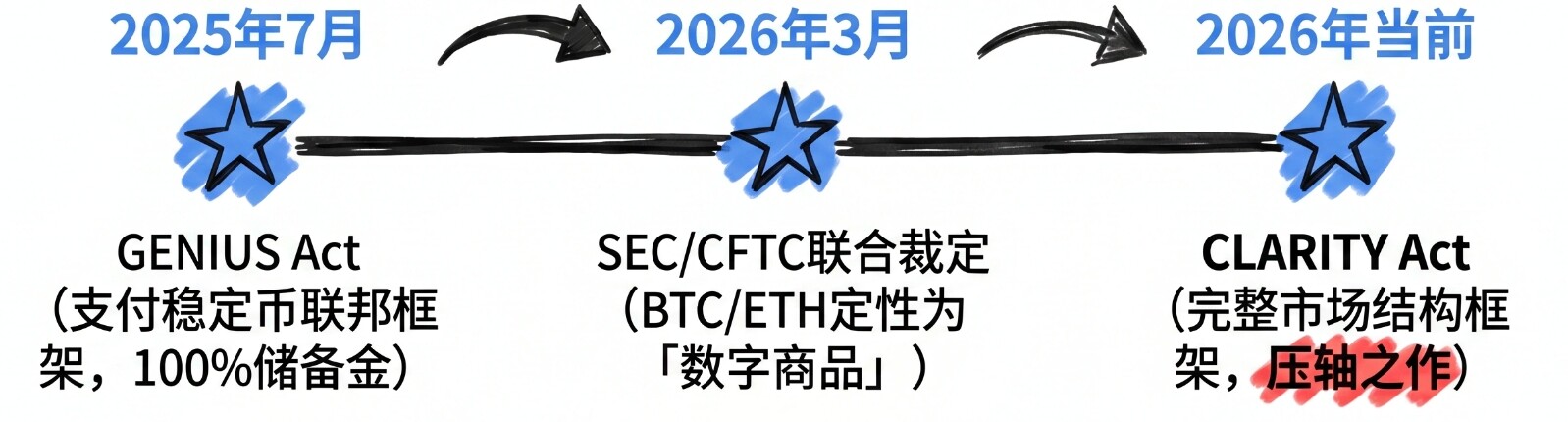
In July 2025, Congress passed the "GENIUS Act," establishing a federal prudential regulatory framework for payment stablecoins for the first time—100% reserve requirements, mandatory AML compliance, OCC oversight. In the same month, the "CLARITY Act" passed the House with strong bipartisan support, 294:134, aiming to establish a market structure framework covering the entire digital asset ecosystem. On March 17, 2026, the SEC and CFTC jointly ruled to formally classify major assets like Bitcoin and Ethereum as "digital commodities," ending years of major jurisdictional disputes. The CLARITY Act is the finale of this series of legislations.
1.3 Why the Time Window is So Scarce
The November 2026 midterm elections constitute the hardest political deadline: if the House changes hands in the election, the pro-crypto Republican legislative coalition collapses, and the political foundation for the CLARITY Act disappears. Senator Lummis gave the most blunt warning on April 11—"Pass it now, or wait until 2030." Senator Moreno further clarified: if the bill cannot reach the full Senate before May, digital asset legislation may not be taken seriously again for years.
JPMorgan's Latest Analysis
"Negotiations have entered the final sprint stage, with contentious points reduced from over a dozen to just two or three."
JPMorgan predicts: If the bill passes in mid-2026, digital asset institutional entry will see a significant acceleration effect in the second half of the year, with pension and insurance funds gaining a clear compliance path.
2 GENIUS Act: Prudential Regulatory Logic and Market Reshaping
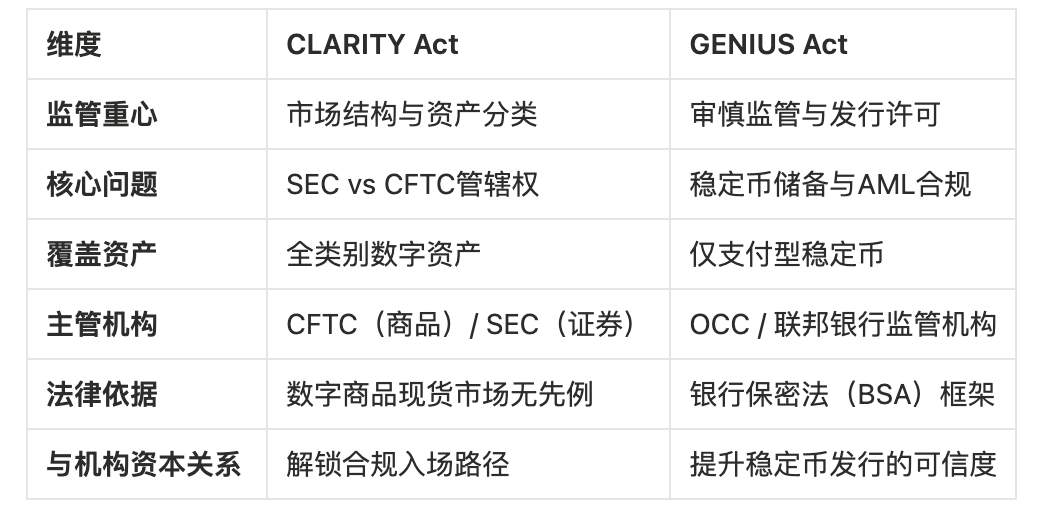
2.1 Regulatory Logic: GENIUS Act vs. CLARITY Act
The regulatory logic of the two acts is fundamentally different. The CLARITY Act focuses on Market Structure, solving asset classification and trading platform regulation issues; while the GENIUS Act focuses on Prudential Regulation, bringing payment stablecoins into a compliance framework similar to banks.
2.2 Compliance Requirements and Market Consolidation Effect
The core of the GENIUS Act is to clearly define stablecoin issuers as "financial institutions" under the Bank Secrecy Act, requiring effective AML/CFT programs, mandatory sanctions compliance systems (Sanctions Compliance Program), 1:1 reserve backing, and strict oversight by federal agencies like the OCC. New rules proposed by FinCEN and OFAC require the establishment of complex technical control systems to freeze or reject non-compliant transactions and conduct independent compliance testing.
These fixed compliance costs—professional AML compliance officers, enterprise-grade monitoring systems, independent audits—create huge barriers to entry for small issuers and will inevitably drive market concentration towards leading compliant enterprises. Forbes analysis pointed out: "Compliance costs will lead to market consolidation."
2.3 Strategic Divergence in the Stablecoin Market
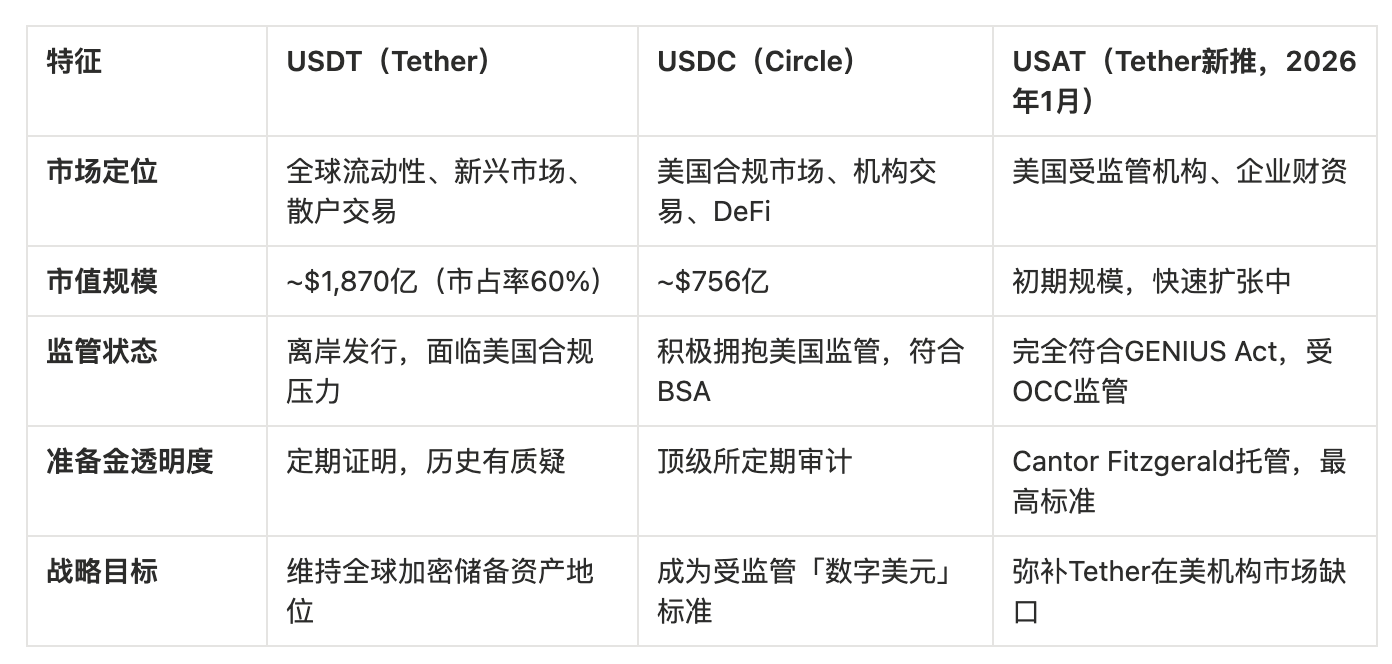
USAT is issued by Anchorage Digital Bank with Cantor Fitzgerald as custodian, fully compliant with the strict standards of the GENIUS Act. Tether uses this highly compliant sub-brand to enter the U.S. institutional market while maintaining USDT's global dominance—a carefully designed "dual-brand two-pronged approach": using USDT to maintain global retail and emerging market liquidity, and using USAT to compete for U.S. institutional funds.
3 The Stablecoin Yield War
3.1 The Essence of the Controversy: Deposit Disintermediation and Spread Competition
The economic core of the stablecoin yield controversy is the deposit disintermediation effect: if holding stablecoins can yield passive income close to short-term Treasury yields (historical range 3.5%–5%), while bank savings account rates are near zero, it creates a strong incentive for capital movement. U.S. Bank CEO Brian Moynihan warned in February 2026 that allowing stablecoin passive yields could trigger "trillion-dollar deposit outflows," threatening the lending capacity of community banks.
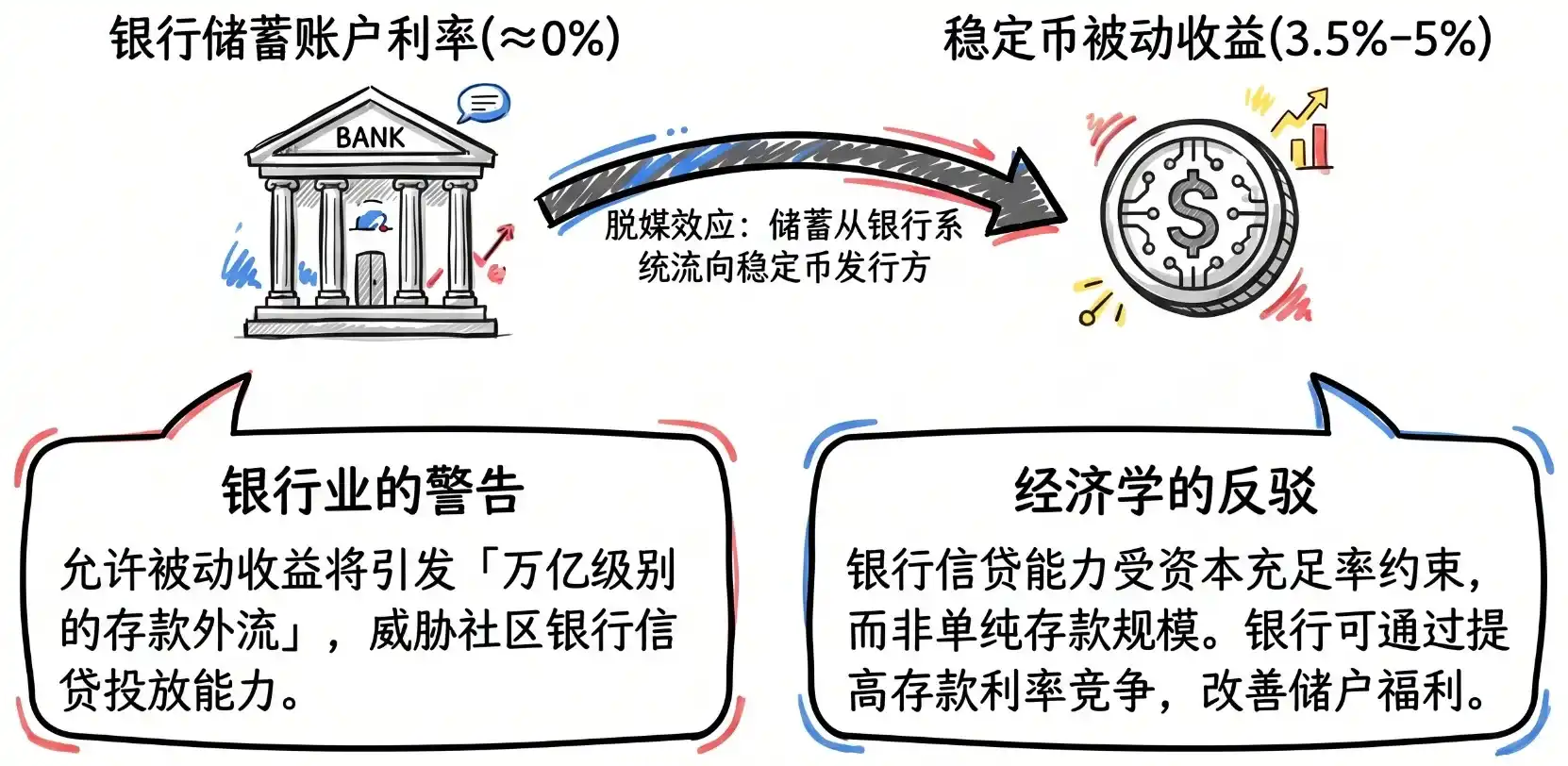
However, a report released by the White House Council of Economic Advisers (CEA) on April 8, 2026, directly challenged the banking industry's argument: a complete ban on stablecoin yields would only increase bank loans by about $2.1 billion (just 0.02%), while simultaneously causing an $800 million net welfare loss for consumers. Even under the most extreme assumptions, the boost to community bank lending is extremely limited. This data report from within the government provided the crypto industry with its most powerful policy lobbying tool.

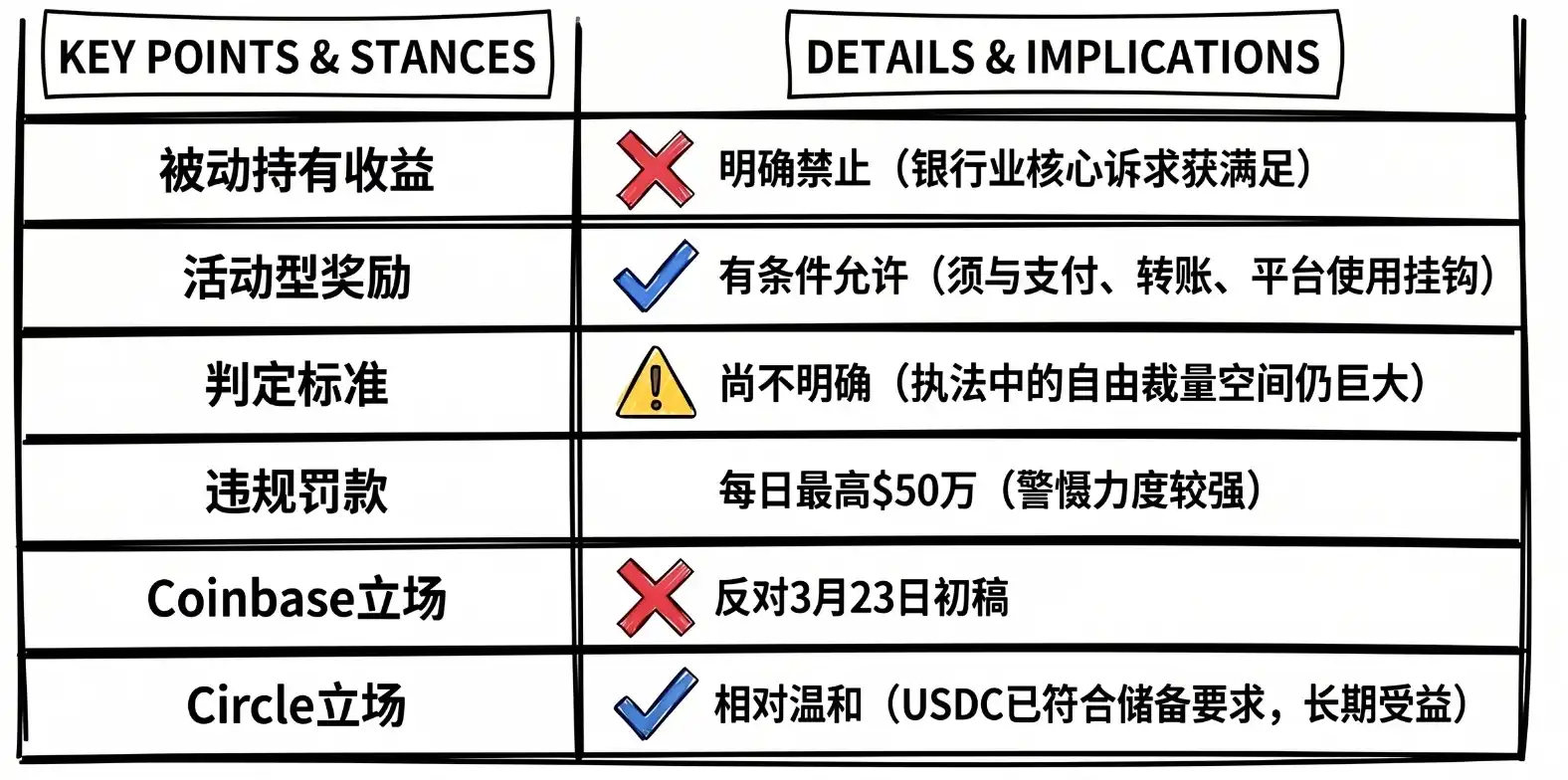
3.2 Full Analysis of the Tillis-Alsobrooks Compromise
On March 20, 2026, Republican Senator Thom Tillis and Democratic Senator Angela Alsobrooks reached a principled compromise, with the core framework as follows:
3.3 Four Unresolved Battlegrounds
- Specific criteria for defining "activity-related" stablecoin rewards: No clear legal or technical precedent exists at the enforcement level to distinguish between "activity-related" and "passive."
- The Fed's veto power over state-chartered issuers: Directly determines whether institutions like USDC can access federal payment rails.
- AML compliance requirements for DeFi: Some Democratic senators worry that non-custodial protocols could become anti-money laundering loopholes.
- Government official conflict-of-interest条款: A hard prerequisite for Democratic cross-party cooperation, directly conflicting with the Trump family's crypto business interests.
4 The Four-Party Game Structure
4.1 Game Map
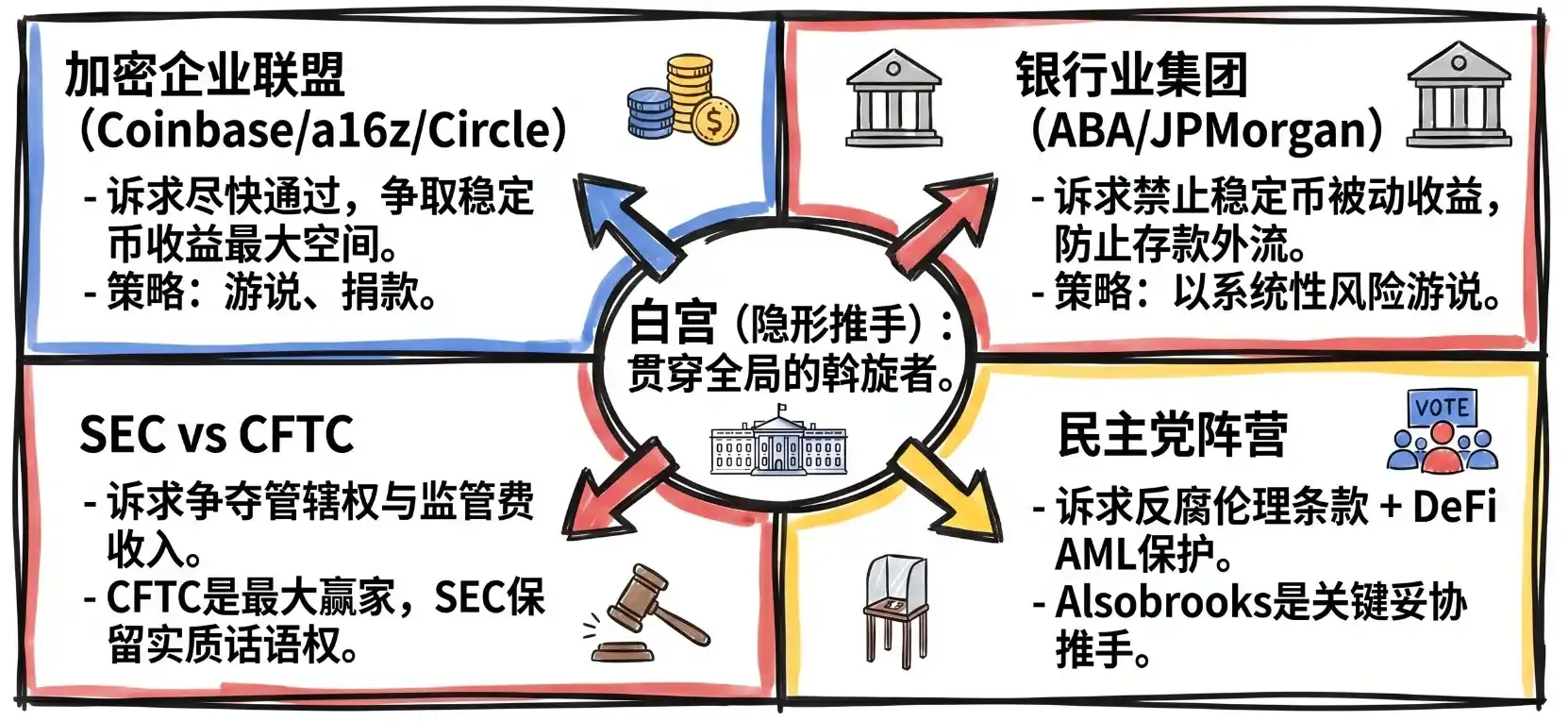
4.2 The White House: The Strongest Invisible Pusher
The Trump administration has positioned the CLARITY Act as the core legislation of its strategy to "make America the global crypto capital," with clear political will. White House Digital Asset Presidential Advisory Committee Executive Director Patrick Witt personally主持 negotiation mediation; Deputy Treasury Secretary Scott Bessent publicly called for rapid progress in the spring of 2026; the White House CEA report proactively provided data ammunition for loosening stablecoin yields.
But the White House faces a dilemma: Accepting the Democrats' presidential holdings ban is akin to admitting the Trump family's business interests pose compliance risks; if rejected, the 60-vote threshold cannot be crossed, and the bill cannot advance regardless.
4.3 Five-Step Legislative Process: Every Step is a Veto Point

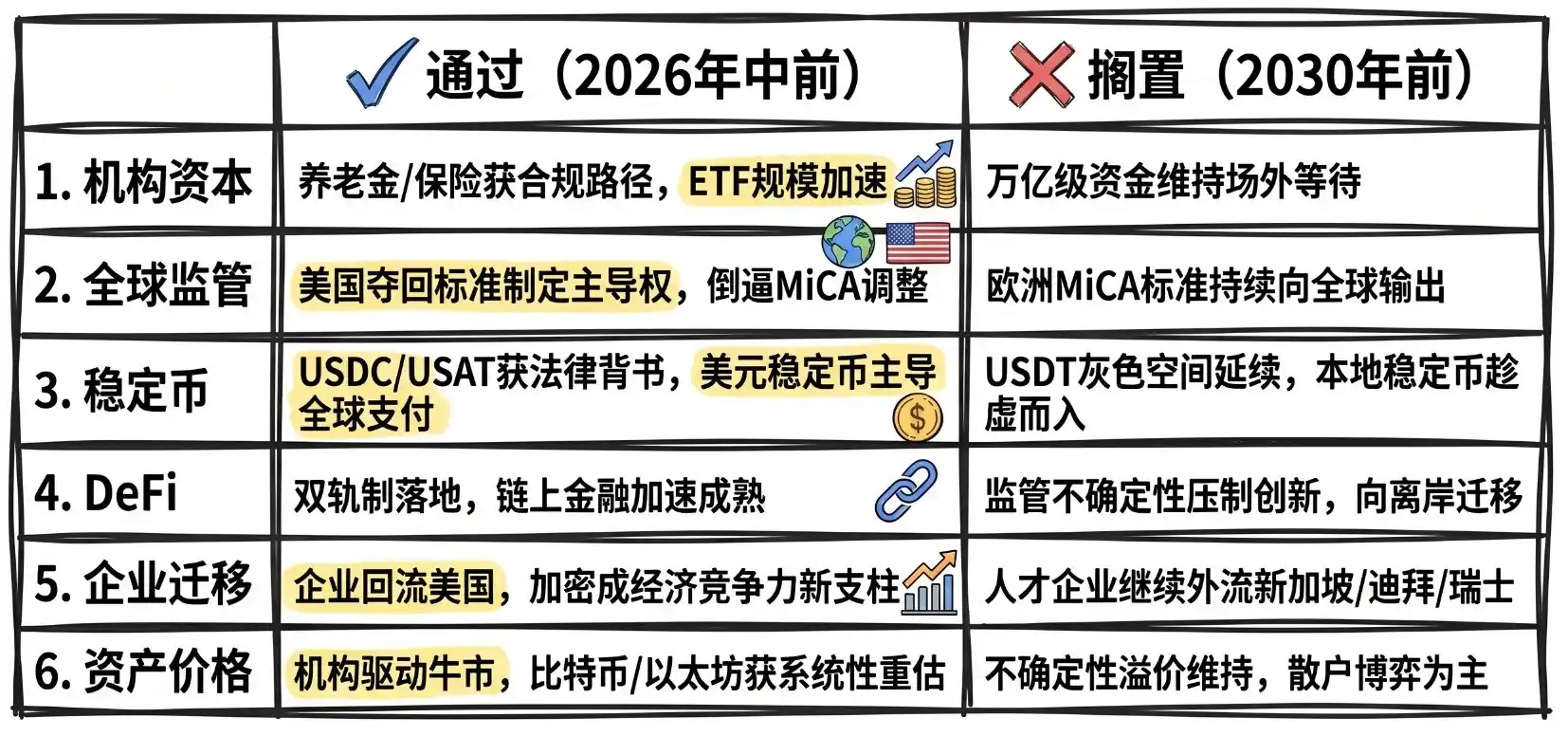
5 Global Impact of Passage or Failure
5.1 Passed vs Shelved: Six-Dimensional Comparison Matrix
5.2 Competitive Landscape with European MiCA
MiCA (Markets in Crypto-Assets Regulation) in the EU came into full effect in early 2025, with about 102 institutions authorized under MiCA, making it the world's most complete crypto regulatory framework. If the CLARITY Act passes, pressure for alignment between U.S. and EU regulatory frameworks increases, and bilateral regulatory recognition negotiations may start. Dollar stablecoins would directly compete with the Euro stablecoin alliance (ING/UniCredit/BNP Paribas, expected launch H2 2026). If shelved, the European MiCA standard will continue to be exported globally without U.S. competitive pressure.
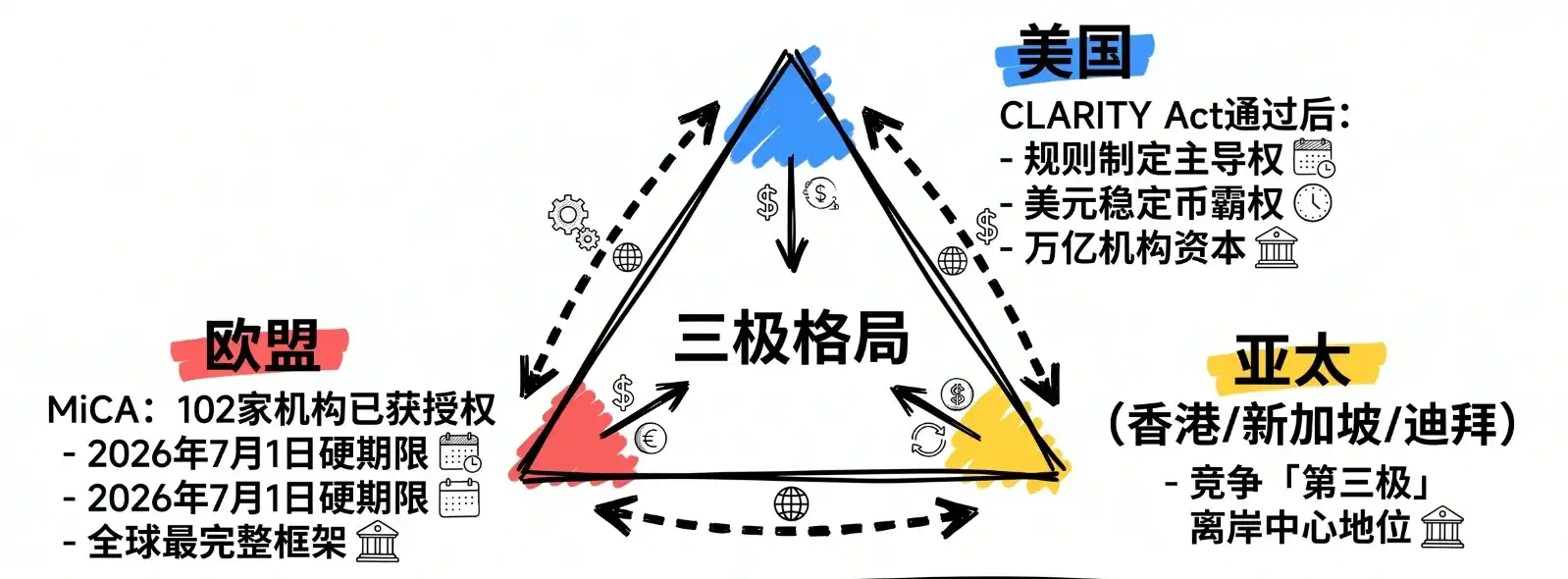
5.3 Tripolar Global Regulatory Competition格局
Global regulatory competition is forming three poles: the U.S. (post-CLARITY Act passage), the EU (MiCA), and Hong Kong/Singapore/Dubai competing for the "third pole" offshore center status. Pakistan formally repealed an 8-year crypto banking ban on April 14, 2026; the UK FCA released a crypto regulatory framework consultation document around the same time, with an authorization window set to open on September 30. If the U.S. is absent, regulatory洼地 in Asia-Pacific will continue to attract corporate and talent outflow.
5.4 Direct Quantitative Impact on Institutional Capital Deployment
Galaxy Research estimates: If the bill fails committee review in April, the probability of passage in 2026 plummets to a very low level. TradingKey analysis指出: "The passage of the bill would unleash trillions of dollars in institutional capital"—conservative institutional investors like pension funds and insurance companies would gain a clear compliance entry path. In 2025, Bitcoin ETFs accumulated over $115 billion in assets, a precursor signal of potentially larger-scale institutional allocation post-CLARITY Act passage.
Conclusion: The New Crypto Order Post-Regulatory Endgame
2026 is a historic watershed for U.S. crypto regulation. Three threads—the legislative endgame of the CLARITY Act, the restructuring of the stablecoin market by the GENIUS Act, and the generational leap in regulatory cognition represented by Warsh—all point in the same direction: cryptocurrency is being pulled from the regulatory grey area into the institutional core of the mainstream financial system.
The scarcity of the legislative window means this game has no second chance. Every participant in the four-party game—crypto firms, banks, regulators, the Democratic camp—is seeking their own path to maximize interests in this limited-time game, and the final compromise text will inevitably be a grey area where "no one is completely satisfied, but everyone can accept it."
For market participants, there is only one core strategic judgment: Regardless of the final form of the bill, compliance capability will become the most important competitive moat in the next five years. In a new crypto market dominated by institutional capital, those who can weather the regulatory cycle will必然 be the pioneers who built their compliance infrastructure提前 amidst institutional uncertainty.
About BlockBooster
BlockBooster is a next-generation alternative asset management firm for the digital age. We use blockchain technology to invest in, incubate, and manage the core assets of the digital era—from blockchain-native projects to real-world assets (RWA). As value co-creators, we are committed to discovering and unleashing the long-term potential of assets, capturing卓越 value for our partners and investors in the wave of the digital economy. Disclaimer: This article/blog is for informational purposes only, represents the author's personal views, and does not represent the position of BlockBooster.
This article is not intended to provide
(i) investment advice or recommendations; (ii) an offer or solicitation to buy, sell, or hold digital assets; or (iii) financial, accounting, legal, or tax advice. Holding digital assets, including stablecoins and NFTs, is highly risky, with significant price volatility, and they could even become worthless. You should carefully consider whether trading or holding digital assets is suitable for you based on your financial situation. Please seek advice from your legal, tax, or investment professional for matters related to specific situations. The information provided herein (including market data and statistics, if any) is for general reference only. Reasonable care has been taken in preparing this data and charts, but no responsibility is accepted for any factual errors or omissions expressed therein.
Related Questions
QWhat is the significance of the April 2026 deadline for the CLARITY Act in the US Senate Banking Committee?
AIf the CLARITY Act does not complete its markup in the Senate Banking Committee by the end of April 2026, its probability of passing that year plummets to a very low level. The bill could be shelved for up to four years, potentially solidifying the global crypto regulatory landscape without significant US participation.
QHow does the GENIUS Act impact the competitive landscape of the stablecoin market?
AThe GENIUS Act's mandatory AML/CFT requirements create high fixed compliance costs, which act as a significant barrier to entry for small issuers. This inevitably drives market consolidation towards large, compliant enterprises, with USDC and Tether's new compliant brand, USAT, positioned as the primary beneficiaries.
QWhat was the core economic concern from the banking industry regarding stablecoin yields, and what was the White House CEA's counter-argument?
ABanking industry leaders, like Bank of America's CEO, warned that allowing passive yields on stablecoins could trigger a 'trillion-dollar deposit outflow,' threatening the lending capacity of community banks. However, a White House Council of Economic Advisors (CEA) report argued that a full ban on such yields would only increase bank loans by approximately $2.1 billion (just 0.02%) while causing an $800 million net welfare loss for consumers, making the threat to community banks' lending capacity extremely limited.
QWhat is the strategic purpose behind Tether's launch of the USAT stablecoin?
ATether's USAT is a highly compliant sub-brand issued by Anchorage Digital Bank and custodied by Cantor Fitzgerald, designed specifically to meet the strict standards of the GENIUS Act. This strategy allows Tether to pursue a 'dual-brand' approach: using USDT to maintain its dominant global liquidity for retail and emerging markets, while using USAT to compete for institutional capital in the US market.
QWhat broader global regulatory competition is highlighted if the CLARITY Act fails to pass?
AIf the CLARITY Act is shelved, a tri-polar global regulatory competition is expected to solidify among the EU (with its already active MiCA framework), the US (if it remains absent), and Asia-Pacific hubs like Hong Kong, Singapore, and Dubai competing to be the 'third pole' offshore center. This could lead to continued brain and business drain from the US to these regulatory havens.





