BTC supply in profit eyes 60%, but analysis hints recovery may ‘roll back over’

cointelegraphPublished on 2026-07-27Last updated on 2026-07-27

Abstract

Bitcoin's overall supply in profit has rebounded sharply, approaching 60% in late July from a 2026 low near 46% in June. However, analysis from CryptoQuant cautions that this recovery remains fragile and not yet a confirmed bull market signal. For a sustained market bottom, key metrics require stronger confirmation: the 30-day average of the Long-Term Holder Spent Output Profit Ratio (LTH-SOPR) must stay above 1, and the supply in profit should exceed 64%. The market has already seen one false breakout in April-June where these conditions briefly met before rolling back over. Currently, the LTH-SOPR average has been below 1 for over 50 days, indicating long-term holders are still moving coins at an aggregate loss—a potential sign of lingering capitulation. While hitting the 50% supply-in-loss mark in June aligned with historical bear market bottoms, the current recovery in profitability lacks the durable onchain support from long-term holders needed to confirm a full trend reversal.

Bitcoin (BTC) investors are back in aggregate profit, but onchain data suggests it’s too early to confirm a new bull market.

Key points:

  • Bitcoin supply profitability is improving, but the trend must prove its staying power before confirming a market recovery, says CryptoQuant.
  • Supply in profit is now approaching 60%, up from its 2026 low near 46% less than a month ago.
  • Long-term holder onchain losses continue to dominate — a caveat in a bullish recovery.

Bitcoin profit metrics risk second false breakout

According to onchain analytics platform CryptoQuant, Bitcoin supply in profit rebounded above the 50% mark in July.
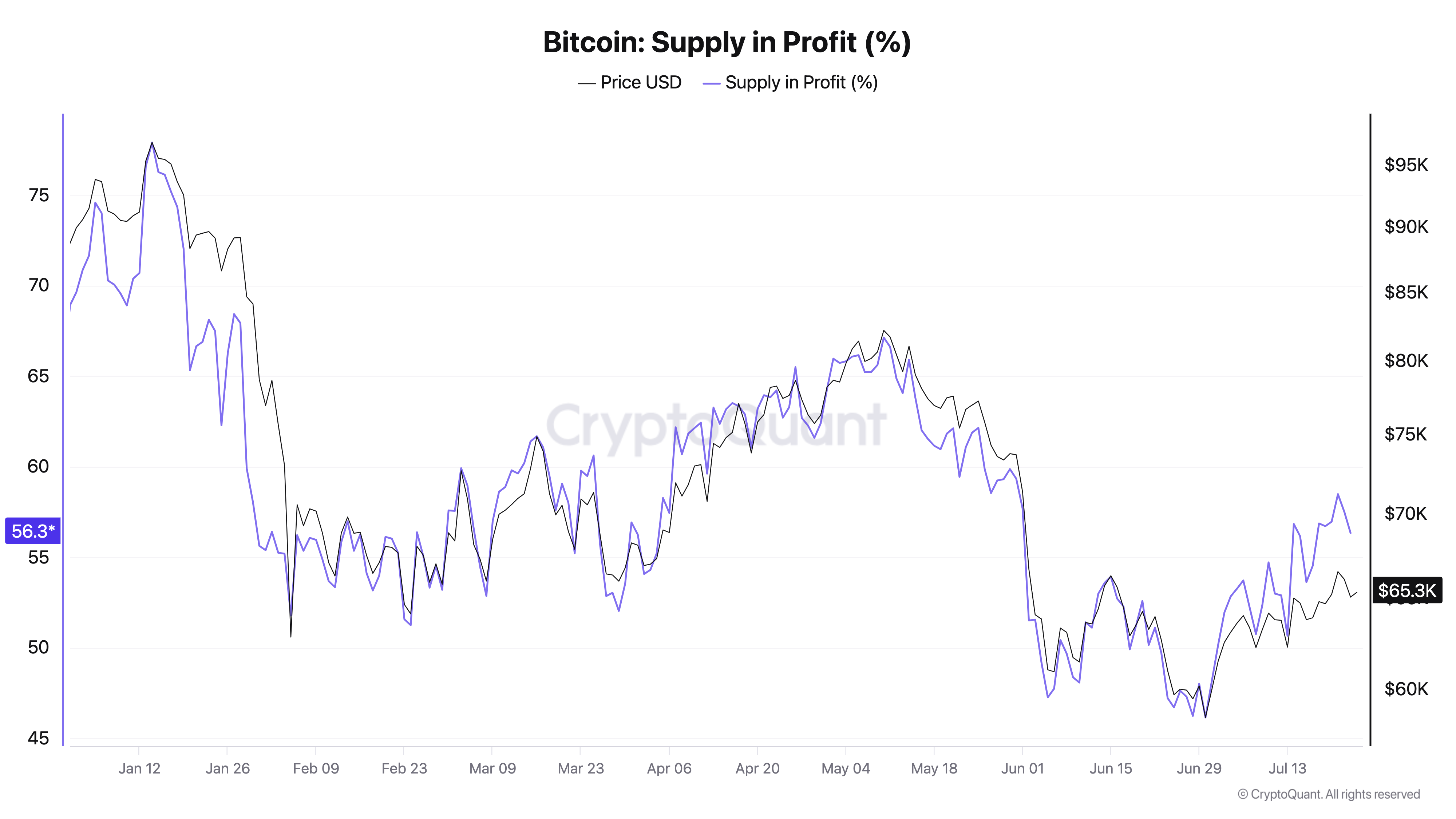
Bitcoin supply in profit. Source: CryptoQuant

“Bitcoin’s Supply in Profit (%), the share of Bitcoin worth more than its acquisition price, has climbed to 57.5% as of July 22, up from 46.2% on June 30, the 2026 low,” CryptoQuant contributor thechessONCHAIN summarized.
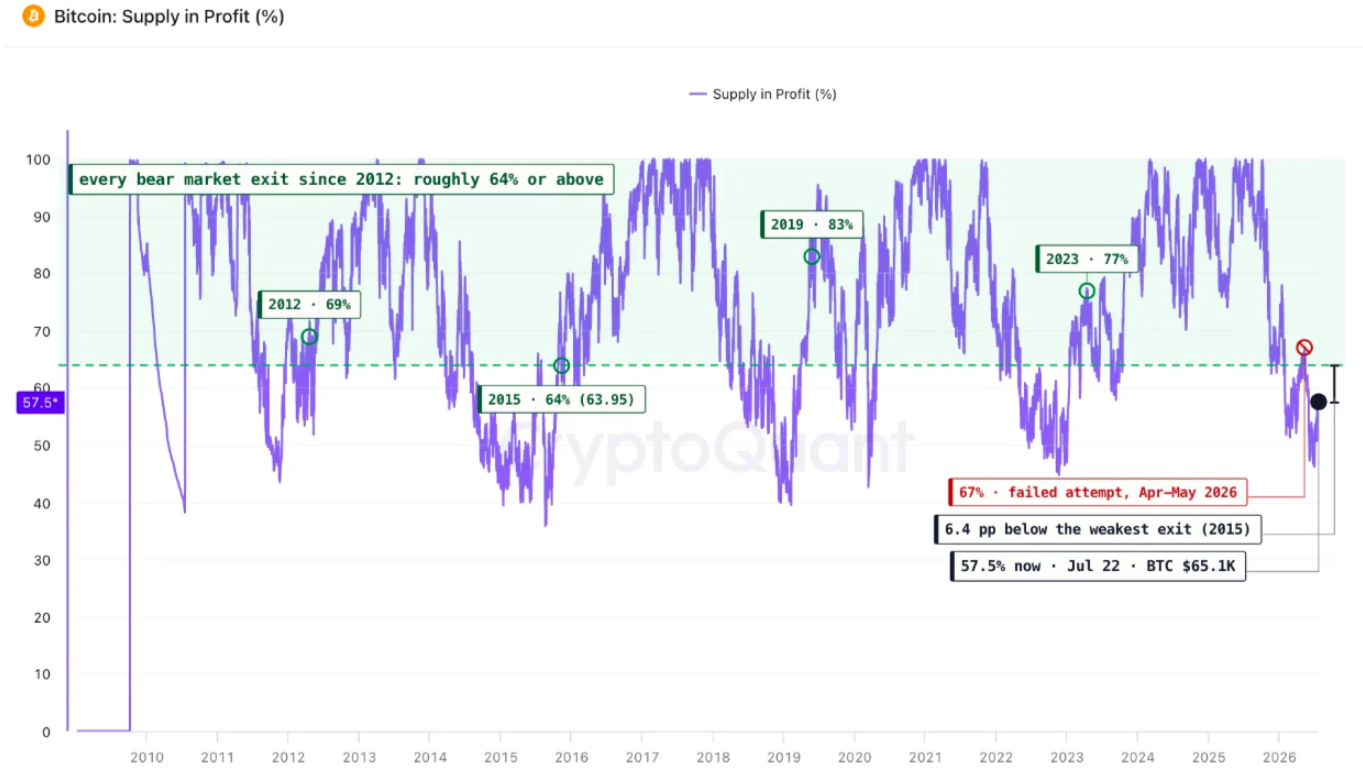
Bitcoin supply in profit data (screenshot). Source: CryptoQuant

With nearly 60% of the BTC supply now in profit, the spent output profit ratio (SOPR) of long-term holders (LTHs) is also improving.

LTHs are entities whose Bitcoin has remained dormant for at least six months. SOPR measures the proportion of LTH coins moving onchain at a higher price relative to their previous transaction. Values above 1 indicate coins moving onchain mostly in profit, while values below 1 indicate LTH investors are moving coins at a loss, potentially indicating capitulatory activity.

ThechessONCHAIN explained that previous bear markets have only ended when both supply in profit and LTH-SOPR meet specific requirements.

The 30-day simple moving average (SMA) of LTH-SOPR should remain above 1 without falling below that level for weeks on end, while total supply in profit should be above 64%.

“This cycle already produced one failed attempt: from April 28 to June 1 the LTH-SOPR average held above 1.0 for 35 days, Supply in Profit reached 67%, and both rolled back over,” TheChessOnChain noted.

Since then, the 30-day SMA of LTH-SOPR has been below 1 for more than 50 days.
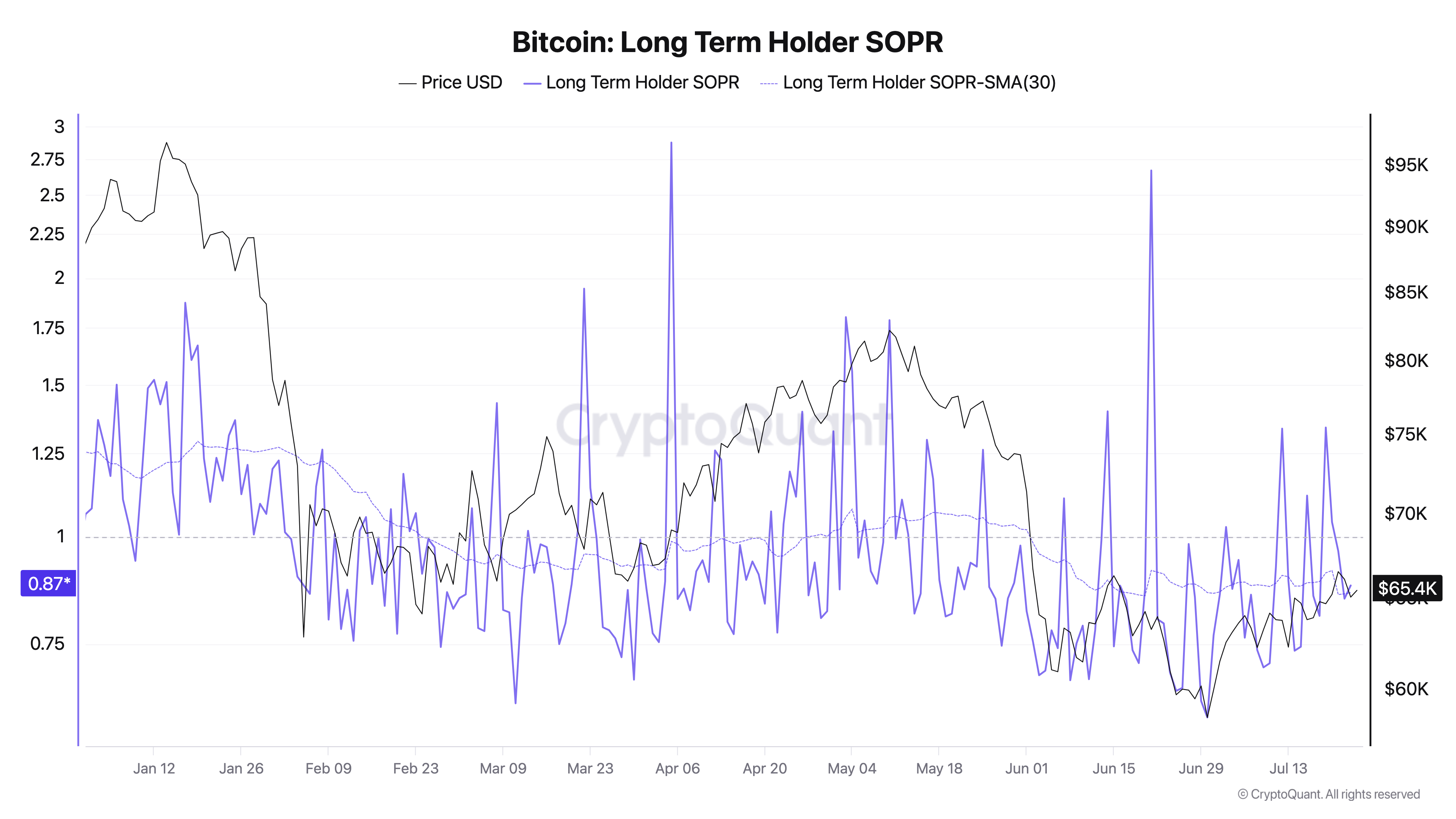
Bitcoin LTH-SOPR chart with 30-day SMA. Source: CryptoQuant

BTC investment recovery stays fragile

As Cointelegraph reported earlier, Bitcoin supply in loss crossed the 50% mark in June, a threshold that has historically preceded bear-market bottoms.

Related: Bitcoin will get ‘lift’ from Hyperliquid, Robinhood in next crypto bull market: Bitwise exec

Here, too, the data reveals similarities among Bitcoin bear markets, with the 50% loss mark sparking the final countdown to a BTC price cycle bottom in previous years.

Demand, meanwhile, appears mixed, with weak spot-market interest meeting a rebound in institutional BTC allocation.


Trending Cryptos

Related Questions

QWhat are the two key on-chain metrics mentioned that need to meet specific criteria to confirm the end of a Bitcoin bear market?

AThe two key metrics are: 1) The 30-day simple moving average (SMA) of the Long-Term Holder Spent Output Profit Ratio (LTH-SOPR) must remain above 1, and 2) The total Bitcoin supply in profit must be above 64%.

QAccording to the article, what percentage of the Bitcoin supply was in profit as of July 22, and what was the percentage at the 2026 low?

AAs of July 22, Bitcoin's supply in profit was 57.5%. At the 2026 low on June 30, it was 46.2%.

QWhat does a Long-Term Holder Spent Output Profit Ratio (LTH-SOPR) value below 1 indicate?

AA LTH-SOPR value below 1 indicates that long-term holder investors are moving their coins on-chain at a loss, which can be a sign of capitulatory activity.

QWhy does the analysis suggest the current recovery might 'roll back over'?

AThe analysis suggests a potential rollback because the current metrics have not yet met the sustained criteria for a confirmed bull market. Specifically, the LTH-SOPR 30-day SMA has been below 1 for over 50 days, and there was already one failed attempt earlier in the year where both metrics improved but then reversed.

QWhat historical threshold for Bitcoin supply in loss was mentioned as preceding bear-market bottoms?

AThe article states that Bitcoin supply in loss crossing the 50% mark has historically preceded bear-market bottoms.

Related Reads

The 800x Golden Dog, "Gacha" Saves NFT Trading

Title: 800x Golden Dog: How 'Gacha' Mechanics Are Rescuing NFT Trading In the past month, the on-chain TCG (Trading Card Game) narrative, centered around "gacha" or loot box mechanics, has emerged as a major crypto-native revenue generator, second only to platforms like Hyperliquid and pump.fun. Recently, this trend hit Ethereum with Fake World Assets (FWA). Within just over a week, FWA generated approximately $1.3 million in revenue, ranking 15th in the past week's crypto app earnings. Its token, $FWA, surged from an initial market cap of ~$47,550 to a peak of ~$38.8 million—an 800x gain. Meanwhile, Collector Cards' token $CARDS declined significantly from its previous highs. FWA, developed by the team behind "PunkStrategy," operates as an NFT gacha system with a built-in token flywheel. Users deposit NFTs paired with ETH as liquidity into pools. Each deposit creates a personal pool; more ETH deposited lowers the chance of the NFT being "won" in a draw. Players spend ETH to "draw" (gacha). If they get an undesirable NFT, they can instantly sell it back to the original depositor at an 85% discount, generating income for the depositor. A 1% fee is taken on each draw and on depositor earnings when an NFT is kept. The key to FWA's momentum is its token $FWA. It cannot be bought directly externally. The primary way to acquire it is by playing the gacha and choosing to receive $FWA (instead of ETH) when selling back an unwanted NFT. This mechanism creates constant buy pressure for $FWA as players engage, especially during its price ascent. Early participants who held $FWA benefited massively from subsequent inflows. This contrasts with projects like Collector Cards, which, despite strong revenues, suffer from perceived low token utility beyond buybacks. In conclusion, while FWA's flywheel design—linking speculative token gains directly to NFT trading activity—has driven rapid growth, its sustainability is questionable. The model relies heavily on continuous $FWA price appreciation to offset the inherent negative expectancy of each draw. When price momentum stalls, activity will likely decline. The case highlights that in crypto markets, pure profitability narratives can be fleeting; understanding the relationship between attention, token buy pressure, and sustainable mechanics is crucial to avoid speculative pitfalls.

marsbit23m ago

The 800x Golden Dog, "Gacha" Saves NFT Trading

marsbit23m ago

The Quantum Computing Threat Approaches, Cryptocurrency May Be Exposed to Risks Before Banks

Quantum computing poses a significant threat to all cryptographic systems, including banks and governments, but decentralized cryptocurrencies with public ledgers like Bitcoin are likely the first practical target. Experts warn that a cryptographically relevant quantum computer (CRQC), capable of running Shor's algorithm to break the elliptic curve cryptography securing most crypto wallets, could emerge around 2029. Recent research shows the required quantum resources for such attacks are shrinking dramatically, potentially enabling key extraction in minutes. The core vulnerability for cryptocurrencies is not the cryptography itself—post-quantum standards are being developed—but the slow, decentralized governance required to implement upgrades. Unlike centralized banks that can swiftly transition, Bitcoin needs near-unanimous consensus among its global network, a historically difficult process as seen in past upgrades. Estimates suggest migrating all vulnerable Bitcoin funds could take at least 76 days of dedicated network time, and it must be completed before a CRQC exists to prevent "now-or-never" attacks on exposed keys. The threat is not binary; it begins when a quantum computer can decrypt data before it loses value, not necessarily in real-time. A significant portion of Bitcoin (estimated at millions of coins) already has public keys permanently exposed on-chain, making them vulnerable to eventual "static attacks." While technical solutions exist, the race is against time for decentralized networks to coordinate a defensive transition, serving as an early warning for the broader financial system.

marsbit34m ago

The Quantum Computing Threat Approaches, Cryptocurrency May Be Exposed to Risks Before Banks

marsbit34m ago

On the First Day of Listing, Changxin Technology's Market Value Exceeds 3 Trillion Yuan, Which Securities Firm Has the Largest Floating Profit?

On July 27th, Changxin Technology, the largest-ever IPO on China's STAR Market, debuted with its share price soaring 465.82% to close at 49 yuan. Its market capitalization reached 3.28 trillion yuan, instantly making it the most valuable A-share company. The stellar performance delivered substantial gains for involved securities firms, primarily through equity investments rather than underwriting fees. China Merchants Securities emerged as the biggest winner. Its direct investment subsidiary, Zhaozheng Investment, alone holds a 0.54% pre-issue stake, translating to a paper profit exceeding 155 billion yuan based on the first-day closing price—surpassing the firm's entire 2025 net profit of 123.5 billion yuan. Other major beneficiaries include Huaan Securities, with an estimated profit of around 123 billion yuan from its 0.44% stake, and the lead underwriters, CICC and CITIC Securities, which each gained approximately 46 billion yuan from mandatory follow-on investments. Firms like Founder Securities, Haitong Securities, and GF Securities also reported significant holdings valued in the billions. Despite these paper gains, shares of some brokerages like Huaan and China Merchants fell on the listing day, reflecting broader market pressures. Analysts remain bullish on Changxin's long-term prospects, citing the AI-driven demand surge for DRAM (Dynamic Random-Access Memory) and a supportive supply-demand dynamic with projected shortages through 2028. As China's largest and most advanced integrated DRAM designer and manufacturer, Changxin is poised to capture growth from domestic substitution and global market shifts, potentially challenging the current "big three" oligopoly (Samsung, SK Hynix, Micron). The IPO proceeds, focused on capacity upgrades and R&D, are expected to accelerate China's semiconductor self-sufficiency.

marsbit1h ago

On the First Day of Listing, Changxin Technology's Market Value Exceeds 3 Trillion Yuan, Which Securities Firm Has the Largest Floating Profit?

marsbit1h ago

Will Changxin Technology Continue to Rise Today?

Changxin Technology made a historic debut on the stock market, with its share price soaring 465.82% to close at 49 yuan. Its market capitalization reached 3.28 trillion yuan, surpassing Industrial and Commercial Bank of China to become the largest company by market cap on the A-share market. Daily trading volume exceeded 140 billion yuan, a first in A-share history. This created a moment of realization for 7.7 million investors who won the lottery for its shares. On the first day, investor strategies varied: some sold immediately and later regretted missing intraday highs, others secured profits to avoid future volatility, while a third group held or even bought more shares, betting on long-term growth. The staggering IPO, massive public enthusiasm, and debut during a peak industry cycle led some to compare Changxin to PetroChina's 2007 listing, which was followed by a long decline. Key similarities noted include comparable fundraising scales (approx. 666 billion yuan for Changxin vs. 668 billion for PetroChina) and both companies listing at a perceived high point in their respective commodity cycles (oil then, memory chips now). However, analysts caution against over-simplifying the comparison. They highlight core differences: Changxin operates in the high-growth semiconductor sector with strong "domestic substitution" tailwinds. Brokerages like Huaxi Securities project significant revenue and profit growth from 2026 to 2028, driven by DDR5 adoption, product mix optimization, and economies of scale. Nomura Securities issued a "buy" rating with a 116 yuan target price, citing AI-driven demand for DRAM, tight supply as major players shift to HBM production, and Changxin's vast room for market share growth. Some analysts position the current memory cycle, fueled by AI, as just beginning, contrasting with the mature energy cycle PetroChina entered. The article concludes that for investors, monitoring the memory cycle's progression and Changxin's breakthroughs in high-end technologies like HBM will be crucial, rather than relying on superficial historical parallels.

marsbit1h ago

Will Changxin Technology Continue to Rise Today?

marsbit1h ago

Trading

Spot

Hot Articles

What is $BITCOIN

DIGITAL GOLD ($BITCOIN): A Comprehensive Analysis Introduction to DIGITAL GOLD ($BITCOIN) DIGITAL GOLD ($BITCOIN) is a blockchain-based project operating on the Solana network, which aims to combine the characteristics of traditional precious metals with the innovation of decentralized technologies. While it shares a name with Bitcoin, often referred to as “digital gold” due to its perception as a store of value, DIGITAL GOLD is a separate token designed to create a unique ecosystem within the Web3 landscape. Its goal is to position itself as a viable alternative digital asset, although specifics regarding its applications and functionalities are still developing. What is DIGITAL GOLD ($BITCOIN)? DIGITAL GOLD ($BITCOIN) is a cryptocurrency token explicitly designed for use on the Solana blockchain. In contrast to Bitcoin, which provides a widely recognized value storage role, this token appears to focus on broader applications and characteristics. Notable aspects include: Blockchain Infrastructure: The token is built on the Solana blockchain, known for its capacity to handle high-speed and low-cost transactions. Supply Dynamics: DIGITAL GOLD has a maximum supply capped at 100 quadrillion tokens (100P $BITCOIN), although details regarding its circulating supply are currently undisclosed. Utility: While precise functionalities are not explicitly outlined, there are indications that the token could be utilized for various applications, potentially involving decentralized applications (dApps) or asset tokenization strategies. Who is the Creator of DIGITAL GOLD ($BITCOIN)? At present, the identity of the creators and development team behind DIGITAL GOLD ($BITCOIN) remains unknown. This situation is typical among many innovative projects within the blockchain space, particularly those aligning with decentralized finance and meme coin phenomena. While such anonymity may foster a community-driven culture, it intensifies concerns about governance and accountability. Who are the Investors of DIGITAL GOLD ($BITCOIN)? The available information indicates that DIGITAL GOLD ($BITCOIN) does not have any known institutional backers or prominent venture capital investments. The project seems to operate on a peer-to-peer model focused on community support and adoption rather than traditional funding routes. Its activity and liquidity are primarily situated on decentralized exchanges (DEXs), such as PumpSwap, rather than established centralized trading platforms, further highlighting its grassroots approach. How DIGITAL GOLD ($BITCOIN) Works The operational mechanics of DIGITAL GOLD ($BITCOIN) can be elaborated on based on its blockchain design and network attributes: Consensus Mechanism: By leveraging Solana’s unique proof-of-history (PoH) combined with a proof-of-stake (PoS) model, the project ensures efficient transaction validation contributing to the network's high performance. Tokenomics: While specific deflationary mechanisms have not been extensively detailed, the vast maximum token supply implies that it may cater to microtransactions or niche use cases that are still to be defined. Interoperability: There exists the potential for integration with Solana’s broader ecosystem, including various decentralized finance (DeFi) platforms. However, the details regarding specific integrations remain unspecified. Timeline of Key Events Here is a timeline that highlights significant milestones concerning DIGITAL GOLD ($BITCOIN): 2023: The initial deployment of the token occurs on the Solana blockchain, marked by its contract address. 2024: DIGITAL GOLD gains visibility as it becomes available for trading on decentralized exchanges like PumpSwap, allowing users to trade it against SOL. 2025: The project witnesses sporadic trading activity and potential interest in community-led engagements, although no noteworthy partnerships or technical advancements have been documented as of yet. Critical Analysis Strengths Scalability: The underlying Solana infrastructure supports high transaction volumes, which could enhance the utility of $BITCOIN in various transaction scenarios. Accessibility: The potential low trading price per token could attract retail investors, facilitating wider participation due to fractional ownership opportunities. Risks Lack of Transparency: The absence of publicly known backers, developers, or an audit process may yield skepticism regarding the project's sustainability and trustworthiness. Market Volatility: The trading activity is heavily reliant on speculative behavior, which can result in significant price volatility and uncertainty for investors. Conclusion DIGITAL GOLD ($BITCOIN) emerges as an intriguing yet ambiguous project within the rapidly evolving Solana ecosystem. While it attempts to leverage the “digital gold” narrative, its departure from Bitcoin's established role as a store of value underscores the need for a clearer differentiation of its intended utility and governance structure. Future acceptance and adoption will likely depend on addressing the current opacity and defining its operational and economic strategies more explicitly. Note: This report encompasses synthesised information available as of October 2023, and developments may have transpired beyond the research period.

1.1k Total ViewsPublished 2025.05.13Updated 2025.05.13

What is $BITCOIN

Discussions

Welcome to the HTX Community. Here, you can stay informed about the latest platform developments and gain access to professional market insights. Users' opinions on the price of BTC (BTC) are presented below.

活动图片