People's Bank of China Promises Steady Growth of Digital Yuan in Its 2026-2030 Plan

cryptonews.ruPublished on 2026-08-10Last updated on 2026-08-10

Abstract

The People's Bank of China (PBOC) has outlined plans for the "steady development" of the digital yuan (e-CNY) in its reform blueprint for the 2026-2030 period. The plan, which covers monetary policy, supervision, and financial openness, places e-CNY as a core task within the central bank's financial infrastructure goals. These include improving payment systems, aiding the credit industry, and strengthening anti-money laundering rules. Internationally, the PBOC aims to boost the yuan's use in trade and investment, develop cross-border payment networks, and expand offshore yuan markets, while enhancing Shanghai and Hong Kong's financial roles. Development began with research in 2014, leading to a formal launch in April 2022 and pilot programs in various cities. Recent domestic measures include allowing commercial banks to pay interest on e-CNY balances. Cross-border adoption is advancing. Pilot programs in Guangdong plan wider trials. Landmark transactions include a Singapore cross-border payment via the CBETS platform and the multi-central bank mBridge platform, which has expanded to Macao and facilitated large-scale transfers, including a record HKD 10 billion transaction. Corporate use of mBridge saw significant growth in the first half of the year.

The People's Bank of China (PBOC) stated that it will "steadily develop" the digital yuan over the next five years.

In a recently published reform plan, the digital yuan (e-CNY) is now listed among the central bank's key tasks.

What measures has China taken to develop its digital yuan?

The People's Bank of China (PBOC) published the so-called " Reform and Development Plan, with supervision, financing of the real economy, and a higher level of openness for China's financial system—all reflected in separate sections of these plans. for the 15th Five-Year Plan", along with nine separate action plans covering more specific policy areas. Monetary policy,

The digital yuan is included in the fifth priority, concerning financial infrastructure and central bank services. The People's Bank of China expresses its desire to improve payment systems, assist the credit industry, and tighten anti-money laundering regulations.

A separate section of the plan places greater emphasis on the international aspect. There, the People's Bank of China commits to expanding the use of the yuan in trade and investment, creating a cross-border payment network, and developing offshore yuan markets, while simultaneously strengthening Shanghai as an international financial center and enhancing Hong Kong's status.

The central bank defined the direction for implementing the 15-year plan as early as the beginning of 2026, when the PBOC established a mechanism allowing commercial banks to pay interest on clients' digital yuan balances.

The People's Bank of China began research on the digital Chinese yuan project in 2014 under the name DCEP and launched the digital yuan in April 2022, encouraging its early adoption through currency giveaways in pilot cities.

As reported by Cryptopolitan, at the 2026 National People's Congress, deputy Fu Xiguo proposed revising the People's Bank of China Law, which was last updated in 2003, arguing that it does not yet define the digital yuan as legal tender.

Has the digital yuan been applied outside of China?

Guangdong Province published a draft five-year plan for public comment until September 5th. The plan calls for larger-scale cross-border payment pilots using the digital yuan and expanding the use cases for this currency.

These calls followed China's first cross-border digital yuan payment with Singapore, where ICBC branches settled approximately 10 million yuan in shipping fees via the upgraded CBETS platform. In June, the first 26 financial institutions connected to this system.

On the other hand, the mBridge project, a multi-central bank settlement platform including Mainland China, Hong Kong, Thailand, the United Arab Emirates, and Saudi Arabia, recently extended its services to Macao through cooperation with Industrial Bank and was used to transfer 500 million yuan (74 million US dollars) in a share acquisition deal.

In the first half of the year, the number of corporate clients using this service increased by 176% compared to the same period last year. Meanwhile, the Bank of China branch in Fujian Province transferred over 10 billion Hong Kong dollars (1.28 billion US dollars) via mBridge, calling it the largest single transfer on the platform to date.

end-content

Trending Cryptos

Related Questions

QWhat does the People's Bank of China (PBOC) promise regarding the digital yuan in its 2026-2030 plan?

AThe People's Bank of China (PBOC) promises 'steady development' of the digital yuan (e-CNY) over the next five years.

QIn which section of the PBOC's reform and development plan is the digital yuan (e-CNY) mentioned as a key task?

AThe digital yuan (e-CNY) is listed among the key tasks in the fifth priority area concerning financial infrastructure and central bank services.

QWhat international objectives related to the yuan and financial hubs does the PBOC's plan emphasize?

AThe plan emphasizes expanding the use of the yuan in trade and investment, establishing cross-border payment networks, developing offshore yuan markets, strengthening Shanghai as an international financial center, and enhancing Hong Kong's status.

QWhat significant cross-border payment initiative involving the digital yuan is mentioned in the article?

AThe article mentions the mBridge project, a multi-central bank digital currency (CBDC) settlement platform involving mainland China, Hong Kong, Thailand, the UAE, and Saudi Arabia, which was recently extended to Macao and used for a 500 million yuan transfer in a share acquisition deal.

QWhat suggestion was made at the 2026 National People's Congress regarding the legal status of the digital yuan?

AAt the 2026 National People's Congress, a deputy named Fu Xiguo suggested revising the PBOC law, last updated in 2003, arguing it does not yet define the e-CNY as legal tender.

Related Reads

Bitcoin Withstood 10 Bearish Blows in 2026, Yet Experienced Its Mildest Bear Market

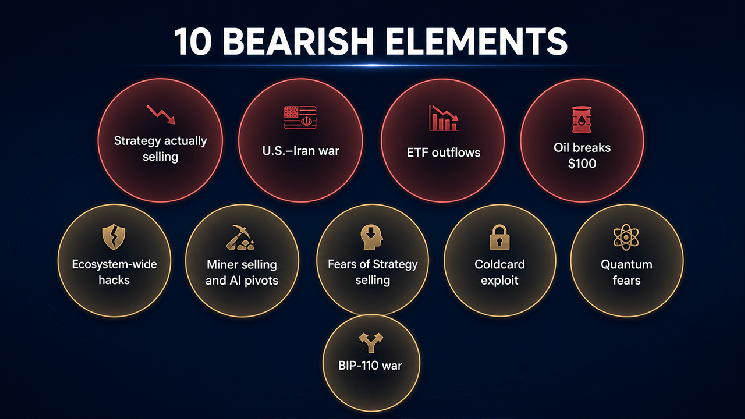
Bitcoin, the leading cryptocurrency by market cap, peaked above $126,000 in early October before entering a prolonged decline. By August, it was mainly trading between $63,000 and $65,400, inflicting losses on late buyers but resulting in what is, historically for Bitcoin, an unusually shallow bear market—down about 49% from its peak, compared to typical 75-80% plunges. Throughout 2026, Bitcoin faced multiple headwinds yet demonstrated notable resilience. Geopolitical tensions in the Middle East and volatile oil prices revived inflation concerns but failed to trigger the panic-driven sell-offs seen in prior cycles. A significant psychological blow came from corporate seller MicroStrategy, a longtime accumulator, which began strategic sales to bolster its cash position, reducing its holdings. U.S. spot Bitcoin ETFs also faced sustained outflows, though a late-week inflow hinted at potential relief. Pressure also came from within the ecosystem. A contentious blockchain proposal, BIP-110, failed after a minority chain stalled. Miners, facing tighter economics, sold reserves and pivoted infrastructure toward AI. A major security breach involving Coldcard hardware wallets saw an estimated 2,000 BTC stolen, shaking confidence in self-custody. Long-term threats like quantum computing resurfaced in discussions. Despite this confluence of corporate selling, ETF outflows, miner capitulation, geopolitical shocks, internal conflict, and security issues—any one of which could historically cause sharp declines—Bitcoin stubbornly held above a key $60,000 support level. Deeper market liquidity, regulated products, and long-term holders appear to be absorbing selling pressure that once would have caused deeper crashes. This resilience suggests a maturing market structure, though risks remain. Another shock could still push Bitcoin toward $50,000. For now, its 49% decline, severe for most assets, is relatively moderate by Bitcoin's own volatile standards. The remaining months of 2026 will test whether $60,000 is a durable floor or merely the next major line of defense.

cryptonews.ru7m ago

Bitcoin Withstood 10 Bearish Blows in 2026, Yet Experienced Its Mildest Bear Market

cryptonews.ru7m ago

Korean Financial Supervisory Service to Revise Compensation System for Phishing Losses Involving Crypto Transfer

The South Korean Financial Supervisory Service (FSS) is overhauling its system for reimbursing victims of voice phishing scams. Starting in October, the new system will be able to calculate and compensate losses held in cryptocurrency, not just in Korean won. Previously, the reimbursement system assumed stolen funds were in won, failing to fully compensate victims whose money was converted into digital assets. The upgraded software will apply a recovery ratio to determine the specific type and quantity of tokens owed to each victim, based on the token's value at the time the payment was frozen. It will also better track cases where fraud proceeds are split across multiple accounts and later consolidated. These changes follow March 31st amendments to the Act on Reimbursement of Losses from Telecommunications Fraud, which now classify virtual assets as both damaged and recoverable property. Major Korean crypto exchanges like Upbit and Bithumb must now comply with the same anti-phishing obligations as banks, including verifying transaction purposes and tracking suspicious funds. The revised law takes effect October 1st, with the FSS allocating a three-month period and a budget of 118.53 million won for system implementation and troubleshooting. The update addresses schemes where stolen money is intentionally laundered through cryptocurrency for overseas transfer. Notably, telecom fraud losses in South Korea rose 14.1% to 433.8 billion won in 2025, a five-year high.

cryptonews.ru17m ago

Korean Financial Supervisory Service to Revise Compensation System for Phishing Losses Involving Crypto Transfer

cryptonews.ru17m ago

Trading

Spot

Hot Articles

How to Buy PEOPLE

Welcome to HTX.com! We've made purchasing ConstitutionDAO (PEOPLE) simple and convenient. Follow our step-by-step guide to embark on your crypto journey.Step 1: Create Your HTX AccountUse your email or phone number to sign up for a free account on HTX. Experience a hassle-free registration journey and unlock all features.Get My AccountStep 2: Go to Buy Crypto and Choose Your Payment MethodCredit/Debit Card: Use your Visa or Mastercard to buy ConstitutionDAO (PEOPLE) instantly.Balance: Use funds from your HTX account balance to trade seamlessly.Third Parties: We've added popular payment methods such as Google Pay and Apple Pay to enhance convenience.P2P: Trade directly with other users on HTX.Over-the-Counter (OTC): We offer tailor-made services and competitive exchange rates for traders.Step 3: Store Your ConstitutionDAO (PEOPLE)After purchasing your ConstitutionDAO (PEOPLE), store it in your HTX account. Alternatively, you can send it elsewhere via blockchain transfer or use it to trade other cryptocurrencies.Step 4: Trade ConstitutionDAO (PEOPLE)Easily trade ConstitutionDAO (PEOPLE) on HTX's spot market. Simply access your account, select your trading pair, execute your trades, and monitor in real-time. We offer a user-friendly experience for both beginners and seasoned traders.

8.0k Total ViewsPublished 2024.03.29Updated 2026.06.02

How to Buy PEOPLE

Discussions

Welcome to the HTX Community. Here, you can stay informed about the latest platform developments and gain access to professional market insights. Users' opinions on the price of PEOPLE (PEOPLE) are presented below.

活动图片