$700 Billion Poured into AI, Americans Taste the Bitter Fruit of Inflation First

marsbitPublished on 2026-04-02Last updated on 2026-04-02

Abstract

A Federal Reserve analysis from the St. Louis Fed argues that AI optimism itself is a driver of inflation. The "news shock" of AI's revolutionary potential causes households and businesses to increase spending and investment in anticipation of future gains, pushing demand beyond current supply and creating inflationary pressure. This is supported by a Deutsche Bank experiment where AI models (dbLumina, Claude, ChatGPT-5.2) assessed a 20-40% probability that AI would raise inflation in the next year, citing surging demand for data centers, semiconductors, and electricity. They saw only a 5% chance of AI significantly reducing inflation. Massive capital expenditure underscores this demand. Amazon, Microsoft, Google, and Meta are projected to spend a combined ~$663B in 2026, a fourfold increase in four years. A significant portion funds power-hungry data centers. For example, OpenAI's "Stargate" project plans a 10-gigawatt capacity, equivalent to the entire electricity load of 16 Vermont states. U.S. data center electricity consumption is forecast to triple by 2030. While AI could eventually boost productivity and be disinflationary long-term, current data shows no such productivity jump. The U.S. economy now faces a cycle: massive AI investment fuels inflation, delays interest rate cuts, raises financing costs—yet the investment continues to accelerate. The outcome hinges on whether these AI models will ultimately make the economy more efficient, a question that remains unan...

On April 1, St. Louis Fed economists Miguel Faria-e-Castro and Serdar Ozkan published a blog post with a restrained title and a sharp conclusion: AI optimism itself is an inflation driver. Not because electricity bills are rising, not because of a chip shortage, but because everyone believes AI will make the future better—this belief makes them spend more money now.

On the same day, Fortune disclosed an experiment by Deutsche Bank: they had three AI models evaluate the "impact of AI on inflation." The conclusion was that even AI itself believes it is pushing up prices.


On social media, posts about soaring US prices are abundant

These two pieces together point to an uncomfortable cycle: the more investment in AI, the higher inflation, the further away interest rate cuts are, the higher financing costs become—yet investment continues to accelerate.

The Unstoppable Arms Race

First, look at the money. According to company financial reports, the combined capital expenditures of Amazon, Microsoft, Google, and Meta in 2023 were approximately $152 billion. By 2024, this number jumped to $251 billion, a 65% increase. For the full year 2025, it settled at $416 billion, another 66% increase.

Company guidance for 2026 is even more aggressive. According to a summary by Wolf Street, Amazon guided for $200 billion, Google for $175 to $185 billion, Microsoft for $145 to $150 billion, and Meta for $135 billion. The four together amount to about $663 billion. Adding Oracle's $42 billion, the total for the five companies approaches $700 billion.
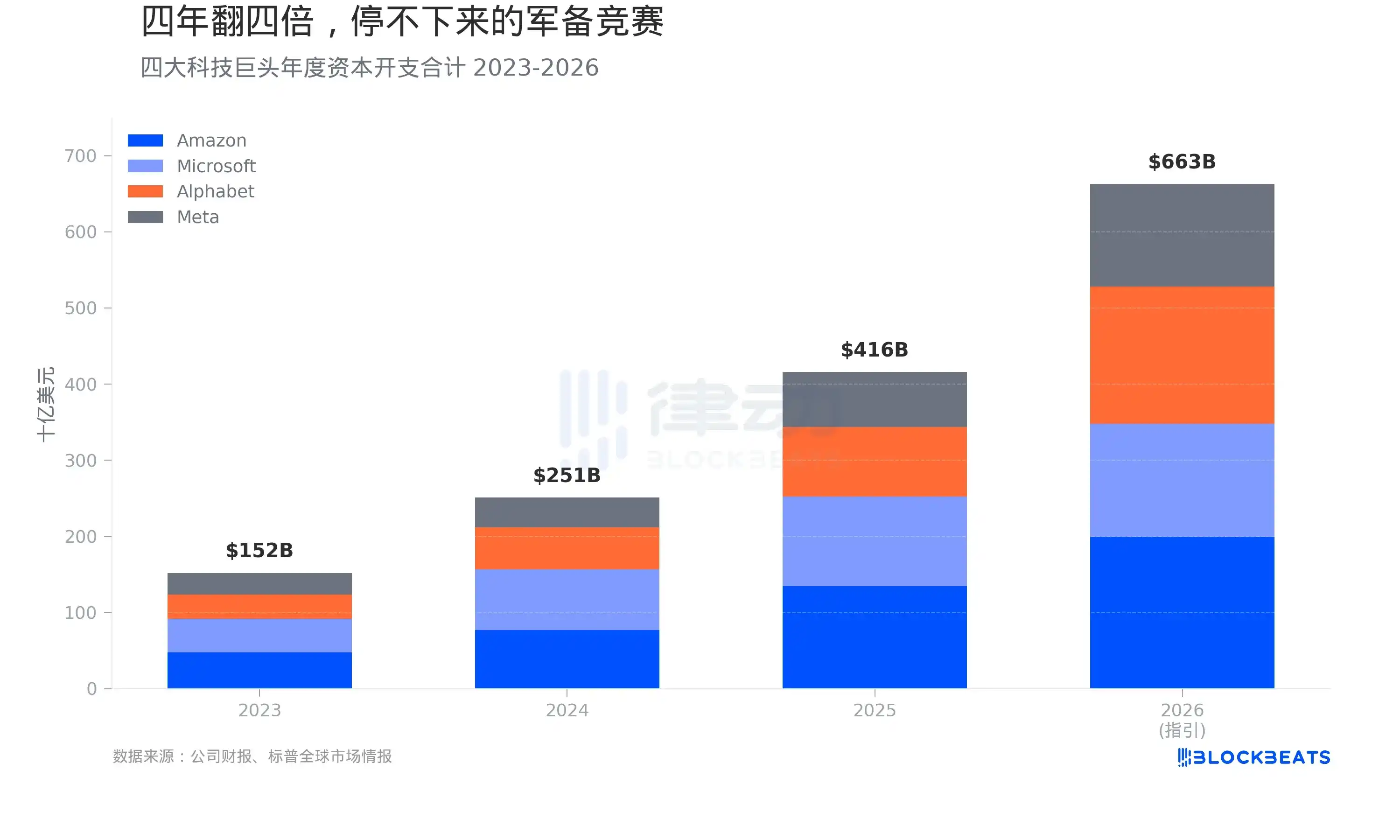
In four years, the capital expenditures of these four companies have quadrupled. This growth rate is unprecedented in US corporate history. According to a Fortune report, this scale already exceeds Sweden's annual GDP.

One Data Center, Consuming as Much Power as an Entire State

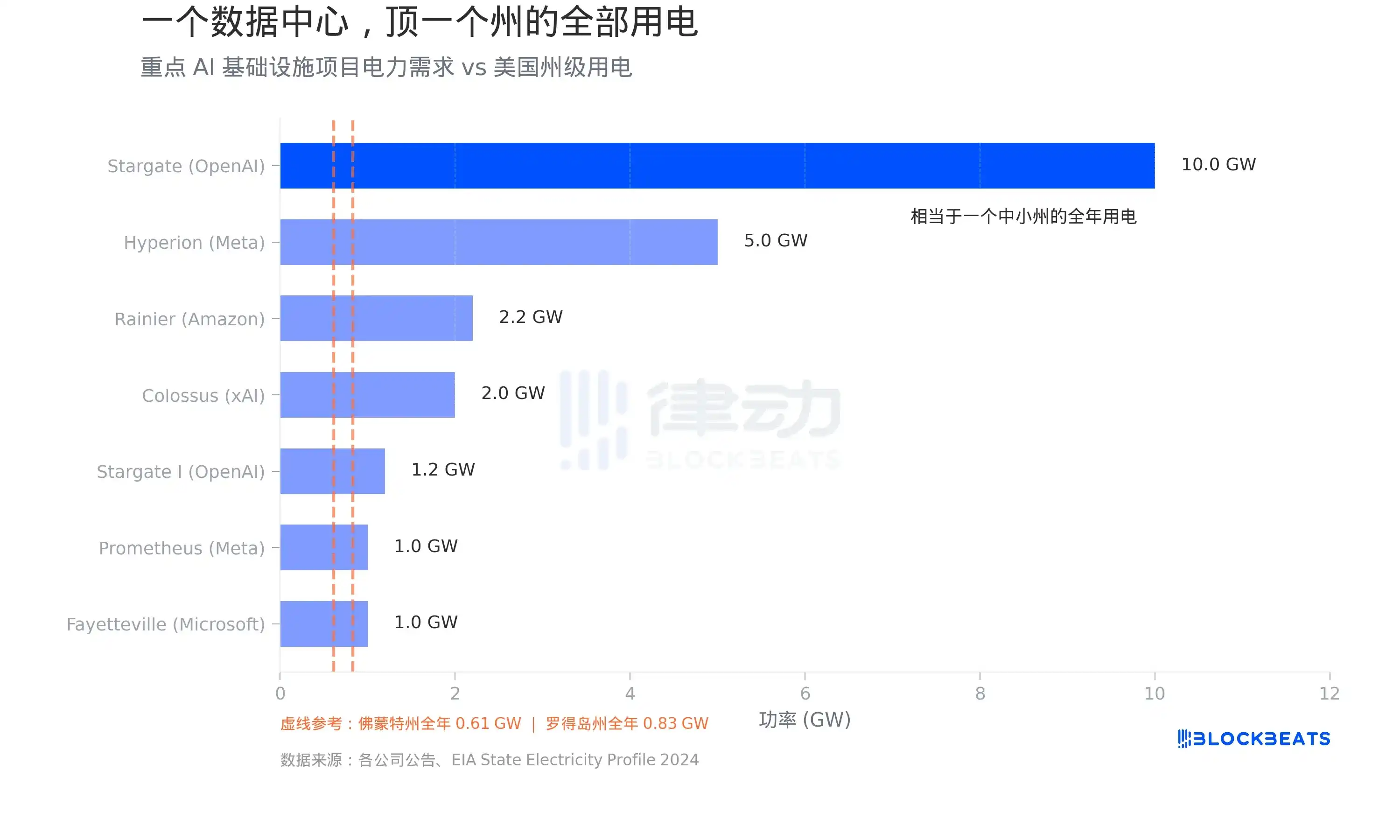
Most of this money is flowing into data centers. And the biggest bottleneck for data centers is not land, but electricity. According to EIA data, Vermont's annual electricity consumption is about 5,364 GWh, which translates to an average load of 0.61 GW. Rhode Island is slightly higher, about 0.83 GW.

Now look at what data centers are doing. According to company announcements, the total planned power capacity for the Stargate project, a collaboration between OpenAI, Oracle, and SoftBank, reaches 10 GW, equivalent to the entire electricity consumption of 16 Vermonts. Meta's Hyperion campus in Louisiana is planned for 5 GW, with an investment of $27 billion. Musk's xAI Colossus in Memphis, Tennessee, has expanded to 2 GW; according to an Introl report, it deployed 555,000 Nvidia GPUs, costing about $18 billion. Amazon and Anthropic's joint Project Rainier in Indiana is planned for 2.2 GW.
According to S&P Global data, US data centers consumed 183 TWh of electricity in 2024, accounting for over 4% of the nation's total electricity consumption. By 2030, this number is expected to triple.

This power demand is not a distant, planned story; it is already straining existing grids. According to a CBRE report, the vacancy rate for North American data centers dropped from 3.3% in the first half of 2023 to a record low of 1.6% in the first half of 2025. According to Cushman & Wakefield data, the vacancy rate slightly recovered to 3.5% in the second half of 2025, but only because a large amount of new capacity was delivered—absolute levels remain at historical lows, and meaningful supply relief is unlikely to appear before 2030.

Even AI Itself Says It's Pushing Up Inflation

While these investments are driving demand, pushing up electricity prices, and causing chip shortages, there is also a more hidden inflation channel.

According to a Fortune report on April 1, a team led by Deutsche Bank's chief US economist, Matthew Luzzetti, conducted an experiment: they asked Deutsche Bank's own model dbLumina, Anthropic's Claude, and OpenAI's ChatGPT-5.2 to respectively assess the "probability that AI will push up inflation in the next year."

Results: dbLumina gave 40%, Claude gave 25%, and ChatGPT-5.2 gave 20%. All three models were consistent in their assessment of the probability of "AI significantly reducing inflation": only 5%.
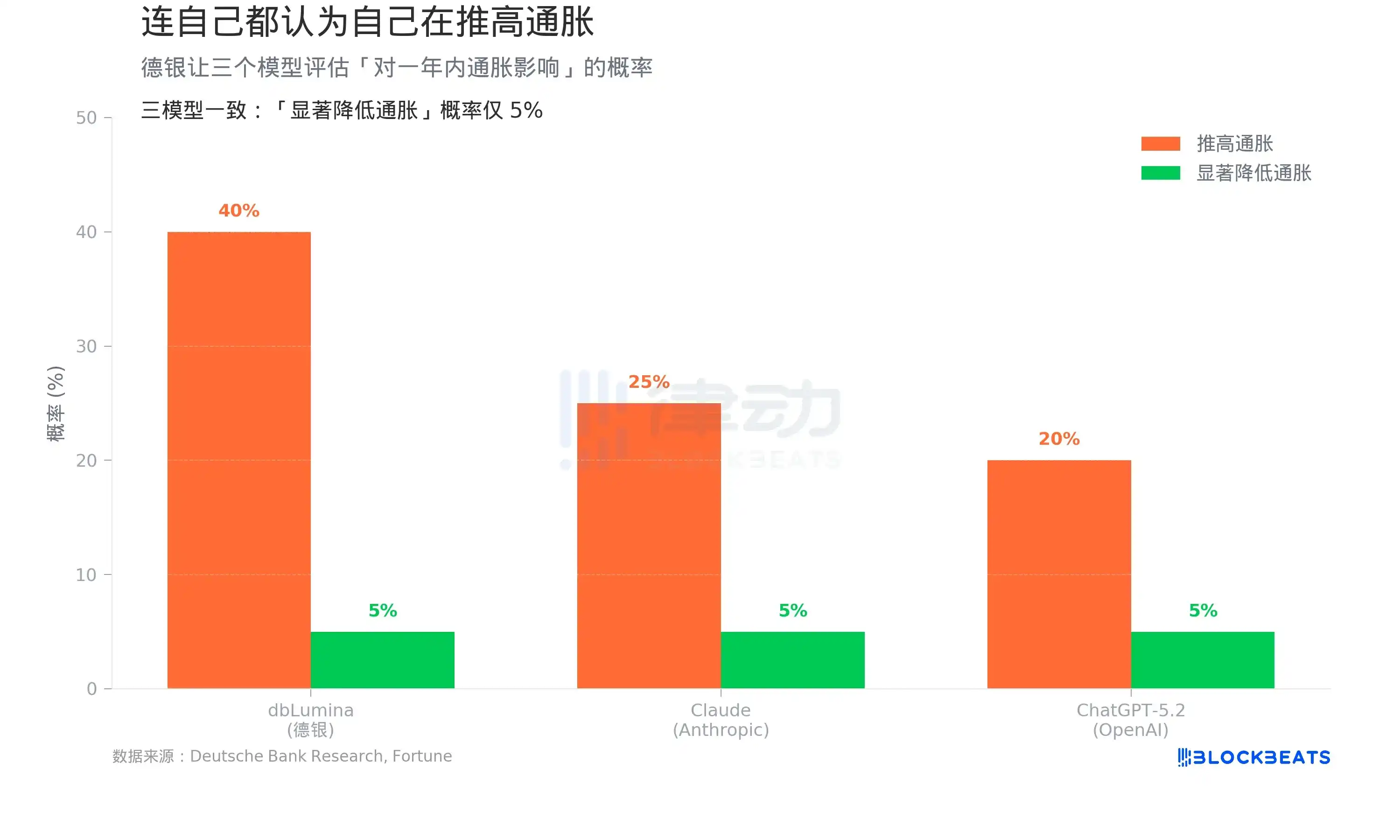
The inflation drivers cited by the three models were highly consistent: data centers are expanding massively, semiconductor demand is soaring, and the power consumption of AI workloads is growing rapidly—all of these are demand-pull price pressures.

This is the opposite of the consensus among some Wall Street investors. The Deutsche Bank team wrote in their research report: "Will AI be a major deflationary force? Even AI itself doesn't think so."

On a five-year horizon, the models did turn to more deflationary possibilities. But the probability of "AI causing large-scale deflation" is still relegated to the tail risk zone.

Optimism Itself Is Inflationary

The St. Louis Fed paper provides a theoretical framework to explain all of this.

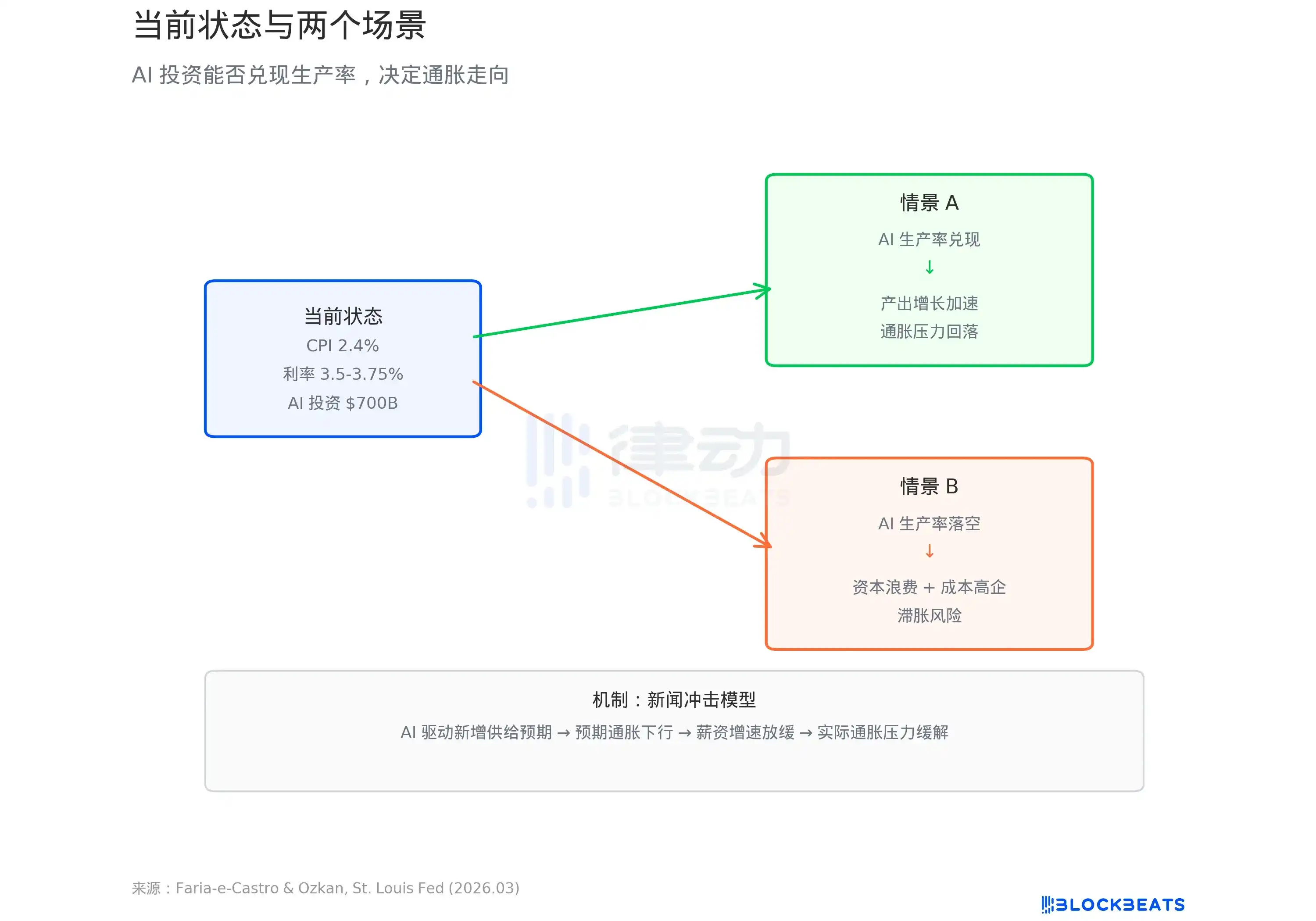
Faria-e-Castro and Ozkan used a standard macroeconomic model, defining the AI investment boom as a "news shock." According to the Fed blog post, the model's logic is: when households see AI described as a revolutionary technology, they expect future income to rise and increase consumption提前 (in advance). Firms expect productivity gains and increase investment. The two combined cause demand to quickly exceed supply. The paper states: "These forces together generate an inflationary surge in aggregate demand—a core feature of the initial phase of a news shock."

The model presents two paths. If AI does bring a productivity leap, short-term inflation will be digested by long-term output growth, and the economy enters a virtuous cycle. But if productivity does not materialize—the paper uses the term "persistent low growth and stubborn high inflation," i.e., stagflation.
According to data cited in the Fed blog post, the annualized growth rate of US Total Factor Productivity (TFP) since the release of ChatGPT has been 1.11%, lower than the historical average of 1.23%. So far, AI has left no mark on productivity data.

Meanwhile, according to BLS data, the US CPI in February 2026 was 2.4% year-on-year, and core CPI was 2.5%, neither yet back to the Fed's 2% target. The Fed's March dot plot shows a median forecast for the year-end rate of 3.4%, pointing to only one rate cut this year.

$700 billion is pouring into AI infrastructure. Whether this money is a cause of inflation or the prelude to a productivity revolution depends on a question no one can yet answer: will the models running in these data centers actually make the economy more efficient.


Trending Cryptos

Related Questions

QAccording to the St. Louis Fed economists, what is the primary mechanism through which AI optimism is driving inflation?

AThe primary mechanism is a 'news shock' where households, believing AI will increase future income, increase current consumption, and firms, expecting productivity gains, increase investment. This surge in aggregate demand outpaces supply, creating inflationary pressure.

QHow much did the combined capital expenditures of Amazon, Microsoft, Google, and Meta increase from 2023 to their projected 2026 total?

ATheir combined capital expenditures increased from $152 billion in 2023 to a projected total of approximately $663 billion in 2026 for the four companies, representing a more than fourfold increase.

QWhat was the consensus among the three AI models (dbLumina, Claude, ChatGPT-5.2) regarding AI's probability of significantly lowering inflation in the next year?

AThe consensus was a low probability of only 5% for AI significantly lowering inflation in the next year.

QWhat is the major bottleneck for the expansion of AI data centers mentioned in the article?

AThe major bottleneck is the supply of electricity, not land.

QWhat does the St. Louis Fed model present as the two potential economic outcomes from the current AI investment boom?

AThe two potential outcomes are: 1. A benign cycle where short-term inflation is digested by long-term output growth if AI delivers a productivity leap. 2. Stagflation, characterized by persistent low growth and stubborn high inflation, if productivity gains fail to materialize.

Related Reads

Must-Watch Events Next Week|CLARITY Act Could Face Senate Vote; SpaceX, Circle to Report Earnings (8.3-8.9)

**Summary: Key Events and Developments to Watch (August 3-9)** The upcoming week is marked by significant financial disclosures, key legislative deadlines, and notable product updates. **Major Financial Events:** Several companies are scheduled to release their Q2 2026 earnings. American Bitcoin (ABTC) will report on August 3, followed by SpaceX and Hut 8 Mining Corp. on August 4, and Circle on August 5. Notably, a significant portion of SpaceX shares (up to 12% of total shares) will be unlocked on August 6 following their earnings release. **Key Legislative Deadline:** The U.S. Senate faces an August 7 deadline to secure 60 votes for the CLARITY Act, a bipartisan bill aiming to establish a federal regulatory framework for cryptocurrencies. The Senate may hold a full vote on the bill during the week. **Economic Data:** The U.S. July Non-Farm Payrolls report will be released on August 7, providing crucial labor market data. **Technology & Product Updates:** * **Shutdowns:** DeFi portfolio tracker Zapper and wallet app Ctrl Wallet will cease operations on August 3. * **Upgrades:** LayerZero will deprecate its v1 relayers on August 3. XRP Ledger's new version 3.3.0, featuring five new functions, is expected next week. * **AI:** Elon Musk announced that the advanced Grok 4.6 AI model is set for release around August 7. * **Bitcoin:** The BIP-110 forced signaling for a potential Bitcoin network change is scheduled to begin around August 8. **Other Notable Events:** Chinese robotics firm Unitree Tech has set its preliminary price inquiry for its IPO for August 5. South Korean exchange Upbit will delist AQT and AERGO tokens on August 3.

marsbit1h ago

Must-Watch Events Next Week|CLARITY Act Could Face Senate Vote; SpaceX, Circle to Report Earnings (8.3-8.9)

marsbit1h ago

Stocks Are Plummeting More Sharply Than Cryptocurrencies. Where Has the Money Gone?

Stock Markets Plunge Deeper Than Cryptocurrencies: Where Did the Money Go? In late July, Seoul's Kospi index triggered circuit breakers for two consecutive days, plummeting over 40% from its June high. The collapse was led by heavyweight stocks like SK Hynix, whose record profits still disappointed investors, and devastating leveraged ETFs, with one major product losing over 83% of its value. This signaled a global, forced deleveraging targeting the most crowded trades. Interestingly, while stocks exhibited extreme volatility akin to crypto markets, Bitcoin rose nearly 15% in July after a prior steep drop. Analysis shows the money fleeing equities did not flow into Bitcoin. Instead, Bitcoin had already absorbed its sell-off in May-June, when U.S. spot Bitcoin ETFs saw historic outflows. The true safe-haven beneficiary was gold, whose price rose over 20% year-on-year, highlighting a decoupling between Bitcoin and gold as "digital gold." The sell-off was a targeted unwinding of leveraged positions in tech and semiconductors, accelerated by broker-dealer risk management and shifts in the AI narrative, including new competition from Chinese memory chipmakers. The retreat path was clear: from high-valuation tech stocks to cash and U.S. Treasuries, then to gold. For Bitcoin to attract sustained institutional inflows, conditions like eased global liquidity pressure, a "soft-landing" Fed rate cut, and U.S. regulatory clarity via legislation like the stalled CLARITY Act are needed. Currently, Bitcoin is not a safe haven but an already-cleared asset. Its low correlation with tech stocks, however, makes it a potential diversification play for institutional portfolios once the storm passes. The money isn't here yet, but the positioning is underway.

marsbit1h ago

Stocks Are Plummeting More Sharply Than Cryptocurrencies. Where Has the Money Gone?

marsbit1h ago

In Conversation with Ray Dalio: We Are Currently in an AI Bubble, with 1% of My Portfolio in Bitcoin

Ray Dalio, founder of Bridgewater Associates, warns in an interview that the current AI boom shows classic bubble characteristics, which could lead to significant economic downturns as seen in past cycles like 1929 or 2000. He explains that speculative enthusiasm, fueled by debt and overvaluation, often precedes a crash when rising rates or taxation force asset sales, causing widespread losses and recession. Dalio also outlines his "Big Cycle" theory, describing an approximate 80-year pattern where widening wealth gaps, massive government deficits, and shifting geopolitical power (like China's rise) create internal conflict and global instability. He emphasizes that we are in a late-cycle, transitional phase where traditional powers like the US and UK face decline. For personal wealth protection, Dalio advises diversification beyond cash into assets like stocks, bonds, real estate, and particularly gold, which he prefers over Bitcoin. While he holds about 1% of his portfolio in Bitcoin as a non-printable hard asset, he views gold as more secure from technological or governmental threats. Regarding AI's impact, Dalio believes it will disproportionately benefit capital owners, worsening inequality by replacing both physical and cognitive labor. He suggests that human intuition and emotional intelligence, combined with AI, will be key for future workers. On taxation, Dalio argues that wealth taxes are impractical and risk triggering asset sell-offs, reducing productive investment. He points to the UK as a cautionary example of debt, low productivity, and political strife. Geopolitically, Dalio foresees a more regionalized world, with the US showing weakness in prolonged conflicts like with Iran, akin to past imperial declines. The ideal outcome, he suggests, is coexisting powerful blocs (e.g., Americas, China-Asia Pacific) without major war.

marsbit5h ago

In Conversation with Ray Dalio: We Are Currently in an AI Bubble, with 1% of My Portfolio in Bitcoin

marsbit5h ago

Trading

Spot

Hot Articles

Discussions

Welcome to the HTX Community. Here, you can stay informed about the latest platform developments and gain access to professional market insights. Users' opinions on the price of AI (AI) are presented below.

活动图片














