Notas del Podcast | Ejecutivo de Bitwise: Las malas noticias ya no asustan a Bitcoin, las compras institucionales en el próximo mercado alcista se centrarán en las principales criptomonedas, y el capital en cadena favorece la capa de aplicación

marsbitPublished on 2026-08-13Last updated on 2026-08-13

Abstract

**Resumen en español:** En un episodio de podcast de The Rollup, Matt Hougan (CIO de Bitwise) y Ryan Rasmussen (director de investigación) analizaron el estado del mercado de criptomonedas (agosto de 2026). Señalaron que Bitcoin se ha vuelto resiliente a las malas noticias (ventas importantes, hackeos, estancamiento regulatorio), interpretándolo como una posible señal de suelo de mercado. Argumentan que el ciclo de 4 años se está comprimiendo, con caídas menos severas, impulsado por la entrada de inversores institucionales a través de ETFs. Estos grandes actores (bancos, gestores de patrimonio) tienen procesos de decisión lentos (unos dos años de "educación") y empezarán asignando capital principalmente a activos principales como Bitcoin y Ethereum por su liquidez. Pronostican un "mercado alcista bifurcado": el capital institucional fluirá hacia los principales criptoactivos, mientras que el capital nativo de la cadena (on-chain) se dirigirá a aplicaciones DeFi con ingresos reales (como Hyperliquid, Uniswap). El mayor catalizador futuro, según ellos, no está dentro del ecosistema cripto, sino en los "modelos de cartera" de las grandes plataformas de gestión de patrimonio (Morgan Stanley, UBS, etc.), que gestionan billones de dólares. Una pequeña asignación del 1-2% a cripto podría significar entradas de cientos de miles de millones de dólares de forma sostenida. En macro, destacan el alto endeudamiento gubernamental de EE.UU. como tendencia de fondo positiva para activos co...

Organizado & Compilado: Deep Tide TechFlow
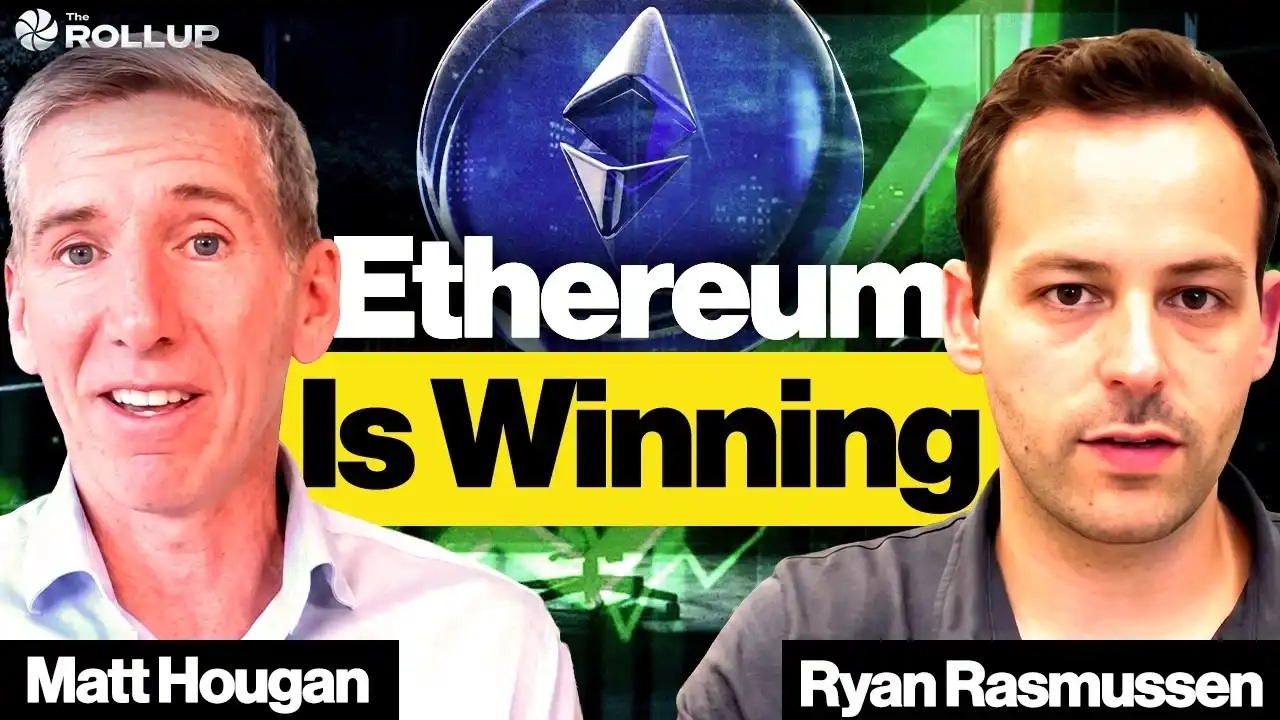
Invitados: Matt Hougan (Director de Inversiones de Bitwise), Ryan Rasmussen (Director de Investigación de Bitwise)

Anfitrión: The Rollup

Fuente del Podcast: The Rollup

Título original: Bitwise CIO & Research Head: Why Institutions Are Buying Ethereum Now (Majors vs Apps)

Fecha de emisión: 12 de agosto de 2026

Nota: La institución de los invitados, Bitwise, opera múltiples productos ETF de criptomonedas, por lo que sus opiniones tienen una inclinación estructural alcista; este artículo conserva sus juicios originales y no constituye un consejo de inversión.

Resumen de puntos clave

Durante la grabación de este episodio, Bitcoin rondaba los 65,000 dólares, más de la mitad de su retroceso desde el máximo de octubre del año pasado. Pero los dos ejecutivos de Bitwise veían otra cara: durante todo el verano, Saylor (fundador de MicroStrategy) vendía monedas, una billetera fría con cientos de millones de dólares fue robada, y la Ley Clarity quedó estancada en el Senado, pero Bitcoin no cayó. Interpretan este fenómeno como una característica de fondo: quienes podían vender ya lo han hecho, los que quedan son tenedores a largo plazo 'ride or die', y los verdaderos compradores importantes, las plataformas de gestión patrimonial de Wall Street, acaban de completar un período educativo de dos años y están a punto de comenzar a asignar.

Los invitados plantean un claro juicio divergente: el próximo mercado alcista se dividirá en dos segmentos. El capital institucional comprará activos principales como Bitcoin y Ethereum que puedan absorber grandes volúmenes de fondos, mientras que el capital nativo en cadena apostará por aplicaciones DeFi con ingresos reales (Hyperliquid, Uniswap, Aave, Morpho, etc.). Enfatizan especialmente que el mayor catalizador no está en el radar del ecosistema cripto, sino en los modelos de cartera de las cuatro grandes plataformas de gestión patrimonial —Morgan Stanley, Wells Fargo, UBS y BofA Merrill— que gestionan conjuntamente unos 20 billones de dólares en activos. Incluir solo un 1% a 2% de asignación a cripto significaría un flujo continuo de cientos de miles de millones de dólares. En el momento de esta compilación (13 de agosto), ETH ronda los 1,900 dólares, y los ETF spot han registrado cinco semanas consecutivas de entradas netas, con alrededor de 245 millones de dólares en la semana más reciente, el mayor flujo en casi cuatro meses; la SEC tiene programado revisar la propuesta Reg Crypto el 14 de agosto, una variable regulatoria discutida en este episodio está a punto de materializarse.

Extracto de puntos de vista destacados

Sobre el fondo del mercado

  • "Cuando el mercado deja de reaccionar por completo a las malas noticias, a menudo es una señal de que se ha tocado fondo." (Matt)
  • "Esta corrección desde el máximo es del 55%, no del 70% al 80% como en el pasado. Los ciclos se están comprimiendo, la volatilidad está disminuyendo." (Ryan)
  • "Los mercados bajistas siempre duran más de lo que piensas, pero un día te despiertas y puede que estés en un gran mercado alcista." (Matt)

Sobre la demanda de compra institucional

  • "El camino típico de nuestros clientes es tener ocho reuniones con nosotros antes de comenzar a asignar, y es posible que solo nos vean una vez al año; ese es un proceso educativo de dos años." (Matt)
  • "Ya no preguntan '¿deberíamos invertir en cripto?', sino '¿cuándo debemos invertir en cripto?'." (Ryan)
  • "Miran horizontes de 3 a 5 años, de 10 años, no de 3 a 5 días. El mercado tiene un nuevo tipo de inversor, y la volatilidad naturalmente disminuye." (Matt)

Sobre el mercado alcista divergente

  • "Bitcoin se parecerá cada vez más al oro, y Ethereum y Solana se parecerán cada vez más a acciones de empresas de software; simplemente deberían tener diferentes factores impulsores." (Ryan)
  • "Un Uniswap con una capitalización de mercado de 2,500 millones de dólares no puede absorber el dinero institucional; la escala de liquidez simplemente no coincide." (Matt)
  • "DeFi se convertirá en lo que pensamos que sería en el mercado alcista de 2021 en el próximo ciclo; los grilletes regulatorios ya se han soltado." (Ryan)

Sobre regulación y macroeconomía

  • "El primer borrador de reglas de Reg Crypto saldrá pronto, permitiendo que nuevos proyectos recauden fondos sin desencadenar el registro de la SEC, para luego avanzar gradualmente hacia la descentralización. Washington es más lento de lo que está acostumbrada la comunidad cripto, pero esto es algo real." (Matt)
  • "El gobierno de EE. UU. dice que pedirá prestados 600,000 millones de dólares en el cuarto trimestre, más que el paquete de rescate bancario de la Crisis Financiera Global, y esta tendencia a largo plazo no se detendrá." (Ryan)

I. El mercado ya no reacciona a las malas noticias, esto podría ser el fondo

Anfitrión: Todos en el mercado esperan una última caída en el verano y comprar en octubre, ¿qué opinan de este guion?

Matt dijo que había publicado un meme de Buzz Lightyear con el texto: el sentimiento colectivo de la comunidad cripto: un último lavado en el verano, una última caída, luego tocar fondo en octubre y subir desde ahí, todos listos para entrar a fin de octubre. Pero el mercado que él ve es diferente.

"Mi sensación más fuerte en los últimos dos meses es que el mercado ha dejado completamente de reaccionar a las malas noticias. Saylor vende Bitcoin, a Bitcoin no le importa; roban una billetera fría por cientos de millones, a Bitcoin no le importa; la Ley Clarity fracasa, a Bitcoin todavía no le importa. Cuando el mercado se vuelve completamente inmune a las malas noticias, a menudo es el momento real de tocar fondo."

Ryan añadió: En ciclos pasados, los mayores aumentos después de salir de un mercado bajista a menudo ocurrían en los primeros días; quienes intentaban cronometrar el fondo exacto se perdían los mejores días. En lugar de esperar Bitcoin a poco más de 50,000, es mejor aceptar una posibilidad: la mayor parte de esta corrección ya ha pasado.

II. El ciclo de cuatro años se está comprimiendo en una nueva forma

Anfitrión: Se dice que el ciclo de cuatro años tiene un año de máximo y un año de mínimo, ¿está cambiando esto ahora?

La observación de Ryan es que la 'amplitud' del ciclo se está comprimiendo. Esta corrección desde el máximo es del 55%; históricamente era común del 70% al 80%; la multiplicación al alcanzar nuevos máximos en el ciclo anterior también fue mucho menor que antes. 2025 fue un año de caída por sí mismo en términos de año natural, la vieja regla de 'tres años de subida, uno de bajada' ya no se ajusta.

La razón detrás es simple: los compradores han cambiado. Hace cuatro años eran minoristas, ahora con quienes Bitwise trata diariamente son instituciones, empresas, fondos soberanos y family offices. Sus horizontes de tenencia son diferentes, sus ritmos de decisión son diferentes, y este mercado es mucho más grande y líquido que antes. El patrón persiste, pero la forma definitivamente cambiará.

Matt dijo que los mercados bajistas siempre duran un poco más de lo esperado, pero "es fácil volver a 100,000 en pocos meses bajo las condiciones adecuadas". Repitió una palabra para describir el próximo mercado alcista: toro lento. Más lento, más basado en fundamentos, más institucional, subiendo poco a poco.

III. ¿Por qué la demanda de compra institucional es lenta? Ocho reuniones, un período educativo de dos años

Anfitrión: ¿Estos inversores entran principalmente a través de ETF? ¿Cómo han sido los flujos recientemente?

Los dos invitados confirmaron que los ETF son el canal principal para la entrada institucional, igual que compran acciones o bonos. Hasta finales de junio, los ETF de cripto tuvieron salidas netas, desde el 1 de julio se convirtieron en entradas netas relativamente sólidas, lideradas por Bitcoin y Ethereum, con poco flujo hacia Solana e Hyperliquid.

¿Por qué ahora? Matt dio un número frío: el cliente típico de Bitwise necesita en promedio ocho reuniones para tomar una decisión de asignación, y es posible que solo se reúnan una vez al año, lo que significa un proceso educativo de dos años. Los ETF de Bitcoin se aprobaron en enero de 2024; para este verano, el ciclo educativo de estas personas acaba de completarse.

"Sus comités de inversión piensan: ¿cómo hacemos que los 10,000 asesores financieros bajo ellos comiencen a asignar cripto? La respuesta es comenzar con Bitcoin, luego añadir un poco de Ethereum, por peso de capitalización de mercado. Siempre comienzas con Bitcoin."

IV. Mercado alcista divergente: Instituciones compran monedas principales, capital en cadena compra aplicaciones

Anfitrión: ¿Por qué ocurriría esta divergencia entre el capital institucional y el nativo en cadena?

Dos razones. Primero, falta de coincidencia en la escala de liquidez: el dinero de instituciones como UBS o Morgan Stanley no cabe en un Uniswap de 25 mil millones de dólares de capitalización; solo unos pocos de los activos más grandes pueden absorber capital a nivel institucional. Segundo, diferencia de mentalidad: las instituciones no tienen el 'trauma psicológico' de los nativos cripto; quienes tienen una asignación del 0% ven una corrección del 55% como un regalo, un mejor punto de entrada, mientras que quienes ya tienen posiciones ven dolor.

Por el contrario, el capital nativo en cadena entiende mejor cosas como los casi 1,000 millones de dólares de ingresos anuales de Hyperliquid, o que Uniswap y Morpho devuelven ingresos a los tenedores de tokens. Ryan dijo que esta narrativa de 'flujo de caja' aún no se ha transmitido completamente al lado institucional, pero llegará tarde o temprano, y los veteranos cripto tienen la oportunidad de adelantarse a las instituciones.

Anfitrión: ¿Ha regresado la narrativa de 'oro digital' de Bitcoin?

Ryan cree que Bitcoin se parece cada vez más al oro, y Ethereum, Solana, Hyperliquid se parecen cada vez más a acciones tecnológicas y empresas de software. La correlación entre Bitcoin y el oro ha aumentado notablemente en el último año, y las instituciones están usando marcos completamente diferentes para valorar estos dos tipos de activos. No cree que si uno sube, el otro baje, solo que divergirán cada vez más porque sus factores impulsores son fundamentalmente diferentes.

V. El mayor catalizador no está en la comunidad cripto: 20 billones de dólares llamando a la puerta

Anfitrión: ¿Hay algún catalizador que las instituciones estén esperando?

Matt señaló el lugar que menos atención recibe en Crypto Twitter: Morgan Stanley, Wells Fargo, UBS, BofA Merrill, las cuatro mayores plataformas de gestión patrimonial, que gestionan conjuntamente unos 20 billones de dólares en activos. Sus 'modelos de cartera', las plantillas de asignación estándar utilizadas por miles de asesores financieros, están siendo rediseñadas. Las cripto ya aparecen en pilotos a pequeña escala, como en Wells Fargo. Si los modelos de cartera dan una asignación del 1% al 2% a cripto, significaría un flujo de cientos de miles de millones de dólares, y sería anual, continuo durante años.

Ryan añadió un contexto más amplio: Ray Dalio recomienda una asignación del 15% a Bitcoin u oro, uno de los asesores financieros más exitosos de EE. UU., Ric Edelman, recomienda a sus clientes asignar del 20% al 40% a cripto, incluso Charles Schwab comienza a decir que puede haber un 6% de cripto en una cartera. Hace cinco años esto era impensable.

Conclusión de Matt: No solo miren las variables a las que está acostumbrada la comunidad cripto, como la Fed o la Ley Clarity. Los compradores más marginales en los próximos años estarán en los modelos de cartera de las plataformas patrimoniales; esas pequeñas noticias discretas desencadenarán flujos de cientos de miles de millones de dólares, sostenidos durante años.

VI. Macro: 600 mil millones en deuda y una Fed halcón

Anfitrión: ¿Rotará el dinero de la IA de vuelta a las cripto?

Ryan dijo que en los dos últimos años, el capital salió de las cripto y el oro y entró en las acciones estadounidenses impulsadas por la IA. Ahora el capital está saliendo de esa operación congestionada en busca de nuevos destinos. Su sensación al hablar con clientes institucionales es que nadie pregunta más '¿deberíamos invertir en cripto?', todos preguntan '¿cuándo?'.

La lógica a largo plazo no ha cambiado: el déficit fiscal de EE. UU. sigue ampliándose, el gobierno ha anunciado que pedirá prestados 600,000 millones de dólares en el cuarto trimestre, más que el paquete de rescate bancario de la Crisis Financiera Global, y esta tendencia se está acelerando. En cuanto a la Fed, las expectativas del mercado sobre subidas de tasas ya han disminuido, el discurso de Jackson Hole a fin de mes dará algo de dirección, pero el tono de la Fed halcón se está asimilando, y la presión de los precios del petróleo también se está atenuando. Con la disminución de la incertidumbre macroeconómica, las instituciones tienen confianza para realizar asignaciones entre activos, y las cripto se beneficiarán de la rotación de capital en Q4 y 2027.

VII. Preguntas rápidas: Ethereum a 8,000 dólares, HYPE a 500 dólares

Anfitrión: ¿Sus clientes compran más Bitcoin o Ethereum ahora?

Matt: Sigue siendo principalmente Bitcoin, el interés en Ethereum está aumentando, la emoción por las stablecoins y la tokenización es alta, pero el punto de partida siempre es Bitcoin.

Anfitrión: ¿Bitcoin a 180,000 en 2030?

Ambos dijeron 'over' (por encima). ¿Ethereum a 8,000? También 'over', pero Matt dijo "hay detalles que vale la pena desglosar aquí". ¿Zcash entre 25,000 y 30,000? Ambos dijeron 'under' (por debajo). La explicación de Ryan: No es que no sean optimistas sobre las monedas de privacidad, sino que el hecho de que todos los activos suban simplemente no es sostenible; Bitcoin hoy está solo en 65,000, llevarlo a millones para 2030 tomará más tiempo del que la gente piensa.

¿HYPE a 500 dólares, aproximadamente 10x, correspondiente a una valoración de unos 600 mil millones? Ambos respondieron incómodamente 'under'. Ryan recordó que, debido al mecanismo de recompra, la capitalización de mercado total al alcanzar ese precio podría ser mucho más baja de lo esperado; además, históricamente ha habido rotación entre tokens de plataforma, y ese es el mayor riesgo en una predicción a largo plazo para 2030.

Al preguntarles si preferían Robinhood (HOOD) o Hyperliquid (HYPE), hubo desacuerdo. Ryan prefería HYPE: capitalización de mercado más pequeña, ciclo más temprano, se beneficiaría del próximo mercado alcista. Matt quería ambas, pero consideraba HOOD como "un activo de nivel herencia que puedes comprar y guardar por diez años, una compañía increíble con una ejecución asombrosa".

Anfitrión: ¿Lighter a 30 o 50?

Ryan dijo que dentro de Bitwise hay varios optimistas sobre Lighter; el espacio de contratos perpetuos crecerá significativamente en los próximos años, 30 dólares se parece más a un techo que a un suelo. Matt sintió que era demasiado difícil predecir para una plataforma tan nueva y cedió su voto a Ryan.

Trending Cryptos

Related Questions

QSegún los ejecutivos de Bitwise, ¿cuál es una señal de que el mercado de criptomonedas podría haber tocado fondo?

ASegún Matt Hougan de Bitwise, una señal clave de que el mercado podría haber tocado fondo es que este ha dejado de reaccionar ante malas noticias, como grandes ventas de figuras conocidas, hackeos de carteras o estancamientos regulatorios. Cuando el precio de activos como Bitcoin se mantiene estable ante este tipo de eventos negativos, sugiere que la venta por parte de los tenedores débiles ha terminado y quedan principalmente los tenedores a largo plazo.

Q¿Cómo está cambiando el ciclo típico de cuatro años en los mercados de criptomonedas, según Ryan Rasmussen?

ARyan Rasmussen señala que el ciclo típico de cuatro años se está 'comprimiendo' en términos de amplitud. Mientras que en ciclos anteriores las caídas desde máximos podían ser del 70-80%, en este ciclo la corrección ha sido de aproximadamente un 55%. Además, los movimientos alcistas son menos pronunciados. Esto se atribuye a la entrada de nuevos inversores institucionales con horizontes de inversión más largos y diferente comportamiento que los inversores minoristas anteriores.

Q¿Cuál es el principal catalizador para la entrada de capital institucional masivo, que no está en el radar habitual de la comunidad cripto?

AMatt Hougan identifica como el mayor catalizador a los 'model portfolios' o carteras modelo de las grandes plataformas de gestión de patrimonios como Morgan Stanley, Wells Fargo, UBS y Bank of America Merrill Lynch. Estas plataformas gestionan colectivamente unos 20 billones de dólares. Si incluyeran una asignación del 1% al 2% a criptoactivos en sus carteras modelo estándar, generaría entradas de cientos de miles de millones de dólares, de manera sostenida durante años.

Q¿En qué se diferencia el comportamiento esperado del capital institucional y del capital nativo 'on-chain' en el próximo mercado alcista, según la visión de 'mercado bifurcado'?

ASegún los ejecutivos, se espera un mercado 'bifurcado'. El capital institucional (bancos, fondos) se dirigirá principalmente a activos de gran capitalización y liquidez como Bitcoin y Ethereum, ya que son los únicos que pueden absorber grandes volúmenes de dinero. Por otro lado, el capital nativo 'on-chain' (inversores más familiarizados con el ecosistema) se centrará en aplicaciones DeFi con ingresos reales y modelos de negocio, como Hyperliquid, Uniswap, Aave o Morpho, que ofrecen narrativas de 'flujo de caja'.

Q¿Qué proceso típico siguen los clientes institucionales de Bitwise antes de asignar capital a criptomonedas, y por qué esto explica el momento actual?

AMatt Hougan explica que el cliente institucional típico de Bitwise tiene un proceso educativo largo, con un promedio de ocho reuniones antes de tomar una decisión de inversión. Dado que suelen reunirse solo una vez al año, este proceso puede llevar unos dos años. Los ETF de Bitcoin se aprobaron en enero de 2024, por lo que en el verano de 2026, muchos de estos clientes han completado su ciclo educativo y están listos para comenzar a asignar capital, lo que coincide con el aumento de entradas en los ETF.

Related Reads

Gold Diggers in Prediction Markets: From Competing for Trading Entrances to Competing for Outcome Definition Rights

The report identifies a shift in prediction market competition from front-end user acquisition to back-end infrastructure, specifically the "outcome layer." This layer encompasses the standardized services for rule comparison, evidence verification, outcome confirmation, and payment triggering. Analysis shows that while a tiny fraction (0.487%) of markets face disputes, they account for a significant share (8.64%) of traded volume. This highlights the financial impact of rule uncertainty, which creates trading alpha but limits strategy capacity due to shallow order books. The larger opportunity lies in productizing these backend functions. Services like automated settlement (e.g., HIP-4), AI-assisted evidence processing, and external data oracles (e.g., Pyth, Chainlink) are becoming reusable, cross-platform infrastructure. This is creating a "second profit pool" separate from trading fees. Current observable revenue for this outcome layer is estimated at $15-37 million annually. If applied to the entire existing market, this could expand to $64-161 million. In a mature state, modeled after existing commercial models like Azuro's, annual revenue potential could reach approximately $456 million. While the industry logic is forming, pure-play investment assets are still early. Platform equities (e.g., Kalshi, Polymarket) price in broad growth, not just the outcome layer. Tokens like HYPE have minimal fee contribution from related products, and ICE's exposure is too small relative to its total business. The key is to track early projects that achieve cross-platform adoption and convert usage into attributable, recurring revenue. The most significant alpha may emerge before the ideal investment target is fully established.

marsbit23m ago

Gold Diggers in Prediction Markets: From Competing for Trading Entrances to Competing for Outcome Definition Rights

marsbit23m ago

Bitcoin Surpasses $72k. What Happens Next?

Bitcoin exceeded $72,000, reaching its highest level since early summer after a $8,000 surge. The broader crypto market followed, with total market capitalization rising 10%. Analysts attribute the rally to a combination of factors: the U.S. Treasury's decision to increase purchases of long-term government bonds, which lowers yields and makes riskier assets like crypto more attractive, and positive remarks about cryptocurrency from former President Donald Trump. Experts note that while Trump's comments provided an emotional boost, the Treasury's action was a more fundamental driver. However, they caution that significant sustained growth is not assured. High U.S. inflation limits the Federal Reserve's ability to ease policy, and network activity within crypto ecosystems remains low. Competition for capital from sectors like semiconductors and AI also persists. Analysts present mixed short-term forecasts. Some see resistance around $72,000; a breakout could target $76,000-$80,000, but a moderate, localized rise within a longer-term downward trend is deemed more likely. Others identify $69,000-$70,000 as a key support zone. A sustained move above $72,000 could open a path toward $75,000-$78,000, or even $80,000-$82,000 under a strong bullish scenario, with support expected around $66,000-$67,000 on any pullback. The overall outlook is cautiously optimistic, with the recent surge signaling improved sentiment, but a confirmed upward trend requires prices to solidify above current levels.

cryptonews.ru27m ago

Bitcoin Surpasses $72k. What Happens Next?

cryptonews.ru27m ago

Optimism Developers' Vote Deprives Users of $49 Million Airdrop

On August 19th, the Optimism community approved a proposal to reallocate 546.9 million OP tokens (worth ~$49.7 million) from a reserve for future user airdrops into a new Strategic Ecosystem Fund for development. The vote passed with 17.97 million OP for and 10.93 million against, with a decisive last-minute vote from developer group Test in Prod securing the majority. The funds will now be managed by the Optimism Foundation to foster ecosystem growth, targeting partnerships with blockchains, protocols, and financial firms, and attracting major brands. This marks a strategic shift from broad user acquisition via airdrops to focusing on corporate clients and enterprise solutions (OP Enterprise). The decision does not affect past airdrops, which distributed 269.1 million OP over five rounds. The proposal faced criticism. L2BEAT and delegate cp0x argued the Foundation gains overly broad discretion without sufficient detail on fund use, results measurement, or benefit to OP holders. Critics also noted these tokens were publicly reserved for future user distributions, and their reallocation removes the need for separate community votes on individual Foundation deals. Test in Prod defended its support, stating the reserve is needed for competitive corporate deals where premature disclosure could be detrimental, while urging the Foundation to later disclose aggregate spending and outcomes.

cryptonews.ru27m ago

Optimism Developers' Vote Deprives Users of $49 Million Airdrop

cryptonews.ru27m ago

Trading

Spot

Hot Articles

What is LINON

Linde plc Tokenized Stock (Ondo): Revolutionizing Traditional Equity Access Through Blockchain Innovation The emergence of Linde plc Tokenized Stock (Ondo), represented by the ticker $LINON, signifies a monumental shift in the fusion of traditional financial structures and decentralized finance (DeFi). This innovative financial instrument showcases the tremendous potential of blockchain technology to democratize access to traditional equity markets while ensuring the security and regulatory compliance necessary for institutional-grade financial products. Through Ondo Finance's pioneering tokenization platform, $LINON provides a seamless pathway for global investors to engage with one of the world's leading industrial gas companies, Linde plc, creating a blockchain-native representation of the underlying equity. Introduction to Linde plc Tokenized Stock The landscape of financial markets is witnessing a groundbreaking transformation through the tokenization of real-world assets. Linde plc Tokenized Stock (Ondo) epitomizes this revolutionary approach by bridging the gap between conventional stock ownership and blockchain-enabled financial infrastructure. The $LINON token allows investors to gain exposure to one of the prominent industrial companies worldwide through decentralized technology. Operating within Ondo Finance's comprehensive ecosystem, $LINON symbolizes a practical application of tokenization technology that enhances accessibility, efficiency, and global connectivity in traditional financial markets. By leveraging blockchain infrastructure, this tokenized stock enables international investors to participate in U.S. equity markets, overcoming traditional barriers associated with cross-border investing. The significance of $LINON goes beyond technological innovation; it represents a fundamental shift in asset structuring, distribution, and trading in the digital age. This tokenized stock maintains all the economic benefits associated with traditional Linde plc shares while offering improved liquidity, programmable compliance features, and seamless integration with decentralized finance protocols. The development of $LINON indicates a growing acceptance of blockchain technology as a viable means for traditional finance, exemplifying how even well-established assets like Linde plc can integrate into blockchain systems. This approach preserves the core attributes that appeal to investors while introducing advanced capabilities that enhance the overall investment proposition. Project Overview and Objectives Linde plc Tokenized Stock (Ondo) encapsulates a strategic effort to democratize access to traditional equity markets through advanced blockchain technologies. The primary objective of $LINON is to provide approved global investors seamless access to the economic exposure associated with Linde plc shares, furthering an effort to create a more inclusive financial ecosystem. Beyond the digital representation of traditional assets, $LINON endeavors to eliminate barriers of geography and time zones that limit investor participation. Its design ensures that blockchain technology can elevate traditional investment vehicles without undermining the security or compliance requirements expected by investors. Key goals of the project include enhanced liquidity provision, programmable compliance mechanisms, and interoperability with other blockchain networks. Each $LINON token is fortified by actual Linde plc securities housed at U.S.-registered broker-dealers, allowing holders to reap economic advantages akin to traditional stockholders, such as dividend reinvestment. Furthermore, $LINON aims to establish new industry standards for institutional-grade tokenized securities, paving the way for traditional assets to embrace blockchain technology while remaining compliant with regulatory frameworks. By associating itself with a company as reputable as Linde plc, the project opens avenues for exploring tokenized equities catering to both conservative institutional players and daring retail investors. Project Creator and Development Team The vision for Linde plc Tokenized Stock (Ondo) comes from Nathan Allman, founder and CEO of Ondo Finance. His background in traditional finance coupled with expertise in blockchain technology positions him uniquely to navigate the complexities of asset tokenization. Allman's academic journey began at Brown University, focusing on Economics and Biology, equipping him with valuable analytical skills. His time at Goldman Sachs in the Digital Assets division strengthened his understanding of the interplay between financial institutions and emerging technologies, laying the groundwork for his later endeavors in alternative investment strategies. Under Allman's guidance, Ondo Finance has emerged as a leader in asset tokenization, launching $LINON as a flagship example of the company's larger mission towards revolutionizing traditional financial systems using blockchain technology. His commitment to leveraging blockchain for creating institutional-grade financial products has shaped the landscape of real-world asset tokenization. Investment and Funding Structure The growth of Ondo Finance, the platform powering Linde plc Tokenized Stock (Ondo), is bolstered by robust financial backing from prestigious venture capital firms and strategic investors. This strong investment foundation underpins the development of the key infrastructure essential for compliant tokenized securities like $LINON. In August 2021, Ondo Finance secured $4 million in seed funding led by a major venture capital firm, which enabled the company to commence platform development and establish the necessary regulatory processes for tokenizing real-world assets. This early investment cemented Ondo Finance's credibility within the industry. The Series A funding round followed, garnering $20 million with participation from renowned firms committed to transformative technology companies. This backing demonstrated substantial institutional confidence in Ondo Finance's vision, allowing it to hone its approach to asset tokenization through mechanisms that ensure compliance and accessibility. Noteworthy contributors, including institutional investors and experienced partners, have added significant value to Ondo Finance’s development efforts. Their involvement underscores the confidence across sectors in Ondo Finance's approach to bridging traditional finance with blockchain innovations. Technical Infrastructure and Innovation The technical architecture that underpins Linde plc Tokenized Stock (Ondo) represents a sophisticated melding of traditional finance systems and cutting-edge blockchain technology. The architecture's foundation is built on the Ethereum network, renowned for its security and programmability—both critical for intricate financial instruments. The $LINON tokenization process comprises creating a blockchain-native representation of Linde plc shares that preserves economic benefits while augmenting investor capabilities. Each token corresponds to actual shares held at U.S.-registered broker-dealers, creating a compliant custody structure that legitimizes the asset's existence and value. Automated compliance systems are integrated into the tokenization process, managing critical components such as know-your-customer (KYC) verification and anti-money laundering (AML) protocols. This incorporation of programmable compliance empowers $LINON to uphold regulatory standards essential for institutional proliferation. Cross-chain interoperability characterizes the advanced technical features of $LINON. While initially deployed on Ethereum, the framework is designed for expansion to other networks such as Solana and BNB Chain. This adaptability enhances liquidity and accessibility, allowing investors to select their preferred blockchain ecosystems. Historical Timeline and Development Crafting the history of Linde plc Tokenized Stock (Ondo) unfolds in parallel with the evolution of Ondo Finance's tokenization platform. The timeline's inception dates back to March 2021 when Nathan Allman laid the foundations for creating institutional-grade financial products on blockchain infrastructure. The initial funding round in August 2021 provided crucial resources for developing the platform and establishing partnerships necessary for effective tokenization. By January 2023, Ondo Finance launched its tokenized treasury products, establishing mechanisms that would facilitate future tokenized equities such as $LINON. A pivotal milestone arose in February 2025 when Ondo Chain—a Layer 1 blockchain designed specifically for asset tokenization—was introduced. This infrastructure enhances capabilities vital for institutional markets, demonstrating Ondo Finance's long-term commitment to tokenization. Subsequently, the launch of Ondo Global Markets in September 2025 marked the official debut of $LINON. This milestone showcased the successful transition from development to active trading, enabling investors around the world to access American financial markets seamlessly. Ongoing development plans include a targeted expansion of available tokenized assets to over 1,000 by the end of 2025, pointing to a bright future for Ondo Finance's ecosystem and its mission to broaden tokenized equity accessibility. Regulatory Compliance and Legal Framework The legal architecture governing Linde plc Tokenized Stock (Ondo) emphasizes a sophisticated approach to regulatory compliance, allowing tokenized securities to be implemented within a blockchain-based framework. The legal structure governing $LINON spans multiple jurisdictions while maintaining a robust legal footing. Compliance systems ensure that only eligible investors can access the token, enforced through automated verification that aligns with international regulations. This innovative regulatory technology promises real-time enforcement of complex requirements, considerably enhancing efficiency in operating within the regulatory landscape. The custody framework undergirding $LINON ensures that the underlying shares are securely held at U.S.-registered broker-dealers, complying with necessary regulations while delivering blockchain-driven access to investors. The token maintains its economic equivalency and security through this carefully structured custody arrangement. KYC and AML compliance systems are embedded within the smart contract architecture, ensuring integrity and adherence to regulatory practices while fostering transparency for investors. The jurisdictional restrictions mark a commitment to navigating the evolving landscape of international securities laws. Market Impact and Industry Significance The advent of Linde plc Tokenized Stock (Ondo) holds profound implications for the broader financial landscape, symbolizing a clear shift towards blockchain-enabled markets. $LINON serves as a proof-of-concept for integrating traditional companies into blockchain ecosystems, showcasing the potential benefits such as broader accessibility and improved efficiency. The market's response to $LINON indicates a growing acceptance of tokenization among institutional investors, contributing to the emergence of an expanding sector wherein traditional assets can be interconnected with blockchain innovations. The success of $LINON further solidifies market confidence, indicating an overarching shift towards recognizing asset tokenization as a transformative force in finance. Future Development and Expansion Plans The future trajectory for Linde plc Tokenized Stock (Ondo) centers around the expansion of the tokenization ecosystem and enhanced infrastructure supporting blockchain-enabled financial services. Plans for cross-chain integration usher in new opportunities for liquidity and flexibility within the investment framework, with existing capabilities poised for continuous enhancement. With the introduction of Ondo Chain, Ondo Finance aims to transition $LINON to an optimized blockchain environment specifically designed for asset tokenization. This new infrastructure heralds exciting prospects for the development of institutional-grade financial products, ensuring ongoing compatibility with contemporary investment strategies. Further integration with decentralized finance protocols signifies a commitment to empowering $LINON holders through advanced financial strategies. The anticipated expansion of available tokenized assets promises to broaden investor access, enhancing the utility and appeal of the platform. In alignment with ambitions for regulatory expansion, ongoing efforts to secure approvals for new jurisdictions will enhance investor access, further positioning $LINON at the forefront of the burgeoning tokenization market. Conclusion Linde plc Tokenized Stock (Ondo), as represented by the $LINON token, stands at the intersection of traditional finance and blockchain innovation. It embodies a transformative milestone in how financial assets are structured, distributed, and engaged within modern investment ecosystems. The technical sophistication behind $LINON, combined with its regulatory compliance framework, illustrates that asset tokenization can improve financial infrastructure rather than simply digitizing existing products. This pioneering effort not only enhances investor access to U.S. equity markets but also signifies an evolution of how traditional financial services can integrate blockchain technology. As the asset tokenization market grows exponentially, with prospects suggesting significant valuation increases, $LINON paves the way for a future where tokenized securities become standard fixtures in the financial landscape. The trajectory of $LINON will undoubtedly influence how traditional finance adapts to a transformed, blockchain-powered world.

4.6k Total ViewsPublished 2025.12.05Updated 2025.12.05

What is LINON

What is CRMON

Salesforce Tokenized Stock (Ondo): Revolutionising Traditional Equity Access Through Blockchain Innovation The emergence of Salesforce Tokenized Stock (CRMON) marks a pivotal advancement in integrating traditional financial markets with blockchain technology. This innovative approach offers investors unprecedented access to equity exposure through tokenisation. Developed by Ondo Finance, CRMON provides tokenholders with economic exposure equivalent to holding Salesforce stock (CRM) while automatically reinvesting dividends. This effectively bridges the gap between conventional equity markets and decentralised finance (DeFi). Introduction and Comprehensive Overview of Salesforce Tokenized Stock In recent years, the financial landscape has dramatically transformed due to blockchain technology, fundamentally altering how investors access and interact with traditional assets. The development of Salesforce Tokenized Stock (CRMON) is a prime example of this evolution, representing a sophisticated fusion of conventional equity markets with cutting-edge distributed ledger technology. CRMON is a tokenised version of Salesforce stock, emerging from the innovative work of Ondo Finance, a leading platform in the real-world asset tokenisation sector that positions itself as a bridge between traditional finance and decentralised systems. Designed to provide tokenholders with economic exposure that mirrors the performance of the underlying Salesforce stock, CRMON incorporates automatic dividend reinvestment mechanisms. This eliminates many traditional barriers associated with international equity investment, such as complex brokerage relationships, currency conversion challenges, and restricted trading hours. The tokenisation process reimagines stock ownership as a blockchain-native asset while maintaining its economic equivalence with the underlying security, offering enhanced portability and integration capabilities within decentralised finance ecosystems. CRMON transcends its individual utility as an investment instrument to represent a fundamental shift in how financial markets can operate in an increasingly digital world. By maintaining full backing through U.S.-registered broker-dealers and implementing robust compliance frameworks, CRMON demonstrates that tokenised securities can achieve the regulatory standards necessary for institutional adoption while delivering the technological advantages of blockchain infrastructure. Understanding Tokenized Real-World Assets and CRMON's Strategic Position Tokenised real-world assets signify one of the most significant innovations in modern finance, fundamentally reimagining how traditional securities are represented, traded, and utilised within digital ecosystems. CRMON operates as a tokenised equity instrument correlating directly with Salesforce stock while optimising accessibility and efficiency. This aligns with Ondo Finance's broader mission to democratise access to institutional-grade financial products through innovative tokenisation strategies. The tokenisation process guarantees complete economic equivalence with the underlying Salesforce equity. Each CRMON token represents a proportional claim on Salesforce stock held by qualified custodians, with dividend payments automatically reinvested to maintain continuous exposure to total return performance. This structure simplifies dividend management and ensures that tokenholders receive the full economic benefit of their equity exposure, encompassing both capital appreciation and income generation. Ondo Finance's strategy in tokenising Salesforce stock demonstrates its expertise in creating compliant, institutional-grade products that meet traditional financial markets' stringent requirements. The platform’s focus on merging regulatory compliance with blockchain benefits positions it at the forefront of decentralised finance, captivating both institutional and retail investors seeking blockchain-native solutions. The Technology and Innovation Framework Behind CRMON The technological infrastructure supporting CRMON integrates blockchain technology with traditional financial mechanisms, delivering institutional-grade security and compliance while maintaining the operational advantages of decentralised systems. Built on the Ethereum blockchain, CRMON utilises robust smart contract capabilities to ensure transparent, secure operations. The smart contract architecture incorporates layered security and compliance mechanisms, enabling automated compliance checks and real-time asset backing verification. Integration with oracle services maintains accurate pricing and dividend information, ensuring CRMON reflects the underlying Salesforce stock's accurate performance. This architecture delivers automated dividend reinvestments and other corporate actions, eliminating manual processing requirements and directly enhancing tokenholder benefits. Ondo Finance ensures CRMON's security structure includes daily third-party verification of holdings, independent collateral agents, and a multiple-layer custody system through partnerships with established financial institutions. This framework safeguards tokenholder interests against operational risks while providing robust asset backing. The user interface enhances integration capabilities, allowing seamless interaction between CRMON and various decentralised finance protocols, as well as cryptocurrency exchanges. This interoperability enables users to leverage their tokenised equity across multiple platforms, creating sophisticated investment strategies that marry traditional equity characteristics with blockchain-native innovation. Leadership and Corporate Structure of Ondo Finance The leadership team behind CRMON and Ondo Finance blends expertise from traditional finance and blockchain technology, presenting a robust combination of skills essential for successfully bridging conventional markets with decentralised finance. Nathan Allman, the founder and CEO, emerged from a distinguished financial background before establishing Ondo Finance in 2021. Allman's experience includes notable roles at major financial institutions, including significant contributions to developing cryptocurrency market services. His insights into regulatory compliance were paramount in developing products like CRMON that successfully unify traditional securities with blockchain technology. With a team of professionals boasting substantial experience in both conventional finance and blockchain sectors, Ondo Finance's leadership comprises diverse expertise that covers every aspect of tokenised asset development. Justin Schmidt serves as President and COO, contributing unique operational expertise, while Chris Tyrell brings essential compliance knowledge. Investment Landscape and Funding History The investment landscape surrounding Ondo Finance reflects significant institutional confidence in its mission to tokenise real-world assets. The company has raised substantial funds through various investment rounds, attracting leading venture capital firms and strategic investors that recognise the transformative potential of tokenised securities like CRMON. Notably, Ondo Finance completed a successful Series A funding round in 2022, led by well-known venture capital firms. This funding success validates Ondo Finance's innovative approach to creating compliant, institutional-grade tokenised products. In total, Ondo Finance has successfully secured substantial funding, raising significant capital for product development and market expansion, including a noteworthy token sale that reinforced its governance structure through the establishment of the ONDO token. The diverse composition of investors reflects broad market confidence in Ondo Finance's business model, demonstrating support from both traditional and blockchain-native organisations. Operational Mechanics and Technical Implementation The operational framework supporting CRMON exemplifies sophisticated integration of traditional financial mechanisms with blockchain technology. The technical implementation introduces multiple layers of security, compliance, and operational efficiency to meet institutional standards while enhancing accessibility. The tokenisation process begins by acquiring actual Salesforce stock through U.S.-registered broker-dealers, ensuring each CRMON token maintains direct correlation with the underlying equity performance. Smart contracts automate operational processes, including dividend reinvestment and corporate action processing, facilitating a streamlined user experience. The Minting and redemption processes allow authorised participants to manage CRMON tokens effectively. During U.S. trading hours, institutions can mint new tokens by depositing stablecoins that are used to purchase corresponding Salesforce equity. This structure maintains a tight correlation with underlying assets, enhancing liquidity and price discovery. Additionally, the infrastructure supports twenty-four-hour token transfer capabilities, providing CRMON holders with operations outside traditional market hours. This represents a significant advantage over conventional securities ownership, thus promoting integration with decentralised finance applications. Plans for cross-chain compatibility through partnerships signal further ambitions for CRMON's market reach. By expanding to other blockchain networks, Ondo Finance aims to enhance accessibility and user engagement with tokenised equity products. Timeline and Historical Development of Tokenized Equity Innovation The timeline of CRMON's development and Ondo Finance's broader tokenised capabilities demonstrates a systematic innovation process beginning with the company's founding in 2021. 2021: Ondo Finance is founded by Nathan Allman and co-founders, launching initial products focused on structured vault offerings on the Ethereum blockchain. 2022: The company completes substantial funding rounds—both equity and token sales—totaling significant capital and launching initial tokenised U.S. Treasury products. 2023-2024: Ondo Finance experiences substantial growth, establishing partnerships with major financial institutions while expanding its product offerings beyond fixed-income securities. February 2025: Ondo Global Markets is announced, marking the transition into equity tokenisation with plans for accessing over one hundred U.S. stocks and ETFs. September 2025: The official launch of Ondo Global Markets includes CRMON alongside other tokenised equity offerings, marking a significant evolution in Ondo Finance's product ecosystem. This timeline highlights the organisation's rapid growth and its capability to adapt its technological and compliance frameworks to accommodate different asset classes effectively while maintaining security and regulatory integrity. Regulatory Framework and Compliance Approach Ondo Finance's regulatory framework showcases a sophisticated compliance strategy, essential for achieving institutional adoption in the tokenised securities market. The company's strong partnerships with U.S.-registered broker-dealers promote adherence to Securities and Exchange Commission regulations and apply robust investor protections. Acquisitions, such as Oasis Pro—a registered broker-dealer—significantly enhance Ondo Finance's compliance capabilities, ensuring thorough alignment with existing regulatory structures. The company employs independent verification procedures that foster transparency, aiming for a solid performance standards reputation. Furthermore, Ondo Finance's commitment extends to international regulatory compliance, ensuring token access remains restricted to eligible investors while adhering to pertinent cross-border securities regulations. Comprehensive attention to tax implications and reporting requirements fortifies the security and compliance landscape of CRMON, ensuring that investor obligations remain manageable. Future Prospects and Market Positioning The forward-looking landscape for CRMON and Ondo Finance illustrates substantial growth opportunities driven by institutional adoption of blockchain technology and escalating demand for efficient alternatives to conventional securities ownership. Market projections indicate the tokenised asset sector could value multiple trillion dollars by 2030. With plans to scale CRMON offerings significantly and integrate it with a dedicated blockchain infrastructure—Ondo Chain—Ondo Finance aims to elevate its institutional-grade tokenised asset operations. Additionally, the development of strategic partnerships enhances distribution capabilities while establishing the company's credibility in the financial market. Furthermore, the integration of tokenised equity with decentralised finance protocols offers new potential for innovative financial products and strategies previously impossible with traditional securities. These factors underscore CRMON's positioning to effectively capture increased market share and deliver innovative solutions for international investment exposure. Conclusion Salesforce Tokenized Stock (CRMON) symbolises a transformative development within financial markets, successfully bridging traditional equity ownership with blockchain technology to create unprecedented accessibility for global investors. Through Ondo Finance's sophisticated tokenisation framework, CRMON provides complete economic exposure to Salesforce equity performance while enhancing operational advantages that exceed traditional ownership. The launch of CRMON reflects the broader evolution of financial markets towards blockchain infrastructures that maintain regulatory compliance while delivering increased efficiency. Ondo Finance's extensive approach to regulatory adherence, institutional-grade security, and technological innovation solidifies CRMON as a model for future tokenised securities, delivering access previously unattainable in conventional brokerage structures. As the tokenised asset sector continues to develop, CRMON is well-positioned to address historical inefficiencies in capital markets while providing investors with innovative solutions for accessing traditional securities. The outlook for CRMON looks exceptionally promising, supported by ambitious expansion plans, technological innovations, and strategic partnerships, thereby representing a pioneering model of modern financial infrastructure evolving through blockchain integration.

4.7k Total ViewsPublished 2025.12.05Updated 2025.12.05

What is CRMON

What is SHOPON

Shopify Tokenized Stock (Ondo): A Comprehensive Analysis of Real-World Asset Tokenization in Web3 This article delves into the Shopify Tokenized Stock (Ondo), recognised by its ticker symbol $SHOPON, exploring its implications at the intersection of traditional finance and blockchain technology. As a part of Ondo Finance's tokenized securities platform, Shopify’s tokenized stock exemplifies advancements in democratizing access to global capital markets through innovative digital assets. Introduction and Overview of Shopify Tokenized Stock (Ondo) Shopify Tokenized Stock (Ondo), or $SHOPON, portrays a pivotal innovation in the realm of tokenized securities, allowing investors to gain economic exposure akin to directly owning shares of Shopify Inc. This token, developed under the umbrella of Ondo Finance, not only provides investors with the ability to hold digital representations of the company’s stock but also integrates features such as automatic reinvestment of dividends. This advancement represents a substantial shift in the landscape of decentralized finance (DeFi), linking conventional equity markets with blockchain solutions designed to enhance accessibility, transparency, and liquidity. By eliminating geographical barriers and enabling 24/7 trading capabilities, $SHOPON is positioned as a bridge connecting traditional financial instruments and the emerging Web3 ecosystem. What is Shopify Tokenized Stock (Ondo), $SHOPON? The $SHOPON token serves as a digital manifestation of Shopify Inc.'s shares, engineered to provide a direct correlation to the underlying asset's performance. Through the utilization of blockchain technology, the token gives holders a mechanism to participate in the economic benefits associated with equity ownership, including capital appreciation and dividend distribution. The unique aspect of $SHOPON lies in its automatic dividend reinvestment mechanism, which allows returns to compound without necessitating active management by the investor. This feature inherently enhances its attractiveness as an investment vehicle, particularly for individuals seeking passive income growth alongside exposure to high-performing equities. The tokenization process is facilitated by the custody of actual Shopify shares through regulated intermediaries, ensuring that every $SHOPON token is verifiably backed by real equity. This structure empowers investors with the dual advantages of both traditional financial characteristics and the innovative benefits tied to blockchain technology. Who is the Creator of Shopify Tokenized Stock (Ondo)? The creator of Shopify Tokenized Stock (Ondo), Nathan Allman, is an experienced figure in the finance sector, formerly associated with Goldman Sachs. His rich background includes significant expertise in digital asset development, bridging the gap between traditional finance and cryptocurrencies. Allman’s educational journey, marked by studies at Brown University, provided him with a deep understanding of economics and biology, equipping him with analytical skills that inform his strategic vision. In 2021, he founded Ondo Finance, committing to developing tokenized securities that meet institutional-grade standards while leveraging blockchain's transformative capabilities. Under Allman's leadership, Ondo Finance has focused on creating compliant and innovative financial products that empower a diverse investor base. Who are the Investors of Shopify Tokenized Stock (Ondo)? The investment landscape surrounding Shopify Tokenized Stock (Ondo) is notably robust, underpinned by significant institutional support. Primarily, Pantera Capital stands out as a strategic partner through the Ondo Catalyst initiative, a $250 million commitment aimed at accelerating the development of on-chain capital markets. This partnership not only signifies institutional confidence in the potential of tokenized assets but also reinforces Ondo Finance's operational capabilities and market positioning. The funding pathways have included earlier rounds that amassed millions in seed funding and further structural investments, solidifying relationships with both venture capital firms and private investors. Moreover, the financial framework is complemented by strategic partnerships with established financial institutions and technology companies, enhancing Ondo’s infrastructure and operational expertise. How Does Shopify Tokenized Stock (Ondo), $SHOPON Work? At the core of $SHOPON's operational framework is a sophisticated system integrating traditional finance mechanisms with blockchain technology. The custody of actual Shopify shares ensures that token holders retain authentic economic exposure, safeguarding their investments in line with recognized legal structures. The smart contracts employed in managing $SHOPON handle various functions, including automatic dividend reinvestment and ownership transfer, offering instant settlement and increased liquidity, marking a significant departure from conventional trading systems plagued by multi-day settlement delays. By providing interoperability with other decentralized finance applications, $SHOPON empowers holders with potentially lucrative opportunities for advanced investment strategies, including lending and automated market making. This complex integration presents a unique value proposition, catering to both traditional and crypto-native investors. The innovative structure of $SHOPON also allows for real-time settlements and transactions documented on the blockchain, delivering unparalleled transparency and security—a major advancement over standard equity trading practices. Timeline of Shopify Tokenized Stock (Ondo) March 2021: Nathan Allman establishes Ondo Finance, initially focusing on decentralized finance yield optimization. August 2021: Completion of a $4 million seed funding round led by Pantera Capital. January 2023: Launch of initial tokenized treasury security products, laying the groundwork for future equity tokenization. July 2025: Announcement of the Ondo Catalyst initiative, a strategic investment program valued at $250 million, aimed at propelling the development of tokenization in capital markets. September 3, 2025: Launch of Ondo Global Markets featuring over 100 tokenized U.S. stocks and ETFs, including $SHOPON. Technical Implementation and Blockchain Infrastructure Shopify Tokenized Stock (Ondo) operates on a technical architectural framework that marries blockchain protocols with traditional financial custody arrangements. The ecosystem leverages Ethereum's smart contract capabilities, providing seamless transaction management while ensuring compliance with regulatory standards through established financial custodians. Central to this architecture are security measures and transparent transaction records that affirm the legitimacy of each tokenholder's economic stake. With automated features managed by intricate smart contracts, $SHOPON not only streamlines ownership transfers but also allows for the tactical reinvestment of dividends—a hallmark of modern investment strategies. Moreover, the incorporation of LayerZero technology facilitates cross-chain interoperability, making $SHOPON accessible across multiple blockchain environments while preserving its functional robustness. This forward-thinking technical design positions $SHOPON as an adaptable asset within the larger DeFi milieu. Regulatory Framework and Compliance Architecture $SHOPON's regulatory framework is built upon the meticulous navigation of existing financial regulations that govern securities. The custody arrangements for the underlying Shopify shares are managed by U.S.-regulated broker-dealers, ensuring compliance and protection for investors. By maintaining a separation between the blockchain tokenization process and traditional custody, $SHOPON adheres to legal requirements while offering innovative functionalities that challenge conventional constraints. This dual-layered compliance approach enhances investor confidence and underscores Ondo Finance's commitment to regulatory integrity. Notably, the availability of $SHOPON is tailored to international investors from regions such as Asia-Pacific, Europe, and Africa, as regulatory parameters in the U.S. and U.K. present challenges in accessing tokenized securities. Market Access and Global Distribution Strategy The distribution strategy of $SHOPON is keenly designed to optimize global access while conforming to regulatory standards. The platform aims to establish comprehensive coverage for eligible investors across multiple regions, effectively dismantling traditional barriers through the implementation of blockchain technology. Integration with various cryptocurrency wallets and exchanges also promotes user-friendliness and accessibility, establishing a streamlined experience for investors to manage their holdings. Moreover, the 24/7 trading capabilities afforded by the tokenized model allow participants to react promptly to market shifts, fundamentally transforming how global equities are accessed and traded. Technology Integration and Cross-Chain Functionality The remarkable technological underpinnings of $SHOPON propagate its multi-chain functionality, set to expand its reach beyond Ethereum to networks such as Solana and BNB Chain. Such cross-chain capabilities allow users flexibility when navigating between blockchains, concurrently leveraging distinct network attributes to optimize their trading experience. LayerZero serves as the backbone for ensuring decentralized transfers between networks while providing the requisite security and speed, quintessential for maintaining investor trust. This comprehensive interoperability illustrates $SHOPON's commitment to being a versatile, user-centric asset in the evolving investment landscape. Ecosystem Integration and DeFi Compatibility Incorporating $SHOPON into broader DeFi protocols signifies its potential beyond traditional stock ownership. Token holders can leverage their holdings for various sophisticated strategies and applications, enhancing investment returns and liquidity management. By establishing a presence in lending protocols and automated trading systems, $SHOPON effectively democratizes access to advanced financial strategies previously limited to institutional investors. Such integration contributes to a more competitive and dynamic financial landscape, where individual investors can capitalize on tools typically reserved for larger entities. Risk Management and Security Framework Security remains paramount in the operational infrastructure of $SHOPON. The tokenization framework employs multiple layers of protection—beginning with regulated custody of the underlying Shopify shares. The operational protocols establish rigorous auditing, key management, and transaction monitoring standards, thus safeguarding against potential vulnerabilities. Moreover, meticulous adherence to evolving regulatory requirements provides an extra layer of security, fortifying investor protections and institutional compliance. Market Impact and Industry Implications The introduction of Shopify Tokenized Stock (Ondo) heralds a transformative shift in how financial markets operate, emphasizing the potential of tokenized securities to reshape traditional investment paradigms. The successful integration of $SHOPON encapsulates the efficiencies inherent in blockchain technology and opens avenues for new user demographics previously barred from extensive market participation. The impact extends beyond the immediate benefits to token holders, indicating broader trends that may challenge the status quo of investment services, particularly in addressing geographic restrictions and operational costs typically associated with traditional brokerage platforms. Undeniably, $SHOPON encapsulates the potential for traditional institutions to innovate further, leveraging the increasing demand for seamless blockchain access to complement existing financial infrastructure. Future Development Roadmap and Strategic Vision As Ondo Finance looks forward, the trajectory of $SHOPON rests on ambitious goals aimed at broadening the spectrum of available tokenized assets significantly. Over the next few years, plans are in place to expand to more than 1,000 tokenized securities, further enhancing market participation and investment options for individuals worldwide. Continued integration with traditional financial actors, development of specialized institutional products, and enhancements in automated trading capabilities will ensure that $SHOPON maintains its position at the forefront of financial innovation. Regulatory collaboration will also remain a focal point, establishing a framework that not only supports the compliance requirements but also promotes a healthy environment for tokenized asset proliferation. Conclusion and Market Significance In summary, Shopify Tokenized Stock (Ondo), represented by the ticker $SHOPON, is more than merely a tokenized equity offering; it embodies the innovation possible when traditional finance collides with modern blockchain applications. With a robust technical architecture, a commitment to compliance, and a clear strategic vision, $SHOPON exemplifies the potential for tokenized assets to enhance liquidity, accessibility, and functionality in capital markets. As the global investment landscape evolves, the transformative implications of $SHOPON extend beyond individual investors to revolutionize how financial instruments are perceived, traded, and utilized within both traditional and decentralized frameworks.

4.7k Total ViewsPublished 2025.12.05Updated 2025.12.05

What is SHOPON

Discussions

Welcome to the HTX Community. Here, you can stay informed about the latest platform developments and gain access to professional market insights. Users' opinions on the price of LAYER (LAYER) are presented below.

活动图片