La bourse sud-coréenne s'effondre à nouveau, dernier commentaire de la Maison Bleue

marsbitPublished on 2026-08-06Last updated on 2026-08-06

Abstract

La bourse sud-coréenne a connu une forte baisse jeudi, avec l'indice KOSPI perdant plus de 4%. Les poids lourds SK Hynix et Samsung Electronics ont chuté de plus de 8% et 5% respectivement, entraînant également les ETF à levier sur ces titres à Hong Kong. La vague de vente fait suite aux prévisions décevantes des géants du stockage américains, SanDisk et Western Digital, publiées mercredi. Leurs perspectives pour le trimestre à venir, bien que solides, n'ont pas répondu aux attentes de croissance plus élevées du marché, provoquant un repli de leurs actions. Cette pessimisme s'est rapidement propagé aux marchés asiatiques, où les investisseurs étrangers ont procédé à d'importantes ventes nettes. Face à la volatilité du marché, le gouvernement sud-coréen est intervenu. Après des accusations portées contre un haut responsable concernant l'introduction précipitée d'ETF à levier, le bureau présidentiel (Bleu House) a indiqué surveiller attentivement la situation et préparer des mesures. Les régulateurs ont récemment relevé les exigences de marge pour ces ETF, entraînant une chute brutale de leur volume d'échanges. Les avis des analystes sont partagés. Morgan Stanley voit la fin des liquidations de levier et une opportunité d'entrée, tandis que CITIC Securities anticipe une volatilité persistante. Malgré des prévisions à court terme prudentes, soulignant une phase de consolidation pour le secteur des semi-conducteurs mémoire, certaines institutions comme Goldman Sachs restent tr...

Jeudi, le marché boursier sud-coréen a fortement baissé.

À la date de publication, l'indice KOSPI de Corée du Sud a chuté de plus de 4%, s'établissant à 6322,55 points. Parmi les valeurs, SK Hynix a chuté de plus de 8% et Samsung Electronics de plus de 5%.
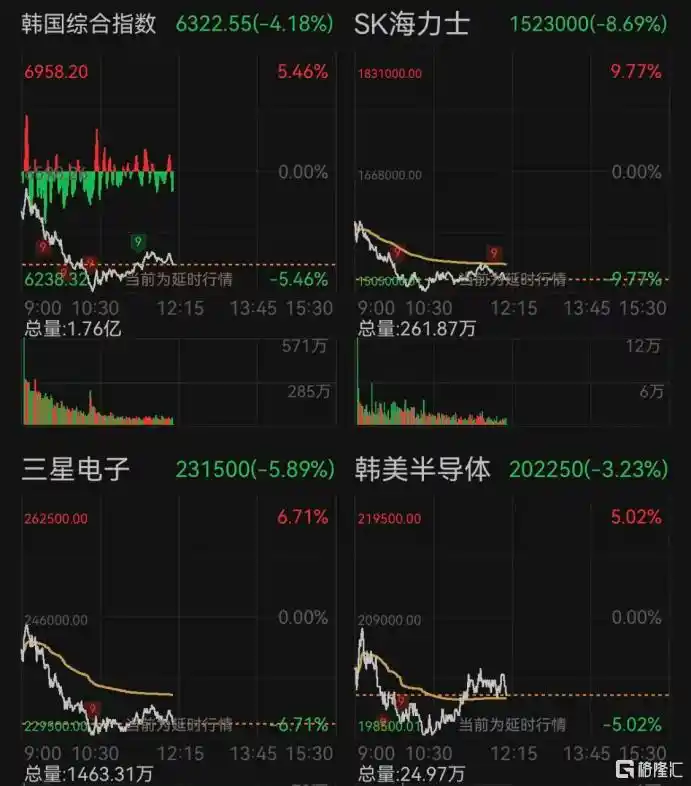
Sur le marché de Hong Kong, le levier double long sur Hynix (ETF) a chuté de plus de 15%, et le levier double long sur Samsung de plus de 11%.

Les perspectives désastreuses des géants américains du stockage

Le déclencheur de cette vague de ventes pointait directement vers la "révélation catastrophique des prévisions de résultats" dans le secteur du stockage aux États-Unis la veille.

Après la clôture mercredi à Wall Street, SanDisk et Western Digital ont tous deux publié leurs derniers résultats financiers.

Les résultats ont montré que les performances des deux géants du stockage au dernier trimestre étaient étonnamment solides, mais leurs prévisions pour le trimestre en cours n'ont pas répondu aux attentes de croissance encore plus explosives de Wall Street.

SanDisk prévoit un chiffre d'affaires de 10,3 à 10,8 milliards de dollars pour le prochain trimestre, inférieur aux attentes des analystes de 11,16 milliards de dollars ; Western Digital prévoit un chiffre d'affaires compris entre 4,0 et 4,2 milliards de dollars pour le prochain trimestre, légèrement supérieur aux attentes des analystes de 4,04 milliards de dollars.

« Le passé meilleur que prévu » n'a pas complètement compensé « un futur légèrement inférieur aux attentes ».

Après la publication des résultats, les deux géants du stockage ont été confrontés à de fortes ventes, SanDisk chutant de plus de 8% et Western Digital de plus de 11%.

Les prévisions pessimistes des géants du stockage se sont rapidement propagées aux marchés asiatiques via la chaîne d'approvisionnement.

Jeudi, après l'ouverture du marché sud-coréen, SK Hynix et Samsung Electronics ont subi de fortes pressions de vente.

Les données montrent que jusqu'à la veille, les investisseurs étrangers avaient accumulé un achat net de 1,4513 trillion de wons d'actions sur le marché boursier composite coréen, mais le 6, ils ont effectué des ventes nettes dépassant 5000 milliards de wons sur ce marché.

Les analystes indiquent que les marchés asiatiques doivent finalement suivre l'humeur de Wall Street, sans avoir le pouvoir de fixer les prix.

Han Ji-young, chercheur chez Mirae Asset Securities, a déclaré qu'en dépit des améliorations géopolitiques et macroéconomiques, sous l'influence de la faiblesse de l'indice des semi-conducteurs de Philadelphie et des prises de bénéfices après la hausse rapide et à court terme des cours, le marché connaîtra très probablement une pause temporaire et une rotation sectorielle.

« Les fluctuations anormalement amplifiées observées lors de l'effondrement de juillet ont dépassé leur pic. »

Dernier commentaire de la Maison Bleue

Il est à noter que depuis son pic historique du 19 juin, le marché boursier sud-coréen a chuté de manière fluctuante. Au cours du dernier mois, l'indice KOSPI de Corée du Sud a cumulé une baisse de 21,17%.
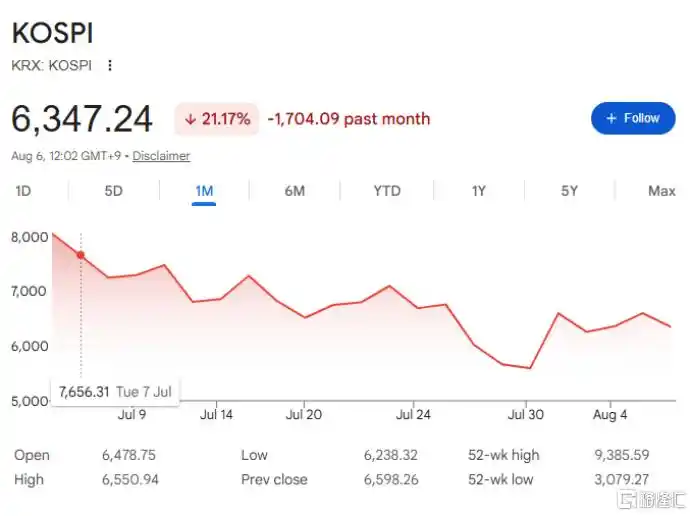
Face aux fluctuations violentes du marché, le gouvernement sud-coréen est en mode "sauvetage" d'urgence.

Précédemment, le directeur du Bureau des politiques du Bureau présidentiel sud-coréen, Kim Yong-beom, a fait face à des accusations pénales pour "l'introduction précipitée des ETF à effet de levier".

En réponse, le secrétaire principal aux relations publiques et à la communication du Bureau présidentiel, Seong Gi-hong, a déclaré dans son dernier commentaire qu'il était plus important pour le moment d'observer attentivement la situation du marché et de formuler des mesures de réponse appropriées.

« Tous les responsables concernés du Bureau présidentiel examinent minutieusement chaque situation et étudient très prudemment comment formuler les mesures pertinentes. »

Vendredi dernier, les autorités de régulation financière sud-coréennes ont relevé les exigences minimales de couverture en espèces pour les investissements dans les ETF à effet de levier sur actions individuelles.

Après la mise en place de mesures restrictives par les régulateurs, le volume des transactions sur les ETF à effet de levier sur actions sud-coréennes a chuté brutalement.

Les dernières données publiées par la Bourse de Corée montrent que le volume quotidien moyen des transactions des 16 ETF à effet de levier sur actions individuelles est tombé à 9198 milliards de wons mercredi, franchissant pour la première fois depuis leur introduction le 27 mai la barre des 10000 milliards de wons.

Morgan Stanley souligne que les fortes liquidations liées à l'effet de levier sont presque terminées, et que la valorisation du KOSPI est tombée à des niveaux historiquement bas, offrant aux investisseurs un moment d'entrée plus attractif.

Cependant, CITIC Securities a un avis différent sur la question.

L'institution estime que si l'effet de levier des investisseurs particuliers sud-coréens s'est rapidement réduit, les soldes de financement sur marge continuent de se contracter au rythme le plus rapide de l'année, et le taux de ventes forcées reste bien supérieur aux niveaux normaux. Elle prévoit que la volatilité du marché restera élevée par la suite.

Pour l'avenir, les analystes estiment que après un long marché haussier, le secteur mondial des semi-conducteurs de stockage est entré dans une phase de haute sensibilité et de forte volatilité, nécessitant du temps pour digérer les chocs émotionnels à court terme.

À moyen et long terme, Goldman Sachs maintient fermement son objectif de 12000 points pour l'indice KOSPI, prévoyant une hausse d'environ 80% à 90% restante pour le marché.

La banque estime que la valorisation actuelle du marché ne reflète pas la pénurie potentiellement sévère de puces mémoire qui pourrait persister jusqu'en 2030. Avec l'accélération de la demande de calcul pour l'IA, l'industrie des semi-conducteurs, qui représente plus de 50% du poids du KOSPI, deviendra le moteur de profit mondial.

JPMorgan maintient également un jugement optimiste sur SK Hynix et le secteur des puces mémoire, considérant ce repli comme une opportunité d'augmenter les positions.

Cet article provient du compte WeChat officiel "Gelonghui APP" (ID : hkguruclub), auteur : L'équipe éditoriale de Gelonghui.


Trending Cryptos

Related Questions

QQuel a été le déclencheur principal de la forte baisse des marchés boursiers sud-coréens décrite dans l'article ?

ALe déclencheur principal a été la publication des perspectives de résultats décevantes ("guidance") des géants américains du stockage, SanDisk et Western Digital, après la clôture des marchés américains. Cela a déclenché une vague de ventes qui s'est propagée aux marchés asiatiques.

QComment le gouvernement sud-coréen, via la Maison Bleue, a-t-il répondu à la volatilité du marché ?

ALe secrétaire principal à la communication de la Maison Bleue, Seong Gi-hong, a déclaré que la priorité était d'observer attentivement la situation du marché et de formuler des mesures de réponse appropriées. Parallèlement, les régulateurs financiers ont relevé les exigences de marge minimale pour les ETF à effet de levier sur actions individuelles, ce qui a fait chuter leur volume de transactions.

QSelon l'analyse citée, pourquoi les marchés asiatiques comme la Corée du Sud sont-ils particulièrement sensibles aux performances du secteur technologique américain ?

AL'analyse souligne que les marchés asiatiques "doivent finalement regarder le visage du marché boursier américain et n'ont pas de pouvoir de fixation des prix", ce qui signifie qu'ils manquent de pouvoir de décision et suivent les tendances initiées aux États-Unis, en particulier dans le secteur des semi-conducteurs.

QQuelles sont les prévisions de Goldman Sachs concernant l'indice KOSPI à moyen et long terme, et quelle en est la raison principale ?

AGoldman Sachs maintient fermement un objectif de 12 000 points pour l'indice KOSPI, prévoyant une hausse d'environ 80% à 90%. La raison principale est que la valorisation actuelle du marché ne reflète pas, selon eux, la pénurie grave de puces mémoire qui pourrait durer jusqu'en 2030, le secteur des semi-conducteurs (plus de 50% du poids du KOSPI) devenant le moteur des bénéfices mondiaux grâce à la demande accrue de calcul pour l'IA.

QQuel impact les nouvelles mesures réglementaires sud-coréennes sur les ETF à effet de levier ont-elles eu, selon les données présentées ?

AAprès l'entrée en vigueur des mesures restrictives des régulateurs, le volume des transactions sur les ETF à effet de levier sur actions individuelles a considérablement chuté. Les données de la Bourse de Corée montrent que le volume quotidien moyen de transactions de ces ETF est tombé à 9 198 milliards de wons, passant pour la première fois sous la barre des 10 000 milliards de wons depuis leur introduction en mai.

Related Reads

Dialogue with Bitwise CIO: Bitcoin May Be Near Bottom, Who Will Drive the Next Rally?

In a recent podcast, Bitwise CIO Matt Hougan analyzed Bitcoin's current market cycle, suggesting it is near a bottom characterized by low volatility and investor indifference. He believes the next major price surge will be driven primarily by wealth management platforms, financial advisors, and family offices, who control trillions in assets and are now gaining access to Bitcoin ETFs. Hougan views Bitcoin as a long-dated, out-of-the-money call option on it becoming a global reserve asset. Its value increases with global monetary system volatility, making it a natural hedge against currency disorder. He outlined Bitcoin's adoption path: first as a global digital store of value (competing with gold), and potentially later as a check against fiat currency abuse by sovereign states. Addressing the muted price action despite institutional ETF inflows, Hougan explained that significant selling by long-term retail holders has offset buying pressure. However, he is optimistic as data shows retail selling has subsided, which, combined with continued institutional inflows, could propel prices higher. Hougan downplayed the future impact of Federal Reserve interest rates and MicroStrategy's actions on Bitcoin's price, arguing they are becoming less relevant. Instead, he pointed to runaway U.S. fiscal deficits and debt as the core long-term drivers. Finally, he discussed the transformative potential of asset tokenization, predicting all traditional assets will eventually trade 24/7 on blockchains. This will merge traditional and crypto markets, increasing efficiency but also introducing crypto-like features such as overnight volatility and easier access to leverage into traditional finance.

marsbit13m ago

Dialogue with Bitwise CIO: Bitcoin May Be Near Bottom, Who Will Drive the Next Rally?

marsbit13m ago

Dalio Warns of U.S. Bond Supply-Demand Imbalance: Gold and Bitcoin Could Become Hedge Assets in Debt Crisis

Ray Dalio warns of an unsustainable imbalance in US Treasury supply and demand, drawing parallels to the mechanisms of a "big debt cycle" described in his book. Key recent developments include Japan selling US bonds to support the yen, rising US long-term yields amid weak demand, and limited Treasury buybacks. Dalio explains that when debt service burdens become too large relative to income, and bond supply outstrips market demand, a crisis point approaches. Typically, central banks then print money to buy bonds, leading to currency devaluation and inflation. He simplifies the US government's position: with ~$5.5T in revenue, ~$7.5T in spending, a $2T deficit, and $32T in debt, annual debt service is roughly $1T in interest plus ~$10T in maturing principal needing refinancing. Without change, he estimates a potential debt crisis in roughly three years, give or take two. Dalio proposes a "3% three-part solution" to reduce the deficit to 3% of GDP through balanced spending cuts, tax increases, and naturally lower interest rates. He warns that Japan's high debt, often cited as sustainable, has led to poor bond returns and significant currency losses versus gold and the dollar. In response to questions, Dalio states that all reserve currencies eventually decline via this debt cycle mechanism. He advises investors to diversify globally, favor countries with strong finances and stable politics, underweight bonds, overweight gold, and allocate a small portion (e.g., 10-15%) to Bitcoin as hedges against government-created currency devaluation.

marsbit13m ago

Dalio Warns of U.S. Bond Supply-Demand Imbalance: Gold and Bitcoin Could Become Hedge Assets in Debt Crisis

marsbit13m ago

Trading

Spot

Hot Articles

What is $BLUE

Blue on Base ($BLUE): The New Frontier in the Meme Economy Introduction In the continuously evolving landscape of digital technologies, the emergence of innovative projects in the realm of Web3 has captured the attention of many. Among these, Blue on Base, denoted by its ticker symbol $BLUE, stands out as a unique concept within the burgeoning world of cryptocurrencies. This project serves as a testament to the fusion of memes, art, and digital progress. Through its novel approach, it encapsulates the essence of what it means to ride the wave of the meme economy, while contributing significantly to the wider dialogue in the blockchain community. What is Blue on Base ($BLUE)? At its core, Blue on Base is described as the first-ever base metameme, a digital construct that captures the distinctive spirit of blue-themed memes. The project aspires to elevate these memes to what it refers to as “the blue sky,” symbolising an expansive horizon of possibilities within the digital landscape. The creators of Blue on Base envision a metameme representing the collective voice of the burgeoning blue meme culture—offering a spectrum from the deepest cobalt hues to the brightest cerulean shades. This project aims to provide a conduit for cultural expression, allowing participants to engage with an expansive library of memes that resonate across various digital platforms. Central to the ambition of Blue on Base is the understanding that memes are more than fleeting images—they embody social commentary, artistic expression, and cultural identities. By tapping into the vast potential of meme culture, the project hopes to engage users by providing a multifaceted platform that brings both entertainment and a sense of community. Who is the Creator of Blue on Base ($BLUE)? The information regarding the creator of Blue on Base ($BLUE) is regrettably sparse. As of now, details pertaining to the individuals or team behind this innovative project remain unknown. This lack of transparency raises questions about accountability and identity in a project that is standard in the crypto space, but it also emphasises the project's focus on the community rather than singular personalities. Who are the Investors of Blue on Base ($BLUE)? While investment dynamics are crucial for the success of any cryptocurrency project, explicit details regarding the financial backers or investment foundations associated with Blue on Base ($BLUE) are not readily available. This lack of defined investor identity raises a critical point regarding transparency in crypto projects—a vital aspect that keeps potential investors and participants apprised of the project’s sustainability. How Does Blue on Base ($BLUE) Work? Central to understanding Blue on Base is its operational framework, which revolves around the concept of being a metameme. This unique approach allows the project to harness the viral nature of memes and engage with a broad audience on Web3 platforms. The project does this by embracing various blue-themed meme constructs which serve as both community engagement tools and frameworks for digital expression. At its heart, Blue on Base works to establish itself as a pivotal player in the meme economy, inviting users to contribute, create, and engage with content defined by its blue theme. The project facilitates interactions among community members, thereby enhancing user experience while pushing the blue meme narrative forward. It's important to note that while the project hinges on community-generated content, specifics regarding its technological infrastructure, such as smart contract dynamics or tokenomics, are not extensively detailed in the current information set. As the project advances, clearer technical specifications will likely emerge, providing a more comprehensive understanding of its functionality. Timeline of Blue on Base ($BLUE) Although detailed chronological milestones of Blue on Base are limited, the conceptualisation and positioning of the project highlight its relevance in the timeline of Web3 innovations. As the atmosphere surrounding cryptocurrencies and meme cultures evolves, Blue on Base fits within the broader context of digital advancement. The timeline of Blue on Base can be inferred generally through key events typical of crypto projects, including conceptual announcement, initial community engagements, and launching phases. It would be critical for interested parties to remain vigilant for updates as the project's trajectory develops over time, possibly yielding significant milestones and growth phases. Key Points About Blue on Base ($BLUE) Concept: Blue on Base ($BLUE) is a digital project that represents the first-ever base metameme, reflecting the intertwining of memes, art, and digital progress. Objective: The project seeks to assemble the strength of various blue-themed memes and represent the collective voice of a new digital dawn. Creator: Currently unknown, emphasising a community-oriented ethos. Investors: Information about specific investors or backing foundations remains unspecified. Operation: Utilises its metameme concept to foster engagement and innovation within Web3, focusing on user participation and cultural significance. Additional Information While Blue on Base ($BLUE) has a unique identity within the cryptocurrency realm, it is paramount that engaging with such projects be conducted with due diligence. Clarity on the potential impacts and innovations of these emerging projects must be approached with discerning optimism. In conclusion, Blue on Base ($BLUE) emerges as an intriguing facet of the evolving digital and meme economies. By framing itself as a metameme, it seeks to challenge conventional interpretations of meme culture while embracing the collective creativity of its community. As the Web3 landscape continues to expand, projects like Blue on Base offer valuable insights into the future intersection of culture, technology, and digital interaction. As the project evolves, further examinations will be needed to provide insights into how it carves its niche in the meme economy and broader cryptocurrency space—ultimately shaping the conversation surrounding digital culture.

226 Total ViewsPublished 2024.04.22Updated 2024.12.03

What is $BLUE

What is VRJAM(BLUE)

VRJAM(BLUE): Revolutionising Live Experiences in the Virtual World Introduction to VRJAM(BLUE), $vrjam(blue) In an age where virtual experiences are becoming increasingly prevalent, VRJAM(BLUE), represented by the token $vrjam(blue), emerges as a pioneering project within the cryptocurrency space. Launched in 2022, VRJAM(BLUE) seeks to transform how live events are conducted in the digital realm by utilising the power of blockchain technology and the Hedera Hashgraph platform. As a unique blend of immersive social gaming and interactive virtual events, VRJAM(BLUE) strives to create a comprehensive, engaging experience that resonates with users worldwide. What is VRJAM(BLUE), $vrjam(blue)? At its core, VRJAM(BLUE) is a live experience platform harnessing blockchain to facilitate immersive interactions during virtual events. It stands out as a futuristic solution that allows users to engage with one another in real time, bridging the gap between the physical and digital worlds. The platform leverages advanced technologies, including AI-powered virtual humans, which introduce customisable digital representations of users. These entities serve as avatars that enhance the social dynamics of virtual gatherings. Coupling these virtual beings with the use of non-fungible tokens (NFTs) introduces a layer of security and authenticity, ensuring that unique digital assets can be traded and valued properly within the platform's ecosystem. Moreover, VRJAM(BLUE) integrates a native cryptocurrency, the VRJAM Coin, which acts as the medium of exchange within its virtual world. This digital currency facilitates transactions for services, content, and assets while enabling users to participate seamlessly in live events and interactive experiences. Creator of VRJAM(BLUE), $vrjam(blue) The specific identity of the creator of VRJAM(BLUE) remains undisclosed, though the project is under the leadership of CEO Sam Speaight. His vision for the platform aims at leveraging innovative technology and strategic partnerships to expand the reach and impact of VRJAM(BLUE) in the rapidly evolving web3 ecosystem. Investors of VRJAM(BLUE), $vrjam(blue) VRJAM(BLUE) has garnered considerable interest from various investors and funding rounds, successfully raising a total of $5.34 million throughout 12 funding events. These various initiatives, including Initial DEX Offerings (IDO) and token launches, have provided the necessary capital to propel the project forward. However, specific details regarding the individual investors or organisations backing VRJAM(BLUE) have not been disclosed. How Does VRJAM(BLUE), $vrjam(blue) Work? The innovative approach of VRJAM(BLUE) revolves around multiple cutting-edge technologies, notably artificial intelligence, virtual reality, and blockchain. AI-Powered Virtual Humans A distinguishing feature of VRJAM(BLUE) is its integration of AI-powered virtual humans. These customisable characters respond dynamically to user interactions, enriching the overall experience of virtual events. This personalisation allows users to create unique identities and facilitates more meaningful connections within the community. NFT Technology By incorporating NFT technology into its framework, VRJAM(BLUE) provides users with enhanced security and ownership of digital assets. Users can purchase, sell, or trade NFTs that represent virtual tickets, memorabilia, or other digital creations linked to live events, ensuring that ownership is verifiable and protected. Native Cryptocurrency The VRJAM Coin serves as the platform's native currency, allowing users to transact seamlessly within the virtual environment. This cryptocurrency not only supports traditional user activities but also bolsters a larger economic ecosystem tailored to the needs of VRJAM’s community. DeFi Solutions The project also embraces decentralised finance (DeFi) by incorporating trustless protocols. These solutions aim to stabilise token prices and enhance liquidity, allowing users to engage in financial transactions without intermediary restrictions. Timeline of VRJAM(BLUE), $vrjam(blue) To fully understand the evolution of VRJAM(BLUE), it's essential to take a closer look at its timeline: 2022: Launch of VRJAM(BLUE) – The platform made its debut, ushering in a new era for virtual event experiences. November 30, 2022: Completion of the Token Generation Event (TGE) – This marked a significant milestone, as the platform's native cryptocurrency became available for investor engagement. Post-TGE: Following the TGE, the distribution of tokens initiated, featuring a 20% immediate release, followed by a linear vesting phase of the remaining 80% over a period of six months. Key Features and Partnerships The success of VRJAM(BLUE) can also be attributed to its strategic partnerships and innovative features. Partnerships In its quest to bring life to the metaverse, VRJAM(BLUE) has formed alliances with prominent entities in the industry. Notably, its collaboration with Polygon aims to enhance the efficiency and reach of live events. Additional partnerships with organisations such as Agora and Enjin further bolster content distribution and the utilisation of NFT technology. These collaborations are enhancing VRJAM(BLUE)'s capabilities and expanding its influence in the web3 ecosystem. Token Liquidity Protocol Operating on the Hedera Hashgraph, VRJAM(BLUE) employs a token liquidity protocol that aggregates liquidity across various trading platforms. This initiative is designed to unify token pricing, thus enhancing user confidence in the VRJAM Coin and promoting stability within the ecosystem. Web3 Economy With the overarching aim of fostering a sustainable web3 economy, VRJAM(BLUE) is diligently working on its DeFi product suite. By providing users with tools for financial engagement, such as yield farming or staking, the project is paving the way for broader participation in its virtual economy. Conclusion VRJAM(BLUE), with its token $vrjam(blue), stands at the forefront of the revolution in virtual experiences and live interactions within the digital space. By intertwining advanced technologies such as AI, virtual reality, and blockchain, the project has developed a platform that not only facilitates immersive experiences but also builds a vibrant, interactive community. As the landscape of the crypto and web3 industries continues to evolve, VRJAM(BLUE) aims to play a critical role in shaping the future of virtual events and experiences. With its commitment to innovation and community engagement, VRJAM(BLUE) is well-positioned to pave a prosperous path for digital interactions in the years to come.

205 Total ViewsPublished 2024.12.03Updated 2024.12.03

What is VRJAM(BLUE)

Discussions

Welcome to the HTX Community. Here, you can stay informed about the latest platform developments and gain access to professional market insights. Users' opinions on the price of BLUE (BLUE) are presented below.

活动图片