Galaxy Says Bitcoin Must Reclaim $82,470 Level to Confirm End of Bear Market

cryptonews.ruPublished on 2026-08-22Last updated on 2026-08-22

Abstract

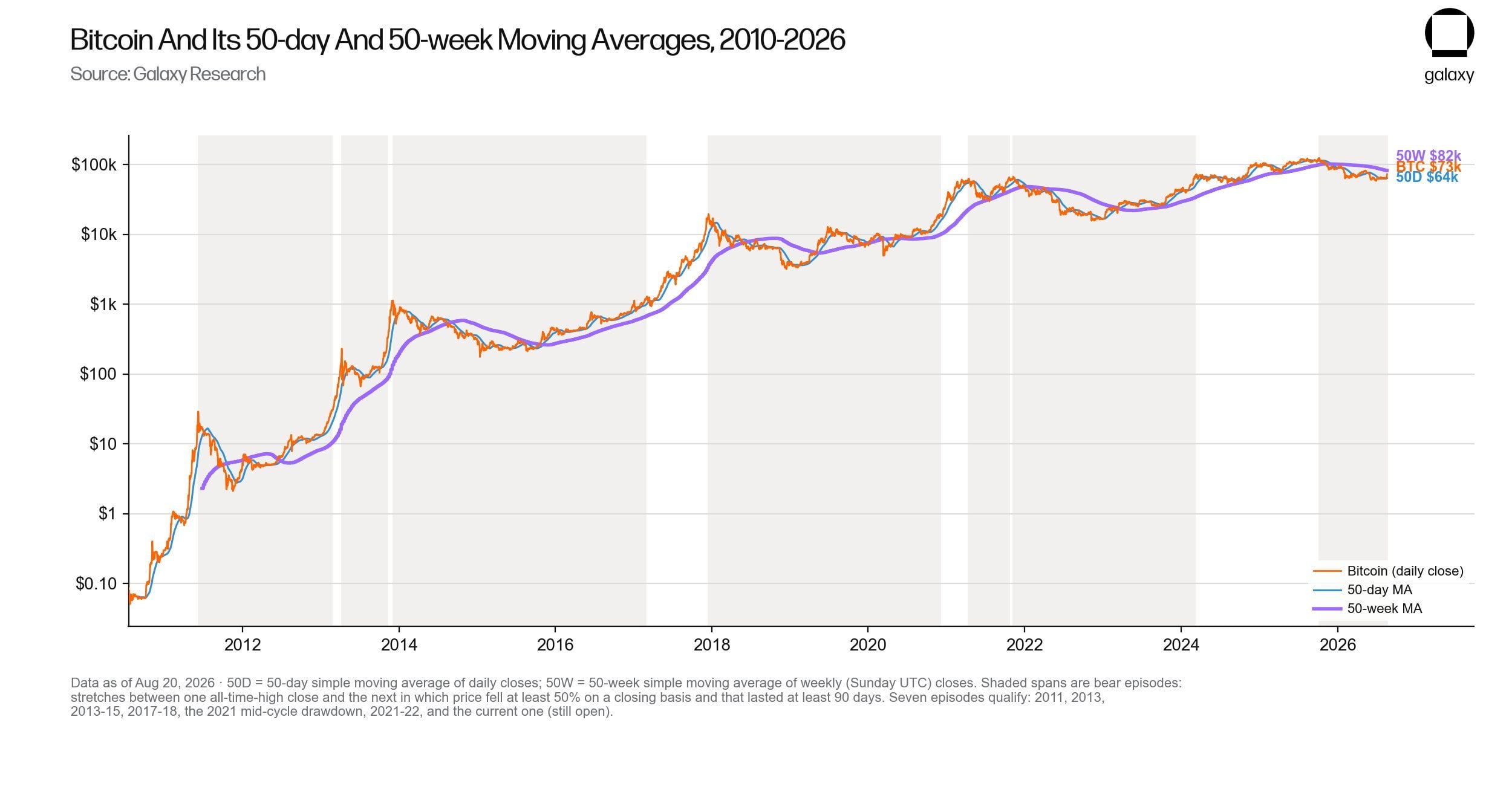
Galaxy Research states that for Bitcoin to confirm the end of its bear market, it must reclaim its 50-week moving average, currently near $82,470. Analysis of historical bear markets since 2011 shows that once Bitcoin sustainably recovers this key weekly level, it has not subsequently set a new closing low in 11 out of 13 instances. While the 50-day moving average provides faster signals, it comes with many false starts; the first attempt to reclaim it failed in every historical bear market. The 50-week average offers more reliable confirmation but at the cost of timing—successful recoveries of this level typically occurred months after the market bottom, with Bitcoin already up 63-237%. In the current cycle, Bitcoin is trading around $77,190, roughly 6% below the critical $82,470 level. The recent rally is optimistic, but a weekly close above this threshold is needed for stronger historical confirmation that the June low marked the bear market bottom. Until then, the recovery remains unconfirmed.

Bitcoin is approaching a technical level that has often separated bear market rallies from sustained recoveries.

Galaxy Research analyzed every completed Bitcoin bear market since 2011 using a mechanical definition: a drawdown in closing price of at least 50%, lasting at least 90 days. The research identified six completed bear markets, as well as the current decline.

During these completed cycles, Bitcoin regained its 50-week moving average 13 times. In 11 of those instances, the cryptocurrency held above this level without subsequently establishing a lower closing low.

Galaxy Research stated:

"All eyes are on Bitcoin's 50-week moving average."

That level is currently near $82,470. As of August 22, 8:50 a.m. ET, Bitcoin is trading around $77,190, roughly 30% above its June 30 low and about 6% below the weekly average.

Weekly Signals Outperform Daily Recoveries

The research found that Bitcoin's 50-day moving average gives faster signals but with far more false starts. Across the six completed bear markets, 43 out of 106 attempts to reclaim the 50-day average failed. Notably, the first attempt to reclaim the 50-day average failed in every single bear market studied.

The most glaring example was the 2013–2015 drawdown. Bitcoin crossed above its 50-day average 13 times before ultimately finding its final low. Some rallies held above the level for nearly two months before reversing.
Source: Galaxy Research

In contrast, the final recovery of the 50-week average was sustained for 945 days. "Bottoms are always accompanied by a 50-day average recovery, but a 50-day average recovery does not prove a bottom," Galaxy notes.

The only two failed recoveries of the 50-week level occurred during Bitcoin's 2021–2022 "double top" cycle — in December 2021 and March 2022. Bitcoin later fell to $15,758.

Stronger Confirmation Comes at a Cost

The trade-off is time.

During Bitcoin's three longer bear markets, the first successful recovery of the 50-week average occurred between 130 and 284 days after the price bottom. By that point, BTC had already rallied 63–80%.

The 2011 cycle was even more extreme. Bitcoin reclaimed the weekly average 51 days after the bottom, but by then it had already gained 237%.

There are exceptions. During the sharp 2013 drawdown, Bitcoin never fell below its 50-week moving average, and the May 2019 recovery was followed by pandemic-crash volatility without a new bear market low being established.

This makes the indicator useful, but not definitive.

For the current cycle, the takeaway is simple: the recent recovery is encouraging, but more substantial historical confirmation lies above the $82,000 level. A weekly close above it would bolster the argument that Bitcoin's June low marked the bottom. Until then, history shows, the recovery remains unconfirmed.

end-content
Related Questions

QAccording to Galaxy Research, what price level does Bitcoin need to reclaim to confirm the end of its bear market?

ABitcoin needs to reclaim and hold its 50-week moving average, which is currently near $82,470, to confirm the end of the bear market.

QHow many times has Bitcoin successfully held its 50-week moving average after reclaiming it during past completed bear markets?

ADuring completed bear market cycles, Bitcoin has reclaimed its 50-week moving average 13 times and successfully held it without subsequently making a lower closing low in 11 of those instances.

QWhy does the article consider the 50-week moving average a more reliable signal than the 50-day moving average for identifying a bear market bottom?

AThe 50-week moving average is considered more reliable because it has had fewer false signals. The 50-day average gave many false starts, with 43 out of 106 reclaim attempts failing during past bear markets. The first reclaim of the 50-day average failed in every single bear market studied.

QWhat was the only historical period where Bitcoin failed to hold a reclaim of its 50-week moving average, leading to a further price drop?

AThe only two failed reclaims of the 50-week moving average occurred during Bitcoin's 2021–2022 'double top' cycle, in December 2021 and March 2022. Bitcoin later dropped to $15,758.

QWhat is the trade-off mentioned for waiting for the more significant confirmation from the 50-week moving average?

AThe trade-off is time. In longer bear markets, the first successful reclaim of the 50-week average occurred 130 to 284 days after the price bottom. By that time, Bitcoin had already rallied between 63% and 80% (and 237% in the 2011 cycle), meaning investors waiting for this confirmation might miss a significant portion of the initial recovery.

Related Reads

Illinois' 0.2% Cryptocurrency Tax Sparks Major Legal Battle

Blockchain Association and Crypto Council for Innovation filed a lawsuit on August 21 in an Illinois district court against state officials, seeking to declare the state's Digital Asset Tax Act unlawful and block its implementation. The lawsuit centers on Illinois' plan to impose a 0.2% tax on the value of a digital asset for certain transactions through a digital asset broker, effective January 1. Plaintiffs argue the tax applies even to non-sales activities like transferring assets between wallets or paying for custody services, which is unlike the treatment of traditional assets like stocks or gold. They contend this discriminates against digital assets, taxing the mechanism of storage or transfer rather than an economic gain. The complaint highlights multiple ambiguities: a single crypto purchase involving exchange, deposit, and custody could trigger multiple taxable events; the law doesn't define how to value the asset or determine a customer's residency for tax purposes, leaving brokers guessing. Businesses face potential civil and criminal penalties for non-compliance, possibly leading them to avoid Illinois customers. The groups also challenge the legislative process, noting the tax was added as a small part of a massive 1,624-page bill passed hastily, violating constitutional requirements. They claim the tax violates federal laws like the Internet Tax Freedom Act and the dormant Commerce Clause. The immediate goal is to obtain an injunction before the January 1 enforcement date, testing whether a state can single out digital asset transactions for such a tax.

cryptonews.ru46m ago

Illinois' 0.2% Cryptocurrency Tax Sparks Major Legal Battle

cryptonews.ru46m ago

Musk Awaits $50 Trillion: Is There a Limit to the U.S. National Debt and What Comes Next?

Elon Musk reacted to a projection of US national debt reaching $50 trillion by 2030, labeling it a "precise timeline" with a laughing emoji. The debt has recently passed the $40 trillion mark. Skeptics note that specific debt thresholds have been breached before without immediate collapse. However, analysts warn the focus should shift from the nominal debt amount to its affordability. A key metric is when the average interest rate on the debt exceeds the economy's growth rate, a point the US Congressional Budget Office projects for 2031. Once this "debt spiral" begins, interest costs grow self-reinforcing. Currently, interest payments have already surpassed defense spending, exceeding $1 trillion annually. Ray Dalio warns a debt crisis could occur within "three years, plus or minus two," advising portfolio diversification into gold and some Bitcoin. Potential outcomes if debt becomes unmanageable include: 1) Financial repression and monetization (the "Japanese path" of controlled yields and inflation), seen as the most likely; 2) Severe austerity (the "Greek path" of spending cuts/tax hikes), considered politically unlikely; or 3) Technical default/restructuring, which would cause global financial shock. The most probable path is a hybrid of moderate financial repression and gradual inflation, leading not to a sudden crash but to long-term economic stagnation and a declining standard of living. By 2056, debt could reach 175% of GDP. Ultimately, the limit for US debt is not a fixed number but a function of market confidence in the dollar.

cryptonews.ru2h ago

Musk Awaits $50 Trillion: Is There a Limit to the U.S. National Debt and What Comes Next?

cryptonews.ru2h ago

Trading

Spot
活动图片