El mercado bursátil de Corea se desploma de nuevo, el último comunicado de la Casa Azul

marsbitPublished on 2026-08-06Last updated on 2026-08-06

Abstract

El jueves, la bolsa surcoreana cayó bruscamente, con el índice KOSPI descendiendo más del 4%. Los gigantes tecnológicos SK Hynix y Samsung Electronics registraron caídas superiores al 8% y 5%, respectivamente. El detonante de esta ola de ventas fueron las débiles perspectivas de ingresos anunciadas por las empresas estadounidenses de almacenamiento SanDisk y Western Digital, que generaron preocupación sobre la demanda del sector semiconductores. La volatilidad se propagó rápidamente a los mercados asiáticos, evidenciando su dependencia de los movimientos bursátiles en EE.UU. En respuesta a la fuerte caída del KOSPI, que acumula un descenso del 21% en el último mes, el gobierno surcoreano está implementando medidas para estabilizar el mercado, incluidos nuevos requisitos de garantía para los ETF apalancados. Mientras instituciones como Goldman Sachs mantienen una visión optimista a largo plazo para el índice, otras como Morgan Stanley ven en la actual corrección una oportunidad de compra. Analistas advierten que el sector global de semiconductores entrará en una fase de alta volatilidad, aunque la demanda impulsada por la IA podría sostener su crecimiento a medio plazo.

El jueves, el mercado bursátil de Corea del Sur cayó drásticamente.

Hasta el momento de la publicación, el índice KOSPI de Corea del Sur había caído más del 4%, cotizando actualmente en 6.322,55 puntos. Entre las acciones, SK Hynix cayó más del 8% y Samsung Electronics cayó más del 5%.
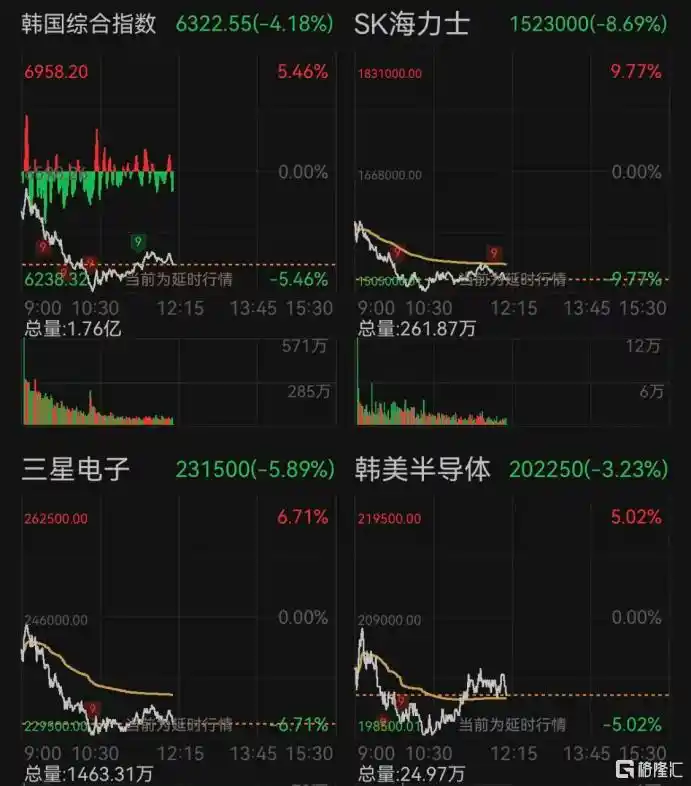
En el mercado de Hong Kong, el ETF 2x largo en Hynix del Sur cayó más del 15%, y el 2x largo en Samsung cayó más del 11%.

Las grandes empresas de almacenamiento de EE.UU. dan una guía desastrosa

El detonante de esta ola de ventas apunta directamente a la "guía de resultados desastrosa" del sector de almacenamiento en las acciones estadounidenses.

Después del cierre del mercado del miércoles (hora del este de EE.UU.), SanDisk y Western Digital publicaron sus últimos resultados financieros.

Los informes mostraron que los resultados del último trimestre fiscal de estos dos gigantes del almacenamiento fueron sorprendentemente sólidos, pero las guías para el trimestre actual no lograron cumplir con las expectativas de crecimiento más explosivas de Wall Street.

Entre ellas, SanDisk prevé unos ingresos para el próximo trimestre fiscal de entre 10.300 y 10.800 millones de dólares, por debajo de los 11.160 millones de dólares esperados por los analistas; Western Digital prevé unos ingresos para el próximo trimestre de entre 4.000 y 4.200 millones de dólares, ligeramente por encima de los 4.040 millones de dólares esperados por los analistas.

Un "pasado que superó las expectativas" no logró compensar completamente un "futuro ligeramente por debajo de las expectativas".

Tras la publicación de los resultados, los dos gigantes del almacenamiento sufrieron fuertes ventas, con SanDisk cayendo más del 8% y Western Digital más del 11%.

La guía pesimista de los gigantes del almacenamiento se transmitió rápidamente a los mercados asiáticos a través de la cadena de suministro.

El jueves, tras la apertura del mercado bursátil de Corea del Sur, SK Hynix y Samsung Electronics sufrieron fuertes presiones de venta.

Los datos muestran que hasta la sesión anterior, los inversores extranjeros habían comprado acciones por un valor neto acumulado de 1,4513 billones de wones en el mercado bursátil integral de Corea, pero el día 6 vendieron netamente más de 500.000 millones de wones en ese mercado.

Los analistas señalan que los mercados asiáticos, al final, tienen que mirar la cara del mercado estadounidense y no tienen poder de fijación de precios.

Han Ji-young, investigadora de Mirae Asset Securities, dijo que, aunque el entorno geopolítico y macroeconómico ha mejorado, debido al debilitamiento del índice de semiconductores de Filadelfia y a la toma de ganancias tras la rápida subida a corto plazo de los precios de las acciones, es muy probable que el mercado experimente un ajuste temporal y una rotación sectorial.

"La volatilidad anormalmente amplificada vista durante la fuerte caída de julio ya ha pasado su punto máximo."

El último comunicado de la Casa Azul

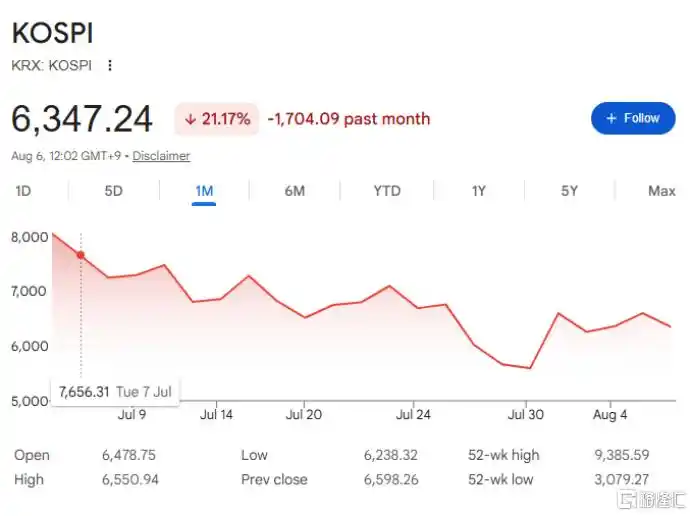
Vale la pena señalar que, desde que alcanzó un máximo histórico el 19 de junio, el mercado bursátil de Corea del Sur ha estado cayendo de manera volátil. En el último mes, el índice KOSPI de Corea del Sur ha acumulado una caída del 21,17%.
Ante las violentas fluctuaciones del mercado, el gobierno de Corea del Sur está implementando medidas de "rescate" de emergencia.

Anteriormente, Kim Yong-beom, jefe de la Oficina de Políticas de la Presidencia de Corea del Sur, enfrentaba cargos penales por la "introducción apresurada de ETFs con apalancamiento".

Al respecto, Seong Gi-hong, alto secretario de Relaciones Públicas y Comunicación de la Presidencia de Corea del Sur, respondió recientemente que, por el momento, es más importante observar de cerca la situación del mercado y formular las medidas de respuesta correspondientes.

"Todos los funcionarios relevantes de la Presidencia están examinando detalladamente cada situación y estudiando con mucha cautela cómo formular las medidas relacionadas."

El viernes pasado, el regulador financiero de Corea del Sur aumentó el requisito de margen de efectivo mínimo para invertir en ETFs de apalancamiento sobre acciones individuales.

Después de que el regulador implementara medidas restrictivas, el volumen de negociación de ETFs de apalancamiento sobre acciones coreanas cayó drásticamente.

Los últimos datos publicados por la Bolsa de Corea del Sur mostraron que el volumen de negociación promedio diario de 16 ETFs de apalancamiento sobre acciones individuales cayó el miércoles a 9.198 billones de wones, por debajo de los 10 billones de wones por primera vez desde su cotización el 27 de mayo.

Morgan Stanley señaló que la intensa liquidación de apalancamiento anterior está cerca de su fin, y que la valoración del KOSPI ha caído a niveles históricamente muy bajos, ofreciendo a los inversores un momento de entrada más atractivo.

Sin embargo, CITIC Securities tiene una opinión diferente al respecto.

La institución considera que, aunque el apalancamiento de los inversores minoristas coreanos se ha reducido rápidamente, el saldo de financiación aún se está contrayendo al ritmo más rápido del año, y la tasa de liquidaciones forzosas sigue siendo mucho más alta que los niveles normales. Se espera que la volatilidad del mercado se mantenga en niveles elevados en el futuro.

En cuanto a las perspectivas, los analistas señalan que, tras un largo mercado alcista, el sector global de semiconductores de almacenamiento ha entrado en una fase de alta sensibilidad y alta volatilidad, y las perturbaciones emocionales a corto plazo necesitan tiempo para digerirse.

A medio y largo plazo, Goldman Sachs mantiene firmemente su objetivo de 12.000 puntos para el índice KOSPI, anticipando un espacio de crecimiento de aproximadamente el 80% al 90% en el mercado.

El banco cree que la valoración actual del mercado no refleja la posible escasez severa de chips de memoria, que podría continuar hasta 2030. A medida que se acelera la demanda de computación de IA, la industria de semiconductores, que representa más del 50% del peso del KOSPI, se convertirá en el motor de ganancias global.

JPMorgan también mantiene un juicio optimista sobre SK Hynix y la industria de chips de memoria, viendo esta corrección como una oportunidad para aumentar posiciones.

Este artículo proviene del WeChat Official Account "Gelonghui APP" (ID: hkguruclub), autor: editor de Gelonghui.


Trending Cryptos

Related Questions

Q¿Cuál fue la principal causa del colapso del mercado de valores surcoreano según el artículo?

ALa causa principal fue la publicación de previsiones de resultados decepcionantes por parte de gigantes estadounidenses de almacenamiento como SanDisk y Western Digital, lo que provocó una venta masiva que se extendió a los mercados asiáticos, afectando a empresas clave como SK Hynix y Samsung Electronics.

Q¿Cómo respondió la Oficina Presidencial de Corea del Sur (la Casa Azul) a la volatilidad del mercado?

AEl secretario senior de Comunicaciones de la Oficina Presidencial, Seong Gi-hong, declaró que la prioridad actual es observar de cerca la situación del mercado y formular medidas de respuesta apropiadas. Los funcionarios relevantes están examinando detalladamente cada situación y estudiando con mucha cautela cómo establecer las medidas pertinentes.

Q¿Qué impacto tuvieron las nuevas regulaciones sobre los ETF apalancados en Corea del Sur?

ADespués de que los reguladores financieros aumentaran los requisitos de margen de efectivo mínimo para invertir en ETF apalancados de acciones individuales, el volumen de negociación de estos productos cayó abruptamente. El volumen diario promedio de los 16 ETF apalancados de acciones individuales cayó por debajo de 1 billón de wones por primera vez desde su lanzamiento.

Q¿Qué opinan las instituciones financieras internacionales como Goldman Sachs sobre el futuro del índice KOSPI?

AGoldman Sachs mantiene firmemente un objetivo de 12,000 puntos para el índice KOSPI, anticipando un potencial de alza de aproximadamente un 80% a 90%. Creen que la valoración actual del mercado no refleja la posible escasez severa de chips de memoria hasta 2030, impulsada por la demanda de computación de IA.

Q¿Cómo describió un analista la situación actual del mercado de semiconductores de memoria a nivel global?

AEl analista señaló que, tras un largo mercado alcista, el sector global de semiconductores de memoria ha entrado en una fase de alta sensibilidad y alta volatilidad. Los impactos emocionales a corto plazo necesitan tiempo para ser digeridos, aunque a largo plazo el sector, especialmente el de chips de memoria, sigue siendo visto como un motor de ganancias global clave para la IA.

Related Reads

Earning on Uselessness? How the Proof of Useful Work Consensus Works

Earning from the Useless? How Proof of Useful Work Consensus Works Classical cryptocurrency mining, like Bitcoin's Proof of Work (PoW), secures the network and prevents double-spending by performing computationally intensive "useless" hash calculations. Proof of Useful Work (PoUW) aims to solve this by making the work miners do valuable beyond the blockchain. The goal is for computational power securing the network to simultaneously solve problems in fields like medicine, astronomy, or AI. However, implementing PoUW faces significant challenges: 1. **Providing Useful Work**: Unlike uniform hash calculations, useful tasks are rarely identical or consistently available, making fair, parallel work distribution difficult. 2. **The Blockchain Trilemma**: Verifying complex "useful" solutions can be slower than verifying a simple hash, potentially harming scalability and security. 3. **Solution Uniqueness**: Solutions must be unique for each block to prevent reuse. 4. **Predictable Effort**: The system must ensure fair competition with predictable costs, preventing participants from cherry-picking only easy tasks. 5. **Economic Model**: The "useless" work in PoW has intrinsic value—it secures the network and incurs real costs (hardware, electricity), which contribute to a cryptocurrency's economic foundation and valuation. Replacing it with externally valuable work complicates this economic incentive structure. Examples of projects exploring PoUW concepts include: * **Primecoin (2013)**: The first major PoUW attempt, where mining involved searching for special chains of prime numbers, contributing to mathematics. * **Gridcoin**: Rewards participants for contributing computational power to scientific projects via the BOINC platform, though it uses PoS as its base consensus. * **Flux**: A decentralized cloud infrastructure where nodes perform real computational work like hosting and AI tasks under a PoUW v2 model. Other networks like Bittensor (machine learning) and Render Network (GPU rendering) also align with the broad idea of useful computation. In conclusion, while PoUW seeks to merge blockchain security with practical problem-solving, it currently grapples with technical and economic hurdles. Despite these challenges, the concept continues to evolve, indicating persistent interest in making computational work genuinely useful.

cryptonews.ru5m ago

Earning on Uselessness? How the Proof of Useful Work Consensus Works

cryptonews.ru5m ago

Trading

Spot

Hot Articles

What is $BLUE

Blue on Base ($BLUE): The New Frontier in the Meme Economy Introduction In the continuously evolving landscape of digital technologies, the emergence of innovative projects in the realm of Web3 has captured the attention of many. Among these, Blue on Base, denoted by its ticker symbol $BLUE, stands out as a unique concept within the burgeoning world of cryptocurrencies. This project serves as a testament to the fusion of memes, art, and digital progress. Through its novel approach, it encapsulates the essence of what it means to ride the wave of the meme economy, while contributing significantly to the wider dialogue in the blockchain community. What is Blue on Base ($BLUE)? At its core, Blue on Base is described as the first-ever base metameme, a digital construct that captures the distinctive spirit of blue-themed memes. The project aspires to elevate these memes to what it refers to as “the blue sky,” symbolising an expansive horizon of possibilities within the digital landscape. The creators of Blue on Base envision a metameme representing the collective voice of the burgeoning blue meme culture—offering a spectrum from the deepest cobalt hues to the brightest cerulean shades. This project aims to provide a conduit for cultural expression, allowing participants to engage with an expansive library of memes that resonate across various digital platforms. Central to the ambition of Blue on Base is the understanding that memes are more than fleeting images—they embody social commentary, artistic expression, and cultural identities. By tapping into the vast potential of meme culture, the project hopes to engage users by providing a multifaceted platform that brings both entertainment and a sense of community. Who is the Creator of Blue on Base ($BLUE)? The information regarding the creator of Blue on Base ($BLUE) is regrettably sparse. As of now, details pertaining to the individuals or team behind this innovative project remain unknown. This lack of transparency raises questions about accountability and identity in a project that is standard in the crypto space, but it also emphasises the project's focus on the community rather than singular personalities. Who are the Investors of Blue on Base ($BLUE)? While investment dynamics are crucial for the success of any cryptocurrency project, explicit details regarding the financial backers or investment foundations associated with Blue on Base ($BLUE) are not readily available. This lack of defined investor identity raises a critical point regarding transparency in crypto projects—a vital aspect that keeps potential investors and participants apprised of the project’s sustainability. How Does Blue on Base ($BLUE) Work? Central to understanding Blue on Base is its operational framework, which revolves around the concept of being a metameme. This unique approach allows the project to harness the viral nature of memes and engage with a broad audience on Web3 platforms. The project does this by embracing various blue-themed meme constructs which serve as both community engagement tools and frameworks for digital expression. At its heart, Blue on Base works to establish itself as a pivotal player in the meme economy, inviting users to contribute, create, and engage with content defined by its blue theme. The project facilitates interactions among community members, thereby enhancing user experience while pushing the blue meme narrative forward. It's important to note that while the project hinges on community-generated content, specifics regarding its technological infrastructure, such as smart contract dynamics or tokenomics, are not extensively detailed in the current information set. As the project advances, clearer technical specifications will likely emerge, providing a more comprehensive understanding of its functionality. Timeline of Blue on Base ($BLUE) Although detailed chronological milestones of Blue on Base are limited, the conceptualisation and positioning of the project highlight its relevance in the timeline of Web3 innovations. As the atmosphere surrounding cryptocurrencies and meme cultures evolves, Blue on Base fits within the broader context of digital advancement. The timeline of Blue on Base can be inferred generally through key events typical of crypto projects, including conceptual announcement, initial community engagements, and launching phases. It would be critical for interested parties to remain vigilant for updates as the project's trajectory develops over time, possibly yielding significant milestones and growth phases. Key Points About Blue on Base ($BLUE) Concept: Blue on Base ($BLUE) is a digital project that represents the first-ever base metameme, reflecting the intertwining of memes, art, and digital progress. Objective: The project seeks to assemble the strength of various blue-themed memes and represent the collective voice of a new digital dawn. Creator: Currently unknown, emphasising a community-oriented ethos. Investors: Information about specific investors or backing foundations remains unspecified. Operation: Utilises its metameme concept to foster engagement and innovation within Web3, focusing on user participation and cultural significance. Additional Information While Blue on Base ($BLUE) has a unique identity within the cryptocurrency realm, it is paramount that engaging with such projects be conducted with due diligence. Clarity on the potential impacts and innovations of these emerging projects must be approached with discerning optimism. In conclusion, Blue on Base ($BLUE) emerges as an intriguing facet of the evolving digital and meme economies. By framing itself as a metameme, it seeks to challenge conventional interpretations of meme culture while embracing the collective creativity of its community. As the Web3 landscape continues to expand, projects like Blue on Base offer valuable insights into the future intersection of culture, technology, and digital interaction. As the project evolves, further examinations will be needed to provide insights into how it carves its niche in the meme economy and broader cryptocurrency space—ultimately shaping the conversation surrounding digital culture.

197 Total ViewsPublished 2024.04.22Updated 2024.12.03

What is $BLUE

What is VRJAM(BLUE)

VRJAM(BLUE): Revolutionising Live Experiences in the Virtual World Introduction to VRJAM(BLUE), $vrjam(blue) In an age where virtual experiences are becoming increasingly prevalent, VRJAM(BLUE), represented by the token $vrjam(blue), emerges as a pioneering project within the cryptocurrency space. Launched in 2022, VRJAM(BLUE) seeks to transform how live events are conducted in the digital realm by utilising the power of blockchain technology and the Hedera Hashgraph platform. As a unique blend of immersive social gaming and interactive virtual events, VRJAM(BLUE) strives to create a comprehensive, engaging experience that resonates with users worldwide. What is VRJAM(BLUE), $vrjam(blue)? At its core, VRJAM(BLUE) is a live experience platform harnessing blockchain to facilitate immersive interactions during virtual events. It stands out as a futuristic solution that allows users to engage with one another in real time, bridging the gap between the physical and digital worlds. The platform leverages advanced technologies, including AI-powered virtual humans, which introduce customisable digital representations of users. These entities serve as avatars that enhance the social dynamics of virtual gatherings. Coupling these virtual beings with the use of non-fungible tokens (NFTs) introduces a layer of security and authenticity, ensuring that unique digital assets can be traded and valued properly within the platform's ecosystem. Moreover, VRJAM(BLUE) integrates a native cryptocurrency, the VRJAM Coin, which acts as the medium of exchange within its virtual world. This digital currency facilitates transactions for services, content, and assets while enabling users to participate seamlessly in live events and interactive experiences. Creator of VRJAM(BLUE), $vrjam(blue) The specific identity of the creator of VRJAM(BLUE) remains undisclosed, though the project is under the leadership of CEO Sam Speaight. His vision for the platform aims at leveraging innovative technology and strategic partnerships to expand the reach and impact of VRJAM(BLUE) in the rapidly evolving web3 ecosystem. Investors of VRJAM(BLUE), $vrjam(blue) VRJAM(BLUE) has garnered considerable interest from various investors and funding rounds, successfully raising a total of $5.34 million throughout 12 funding events. These various initiatives, including Initial DEX Offerings (IDO) and token launches, have provided the necessary capital to propel the project forward. However, specific details regarding the individual investors or organisations backing VRJAM(BLUE) have not been disclosed. How Does VRJAM(BLUE), $vrjam(blue) Work? The innovative approach of VRJAM(BLUE) revolves around multiple cutting-edge technologies, notably artificial intelligence, virtual reality, and blockchain. AI-Powered Virtual Humans A distinguishing feature of VRJAM(BLUE) is its integration of AI-powered virtual humans. These customisable characters respond dynamically to user interactions, enriching the overall experience of virtual events. This personalisation allows users to create unique identities and facilitates more meaningful connections within the community. NFT Technology By incorporating NFT technology into its framework, VRJAM(BLUE) provides users with enhanced security and ownership of digital assets. Users can purchase, sell, or trade NFTs that represent virtual tickets, memorabilia, or other digital creations linked to live events, ensuring that ownership is verifiable and protected. Native Cryptocurrency The VRJAM Coin serves as the platform's native currency, allowing users to transact seamlessly within the virtual environment. This cryptocurrency not only supports traditional user activities but also bolsters a larger economic ecosystem tailored to the needs of VRJAM’s community. DeFi Solutions The project also embraces decentralised finance (DeFi) by incorporating trustless protocols. These solutions aim to stabilise token prices and enhance liquidity, allowing users to engage in financial transactions without intermediary restrictions. Timeline of VRJAM(BLUE), $vrjam(blue) To fully understand the evolution of VRJAM(BLUE), it's essential to take a closer look at its timeline: 2022: Launch of VRJAM(BLUE) – The platform made its debut, ushering in a new era for virtual event experiences. November 30, 2022: Completion of the Token Generation Event (TGE) – This marked a significant milestone, as the platform's native cryptocurrency became available for investor engagement. Post-TGE: Following the TGE, the distribution of tokens initiated, featuring a 20% immediate release, followed by a linear vesting phase of the remaining 80% over a period of six months. Key Features and Partnerships The success of VRJAM(BLUE) can also be attributed to its strategic partnerships and innovative features. Partnerships In its quest to bring life to the metaverse, VRJAM(BLUE) has formed alliances with prominent entities in the industry. Notably, its collaboration with Polygon aims to enhance the efficiency and reach of live events. Additional partnerships with organisations such as Agora and Enjin further bolster content distribution and the utilisation of NFT technology. These collaborations are enhancing VRJAM(BLUE)'s capabilities and expanding its influence in the web3 ecosystem. Token Liquidity Protocol Operating on the Hedera Hashgraph, VRJAM(BLUE) employs a token liquidity protocol that aggregates liquidity across various trading platforms. This initiative is designed to unify token pricing, thus enhancing user confidence in the VRJAM Coin and promoting stability within the ecosystem. Web3 Economy With the overarching aim of fostering a sustainable web3 economy, VRJAM(BLUE) is diligently working on its DeFi product suite. By providing users with tools for financial engagement, such as yield farming or staking, the project is paving the way for broader participation in its virtual economy. Conclusion VRJAM(BLUE), with its token $vrjam(blue), stands at the forefront of the revolution in virtual experiences and live interactions within the digital space. By intertwining advanced technologies such as AI, virtual reality, and blockchain, the project has developed a platform that not only facilitates immersive experiences but also builds a vibrant, interactive community. As the landscape of the crypto and web3 industries continues to evolve, VRJAM(BLUE) aims to play a critical role in shaping the future of virtual events and experiences. With its commitment to innovation and community engagement, VRJAM(BLUE) is well-positioned to pave a prosperous path for digital interactions in the years to come.

176 Total ViewsPublished 2024.12.03Updated 2024.12.03

What is VRJAM(BLUE)

Discussions

Welcome to the HTX Community. Here, you can stay informed about the latest platform developments and gain access to professional market insights. Users' opinions on the price of BLUE (BLUE) are presented below.

活动图片