Le modèle B2B de la banque Sygnum stimule l'essor des cryptomonnaies en Suisse

cryptonews.ruPublished on 2026-08-01Last updated on 2026-08-01

Abstract

Le modèle B2B de la banque Sygnum permet aux établissements bancaires suisses d'intégrer facilement les services de cryptomonnaies à leurs plateformes existantes. Grâce à cette solution, les clients peuvent désormais acheter, vendre et détenir des actifs numériques comme le Bitcoin ou l'Ethereum directement depuis leur interface bancaire habituelle, sans avoir à utiliser des plateformes externes. L'accord avec Bancastato illustre cette tendance : la banque utilise l'infrastructure et l'API de Sygnum pour offrir des services de trading, tandis que Sygnum gère l'exécution des ordres et le stockage sécurisé des actifs. Cette division des rôles permet aux banques de proposer rapidement des services régulés sans développer leur propre technologie coûteuse. Sygnum, fondée en 2018 et détentrice de licences en Suisse, à Singapour et dans l'UE, fournit ainsi l'infrastructure technique et réglementaire qui manque à de nombreuses banques traditionnelles. Plus de 25 institutions financières suisses utilisent déjà sa plateforme B2B. Cette approche contribue à l'adoption grand public des cryptomonnaies en Suisse, où 18 à 23% de la population en possèderait. Le pays a intégré ces actifs dans son cadre réglementaire bancaire existant, offrant ainsi une voie claire et sécurisée pour leur adoption par les établissements financiers établis.

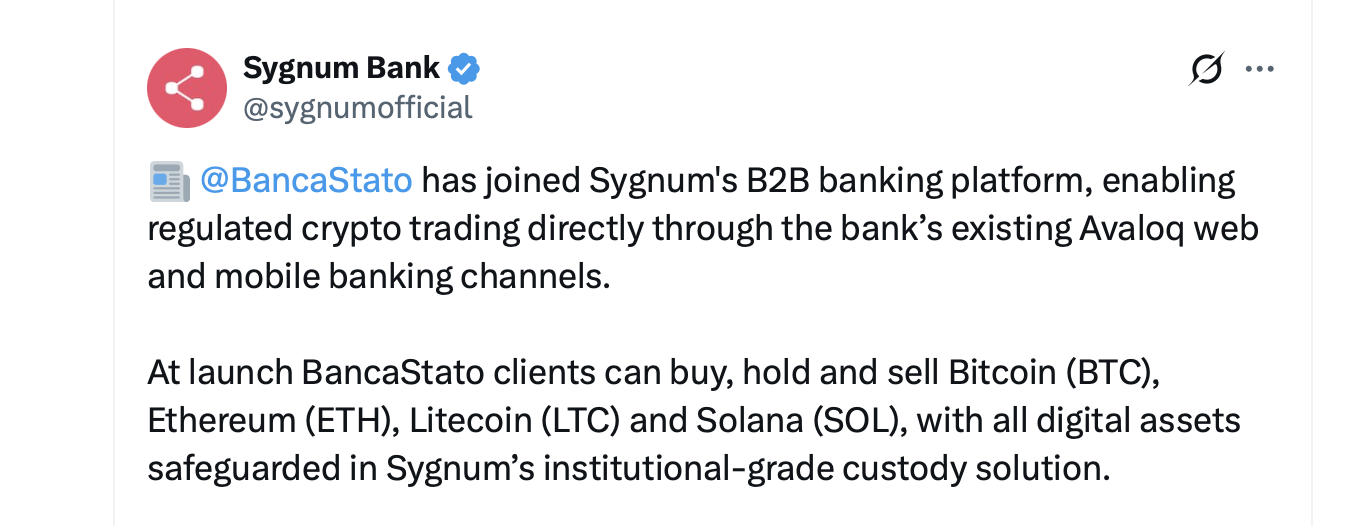
Comme l'a expliqué l'entreprise Sygnum, grâce à cette intégration, le bitcoin, l'ether, le litecoin et le solana deviennent accessibles dans les mêmes applications web et mobiles bancaires que les clients utilisent déjà pour les dépôts, les investissements et les opérations bancaires quotidiennes. Ceci est important, car l'un des principaux obstacles à l'adoption des cryptomonnaies par les banques n'a jamais été la demande.

Le problème provenait des inconvénients liés au fait que les clients devaient quitter l'écosystème de leur banque, passer par une nouvelle procédure d'inscription et gérer leurs actifs sur une plateforme distincte. Grâce au fait que toutes les fonctionnalités restent au sein de l'interface existante de Bancastato, cela ressemble davantage pour les clients à l'ajout d'un nouveau produit d'investissement, plutôt qu'à l'entrée dans une relation financière entièrement nouvelle.
Source de l'image : X

Grâce à cet accord, Bancastato devient également la première banque à utiliser l'environnement bancaire Avaloq selon le modèle « logiciel en tant que service » (SaaS) pour fournir des services de trading de cryptomonnaies via l'interface de programmation d'applications (API) de Sygnum. En pratique, cela signifie que l'infrastructure de trading fonctionne « en coulisses », tandis que les clients continuent d'interagir avec la même plateforme bancaire à laquelle ils sont déjà habitués.

Les banques évitent de restructurer leurs systèmes centraux, et les clients évitent de devoir basculer entre des applications à chaque fois qu'ils souhaitent effectuer une transaction. Les clients peuvent passer des ordres de marché, en indiquant soit la quantité souhaitée de cryptomonnaie, soit sa valeur en dollars américains. Sygnum exécute chaque transaction, tandis que Bancastato gère la relation client, la marque et l'interface utilisateur.

Cette répartition reflète un modèle devenant de plus en plus courant dans le secteur des services financiers régulés : les banques conservent la propriété de la relation client, tandis que des fournisseurs spécialisés gèrent l'infrastructure qui, autrement, nécessiterait des années de développement, l'obtention d'autorisations réglementaires et une maintenance constante. Sygnum assure également la protection des actifs numériques des clients via sa plateforme de garde institutionnelle.

La garde d'actifs va bien au-delà du simple stockage de clés privées. Elle comprend des mesures de sécurité multicouches, des procédures de gouvernance, des audits indépendants et des structures juridiques conçues pour séparer les actifs des clients du bilan propre de la banque. Cette séparation juridique est devenue l'une des caractéristiques déterminantes attendues par les clients institutionnels, car elle contribue à réduire le risque de contrepartie si une institution financière rencontre des difficultés opérationnelles ou financières.

Sygnum crée l'infrastructure qui manque aux banques

Le directeur des clients entreprises (B2B) de Sygnum, Fritz Jost, a souligné que cette intégration reflète une demande croissante pour des services régulés d'actifs numériques qui s'intègrent directement dans les systèmes bancaires existants. Il a qualifié le lancement chez Bancastato d'« étape importante vers la maturité et l'évolutivité de l'infrastructure régulée des actifs numériques ».

Le responsable de Bancastato, Curtio De Gottardi, a expliqué que l'ajout d'actifs numériques élargit l'offre d'investissement existante de la banque. Cette observation reflète un changement plus large dans le secteur financier traditionnel. De nombreuses banques régionales ne considèrent plus la cryptomonnaie comme un produit distinct, en concurrence avec les instruments financiers traditionnels. Au contraire, elle occupe de plus en plus une place aux côtés des devises, des actions et des portefeuilles gérés, en tant que classe d'actifs supplémentaire à laquelle les clients s'attendent à avoir accès depuis un seul compte.

Cette stratégie est au cœur du modèle commercial de Sygnum. Au lieu de rivaliser pour les dépôts des particuliers, cette entreprise zurichoise fournit l'infrastructure pour le trading, la garde, la conformité réglementaire et le règlement que les institutions partenaires devraient autrement développer, construire et maintenir elles-mêmes. Plus de 25 banques et institutions financières internationales utilisent déjà sa plateforme inter-entreprises (B2B), dont Zuger Kantonalbank, Luzerner Kantonalbank, Postfinance et VZ Vermögenszentrum.

Selon Sygnum, grâce à ces partenariats, les services d'actifs numériques régulés sont déjà accessibles à plus d'un tiers de la population suisse via leurs relations bancaires existantes. Bancastato étend ce réseau à la région italophone du pays, renforçant une autre tendance observée à travers l'Europe : les banques régionales adoptent de plus en plus les actifs numériques, sans pour autant renoncer à leur rôle traditionnel d'institutions financières au service des communautés locales.

Une start-up zurichoise devient un réseau bancaire régulé

Les origines de Sygnum remontent à des discussions tenues lors du Singapore FinTech Festival en 2017. L'entreprise a été enregistrée en Suisse en mai 2018, et un mois plus tard à Singapour, créant une structure à double pivot axée sur le secteur bancaire zurichois et les marchés des capitaux singapouriens.

Zurich demeure le siège opérationnel et réglementaire de l'entreprise, fournissant les services de garde, la conformité, la gestion des risques, le développement de produits et le support technologique aux institutions partenaires. En 2019, Sygnum a obtenu les licences bancaire et de négociation de valeurs mobilières en Suisse, la plaçant sous la supervision de l'Autorité fédérale de surveillance des marchés financiers (FINMA).

Depuis lors, son champ d'activité s'est étendu pour inclure des opérations sous licence à Singapour, Abu Dhabi et au Liechtenstein. Le 30 juin, Sygnum Europe a obtenu une licence de fournisseur de services sur actifs cryptographiques conformément à la législation-cadre de l'Union européenne « Markets in Crypto-Assets » (MiCA). Au-delà de l'accès à de nouveaux marchés, ces autorisations réduisent l'incertitude réglementaire pour les banques partenaires, leur donnant davantage de confiance dans le fait que les services transfrontaliers en actifs numériques peuvent être fournis dans le cadre d'un même socle juridique, plutôt que selon des règles locales disparates.

Cette expansion souligne également la réalité pratique au sein du secteur bancaire traditionnel. La construction de systèmes de garde, de conformité et d'exécution de niveau institutionnel pour les cryptomonnaies nécessite une expertise qui va bien au-delà des forces traditionnelles de la plupart des banques. Beaucoup d'institutions ont conclu qu'intégrer une infrastructure éprouvée est plus rapide, moins coûteux et plus sûr d'un point de vue opérationnel que de tenter de la construire de zéro.

La Suisse fait entrer les cryptomonnaies dans le courant dominant

Le lancement chez Bancastato reflète également l'évolution plus large de la Suisse vers l'établissement en tant que l'un des marchés d'actifs numériques les plus matures et régulés au monde. Selon les estimations d'études, entre 18% et 23% de la population suisse détient des cryptomonnaies, cette proportion atteignant environ 36% chez certains individus âgés de 18 à 24 ans.

Selon un rapport de Big Whale publié en mars, vers mi-2026, environ 20 banques suisses proposaient certains services liés aux cryptomonnaies pour plus de 2,5 millions de comptes clients. UBS, Zürcher Kantonalbank, Postfinance, ainsi que les banques cantonales de Zoug, Lucerne, Saint-Gall, Thurgovie et Tessin ont mis en place des offres régulées, beaucoup préférant recourir aux services de fournisseurs d'infrastructure spécialisés plutôt que de créer leurs propres plateformes.

Cette tendance illustre comment la Suisse a abordé les actifs numériques différemment de nombreuses autres juridictions. Au lieu de créer un système financier parallèle, les régulateurs ont essentiellement intégré les cryptomonnaies dans le système de surveillance bancaire existant via des normes de licences couvrant les exigences de garde, de négociation, de conformité et de lutte contre le blanchiment d'argent (AML).

Combinée à la concentration d'entreprises blockchain dans la région de la « Crypto Valley » à Zoug, cette base réglementaire a offert aux institutions financières un chemin plus clair pour lancer des services régulés sans avoir à restructurer l'ensemble de leur modèle opérationnel.

end-content

Trending Cryptos

Related Questions

QComment le modèle B2B de Sygnum aide-t-il les banques suisses à intégrer les crypto-monnaies ?

ASygnum fournit une infrastructure clé en main (négociation, garde, conformité, règlement) via son API, permettant aux banques partenaires d'intégrer des services sur actifs numériques directement dans leurs interfaces bancaires existantes sans avoir à développer ces systèmes complexes et coûteux en interne.

QQuels avantages les clients de Bancastato obtiennent-ils grâce à l'intégration de Sygnum ?

ALes clients peuvent acheter, vendre et détenir des crypto-monnaies (Bitcoin, Ethereum, etc.) directement depuis les applications web et mobiles de leur banque habituelle, sans avoir à s'inscrire sur une plateforme externe. Cela simplifie l'expérience utilisateur et intègre les crypto-actifs comme une classe d'actifs supplémentaire parmi leurs comptes et investissements existants.

QPourquoi la séparation légale des actifs clients est-elle importante dans les services de garde de Sygnum ?

ALa séparation légale des actifs clients du bilan de la banque réduit le risque de contrepartie. Si l'institution financière rencontre des difficultés, les actifs numériques des clients sont protégés. C'est une caractéristique essentielle attendue par les clients institutionnels, en plus des mesures de sécurité techniques et des audits indépendants.

QQuelle est l'étendue géographique et réglementaire des activités de Sygnum ?

ASygnum opère depuis des centres réglementés en Suisse (siège opérationnel), à Singapour, Abu Dhabi et au Liechtenstein. Récemment, Sygnum Europe a également obtenu une licence de prestataire de services sur actifs crypto (PSAN) dans le cadre de la réglementation européenne MiCA, facilitant l'offre de services transfrontaliers sous un cadre juridique unifié.

QComment la Suisse est-elle devenue un marché majeur pour les actifs numériques régulés ?

ALa Suisse a intégré les crypto-actifs dans son cadre bancaire et de surveillance financier existant (via FINMA), en établissant des normes de licence claires pour la garde, la négociation et la conformité. Couplée à la concentration d'entreprises blockchain dans la 'Crypto Valley' de Zoug, cette approche a offert aux banques un chemin direct pour proposer des services régulés, menant à une adoption par plus de 20 banques et 2,5 millions de comptes clients.

Related Reads

Thanks to Dice Rolls, Bitcoin Keys Are Stored Offline, But Not Everyone Will Do It

The article discusses using dice rolls to generate secure Bitcoin wallet seeds, providing entropy independent of potentially flawed hardware random number generators. It explains that each fair dice roll offers about 2.585 bits of entropy, with around 50 rolls needed for a standard 12-word seed phrase and 99+ recommended for higher security. This method gained attention after a vulnerability was revealed in some Coldcard hardware wallets, where a faulty firmware RNG (dating back to 2021) compromised generated keys. The analysis notes that while a dice-generated main seed was safe from this specific flaw, other Coldcard functions (like creating paper wallets, backup keys, or passwords) could still be vulnerable if they used the defective RNG. The piece argues that while dice-based entropy is technically robust, the manual process is error-prone, tedious, and unrealistic for most new users, who might make mistakes in recording or inputting rolls. It concludes that while manual entropy generation should remain an option for advanced users, the long-term goal is to develop reliable, user-friendly hardware and software that securely generates randomness without requiring specialized knowledge. Coldcard users are advised to check their firmware version and replace any secondary secrets (like paper wallet keys) created with vulnerable devices, while also considering multi-signature setups with devices from different manufacturers for added security.

cryptonews.ru4h ago

Thanks to Dice Rolls, Bitcoin Keys Are Stored Offline, But Not Everyone Will Do It

cryptonews.ru4h ago

Trading

Spot

Hot Articles

What is SONIC

Sonic: Pioneering the Future of Gaming in Web3 Introduction to Sonic In the ever-evolving landscape of Web3, the gaming industry stands out as one of the most dynamic and promising sectors. At the forefront of this revolution is Sonic, a project designed to amplify the gaming ecosystem on the Solana blockchain. Leveraging cutting-edge technology, Sonic aims to deliver an unparalleled gaming experience by efficiently processing millions of requests per second, ensuring that players enjoy seamless gameplay while maintaining low transaction costs. This article delves into the intricate details of Sonic, exploring its creators, funding sources, operational mechanics, and the timeline of significant events that have shaped its journey. What is Sonic? Sonic is an innovative layer-2 network that operates atop the Solana blockchain, specifically tailored to enhance the existing Solana gaming ecosystem. It accomplishes this through a customised, VM-agnostic game engine paired with a HyperGrid interpreter, facilitating sovereign game economies that roll up back to the Solana platform. The primary goals of Sonic include: Enhanced Gaming Experiences: Sonic is committed to offering lightning-fast on-chain gameplay, allowing players and developers to engage with games at previously unattainable speeds. Atomic Interoperability: This feature enables transactions to be executed within Sonic without the need to redeploy Solana programmes and accounts. This makes the process more efficient and directly benefits from Solana Layer1 services and liquidity. Seamless Deployment: Sonic allows developers to write for Ethereum Virtual Machine (EVM) based systems and execute them on Solana’s SVM infrastructure. This interoperability is crucial for attracting a broader range of dApps and decentralised applications to the platform. Support for Developers: By offering native composable gaming primitives and extensible data types - dining within the Entity-Component-System (ECS) framework - game creators can craft intricate business logic with ease. Overall, Sonic's unique approach not only caters to players but also provides an accessible and low-cost environment for developers to innovate and thrive. Creator of Sonic The information regarding the creator of Sonic is somewhat ambiguous. However, it is known that Sonic's SVM is owned by the company Mirror World. The absence of detailed information about the individuals behind Sonic reflects a common trend in several Web3 projects, where collective efforts and partnerships often overshadow individual contributions. Investors of Sonic Sonic has garnered considerable attention and support from various investors within the crypto and gaming sectors. Notably, the project raised an impressive $12 million during its Series A funding round. The round was led by BITKRAFT Ventures, with other notable investors including Galaxy, Okx Ventures, Interactive, Big Brain Holdings, and Mirana. This financial backing signifies the confidence that investment foundations have in Sonic’s potential to revolutionise the Web3 gaming landscape, further validating its innovative approaches and technologies. How Does Sonic Work? Sonic utilises the HyperGrid framework, a sophisticated parallel processing mechanism that enhances its scalability and customisability. Here are the core features that set Sonic apart: Lightning Speed at Low Costs: Sonic offers one of the fastest on-chain gaming experiences compared to other Layer-1 solutions, powered by the scalability of Solana’s virtual machine (SVM). Atomic Interoperability: Sonic enables transaction execution without redeployment of Solana programmes and accounts, effectively streamlining the interaction between users and the blockchain. EVM Compatibility: Developers can effortlessly migrate decentralised applications from EVM chains to the Solana environment using Sonic’s HyperGrid interpreter, increasing the accessibility and integration of various dApps. Ecosystem Support for Developers: By exposing native composable gaming primitives, Sonic facilitates a sandbox-like environment where developers can experiment and implement business logic, greatly enhancing the overall development experience. Monetisation Infrastructure: Sonic natively supports growth and monetisation efforts, providing frameworks for traffic generation, payments, and settlements, thereby ensuring that gaming projects are not only viable but also sustainable financially. Timeline of Sonic The evolution of Sonic has been marked by several key milestones. Below is a brief timeline highlighting critical events in the project's history: 2022: The Sonic cryptocurrency was officially launched, marking the beginning of its journey in the Web3 gaming arena. 2024: June: Sonic SVM successfully raised $12 million in a Series A funding round. This investment allowed Sonic to further develop its platform and expand its offerings. August: The launch of the Sonic Odyssey testnet provided users with the first opportunity to engage with the platform, offering interactive activities such as collecting rings—a nod to gaming nostalgia. October: SonicX, an innovative crypto game integrated with Solana, made its debut on TikTok, capturing the attention of over 120,000 users within a short span. This integration illustrated Sonic’s commitment to reaching a broader, global audience and showcased the potential of blockchain gaming. Key Points Sonic SVM is a revolutionary layer-2 network on Solana explicitly designed to enhance the GameFi landscape, demonstrating great potential for future development. HyperGrid Framework empowers Sonic by introducing horizontal scaling capabilities, ensuring that the network can handle the demands of Web3 gaming. Integration with Social Platforms: The successful launch of SonicX on TikTok displays Sonic’s strategy to leverage social media platforms to engage users, exponentially increasing the exposure and reach of its projects. Investment Confidence: The substantial funding from BITKRAFT Ventures, among others, emphasizes the robust backing Sonic has, paving the way for its ambitious future. In conclusion, Sonic encapsulates the essence of Web3 gaming innovation, striking a balance between cutting-edge technology, developer-centric tools, and community engagement. As the project continues to evolve, it is poised to redefine the gaming landscape, making it a notable entity for gamers and developers alike. As Sonic moves forward, it will undoubtedly attract greater interest and participation, solidifying its place within the broader narrative of blockchain gaming.

2.2k Total ViewsPublished 2024.04.04Updated 2024.12.03

What is SONIC

What is $S$

Understanding SPERO: A Comprehensive Overview Introduction to SPERO As the landscape of innovation continues to evolve, the emergence of web3 technologies and cryptocurrency projects plays a pivotal role in shaping the digital future. One project that has garnered attention in this dynamic field is SPERO, denoted as SPERO,$$s$. This article aims to gather and present detailed information about SPERO, to help enthusiasts and investors understand its foundations, objectives, and innovations within the web3 and crypto domains. What is SPERO,$$s$? SPERO,$$s$ is a unique project within the crypto space that seeks to leverage the principles of decentralisation and blockchain technology to create an ecosystem that promotes engagement, utility, and financial inclusion. The project is tailored to facilitate peer-to-peer interactions in new ways, providing users with innovative financial solutions and services. At its core, SPERO,$$s$ aims to empower individuals by providing tools and platforms that enhance user experience in the cryptocurrency space. This includes enabling more flexible transaction methods, fostering community-driven initiatives, and creating pathways for financial opportunities through decentralised applications (dApps). The underlying vision of SPERO,$$s$ revolves around inclusiveness, aiming to bridge gaps within traditional finance while harnessing the benefits of blockchain technology. Who is the Creator of SPERO,$$s$? The identity of the creator of SPERO,$$s$ remains somewhat obscure, as there are limited publicly available resources providing detailed background information on its founder(s). This lack of transparency can stem from the project's commitment to decentralisation—an ethos that many web3 projects share, prioritising collective contributions over individual recognition. By centring discussions around the community and its collective goals, SPERO,$$s$ embodies the essence of empowerment without singling out specific individuals. As such, understanding the ethos and mission of SPERO remains more important than identifying a singular creator. Who are the Investors of SPERO,$$s$? SPERO,$$s$ is supported by a diverse array of investors ranging from venture capitalists to angel investors dedicated to fostering innovation in the crypto sector. The focus of these investors generally aligns with SPERO's mission—prioritising projects that promise societal technological advancement, financial inclusivity, and decentralised governance. These investor foundations are typically interested in projects that not only offer innovative products but also contribute positively to the blockchain community and its ecosystems. The backing from these investors reinforces SPERO,$$s$ as a noteworthy contender in the rapidly evolving domain of crypto projects. How Does SPERO,$$s$ Work? SPERO,$$s$ employs a multi-faceted framework that distinguishes it from conventional cryptocurrency projects. Here are some of the key features that underline its uniqueness and innovation: Decentralised Governance: SPERO,$$s$ integrates decentralised governance models, empowering users to participate actively in decision-making processes regarding the project’s future. This approach fosters a sense of ownership and accountability among community members. Token Utility: SPERO,$$s$ utilises its own cryptocurrency token, designed to serve various functions within the ecosystem. These tokens enable transactions, rewards, and the facilitation of services offered on the platform, enhancing overall engagement and utility. Layered Architecture: The technical architecture of SPERO,$$s$ supports modularity and scalability, allowing for seamless integration of additional features and applications as the project evolves. This adaptability is paramount for sustaining relevance in the ever-changing crypto landscape. Community Engagement: The project emphasises community-driven initiatives, employing mechanisms that incentivise collaboration and feedback. By nurturing a strong community, SPERO,$$s$ can better address user needs and adapt to market trends. Focus on Inclusion: By offering low transaction fees and user-friendly interfaces, SPERO,$$s$ aims to attract a diverse user base, including individuals who may not previously have engaged in the crypto space. This commitment to inclusion aligns with its overarching mission of empowerment through accessibility. Timeline of SPERO,$$s$ Understanding a project's history provides crucial insights into its development trajectory and milestones. Below is a suggested timeline mapping significant events in the evolution of SPERO,$$s$: Conceptualisation and Ideation Phase: The initial ideas forming the basis of SPERO,$$s$ were conceived, aligning closely with the principles of decentralisation and community focus within the blockchain industry. Launch of Project Whitepaper: Following the conceptual phase, a comprehensive whitepaper detailing the vision, goals, and technological infrastructure of SPERO,$$s$ was released to garner community interest and feedback. Community Building and Early Engagements: Active outreach efforts were made to build a community of early adopters and potential investors, facilitating discussions around the project’s goals and garnering support. Token Generation Event: SPERO,$$s$ conducted a token generation event (TGE) to distribute its native tokens to early supporters and establish initial liquidity within the ecosystem. Launch of Initial dApp: The first decentralised application (dApp) associated with SPERO,$$s$ went live, allowing users to engage with the platform's core functionalities. Ongoing Development and Partnerships: Continuous updates and enhancements to the project's offerings, including strategic partnerships with other players in the blockchain space, have shaped SPERO,$$s$ into a competitive and evolving player in the crypto market. Conclusion SPERO,$$s$ stands as a testament to the potential of web3 and cryptocurrency to revolutionise financial systems and empower individuals. With a commitment to decentralised governance, community engagement, and innovatively designed functionalities, it paves the way toward a more inclusive financial landscape. As with any investment in the rapidly evolving crypto space, potential investors and users are encouraged to research thoroughly and engage thoughtfully with the ongoing developments within SPERO,$$s$. The project showcases the innovative spirit of the crypto industry, inviting further exploration into its myriad possibilities. While the journey of SPERO,$$s$ is still unfolding, its foundational principles may indeed influence the future of how we interact with technology, finance, and each other in interconnected digital ecosystems.

232 Total ViewsPublished 2024.12.17Updated 2024.12.17

What is $S$

What is AGENT S

Agent S: The Future of Autonomous Interaction in Web3 Introduction In the ever-evolving landscape of Web3 and cryptocurrency, innovations are constantly redefining how individuals interact with digital platforms. One such pioneering project, Agent S, promises to revolutionise human-computer interaction through its open agentic framework. By paving the way for autonomous interactions, Agent S aims to simplify complex tasks, offering transformative applications in artificial intelligence (AI). This detailed exploration will delve into the project's intricacies, its unique features, and the implications for the cryptocurrency domain. What is Agent S? Agent S stands as a groundbreaking open agentic framework, specifically designed to tackle three fundamental challenges in the automation of computer tasks: Acquiring Domain-Specific Knowledge: The framework intelligently learns from various external knowledge sources and internal experiences. This dual approach empowers it to build a rich repository of domain-specific knowledge, enhancing its performance in task execution. Planning Over Long Task Horizons: Agent S employs experience-augmented hierarchical planning, a strategic approach that facilitates efficient breakdown and execution of intricate tasks. This feature significantly enhances its ability to manage multiple subtasks efficiently and effectively. Handling Dynamic, Non-Uniform Interfaces: The project introduces the Agent-Computer Interface (ACI), an innovative solution that enhances the interaction between agents and users. Utilizing Multimodal Large Language Models (MLLMs), Agent S can navigate and manipulate diverse graphical user interfaces seamlessly. Through these pioneering features, Agent S provides a robust framework that addresses the complexities involved in automating human interaction with machines, setting the stage for myriad applications in AI and beyond. Who is the Creator of Agent S? While the concept of Agent S is fundamentally innovative, specific information about its creator remains elusive. The creator is currently unknown, which highlights either the nascent stage of the project or the strategic choice to keep founding members under wraps. Regardless of anonymity, the focus remains on the framework's capabilities and potential. Who are the Investors of Agent S? As Agent S is relatively new in the cryptographic ecosystem, detailed information regarding its investors and financial backers is not explicitly documented. The lack of publicly available insights into the investment foundations or organisations supporting the project raises questions about its funding structure and development roadmap. Understanding the backing is crucial for gauging the project's sustainability and potential market impact. How Does Agent S Work? At the core of Agent S lies cutting-edge technology that enables it to function effectively in diverse settings. Its operational model is built around several key features: Human-like Computer Interaction: The framework offers advanced AI planning, striving to make interactions with computers more intuitive. By mimicking human behaviour in tasks execution, it promises to elevate user experiences. Narrative Memory: Employed to leverage high-level experiences, Agent S utilises narrative memory to keep track of task histories, thereby enhancing its decision-making processes. Episodic Memory: This feature provides users with step-by-step guidance, allowing the framework to offer contextual support as tasks unfold. Support for OpenACI: With the ability to run locally, Agent S allows users to maintain control over their interactions and workflows, aligning with the decentralised ethos of Web3. Easy Integration with External APIs: Its versatility and compatibility with various AI platforms ensure that Agent S can fit seamlessly into existing technological ecosystems, making it an appealing choice for developers and organisations. These functionalities collectively contribute to Agent S's unique position within the crypto space, as it automates complex, multi-step tasks with minimal human intervention. As the project evolves, its potential applications in Web3 could redefine how digital interactions unfold. Timeline of Agent S The development and milestones of Agent S can be encapsulated in a timeline that highlights its significant events: September 27, 2024: The concept of Agent S was launched in a comprehensive research paper titled “An Open Agentic Framework that Uses Computers Like a Human,” showcasing the groundwork for the project. October 10, 2024: The research paper was made publicly available on arXiv, offering an in-depth exploration of the framework and its performance evaluation based on the OSWorld benchmark. October 12, 2024: A video presentation was released, providing a visual insight into the capabilities and features of Agent S, further engaging potential users and investors. These markers in the timeline not only illustrate the progress of Agent S but also indicate its commitment to transparency and community engagement. Key Points About Agent S As the Agent S framework continues to evolve, several key attributes stand out, underscoring its innovative nature and potential: Innovative Framework: Designed to provide an intuitive use of computers akin to human interaction, Agent S brings a novel approach to task automation. Autonomous Interaction: The ability to interact autonomously with computers through GUI signifies a leap towards more intelligent and efficient computing solutions. Complex Task Automation: With its robust methodology, it can automate complex, multi-step tasks, making processes faster and less error-prone. Continuous Improvement: The learning mechanisms enable Agent S to improve from past experiences, continually enhancing its performance and efficacy. Versatility: Its adaptability across different operating environments like OSWorld and WindowsAgentArena ensures that it can serve a broad range of applications. As Agent S positions itself in the Web3 and crypto landscape, its potential to enhance interaction capabilities and automate processes signifies a significant advancement in AI technologies. Through its innovative framework, Agent S exemplifies the future of digital interactions, promising a more seamless and efficient experience for users across various industries. Conclusion Agent S represents a bold leap forward in the marriage of AI and Web3, with the capacity to redefine how we interact with technology. While still in its early stages, the possibilities for its application are vast and compelling. Through its comprehensive framework addressing critical challenges, Agent S aims to bring autonomous interactions to the forefront of the digital experience. As we move deeper into the realms of cryptocurrency and decentralisation, projects like Agent S will undoubtedly play a crucial role in shaping the future of technology and human-computer collaboration.

900 Total ViewsPublished 2025.01.14Updated 2025.01.14

What is AGENT S

Discussions

Welcome to the HTX Community. Here, you can stay informed about the latest platform developments and gain access to professional market insights. Users' opinions on the price of S (S) are presented below.

活动图片












