El modelo B2B del banco Sygnum impulsa el auge de las criptomonedas en Suiza

cryptonews.ruPublished on 2026-08-01Last updated on 2026-08-01

Abstract

El banco suizo Sygnum, a través de su modelo B2B, está impulsando la integración de criptomonedas en la banca tradicional suiza. Su alianza con Bancastato permite a los clientes operar con bitcoin, ether, litecoin y solana directamente desde sus aplicaciones bancarias habituales, sin salir de la plataforma. Esto elimina una barrera clave: la necesidad de usar plataformas externas. Sygnum actúa como proveedor de infraestructura regulada (custodia, cumplimiento, ejecución) para bancos asociados, que mantienen la relación con el cliente. Más de 25 instituciones financieras ya utilizan su plataforma, haciendo que los servicios de activos digitales lleguen a más de un tercio de la población suiza. Esta colaboración refleja una tendencia más amplia en Suiza, donde los activos digitales se están integrando en el sistema financiero tradicional bajo supervisión regulatoria clara (como FINMA). Muchos bancos regionales ahora los ofrecen como una clase de activos más, junto a acciones o divisas. El enfoque suizo, basado en la regulación existente y proveedores especializados como Sygnum, contrasta con la creación de sistemas paralelos en otras jurisdicciones.

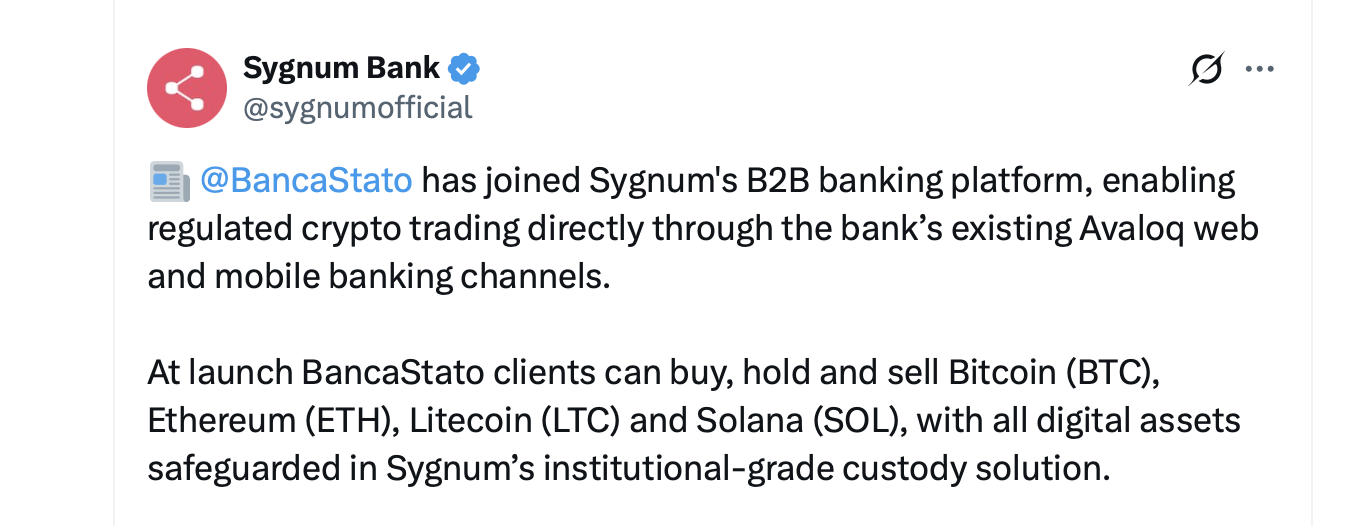
Como explicó la empresa Sygnum, gracias a esta integración, bitcoin, ether, litecoin y solana estarán disponibles en las mismas aplicaciones web y aplicaciones bancarias móviles que los clientes ya utilizan para depósitos, inversiones y operaciones bancarias diarias. Esto es importante porque uno de los principales obstáculos para la adopción de criptomonedas por parte de los bancos nunca ha sido la demanda.

El problema eran las inconveniencias que surgen cuando los clientes se ven obligados a salir del ecosistema de su banco, pasar por otro proceso de registro y gestionar activos en una plataforma separada. Debido a que todas las funciones permanecen dentro de la interfaz existente de Bancastato, para los clientes esto se parece más a añadir otro producto de inversión que a establecer relaciones financieras completamente nuevas.
Fuente de la imagen: X

Gracias a este acuerdo, Bancastato también se convierte en el primer banco en utilizar el entorno bancario Avaloq bajo el modelo de "software como servicio" (SaaS) para ofrecer servicios de negociación de criptomonedas a través de la interfaz de programación de aplicaciones (API) de Sygnum. En la práctica, esto significa que la infraestructura de negociación opera "entre bastidores", mientras que los clientes continúan interactuando con la misma plataforma bancaria a la que ya están acostumbrados.

Los bancos evitan remodelar sus sistemas centrales, y los clientes evitan tener que cambiar entre aplicaciones cada vez que desean realizar una transacción. Los clientes pueden colocar órdenes de mercado, especificando ya sea la cantidad deseada de criptomoneda o su valor en dólares estadounidenses. Sygnum ejecuta cada transacción, mientras que Bancastato mantiene las relaciones con los clientes, el branding y la interfaz de usuario.

Esta separación refleja un modelo que se está volviendo cada vez más común en el sector de servicios financieros regulados: los bancos retienen la titularidad de los clientes, y proveedores especializados se encargan de la infraestructura que, de otro modo, requeriría años de desarrollo, aprobaciones regulatorias y mantenimiento constante. Sygnum también asegura la custodia de los activos digitales de los clientes mediante su plataforma de custodia institucional.

La custodia va mucho más allá del simple almacenamiento de claves privadas. Incluye medidas de seguridad de múltiples capas, procedimientos de gobierno, auditorías independientes y estructuras legales diseñadas para separar los activos de los clientes del balance propio del banco. La separación legal se ha convertido en una de las características definitorias que esperan los clientes institucionales, ya que ayuda a reducir el riesgo de contraparte en caso de que la institución financiera enfrente dificultades operativas o financieras.

Sygnum crea la infraestructura que les falta a los bancos

El Director de Clientes Corporativos (B2B) de Sygnum, Fritz Jost, señaló que esta integración refleja la creciente demanda de servicios regulados de activos digitales que se integren directamente en los sistemas bancarios existentes. Caracterizó el lanzamiento de Bancastato como "un paso importante hacia la madurez y escalabilidad de la infraestructura regulada de activos digitales".

El director de Bancastato, Kurzio De Gottardi, explicó que la adición de activos digitales amplía la oferta de inversión existente del banco. Esta observación refleja un cambio más amplio en el sector financiero tradicional. Muchos bancos regionales ya no ven las criptomonedas como un producto separado que compite con los instrumentos financieros tradicionales. Por el contrario, cada vez más ocupan un lugar junto con monedas, acciones y carteras gestionadas como otra clase de activos a la que los clientes esperan acceder desde una sola cuenta.

Esta estrategia es la base del modelo de negocio de Sygnum. En lugar de competir por depósitos minoristas, esta empresa de Zúrich proporciona la infraestructura para negociación, custodia, cumplimiento normativo y liquidación que las instituciones asociadas tendrían que desarrollar, construir y mantener por sí mismas. Más de 25 bancos e instituciones financieras internacionales ya utilizan su plataforma B2B, incluidos Zuger Kantonalbank, Luzerner Kantonalbank, Postfinance y VZ Vermögenszentrum.

Según Sygnum, gracias a estas asociaciones, los servicios de activos digitales regulados ya están disponibles para más de un tercio de la población de Suiza a través de relaciones bancarias existentes. Bancastato amplía esta red a la región de habla italiana del país, reforzando otra tendencia observada en toda Europa: los bancos regionales están adoptando cada vez más activos digitales sin abandonar su papel tradicional como instituciones financieras comunitarias locales.

La startup de Zúrich se convierte en una red bancaria regulada

Los orígenes de Sygnum se remontan a discusiones mantenidas durante el Festival de Fintech de Singapur en 2017. La empresa se registró en Suiza en mayo de 2018 y, un mes después, en Singapur, creando una estructura de doble centro enfocada en el sector bancario de Zúrich y los mercados de capitales de Singapur.

Zúrich sigue siendo la sede operativa y regulatoria de la empresa, proporcionando servicios de custodia, cumplimiento, gestión de riesgos, desarrollo de productos y soporte tecnológico a las instituciones asociadas. En 2019, Sygnum obtuvo licencias bancarias y de comercio de valores en Suiza, quedando bajo la supervisión de la Autoridad de Supervisión del Mercado Financiero Suizo (FINMA).

Desde entonces, el alcance de la empresa se ha expandido para incluir operaciones con licencia en Singapur, Abu Dabi y Liechtenstein. El 30 de junio, Sygnum Europe obtuvo una licencia de proveedor de servicios de criptoactivos bajo la regulación de la Unión Europea "Mercados de Criptoactivos" (MiCA). Además de abrir nuevos mercados, este tipo de autorizaciones reducen la incertidumbre regulatoria para los bancos asociados, dándoles mayor confianza en que los servicios de activos digitales transfronterizos se pueden prestar bajo un único marco legal, en lugar de reglas locales fragmentadas.

Esta expansión también subraya la realidad práctica dentro del sector bancario tradicional. Crear sistemas de custodia, cumplimiento y ejecución de nivel institucional para criptomonedas requiere una experiencia que va mucho más allá de las fortalezas tradicionales de la mayoría de los bancos. Muchas instituciones han concluido que integrar una infraestructura probada es más rápido, más barato y más seguro desde un punto de vista operativo que intentar construirla desde cero.

Suiza lleva las criptomonedas a la corriente principal

El lanzamiento de Bancastato también refleja una evolución más amplia de Suiza hacia la consolidación como uno de los mercados de activos digitales más maduros y regulados del mundo. Según estimaciones de estudios, entre el 18% y el 23% de los residentes de Suiza poseen criptomonedas, alcanzando aproximadamente el 36% entre algunos individuos de 18 a 24 años.

Según un informe de Big Whale publicado en marzo, para mediados de 2026, alrededor de 20 bancos suizos ofrecían algún tipo de servicios relacionados con criptomonedas para más de 2.5 millones de cuentas de clientes. UBS, Zürcher Kantonalbank, Postfinance y los bancos cantonales de Zug, Lucerna, Sankt Gallen, Turgovia y Ticino han implementado ofertas reguladas, y muchos prefirieron utilizar proveedores de infraestructura especializados en lugar de construir sus propias plataformas.

Esta tendencia ilustra cómo Suiza ha abordado los activos digitales de manera diferente a muchas otras jurisdicciones. En lugar de crear un sistema financiero paralelo, los reguladores han incorporado principalmente las criptomonedas al sistema de supervisión bancaria existente a través de estándares de licencias que cubren requisitos de custodia, negociación, cumplimiento normativo y lucha contra el lavado de dinero (AML).

Combinado con la concentración de empresas blockchain en el área de "Crypto Valley" en Zug, este marco regulatorio ha proporcionado a las instituciones financieras un camino más claro para lanzar servicios regulados sin tener que remodelar completamente su modelo operativo.

end-content

Trending Cryptos

Related Questions

Q¿Cómo hace Sygnum que las criptomonedas sean accesibles para los clientes bancarios tradicionales?

ASygnum integra sus servicios de infraestructura de activos digitales en las aplicaciones bancarias existentes de los socios, como Bancastato. Esto permite a los clientes comprar, mantener y operar con criptomonedas como Bitcoin, Ethereum, Litecoin y Solana directamente desde la misma interfaz que usan para sus cuentas bancarias e inversiones tradicionales, sin necesidad de salir de la plataforma de su banco ni crear cuentas en exchanges externos.

Q¿Qué es el modelo B2B de Sygnum y por qué es atractivo para los bancos?

AEl modelo B2B de Sygnum consiste en proporcionar a los bancos (como Bancastato, Zuger Kantonalbank, etc.) la infraestructura tecnológica, regulatoria y de custodia necesaria para ofrecer servicios de activos digitales. Es atractivo porque permite a los bancos evitar desarrollar internamente estos sistemas complejos (que requieren años de desarrollo y aprobaciones regulatorias como las de FINMA) y centrarse en su relación con el cliente, su marca y su interfaz de usuario, mientras Sygnum gestiona la custodia, ejecución de órdenes y cumplimiento normativo.

Q¿Cómo gestiona Sygnum la custodia segura de los activos digitales para sus clientes institucionales?

ASygnum ofrece una plataforma de custodia institucional que va más allá del simple almacenamiento de claves privadas. Incluye múltiples capas de seguridad física y cibernética, procedimientos de gestión estrictos, auditorías independientes y estructuras legales que separan claramente los activos de los clientes del balance del propio banco. Esta segregación legal es crucial para reducir el riesgo de contrapartida y es una demanda clave de los clientes institucionales.

Q¿Qué impacto está teniendo la expansión de los servicios de Sygnum en el panorama financiero suizo?

ALa expansión de Sygnum, al asociarse con más de 25 bancos e instituciones financieras, ha hecho que los servicios de activos digitales regulados estén disponibles para más de un tercio de la población suiza a través de sus bancos tradicionales. Esto está ayudando a llevar las criptomonedas a la corriente principal financiera de Suiza, donde ya entre el 18% y el 23% de la población posee algún criptoactivo, con cifras aún mayores entre los jóvenes.

Q¿Cuál ha sido el enfoque regulatorio de Suiza respecto a los activos digitales y cómo ha ayudado a empresas como Sygnum?

ASuiza ha optado por integrar los criptoactivos en su sistema bancario y de supervisión financiera existente, en lugar de crear un marco regulatorio paralelo. Reguladores como FINMA han establecido estándares de licencia que cubren custodia, comercio, cumplimiento normativo (como AML) y solvencia. Este enfoque claro y la concentración de empresas en la 'Crypto Valley' de Zug proporcionan un camino definido para que bancos y proveedores de infraestructura como Sygnum operen de manera regulada y segura, fomentando la innovación y la confianza del mercado.

Related Reads

Once-Popular Web3 Enters Wave of Layoffs

The once-hot Web3 industry is experiencing a severe wave of layoffs. While many companies attribute job cuts to AI-driven restructuring, the primary reason is often financial pressure. The Web3 sector, at the intersection of tech and finance, has been hit particularly hard. Employees at major cryptocurrency exchanges report sudden, impersonal layoffs—often with system access revoked overnight—and minimal or no severance. Common tactics include setting impossible performance targets or terminating employees for minor policy violations. The working atmosphere has become toxic, marked by intense monitoring, excessive meetings, and management obsessed with control and internal politics rather than product innovation. The industry's core business model is collapsing. Exchange revenue from trading fees and listing charges has plummeted due to a decline in quality projects and retail investor exodus. Events like the massive forced liquidation on October 10th further shattered confidence. Competition from on-chain derivatives platforms and prediction markets is intensifying the downturn. As layoffs continue, displaced workers struggle to find new opportunities. Many transition to the AI sector, but face significant bias from traditional finance and even some AI firms, which view crypto industry experience with suspicion. The current downturn appears more structural than cyclical, driven by unsustainable practices, internal strife, and a failure to innovate, raising questions about the industry's future trajectory.

marsbit5m ago

Once-Popular Web3 Enters Wave of Layoffs

marsbit5m ago

Sales Drop 26% But Prices Rise? Xiaomi's Dilemma

Xiaomi, facing a significant 26.3% year-on-year decline in global smartphone shipments in Q2 2026, has implemented its third price hike of the year. On August 2nd, prices were raised for nine models, including the flagship Mi 17 series (up 400-500 yuan) and Redmi K90/Turbo 5 series (up 300 yuan). This move completes a pattern where cost pressure, originating from surging memory chip prices, has climbed from entry-level to mid-range and now flagship products. The primary driver is a severe supply squeeze on consumer-grade DRAM and NAND flash memory, as major manufacturers like Samsung shift advanced capacity to more profitable HBM for AI applications. According to Xiaomi President Lu Weibing, memory prices for the same configuration have skyrocketed nearly fourfold since Q1 2025, adding roughly 1500 yuan to the cost of a mainstream 12GB+512GB phone. IDC estimates consumer memory costs have risen nearly 300% year-on-year. While the price increases hurt demand and contributed to the sales slump, Xiaomi's strategy of reducing entry-level models and upgrading its product mix also played a role. Domestically, its market share in China fell to 12% (5th place), while leaders Huawei and Apple saw shipments grow over 24%. To mitigate future risks, Xiaomi is accelerating its in-house "Surge" chip development and optimizing memory configurations across its lineup. Xiaomi is not alone; major brands like OPPO, vivo, and Apple have already raised prices in 2026, with industry insiders predicting another round of increases (200-800 yuan) in the second half. A full-scale industry-wide涨价 cycle is underway, forcing both manufacturers and consumers to recalibrate their strategies and purchasing decisions amid sustained cost pressures.

marsbit16m ago

Sales Drop 26% But Prices Rise? Xiaomi's Dilemma

marsbit16m ago

Three Consecutive Quarters of Decline: The Crypto Market is Experiencing Its Longest Ebb Since 2022

The cryptocurrency market experienced its third consecutive quarterly decline in Q2 2026, marking its longest downturn since 2022, according to a CoinGecko report. The total market capitalization fell 12.6% to $2.1 trillion, a retreat of roughly 52% from its October 2025 peak. Multiple indicators signal an orderly capital exit from the sector. For the first time since Q3 2023, the total stablecoin market cap shrank (-1.6% to $305.1B), indicating funds are leaving the ecosystem entirely, not just rotating to safer crypto assets. Trading volumes on centralized exchanges dropped 27.9%, while DeFi's Total Value Locked (TVL) plummeted 23.4%. Both Bitcoin (-14.2%) and Ethereum (-25.4%) underperformed traditional risk assets like equities in Q2, breaking from previous correlative narratives. Ethereum saw its first-ever three-quarter losing streak, with its market share falling to around 10%. A few areas saw growth. Prediction market volumes surged 48.7%, largely driven by sports betting. Hyperliquid's HYPE token entered the top 10 by market cap, and tokenized collectibles platforms grew, though primarily via gamified mechanics. Despite a ~9.8% Bitcoin rebound in July, historical trends suggest caution for August. The market, now ~49% below its 2025 high, is undergoing a measured retreat. Its recovery hinges on future Federal Reserve policy and the industry's ability to develop sustainable revenue streams beyond speculation.

marsbit30m ago

Three Consecutive Quarters of Decline: The Crypto Market is Experiencing Its Longest Ebb Since 2022

marsbit30m ago

Trading

Spot

Hot Articles

What is SONIC

Sonic: Pioneering the Future of Gaming in Web3 Introduction to Sonic In the ever-evolving landscape of Web3, the gaming industry stands out as one of the most dynamic and promising sectors. At the forefront of this revolution is Sonic, a project designed to amplify the gaming ecosystem on the Solana blockchain. Leveraging cutting-edge technology, Sonic aims to deliver an unparalleled gaming experience by efficiently processing millions of requests per second, ensuring that players enjoy seamless gameplay while maintaining low transaction costs. This article delves into the intricate details of Sonic, exploring its creators, funding sources, operational mechanics, and the timeline of significant events that have shaped its journey. What is Sonic? Sonic is an innovative layer-2 network that operates atop the Solana blockchain, specifically tailored to enhance the existing Solana gaming ecosystem. It accomplishes this through a customised, VM-agnostic game engine paired with a HyperGrid interpreter, facilitating sovereign game economies that roll up back to the Solana platform. The primary goals of Sonic include: Enhanced Gaming Experiences: Sonic is committed to offering lightning-fast on-chain gameplay, allowing players and developers to engage with games at previously unattainable speeds. Atomic Interoperability: This feature enables transactions to be executed within Sonic without the need to redeploy Solana programmes and accounts. This makes the process more efficient and directly benefits from Solana Layer1 services and liquidity. Seamless Deployment: Sonic allows developers to write for Ethereum Virtual Machine (EVM) based systems and execute them on Solana’s SVM infrastructure. This interoperability is crucial for attracting a broader range of dApps and decentralised applications to the platform. Support for Developers: By offering native composable gaming primitives and extensible data types - dining within the Entity-Component-System (ECS) framework - game creators can craft intricate business logic with ease. Overall, Sonic's unique approach not only caters to players but also provides an accessible and low-cost environment for developers to innovate and thrive. Creator of Sonic The information regarding the creator of Sonic is somewhat ambiguous. However, it is known that Sonic's SVM is owned by the company Mirror World. The absence of detailed information about the individuals behind Sonic reflects a common trend in several Web3 projects, where collective efforts and partnerships often overshadow individual contributions. Investors of Sonic Sonic has garnered considerable attention and support from various investors within the crypto and gaming sectors. Notably, the project raised an impressive $12 million during its Series A funding round. The round was led by BITKRAFT Ventures, with other notable investors including Galaxy, Okx Ventures, Interactive, Big Brain Holdings, and Mirana. This financial backing signifies the confidence that investment foundations have in Sonic’s potential to revolutionise the Web3 gaming landscape, further validating its innovative approaches and technologies. How Does Sonic Work? Sonic utilises the HyperGrid framework, a sophisticated parallel processing mechanism that enhances its scalability and customisability. Here are the core features that set Sonic apart: Lightning Speed at Low Costs: Sonic offers one of the fastest on-chain gaming experiences compared to other Layer-1 solutions, powered by the scalability of Solana’s virtual machine (SVM). Atomic Interoperability: Sonic enables transaction execution without redeployment of Solana programmes and accounts, effectively streamlining the interaction between users and the blockchain. EVM Compatibility: Developers can effortlessly migrate decentralised applications from EVM chains to the Solana environment using Sonic’s HyperGrid interpreter, increasing the accessibility and integration of various dApps. Ecosystem Support for Developers: By exposing native composable gaming primitives, Sonic facilitates a sandbox-like environment where developers can experiment and implement business logic, greatly enhancing the overall development experience. Monetisation Infrastructure: Sonic natively supports growth and monetisation efforts, providing frameworks for traffic generation, payments, and settlements, thereby ensuring that gaming projects are not only viable but also sustainable financially. Timeline of Sonic The evolution of Sonic has been marked by several key milestones. Below is a brief timeline highlighting critical events in the project's history: 2022: The Sonic cryptocurrency was officially launched, marking the beginning of its journey in the Web3 gaming arena. 2024: June: Sonic SVM successfully raised $12 million in a Series A funding round. This investment allowed Sonic to further develop its platform and expand its offerings. August: The launch of the Sonic Odyssey testnet provided users with the first opportunity to engage with the platform, offering interactive activities such as collecting rings—a nod to gaming nostalgia. October: SonicX, an innovative crypto game integrated with Solana, made its debut on TikTok, capturing the attention of over 120,000 users within a short span. This integration illustrated Sonic’s commitment to reaching a broader, global audience and showcased the potential of blockchain gaming. Key Points Sonic SVM is a revolutionary layer-2 network on Solana explicitly designed to enhance the GameFi landscape, demonstrating great potential for future development. HyperGrid Framework empowers Sonic by introducing horizontal scaling capabilities, ensuring that the network can handle the demands of Web3 gaming. Integration with Social Platforms: The successful launch of SonicX on TikTok displays Sonic’s strategy to leverage social media platforms to engage users, exponentially increasing the exposure and reach of its projects. Investment Confidence: The substantial funding from BITKRAFT Ventures, among others, emphasizes the robust backing Sonic has, paving the way for its ambitious future. In conclusion, Sonic encapsulates the essence of Web3 gaming innovation, striking a balance between cutting-edge technology, developer-centric tools, and community engagement. As the project continues to evolve, it is poised to redefine the gaming landscape, making it a notable entity for gamers and developers alike. As Sonic moves forward, it will undoubtedly attract greater interest and participation, solidifying its place within the broader narrative of blockchain gaming.

2.2k Total ViewsPublished 2024.04.04Updated 2024.12.03

What is SONIC

What is $S$

Understanding SPERO: A Comprehensive Overview Introduction to SPERO As the landscape of innovation continues to evolve, the emergence of web3 technologies and cryptocurrency projects plays a pivotal role in shaping the digital future. One project that has garnered attention in this dynamic field is SPERO, denoted as SPERO,$$s$. This article aims to gather and present detailed information about SPERO, to help enthusiasts and investors understand its foundations, objectives, and innovations within the web3 and crypto domains. What is SPERO,$$s$? SPERO,$$s$ is a unique project within the crypto space that seeks to leverage the principles of decentralisation and blockchain technology to create an ecosystem that promotes engagement, utility, and financial inclusion. The project is tailored to facilitate peer-to-peer interactions in new ways, providing users with innovative financial solutions and services. At its core, SPERO,$$s$ aims to empower individuals by providing tools and platforms that enhance user experience in the cryptocurrency space. This includes enabling more flexible transaction methods, fostering community-driven initiatives, and creating pathways for financial opportunities through decentralised applications (dApps). The underlying vision of SPERO,$$s$ revolves around inclusiveness, aiming to bridge gaps within traditional finance while harnessing the benefits of blockchain technology. Who is the Creator of SPERO,$$s$? The identity of the creator of SPERO,$$s$ remains somewhat obscure, as there are limited publicly available resources providing detailed background information on its founder(s). This lack of transparency can stem from the project's commitment to decentralisation—an ethos that many web3 projects share, prioritising collective contributions over individual recognition. By centring discussions around the community and its collective goals, SPERO,$$s$ embodies the essence of empowerment without singling out specific individuals. As such, understanding the ethos and mission of SPERO remains more important than identifying a singular creator. Who are the Investors of SPERO,$$s$? SPERO,$$s$ is supported by a diverse array of investors ranging from venture capitalists to angel investors dedicated to fostering innovation in the crypto sector. The focus of these investors generally aligns with SPERO's mission—prioritising projects that promise societal technological advancement, financial inclusivity, and decentralised governance. These investor foundations are typically interested in projects that not only offer innovative products but also contribute positively to the blockchain community and its ecosystems. The backing from these investors reinforces SPERO,$$s$ as a noteworthy contender in the rapidly evolving domain of crypto projects. How Does SPERO,$$s$ Work? SPERO,$$s$ employs a multi-faceted framework that distinguishes it from conventional cryptocurrency projects. Here are some of the key features that underline its uniqueness and innovation: Decentralised Governance: SPERO,$$s$ integrates decentralised governance models, empowering users to participate actively in decision-making processes regarding the project’s future. This approach fosters a sense of ownership and accountability among community members. Token Utility: SPERO,$$s$ utilises its own cryptocurrency token, designed to serve various functions within the ecosystem. These tokens enable transactions, rewards, and the facilitation of services offered on the platform, enhancing overall engagement and utility. Layered Architecture: The technical architecture of SPERO,$$s$ supports modularity and scalability, allowing for seamless integration of additional features and applications as the project evolves. This adaptability is paramount for sustaining relevance in the ever-changing crypto landscape. Community Engagement: The project emphasises community-driven initiatives, employing mechanisms that incentivise collaboration and feedback. By nurturing a strong community, SPERO,$$s$ can better address user needs and adapt to market trends. Focus on Inclusion: By offering low transaction fees and user-friendly interfaces, SPERO,$$s$ aims to attract a diverse user base, including individuals who may not previously have engaged in the crypto space. This commitment to inclusion aligns with its overarching mission of empowerment through accessibility. Timeline of SPERO,$$s$ Understanding a project's history provides crucial insights into its development trajectory and milestones. Below is a suggested timeline mapping significant events in the evolution of SPERO,$$s$: Conceptualisation and Ideation Phase: The initial ideas forming the basis of SPERO,$$s$ were conceived, aligning closely with the principles of decentralisation and community focus within the blockchain industry. Launch of Project Whitepaper: Following the conceptual phase, a comprehensive whitepaper detailing the vision, goals, and technological infrastructure of SPERO,$$s$ was released to garner community interest and feedback. Community Building and Early Engagements: Active outreach efforts were made to build a community of early adopters and potential investors, facilitating discussions around the project’s goals and garnering support. Token Generation Event: SPERO,$$s$ conducted a token generation event (TGE) to distribute its native tokens to early supporters and establish initial liquidity within the ecosystem. Launch of Initial dApp: The first decentralised application (dApp) associated with SPERO,$$s$ went live, allowing users to engage with the platform's core functionalities. Ongoing Development and Partnerships: Continuous updates and enhancements to the project's offerings, including strategic partnerships with other players in the blockchain space, have shaped SPERO,$$s$ into a competitive and evolving player in the crypto market. Conclusion SPERO,$$s$ stands as a testament to the potential of web3 and cryptocurrency to revolutionise financial systems and empower individuals. With a commitment to decentralised governance, community engagement, and innovatively designed functionalities, it paves the way toward a more inclusive financial landscape. As with any investment in the rapidly evolving crypto space, potential investors and users are encouraged to research thoroughly and engage thoughtfully with the ongoing developments within SPERO,$$s$. The project showcases the innovative spirit of the crypto industry, inviting further exploration into its myriad possibilities. While the journey of SPERO,$$s$ is still unfolding, its foundational principles may indeed influence the future of how we interact with technology, finance, and each other in interconnected digital ecosystems.

293 Total ViewsPublished 2024.12.17Updated 2024.12.17

What is $S$

What is AGENT S

Agent S: The Future of Autonomous Interaction in Web3 Introduction In the ever-evolving landscape of Web3 and cryptocurrency, innovations are constantly redefining how individuals interact with digital platforms. One such pioneering project, Agent S, promises to revolutionise human-computer interaction through its open agentic framework. By paving the way for autonomous interactions, Agent S aims to simplify complex tasks, offering transformative applications in artificial intelligence (AI). This detailed exploration will delve into the project's intricacies, its unique features, and the implications for the cryptocurrency domain. What is Agent S? Agent S stands as a groundbreaking open agentic framework, specifically designed to tackle three fundamental challenges in the automation of computer tasks: Acquiring Domain-Specific Knowledge: The framework intelligently learns from various external knowledge sources and internal experiences. This dual approach empowers it to build a rich repository of domain-specific knowledge, enhancing its performance in task execution. Planning Over Long Task Horizons: Agent S employs experience-augmented hierarchical planning, a strategic approach that facilitates efficient breakdown and execution of intricate tasks. This feature significantly enhances its ability to manage multiple subtasks efficiently and effectively. Handling Dynamic, Non-Uniform Interfaces: The project introduces the Agent-Computer Interface (ACI), an innovative solution that enhances the interaction between agents and users. Utilizing Multimodal Large Language Models (MLLMs), Agent S can navigate and manipulate diverse graphical user interfaces seamlessly. Through these pioneering features, Agent S provides a robust framework that addresses the complexities involved in automating human interaction with machines, setting the stage for myriad applications in AI and beyond. Who is the Creator of Agent S? While the concept of Agent S is fundamentally innovative, specific information about its creator remains elusive. The creator is currently unknown, which highlights either the nascent stage of the project or the strategic choice to keep founding members under wraps. Regardless of anonymity, the focus remains on the framework's capabilities and potential. Who are the Investors of Agent S? As Agent S is relatively new in the cryptographic ecosystem, detailed information regarding its investors and financial backers is not explicitly documented. The lack of publicly available insights into the investment foundations or organisations supporting the project raises questions about its funding structure and development roadmap. Understanding the backing is crucial for gauging the project's sustainability and potential market impact. How Does Agent S Work? At the core of Agent S lies cutting-edge technology that enables it to function effectively in diverse settings. Its operational model is built around several key features: Human-like Computer Interaction: The framework offers advanced AI planning, striving to make interactions with computers more intuitive. By mimicking human behaviour in tasks execution, it promises to elevate user experiences. Narrative Memory: Employed to leverage high-level experiences, Agent S utilises narrative memory to keep track of task histories, thereby enhancing its decision-making processes. Episodic Memory: This feature provides users with step-by-step guidance, allowing the framework to offer contextual support as tasks unfold. Support for OpenACI: With the ability to run locally, Agent S allows users to maintain control over their interactions and workflows, aligning with the decentralised ethos of Web3. Easy Integration with External APIs: Its versatility and compatibility with various AI platforms ensure that Agent S can fit seamlessly into existing technological ecosystems, making it an appealing choice for developers and organisations. These functionalities collectively contribute to Agent S's unique position within the crypto space, as it automates complex, multi-step tasks with minimal human intervention. As the project evolves, its potential applications in Web3 could redefine how digital interactions unfold. Timeline of Agent S The development and milestones of Agent S can be encapsulated in a timeline that highlights its significant events: September 27, 2024: The concept of Agent S was launched in a comprehensive research paper titled “An Open Agentic Framework that Uses Computers Like a Human,” showcasing the groundwork for the project. October 10, 2024: The research paper was made publicly available on arXiv, offering an in-depth exploration of the framework and its performance evaluation based on the OSWorld benchmark. October 12, 2024: A video presentation was released, providing a visual insight into the capabilities and features of Agent S, further engaging potential users and investors. These markers in the timeline not only illustrate the progress of Agent S but also indicate its commitment to transparency and community engagement. Key Points About Agent S As the Agent S framework continues to evolve, several key attributes stand out, underscoring its innovative nature and potential: Innovative Framework: Designed to provide an intuitive use of computers akin to human interaction, Agent S brings a novel approach to task automation. Autonomous Interaction: The ability to interact autonomously with computers through GUI signifies a leap towards more intelligent and efficient computing solutions. Complex Task Automation: With its robust methodology, it can automate complex, multi-step tasks, making processes faster and less error-prone. Continuous Improvement: The learning mechanisms enable Agent S to improve from past experiences, continually enhancing its performance and efficacy. Versatility: Its adaptability across different operating environments like OSWorld and WindowsAgentArena ensures that it can serve a broad range of applications. As Agent S positions itself in the Web3 and crypto landscape, its potential to enhance interaction capabilities and automate processes signifies a significant advancement in AI technologies. Through its innovative framework, Agent S exemplifies the future of digital interactions, promising a more seamless and efficient experience for users across various industries. Conclusion Agent S represents a bold leap forward in the marriage of AI and Web3, with the capacity to redefine how we interact with technology. While still in its early stages, the possibilities for its application are vast and compelling. Through its comprehensive framework addressing critical challenges, Agent S aims to bring autonomous interactions to the forefront of the digital experience. As we move deeper into the realms of cryptocurrency and decentralisation, projects like Agent S will undoubtedly play a crucial role in shaping the future of technology and human-computer collaboration.

959 Total ViewsPublished 2025.01.14Updated 2025.01.14

What is AGENT S

Discussions

Welcome to the HTX Community. Here, you can stay informed about the latest platform developments and gain access to professional market insights. Users' opinions on the price of S (S) are presented below.

活动图片