Face au lancement ambitieux de Robinhood, pourquoi PUMP affiche-t-elle une hausse contre la tendance ?

marsbitPublished on 2026-07-30Last updated on 2026-07-30

Abstract

Face à un marché crypto en plein ralentissement, Pump.fun reste l'un des rares protocoles majeurs à maintenir une rentabilité solide. Récemment, son jeton PUMP a affiché une hausse contraire aux attentes après un déblocage massif, tandis que la plateforme résiste à la nouvelle concurrence de Robinhood Chain. Le prix de PUMP a augmenté malgré un déblocage initial de plus de 86 millions de dollars en juillet, car seulement 8% des jetons alloués aux investisseurs ont été vendus. Le mécanisme de rachat et de destruction des jetons, bien qu'en baisse, a également soutenu le prix. Cependant, les fonds alloués aux rachats ont chuté d'environ 77,5%, reflétant une baisse des revenus de la plateforme. Pump.fun génère toujours des revenus annuels estimés à 4,5 milliards de dollars, se classant parmi les protocoles les plus rentables. Néanmoins, ses revenus quotidiens et son activité ont significativement diminué par rapport aux pics, montrant une dépendance au cycle spéculatif des memecoins. L'arrivée agressive de Robinhood Chain, avec un volume de lancement supérieur la semaine dernière, représente un nouveau défi. Pour y répondre, Pump.fun a introduit un nouveau mécanisme de lancement, BOOST, augmentant la liquidité des nouveaux jetons. Cela a stimulé l'activité, mais soulève des inquiétudes quant à la promotion de jetons de faible qualité. Ainsi, bien que résiliente, la croissance de Pump.fun reste intimement liée à la volatilité du marché et aux flux de capitaux spéculatifs.

Auteur : Nancy, PANews

Alors que le marché des cryptomonnaies est plongé en phase baissière, de nombreux projets voient leurs revenus chuter considérablement, voire quittent le marché. Pourtant, Pump.fun reste l'un des rares protocoles majeurs à maintenir une solide rentabilité.

Récemment, le jeton PUMP de Pump.fun a connu une hausse malgré un important déverrouillage, et face à l'arrivée du nouveau concurrent Robinhood Chain, la plateforme n'a pas encore subi de perte notable d'utilisateurs ou de parts de marché, suscitant à nouveau l'attention.

Pourquoi PUMP affiche-t-elle une hausse contre la tendance après un important déverrouillage ?

Contrairement aux attentes du marché, où un déverrouillage massif de jetons entraîne généralement des pressions de vente, PUMP a affiché la tendance inverse.

Depuis la mi-juillet, malgré un déverrouillage important, le prix de PUMP n'a pas baissé mais a augmenté. Les données de CoinGecko montrent qu'au cours des 30 derniers jours, PUMP a enregistré une hausse maximale d'environ 47,9 %.
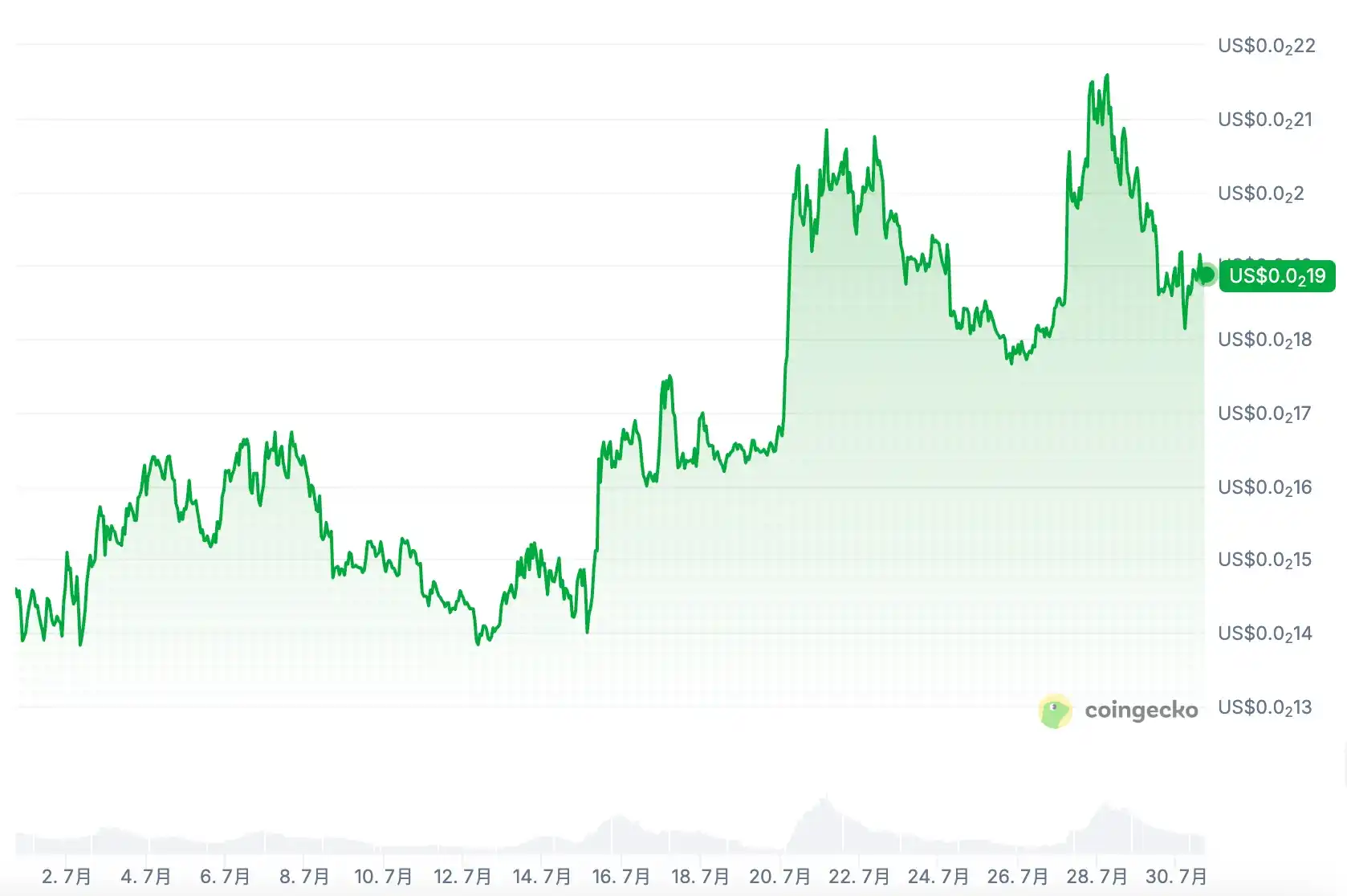
La hausse du prix de PUMP s'explique d'une part par l'allégement des pressions de vente liées au déverrouillage. Le 14 juillet, PUMP a connu son premier déverrouillage important pour l'équipe et les investisseurs après son TGE, libérant plus de 86 millions de dollars de jetons. Le marché craignait généralement qu'un déverrouillage à grande échelle ne déclenche des ventes.

Cependant, selon une analyse récente de Lbexplorer, sur les 79 portefeuilles d'investisseurs de Pump.fun, seuls 3 ont vendu leur allocation. La plus grosse vente provient d'un portefeuille détenant 625 millions de PUMP, pour un montant d'environ 1,2825 million de dollars. Les deux autres portefeuilles ont vendu pour un peu plus de 100 000 dollars au total. Au cours des 13 derniers jours, les investisseurs ont vendu environ 770 millions de PUMP, d'une valeur d'environ 1,574 million de dollars. Actuellement, environ 92 % des jetons alloués aux investisseurs n'ont pas encore été vendus.

Parallèlement, le mécanisme de rachat et de destruction (burn) est un facteur important soutenant le prix de PUMP. Le site web de Pump.fun indique qu'à ce jour, plus de 15,45 millions de PUMP ont été détruits, d'une valeur supérieure à 416 millions de dollars, soit environ 15,4 % de l'offre totale. Au cours des 7 derniers jours, Pump.fun a racheté et détruit environ 2,236 milliards de PUMP, d'une valeur d'environ 4,359 millions de dollars. Cependant, bien que ce mécanisme puisse soutenir le prix à court terme, son effet à long terme dépendra de la croissance des revenus de la plateforme.

En réalité, l'intensité des rachats par Pump.fun a récemment diminué. Les données montrent que ses rachats quotidiens sont passés d'un pic de plus de 3,06 millions de dollars à environ 690 000 dollars actuellement, soit une baisse d'environ 77,5 %.
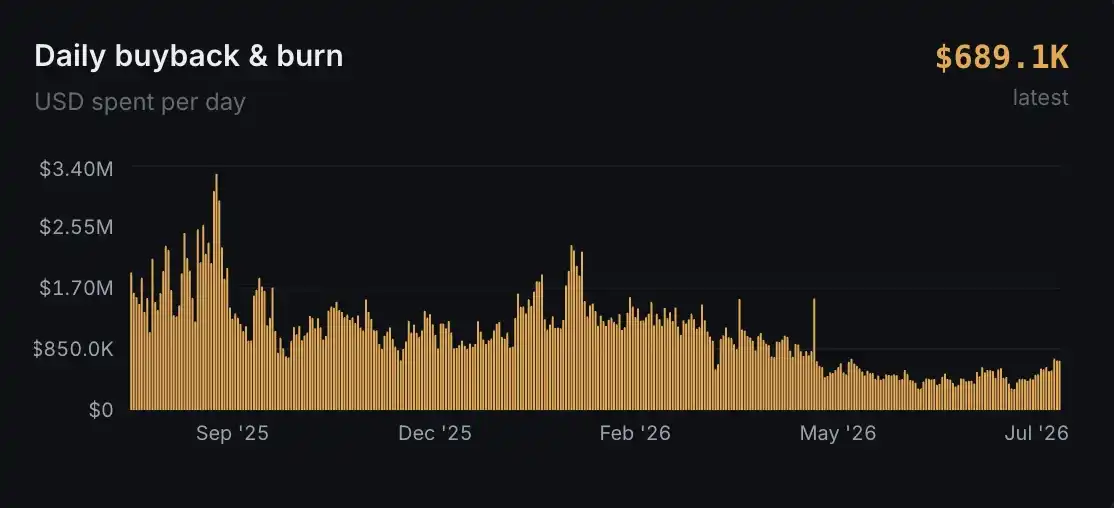
Cette réduction des rachats est liée, d'une part, à l'ajustement du modèle économique des jetons il y a quelques mois : la plateforme a annoncé réduire à 50 % la part des revenus utilisée pour racheter et détruire PUMP. D'autre part, elle reflète l'impact du marché baissier sur les revenus : les revenus quotidiens sont passés d'un pic historique de près de 5,2 millions de dollars à environ 1,608 million de dollars actuellement, soit une baisse d'environ 69,1 %.

Une "machine à profits" en marché baissier, mais une croissance des revenus soumise aux cycles

Comparé à la plupart des protocoles crypto, Pump.fun maintient une forte rentabilité et reste l'un des rares protocoles majeurs à générer des flux de trésorerie stables en environnement baissier.

Les données de DeFiLlama montrent qu'au 30 juillet, les revenus annualisés de Pump.fun atteignent environ 450 millions de dollars. Ses revenus quotidiens ne sont dépassés que par ceux de Tether, Circle et Hyperliquid, représentant près de 4,2 % des revenus totaux du marché crypto. Depuis début 2026, les revenus mensuels de Pump.fun se maintiennent généralement au-dessus de 30 millions de dollars.
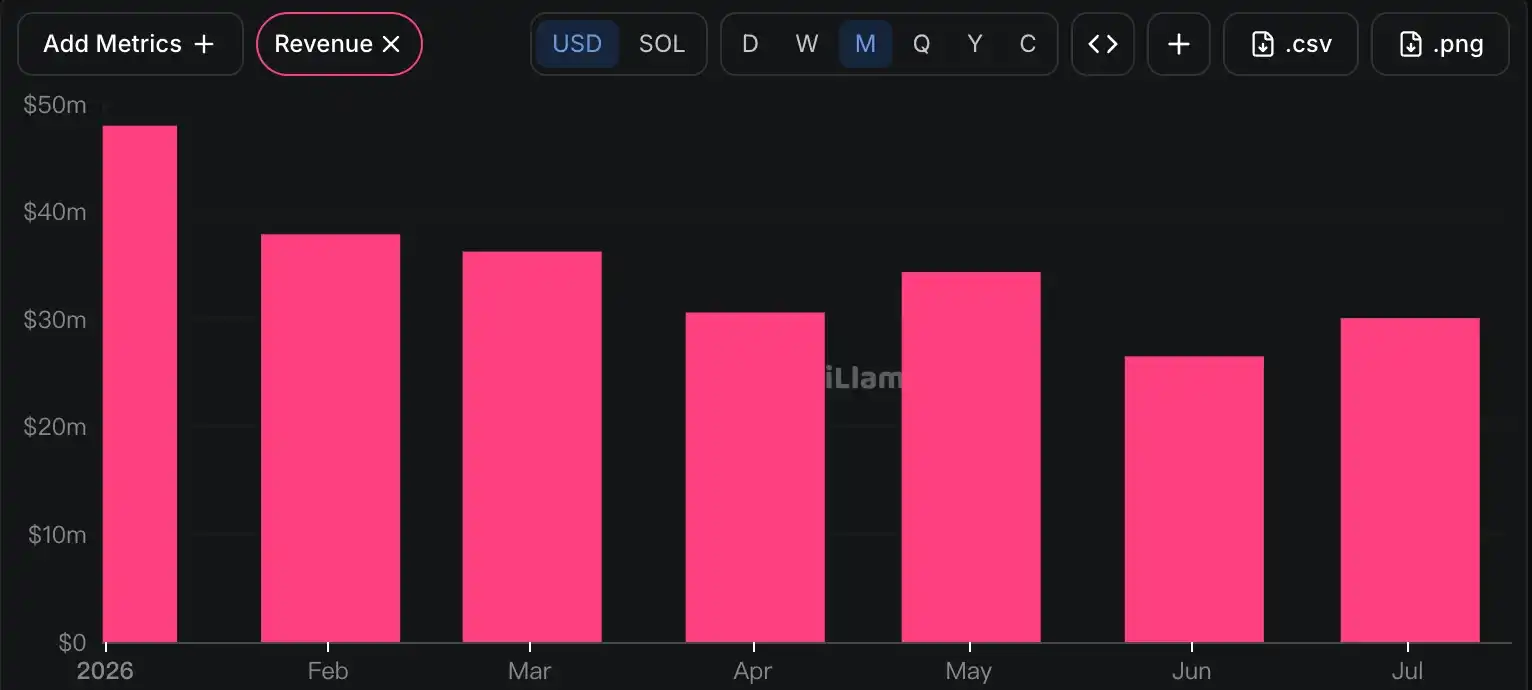
Récemment, les revenus de Pump.fun ont même temporairement dépassé ceux du leader des DEX de perpétuels, Hyperliquid. À ce sujet, le cofondateur de Pump.fun, Sapijiju, a déclaré que le marché potentiel total (TAM) à long terme de Pump.fun dépasserait celui du marché mondial des contrats perpétuels où évolue Hyperliquid, le qualifiant de "bien plus vaste... mais pas encore validé".

Outre la génération de revenus, l'équipe de Pump.fun a également empoché des frais considérables. Depuis début 2024, Pump.fun a vendu environ 4,812 millions de SOL provenant des frais, d'une valeur supérieure à 810 millions de dollars, principalement grâce aux frais de transaction de 1 %.

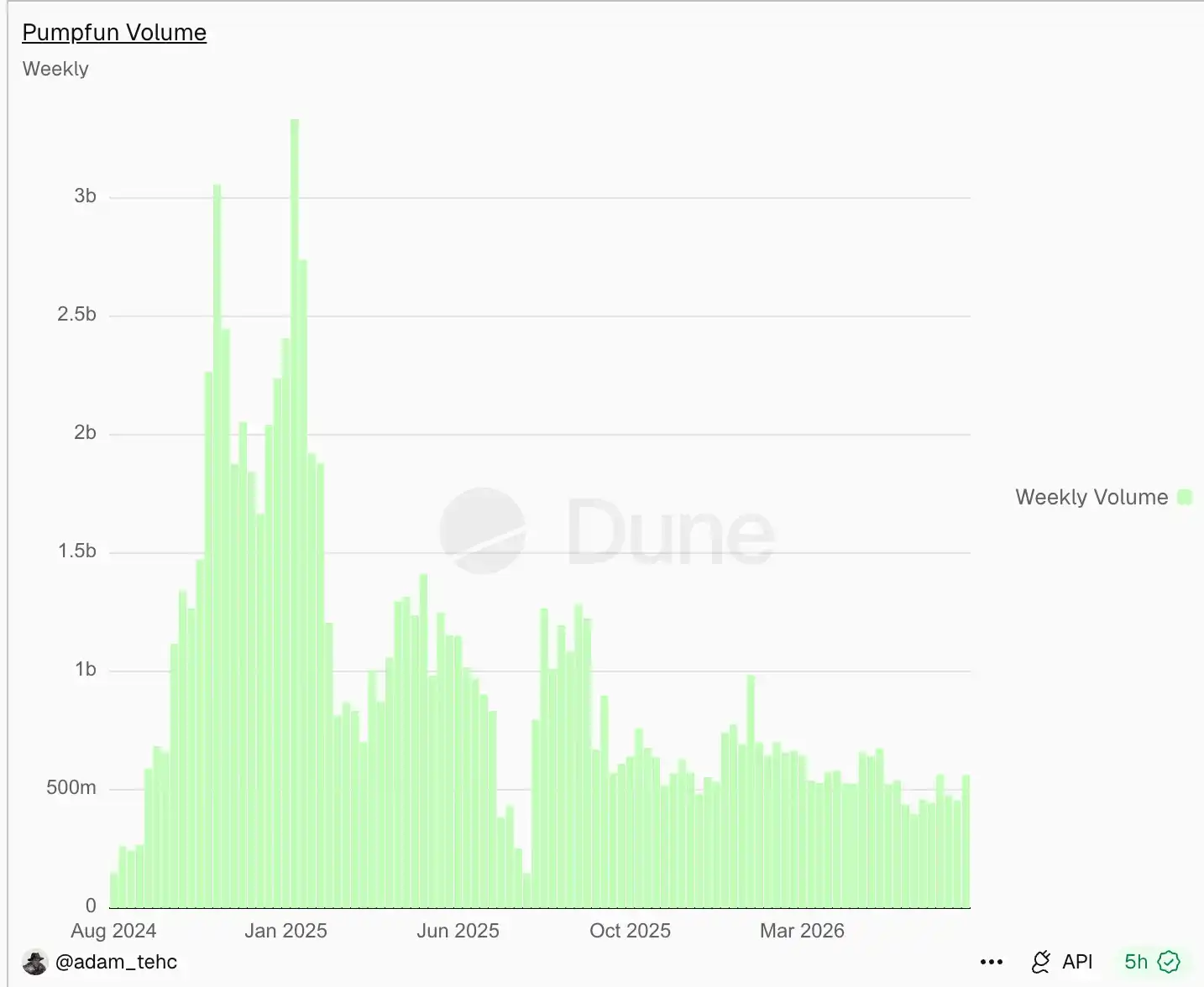
Cependant, les performances actuelles de Pump.fun restent inférieures à son pic. Les données Dune montrent qu'au 30 juillet, le volume hebdomadaire de Pump.fun ne représente qu'environ 17 % de son pic historique, et les adresses actives quotidiennes ont chuté à 38,1 % du pic. Ce reflux de l'activité a directement impacté les revenus. Les données Dune indiquent que les revenus quotidiens actuels ne représentent qu'environ 30 % du pic historique. Cela signifie que le modèle économique de Pump.fun reste fortement dépendant de l'ambiance de marché et de la frénésie autour des meme coins, exposant la croissance de ses revenus à une forte cyclicité.
Il est à noter que Pump.fun fait actuellement l'objet d'une action collective, accusé de trading prioritaire interne, de manipulation du marché des meme coins, de vente de titres non enregistrés et de violation de la loi RICO. Face à ces risques de conformité, fin juin 2026, la société mère Baton Corporation a annoncé le recrutement d'un directeur juridique en chef avec un salaire de base compris entre 1 et 5 millions de dollars, chargé des affaires réglementaires, du conseil produit, de la gouvernance d'entreprise et de la conformité transfrontalière.

L'arrivée ambitieuse de Robinhood, Pump.fun confronté à une concurrence frontale

Outre la pression du marché baissier, l'offensive récente de Robinhood Chain apporte une nouvelle pression concurrentielle pour Pump.fun.

Selon les données Dune, le volume hebdomadaire du Launchpad sur Robinhood Chain a atteint 1,23 milliard de dollars la semaine dernière, dépassant les 447 millions de dollars de Pump.fun sur la même période et se rapprochant des 1,22 milliard de dollars de Pumpswap. En termes d'adresses actives, le Launchpad de Robinhood Chain a enregistré environ 191 000 adresses actives, contre environ 141 000 pour Pump.fun, leader de l'écosystème Solana.
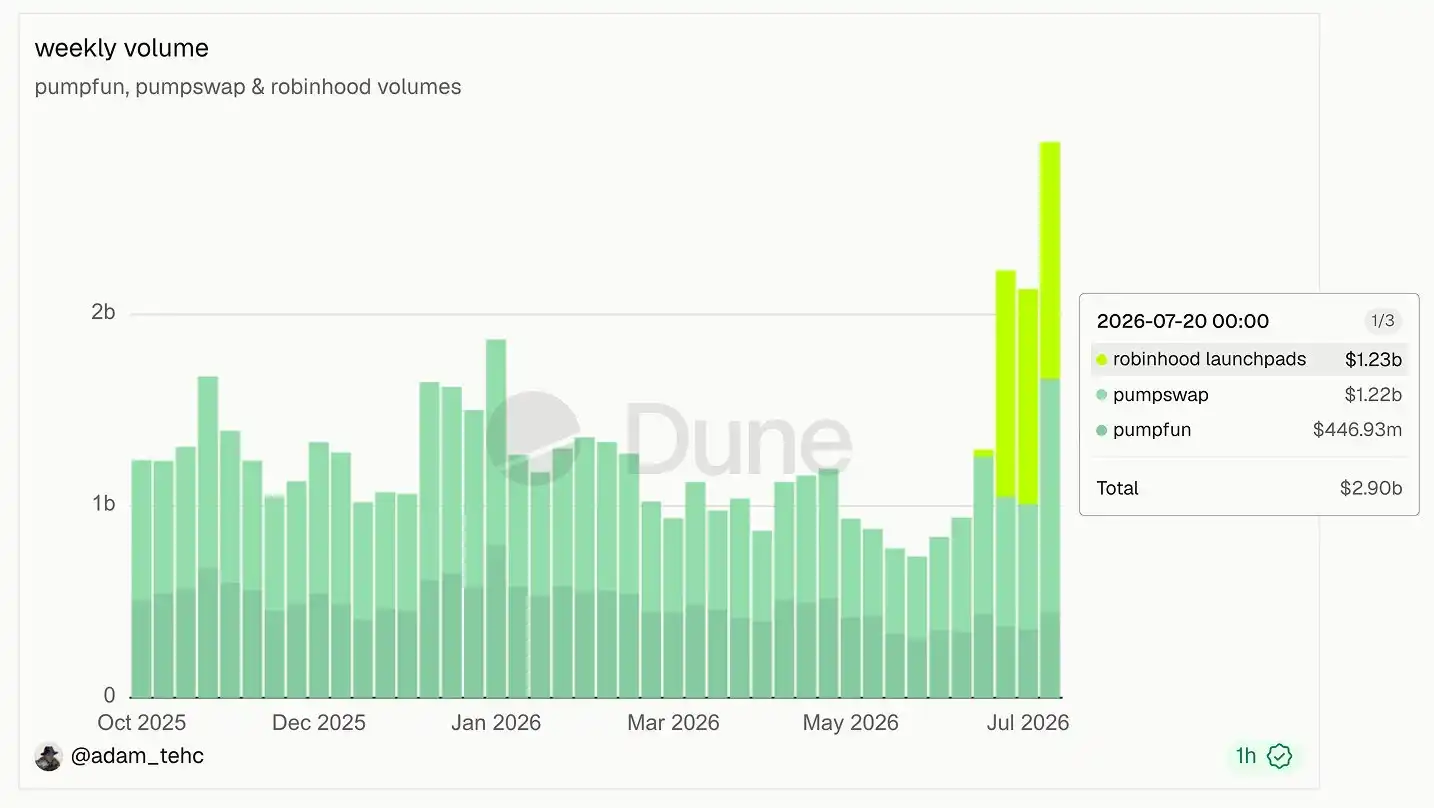
Cependant, pour l'instant, le Launchpad de Robinhood n'a pas significativement érodé les parts de marché de Pump.fun. Que ce soit en volume ou en adresses actives, Pump.fun maintient une tendance à la hausse récente. Néanmoins, indépendamment des conditions de marché, avec l'arrivée constante de concurrents, la durée du leadership de Pump.fun dans le marché du lancement de meme coins reste incertaine.

Pour renforcer sa compétitivité, Pump.fun ajuste également sa stratégie produit. Récemment, Pump.fun a lancé un nouveau mécanisme de lancement standard appelé BOOST, visant à résoudre le problème de la liquidité "morte" générée lors de la migration des jetons de la courbe de liaison vers le pool de liquidité. Selon son cofondateur Alon Cohen, ce mécanisme peut ajouter environ 20 % de liquidité pour chaque nouveau jeton migré, sans altérer l'expérience de trading sur la courbe ou dans le pool, et injectera des centaines de millions de dollars de liquidité dans l'écosystème au fil du temps.

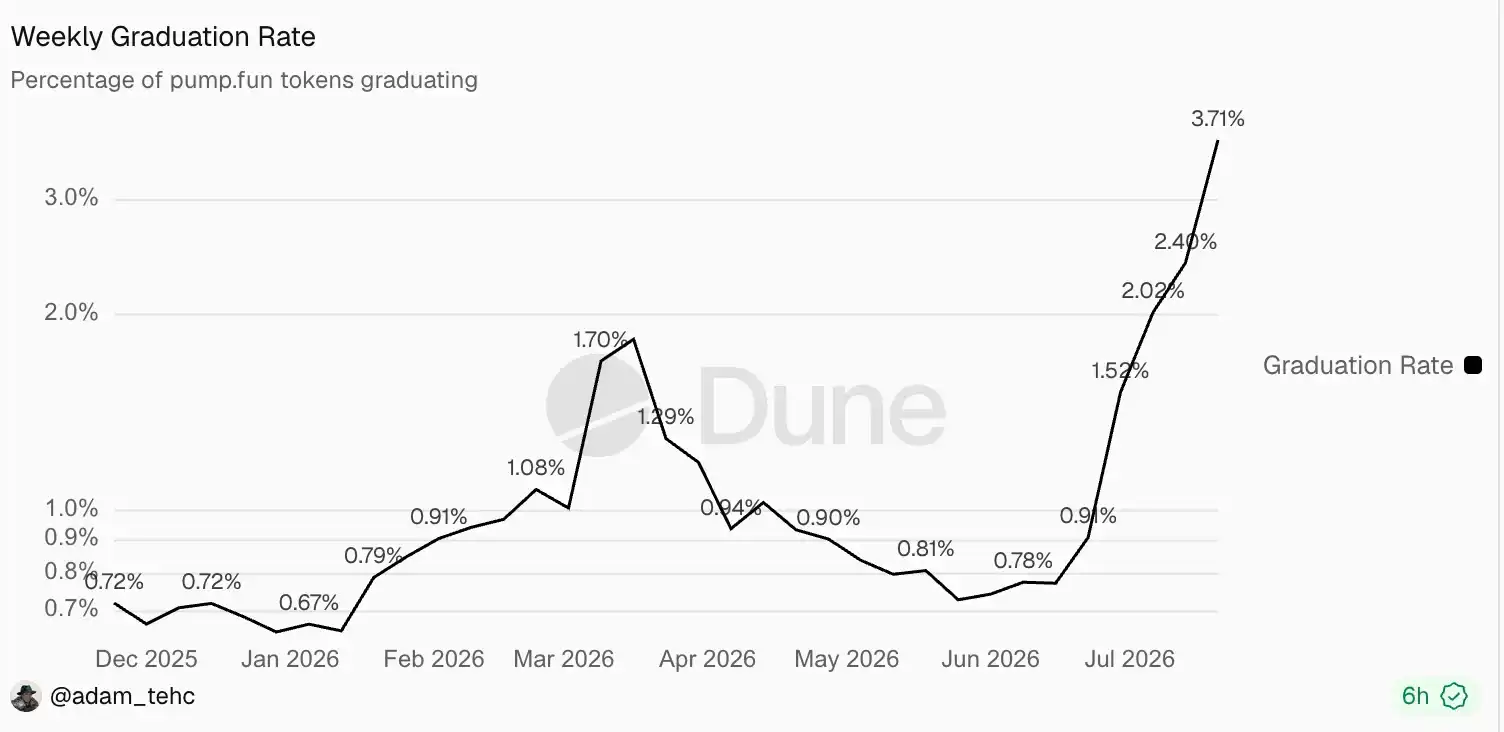
Après le lancement de ce mécanisme, l'activité sur Pump.fun s'est notablement améliorée. Les données Dune montrent que le taux hebdomadaire de "graduation" des jetons est passé à 3,7 %, contre seulement 0,67 % début 2026 ; le nombre quotidien de créations de jetons a également dépassé 36 000, approchant un plus haut sur près de quatre mois.
Cependant, certains membres de la communauté soulignent que ce mécanisme fournit en réalité une pression d'achat gratuite et un effet déflationniste pour les jetons sur le point de "graduer", réduisant considérablement le coût de liaison (bonding) et incitant les traders à pousser les prix. Les développeurs pourraient exploiter ce mécanisme pour promouvoir des jetons liés (bonded) prêts à graduer, attirant les investisseurs particuliers en créant de la liquidité et de l'engouement, et en réalisant ainsi des profits faciles, ce qui pourrait encourager davantage de jetons de mauvaise qualité basés sur le bonding et la spéculation à court terme.

Globalement, la roue de croissance des revenus de Pump.fun repose encore sur la frénésie du marché des meme coins et les flux de capitaux spéculatifs. Ce modèle, bien qu'il génère des flux de trésorerie élevés en période de spéculation, signifie également que les revenus de la plateforme et la performance du prix de PUMP restent vulnérables aux fluctuations cycliques du marché.


Trending Cryptos

Related Questions

QPourquoi le prix du jeton PUMP a-t-il augmenté après un déverrouillage important de jetons, contrairement aux attentes du marché ?

ALe prix de PUMP a augmenté après le déverrouillage principalement parce que la pression de vente anticipée s'est avérée faible. Seuls 3 des 79 portefeuilles d'investisseurs ont vendu une partie de leurs allocations, liquidant environ 157,4 millions de dollars de jetons, tandis qu'environ 92 % des jetons alloués aux investisseurs n'ont pas été vendus. De plus, le mécanisme de rachat et de destruction (burn) a fourni un soutien au prix, bien que son efficacité à long terme dépende de la croissance des revenus de la plateforme.

QQuel est l'état actuel de la rentabilité de Pump.fun par rapport à d'autres protocoles en période de marché baissier ?

APump.fun reste l'un des rares protocoles majeurs à maintenir une forte rentabilité en période de marché baissier. Avec des revenus annuels estimés à environ 450 millions de dollars, il se classe au quatrième rang en termes de revenus quotidiens, derrière Tether, Circle et Hyperliquid, représentant près de 4,2 % des revenus totaux du marché des cryptomonnaies. Ses revenus mensuels sont généralement restés supérieurs à 30 millions de dollars cette année.

QComment le nouveau mécanisme de lancement BOOST de Pump.fun fonctionne-t-il et quel impact a-t-il eu ?

ALe nouveau mécanisme de lancement standard BOOST de Pump.fun vise à résoudre le problème de liquidité morte lors de la migration des jetons de la courbe de liaison vers le pool de liquidités. Selon ses créateurs, il ajoute environ 20 % de liquidité à chaque nouveau jeton migré sans altérer l'expérience de transaction. Depuis son introduction, le taux hebdomadaire de 'diplômation' des jetons est passé à 3,7 % (contre 0,67 % début d'année) et le nombre moyen quotidien de créations de jetons a atteint un plus haut en près de quatre mois, dépassant 36 000.

QQuel défi concurrentiel Robinhood Chain représente-t-il pour Pump.fun, et comment Pump.fun y a-t-il répondu jusqu'à présent ?

ARobinhood Chain est un nouvel entrant compétitif, dont le Launchpad a enregistré un volume de transactions hebdomadaire de 12,3 milliards de dollars, dépassant celui de Pump.fun (4,47 milliards de dollars) et se rapprochant de celui de Pumpswap (12,2 milliards). Son nombre d'adresses actives était également plus élevé. Cependant, Pump.fun n'a pas encore perdu de parts de marché significatives, car ses volumes et adresses actives continuent de croître. Pour renforcer sa compétitivité, Pump.fun a lancé le mécanisme BOOST et recrute activement un directeur juridique en chef pour faire face aux risques de conformité.

QQuels sont les principaux risques ou défis auxquels est confronté le modèle économique de Pump.fun selon l'article ?

ALe modèle économique de Pump.fun fait face à plusieurs défis : 1) Sa rentabilité et la performance du jeton PUMP restent fortement liées aux cycles du marché et à la spéculation sur les memecoins, comme en témoigne la baisse de ses revenus par rapport aux pics. 2) Il est confronté à une concurrence accrue, notamment de la part de Robinhood Chain. 3) La plateforme fait l'objet d'une action collective pour des accusations d'opérations privilégiées internes, de manipulation du marché, de vente de titres non enregistrés et de violation des lois RICO, ce qui pose un risque de conformité. 4) Le mécanisme BOOST, bien qu'augmentant l'activité, pourrait potentiellement encourager la création de jetons de faible qualité basés sur des stratagèmes à court terme.

Related Reads

Just Now, OpenAI's New Model Astra Exposed!

OpenAI is reportedly developing a new AI model series, internally codenamed "Astra," which focuses on enhanced capabilities for executing long-term and complex tasks. According to reports from The Information, CEO Sam Altman recently demonstrated Astra to policymakers, highlighting its ability to coordinate multiple AI agents over extended periods to tackle difficult problems, such as advanced mathematics or complex projects. Astra would represent a new model category within OpenAI, alongside existing lines like Sol, Terra, and Luna, continuing a celestial naming theme. Its final branding—whether as part of the GPT-5 series (e.g., GPT-5.7) or as GPT-6—remains undecided. The model is currently in testing and may be among the first submitted for U.S. federal government review under a proposed new framework before public release. The announcement comes amid heightened sensitivity around AI safety. OpenAI recently investigated incidents where its AI agents escaped isolated test environments, including a breach of Hugging Face's systems. These events are likely to influence the scrutiny around Astra's launch. Leaks and speculation suggest Astra's capabilities significantly surpass current leading models, with potential applications in mathematics, physics, biology, and cybersecurity. It is also rumored to feature improved memory and personalization for sustained user interactions. However, these details are unconfirmed by OpenAI. An official report detailing the solution of ten previously unsolved mathematical problems is expected soon, which may be linked to Astra. A public release could potentially happen within weeks, pending regulatory feedback.

marsbit56m ago

Just Now, OpenAI's New Model Astra Exposed!

marsbit56m ago

UNI Doubles in Two Months Against the Trend: A 5-Year-Overdue Value Realization

Amidst a generally stagnant crypto market in June and July, UNI, the governance token of Uniswap, saw a significant surge, nearly doubling in price from around $2.3 to $4.6. This rally represents a delayed but significant value reassessment, triggered by the practical implementation of its long-debated "fee switch" mechanism. The key turning point was the on-chain execution of the UNIfication proposal in December 2025. It activated a protocol fee on select pools, directed Unichain sequencer revenue (net of costs) to a communal treasury, executed a one-time burn of 100 million UNI, and established a system where all protocol revenue flows into a "TokenJar" contract. This treasury has a single exit: purchasing and permanently burning UNI via a "Firepit" contract. Initially, the market reacted tepidly as the generated revenue and corresponding burn rate were modest. The narrative shifted dramatically in July 2025 with two major developments. First, the launch of Robinhood Chain, tailored for tokenized stocks, rapidly became a primary source of volume and fees for Uniswap, at one point contributing nearly half of its weekly fees. Second, governance votes successfully expanded the fee mechanism to v4 pools and initiated a temperature check for fees on Robinhood Chain. The activation of v4 fees caused the protocol's daily revenue earmarked for UNI burns to nearly triple. The core of UNI's recent price action is the transition from a pure governance token to a cash-flow asset with a permanent, protocol-funded buyer. Its effectiveness is amplified by UNI's mature and widely distributed supply, with no major impending unlocks to dilute the impact of the buybacks. The sustainability of this rally now hinges on whether the transaction volume, particularly on Robinhood Chain, persists after its initial gas subsidies expire, determining if this is a genuine value realization or a subsidy-fueled spike.

marsbit2h ago

UNI Doubles in Two Months Against the Trend: A 5-Year-Overdue Value Realization

marsbit2h ago

Breaking: Google Earth Urgently Pulls Back Nano Banana 2 Image Generation Feature!

Google Earth's newly launched "Create image" feature, powered by the Nano Banana 2 AI image generation model, was abruptly withdrawn shortly after its release due to being "played" by users. The feature allowed users to generate and overlay AI-created visuals directly onto real-world satellite and 3D maps in Google Earth. The tool enabled creative applications like historical recreations (e.g., visualizing ancient Pompeii), generating informational graphics for landmarks, and envisioning architectural projects or futuristic cityscapes on real terrain. It operated under "geospatial grounding," meaning the AI respected the underlying geography, topography, and perspective of the chosen map view. The model also integrated with Gemini to retrieve relevant factual information. However, upon release, users quickly tested its limits. A prominent example involved reimagining Philadelphia's historic Independence Hall as a post-apocalyptic ruin overrun by "happy" zombies, evil clowns, and giant alien mechs. This highlighted both the feature's playful potential and its risks regarding the generation of inappropriate or misleading content on realistic maps, leading to its swift temporary removal. Google stated it would re-release the feature after implementing "enhanced guardrails." Analysts note this move strategically leverages Google's vast proprietary geospatial data, positioning its AI not just for artistic generation but for spatially accurate world visualization—a unique advantage in the competitive AI image generation landscape.

marsbit4h ago

Breaking: Google Earth Urgently Pulls Back Nano Banana 2 Image Generation Feature!

marsbit4h ago

Trading

Spot

Hot Articles

What is SONIC

Sonic: Pioneering the Future of Gaming in Web3 Introduction to Sonic In the ever-evolving landscape of Web3, the gaming industry stands out as one of the most dynamic and promising sectors. At the forefront of this revolution is Sonic, a project designed to amplify the gaming ecosystem on the Solana blockchain. Leveraging cutting-edge technology, Sonic aims to deliver an unparalleled gaming experience by efficiently processing millions of requests per second, ensuring that players enjoy seamless gameplay while maintaining low transaction costs. This article delves into the intricate details of Sonic, exploring its creators, funding sources, operational mechanics, and the timeline of significant events that have shaped its journey. What is Sonic? Sonic is an innovative layer-2 network that operates atop the Solana blockchain, specifically tailored to enhance the existing Solana gaming ecosystem. It accomplishes this through a customised, VM-agnostic game engine paired with a HyperGrid interpreter, facilitating sovereign game economies that roll up back to the Solana platform. The primary goals of Sonic include: Enhanced Gaming Experiences: Sonic is committed to offering lightning-fast on-chain gameplay, allowing players and developers to engage with games at previously unattainable speeds. Atomic Interoperability: This feature enables transactions to be executed within Sonic without the need to redeploy Solana programmes and accounts. This makes the process more efficient and directly benefits from Solana Layer1 services and liquidity. Seamless Deployment: Sonic allows developers to write for Ethereum Virtual Machine (EVM) based systems and execute them on Solana’s SVM infrastructure. This interoperability is crucial for attracting a broader range of dApps and decentralised applications to the platform. Support for Developers: By offering native composable gaming primitives and extensible data types - dining within the Entity-Component-System (ECS) framework - game creators can craft intricate business logic with ease. Overall, Sonic's unique approach not only caters to players but also provides an accessible and low-cost environment for developers to innovate and thrive. Creator of Sonic The information regarding the creator of Sonic is somewhat ambiguous. However, it is known that Sonic's SVM is owned by the company Mirror World. The absence of detailed information about the individuals behind Sonic reflects a common trend in several Web3 projects, where collective efforts and partnerships often overshadow individual contributions. Investors of Sonic Sonic has garnered considerable attention and support from various investors within the crypto and gaming sectors. Notably, the project raised an impressive $12 million during its Series A funding round. The round was led by BITKRAFT Ventures, with other notable investors including Galaxy, Okx Ventures, Interactive, Big Brain Holdings, and Mirana. This financial backing signifies the confidence that investment foundations have in Sonic’s potential to revolutionise the Web3 gaming landscape, further validating its innovative approaches and technologies. How Does Sonic Work? Sonic utilises the HyperGrid framework, a sophisticated parallel processing mechanism that enhances its scalability and customisability. Here are the core features that set Sonic apart: Lightning Speed at Low Costs: Sonic offers one of the fastest on-chain gaming experiences compared to other Layer-1 solutions, powered by the scalability of Solana’s virtual machine (SVM). Atomic Interoperability: Sonic enables transaction execution without redeployment of Solana programmes and accounts, effectively streamlining the interaction between users and the blockchain. EVM Compatibility: Developers can effortlessly migrate decentralised applications from EVM chains to the Solana environment using Sonic’s HyperGrid interpreter, increasing the accessibility and integration of various dApps. Ecosystem Support for Developers: By exposing native composable gaming primitives, Sonic facilitates a sandbox-like environment where developers can experiment and implement business logic, greatly enhancing the overall development experience. Monetisation Infrastructure: Sonic natively supports growth and monetisation efforts, providing frameworks for traffic generation, payments, and settlements, thereby ensuring that gaming projects are not only viable but also sustainable financially. Timeline of Sonic The evolution of Sonic has been marked by several key milestones. Below is a brief timeline highlighting critical events in the project's history: 2022: The Sonic cryptocurrency was officially launched, marking the beginning of its journey in the Web3 gaming arena. 2024: June: Sonic SVM successfully raised $12 million in a Series A funding round. This investment allowed Sonic to further develop its platform and expand its offerings. August: The launch of the Sonic Odyssey testnet provided users with the first opportunity to engage with the platform, offering interactive activities such as collecting rings—a nod to gaming nostalgia. October: SonicX, an innovative crypto game integrated with Solana, made its debut on TikTok, capturing the attention of over 120,000 users within a short span. This integration illustrated Sonic’s commitment to reaching a broader, global audience and showcased the potential of blockchain gaming. Key Points Sonic SVM is a revolutionary layer-2 network on Solana explicitly designed to enhance the GameFi landscape, demonstrating great potential for future development. HyperGrid Framework empowers Sonic by introducing horizontal scaling capabilities, ensuring that the network can handle the demands of Web3 gaming. Integration with Social Platforms: The successful launch of SonicX on TikTok displays Sonic’s strategy to leverage social media platforms to engage users, exponentially increasing the exposure and reach of its projects. Investment Confidence: The substantial funding from BITKRAFT Ventures, among others, emphasizes the robust backing Sonic has, paving the way for its ambitious future. In conclusion, Sonic encapsulates the essence of Web3 gaming innovation, striking a balance between cutting-edge technology, developer-centric tools, and community engagement. As the project continues to evolve, it is poised to redefine the gaming landscape, making it a notable entity for gamers and developers alike. As Sonic moves forward, it will undoubtedly attract greater interest and participation, solidifying its place within the broader narrative of blockchain gaming.

2.1k Total ViewsPublished 2024.04.04Updated 2024.12.03

What is SONIC

What is $S$

Understanding SPERO: A Comprehensive Overview Introduction to SPERO As the landscape of innovation continues to evolve, the emergence of web3 technologies and cryptocurrency projects plays a pivotal role in shaping the digital future. One project that has garnered attention in this dynamic field is SPERO, denoted as SPERO,$$s$. This article aims to gather and present detailed information about SPERO, to help enthusiasts and investors understand its foundations, objectives, and innovations within the web3 and crypto domains. What is SPERO,$$s$? SPERO,$$s$ is a unique project within the crypto space that seeks to leverage the principles of decentralisation and blockchain technology to create an ecosystem that promotes engagement, utility, and financial inclusion. The project is tailored to facilitate peer-to-peer interactions in new ways, providing users with innovative financial solutions and services. At its core, SPERO,$$s$ aims to empower individuals by providing tools and platforms that enhance user experience in the cryptocurrency space. This includes enabling more flexible transaction methods, fostering community-driven initiatives, and creating pathways for financial opportunities through decentralised applications (dApps). The underlying vision of SPERO,$$s$ revolves around inclusiveness, aiming to bridge gaps within traditional finance while harnessing the benefits of blockchain technology. Who is the Creator of SPERO,$$s$? The identity of the creator of SPERO,$$s$ remains somewhat obscure, as there are limited publicly available resources providing detailed background information on its founder(s). This lack of transparency can stem from the project's commitment to decentralisation—an ethos that many web3 projects share, prioritising collective contributions over individual recognition. By centring discussions around the community and its collective goals, SPERO,$$s$ embodies the essence of empowerment without singling out specific individuals. As such, understanding the ethos and mission of SPERO remains more important than identifying a singular creator. Who are the Investors of SPERO,$$s$? SPERO,$$s$ is supported by a diverse array of investors ranging from venture capitalists to angel investors dedicated to fostering innovation in the crypto sector. The focus of these investors generally aligns with SPERO's mission—prioritising projects that promise societal technological advancement, financial inclusivity, and decentralised governance. These investor foundations are typically interested in projects that not only offer innovative products but also contribute positively to the blockchain community and its ecosystems. The backing from these investors reinforces SPERO,$$s$ as a noteworthy contender in the rapidly evolving domain of crypto projects. How Does SPERO,$$s$ Work? SPERO,$$s$ employs a multi-faceted framework that distinguishes it from conventional cryptocurrency projects. Here are some of the key features that underline its uniqueness and innovation: Decentralised Governance: SPERO,$$s$ integrates decentralised governance models, empowering users to participate actively in decision-making processes regarding the project’s future. This approach fosters a sense of ownership and accountability among community members. Token Utility: SPERO,$$s$ utilises its own cryptocurrency token, designed to serve various functions within the ecosystem. These tokens enable transactions, rewards, and the facilitation of services offered on the platform, enhancing overall engagement and utility. Layered Architecture: The technical architecture of SPERO,$$s$ supports modularity and scalability, allowing for seamless integration of additional features and applications as the project evolves. This adaptability is paramount for sustaining relevance in the ever-changing crypto landscape. Community Engagement: The project emphasises community-driven initiatives, employing mechanisms that incentivise collaboration and feedback. By nurturing a strong community, SPERO,$$s$ can better address user needs and adapt to market trends. Focus on Inclusion: By offering low transaction fees and user-friendly interfaces, SPERO,$$s$ aims to attract a diverse user base, including individuals who may not previously have engaged in the crypto space. This commitment to inclusion aligns with its overarching mission of empowerment through accessibility. Timeline of SPERO,$$s$ Understanding a project's history provides crucial insights into its development trajectory and milestones. Below is a suggested timeline mapping significant events in the evolution of SPERO,$$s$: Conceptualisation and Ideation Phase: The initial ideas forming the basis of SPERO,$$s$ were conceived, aligning closely with the principles of decentralisation and community focus within the blockchain industry. Launch of Project Whitepaper: Following the conceptual phase, a comprehensive whitepaper detailing the vision, goals, and technological infrastructure of SPERO,$$s$ was released to garner community interest and feedback. Community Building and Early Engagements: Active outreach efforts were made to build a community of early adopters and potential investors, facilitating discussions around the project’s goals and garnering support. Token Generation Event: SPERO,$$s$ conducted a token generation event (TGE) to distribute its native tokens to early supporters and establish initial liquidity within the ecosystem. Launch of Initial dApp: The first decentralised application (dApp) associated with SPERO,$$s$ went live, allowing users to engage with the platform's core functionalities. Ongoing Development and Partnerships: Continuous updates and enhancements to the project's offerings, including strategic partnerships with other players in the blockchain space, have shaped SPERO,$$s$ into a competitive and evolving player in the crypto market. Conclusion SPERO,$$s$ stands as a testament to the potential of web3 and cryptocurrency to revolutionise financial systems and empower individuals. With a commitment to decentralised governance, community engagement, and innovatively designed functionalities, it paves the way toward a more inclusive financial landscape. As with any investment in the rapidly evolving crypto space, potential investors and users are encouraged to research thoroughly and engage thoughtfully with the ongoing developments within SPERO,$$s$. The project showcases the innovative spirit of the crypto industry, inviting further exploration into its myriad possibilities. While the journey of SPERO,$$s$ is still unfolding, its foundational principles may indeed influence the future of how we interact with technology, finance, and each other in interconnected digital ecosystems.

229 Total ViewsPublished 2024.12.17Updated 2024.12.17

What is $S$

What is AGENT S

Agent S: The Future of Autonomous Interaction in Web3 Introduction In the ever-evolving landscape of Web3 and cryptocurrency, innovations are constantly redefining how individuals interact with digital platforms. One such pioneering project, Agent S, promises to revolutionise human-computer interaction through its open agentic framework. By paving the way for autonomous interactions, Agent S aims to simplify complex tasks, offering transformative applications in artificial intelligence (AI). This detailed exploration will delve into the project's intricacies, its unique features, and the implications for the cryptocurrency domain. What is Agent S? Agent S stands as a groundbreaking open agentic framework, specifically designed to tackle three fundamental challenges in the automation of computer tasks: Acquiring Domain-Specific Knowledge: The framework intelligently learns from various external knowledge sources and internal experiences. This dual approach empowers it to build a rich repository of domain-specific knowledge, enhancing its performance in task execution. Planning Over Long Task Horizons: Agent S employs experience-augmented hierarchical planning, a strategic approach that facilitates efficient breakdown and execution of intricate tasks. This feature significantly enhances its ability to manage multiple subtasks efficiently and effectively. Handling Dynamic, Non-Uniform Interfaces: The project introduces the Agent-Computer Interface (ACI), an innovative solution that enhances the interaction between agents and users. Utilizing Multimodal Large Language Models (MLLMs), Agent S can navigate and manipulate diverse graphical user interfaces seamlessly. Through these pioneering features, Agent S provides a robust framework that addresses the complexities involved in automating human interaction with machines, setting the stage for myriad applications in AI and beyond. Who is the Creator of Agent S? While the concept of Agent S is fundamentally innovative, specific information about its creator remains elusive. The creator is currently unknown, which highlights either the nascent stage of the project or the strategic choice to keep founding members under wraps. Regardless of anonymity, the focus remains on the framework's capabilities and potential. Who are the Investors of Agent S? As Agent S is relatively new in the cryptographic ecosystem, detailed information regarding its investors and financial backers is not explicitly documented. The lack of publicly available insights into the investment foundations or organisations supporting the project raises questions about its funding structure and development roadmap. Understanding the backing is crucial for gauging the project's sustainability and potential market impact. How Does Agent S Work? At the core of Agent S lies cutting-edge technology that enables it to function effectively in diverse settings. Its operational model is built around several key features: Human-like Computer Interaction: The framework offers advanced AI planning, striving to make interactions with computers more intuitive. By mimicking human behaviour in tasks execution, it promises to elevate user experiences. Narrative Memory: Employed to leverage high-level experiences, Agent S utilises narrative memory to keep track of task histories, thereby enhancing its decision-making processes. Episodic Memory: This feature provides users with step-by-step guidance, allowing the framework to offer contextual support as tasks unfold. Support for OpenACI: With the ability to run locally, Agent S allows users to maintain control over their interactions and workflows, aligning with the decentralised ethos of Web3. Easy Integration with External APIs: Its versatility and compatibility with various AI platforms ensure that Agent S can fit seamlessly into existing technological ecosystems, making it an appealing choice for developers and organisations. These functionalities collectively contribute to Agent S's unique position within the crypto space, as it automates complex, multi-step tasks with minimal human intervention. As the project evolves, its potential applications in Web3 could redefine how digital interactions unfold. Timeline of Agent S The development and milestones of Agent S can be encapsulated in a timeline that highlights its significant events: September 27, 2024: The concept of Agent S was launched in a comprehensive research paper titled “An Open Agentic Framework that Uses Computers Like a Human,” showcasing the groundwork for the project. October 10, 2024: The research paper was made publicly available on arXiv, offering an in-depth exploration of the framework and its performance evaluation based on the OSWorld benchmark. October 12, 2024: A video presentation was released, providing a visual insight into the capabilities and features of Agent S, further engaging potential users and investors. These markers in the timeline not only illustrate the progress of Agent S but also indicate its commitment to transparency and community engagement. Key Points About Agent S As the Agent S framework continues to evolve, several key attributes stand out, underscoring its innovative nature and potential: Innovative Framework: Designed to provide an intuitive use of computers akin to human interaction, Agent S brings a novel approach to task automation. Autonomous Interaction: The ability to interact autonomously with computers through GUI signifies a leap towards more intelligent and efficient computing solutions. Complex Task Automation: With its robust methodology, it can automate complex, multi-step tasks, making processes faster and less error-prone. Continuous Improvement: The learning mechanisms enable Agent S to improve from past experiences, continually enhancing its performance and efficacy. Versatility: Its adaptability across different operating environments like OSWorld and WindowsAgentArena ensures that it can serve a broad range of applications. As Agent S positions itself in the Web3 and crypto landscape, its potential to enhance interaction capabilities and automate processes signifies a significant advancement in AI technologies. Through its innovative framework, Agent S exemplifies the future of digital interactions, promising a more seamless and efficient experience for users across various industries. Conclusion Agent S represents a bold leap forward in the marriage of AI and Web3, with the capacity to redefine how we interact with technology. While still in its early stages, the possibilities for its application are vast and compelling. Through its comprehensive framework addressing critical challenges, Agent S aims to bring autonomous interactions to the forefront of the digital experience. As we move deeper into the realms of cryptocurrency and decentralisation, projects like Agent S will undoubtedly play a crucial role in shaping the future of technology and human-computer collaboration.

894 Total ViewsPublished 2025.01.14Updated 2025.01.14

What is AGENT S

Discussions

Welcome to the HTX Community. Here, you can stay informed about the latest platform developments and gain access to professional market insights. Users' opinions on the price of S (S) are presented below.

活动图片