Five New Key Features Coming to XRP! Ripple Representative Announces

cryptonews.ruPublished on 2026-08-01Last updated on 2026-08-01

Abstract

Ripple's Head of Product, Jazzy Cooper, has announced five major upcoming upgrades to the XRP Ledger (XRPL) aimed at boosting its use in institutional finance and tokenized asset markets. The features are scheduled for release in version 3.3.0 next week, pending validator approval. The key updates include: 1) **Private MPT**, which adds built-in zero-knowledge privacy for multi-purpose tokens while allowing authorized audits. 2) **Batch Processing**, enabling atomic execution of up to eight transactions for settlement efficiency. 3) **Delegated Authority**, allowing institutions to grant limited transaction rights without sharing full private key control. 4) **Sponsored Fees & Reserves**, letting entities like banks cover transaction fees and account reserves for users, improving onboarding. 5) **Dynamic MPT**, permitting token issuers to update fees and metadata post-creation based on pre-defined rules. Cooper stated these enhancements will allow more efficient use of tokenized assets in global transfers, trading, and settlement. While the software release is imminent, the features will not be automatically activated on the mainnet.

Ripple's Head of Product, Jazzi Cooper, has announced five new updates that could significantly expand the use of the $XRP Ledger in institutional finance and tokenized asset markets. The release of these features is scheduled for next week in xrpld version 3.3.0.

Cooper stated that XRPL has already proven its ability to support tokenized assets at scale, and the next step will be to more efficiently utilize these assets in global transfers, trading, collateral, and settlement operations.

The first change to be included in the new version, "Confidential MPT," will provide built-in privacy features for Multi-Purpose Tokens on XRPL using zero-knowledge proofs and elliptic curve cryptography. This system will allow token balances and transaction amounts to be kept private within the public ledger. However, authorized parties, such as auditors or regulators, will be able to verify transaction details if needed.

The "Batch Processing" feature will allow up to eight transactions between different accounts to be executed atomically within a single ledger entry. All transactions will either succeed or none will occur. This structure is expected to simplify the operation of applications in corporate finance, particularly those involving delivery-versus-payment and atomic reconciliation.

The "Delegated Authority" mechanism will enable institutions to define limited rights for executing transactions without transferring full control over private keys. This means treasury units will retain control over asset issuance keys, while trading desks or operational teams can perform specific transactions within set limits.

The "Sponsored Fees and Reserves" feature will allow banks, token issuers, or platforms to cover transaction fees in $XRP and account reserves for other users. Users will retain ownership of their accounts and private keys, eliminating the need to purchase and manage $XRP before joining the network. Ripple believes this feature will improve the user experience in both corporate and consumer applications.

Finally, the "Dynamic MPT" regulation will allow token issuers to update fee structures, metadata, and other specific characteristics after a token's creation. Under the existing system, such changes might require issuing a new token and migrating users to the new asset. With the new feature, issuers will be able to pre-define which characteristics can be modified in the future at the token creation stage.

Cooper added that xrpld version 3.3.0 is expected to be released next week, but these changes will not be activated automatically. The updates must be validated by network validators before they can be activated on the $XRP Ledger.

*This is not investment advice.

Related Questions

QWhat are the five new features announced for the XRP Ledger, according to Ripple's Product Head?

AThe five new features are: 1) Confidential MPT, which provides built-in privacy for multi-purpose tokens using zero-knowledge proofs and elliptic curve cryptography. 2) Batch Processing, enabling atomic execution of up to eight transactions in a single ledger entry. 3) Delegated Authority, allowing institutions to define limited transaction permissions. 4) Sponsored Fees and Reserves, enabling third parties to cover transaction fees and account reserves for users. 5) Dynamic MPT, which lets token issuers update fees, metadata, and other characteristics after token creation.

QHow does the Confidential MPT feature aim to improve privacy on the XRPL, and what is the exception to this privacy?

AThe Confidential MPT feature improves privacy by allowing token balances and transaction amounts to be kept confidential on the public ledger using zero-knowledge proofs and elliptic curve cryptography. The exception is that authorized parties, such as auditors or regulators, can still inspect transaction details when necessary.

QWhich specific user challenge does the Sponsored Fees and Reserves feature address, and how does it solve it?

AThe Sponsored Fees and Reserves feature addresses the challenge for new users who need to acquire and manage XRP to pay for transaction fees and account reserves before joining the network. It solves this by allowing banks, token issuers, or platforms to cover these fees and reserves for users, while users retain ownership of their accounts and private keys.

QWhat practical business application is the Batch Processing feature expected to simplify?

AThe Batch Processing feature is expected to simplify applications in corporate finance, particularly those related to Delivery-vs-Payment (DvP) and atomic settlement, by allowing multiple transactions to be executed atomically (all succeed or none occur).

QWhen are these features planned for release, and what must happen before they become active on the XRP Ledger?

AThe features are planned for release in the xrpld version 3.3.0, expected the following week. However, they will not be activated automatically. The updates must first be validated and voted on by the network validators before they can be activated on the XRP Ledger.

Related Reads

CLARITY Act Support Reaches 1 Million 7 Days Before Senate Recess

Stand With Crypto announced that its supporters have contacted lawmakers 1 million times to urge the Senate to pass the CLARITY Act before its August 7 recess. The milestone comes amid ongoing Senate disagreements over enforcement powers, financial conflicts of interest, anti-money laundering measures, DeFi, asset custody, and stablecoin provisions. Supporters frame the bill as a regulatory framework for federal agencies, while critics argue it could hamper state-level investigations and leave ethics gaps. Institutional backing from firms like BlackRock and Fidelity has grown, but Galaxy Research lowered its 2026 passage odds from 50% to 30%, citing disputes, Senate voting hurdles, and a tight legislative calendar. New York Attorney General Letitia James called for stricter crypto oversight, warning the CLARITY Act might limit state action against fraud. Senate Republicans counter that the bill preserves federal anti-fraud powers and extends Bank Secrecy Act rules to crypto intermediaries. A Senate minority analysis concluded the bill's ethics provisions would not affect former President Donald Trump's existing crypto ventures, fueling Democratic calls for broader rules on officials' digital asset holdings. With the Senate's August break approaching, lawmakers must reconcile public and institutional pressure for the bill with demands for stronger state controls, consumer protections, and ethics rules. Passing major legislation requires 60 votes, making bipartisan support crucial ahead of the recess.

cryptonews.ru9m ago

CLARITY Act Support Reaches 1 Million 7 Days Before Senate Recess

cryptonews.ru9m ago

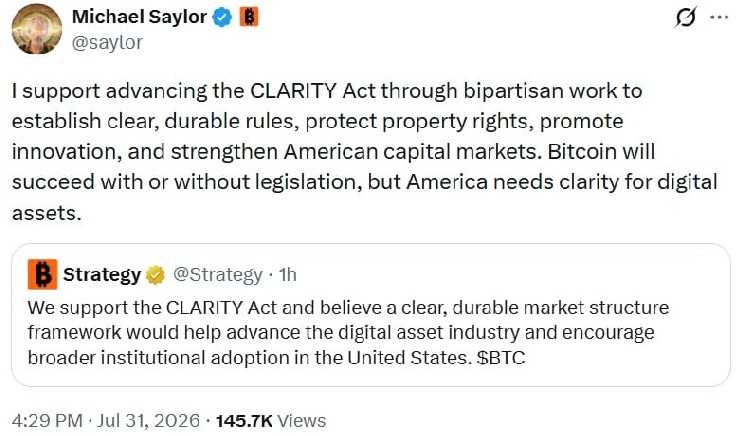
Saylor and Strategy Inc. Officially Endorse the CLARITY Act Bill Concerning Cryptocurrencies in the US

On July 31, Strategy Inc. (MSTR), the world's largest corporate holder of Bitcoin, announced its endorsement of the bipartisan CLARITY Act (Digital Asset Market Clarity Act). The company framed the bill as promoting market growth, institutional investor participation, consumer protection, and individuals' rights to own and control digital assets. Executive Chairman Michael Saylor added his influential voice, stating that while Bitcoin will succeed with or without regulation, America needs clarity for digital assets. The support comes as the Senate considers market structure legislation that would define regulatory roles for the SEC and CFTC and establish registration procedures for exchanges and custodians. The endorsement coincides with Strategy's Q2 report, which showed a significant net loss largely due to Bitcoin's volatility, underscoring the direct relevance of digital asset regulation to its shareholders and capital-raising strategy. Saylor's broader views link Bitcoin's long-term value to regulatory certainty and stable protocol rules. Political pressure is mounting as supporters have initiated nearly 1 million messages urging lawmakers to advance digital asset bills. However, legislative prospects remain uncertain, with one research firm lowering its passage probability estimate to 30%, even as crypto owners indicate the issue could influence their votes in the upcoming midterm elections.

cryptonews.ru19m ago

Saylor and Strategy Inc. Officially Endorse the CLARITY Act Bill Concerning Cryptocurrencies in the US

cryptonews.ru19m ago

Trading

Spot
活动图片