Japanese and Korean Stock Markets Crashed! Nikkei Plummets Over 4%, KOSPI Plunges 8%, Market Panics Ahead of AI Giants' Earnings Week

marsbitPublished on 2026-07-28Last updated on 2026-07-28

Abstract

Japanese and South Korean stock markets plunged sharply in early Tuesday trading, with the Nikkei 225 down over 4% and the KOSPI index tumbling 8%, triggering a circuit breaker. The sell-off was led by semiconductor and equipment stocks like Tokyo Electron, Kioxia, Samsung Electronics, and SK Hynix, the latter dropping as much as 30%. The primary driver is mounting investor concern over the sustainability of the AI boom. Worries intensified following news related to Nvidia's major AI supply agreements and rising debt insurance costs. Analysts point to fears over excessive capital expenditure, crowded trades in AI-related stocks, and high corporate debt levels. Market sentiment has soured ahead of key earnings reports from major tech firms, including Meta and SK Hynix. While SK Hynix is expected to post record results, its recent 38% price drop from June highs reflects deep skepticism about whether AI infrastructure spending can maintain its pace and deliver returns. The sell-off appears more driven by a sharp deterioration in sentiment than by immediate fundamental changes.

On Tuesday morning, dragged down by concerns related to Nvidia's (NVDA.O) significant AI supply agreements and intensifying market competition, investor sentiment was hit, causing Japanese and Korean stock markets to open lower and extend losses.

As of the time of writing, the Nikkei 225 Index had plunged over 4% intraday, hitting its lowest level since May 22; the TOPIX Index saw its biggest drop of 2.7%. South Korea's KOSPI Index widened its losses to 8%, triggering a trading halt for 20 minutes. The Korea Exchange had also earlier activated the KOSPI sidecar mechanism, temporarily suspending program sell orders on the KOSPI.

Semiconductor and equipment stocks like Tokyo Electron, Kioxia, Samsung Electronics, and SK Hynix led the declines, all falling more than 9%. Among them, SK Hynix's stock price plummeted as much as 30%, marking its biggest single-day drop in history; Kioxia's stock price fell up to 18%, its largest decline since last November. As the global sell-off in semiconductor stocks intensified, investor sentiment regarding the sustainability of the AI boom continued to deteriorate.

Amid a wave of AI-related deals totaling over $750 billion, the cost of debt default insurance for Nvidia surged, triggering a decline in tech stocks. Hideyuki Ishiguro, Chief Strategist at Nomura Asset Management, stated that following reports on Nvidia's significant investment deals, the rise in its credit risk is being viewed by investors as a negative signal.

Additionally, Ishiguro pointed out that China's progress in the semiconductor manufacturing equipment sector poses a threat to Japanese suppliers—who have long held a competitive advantage in this field.
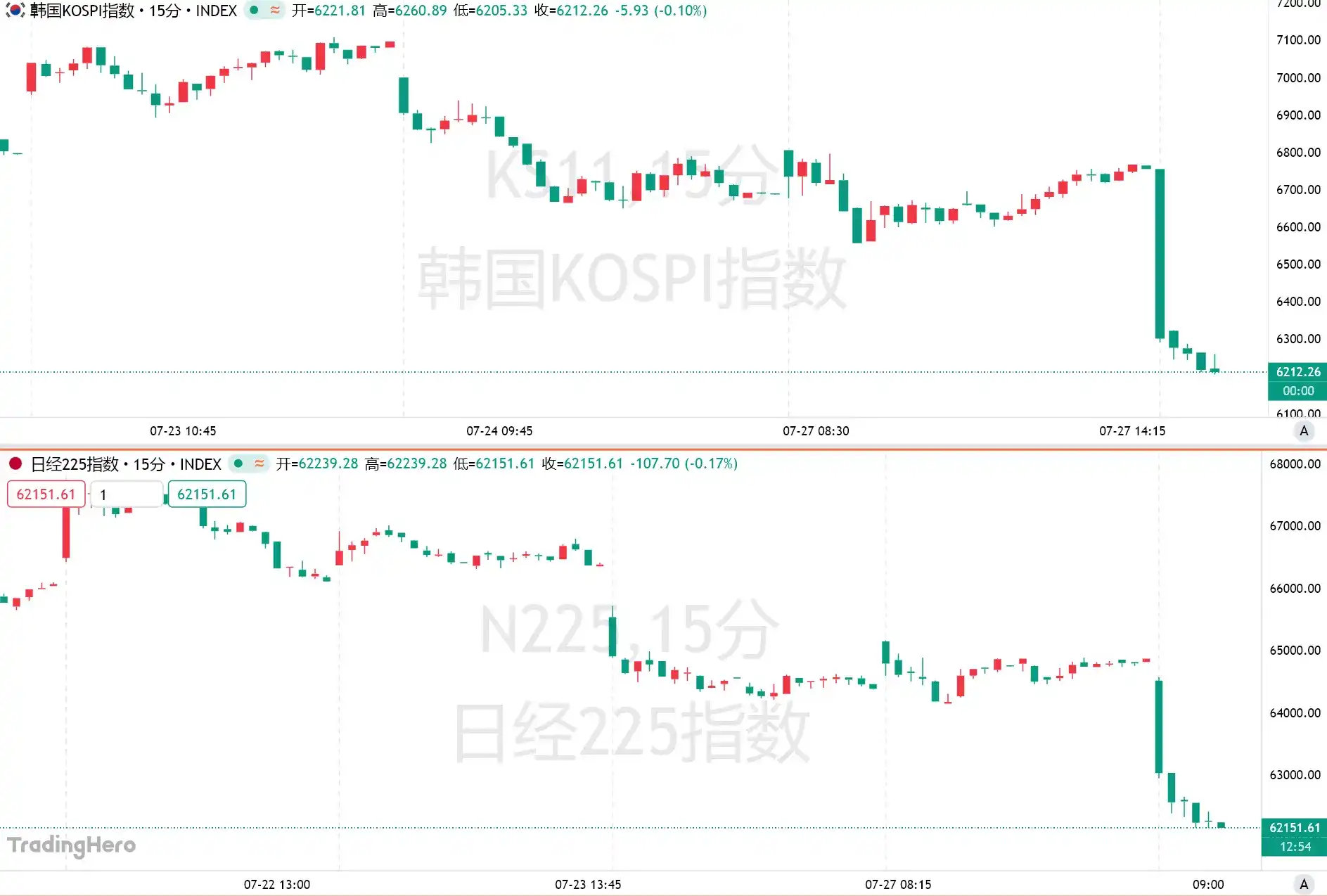
These declines point to deepening concerns in the market regarding crowded stock positioning and rising corporate debt levels as AI infrastructure development advances.

"The recent sell-off in semiconductor stocks seems to be driven more by sharply deteriorating market sentiment than by any immediate change in fundamentals," said Jung In Yun, CEO of Fibonacci Asset Management Global. "Investors are increasingly questioning whether the pace of AI infrastructure spending can be sustained."

Chris Larkin of Morgan Stanley E*Trade said: "This week is packed with potential surprises, both good and bad. Geopolitics and oil prices could be the biggest variables, but an optimistic reaction to strong earnings from the Magnificent Seven is not a given, especially if AI spending levels continue to surprise."

Kyle Rodda, Senior Analyst at Capital.com, wrote in a note to clients: "These companies embody the key themes currently affecting market sentiment—excessive capital expenditure and spending by AI companies, which investors worry will erode returns."

This week, several top tech companies, including Meta Platforms Inc. (META), are set to release key earnings. News earlier this month that Meta planned to sell excess AI computing capacity had already sparked concerns about demand. Apple Inc. (AAPL) has issued warnings about cost pressures, and reports indicate it is lobbying for approval to purchase memory components from competitors.

Investors are also awaiting the full results for Samsung Electronics' June quarter. Kim Minji, a portfolio manager at Seoul's Must Asset Management, said the world's largest traditional memory chipmaker is catching up to SK Hynix in the HBM field.

Furthermore, although SK Hynix is expected to announce another quarter of record-breaking earnings on Wednesday, investor sentiment has clearly weakened. The core market concern is that continuously rising memory prices may force customers to reduce purchases and seek lower-cost alternatives.

Since hitting a historic high in June, SK Hynix's stock price has cumulatively fallen 38%, with market worries about overcrowded trading and leverage amplifying price volatility. In this round of adjustment, the company's market capitalization shrinkage is second only to SpaceX (SPCX) globally.

In just over a month, approximately $470 billion in market value has evaporated from SK Hynix. The South Korean memory chipmaker, once seen as one of the world's hottest AI trades, is now becoming one of the most contentious holdings in investor portfolios.

Shawn Oh, Head of Korea Cash Equities Business at NH Investment & Securities, stated in a research report that, considering the current attractive valuation and the ongoing deleveraging by Korean retail investors, SK Hynix remains "an extremely attractive buying opportunity." However, he also noted that the market is reducing stock positions ahead of the U.S. tech company earnings season.

The market expects SK Hynix's June quarter sales to more than double year-on-year, reaching about $57 billion; operating profit is projected to increase sixfold year-on-year. But James Ooi, a market strategist at Tiger Brokers, said the significance of SK Hynix's earnings may transcend the company itself.

"SK Hynix's performance could also become a sentiment barometer for the global AI hardware sector," he said, adding that market expectations have largely been priced in already, so "even a slight miss could trigger a sharp reaction."

Hebe Chen, Senior Market Analyst at Vantage Global Prime, said: "The recent sell-off in chipmakers shows that doubts about spending, returns, and valuations are deepening, not subsiding. With several major catalysts approaching, the hesitation to buy the dip suggests investors are waiting for stronger evidence before rebuilding risk exposure."


Trending Cryptos

Related Questions

QWhat were the main factors cited as causing the sharp decline in Japanese and South Korean stock markets on Tuesday morning?

AThe main factors were investor concerns about NVIDIA's major AI supply agreement and increasing market competition, which negatively impacted sentiment. Specific triggers included a surge in NVIDIA's debt default insurance costs within the large AI-related deal wave and worries about competition from China in semiconductor manufacturing equipment for Japanese firms.

QWhat specific market mechanisms were triggered in the South Korean market due to the sell-off, and for what key stock index?

AFor the South Korean KOSPI index, the decline widened to 8%, triggering a market-wide circuit breaker which halted trading for 20 minutes. The Korea Exchange also initiated a sidecar mechanism for the KOSPI, temporarily suspending program selling.

QWhich semiconductor and equipment stocks were mentioned as leading the declines, and what were some of their significant losses?

ATokyo Electron, Kioxia, Samsung Electronics, and SK Hynix were mentioned as leading the declines. Specific notable losses included SK Hynix's stock plunging as much as 30% (its biggest-ever daily drop) and Kioxia's stock falling up to 18% (its largest drop since November of the previous year).

QAccording to analysts cited in the article, what is the core investor worry regarding the current AI boom that is driving the market sell-off?

AThe core investor worry, as stated by analysts, is skepticism about the sustainability of AI infrastructure spending and capital expenditure. Investors are increasingly questioning whether the pace of AI-related spending can continue, fearing it will erode company returns. The sell-off reflects deepening concerns over crowded stock positions and rising corporate debt levels in the AI build-out.

QWhy is SK Hynix's upcoming earnings report considered significant beyond the company's own performance, and what potential market reaction is anticipated?

ASK Hynix's earnings report is seen as a potential sentiment barometer for the global AI hardware sector. The market has largely priced in high expectations, so even a slight miss in earnings could trigger a significant and volatile negative reaction across related stocks. Its performance is being watched for clues about the broader health and trajectory of AI demand.

Related Reads

Welcome to the New Crypto World: Only This Time, The Place Where You Lose Money Is Called the Stock Market

Welcome to the New Crypto World: Only This Time, the Place to Lose Money is Called the Stock Market. The article depicts a future (2026) where global stock markets, particularly tech stocks, are exhibiting behaviors and risks reminiscent of the cryptocurrency world. The narrative centers on a sharp crash in South Korea's KOSPI index and leading stocks like SK Hynix, highlighting widespread retail losses, leverage-induced liquidations, and extreme volatility. It argues that a significant shift in market dynamics is underway: pricing is increasingly driven by narratives (like the AI boom) over fundamental valuation, amplified by high leverage and the rapid, emotion-fueled consensus formed on social media. Former crypto traders, seeking new opportunities, brought their high-risk strategies—chasing narratives, using leverage—into equity markets, focusing on sectors like AI and semiconductors. Ironically, data suggests some major tech stocks have recently shown greater volatility and faster crashes than Bitcoin, which is becoming relatively more stable and "stock-like" through institutional adoption. The piece details how leveraged ETFs in Korea, particularly those tied to single stocks, created a vicious cycle of forced selling that exacerbated the market plunge. It concludes that while stocks retain underlying fundamentals, the *trading* of them has undergone a "de-rationalization": markets now prioritize themes, social media sentiment, and leveraged bets over traditional analysis. In a paradoxical twist, Bitcoin is striving to become more like a traditional asset, while a segment of the stock market is becoming more like crypto—a cycle of grand stories, crowded trades, easy leverage, and the pervasive, often misplaced, belief that one can exit before everyone else. The final, poignant wish from a Korean retail investor—to go back to life before trading and get their money back—underscores that markets offer no refunds.

marsbit1m ago

Welcome to the New Crypto World: Only This Time, The Place Where You Lose Money Is Called the Stock Market

marsbit1m ago

Feishu Has Become Doubao

This may be the most important day in the ten-year history of Feishu. On July 30, ByteDance announced a major restructuring via internal email. Feishu, an independent operation for a decade, will no longer function separately and will lose its independent sales and marketing teams. Its product team is being integrated into Doubao AI, and its Go-to-Market strategy merges into the Volcano Engine's To B system. This move signals a strategic pivot, not a failure of Feishu. The era where Feishu sought to be an all-encompassing super-app for productivity is ending. AI has become the dominant logic. Industry trends show a shift from building platform "entrances" to embedding AI directly into workflows, as seen with Microsoft Copilot and Google's Gemini. Data reveals the driver: over 90% of Feishu's new clients in Q2 2026 purchased its AI products. Enterprises are now buying integrated AI solutions, not standalone software. By integrating Feishu's deep enterprise workflow scenarios, Doubao evolves from a consumer-facing chatbot into a powerful enterprise productivity engine. This gives Doubao a critical asset: real-world business application. Concurrently, ByteDance established the "Creative Services Platform," unifying its previously fragmented sales fronts (Feishu, Doubao, Volcano Engine) into a single customer-facing entity. This represents ByteDance's first genuine shift to thinking like a true To B company, organizing around client needs rather than internal product silos. The restructuring underscores that AI is no longer just a business line but foundational infrastructure. Doubao is becoming the new organizational core, mirroring TikTok's past ascendancy. This demonstrates a profound shift: AI is beginning to reshape corporate structures, determining resource allocation and strategic priorities. ByteDance is likely just the first of many companies to undergo such an AI-driven reorganization.

marsbit11m ago

Feishu Has Become Doubao

marsbit11m ago

The Second Half of the RWA Issuance Race: Amidst the Utilization Dilemma, Trillions Worth of On-Chain Assets Awaken

RWA (Real-World Asset) tokenization has surged to a record $32 billion in on-chain value. However, a structural challenge has emerged: approximately 87% of these tokenized assets are inactive, not participating in DeFi lending or trading activities. This "utilization gap" highlights a key question: what happens after assets are brought on-chain? Data shows a stark contrast among major platforms. While Securitize leads in scale ($4.9B), it has a DeFi utilization rate of only 0.7%. Similarly, Ondo Finance ($3.5B) sees about 2.7% utilization. In contrast, Maple Finance, with a smaller $2.3B in assets, achieves a 62% utilization rate by embedding its assets directly into lending activities from the outset. Three primary factors contribute to low utilization: 1) **Asset Nature**: Tokenized treasuries are often held for yield, not traded. 2) **Regulatory Barriers**: Securities laws and KYC requirements restrict free movement into permissionless DeFi pools. 3) **Infrastructure Gaps**: A lack of deep secondary markets, real-time pricing, and mature clearing mechanisms hinders liquidity. The RWA narrative is now shifting from a "race to issue" to a "battle for application." While native lending protocols like Maple have inherent advantages, distribution channels are becoming critical. The success of products like SyrupUSDG on platforms like Robinhood Crypto demonstrates that access to existing user bases can accelerate adoption far more effectively than protocol-led efforts alone. The $32 billion milestone validates the feasibility of tokenization, but low utilization underscores that bringing assets on-chain is just the first step. The true test for the sector is enabling these assets to circulate, be utilized, and create new economic value within the DeFi ecosystem.

marsbit11m ago

The Second Half of the RWA Issuance Race: Amidst the Utilization Dilemma, Trillions Worth of On-Chain Assets Awaken

marsbit11m ago

Trading

Spot

Hot Articles

How to Buy 4

Welcome to HTX.com! We've made purchasing 4 (4) simple and convenient. Follow our step-by-step guide to embark on your crypto journey.Step 1: Create Your HTX AccountUse your email or phone number to sign up for a free account on HTX. Experience a hassle-free registration journey and unlock all features.Get My AccountStep 2: Go to Buy Crypto and Choose Your Payment MethodCredit/Debit Card: Use your Visa or Mastercard to buy 4 (4) instantly.Balance: Use funds from your HTX account balance to trade seamlessly.Third Parties: We've added popular payment methods such as Google Pay and Apple Pay to enhance convenience.P2P: Trade directly with other users on HTX.Over-the-Counter (OTC): We offer tailor-made services and competitive exchange rates for traders.Step 3: Store Your 4 (4)After purchasing your 4 (4), store it in your HTX account. Alternatively, you can send it elsewhere via blockchain transfer or use it to trade other cryptocurrencies.Step 4: Trade 4 (4)Easily trade 4 (4) on HTX's spot market. Simply access your account, select your trading pair, execute your trades, and monitor in real-time. We offer a user-friendly experience for both beginners and seasoned traders.

4.9k Total ViewsPublished 2025.10.20Updated 2026.06.02

How to Buy 4

Discussions

Welcome to the HTX Community. Here, you can stay informed about the latest platform developments and gain access to professional market insights. Users' opinions on the price of 4 (4) are presented below.

活动图片