Interprétation de Bernstein : 142 milliards de dollars de commandes à long terme peuvent-ils amortir le cycle de la mémoire ?

marsbitPublished on 2026-07-21Last updated on 2026-07-21

Abstract

L'analyse de Bernstein met en lumière les accords d'achat à long terme (LTA) conclus par Micron et SanDisk, représentant un minimum contractuel de revenus d'environ 1420 milliards de dollars et des garanties financières d'environ 330 milliards de dollars. Ces accords, sécurisés par des dépôts de garantie, visent à stabiliser les revenus face aux cycles volatils de la mémoire. Cependant, le rapport souligne que ces garanties, bien que significatives, ne couvriraient qu'environ 0,6% des revenus potentiels du secteur sur 3 à 5 ans (estimés à 5,2 billions de dollars dans leur modèle). Ils agissent donc comme un tampon en cas de baisse modérée des prix, mais ne protègent pas pleinement contre une récession profonde où les clients pourraient trouver plus économique de rompre le contrat malgré les pénalités. De plus, la portée des LTA est limitée. Ils concernent principalement les grands clients cloud américains, sensibles à la stabilité des approvisionnements pour l'IA. Une part importante du marché (30 à 50%), incluant les produits grand public, les PC, les smartphones et certains clients chinois, reste ancrée dans des achats au comptant ou à court terme, perpétuant la cyclicité. En conclusion, ces LTA améliorent la visibilité et adoucissent potentiellement les phases de ralentissement, notamment grâce à des mécanismes de garantie qui deviennent plus contraignants en fin de contrat. Toutefois, ils ne transforment pas l'industrie de la mémoire en service public et ne suppriment ...

Dans son dernier rapport, Bernstein remet sous les projecteurs les accords d'achat à long terme (LTA) dans l'industrie de la mémoire : Micron et SanDisk ont signé une série de nouveaux LTA comprenant des engagements d'achat, des prix planchers et des garanties financières, cherchant ainsi à établir un plancher pour leurs bénéfices futurs.

Ce plancher n'est pas aussi épais qu'il n'y paraît.

Selon les documents publics et les propos tenus lors des conférences téléphoniques de Micron et SanDisk, Micron a signé 16 accords avec des clients stratégiques. Pour 14 d'entre eux, le revenu minimum cumulé calculé sur la base du prix contractuel plancher s'élève à environ 1000 milliards de dollars, avec des dépôts en espèces associés et des engagements financiers d'environ 220 milliards de dollars. SanDisk a déclaré que trois contrats du trimestre en cours représentaient un revenu contractuel minimum d'environ 420 milliards de dollars, et que cinq accords offraient ensemble des garanties financières dépassant 110 milliards de dollars.

Les deux entreprises disposent d'environ 330 milliards de dollars de garanties, ce qui rend effectivement plus coûteux pour les grands clients de rompre un contrat. Cependant, le modèle de Bernstein estime que le volume de revenus susceptible d'avoir besoin d'une protection LTA au cours des 3 à 5 prochaines années avoisine les 5 200 milliards de dollars. Selon cette approche, les garanties existantes ne représentent qu'environ 0,6 % de ce montant.

C'est précisément la divergence que le rapport cherche à exprimer : les LTA modifient la position de négociation des entreprises de mémoire et de leurs grands clients, mais ils agissent davantage comme un coussin amortisseur en période de cycle baissier, et ne transforment pas la DRAM et la NAND en services publics.

Les grands clients liés par des accords à long terme, les garanties commencent à peser réellement

Les LTA ne sont pas complexes. Le client s'engage à l'avance sur des volumes d'achat futurs, et le fournisseur garantit l'approvisionnement et un mécanisme de prix. Si le client n'achète pas, il peut perdre la garantie prépayée ou engager d'autres coûts économiques.

Cette fois, la différence par rapport aux intentions d'achat courantes dans l'industrie de la mémoire réside dans l'intégration structurelle de garanties financières dans les contrats.

Micron a signé 16 accords avec des clients stratégiques échelonnés jusqu'en juin 2026, comprenant 4 très grands clients et 3 clients de taille moyenne. Pour 14 accords, le revenu minimum cumulé calculé sur la base du prix contractuel plancher est d'environ 1000 milliards de dollars, avec des dépôts en espèces attendus et des engagements financiers associés d'environ 220 milliards de dollars. Ce chiffre inclut les accords signés et ceux signés après la clôture du trimestre, et n'est pas strictement équivalent au RPO (obligations contractuelles non exécutées) en fin de période au bilan.

SanDisk a déclaré qu'au 3 avril 2026, son RPO s'élevait à 416 milliards de dollars. Lors de sa conférence téléphonique, la société a également mentionné que trois contrats du trimestre en cours assuraient un revenu contractuel minimum d'environ 420 milliards de dollars, et que cinq accords offraient ensemble plus de 110 milliards de dollars de garanties financières, couvrant plus d'un tiers de l'approvisionnement en bits pour l'exercice FY27.

Les mécanismes des deux entreprises diffèrent. Les garanties de Micron sont davantage pondérées en fin de contrat. Au fur et à mesure de l'avancement du contrat et de la diminution des obligations d'achat restantes du client, la proportion de la garantie par rapport au RPO augmente, rendant la rupture de contrat plus coûteuse en fin de période. SanDisk propose des garanties plus proches d'un montant fixe, qui devraient rester relativement stables pendant la durée du contrat.
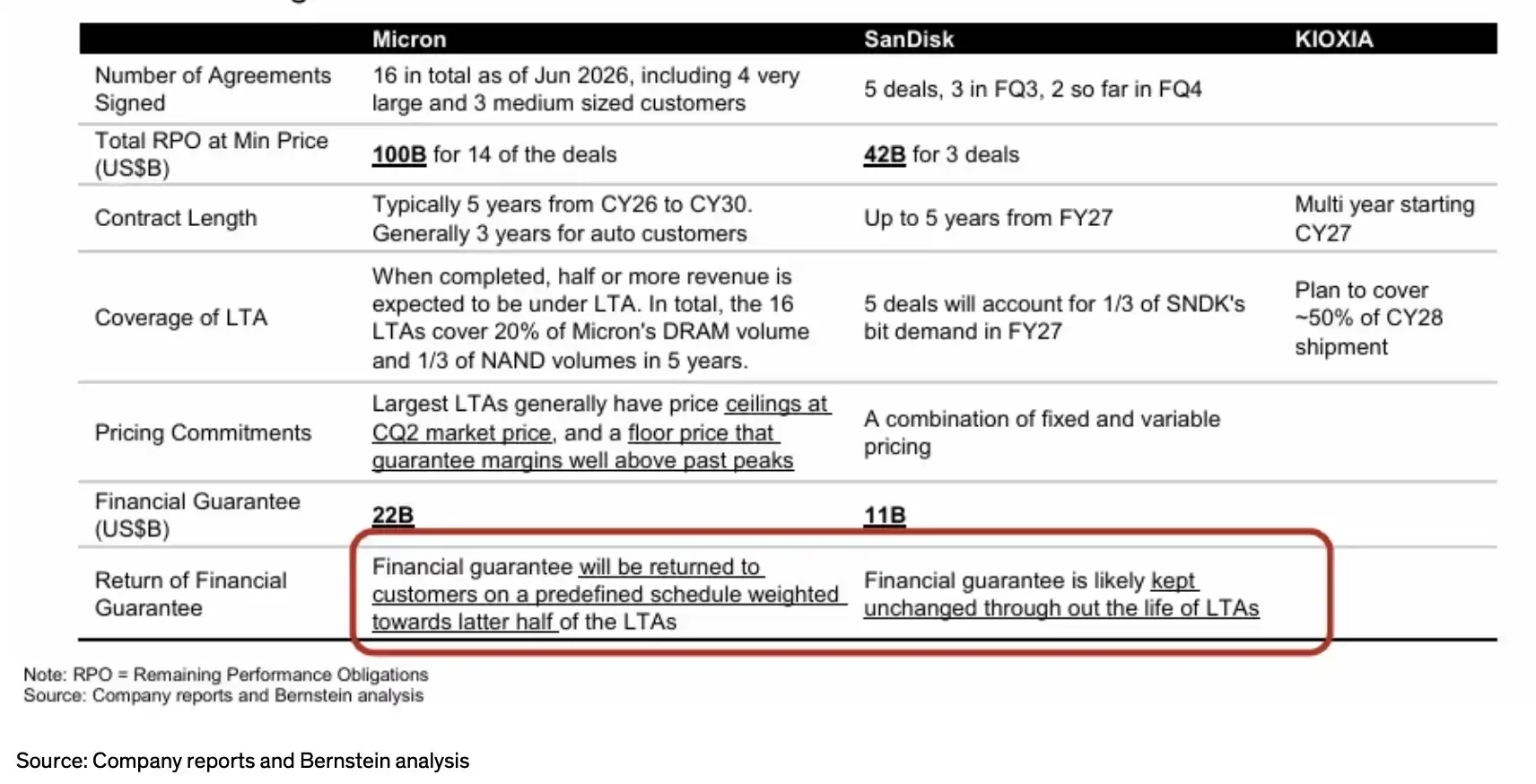
16 accords de Micron, RPO ~1000 milliards de dollars, garanties ~220 milliards de dollars ; 5 accords de SanDisk, RPO ~420 milliards de dollars, garanties >110 milliards de dollars.

C'est ce que les partisans optimistes (« bulls ») mettent le plus en avant. Le plus gros problème passé de l'industrie de la mémoire était l'effondrement trop rapide des bénéfices lorsque les prix chutaient. Si les grands clients acceptent de payer des garanties pour un approvisionnement à long terme, les fournisseurs obtiennent au moins un plancher de revenus plus clair, et leurs dépenses en capital et leurs plans de capacité ne sont plus totalement dictés par les prix spot.

330 milliards de dollars de garanties ne sont pas minces, mais ne suffisent pas pour amortir une forte baisse

L'échelle des garanties et celle des revenus à protéger ne sont pas du même ordre.

Bernstein estime, via son modèle, que si les LTA devaient couvrir les revenus potentiels des 3 à 5 prochaines années, le volume de protection requis serait d'environ 5 200 milliards de dollars. Ce chiffre est spécifique au modèle du rapport ; les documents publics des entreprises ne divulguent pas directement un chiffre de revenu similaire pour l'ensemble du secteur, et il faut aussi distinguer entre les revenus totaux de la mémoire, des semi-conducteurs, et les revenus de l'échantillon de fournisseurs.

Néanmoins, un ratio de garantie de 0,6 % indique une chose : les LTA ne peuvent pas protéger les bénéfices dans tous les scénarios de prix.

Si les prix spot ne chutent que modérément, il n'est pas rentable pour le client de rompre. Perdre la garantie, nuire à la relation avec le fournisseur, et risquer de ne pas obtenir de capacité future rare, ces coûts suffisent à maintenir le client dans le contrat. Les clients serveurs IA, fournisseurs de cloud et datacenters ont également un besoin plus fort d'un approvisionnement stable que les clients d'électronique grand public.

Mais si les prix chutent suffisamment profondément, les clients feront toujours leur calcul économique. Si le volume d'achat restant est important et que le prix spot est significativement inférieur au prix plancher contractuel, le client pourrait trouver plus économique d'acheter sur le marché, même en perdant sa garantie.

Le mécanisme de pondération en fin de contrat peut atténuer ce problème. Plus on avance dans le contrat, plus le RPO restant diminue et la proportion de la garantie par rapport à l'obligation restante augmente, ce qui alourdit le coût de rupture pour le client. La protection pourrait être plus forte en fin de contrat, période où le cycle de la mémoire en a souvent le plus besoin.

Ce n'est toujours pas une assurance inconditionnelle. La force de protection des LTA dépend de trois chiffres : jusqu'où chutent les prix spot, combien il reste d'obligations d'achat au client, et quel est le solde de la garantie.
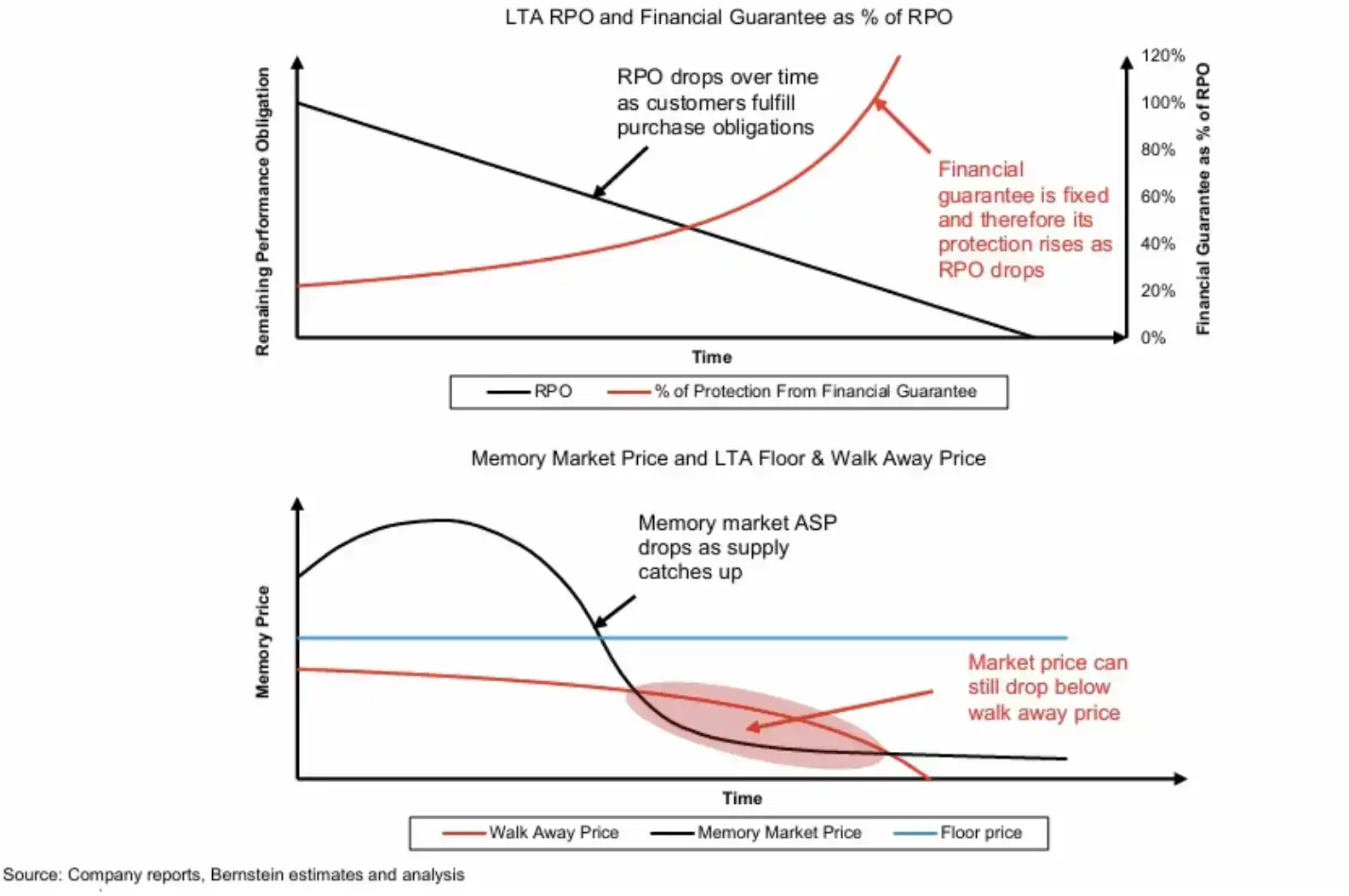
Le RPO diminue avec le temps, le ratio Garantie/RPO augmente ; si le prix moyen pondéré (ASP) spot chute trop profondément en dessous du prix plancher contractuel, le client peut toujours choisir de rompre.

C'est aussi le cœur du débat entre optimistes (« bulls ») et pessimistes (« bears »). Les optimistes voient que les entreprises de mémoire obtiennent enfin des engagements à long terme en argent sonnant et trébuchant de la part de leurs clients. Les pessimistes craignent que cette ampleur d'engagement soit encore insuffisante pour protéger les bénéfices de pointe, et que lors d'un cycle baissier suffisamment profond, les clients agiront toujours selon la logique des coûts.

Pas toute la demande en mémoire ne veut être liée par des LTA

Les LTA ont aussi une limite pratique : tous les clients ne sont pas aptes à signer des accords à long terme.

Les fournisseurs de services cloud américains (CSP) sont les candidats idéaux. Leur demande est importante, leur crédit solide, ils sont sensibles à la stabilité de l'approvisionnement pour l'infrastructure IA et sont plus motivés à sécuriser leur approvisionnement via des accords à long terme. Micron a essentiellement terminé ses négociations avec les CSP américains et poursuit celles avec les CSP chinois, les entreprises et certains autres clients.

Le secteur de la consommation est différent. Le directeur financier de SanDisk a déclaré que le secteur grand public était « plus transactionnel » et que les LTA « ne s'appliquent pas ». Le marché des téléphones, PC et du stockage grand public a davantage l'habitude d'acheter en fonction des prix et des cycles d'inventaire. En cas de baisse des prix, les clients souhaitent naturellement conserver de la flexibilité plutôt que d'être liés par des prix planchers sur plusieurs années.

Les clients chinois ne seront pas non plus nécessairement des acheteurs stables pour les LTA. D'une part, les fournisseurs de cloud et les clients finaux chinois pourraient préférer les fournisseurs locaux. D'autre part, l'expansion de l'offre locale de DRAM et NAND ajoute de l'incertitude aux engagements d'achat à long terme.

Bernstein estime qu'environ 30 % à 50 % du marché final de la DRAM et de la NAND pourraient être difficiles à couvrir par des LTA. Même si les principaux fournisseurs parviennent à verrouiller les grands clients américains, une part substantielle du marché continuera à fonctionner selon les prix spot, les commandes à court terme et les anticipations cycliques.
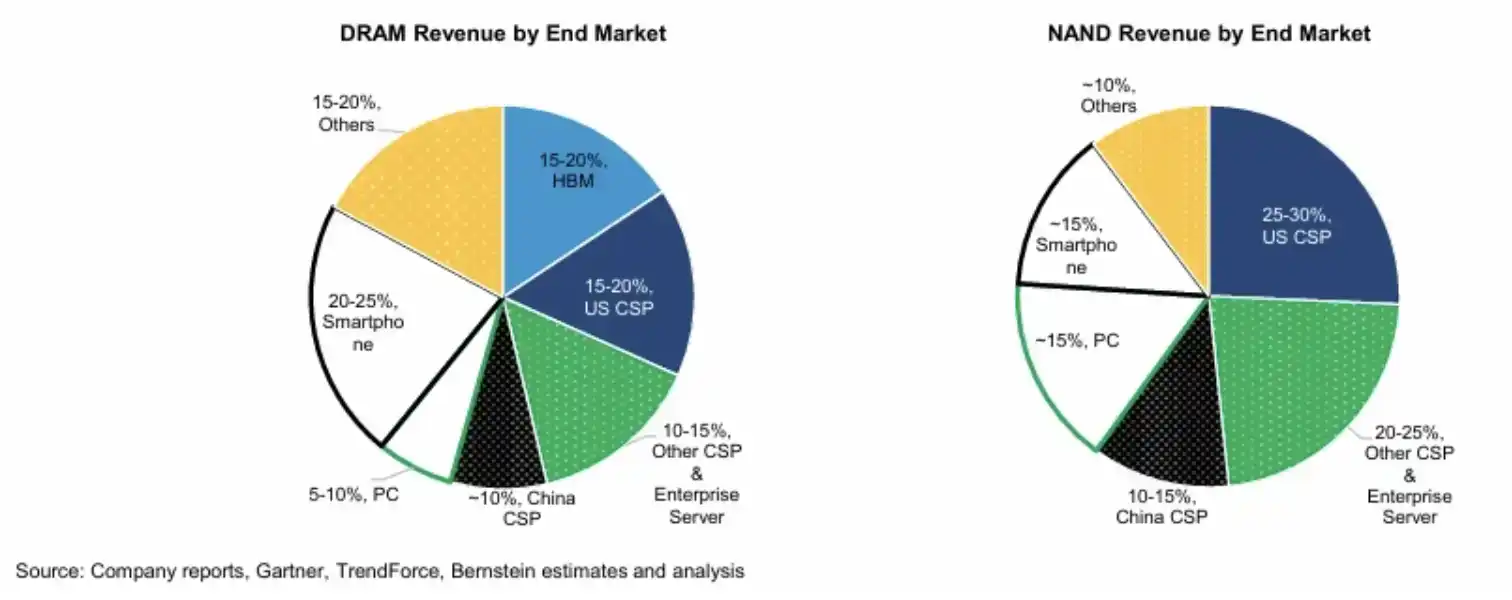
La segmentation du marché final DRAM/NAND montre qu'au-delà des CSP américains, il existe une demande des CSP chinois, des serveurs d'entreprise, du secteur grand public/PC, des smartphones, etc. Environ 30 à 50 % du marché pourrait être difficile à couvrir par les LTA.

Tant qu'une proportion suffisamment importante de la demande reste dans le système spot ou à court terme, le signal des prix ne disparaîtra pas. Et tant que ce signal des prix existe, l'expansion des capacités des fournisseurs, la réduction des stocks des clients et les annulations de commandes dans les canaux continueront d'amplifier la volatilité cyclique.

La demande IA soutient la valorisation, mais les bénéfices de pointe ne peuvent être simplement extrapolés

Le marché est prêt à accorder une valorisation plus élevée aux entreprises de mémoire, un contexte dans lequel la demande IA modifie la forme du creux de ce cycle.

Du côté de la DRAM, la demande en HBM (High Bandwidth Memory) reste forte. L'équipe Asie de Bernstein prévoit que les prix du HBM en 2027 pourraient être 2 à 2,5 fois supérieurs à ceux de 2026. Les prix commerciaux de la DRAM conventionnelle ont déjà fortement augmenté et pourraient rester élevés au cours des 12 prochains mois. Bien que le HBM soit plus stable que la mémoire standard, il partage une partie des capacités de production avec la DRAM classique, et l'allocation des capacités affecte les autres gammes de produits.

Du côté de la NAND, l'inférence IA et les fenêtres de contexte plus longues ouvrent également de nouvelles perspectives de demande. Les premières phases d'entraînement de l'IA consommaient principalement du HBM et de la DRAM, mais avec l'augmentation de l'inférence, de l'IA agentique et des applications à contexte long, la demande en stockage pourrait continuer à augmenter. Il est à noter que la formulation concernant la capacité liée à Vera Rubin ne doit pas être simplement écrite comme « la capacité NAND du GPU » ; la page officielle de Nvidia mentionne « 20,7 TB HBM4 GPU memory ».

Dans cet environnement, la valeur des LTA ressemble davantage à la fixation d'une partie des revenus générés par la forte conjoncture. Si la demande IA reste robuste, les fournisseurs peuvent verrouiller une partie des achats des grands clients via des accords à long terme. Si les prix baissent, les garanties et les prix planchers peuvent ralentir le déclin des bénéfices.

Le test de résistance de SanDisk pointe vers une conclusion similaire. Le modèle de Bernstein montre que, même avec des hypothèses sévères, les LTA pourraient maintenir le BPA (EPS) des exercices FY29-FY30 au-dessus des scénarios sans LTA dans la plupart des cas de taux de pénétration, avec une protection particulièrement plus forte en fin de période. Mais ce même test de résistance montre aussi que les bénéfices de pointe ne peuvent être simplement extrapolés. Dans des scénarios de marge opérationnelle plus faible, le BPA pourrait être nettement inférieur aux niveaux actuels.
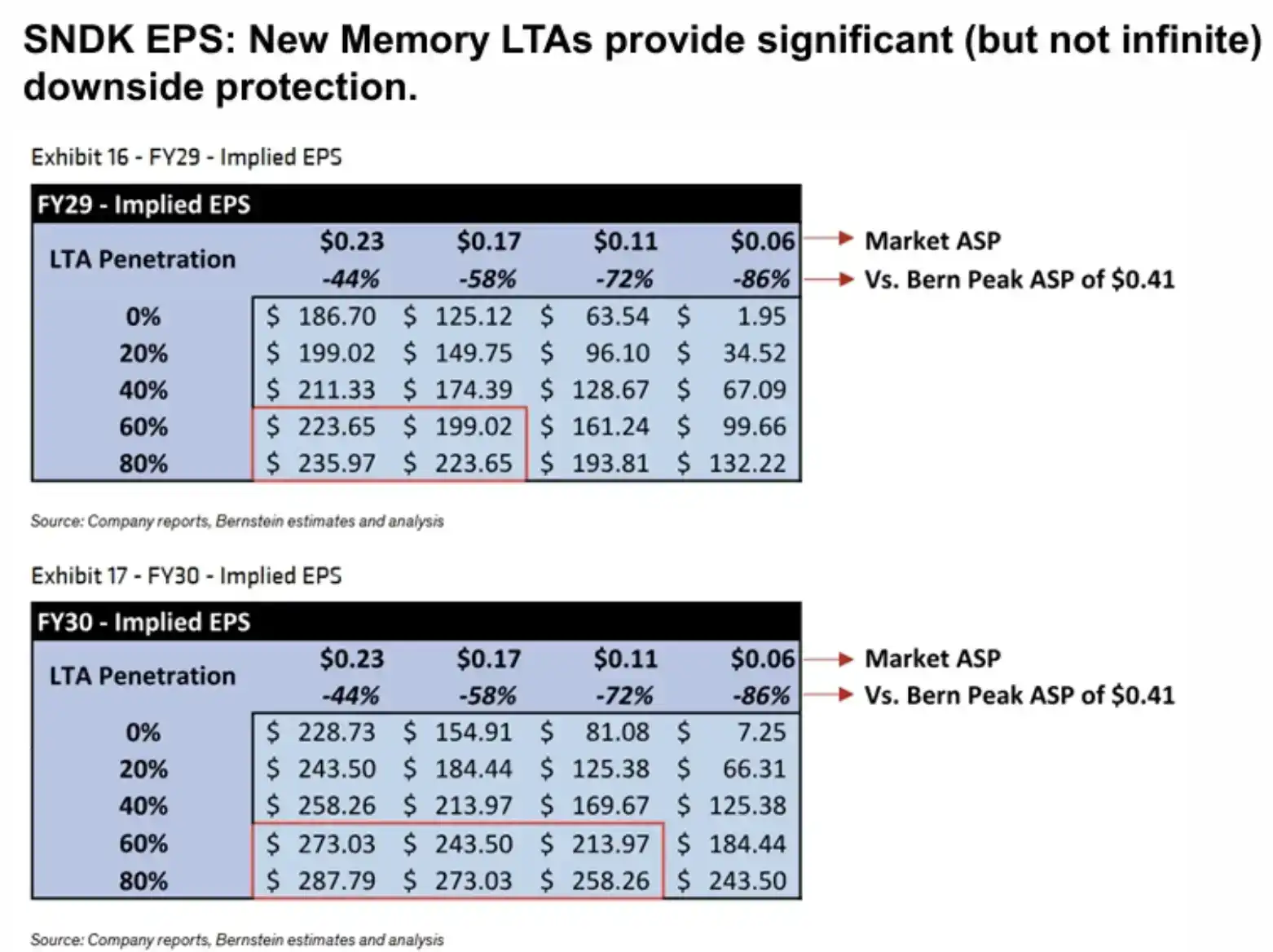
Le tableau de sensibilité du BPA de SanDisk pour FY29-FY30 montre une large plage de BPA selon différents scénarios de prix moyen pondéré (ASP) et de taux de pénétration des LTA. Les LTA améliorent les scénarios de baisse mais ne peuvent verrouiller les bénéfices de pointe.

Le jugement le plus important à retenir de ce rapport n'est pas « la fin du cycle de la mémoire », mais « l'atténuation possible du ralentissement du cycle ».

Le fait que Micron et SanDisk obtiennent des accords à long terme et des garanties financières montre que les grands clients sont prêts à payer pour la certitude d'approvisionnement à l'ère de l'IA. Pour les entreprises de mémoire, cela augmente la visibilité sur leurs revenus futurs et rend le marché financier plus enclin à croire que le plancher de bénéfices est plus élevé que par le passé.

Les limites sont tout aussi claires. Les 330 milliards de dollars de garanties ne peuvent offrir qu'un amortissement localisé ; les clients grand public, chinois et une partie de la demande transactionnelle n'entreront pas tous dans des accords à long terme. Bernstein estime également que la part chinoise dans la DRAM pourrait passer d'environ 8 % à 16 % dans les prochaines années, et que la NAND pourrait faire face à une pression d'offre plus forte après 2028.

Ce que les LTA doivent véritablement démontrer, ce n'est pas s'ils peuvent être signés en période de hausse, mais si, lors du prochain cycle baissier, les clients honoreront leurs engagements, si les garanties seront suffisamment dissuasives, et si les fournisseurs maintiendront leur discipline en matière de capacités. Avant que ces questions ne soient résolues, ils constituent un nouveau coussin amortisseur pour l'industrie de la mémoire, pas un bouton d'arrêt du cycle.


Trending Cryptos

Related Questions

QQuels sont les principaux accords d'achat à long terme (LTA) signés par Micron et SanDisk, et quels sont leurs valeurs financières respectives ?

ASelon l'article, Micron a signé 16 accords avec des clients stratégiques, dont 14 comportent un revenu minimum cumulé d'environ 1000 milliards de dollars et des garanties financières (dépôts de garantie, engagements) d'environ 220 milliards de dollars. SanDisk a signé 5 accords, avec des revenus contractuels minimums d'environ 420 milliards de dollars et des garanties financières dépassant 110 milliards de dollars. Ensemble, les garanties s'élèvent à environ 330 milliards de dollars.

QPourquoi les LTA actuels ne peuvent-ils pas totalement protéger les fabricants de mémoire contre un cycle baissier profond ?

ALes garanties financières des LTA (environ 330 milliards de dollars pour Micron et SanDisk) ne représentent qu'environ 0,6% du montant estimé de 5,2 billions de dollars de revenus qu'elles devraient couvrir sur 3 à 5 ans, selon le modèle de Bernstein. En cas de baisse suffisamment forte des prix spot, les clients pourraient trouver plus économique de rompre le contrat et d'acheter sur le marché spot, même en perdant leur garantie, surtout si leurs obligations d'achat restantes sont importantes.

QQuels types de clients sont les plus susceptibles de signer des LTA, et lesquels sont plus réticents ?

ALes clients les plus enclins à signer des LTA sont les grands fournisseurs de services cloud américains (CSP). Ils ont un besoin important, une solide crédibilité et sont très sensibles à la stabilité de l'approvisionnement pour leurs infrastructures d'IA. En revanche, les activités grand public (téléphones, PC, stockage) sont décrites comme plus « transactionnelles » et moins adaptées aux LTA, les clients préférant la flexibilité. Les clients chinois pourraient également être moins stables en raison de leur préférence pour les fournisseurs locaux et de l'expansion de la production locale.

QComment la demande en IA influence-t-elle la dynamique du cycle des mémoires et la valeur des LTA ?

ALa forte demande en mémoire HBM pour l'IA soutient les prix du DRAM et offre un plancher plus élevé à ce cycle. Dans ce contexte, les LTA permettent aux fournisseurs de verrouiller une partie des achats de leurs grands clients. Cependant, l'article souligne que les bénéfices de pointe de ce cycle de hausse ne peuvent pas être simplement extrapolés. Les LTA aident à fixer certains revenus et à amortir une éventuelle baisse, mais ils ne suppriment pas le cycle, d'autant que l'allocation de capacité pour le HBM peut impacter d'autres lignes de produits.

QQuel est le jugement principal de l'article de Bernstein sur l'impact des LTA sur le cycle des mémoires ?

ALe jugement principal de Bernstein est que les LTA, avec leurs garanties financières, ne mettent pas fin au cycle traditionnel de l'industrie de la mémoire. Ils représentent plutôt un « nouveau tampon » ou un « coussin de sécurité » qui peut adoucir la phase baissière du cycle en offrant une meilleure visibilité des revenus et un plancher de rentabilité plus élevé. Le véritable test sera de voir si les clients respecteront ces contrats et si les garanties seront suffisamment dissuasives lors du prochain ralentissement majeur.

Related Reads

2026 Mid-Year Report On-Chain RWA: Tokenized Stock Market Cap Doubles in a Year, But 90% of Rights Are Hollow Shells

The 2026 Mid-Year Report on On-Chain RWA highlights a significant growth in tokenized stock market capitalization, which nearly doubled from $951 million in March to $1.89 billion by July. However, the report reveals a fundamental contradiction in this "layer 2.5" ecosystem: products with the strongest legal foundation (like regulated U.S. infrastructure) lack liquidity and distribution, while freely tradable offshored wrapper products often lack substantive ownership rights. The increase is driven largely by a few products (SECZ, FGRS, STRCx) and platforms (Ondo, xStocks, Securitize collectively hold over 85% share). While distributed value across networks like Ethereum, Solana, and BNB Chain has grown, the market remains fragmented. Products referencing the same underlying asset (e.g., Apple stock) are distinct legal liabilities with different intermediaries and jurisdictional rules, offering varying degrees of legal claim. The report cautions that headline numbers are misleading, as they reflect changes in distributed token value—driven by issuance, conversions, and price movements—not pure investor inflows. True "canonical shares" with legal ownership, wide wallet distribution, institutional liquidity, and independent on-chain price discovery do not yet exist at scale. Tokenized treasuries show stronger product-market fit, and ETFs may be easier to scale than single stocks. The core takeaway is a trade-off: legal certainty versus liquidity and composability.

marsbit21m ago

2026 Mid-Year Report On-Chain RWA: Tokenized Stock Market Cap Doubles in a Year, But 90% of Rights Are Hollow Shells

marsbit21m ago

Coldcard Hardware Wallet Hacked: 594 Bitcoin Withdrawn in 25 Minutes

The Coldcard hardware wallet has been compromised, with hackers stealing approximately 594.5 Bitcoin (~$40 million) from 500 addresses in just 25 minutes. The root cause was a critical software bug, undetected for five years, which disabled the device's secure chip for generating true random numbers. This led to the creation of private keys based on predictable data like the processor's serial number, drastically reducing cryptographic security. The attackers exploited this offline by brute-forcing possible seed phrases, finding active addresses on the public ledger, and signing transactions. Initially, Coinkite (Coldcard's maker) claimed only older models were at risk but later admitted all devices running the compromised firmware were vulnerable. CEO Rodolphe Novak (NVK) apologized but ruled out financial compensation for affected users. To secure funds, owners must urgently update their firmware to specific safe versions, generate a completely new seed phrase on the updated device, and transfer all assets to new addresses created with that new seed. While a BIP-39 passphrase can help, it does not replace this migration process. Other Coinkite products like TAPSIGNER were not affected. This incident underscores that even specialized hardware requires rigorous, independent code audits, especially for cryptographic functions. It parallels past failures, like a 2006 OpenSSL bug in Debian, and raises questions about whether automated code analysis can ever fully replace human scrutiny in critical security areas.

cryptonews.ru2h ago

Coldcard Hardware Wallet Hacked: 594 Bitcoin Withdrawn in 25 Minutes

cryptonews.ru2h ago

Trading

Spot

Hot Articles

What is LINON

Linde plc Tokenized Stock (Ondo): Revolutionizing Traditional Equity Access Through Blockchain Innovation The emergence of Linde plc Tokenized Stock (Ondo), represented by the ticker $LINON, signifies a monumental shift in the fusion of traditional financial structures and decentralized finance (DeFi). This innovative financial instrument showcases the tremendous potential of blockchain technology to democratize access to traditional equity markets while ensuring the security and regulatory compliance necessary for institutional-grade financial products. Through Ondo Finance's pioneering tokenization platform, $LINON provides a seamless pathway for global investors to engage with one of the world's leading industrial gas companies, Linde plc, creating a blockchain-native representation of the underlying equity. Introduction to Linde plc Tokenized Stock The landscape of financial markets is witnessing a groundbreaking transformation through the tokenization of real-world assets. Linde plc Tokenized Stock (Ondo) epitomizes this revolutionary approach by bridging the gap between conventional stock ownership and blockchain-enabled financial infrastructure. The $LINON token allows investors to gain exposure to one of the prominent industrial companies worldwide through decentralized technology. Operating within Ondo Finance's comprehensive ecosystem, $LINON symbolizes a practical application of tokenization technology that enhances accessibility, efficiency, and global connectivity in traditional financial markets. By leveraging blockchain infrastructure, this tokenized stock enables international investors to participate in U.S. equity markets, overcoming traditional barriers associated with cross-border investing. The significance of $LINON goes beyond technological innovation; it represents a fundamental shift in asset structuring, distribution, and trading in the digital age. This tokenized stock maintains all the economic benefits associated with traditional Linde plc shares while offering improved liquidity, programmable compliance features, and seamless integration with decentralized finance protocols. The development of $LINON indicates a growing acceptance of blockchain technology as a viable means for traditional finance, exemplifying how even well-established assets like Linde plc can integrate into blockchain systems. This approach preserves the core attributes that appeal to investors while introducing advanced capabilities that enhance the overall investment proposition. Project Overview and Objectives Linde plc Tokenized Stock (Ondo) encapsulates a strategic effort to democratize access to traditional equity markets through advanced blockchain technologies. The primary objective of $LINON is to provide approved global investors seamless access to the economic exposure associated with Linde plc shares, furthering an effort to create a more inclusive financial ecosystem. Beyond the digital representation of traditional assets, $LINON endeavors to eliminate barriers of geography and time zones that limit investor participation. Its design ensures that blockchain technology can elevate traditional investment vehicles without undermining the security or compliance requirements expected by investors. Key goals of the project include enhanced liquidity provision, programmable compliance mechanisms, and interoperability with other blockchain networks. Each $LINON token is fortified by actual Linde plc securities housed at U.S.-registered broker-dealers, allowing holders to reap economic advantages akin to traditional stockholders, such as dividend reinvestment. Furthermore, $LINON aims to establish new industry standards for institutional-grade tokenized securities, paving the way for traditional assets to embrace blockchain technology while remaining compliant with regulatory frameworks. By associating itself with a company as reputable as Linde plc, the project opens avenues for exploring tokenized equities catering to both conservative institutional players and daring retail investors. Project Creator and Development Team The vision for Linde plc Tokenized Stock (Ondo) comes from Nathan Allman, founder and CEO of Ondo Finance. His background in traditional finance coupled with expertise in blockchain technology positions him uniquely to navigate the complexities of asset tokenization. Allman's academic journey began at Brown University, focusing on Economics and Biology, equipping him with valuable analytical skills. His time at Goldman Sachs in the Digital Assets division strengthened his understanding of the interplay between financial institutions and emerging technologies, laying the groundwork for his later endeavors in alternative investment strategies. Under Allman's guidance, Ondo Finance has emerged as a leader in asset tokenization, launching $LINON as a flagship example of the company's larger mission towards revolutionizing traditional financial systems using blockchain technology. His commitment to leveraging blockchain for creating institutional-grade financial products has shaped the landscape of real-world asset tokenization. Investment and Funding Structure The growth of Ondo Finance, the platform powering Linde plc Tokenized Stock (Ondo), is bolstered by robust financial backing from prestigious venture capital firms and strategic investors. This strong investment foundation underpins the development of the key infrastructure essential for compliant tokenized securities like $LINON. In August 2021, Ondo Finance secured $4 million in seed funding led by a major venture capital firm, which enabled the company to commence platform development and establish the necessary regulatory processes for tokenizing real-world assets. This early investment cemented Ondo Finance's credibility within the industry. The Series A funding round followed, garnering $20 million with participation from renowned firms committed to transformative technology companies. This backing demonstrated substantial institutional confidence in Ondo Finance's vision, allowing it to hone its approach to asset tokenization through mechanisms that ensure compliance and accessibility. Noteworthy contributors, including institutional investors and experienced partners, have added significant value to Ondo Finance’s development efforts. Their involvement underscores the confidence across sectors in Ondo Finance's approach to bridging traditional finance with blockchain innovations. Technical Infrastructure and Innovation The technical architecture that underpins Linde plc Tokenized Stock (Ondo) represents a sophisticated melding of traditional finance systems and cutting-edge blockchain technology. The architecture's foundation is built on the Ethereum network, renowned for its security and programmability—both critical for intricate financial instruments. The $LINON tokenization process comprises creating a blockchain-native representation of Linde plc shares that preserves economic benefits while augmenting investor capabilities. Each token corresponds to actual shares held at U.S.-registered broker-dealers, creating a compliant custody structure that legitimizes the asset's existence and value. Automated compliance systems are integrated into the tokenization process, managing critical components such as know-your-customer (KYC) verification and anti-money laundering (AML) protocols. This incorporation of programmable compliance empowers $LINON to uphold regulatory standards essential for institutional proliferation. Cross-chain interoperability characterizes the advanced technical features of $LINON. While initially deployed on Ethereum, the framework is designed for expansion to other networks such as Solana and BNB Chain. This adaptability enhances liquidity and accessibility, allowing investors to select their preferred blockchain ecosystems. Historical Timeline and Development Crafting the history of Linde plc Tokenized Stock (Ondo) unfolds in parallel with the evolution of Ondo Finance's tokenization platform. The timeline's inception dates back to March 2021 when Nathan Allman laid the foundations for creating institutional-grade financial products on blockchain infrastructure. The initial funding round in August 2021 provided crucial resources for developing the platform and establishing partnerships necessary for effective tokenization. By January 2023, Ondo Finance launched its tokenized treasury products, establishing mechanisms that would facilitate future tokenized equities such as $LINON. A pivotal milestone arose in February 2025 when Ondo Chain—a Layer 1 blockchain designed specifically for asset tokenization—was introduced. This infrastructure enhances capabilities vital for institutional markets, demonstrating Ondo Finance's long-term commitment to tokenization. Subsequently, the launch of Ondo Global Markets in September 2025 marked the official debut of $LINON. This milestone showcased the successful transition from development to active trading, enabling investors around the world to access American financial markets seamlessly. Ongoing development plans include a targeted expansion of available tokenized assets to over 1,000 by the end of 2025, pointing to a bright future for Ondo Finance's ecosystem and its mission to broaden tokenized equity accessibility. Regulatory Compliance and Legal Framework The legal architecture governing Linde plc Tokenized Stock (Ondo) emphasizes a sophisticated approach to regulatory compliance, allowing tokenized securities to be implemented within a blockchain-based framework. The legal structure governing $LINON spans multiple jurisdictions while maintaining a robust legal footing. Compliance systems ensure that only eligible investors can access the token, enforced through automated verification that aligns with international regulations. This innovative regulatory technology promises real-time enforcement of complex requirements, considerably enhancing efficiency in operating within the regulatory landscape. The custody framework undergirding $LINON ensures that the underlying shares are securely held at U.S.-registered broker-dealers, complying with necessary regulations while delivering blockchain-driven access to investors. The token maintains its economic equivalency and security through this carefully structured custody arrangement. KYC and AML compliance systems are embedded within the smart contract architecture, ensuring integrity and adherence to regulatory practices while fostering transparency for investors. The jurisdictional restrictions mark a commitment to navigating the evolving landscape of international securities laws. Market Impact and Industry Significance The advent of Linde plc Tokenized Stock (Ondo) holds profound implications for the broader financial landscape, symbolizing a clear shift towards blockchain-enabled markets. $LINON serves as a proof-of-concept for integrating traditional companies into blockchain ecosystems, showcasing the potential benefits such as broader accessibility and improved efficiency. The market's response to $LINON indicates a growing acceptance of tokenization among institutional investors, contributing to the emergence of an expanding sector wherein traditional assets can be interconnected with blockchain innovations. The success of $LINON further solidifies market confidence, indicating an overarching shift towards recognizing asset tokenization as a transformative force in finance. Future Development and Expansion Plans The future trajectory for Linde plc Tokenized Stock (Ondo) centers around the expansion of the tokenization ecosystem and enhanced infrastructure supporting blockchain-enabled financial services. Plans for cross-chain integration usher in new opportunities for liquidity and flexibility within the investment framework, with existing capabilities poised for continuous enhancement. With the introduction of Ondo Chain, Ondo Finance aims to transition $LINON to an optimized blockchain environment specifically designed for asset tokenization. This new infrastructure heralds exciting prospects for the development of institutional-grade financial products, ensuring ongoing compatibility with contemporary investment strategies. Further integration with decentralized finance protocols signifies a commitment to empowering $LINON holders through advanced financial strategies. The anticipated expansion of available tokenized assets promises to broaden investor access, enhancing the utility and appeal of the platform. In alignment with ambitions for regulatory expansion, ongoing efforts to secure approvals for new jurisdictions will enhance investor access, further positioning $LINON at the forefront of the burgeoning tokenization market. Conclusion Linde plc Tokenized Stock (Ondo), as represented by the $LINON token, stands at the intersection of traditional finance and blockchain innovation. It embodies a transformative milestone in how financial assets are structured, distributed, and engaged within modern investment ecosystems. The technical sophistication behind $LINON, combined with its regulatory compliance framework, illustrates that asset tokenization can improve financial infrastructure rather than simply digitizing existing products. This pioneering effort not only enhances investor access to U.S. equity markets but also signifies an evolution of how traditional financial services can integrate blockchain technology. As the asset tokenization market grows exponentially, with prospects suggesting significant valuation increases, $LINON paves the way for a future where tokenized securities become standard fixtures in the financial landscape. The trajectory of $LINON will undoubtedly influence how traditional finance adapts to a transformed, blockchain-powered world.

3.9k Total ViewsPublished 2025.12.05Updated 2025.12.05

What is LINON

What is CRMON

Salesforce Tokenized Stock (Ondo): Revolutionising Traditional Equity Access Through Blockchain Innovation The emergence of Salesforce Tokenized Stock (CRMON) marks a pivotal advancement in integrating traditional financial markets with blockchain technology. This innovative approach offers investors unprecedented access to equity exposure through tokenisation. Developed by Ondo Finance, CRMON provides tokenholders with economic exposure equivalent to holding Salesforce stock (CRM) while automatically reinvesting dividends. This effectively bridges the gap between conventional equity markets and decentralised finance (DeFi). Introduction and Comprehensive Overview of Salesforce Tokenized Stock In recent years, the financial landscape has dramatically transformed due to blockchain technology, fundamentally altering how investors access and interact with traditional assets. The development of Salesforce Tokenized Stock (CRMON) is a prime example of this evolution, representing a sophisticated fusion of conventional equity markets with cutting-edge distributed ledger technology. CRMON is a tokenised version of Salesforce stock, emerging from the innovative work of Ondo Finance, a leading platform in the real-world asset tokenisation sector that positions itself as a bridge between traditional finance and decentralised systems. Designed to provide tokenholders with economic exposure that mirrors the performance of the underlying Salesforce stock, CRMON incorporates automatic dividend reinvestment mechanisms. This eliminates many traditional barriers associated with international equity investment, such as complex brokerage relationships, currency conversion challenges, and restricted trading hours. The tokenisation process reimagines stock ownership as a blockchain-native asset while maintaining its economic equivalence with the underlying security, offering enhanced portability and integration capabilities within decentralised finance ecosystems. CRMON transcends its individual utility as an investment instrument to represent a fundamental shift in how financial markets can operate in an increasingly digital world. By maintaining full backing through U.S.-registered broker-dealers and implementing robust compliance frameworks, CRMON demonstrates that tokenised securities can achieve the regulatory standards necessary for institutional adoption while delivering the technological advantages of blockchain infrastructure. Understanding Tokenized Real-World Assets and CRMON's Strategic Position Tokenised real-world assets signify one of the most significant innovations in modern finance, fundamentally reimagining how traditional securities are represented, traded, and utilised within digital ecosystems. CRMON operates as a tokenised equity instrument correlating directly with Salesforce stock while optimising accessibility and efficiency. This aligns with Ondo Finance's broader mission to democratise access to institutional-grade financial products through innovative tokenisation strategies. The tokenisation process guarantees complete economic equivalence with the underlying Salesforce equity. Each CRMON token represents a proportional claim on Salesforce stock held by qualified custodians, with dividend payments automatically reinvested to maintain continuous exposure to total return performance. This structure simplifies dividend management and ensures that tokenholders receive the full economic benefit of their equity exposure, encompassing both capital appreciation and income generation. Ondo Finance's strategy in tokenising Salesforce stock demonstrates its expertise in creating compliant, institutional-grade products that meet traditional financial markets' stringent requirements. The platform’s focus on merging regulatory compliance with blockchain benefits positions it at the forefront of decentralised finance, captivating both institutional and retail investors seeking blockchain-native solutions. The Technology and Innovation Framework Behind CRMON The technological infrastructure supporting CRMON integrates blockchain technology with traditional financial mechanisms, delivering institutional-grade security and compliance while maintaining the operational advantages of decentralised systems. Built on the Ethereum blockchain, CRMON utilises robust smart contract capabilities to ensure transparent, secure operations. The smart contract architecture incorporates layered security and compliance mechanisms, enabling automated compliance checks and real-time asset backing verification. Integration with oracle services maintains accurate pricing and dividend information, ensuring CRMON reflects the underlying Salesforce stock's accurate performance. This architecture delivers automated dividend reinvestments and other corporate actions, eliminating manual processing requirements and directly enhancing tokenholder benefits. Ondo Finance ensures CRMON's security structure includes daily third-party verification of holdings, independent collateral agents, and a multiple-layer custody system through partnerships with established financial institutions. This framework safeguards tokenholder interests against operational risks while providing robust asset backing. The user interface enhances integration capabilities, allowing seamless interaction between CRMON and various decentralised finance protocols, as well as cryptocurrency exchanges. This interoperability enables users to leverage their tokenised equity across multiple platforms, creating sophisticated investment strategies that marry traditional equity characteristics with blockchain-native innovation. Leadership and Corporate Structure of Ondo Finance The leadership team behind CRMON and Ondo Finance blends expertise from traditional finance and blockchain technology, presenting a robust combination of skills essential for successfully bridging conventional markets with decentralised finance. Nathan Allman, the founder and CEO, emerged from a distinguished financial background before establishing Ondo Finance in 2021. Allman's experience includes notable roles at major financial institutions, including significant contributions to developing cryptocurrency market services. His insights into regulatory compliance were paramount in developing products like CRMON that successfully unify traditional securities with blockchain technology. With a team of professionals boasting substantial experience in both conventional finance and blockchain sectors, Ondo Finance's leadership comprises diverse expertise that covers every aspect of tokenised asset development. Justin Schmidt serves as President and COO, contributing unique operational expertise, while Chris Tyrell brings essential compliance knowledge. Investment Landscape and Funding History The investment landscape surrounding Ondo Finance reflects significant institutional confidence in its mission to tokenise real-world assets. The company has raised substantial funds through various investment rounds, attracting leading venture capital firms and strategic investors that recognise the transformative potential of tokenised securities like CRMON. Notably, Ondo Finance completed a successful Series A funding round in 2022, led by well-known venture capital firms. This funding success validates Ondo Finance's innovative approach to creating compliant, institutional-grade tokenised products. In total, Ondo Finance has successfully secured substantial funding, raising significant capital for product development and market expansion, including a noteworthy token sale that reinforced its governance structure through the establishment of the ONDO token. The diverse composition of investors reflects broad market confidence in Ondo Finance's business model, demonstrating support from both traditional and blockchain-native organisations. Operational Mechanics and Technical Implementation The operational framework supporting CRMON exemplifies sophisticated integration of traditional financial mechanisms with blockchain technology. The technical implementation introduces multiple layers of security, compliance, and operational efficiency to meet institutional standards while enhancing accessibility. The tokenisation process begins by acquiring actual Salesforce stock through U.S.-registered broker-dealers, ensuring each CRMON token maintains direct correlation with the underlying equity performance. Smart contracts automate operational processes, including dividend reinvestment and corporate action processing, facilitating a streamlined user experience. The Minting and redemption processes allow authorised participants to manage CRMON tokens effectively. During U.S. trading hours, institutions can mint new tokens by depositing stablecoins that are used to purchase corresponding Salesforce equity. This structure maintains a tight correlation with underlying assets, enhancing liquidity and price discovery. Additionally, the infrastructure supports twenty-four-hour token transfer capabilities, providing CRMON holders with operations outside traditional market hours. This represents a significant advantage over conventional securities ownership, thus promoting integration with decentralised finance applications. Plans for cross-chain compatibility through partnerships signal further ambitions for CRMON's market reach. By expanding to other blockchain networks, Ondo Finance aims to enhance accessibility and user engagement with tokenised equity products. Timeline and Historical Development of Tokenized Equity Innovation The timeline of CRMON's development and Ondo Finance's broader tokenised capabilities demonstrates a systematic innovation process beginning with the company's founding in 2021. 2021: Ondo Finance is founded by Nathan Allman and co-founders, launching initial products focused on structured vault offerings on the Ethereum blockchain. 2022: The company completes substantial funding rounds—both equity and token sales—totaling significant capital and launching initial tokenised U.S. Treasury products. 2023-2024: Ondo Finance experiences substantial growth, establishing partnerships with major financial institutions while expanding its product offerings beyond fixed-income securities. February 2025: Ondo Global Markets is announced, marking the transition into equity tokenisation with plans for accessing over one hundred U.S. stocks and ETFs. September 2025: The official launch of Ondo Global Markets includes CRMON alongside other tokenised equity offerings, marking a significant evolution in Ondo Finance's product ecosystem. This timeline highlights the organisation's rapid growth and its capability to adapt its technological and compliance frameworks to accommodate different asset classes effectively while maintaining security and regulatory integrity. Regulatory Framework and Compliance Approach Ondo Finance's regulatory framework showcases a sophisticated compliance strategy, essential for achieving institutional adoption in the tokenised securities market. The company's strong partnerships with U.S.-registered broker-dealers promote adherence to Securities and Exchange Commission regulations and apply robust investor protections. Acquisitions, such as Oasis Pro—a registered broker-dealer—significantly enhance Ondo Finance's compliance capabilities, ensuring thorough alignment with existing regulatory structures. The company employs independent verification procedures that foster transparency, aiming for a solid performance standards reputation. Furthermore, Ondo Finance's commitment extends to international regulatory compliance, ensuring token access remains restricted to eligible investors while adhering to pertinent cross-border securities regulations. Comprehensive attention to tax implications and reporting requirements fortifies the security and compliance landscape of CRMON, ensuring that investor obligations remain manageable. Future Prospects and Market Positioning The forward-looking landscape for CRMON and Ondo Finance illustrates substantial growth opportunities driven by institutional adoption of blockchain technology and escalating demand for efficient alternatives to conventional securities ownership. Market projections indicate the tokenised asset sector could value multiple trillion dollars by 2030. With plans to scale CRMON offerings significantly and integrate it with a dedicated blockchain infrastructure—Ondo Chain—Ondo Finance aims to elevate its institutional-grade tokenised asset operations. Additionally, the development of strategic partnerships enhances distribution capabilities while establishing the company's credibility in the financial market. Furthermore, the integration of tokenised equity with decentralised finance protocols offers new potential for innovative financial products and strategies previously impossible with traditional securities. These factors underscore CRMON's positioning to effectively capture increased market share and deliver innovative solutions for international investment exposure. Conclusion Salesforce Tokenized Stock (CRMON) symbolises a transformative development within financial markets, successfully bridging traditional equity ownership with blockchain technology to create unprecedented accessibility for global investors. Through Ondo Finance's sophisticated tokenisation framework, CRMON provides complete economic exposure to Salesforce equity performance while enhancing operational advantages that exceed traditional ownership. The launch of CRMON reflects the broader evolution of financial markets towards blockchain infrastructures that maintain regulatory compliance while delivering increased efficiency. Ondo Finance's extensive approach to regulatory adherence, institutional-grade security, and technological innovation solidifies CRMON as a model for future tokenised securities, delivering access previously unattainable in conventional brokerage structures. As the tokenised asset sector continues to develop, CRMON is well-positioned to address historical inefficiencies in capital markets while providing investors with innovative solutions for accessing traditional securities. The outlook for CRMON looks exceptionally promising, supported by ambitious expansion plans, technological innovations, and strategic partnerships, thereby representing a pioneering model of modern financial infrastructure evolving through blockchain integration.

4.0k Total ViewsPublished 2025.12.05Updated 2025.12.05

What is CRMON

What is SHOPON

Shopify Tokenized Stock (Ondo): A Comprehensive Analysis of Real-World Asset Tokenization in Web3 This article delves into the Shopify Tokenized Stock (Ondo), recognised by its ticker symbol $SHOPON, exploring its implications at the intersection of traditional finance and blockchain technology. As a part of Ondo Finance's tokenized securities platform, Shopify’s tokenized stock exemplifies advancements in democratizing access to global capital markets through innovative digital assets. Introduction and Overview of Shopify Tokenized Stock (Ondo) Shopify Tokenized Stock (Ondo), or $SHOPON, portrays a pivotal innovation in the realm of tokenized securities, allowing investors to gain economic exposure akin to directly owning shares of Shopify Inc. This token, developed under the umbrella of Ondo Finance, not only provides investors with the ability to hold digital representations of the company’s stock but also integrates features such as automatic reinvestment of dividends. This advancement represents a substantial shift in the landscape of decentralized finance (DeFi), linking conventional equity markets with blockchain solutions designed to enhance accessibility, transparency, and liquidity. By eliminating geographical barriers and enabling 24/7 trading capabilities, $SHOPON is positioned as a bridge connecting traditional financial instruments and the emerging Web3 ecosystem. What is Shopify Tokenized Stock (Ondo), $SHOPON? The $SHOPON token serves as a digital manifestation of Shopify Inc.'s shares, engineered to provide a direct correlation to the underlying asset's performance. Through the utilization of blockchain technology, the token gives holders a mechanism to participate in the economic benefits associated with equity ownership, including capital appreciation and dividend distribution. The unique aspect of $SHOPON lies in its automatic dividend reinvestment mechanism, which allows returns to compound without necessitating active management by the investor. This feature inherently enhances its attractiveness as an investment vehicle, particularly for individuals seeking passive income growth alongside exposure to high-performing equities. The tokenization process is facilitated by the custody of actual Shopify shares through regulated intermediaries, ensuring that every $SHOPON token is verifiably backed by real equity. This structure empowers investors with the dual advantages of both traditional financial characteristics and the innovative benefits tied to blockchain technology. Who is the Creator of Shopify Tokenized Stock (Ondo)? The creator of Shopify Tokenized Stock (Ondo), Nathan Allman, is an experienced figure in the finance sector, formerly associated with Goldman Sachs. His rich background includes significant expertise in digital asset development, bridging the gap between traditional finance and cryptocurrencies. Allman’s educational journey, marked by studies at Brown University, provided him with a deep understanding of economics and biology, equipping him with analytical skills that inform his strategic vision. In 2021, he founded Ondo Finance, committing to developing tokenized securities that meet institutional-grade standards while leveraging blockchain's transformative capabilities. Under Allman's leadership, Ondo Finance has focused on creating compliant and innovative financial products that empower a diverse investor base. Who are the Investors of Shopify Tokenized Stock (Ondo)? The investment landscape surrounding Shopify Tokenized Stock (Ondo) is notably robust, underpinned by significant institutional support. Primarily, Pantera Capital stands out as a strategic partner through the Ondo Catalyst initiative, a $250 million commitment aimed at accelerating the development of on-chain capital markets. This partnership not only signifies institutional confidence in the potential of tokenized assets but also reinforces Ondo Finance's operational capabilities and market positioning. The funding pathways have included earlier rounds that amassed millions in seed funding and further structural investments, solidifying relationships with both venture capital firms and private investors. Moreover, the financial framework is complemented by strategic partnerships with established financial institutions and technology companies, enhancing Ondo’s infrastructure and operational expertise. How Does Shopify Tokenized Stock (Ondo), $SHOPON Work? At the core of $SHOPON's operational framework is a sophisticated system integrating traditional finance mechanisms with blockchain technology. The custody of actual Shopify shares ensures that token holders retain authentic economic exposure, safeguarding their investments in line with recognized legal structures. The smart contracts employed in managing $SHOPON handle various functions, including automatic dividend reinvestment and ownership transfer, offering instant settlement and increased liquidity, marking a significant departure from conventional trading systems plagued by multi-day settlement delays. By providing interoperability with other decentralized finance applications, $SHOPON empowers holders with potentially lucrative opportunities for advanced investment strategies, including lending and automated market making. This complex integration presents a unique value proposition, catering to both traditional and crypto-native investors. The innovative structure of $SHOPON also allows for real-time settlements and transactions documented on the blockchain, delivering unparalleled transparency and security—a major advancement over standard equity trading practices. Timeline of Shopify Tokenized Stock (Ondo) March 2021: Nathan Allman establishes Ondo Finance, initially focusing on decentralized finance yield optimization. August 2021: Completion of a $4 million seed funding round led by Pantera Capital. January 2023: Launch of initial tokenized treasury security products, laying the groundwork for future equity tokenization. July 2025: Announcement of the Ondo Catalyst initiative, a strategic investment program valued at $250 million, aimed at propelling the development of tokenization in capital markets. September 3, 2025: Launch of Ondo Global Markets featuring over 100 tokenized U.S. stocks and ETFs, including $SHOPON. Technical Implementation and Blockchain Infrastructure Shopify Tokenized Stock (Ondo) operates on a technical architectural framework that marries blockchain protocols with traditional financial custody arrangements. The ecosystem leverages Ethereum's smart contract capabilities, providing seamless transaction management while ensuring compliance with regulatory standards through established financial custodians. Central to this architecture are security measures and transparent transaction records that affirm the legitimacy of each tokenholder's economic stake. With automated features managed by intricate smart contracts, $SHOPON not only streamlines ownership transfers but also allows for the tactical reinvestment of dividends—a hallmark of modern investment strategies. Moreover, the incorporation of LayerZero technology facilitates cross-chain interoperability, making $SHOPON accessible across multiple blockchain environments while preserving its functional robustness. This forward-thinking technical design positions $SHOPON as an adaptable asset within the larger DeFi milieu. Regulatory Framework and Compliance Architecture $SHOPON's regulatory framework is built upon the meticulous navigation of existing financial regulations that govern securities. The custody arrangements for the underlying Shopify shares are managed by U.S.-regulated broker-dealers, ensuring compliance and protection for investors. By maintaining a separation between the blockchain tokenization process and traditional custody, $SHOPON adheres to legal requirements while offering innovative functionalities that challenge conventional constraints. This dual-layered compliance approach enhances investor confidence and underscores Ondo Finance's commitment to regulatory integrity. Notably, the availability of $SHOPON is tailored to international investors from regions such as Asia-Pacific, Europe, and Africa, as regulatory parameters in the U.S. and U.K. present challenges in accessing tokenized securities. Market Access and Global Distribution Strategy The distribution strategy of $SHOPON is keenly designed to optimize global access while conforming to regulatory standards. The platform aims to establish comprehensive coverage for eligible investors across multiple regions, effectively dismantling traditional barriers through the implementation of blockchain technology. Integration with various cryptocurrency wallets and exchanges also promotes user-friendliness and accessibility, establishing a streamlined experience for investors to manage their holdings. Moreover, the 24/7 trading capabilities afforded by the tokenized model allow participants to react promptly to market shifts, fundamentally transforming how global equities are accessed and traded. Technology Integration and Cross-Chain Functionality The remarkable technological underpinnings of $SHOPON propagate its multi-chain functionality, set to expand its reach beyond Ethereum to networks such as Solana and BNB Chain. Such cross-chain capabilities allow users flexibility when navigating between blockchains, concurrently leveraging distinct network attributes to optimize their trading experience. LayerZero serves as the backbone for ensuring decentralized transfers between networks while providing the requisite security and speed, quintessential for maintaining investor trust. This comprehensive interoperability illustrates $SHOPON's commitment to being a versatile, user-centric asset in the evolving investment landscape. Ecosystem Integration and DeFi Compatibility Incorporating $SHOPON into broader DeFi protocols signifies its potential beyond traditional stock ownership. Token holders can leverage their holdings for various sophisticated strategies and applications, enhancing investment returns and liquidity management. By establishing a presence in lending protocols and automated trading systems, $SHOPON effectively democratizes access to advanced financial strategies previously limited to institutional investors. Such integration contributes to a more competitive and dynamic financial landscape, where individual investors can capitalize on tools typically reserved for larger entities. Risk Management and Security Framework Security remains paramount in the operational infrastructure of $SHOPON. The tokenization framework employs multiple layers of protection—beginning with regulated custody of the underlying Shopify shares. The operational protocols establish rigorous auditing, key management, and transaction monitoring standards, thus safeguarding against potential vulnerabilities. Moreover, meticulous adherence to evolving regulatory requirements provides an extra layer of security, fortifying investor protections and institutional compliance. Market Impact and Industry Implications The introduction of Shopify Tokenized Stock (Ondo) heralds a transformative shift in how financial markets operate, emphasizing the potential of tokenized securities to reshape traditional investment paradigms. The successful integration of $SHOPON encapsulates the efficiencies inherent in blockchain technology and opens avenues for new user demographics previously barred from extensive market participation. The impact extends beyond the immediate benefits to token holders, indicating broader trends that may challenge the status quo of investment services, particularly in addressing geographic restrictions and operational costs typically associated with traditional brokerage platforms. Undeniably, $SHOPON encapsulates the potential for traditional institutions to innovate further, leveraging the increasing demand for seamless blockchain access to complement existing financial infrastructure. Future Development Roadmap and Strategic Vision As Ondo Finance looks forward, the trajectory of $SHOPON rests on ambitious goals aimed at broadening the spectrum of available tokenized assets significantly. Over the next few years, plans are in place to expand to more than 1,000 tokenized securities, further enhancing market participation and investment options for individuals worldwide. Continued integration with traditional financial actors, development of specialized institutional products, and enhancements in automated trading capabilities will ensure that $SHOPON maintains its position at the forefront of financial innovation. Regulatory collaboration will also remain a focal point, establishing a framework that not only supports the compliance requirements but also promotes a healthy environment for tokenized asset proliferation. Conclusion and Market Significance In summary, Shopify Tokenized Stock (Ondo), represented by the ticker $SHOPON, is more than merely a tokenized equity offering; it embodies the innovation possible when traditional finance collides with modern blockchain applications. With a robust technical architecture, a commitment to compliance, and a clear strategic vision, $SHOPON exemplifies the potential for tokenized assets to enhance liquidity, accessibility, and functionality in capital markets. As the global investment landscape evolves, the transformative implications of $SHOPON extend beyond individual investors to revolutionize how financial instruments are perceived, traded, and utilized within both traditional and decentralized frameworks.

4.0k Total ViewsPublished 2025.12.05Updated 2025.12.05

What is SHOPON

Discussions

Welcome to the HTX Community. Here, you can stay informed about the latest platform developments and gain access to professional market insights. Users' opinions on the price of ORDER (ORDER) are presented below.

活动图片