8 Jam, $150 Jadi $200 Ribu, Tahun Ini Banyak "Anak Terpilih" di Kalangan Penambang Bitcoin

Foresight NewsPublished on 2026-07-15Last updated on 2026-07-15

Abstract

Judul: 8 Jam, $150 Jadi $200.000, Tahun Ini Banyak 'Orang Terpilih' di Kalangan Penambang Bitcoin Pada 10 Juli dini hari, seorang penambang Bitcoin menghubungkan perangkat Bitaxe Gamma senilai $150 ke stopkontak dan WiFi rumah, menambang di Public Pool selama 8 jam, dan secara ajaib berhasil menambang blok 957382, mendapatkan 3,1382 BTC senilai sekitar $200.000. Perangkat kecil seukuran router ini hanya memiliki daya komputasi di bawah 1 TH/s. Dengan tingkat kesulitan jaringan Bitcoin saat itu, secara teoritis dibutuhkan sekitar 16.701 tahun untuk menemukan satu blok, namun keberuntungannya hanya memakan waktu 8 jam dengan probabilitas kemenangan sekitar 1 dalam 18,3 juta, setara dengan memenangkan lotere. Kasus 'keberuntungan ekstrem' semacam ini bukan kali pertama terjadi tahun ini. Sejak Februari, beberapa penambang individu dengan perangkat berdaya rendah atau sewa daya komputasi telah berhasil menambang blok dan mendapatkan hadiah 3 BTC lebih. Misalnya, di bulan Maret, perangkat Bitaxe Pocket Rig berdaya 480 GH/s berhasil menemukan blok dengan probabilitas harian hanya beberapa puluh juta分之一. Menurut statistik CoinDesk, dalam 12 bulan terakhir, penambang individu telah menambang total 24 blok, dengan 12 di antaranya terjadi pada tahun 2026. Meskipun demikian, lebih dari 99,9% blok Bitcoin masih dikendalikan oleh kolam penambangan industri raksasa seperti Foundry USA dan AntPool. Kisah-kisah penambang kecil yang beruntung ini lebih mirip orang biasa yang memenangkan lo...


Penulis: Eric, Foresight News


Pada dini hari 10 Juli waktu Beijing, seorang penambang Bitcoin menyambungkan perangkat Bitaxe Gamma seharga $150 ke stopkontak, menghubungkannya ke WiFi rumah, dan menjalankannya di Public Pool selama 8 jam, dan secara ajaib berhasil menambang blok Bitcoin 957382, menerima 3.1382 Bitcoin yang nilainya sekitar $200 ribu sesuai harga saat itu.
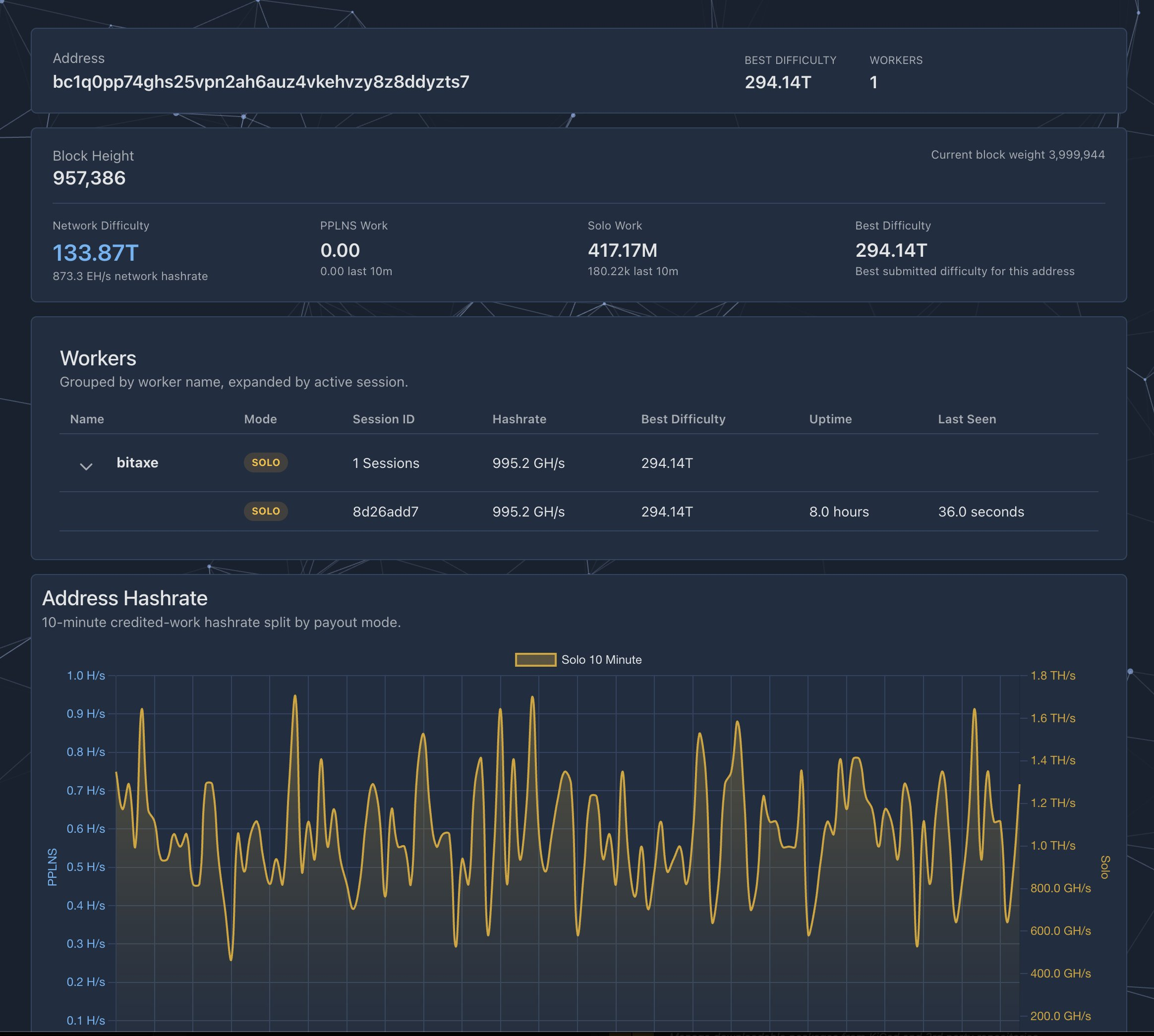


"Rig penambangan" yang disebutkan ini hanya seukuran router: satu chip BM1370, konsumsi daya 15 hingga 21 watt, dan hashrate kurang dari 1 TH/s. Selama periode penambangannya, total hashrate jaringan Bitcoin sekitar 874 EH/s, hashrate mesin kecil ini kurang dari satu per sembilan ratus juta dari total jaringan.


Dengan kecepatan ini, secara teoritis mesin kecil ini perlu menunggu 16.701 tahun untuk menambang satu blok, atau kira-kira dari Zaman Batu Tua 14.000 SM hingga hari ini, barulah bisa menambang satu blok Bitcoin. Pada masa itu, Homo sapiens belum menguasai teknologi bercocok tanam dan beternak, hanya bertahan hidup dengan berburu.


Tapi "anak terpilih" ini hanya membutuhkan 8 jam. Dalam 8 jam itu, Bitcoin mengalami 48 siklus blok, dan peluangnya memenangkannya kira-kira 1 dalam 18,3 juta.


Apa konsep angka ini? Peluang memenangkan hadiah utama lotre Double Color Ball adalah 1 dalam 17,72 juta. Artinya, dengan perangkat yang lebih kecil dari set-top box, dalam waktu kurang dari semalam, dia mencapai prestasi setara dengan memenangkan hadiah utama Double Color Ball sekali, dengan imbalan mencapai sekitar 1.330 kali lipat.


Kejadian "tidak masuk akal" seperti ini bukan yang pertama kali terjadi tahun ini.


Bulan Februari, penambang lain bahkan tidak membeli perangkat keras, hanya menghabiskan $75 untuk menyewa hashrate 1 PH/s di platform sewa hashrate, dan mencoba peruntungan di CKPool. Menurut total hashrate jaringan Bitcoin saat itu, peluang penambang ini menambang satu blok kira-kira 1 dalam 800 ribu, secara teoritis perlu menunggu 15 tahun. Hasilnya, sebelum $75 habis, blok 938092 sudah menjadi miliknya, dan 3,125 Bitcoin pun diraih.


Pada 10 Maret, Bitaxe Pocket Rig dengan hashrate 480 GH/s juga berhasil. Hashrate 480 GH/s bahkan setengah dari perangkat di awal artikel. Menurut perhitungan data saat itu, waktu harapan penambang ini untuk menemukan blok melebihi 25.000 tahun. Tapi tepat pada suatu hari di bulan Maret, dia menemukan blok 887212, dan mengambil hadiah sekitar $258 ribu. Con Kolivas, pemimpin CKPool, setelahnya berseru di media sosial bahwa hashrate seperti itu hanya memiliki peluang menang puluhan juta per hari, "murni keberuntungan yang sangat tidak masuk akal".


Tahun ini, contoh seperti ini tidak sedikit. Pada 9 April, seorang penambang dengan sekitar 70 TH/s (setara dengan Antminer S17+ tua) menambang blok 944306 melalui CKPool, mendapatkan sekitar 3,128 Bitcoin (nilai sekitar $222 ribu), dengan peluang harian sekitar 1 dalam 100 ribu; Akhir Mei, seorang penambang menggunakan klaster kecil yang terdiri dari 14 perangkat Canaan Nano (total hashrate 157 TH/s) menambang blok 951771 melalui Braiins Solo, hadiahnya bernilai sekitar $232 ribu.


Menurut statistik CoinDesk, dalam 12 bulan terakhir, penambang individu secara total telah menambang 24 blok, dan sejak awal 2026 hingga kini, 12 blok telah menjadi milik beberapa penambang individu yang "membeli lotre" dengan rig penambangan. Dibandingkan dengan total jumlah blok Bitcoin dalam 12 bulan, proporsi orang-orang beruntung ini kurang dari lima per sepuluh ribu.


Tidak termasuk kasus-kasus ekstrem yang sangat beruntung ini, lebih dari 99,9% blok masih dikendalikan erat oleh kolam penambangan tingkat industri seperti Foundry USA dan AntPool. Orang-orang beruntung ini lebih mirip orang biasa yang memenangkan lotre besar, bukan perwakilan tren industri mana pun. Tapi justru karena peluangnya rendah hingga hampir absurd, cerita-cerita ini menjadi menarik. Ketika seseorang menghabiskan $150 untuk membeli perangkat kecil yang terlihat seperti mainan elektronik, meletakkannya di meja, dan 8 jam kemudian akunnya bertambah $200 ribu. Peristiwa seperti ini, meski hanya terjadi sekali, sudah cukup untuk dibanggakan di kalangan teman seumur hidup.


Tentu saja, di balik semua peristiwa berpeluang rendah ini, ada banyak orang yang kurang beruntung yang telah menjalankan rig mereka selama berbulan-bulan atau bahkan bertahun-tahun tanpa menambang apa pun, diam-diam membayar tagihan listrik. Penambangan Bitcoin selalu seperti ini, cerita kekayaan mendadak segelintir orang menjadi headline berita, sementara perangkat kebanyakan orang diam-diam memanas di sudut ruangan. Hanya saja, setiap beberapa waktu, akan muncul seseorang yang sangat beruntung hingga menimbulkan kecemburuan, mengingatkan kita bahwa pada dasarnya hal ini masih merupakan lotre matematika. Dan tahun ini, lotre tersebut tampaknya sangat mendukung para pemain yang mencoba peruntungan dengan modal kecil.


Trending Cryptos

Related Questions

QApa yang terjadi pada seorang penambang Bitcoin pada 10 Juli waktu Beijing yang membuatnya disebut 'anak terpilih'?

ASeorang penambang Bitcoin menghubungkan perangkat Bitaxe Gamma seharga $150 ke soket dan WiFi rumahnya, lalu menjalankannya di Public Pool selama 8 jam. Secara ajaib, dia berhasil menambang blok Bitcoin 957382 dan mendapatkan 3.1382 BTC, yang bernilai sekitar $200.000 pada saat itu.

QApa itu Bitaxe Gamma dan seberapa besar kemungkinannya untuk menambang satu blok Bitcoin?

ABitaxe Gamma adalah perangkat penambangan seukuran router dengan chip BM1370, konsumsi daya 15-21 watt, dan hash rate kurang dari 1 TH/s. Dengan hash rate ini, secara teoretis dibutuhkan sekitar 16.701 tahun untuk menambang satu blok Bitcoin. Peluangnya saat itu kira-kira 1 dalam 18,3 juta, setara dengan memenangkan lotre.

QSelain kisah Juli, adakah contoh keberuntungan serupa dari penambang individu pada tahun ini?

AYa, ada beberapa contoh. Pada Februari, seorang penambang menyewa 1 PH/s hash rate dengan $75 dan memenangkan blok 938092. Pada 10 Maret, perangkat Bitaxe Pocket Rig 480 GH/s memenangkan blok 887212. Contoh lain terjadi pada 9 April dan akhir Mei, di mana penambang dengan perangkat berhash rate rendah juga berhasil mendapatkan blok dan hadiah Bitcoin.

QMenurut statistik, berapa banyak blok yang berhasil ditambang oleh penambang individu dalam 12 bulan terakhir, dan bagaimana proporsinya?

ADalam 12 bulan terakhir, penambang individu secara total berhasil menambang 24 blok. Dari jumlah tersebut, 12 blok berhasil ditambang pada tahun 2026 saja. Namun, dibandingkan dengan total jumlah blok Bitcoin dalam periode yang sama, kontribusi para 'orang beruntung' ini kurang dari 0,05%.

QApakah kisah keberuntungan ini mengubah dominasi penambangan Bitcoin secara keseluruhan?

ATidak. Lebih dari 99,9% blok Bitcoin masih dikuasai oleh kolam penambangan industri besar seperti Foundry USA dan AntPool. Kisah-kisah penambang individu yang beruntung ini lebih seperti memenangkan lotre dan tidak mewakili tren industri. Mereka adalah pengecualian yang sangat jarang, tetapi menarik karena probabilitasnya yang sangat rendah.

Related Reads

Has the Crypto Utopia Collapsed? The Industry Reaches an Inflection Point After the Frenzy Subsides

Has the crypto utopia collapsed? The industry is at an inflection point as the hype fades. The prevailing view is that crypto has become an outlet for excess liquidity, with many participants leaving as financial returns have fallen short of past-decade expectations. The 2021 boom has been revealed as an illusion, placing the industry in the "trough of disillusionment" on Gartner's Hype Cycle. This forces a return to first principles: re-evaluating token value, securing DeFi protocols, and finding real-world applications. The core failure is a repetitive cycle of reflexive speculation, driven by the premature liquidity of tokens. The industry's incentives prioritized short-term gains over genuine innovation. While curiosity drives invention, recent DeFi hacks signal a need for engineering and iteration, including token models. The culture is shifting; the industry is no longer in its early stages. Positioned at a turning point on the technology adoption curve, crypto faces the immense challenge of rebuilding finance from scratch, a process of inevitable iteration and failure. Regarding crypto VC, claims of its death are overstated. The exceptional returns of 2016-2021 were an anomaly. The initial crypto-anarchist ethos has largely been co-opted by Wall Street and regulators. The utopian vision is over; the industry is being assimilated into the existing system, becoming a business. Current viable project categories include stablecoins, prediction markets, tokenized assets/RWA, perpetual contracts, and AI/agent integration. Crypto is converging with fintech, far from the envisioned DeFi revolution, and must find killer apps within regulatory boundaries. A reconciliation is possible: cryptocurrency may change value storage and transfer in subtle, imperceptible ways that integrate into existing systems, rather than through revolutionary fanfare. True creativity often emerges from adversity. There remains much to build for those driven by genuine curiosity.

marsbit14m ago

Has the Crypto Utopia Collapsed? The Industry Reaches an Inflection Point After the Frenzy Subsides

marsbit14m ago

Lei Jun Earns 7 Billion in One Day from CXMT's IPO? Xiaomi Executive Responds

On July 28th, Changxin Technology's stock price on the Sci-Tech Innovation Board experienced minor fluctuations. The company had made a historic market debut the previous day, becoming the first A-share stock to record a single-day trading volume exceeding 1 trillion yuan. This led to significant paper gains for its strategic investors. Among them, Xiaomi's wholly-owned subsidiary was allocated 18.24 million shares with an initial investment of approximately 158 million yuan. Reports estimated a paper profit of 717 million yuan for Xiaomi founder Lei Jun based on his shareholding structure. However, a Xiaomi executive clarified that this was a corporate investment and should not be conflated with personal wealth. Other major beneficiaries included Alibaba and Nio. Alibaba, an early investor, held nearly a 5% stake through two entities, with an estimated paper gain exceeding 160 billion yuan. Nio, participating in the strategic placement, also saw substantial paper returns. Additionally, state-owned banks and insurance institutions that invested in Changxin recorded potential gains in the hundreds of billions. Conversely, companies like Country Garden reportedly missed out on nearly 50 billion yuan in potential gains after divesting their stakes before the IPO due to liquidity pressures. The article notes that these are paper profits based on the listing price, as the allocated shares are subject to lock-up periods, and final realized gains will depend on future stock performance. An employee from Changxin Technology commented that ordinary staff remain focused on their salaries and benefits rather than the market hype.

marsbit23m ago

Lei Jun Earns 7 Billion in One Day from CXMT's IPO? Xiaomi Executive Responds

marsbit23m ago

Selling Tokens or Selling Outcomes: Several Paradoxes of the AI Business Model

"The Token vs. Outcome Sale: Key Paradoxes in the AI Business Model By mid-2026, the AI industry shows rapid growth in revenue and token usage, yet the underlying business models differ significantly. This article analyzes four structural paradoxes defining the current landscape, all pointing to the commoditization of intelligence and the concentration of profits in few segments. **The Cost Paradox: Cheaper Tokens, Heavier Bills** Despite a >95% price drop for equivalent AI capability since 2023, total spending has skyrocketed due to the Jevons Paradox: lower prices expand usage into previously uneconomical tasks. Furthermore, the shift to autonomous agents operating 24/7 multiplies consumption. However, efficiency gains often remain unrealized due to unchanged organizational workflows (the Solow Paradox). The focus is shifting from optimizing token price to optimizing the task itself. **The Hierarchy Paradox: The App is King vs. The App is Dead** While conventional wisdom holds that value accrues at the application layer, the AI stack is inverted. Infrastructure (chips) captures ~70% of industry revenue and ~80% of gross profit, while application-layer margins are thin (0-30%). Fast-evolving base models threaten "thin" apps. Sustainable applications are those that embed intelligence into specific contexts, possessing private data, workflows, or delivery capabilities that become more valuable as the base model improves. **The Responsibility Paradox: Profit Follows Accountability** Growth rates alone don't guarantee profit. A key differentiator is a company's willingness and ability to take responsibility for specific outcomes. Selling by the token competes for IT budgets; selling by the outcome (e.g., a resolved support ticket) taps into larger human labor budgets. Low-responsibility, high-volume tasks (e.g., generic客服) face commoditization. High-stakes, regulated domains (e.g., law, healthcare) where vendors assume heavier liability for results command higher margins, as seen with companies like Harvey in legal tech. **The Open-Source Paradox: Open Wins Traffic, Closed Wins Revenue** Open-source models dominate in usage share and developer adoption, often being 5-20x cheaper. However, closed-source models still capture the majority of enterprise spending (~89%). Enterprises pay a premium for closed-source reliability, support, compliance, and accountability. The total cost of ownership (TCO) is converging as closed-source prices fall faster than open-source builds trust, leading to hybrid deployments. Profit is migrating from the model layer itself to upstream (compute) and downstream (orchestration, data, services)."

marsbit24m ago

Selling Tokens or Selling Outcomes: Several Paradoxes of the AI Business Model

marsbit24m ago

Trading

Spot

Hot Articles

What is $BITCOIN

DIGITAL GOLD ($BITCOIN): A Comprehensive Analysis Introduction to DIGITAL GOLD ($BITCOIN) DIGITAL GOLD ($BITCOIN) is a blockchain-based project operating on the Solana network, which aims to combine the characteristics of traditional precious metals with the innovation of decentralized technologies. While it shares a name with Bitcoin, often referred to as “digital gold” due to its perception as a store of value, DIGITAL GOLD is a separate token designed to create a unique ecosystem within the Web3 landscape. Its goal is to position itself as a viable alternative digital asset, although specifics regarding its applications and functionalities are still developing. What is DIGITAL GOLD ($BITCOIN)? DIGITAL GOLD ($BITCOIN) is a cryptocurrency token explicitly designed for use on the Solana blockchain. In contrast to Bitcoin, which provides a widely recognized value storage role, this token appears to focus on broader applications and characteristics. Notable aspects include: Blockchain Infrastructure: The token is built on the Solana blockchain, known for its capacity to handle high-speed and low-cost transactions. Supply Dynamics: DIGITAL GOLD has a maximum supply capped at 100 quadrillion tokens (100P $BITCOIN), although details regarding its circulating supply are currently undisclosed. Utility: While precise functionalities are not explicitly outlined, there are indications that the token could be utilized for various applications, potentially involving decentralized applications (dApps) or asset tokenization strategies. Who is the Creator of DIGITAL GOLD ($BITCOIN)? At present, the identity of the creators and development team behind DIGITAL GOLD ($BITCOIN) remains unknown. This situation is typical among many innovative projects within the blockchain space, particularly those aligning with decentralized finance and meme coin phenomena. While such anonymity may foster a community-driven culture, it intensifies concerns about governance and accountability. Who are the Investors of DIGITAL GOLD ($BITCOIN)? The available information indicates that DIGITAL GOLD ($BITCOIN) does not have any known institutional backers or prominent venture capital investments. The project seems to operate on a peer-to-peer model focused on community support and adoption rather than traditional funding routes. Its activity and liquidity are primarily situated on decentralized exchanges (DEXs), such as PumpSwap, rather than established centralized trading platforms, further highlighting its grassroots approach. How DIGITAL GOLD ($BITCOIN) Works The operational mechanics of DIGITAL GOLD ($BITCOIN) can be elaborated on based on its blockchain design and network attributes: Consensus Mechanism: By leveraging Solana’s unique proof-of-history (PoH) combined with a proof-of-stake (PoS) model, the project ensures efficient transaction validation contributing to the network's high performance. Tokenomics: While specific deflationary mechanisms have not been extensively detailed, the vast maximum token supply implies that it may cater to microtransactions or niche use cases that are still to be defined. Interoperability: There exists the potential for integration with Solana’s broader ecosystem, including various decentralized finance (DeFi) platforms. However, the details regarding specific integrations remain unspecified. Timeline of Key Events Here is a timeline that highlights significant milestones concerning DIGITAL GOLD ($BITCOIN): 2023: The initial deployment of the token occurs on the Solana blockchain, marked by its contract address. 2024: DIGITAL GOLD gains visibility as it becomes available for trading on decentralized exchanges like PumpSwap, allowing users to trade it against SOL. 2025: The project witnesses sporadic trading activity and potential interest in community-led engagements, although no noteworthy partnerships or technical advancements have been documented as of yet. Critical Analysis Strengths Scalability: The underlying Solana infrastructure supports high transaction volumes, which could enhance the utility of $BITCOIN in various transaction scenarios. Accessibility: The potential low trading price per token could attract retail investors, facilitating wider participation due to fractional ownership opportunities. Risks Lack of Transparency: The absence of publicly known backers, developers, or an audit process may yield skepticism regarding the project's sustainability and trustworthiness. Market Volatility: The trading activity is heavily reliant on speculative behavior, which can result in significant price volatility and uncertainty for investors. Conclusion DIGITAL GOLD ($BITCOIN) emerges as an intriguing yet ambiguous project within the rapidly evolving Solana ecosystem. While it attempts to leverage the “digital gold” narrative, its departure from Bitcoin's established role as a store of value underscores the need for a clearer differentiation of its intended utility and governance structure. Future acceptance and adoption will likely depend on addressing the current opacity and defining its operational and economic strategies more explicitly. Note: This report encompasses synthesised information available as of October 2023, and developments may have transpired beyond the research period.

1.1k Total ViewsPublished 2025.05.13Updated 2025.05.13

What is $BITCOIN

Discussions

Welcome to the HTX Community. Here, you can stay informed about the latest platform developments and gain access to professional market insights. Users' opinions on the price of BTC (BTC) are presented below.

活动图片