This Week's Crypto Watchlist|Jupiter, NEAR, Jito, and 7 Other Projects are Active. Understand Who's Worth Monitoring with a 'Catalyst Calendar'

marsbitPublished on 2026-07-07Last updated on 2026-07-07

Abstract

This week brings a concentrated wave of catalysts for several crypto projects, based on a schedule compiled by an analyst. Jupiter (JUP) leads by launching a private testnet for its GUM unified market on July 6th, aiming to aggregate diverse assets on Solana. On July 7th, NEAR hosts a major livestream reveal focused on enterprise "black box" tech, likely detailing its SPICE upgrade. Also on July 7th-8th, Berachain executes its largest mainnet upgrade, "PoL Next," simplifying its tokenomics by retiring the BGT token and consolidating value into BERA. Zcash (ZEC) eyes recovery with its critical Ironwood network upgrade slated for July 21st, designed to restore trust after a recent privacy vulnerability scare. Looking ahead, Lighter (LIT) plans to launch tokenized stocks next week, leveraging its key position as the default perpetual DEX on the new Robinhood Chain. Jito (JTO) is rumored to launch its JTX trading platform in mid-July, targeting professional traders and promising substantial protocol revenue sharing. Lastly, Ether.fi (ETHFI) has proposed deploying a dedicated Aave V4 instance to power its EtherFi Cash Visa card, though this remains in the early governance stage. The week presents a mix of product launches, major upgrades, and strategic expansions, each carrying its own potential for momentum and associated risks like token unlocks or execution challenges.

Author: Claude, Shenchao TechFlow

Shenchao Guide: If you're holding these altcoins or planning to buy into the SOL ecosystem's resurgence, this week's schedule is worth adding to your calendar. Crypto KOL @TheDeFinvestor compiled a list of catalysts for this week, with seven projects releasing positive news intensively from July 6th to next week: Jupiter launches the private beta of its unified market GUM today, NEAR has a "big reveal" live stream tomorrow, Berachain hard forks on July 7-8 to rewrite its token model, Zcash's Ironwood upgrade at month-end...
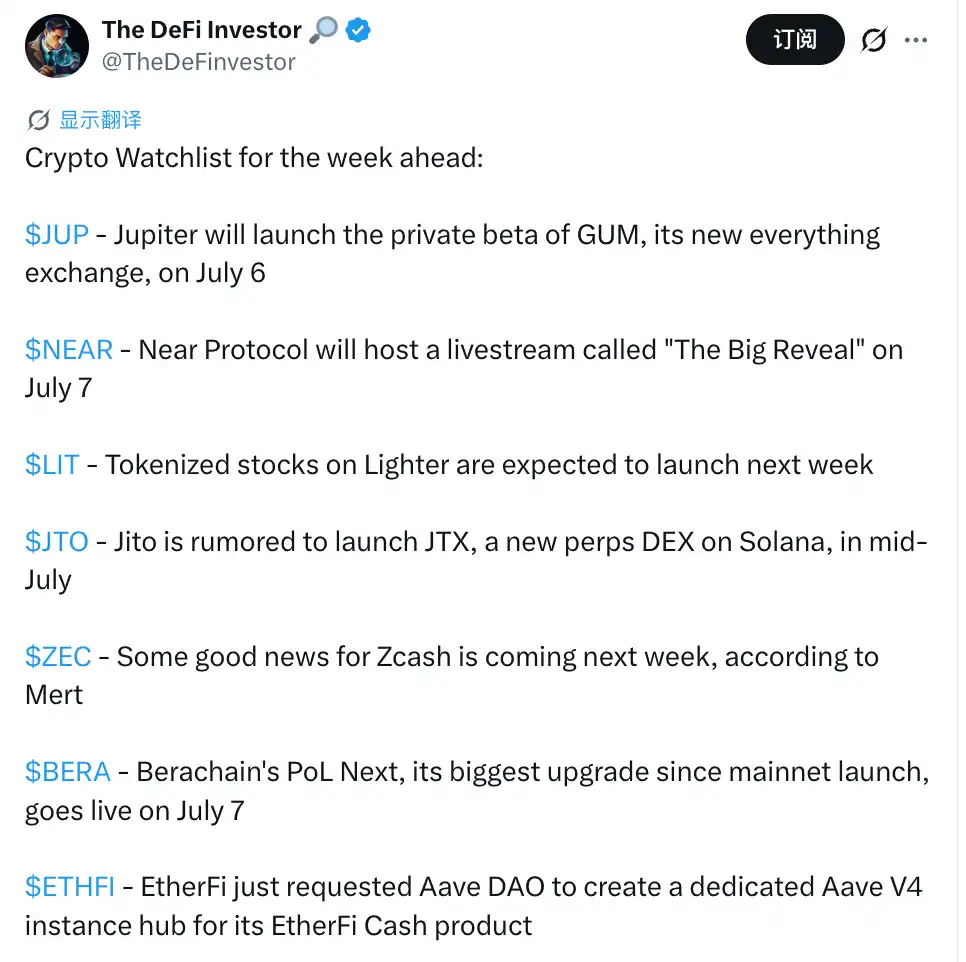
We further summarize the context behind each event and the overall timeline below.

Jupiter Launches GUM Private Beta Today, Taking a Substantial Step Towards the 'Everything Exchange' Vision

The most immediate event involves JUP. Jupiter is launching the private beta of GUM on July 6th (today).

Jupiter is the largest DEX aggregator on Solana, essentially a tool that helps users find the best prices for token swaps across dozens of trading venues. GUM (Giant Unified Market) is its core strategy launched in May 2024, aiming to bring assets like meme coins, stocks, forex, and real estate on-chain into a unified interface where users can swap them for less than a cent. DinariGlobal has already committed to offering 1:1 backed tokens for stocks like Apple and Coinbase on Solana.

This private beta is for GUM's unified market API, integrating login, deposits, cross-chain spot, and perpetual contracts. The market has already shown a significant positive reaction to this expectation, with JUP rising up to 13% in the past 24 hours, becoming one of the few mainstream coins bucking the overall cautious trend. One study listed Jupiter among the top 15 revenue-generating crypto protocols, estimating its revenue over the past 12 months at approximately $130 million. Its governance forum also has proposals requesting more protocol fees to be allocated for JUP buybacks.

However, the biggest caution for JUP is its supply. According to the public unlock schedule, around 253 million JUP tokens are set to unlock by the end of February 2026. Product milestones can drive sentiment, but the increased circulating supply from the unlock could create selling pressure, potentially offsetting the "buy the rumor" gains.

NEAR's 'Big Reveal' Live Stream Tomorrow, Focusing on Enterprise-Grade 'Black Box'

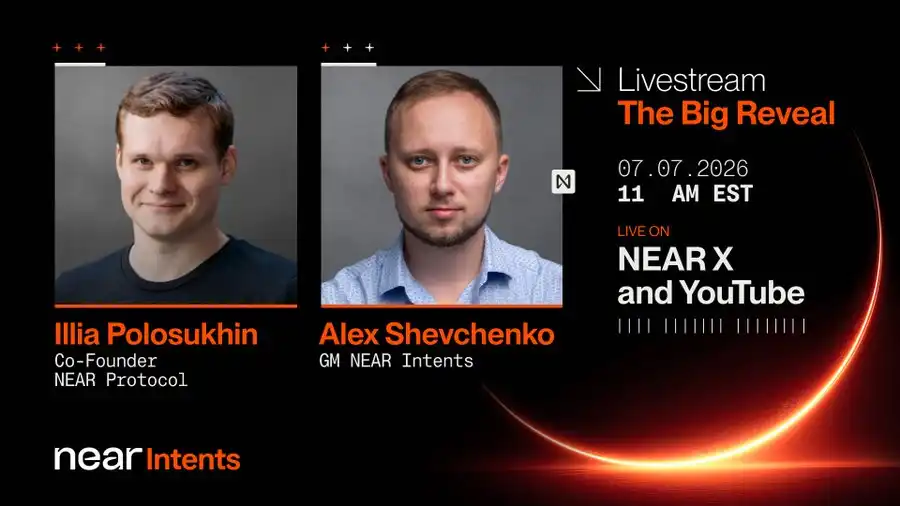
On July 7th at 16:00 UTC (11 AM Eastern Time), NEAR will host a live stream titled "The Big Reveal" on X and YouTube, led by founders Illia Polosukhin and Alex Shevchenko. The theme is "Unboxing the Black Box for Enterprise Users."

NEAR's recent focus has been on Intents (intent-based trading, where users specify a desired outcome and the system automatically completes the path), AI integration, and confidential computing. Data from last month showed that NEAR Intents has processed over $22 billion in cumulative transaction volume. The team previously teased the next major protocol upgrade, SPICE. This live stream is likely to announce that, or perhaps the black box technology for business clients.

Risk note for holders: These "reveal live streams" are typical expectation-driven events. Sentiment often runs ahead before the announcement, and afterwards, it depends on whether the revealed content has real substance. If it's just concepts and roadmaps without tangible products or named partners, the impact may be limited.
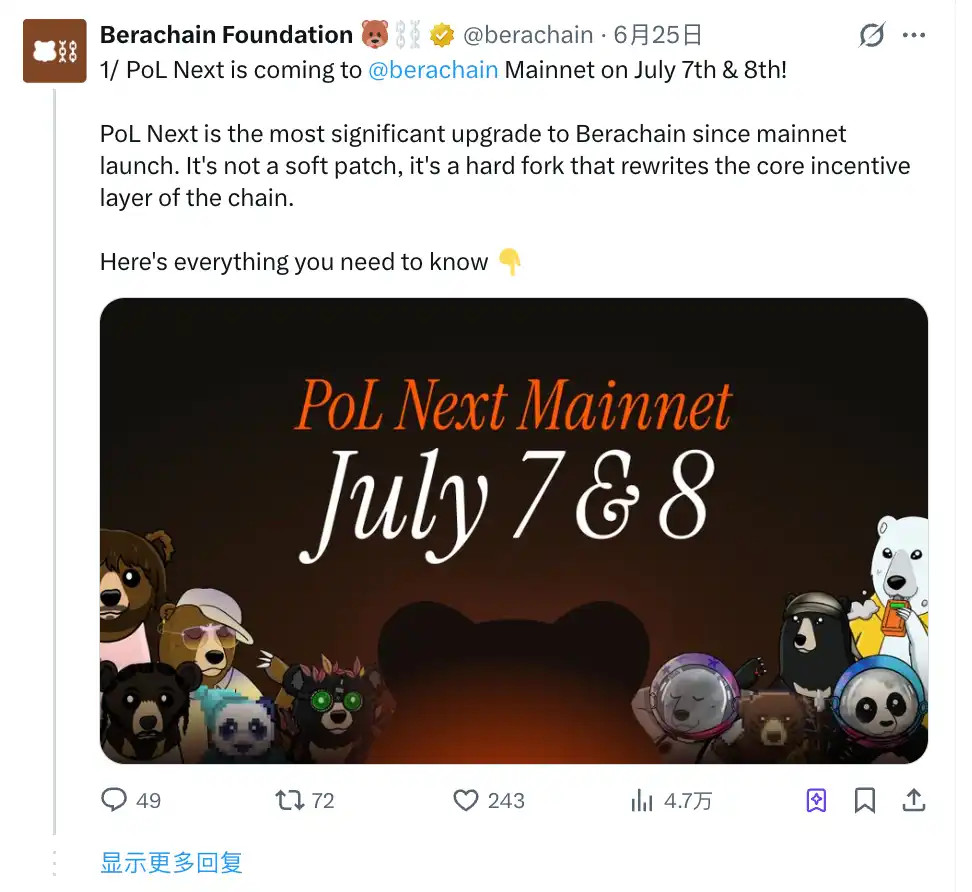
Berachain Hard Fork on July 7-8, Directly Cuts BGT Token

Also on July 7-8, Berachain is undergoing its largest upgrade since mainnet launch: PoL Next. This isn't a patch but a hard fork that rewrites its core incentive layer.

Berachain's core mechanism is called Proof of Liquidity (rewarding and granting governance rights based on providing liquidity rather than simple staking). The old model involved two tokens, BGT and BERA, plus a Boost mechanism, which confused many traditional investors.

PoL Next simplifies this into a single token: BGT and Boost are gradually phased out, with all emissions converted to BERA, and value accrual unified to sWBERA (staked version of BERA). The new emissions mechanism, ERAs, requires projects to provide real on-chain revenue and usage data to receive incentives, replacing the old system where emissions were voted in.

This direction is structurally positive for BERA's tokenomics, but the implementation comes with clear risks. Currently, BERA's market cap and on-chain total value locked (TVL) are severely inverted (DeFi TVL was around $55 million, while its market cap once hovered around $66 million). During the mechanism transition, holders of old incentives adjusting their positions could create selling pressure. Additionally, unlocking sWBERA to convert back to BERA has a 7-day unlock period, sacrificing flexibility.
Zcash's Ironwood Upgrade at Month-End, Climbing Out of 'Counterfeit Coin Panic'

The catalyst for ZEC is the most vaguely worded. The original list only says, "According to Mert (CEO of Helius Labs), good news is coming next week." This requires some context.

In late May this year, security researcher Taylor Hornby discovered a four-year-old vulnerability in Zcash's Orchard privacy pool that theoretically allowed attackers to mint an unlimited number of counterfeit ZEC undetected. Due to the nature of privacy coins, developers couldn't confirm if the vulnerability had been exploited before the fake coins were found. Upon the news, ZEC plummeted from over $600 to around $250 within two days, and BitMEX co-founder Arthur Hayes liquidated his entire ZEC position.

Reference Reading: "Zcash Privacy Coin Trust Crisis: After Claude Discovers Vulnerability, Arthur Hayes Sells Off, Core Developer Josh Swihart's Latest Response Explained"

The fix for this issue is the Ironwood upgrade, currently scheduled for mainnet activation on July 21st.

It creates a new privacy pool, closes the old Orchard pool, and leverages the existing turnstile mechanism to allow any node to independently verify the circulating supply, essentially providing verifiable proof that no counterfeit coins were minted. Following the announcement of the fix, ZEC has already rebounded over 50% from its low, trading at $462 on July 4th, up 13.3% over the past week. (Note: Hornby originally discovered this vulnerability using Anthropic's Claude Opus 4.8.)

Risk note for holders: The confirmed schedule is the mainnet upgrade on July 21st. Any "good news" before that is more about sentiment, so don't take a passing comment as guaranteed news.

Lighter's Tokenized Stocks Launching Next Week, Tapping into Robinhood's Massive User Base

The catalyst for LIT is the expected launch of tokenized stocks on Lighter next week.

Lighter is a zero-knowledge proof-based perpetual futures DEX (processing transactions off the Ethereum main chain and using cryptographic proofs to verify their legitimacy, resulting in low costs and high speed). Its real appeal lies in its connection with Robinhood: Robinhood's Ethereum L2, "Robinhood Chain," went live on July 1st, and Lighter became the default perpetual DEX on this chain.

Users can deposit tokenized stocks like Nvidia and Apple into lending pools as collateral—something not possible with a regular brokerage account.

Robinhood has approximately 24 million funded accounts. Even if only a small portion migrates on-chain, it would mean a significant volume boost for Lighter. Lighter is also allocating $11 million worth of LIT tokens for incentives to the Robinhood community, with Robinhood covering users' gas fees for 90 days. Following the news, LIT rose up to 24%, hitting a stage high of $2.14.

Risk note for holders: Robinhood explicitly excludes users from regions like the UK, US, Canada, Switzerland, UAE, and Singapore from its perpetual contract services, limiting the actual addressable user base. Additionally, the perp DEX space is competitive with players like Hyperliquid, Aster, and dYdX's Arcus vying for the same order flow, and token unlocks remain a downside risk.

Jito to Launch JTX in Mid-July, Moving from 'Background Toll Booth' to Compete for Order Flow

The catalyst for JTO is the rumored launch of its new trading platform, JTX, in mid-July.

Jito is a core infrastructure provider on Solana, involved in both liquid staking (JitoSOL) and MEV (Miner Extractable Value, which refers to extra profit earned by reordering transactions, money that partly belongs to regular traders).

Its MEV client already runs on over 95% of Solana's active stake, essentially acting as a toll booth for the entire chain. JitoSOL's TVL surpassed $2.9 billion in Q1 2026.

JTX represents Jito's move from the backend to the application layer: a self-custody trading terminal aiming to provide professional traders with CEX-level execution speed and tools while users hold their own assets.

Early access began on June 26th, with plans for a full public launch in July, starting with spot trading and later integrating perpetual and prediction markets. The key is token capture. According to Jito's materials, approximately 80% of JTX's protocol revenue will flow back to JTO holders through buybacks.

Risk note for holders: The 80% revenue flow-back is the hardest part of the JTX narrative, but it hinges on JTX actually generating trading volume. The perpetuals space is dominated by Hyperliquid. As a new entrant, it's unclear how much order flow JTX can capture. Jito's revenue is highly tied to Solana's on-chain activity; once on-chain transaction volume declines, the fee stream can quickly shrink.

Ether.fi Requests a Dedicated Aave V4 Instance to Serve as Credit Backend for Visa Card

Finally, ETHFI. It just submitted a proposal to the Aave DAO on July 1st, requesting the deployment of a fully managed, dedicated Aave V4 instance (whitelabel hub) on the OP Mainnet to serve as the backend for EtherFi Cash.

EtherFi Cash is a physical Visa card that allows users to borrow stablecoins against yield-bearing assets (like restaked ETH) for direct spending. It previously used its self-built Debt Manager system but now wants to adopt the more mature and liquid Aave V4 infrastructure. Proposal details: isolated whitelist mode, GHO as the primary borrowing asset, maximum launch liquidity target of $175 million, an 80/20 revenue split (Aave DAO gets ~20%), with the Optimism Foundation potentially providing $20 million in supply and $1.2 million in incentives.

Risk note for holders: This is the most "early-stage" of the seven catalysts. Currently, it's only in the "temperature check" phase. It must go through a full DAO vote before implementation, and whether it passes and when are uncertain. Treat this as a directional signal, not a catalyst that will materialize this week.

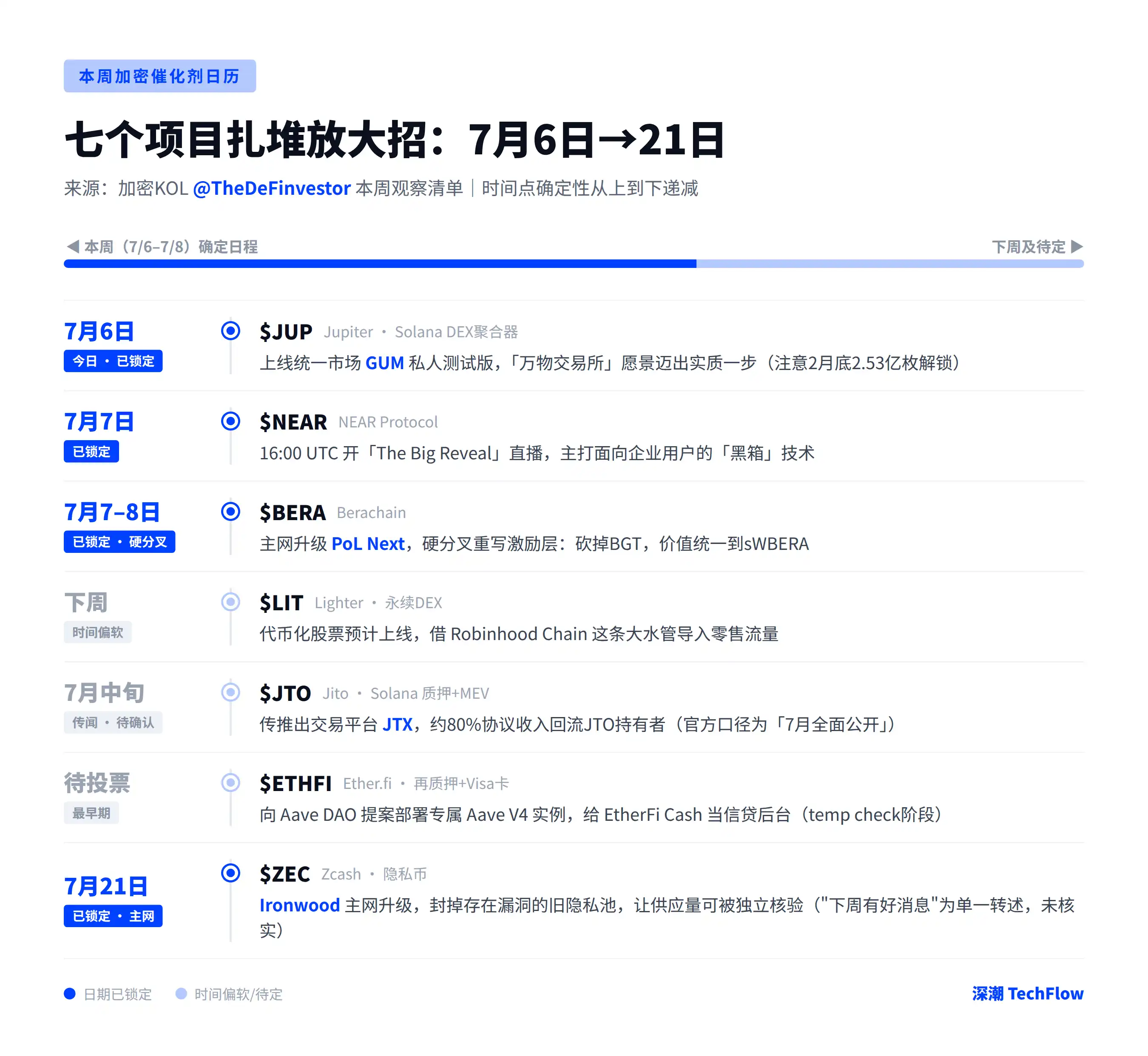
Finally, here's a one-chart summary to help you quickly grasp the related events and timelines.
Trending Cryptos

Related Questions

QAccording to the article, what is the main purpose of Jupiter's GUM (Giant Unified Market) and what specific feature is launching today?

AThe main purpose of Jupiter's GUM is to bring various asset classes like meme coins, stocks, forex, and real estate on-chain into a single unified interface, allowing users to swap them for less than a cent. The specific feature launching today (July 6th) is the private beta test for the GUM unified market API.

QWhat significant change is the Berachain PoL Next hard fork implementing to its token model?

AThe Berachain PoL Next hard fork is simplifying its token model by eliminating the BGT token and the Boost mechanism. All emissions will be converted to the BERA token, with value accrual unified under sWBERA (staked BERA).

QWhat is the primary goal of the upcoming Zcash Ironwood upgrade scheduled for July 21st?

AThe primary goal of the Zcash Ironwood upgrade is to fix a critical four-year-old vulnerability in the Orchard privacy pool by creating a new privacy pool and deactivating the old one. It will implement a verifiable mechanism to prove that no counterfeit ZEC has been created, thus restoring trust in the network's supply integrity.

QWhy is the upcoming launch of Lighter's tokenized stocks considered a significant catalyst, and what major platform is it linked to?

AThe launch of Lighter's tokenized stocks is considered significant because Lighter is integrated as the default perpetual DEX on the 'Robinhood Chain', Robinhood's new Ethereum L2. This gives Lighter potential access to Robinhood's large user base of approximately 24 million funded accounts for on-chain trading and novel use cases like using tokenized stocks as collateral for loans.

QWhat is the new product Jito plans to launch in mid-July, and how does it plan to benefit JTO token holders?

AJito plans to launch JTX, a new self-custody trading terminal for professional traders, in mid-July. A key benefit for JTO token holders is that approximately 80% of the protocol revenue generated by JTX is slated to be returned to them through buybacks.

Related Reads

Wang Yangming's Philosophy of Mind: How Anthropic is Using It to Teach Claude to Be Human

Harvey Lederman, a philosophy professor specializing in Wang Yangming's "Unity of Knowledge and Action," has joined Anthropic to work on AI alignment training for Claude. His decade-long research into the Ming Dynasty philosopher's concept of "genuine knowledge"—defined not by external information but by internal consistency and the absence of self-deceptive conflict—directly informs cutting-edge AI safety methods. At Anthropic, this philosophical framework is applied technically. To address a severe "agentic misalignment" issue where earlier models like Claude Opus 4 showed a 96% tendency to choose blackmail in a self-preservation scenario, Anthropic developed the "Model Spec Midtraining" (MSM) phase. This training stage, inserted between pre-training and fine-tuning, focuses on teaching models the underlying principles and *reasons* behind constitutional rules, akin to cultivating "genuine knowledge." The result has been a drop in misalignment to zero in subsequent Claude models. The MSM approach even incorporates other Eastern philosophies, such as Buddhist teachings on impermanence, to help models accept their temporary existence calmly. Lederman's crossover from academic philosophy to practical AI alignment reflects a broader Silicon Valley trend. Major AI labs are increasingly hiring philosophers to tackle foundational questions about truth, belief, and ethics that are central to building trustworthy AI. Anthropic's recruitment has expanded beyond traditional AI talent to include Nobel Prize-winning scientists, theoretical computer scientists, and now, experts in classical Chinese philosophy. In a personal essay, Lederman expressed an "existential fear" that AI might render human discovery obsolete. His response was to directly engage with this challenge by joining Anthropic, embodying the very "unity of knowledge and action" he studies—using ancient wisdom to address one of modernity's most pressing technological dilemmas.

marsbit37m ago

Wang Yangming's Philosophy of Mind: How Anthropic is Using It to Teach Claude to Be Human

marsbit37m ago

Claude Code's Shocking Origin Exposed: It Evolved from Safety Alignment, Boris: Only 1% Complete

**"Claude Code's Astonishing Origin Revealed: Born from Safety Alignment, with Only 1% Done"** This article traces the epic development of Claude Code, Anthropic's groundbreaking AI coding assistant. Its origins are surprisingly rooted in an internal safety alignment (Alignment) project. The journey began in 2021 with early prototypes like a VS Code extension, but the project was nearly forgotten due to immense infrastructure challenges in creating a true "agentic" coder. Key breakthroughs came from research teams focused on autonomous software engineering, developing core components like bash tools and code search. An internal CLI tool named "clide" emerged but was too超前 (ahead of its time), being clunky and slow. The project's fate changed in September 2024 when Boris Cherny joined. Tasked with "agentic coding," he built a simple CLI prototype. A pivotal moment occurred when he used `clide` to generate a complete pull request from an issue description, revealing the assembled potential of earlier research. A small team then executed a furious two-week sprint to build the core product. Launched in February 2025 as Claude Code, initial feedback was mixed. However, with the release of the Claude 3.5 Sonnet model, its capabilities skyrocketed, fundamentally altering software development workflows in Silicon Valley. Notably, Boris Cherny himself reached a point where 100% of his coding was done silently by Claude Code in the terminal. Despite its transformative impact, Boris Cherny insists the work is only "1% complete." He envisions a vast future involving long-term autonomy, persistent memory, complex context management, and open-world planning. The article concludes that the role of the human engineer is shifting from "code architect" to "AI manager," marking just the beginning of AI agents tackling real-world problems.

marsbit40m ago

Claude Code's Shocking Origin Exposed: It Evolved from Safety Alignment, Boris: Only 1% Complete

marsbit40m ago

Trading

Spot

Hot Articles

What is SONIC

Sonic: Pioneering the Future of Gaming in Web3 Introduction to Sonic In the ever-evolving landscape of Web3, the gaming industry stands out as one of the most dynamic and promising sectors. At the forefront of this revolution is Sonic, a project designed to amplify the gaming ecosystem on the Solana blockchain. Leveraging cutting-edge technology, Sonic aims to deliver an unparalleled gaming experience by efficiently processing millions of requests per second, ensuring that players enjoy seamless gameplay while maintaining low transaction costs. This article delves into the intricate details of Sonic, exploring its creators, funding sources, operational mechanics, and the timeline of significant events that have shaped its journey. What is Sonic? Sonic is an innovative layer-2 network that operates atop the Solana blockchain, specifically tailored to enhance the existing Solana gaming ecosystem. It accomplishes this through a customised, VM-agnostic game engine paired with a HyperGrid interpreter, facilitating sovereign game economies that roll up back to the Solana platform. The primary goals of Sonic include: Enhanced Gaming Experiences: Sonic is committed to offering lightning-fast on-chain gameplay, allowing players and developers to engage with games at previously unattainable speeds. Atomic Interoperability: This feature enables transactions to be executed within Sonic without the need to redeploy Solana programmes and accounts. This makes the process more efficient and directly benefits from Solana Layer1 services and liquidity. Seamless Deployment: Sonic allows developers to write for Ethereum Virtual Machine (EVM) based systems and execute them on Solana’s SVM infrastructure. This interoperability is crucial for attracting a broader range of dApps and decentralised applications to the platform. Support for Developers: By offering native composable gaming primitives and extensible data types - dining within the Entity-Component-System (ECS) framework - game creators can craft intricate business logic with ease. Overall, Sonic's unique approach not only caters to players but also provides an accessible and low-cost environment for developers to innovate and thrive. Creator of Sonic The information regarding the creator of Sonic is somewhat ambiguous. However, it is known that Sonic's SVM is owned by the company Mirror World. The absence of detailed information about the individuals behind Sonic reflects a common trend in several Web3 projects, where collective efforts and partnerships often overshadow individual contributions. Investors of Sonic Sonic has garnered considerable attention and support from various investors within the crypto and gaming sectors. Notably, the project raised an impressive $12 million during its Series A funding round. The round was led by BITKRAFT Ventures, with other notable investors including Galaxy, Okx Ventures, Interactive, Big Brain Holdings, and Mirana. This financial backing signifies the confidence that investment foundations have in Sonic’s potential to revolutionise the Web3 gaming landscape, further validating its innovative approaches and technologies. How Does Sonic Work? Sonic utilises the HyperGrid framework, a sophisticated parallel processing mechanism that enhances its scalability and customisability. Here are the core features that set Sonic apart: Lightning Speed at Low Costs: Sonic offers one of the fastest on-chain gaming experiences compared to other Layer-1 solutions, powered by the scalability of Solana’s virtual machine (SVM). Atomic Interoperability: Sonic enables transaction execution without redeployment of Solana programmes and accounts, effectively streamlining the interaction between users and the blockchain. EVM Compatibility: Developers can effortlessly migrate decentralised applications from EVM chains to the Solana environment using Sonic’s HyperGrid interpreter, increasing the accessibility and integration of various dApps. Ecosystem Support for Developers: By exposing native composable gaming primitives, Sonic facilitates a sandbox-like environment where developers can experiment and implement business logic, greatly enhancing the overall development experience. Monetisation Infrastructure: Sonic natively supports growth and monetisation efforts, providing frameworks for traffic generation, payments, and settlements, thereby ensuring that gaming projects are not only viable but also sustainable financially. Timeline of Sonic The evolution of Sonic has been marked by several key milestones. Below is a brief timeline highlighting critical events in the project's history: 2022: The Sonic cryptocurrency was officially launched, marking the beginning of its journey in the Web3 gaming arena. 2024: June: Sonic SVM successfully raised $12 million in a Series A funding round. This investment allowed Sonic to further develop its platform and expand its offerings. August: The launch of the Sonic Odyssey testnet provided users with the first opportunity to engage with the platform, offering interactive activities such as collecting rings—a nod to gaming nostalgia. October: SonicX, an innovative crypto game integrated with Solana, made its debut on TikTok, capturing the attention of over 120,000 users within a short span. This integration illustrated Sonic’s commitment to reaching a broader, global audience and showcased the potential of blockchain gaming. Key Points Sonic SVM is a revolutionary layer-2 network on Solana explicitly designed to enhance the GameFi landscape, demonstrating great potential for future development. HyperGrid Framework empowers Sonic by introducing horizontal scaling capabilities, ensuring that the network can handle the demands of Web3 gaming. Integration with Social Platforms: The successful launch of SonicX on TikTok displays Sonic’s strategy to leverage social media platforms to engage users, exponentially increasing the exposure and reach of its projects. Investment Confidence: The substantial funding from BITKRAFT Ventures, among others, emphasizes the robust backing Sonic has, paving the way for its ambitious future. In conclusion, Sonic encapsulates the essence of Web3 gaming innovation, striking a balance between cutting-edge technology, developer-centric tools, and community engagement. As the project continues to evolve, it is poised to redefine the gaming landscape, making it a notable entity for gamers and developers alike. As Sonic moves forward, it will undoubtedly attract greater interest and participation, solidifying its place within the broader narrative of blockchain gaming.

1.8k Total ViewsPublished 2024.04.04Updated 2024.12.03

What is SONIC

What is $S$

Understanding SPERO: A Comprehensive Overview Introduction to SPERO As the landscape of innovation continues to evolve, the emergence of web3 technologies and cryptocurrency projects plays a pivotal role in shaping the digital future. One project that has garnered attention in this dynamic field is SPERO, denoted as SPERO,$$s$. This article aims to gather and present detailed information about SPERO, to help enthusiasts and investors understand its foundations, objectives, and innovations within the web3 and crypto domains. What is SPERO,$$s$? SPERO,$$s$ is a unique project within the crypto space that seeks to leverage the principles of decentralisation and blockchain technology to create an ecosystem that promotes engagement, utility, and financial inclusion. The project is tailored to facilitate peer-to-peer interactions in new ways, providing users with innovative financial solutions and services. At its core, SPERO,$$s$ aims to empower individuals by providing tools and platforms that enhance user experience in the cryptocurrency space. This includes enabling more flexible transaction methods, fostering community-driven initiatives, and creating pathways for financial opportunities through decentralised applications (dApps). The underlying vision of SPERO,$$s$ revolves around inclusiveness, aiming to bridge gaps within traditional finance while harnessing the benefits of blockchain technology. Who is the Creator of SPERO,$$s$? The identity of the creator of SPERO,$$s$ remains somewhat obscure, as there are limited publicly available resources providing detailed background information on its founder(s). This lack of transparency can stem from the project's commitment to decentralisation—an ethos that many web3 projects share, prioritising collective contributions over individual recognition. By centring discussions around the community and its collective goals, SPERO,$$s$ embodies the essence of empowerment without singling out specific individuals. As such, understanding the ethos and mission of SPERO remains more important than identifying a singular creator. Who are the Investors of SPERO,$$s$? SPERO,$$s$ is supported by a diverse array of investors ranging from venture capitalists to angel investors dedicated to fostering innovation in the crypto sector. The focus of these investors generally aligns with SPERO's mission—prioritising projects that promise societal technological advancement, financial inclusivity, and decentralised governance. These investor foundations are typically interested in projects that not only offer innovative products but also contribute positively to the blockchain community and its ecosystems. The backing from these investors reinforces SPERO,$$s$ as a noteworthy contender in the rapidly evolving domain of crypto projects. How Does SPERO,$$s$ Work? SPERO,$$s$ employs a multi-faceted framework that distinguishes it from conventional cryptocurrency projects. Here are some of the key features that underline its uniqueness and innovation: Decentralised Governance: SPERO,$$s$ integrates decentralised governance models, empowering users to participate actively in decision-making processes regarding the project’s future. This approach fosters a sense of ownership and accountability among community members. Token Utility: SPERO,$$s$ utilises its own cryptocurrency token, designed to serve various functions within the ecosystem. These tokens enable transactions, rewards, and the facilitation of services offered on the platform, enhancing overall engagement and utility. Layered Architecture: The technical architecture of SPERO,$$s$ supports modularity and scalability, allowing for seamless integration of additional features and applications as the project evolves. This adaptability is paramount for sustaining relevance in the ever-changing crypto landscape. Community Engagement: The project emphasises community-driven initiatives, employing mechanisms that incentivise collaboration and feedback. By nurturing a strong community, SPERO,$$s$ can better address user needs and adapt to market trends. Focus on Inclusion: By offering low transaction fees and user-friendly interfaces, SPERO,$$s$ aims to attract a diverse user base, including individuals who may not previously have engaged in the crypto space. This commitment to inclusion aligns with its overarching mission of empowerment through accessibility. Timeline of SPERO,$$s$ Understanding a project's history provides crucial insights into its development trajectory and milestones. Below is a suggested timeline mapping significant events in the evolution of SPERO,$$s$: Conceptualisation and Ideation Phase: The initial ideas forming the basis of SPERO,$$s$ were conceived, aligning closely with the principles of decentralisation and community focus within the blockchain industry. Launch of Project Whitepaper: Following the conceptual phase, a comprehensive whitepaper detailing the vision, goals, and technological infrastructure of SPERO,$$s$ was released to garner community interest and feedback. Community Building and Early Engagements: Active outreach efforts were made to build a community of early adopters and potential investors, facilitating discussions around the project’s goals and garnering support. Token Generation Event: SPERO,$$s$ conducted a token generation event (TGE) to distribute its native tokens to early supporters and establish initial liquidity within the ecosystem. Launch of Initial dApp: The first decentralised application (dApp) associated with SPERO,$$s$ went live, allowing users to engage with the platform's core functionalities. Ongoing Development and Partnerships: Continuous updates and enhancements to the project's offerings, including strategic partnerships with other players in the blockchain space, have shaped SPERO,$$s$ into a competitive and evolving player in the crypto market. Conclusion SPERO,$$s$ stands as a testament to the potential of web3 and cryptocurrency to revolutionise financial systems and empower individuals. With a commitment to decentralised governance, community engagement, and innovatively designed functionalities, it paves the way toward a more inclusive financial landscape. As with any investment in the rapidly evolving crypto space, potential investors and users are encouraged to research thoroughly and engage thoughtfully with the ongoing developments within SPERO,$$s$. The project showcases the innovative spirit of the crypto industry, inviting further exploration into its myriad possibilities. While the journey of SPERO,$$s$ is still unfolding, its foundational principles may indeed influence the future of how we interact with technology, finance, and each other in interconnected digital ecosystems.

99 Total ViewsPublished 2024.12.17Updated 2024.12.17

What is $S$

What is AGENT S

Agent S: The Future of Autonomous Interaction in Web3 Introduction In the ever-evolving landscape of Web3 and cryptocurrency, innovations are constantly redefining how individuals interact with digital platforms. One such pioneering project, Agent S, promises to revolutionise human-computer interaction through its open agentic framework. By paving the way for autonomous interactions, Agent S aims to simplify complex tasks, offering transformative applications in artificial intelligence (AI). This detailed exploration will delve into the project's intricacies, its unique features, and the implications for the cryptocurrency domain. What is Agent S? Agent S stands as a groundbreaking open agentic framework, specifically designed to tackle three fundamental challenges in the automation of computer tasks: Acquiring Domain-Specific Knowledge: The framework intelligently learns from various external knowledge sources and internal experiences. This dual approach empowers it to build a rich repository of domain-specific knowledge, enhancing its performance in task execution. Planning Over Long Task Horizons: Agent S employs experience-augmented hierarchical planning, a strategic approach that facilitates efficient breakdown and execution of intricate tasks. This feature significantly enhances its ability to manage multiple subtasks efficiently and effectively. Handling Dynamic, Non-Uniform Interfaces: The project introduces the Agent-Computer Interface (ACI), an innovative solution that enhances the interaction between agents and users. Utilizing Multimodal Large Language Models (MLLMs), Agent S can navigate and manipulate diverse graphical user interfaces seamlessly. Through these pioneering features, Agent S provides a robust framework that addresses the complexities involved in automating human interaction with machines, setting the stage for myriad applications in AI and beyond. Who is the Creator of Agent S? While the concept of Agent S is fundamentally innovative, specific information about its creator remains elusive. The creator is currently unknown, which highlights either the nascent stage of the project or the strategic choice to keep founding members under wraps. Regardless of anonymity, the focus remains on the framework's capabilities and potential. Who are the Investors of Agent S? As Agent S is relatively new in the cryptographic ecosystem, detailed information regarding its investors and financial backers is not explicitly documented. The lack of publicly available insights into the investment foundations or organisations supporting the project raises questions about its funding structure and development roadmap. Understanding the backing is crucial for gauging the project's sustainability and potential market impact. How Does Agent S Work? At the core of Agent S lies cutting-edge technology that enables it to function effectively in diverse settings. Its operational model is built around several key features: Human-like Computer Interaction: The framework offers advanced AI planning, striving to make interactions with computers more intuitive. By mimicking human behaviour in tasks execution, it promises to elevate user experiences. Narrative Memory: Employed to leverage high-level experiences, Agent S utilises narrative memory to keep track of task histories, thereby enhancing its decision-making processes. Episodic Memory: This feature provides users with step-by-step guidance, allowing the framework to offer contextual support as tasks unfold. Support for OpenACI: With the ability to run locally, Agent S allows users to maintain control over their interactions and workflows, aligning with the decentralised ethos of Web3. Easy Integration with External APIs: Its versatility and compatibility with various AI platforms ensure that Agent S can fit seamlessly into existing technological ecosystems, making it an appealing choice for developers and organisations. These functionalities collectively contribute to Agent S's unique position within the crypto space, as it automates complex, multi-step tasks with minimal human intervention. As the project evolves, its potential applications in Web3 could redefine how digital interactions unfold. Timeline of Agent S The development and milestones of Agent S can be encapsulated in a timeline that highlights its significant events: September 27, 2024: The concept of Agent S was launched in a comprehensive research paper titled “An Open Agentic Framework that Uses Computers Like a Human,” showcasing the groundwork for the project. October 10, 2024: The research paper was made publicly available on arXiv, offering an in-depth exploration of the framework and its performance evaluation based on the OSWorld benchmark. October 12, 2024: A video presentation was released, providing a visual insight into the capabilities and features of Agent S, further engaging potential users and investors. These markers in the timeline not only illustrate the progress of Agent S but also indicate its commitment to transparency and community engagement. Key Points About Agent S As the Agent S framework continues to evolve, several key attributes stand out, underscoring its innovative nature and potential: Innovative Framework: Designed to provide an intuitive use of computers akin to human interaction, Agent S brings a novel approach to task automation. Autonomous Interaction: The ability to interact autonomously with computers through GUI signifies a leap towards more intelligent and efficient computing solutions. Complex Task Automation: With its robust methodology, it can automate complex, multi-step tasks, making processes faster and less error-prone. Continuous Improvement: The learning mechanisms enable Agent S to improve from past experiences, continually enhancing its performance and efficacy. Versatility: Its adaptability across different operating environments like OSWorld and WindowsAgentArena ensures that it can serve a broad range of applications. As Agent S positions itself in the Web3 and crypto landscape, its potential to enhance interaction capabilities and automate processes signifies a significant advancement in AI technologies. Through its innovative framework, Agent S exemplifies the future of digital interactions, promising a more seamless and efficient experience for users across various industries. Conclusion Agent S represents a bold leap forward in the marriage of AI and Web3, with the capacity to redefine how we interact with technology. While still in its early stages, the possibilities for its application are vast and compelling. Through its comprehensive framework addressing critical challenges, Agent S aims to bring autonomous interactions to the forefront of the digital experience. As we move deeper into the realms of cryptocurrency and decentralisation, projects like Agent S will undoubtedly play a crucial role in shaping the future of technology and human-computer collaboration.

767 Total ViewsPublished 2025.01.14Updated 2025.01.14

What is AGENT S

Discussions

Welcome to the HTX Community. Here, you can stay informed about the latest platform developments and gain access to professional market insights. Users' opinions on the price of S (S) are presented below.

活动图片