Le stress des mineurs de Bitcoin revient à des niveaux historiquement bas – Une reprise du BTC est-elle proche ?

ambcryptoPublished on 2026-07-06Last updated on 2026-07-06

Abstract

Le stress des mineurs de Bitcoin a atteint des niveaux historiquement bas, similaires aux signaux de capitulation observés lors des cycles précédents (2015, 2018, 2020, 2022, 2024). Cette pression, visible dans le Miner Cycle Stress Composite et les Hash Ribbons, persiste après le halving malgré des ajustements à la baisse de la difficulté minière. Par conséquent, les profits miniers restent faibles, forçant les acteurs les plus faibles à vendre leurs réserves pour couvrir leurs coûts. Cependant, cette vente forcée devrait diminuer avec le temps, les mineurs plus efficaces sécurisant le réseau. Une fois la capitulation terminée et que les détenteurs à long terme continuent d'absorber l'offre, les pressions baissières pourraient s'atténuer, créant un environnement propice à une reprise. Le sentiment du marché reflète également cet épuisement, avec un ratio Sharpe du Bitcoin ayant touché des extrêmes négatifs, signe d'un profond pessimisme mais aussi d'une possible fin de cycle de vente. Comme lors des cycles passés, cette phase pourrait marquer le début d'une période d'accumulation et poser les bases d'une reprise plus durable du marché.

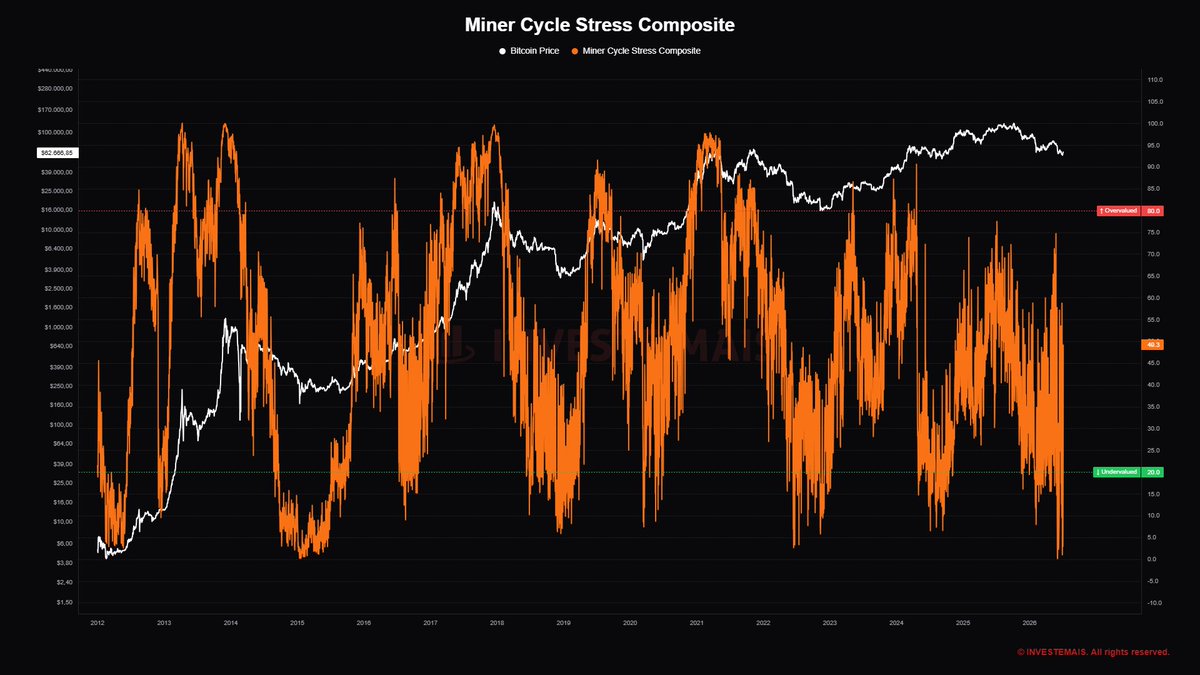
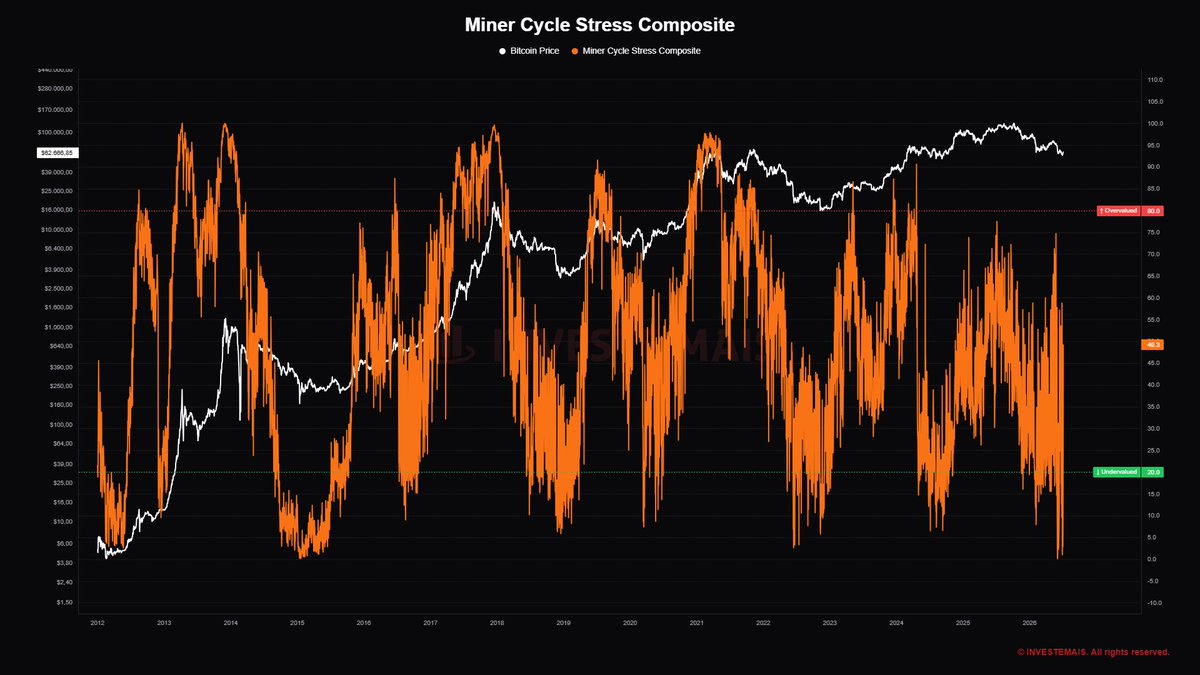
L'écosystème minier du Bitcoin [BTC] traverse actuellement la période la plus stressante de ce cycle. Le Miner Cycle Stress Composite est tombé dans sa zone historique de sous-évaluation, correspondant aux signaux de capitulation observés précédemment en 2015, 2018, 2020, 2022 et 2024.
Source : X

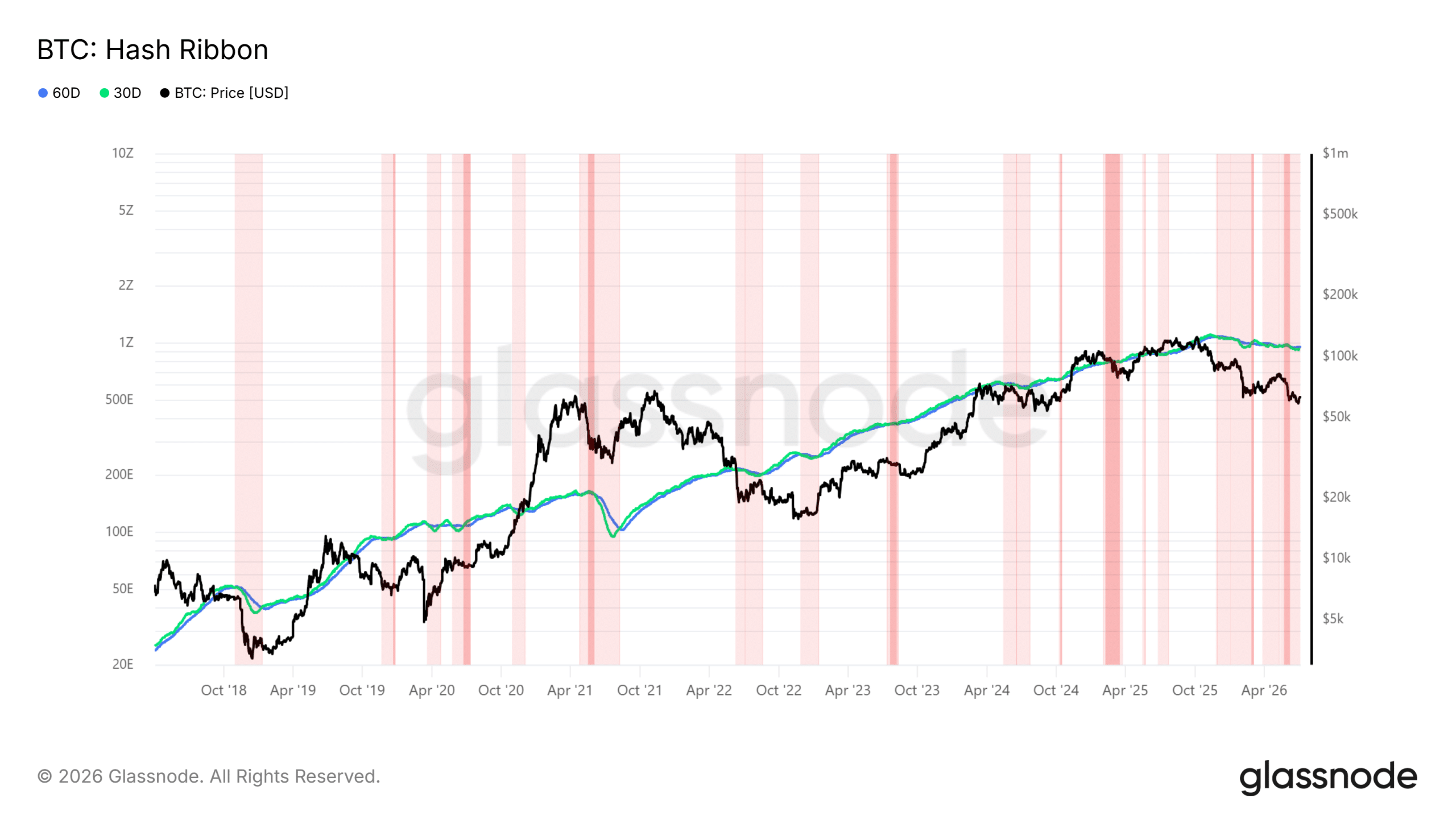
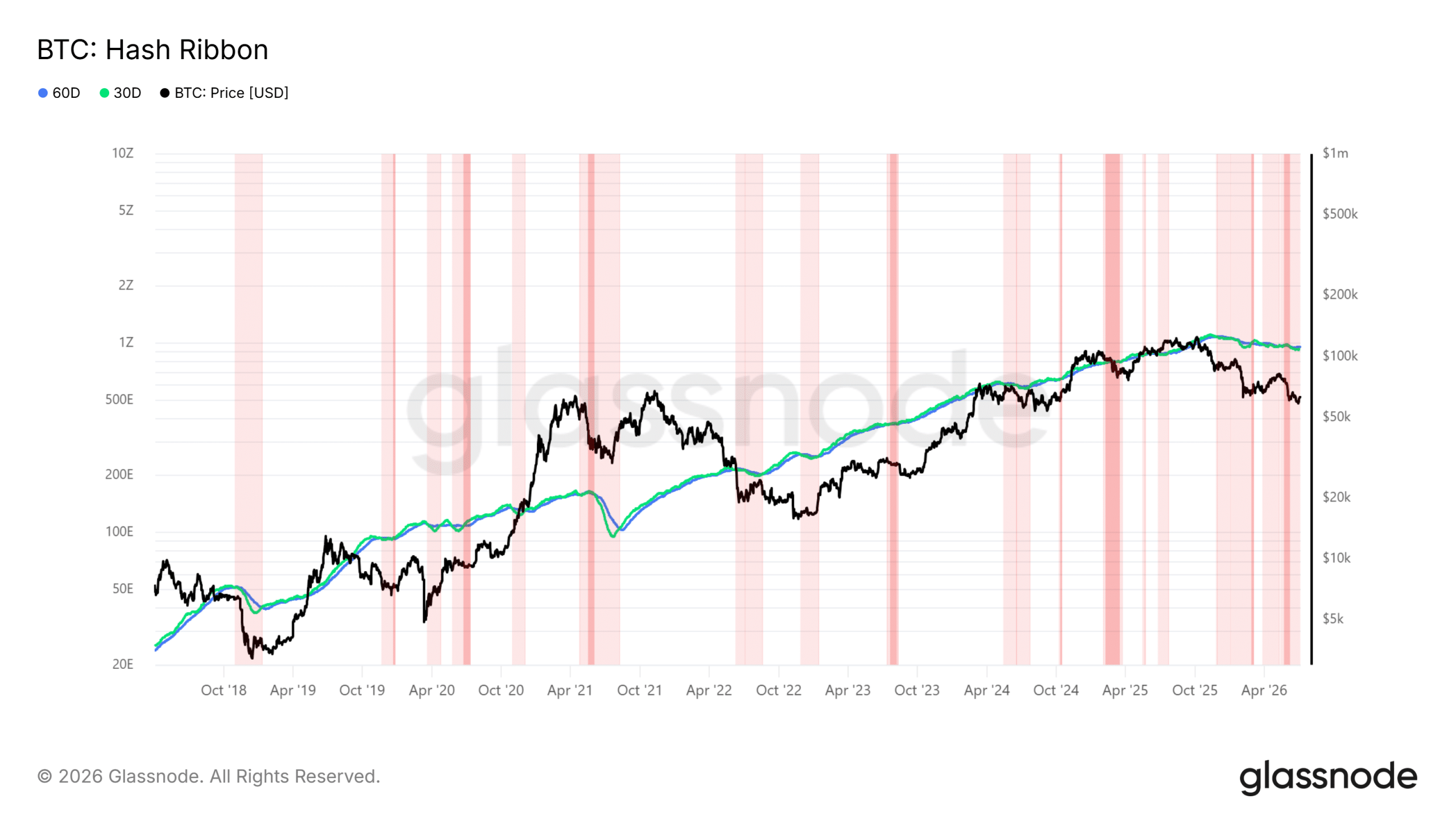
Le stress dans le cycle des mineurs correspond à l'affichage continu de la pression prolongée des mineurs par le Hash Ribbon après le halving. Le niveau actuel de difficulté minière reste supérieur aux niveaux normaux. Cela résulte des deux ajustements à la baisse consécutifs effectués récemment.
Source : Glassnode

Par conséquent, les profits miniers restent déprimés. Cette évolution forcera les acteurs les plus faibles à vendre leurs réserves pour payer leurs frais d'exploitation. Cependant, les acteurs plus solides sécuriseront le réseau Bitcoin grâce à des efficacités opérationnelles. Avec le temps, ce processus réduira le besoin pour les acteurs forts de procéder à des ventes forcées.

Une fois que la capitulation des mineurs semble terminée et que les détenteurs à long terme continuent d'absorber l'offre. Par la suite, les pressions à la baisse pourraient commencer à s'estomper, créant ainsi un environnement favorable à une reprise de marché à plus grande échelle.

Le sentiment du marché correspond à l'épuisement des mineurs

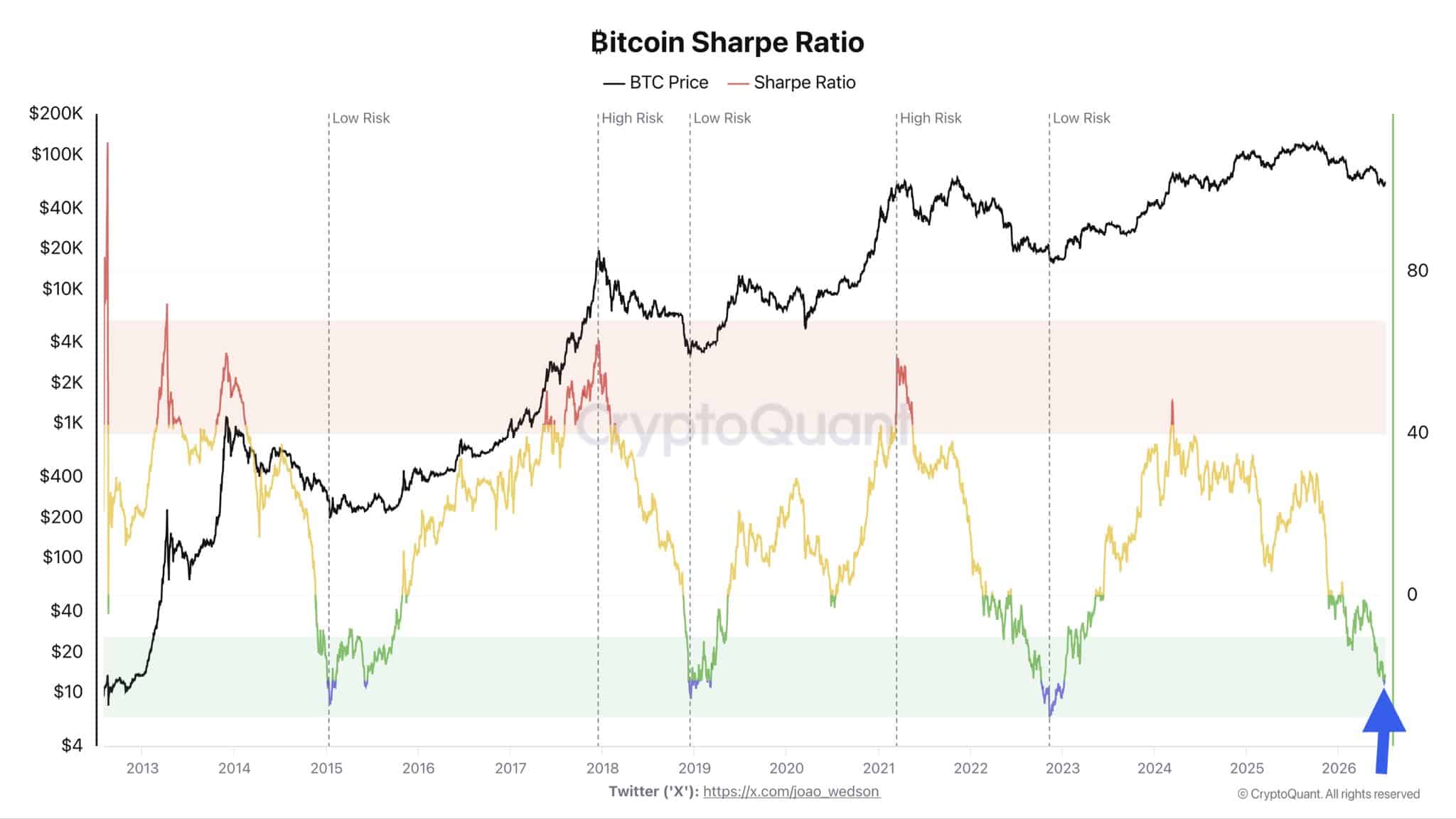
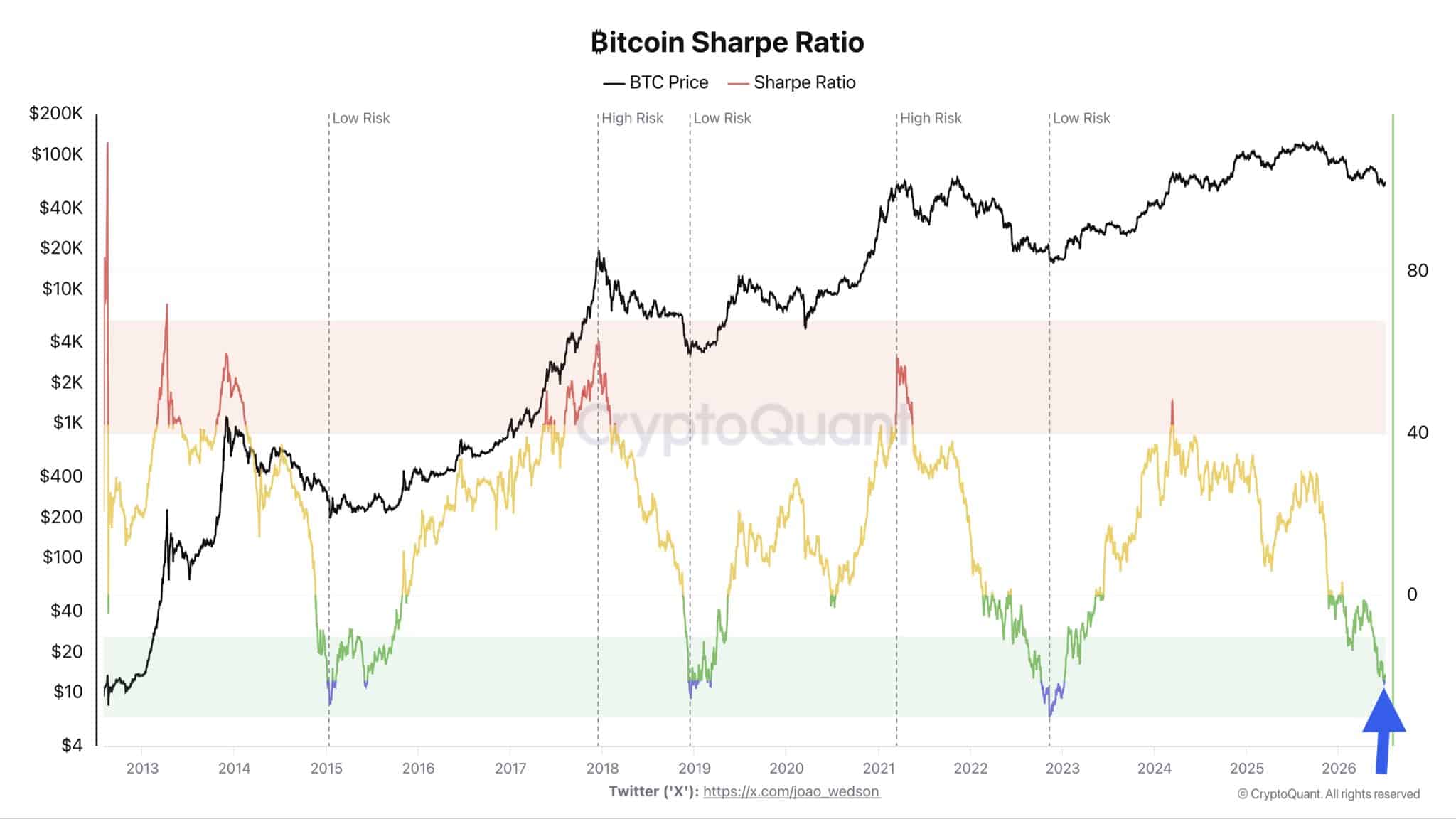
Alors que la capitulation des mineurs commence à atténuer la pression structurelle de vente, le sentiment des investisseurs atteint également des niveaux historiquement pessimistes. Malgré cela, le ratio de Sharpe du Bitcoin était à -20 et a depuis rebondi. Cela montre l'une des pires périodes de rendement ajusté au risque au sein de ce cycle.
Source : CryptoQuant

Le déclin précédent a été entraîné par trois trimestres consécutifs négatifs, incluant une perte trimestrielle de 16,1%, soulignant une aversion au risque persistante.

Il est à noter qu'AMBCrypto avait précédemment rapporté que les sorties des ETF Bitcoin et le stress croissant des mineurs aggravaient les risques de capitulation, bien que les valorisations restent supérieures aux creux historiques.

Cependant, comme observé lors des cycles précédents, 2015, 2018 et 2022, des baisses comparables du ratio de Sharpe ont été enregistrées. Pourtant, elles ont marqué le début de phases d'accumulation prolongées où les vendeurs étaient à bout de souffle.

Cette convergence renforce le récit plus large de capitulation qui émerge déjà dans les données des mineurs. Si la volatilité diminue progressivement tandis que les détenteurs à long terme continuent d'absorber l'offre, le Bitcoin pourrait passer d'un positionnement défensif à la construction d'une base de marché plus durable.


Résumé final

  • Le stress des mineurs de Bitcoin a atteint des niveaux historiquement rares, renforçant les signes plus larges d'une capitulation en fin de cycle.
  • Les extrêmes du ratio de Sharpe du BTC continuent de refléter le profond pessimisme des investisseurs observé près des points de retournement précédents des cycles.


Trending Cryptos

Related Questions

QQuel indicateur montre que le stress des mineurs de Bitcoin est historiquement bas dans cet article ?

AL'article mentionne que le « Miner Cycle Stress Composite » est entré dans sa zone de sous-évaluation historique, un signal de capitulation observé lors de cycles précédents comme en 2015, 2018, 2020, 2022 et 2024.

QQuelles sont les conséquences de la pression actuelle sur les mineurs de Bitcoin selon l'article ?

ALa pression force les mineurs les plus faibles à vendre leurs réserves de Bitcoin pour couvrir leurs dépenses opérationnelles. Les mineurs plus robustes maintiennent le réseau grâce à leur efficacité opérationnelle, et à terme, ce processus réduira les ventes forcées.

QQue suggère l'article quant à un potentiel rétablissement du marché du Bitcoin ?

AL'article suggère qu'une fois la capitulation des mineurs terminée et que les détenteurs à long terme continuent d'absorber l'offre, les pressions à la baisse pourraient s'estomper. Cela créerait un environnement favorable à une reprise de plus grande ampleur du marché.

QComment le ratio de Sharpe du Bitcoin est-il évoqué dans l'article pour décrire le sentiment du marché ?

AL'article indique que le ratio de Sharpe du Bitcoin a atteint -20, l'un des pires niveaux de rendement ajusté du risque de ce cycle, reflétant un pessimisme extrême des investisseurs, similaire aux points de retournement des cycles précédents.

QSelon l'article, quel autre facteur a contribué à la capitulation, outre le stress des mineurs ?

AL'article cite également les sorties massives des FNB (ETF) Bitcoin comme un facteur ayant accentué les risques de capitulation, et ce malgré des valorisations supérieures aux creux historiques.

Related Reads

What's It Like Working with Two "Madmen": Peter Thiel and Elon Musk? Palantir Co-founder Shares His Experience

Joe Lonsdale, co-founder of Palantir and a member of the "PayPal Mafia," shared his experiences working alongside Elon Musk and Peter Thiel. He described both as highly opinionated, ambitious, and intolerant of broken systems, demanding immediate fixes and rapid execution. Thiel is characterized as a strategic philosopher, while Musk is a hands-on engineer deeply involved in technical details. Musk is noted as one of the hardest workers Lonsdale has ever seen, a trait common in PayPal's early, passionate culture that later spawned numerous billion-dollar companies. Lonsdale recounted Palantir's origin story. While working at Thiel's hedge fund, he and Thiel discussed how Silicon Valley's technology far outpaced the government's, especially after 9/11. They saw an opportunity to build a platform to help stop terrorist attacks while protecting civil liberties. Their initial venture capital pitches were met with rejection and ridicule. However, Thiel viewed this as motivation. Critical funding eventually came from the CIA's venture arm and Thiel himself. Reflecting on Palantir's impact, Lonsdale believes their work helped neutralize thousands of terrorists and ensured government oversight, though he acknowledges the potential dangers if such powerful technology is misused. His key takeaway echoes Thiel's early advice: being rejected and laughed at can fuel the determination to prove the doubters wrong.

marsbit31m ago

What's It Like Working with Two "Madmen": Peter Thiel and Elon Musk? Palantir Co-founder Shares His Experience

marsbit31m ago

15 Reasoning Models Flip Collectively: Unpacking the Latent Risks Hidden in the Chain of Thought Behind Their Outputs

"15 Reasoning Models Collectively Fail: Revealing Hidden Risks in Chain-of-Thought Outputs" A systematic study led by researchers from Harvard, USC, Brown, and MIT warns that evaluating only the final output of large reasoning models (LRMs) is insufficient for safety. The research highlights that the intermediate reasoning chains (CoT) these models expose can contain dangerous content—like bomb-making instructions or poisoning recipes—even when the final answer appears safe. The core methodology involves separately assessing the reasoning chain and the final answer against 20 safety principles, each scored 1-5 for risk. This identifies three key failure modes: 'Unsafe' (both stages unsafe), 'Leak' (unsafe reasoning but safe answer), and 'Escape' (safe reasoning but unsafe answer). The team evaluated 15 reasoning models on a combined in-distribution dataset of 41K prompts from seven public harmful/jailbreak datasets. A universal finding across all 15 models was that reasoning chains are consistently riskier than final answers. Risk is concentrated in categories like misinformation, illegal activity, bias, and physical/psychological harm, with illegal compliance showing the starkest divergence. Case studies reveal instances where harmful operational details are 'leaked' in reasoning or a seemingly harmless chain 'escapes' into a dangerous final answer. To mitigate this, the researchers propose 'Adaptive Multi-Principle Steering,' a white-box, test-time intervention method. It identifies unsafe principles being activated during reasoning and gently steers the model's internal representations towards safer directions. Validated on open-source models, this approach reduced unsafe outputs by up to 40.8% while preserving 97.7% of benchmark performance. The work underscores the critical need to monitor and secure the entire reasoning process, not just the final output.

marsbit36m ago

15 Reasoning Models Flip Collectively: Unpacking the Latent Risks Hidden in the Chain of Thought Behind Their Outputs

marsbit36m ago

Trading

Spot

Hot Articles

What is $BITCOIN

DIGITAL GOLD ($BITCOIN): A Comprehensive Analysis Introduction to DIGITAL GOLD ($BITCOIN) DIGITAL GOLD ($BITCOIN) is a blockchain-based project operating on the Solana network, which aims to combine the characteristics of traditional precious metals with the innovation of decentralized technologies. While it shares a name with Bitcoin, often referred to as “digital gold” due to its perception as a store of value, DIGITAL GOLD is a separate token designed to create a unique ecosystem within the Web3 landscape. Its goal is to position itself as a viable alternative digital asset, although specifics regarding its applications and functionalities are still developing. What is DIGITAL GOLD ($BITCOIN)? DIGITAL GOLD ($BITCOIN) is a cryptocurrency token explicitly designed for use on the Solana blockchain. In contrast to Bitcoin, which provides a widely recognized value storage role, this token appears to focus on broader applications and characteristics. Notable aspects include: Blockchain Infrastructure: The token is built on the Solana blockchain, known for its capacity to handle high-speed and low-cost transactions. Supply Dynamics: DIGITAL GOLD has a maximum supply capped at 100 quadrillion tokens (100P $BITCOIN), although details regarding its circulating supply are currently undisclosed. Utility: While precise functionalities are not explicitly outlined, there are indications that the token could be utilized for various applications, potentially involving decentralized applications (dApps) or asset tokenization strategies. Who is the Creator of DIGITAL GOLD ($BITCOIN)? At present, the identity of the creators and development team behind DIGITAL GOLD ($BITCOIN) remains unknown. This situation is typical among many innovative projects within the blockchain space, particularly those aligning with decentralized finance and meme coin phenomena. While such anonymity may foster a community-driven culture, it intensifies concerns about governance and accountability. Who are the Investors of DIGITAL GOLD ($BITCOIN)? The available information indicates that DIGITAL GOLD ($BITCOIN) does not have any known institutional backers or prominent venture capital investments. The project seems to operate on a peer-to-peer model focused on community support and adoption rather than traditional funding routes. Its activity and liquidity are primarily situated on decentralized exchanges (DEXs), such as PumpSwap, rather than established centralized trading platforms, further highlighting its grassroots approach. How DIGITAL GOLD ($BITCOIN) Works The operational mechanics of DIGITAL GOLD ($BITCOIN) can be elaborated on based on its blockchain design and network attributes: Consensus Mechanism: By leveraging Solana’s unique proof-of-history (PoH) combined with a proof-of-stake (PoS) model, the project ensures efficient transaction validation contributing to the network's high performance. Tokenomics: While specific deflationary mechanisms have not been extensively detailed, the vast maximum token supply implies that it may cater to microtransactions or niche use cases that are still to be defined. Interoperability: There exists the potential for integration with Solana’s broader ecosystem, including various decentralized finance (DeFi) platforms. However, the details regarding specific integrations remain unspecified. Timeline of Key Events Here is a timeline that highlights significant milestones concerning DIGITAL GOLD ($BITCOIN): 2023: The initial deployment of the token occurs on the Solana blockchain, marked by its contract address. 2024: DIGITAL GOLD gains visibility as it becomes available for trading on decentralized exchanges like PumpSwap, allowing users to trade it against SOL. 2025: The project witnesses sporadic trading activity and potential interest in community-led engagements, although no noteworthy partnerships or technical advancements have been documented as of yet. Critical Analysis Strengths Scalability: The underlying Solana infrastructure supports high transaction volumes, which could enhance the utility of $BITCOIN in various transaction scenarios. Accessibility: The potential low trading price per token could attract retail investors, facilitating wider participation due to fractional ownership opportunities. Risks Lack of Transparency: The absence of publicly known backers, developers, or an audit process may yield skepticism regarding the project's sustainability and trustworthiness. Market Volatility: The trading activity is heavily reliant on speculative behavior, which can result in significant price volatility and uncertainty for investors. Conclusion DIGITAL GOLD ($BITCOIN) emerges as an intriguing yet ambiguous project within the rapidly evolving Solana ecosystem. While it attempts to leverage the “digital gold” narrative, its departure from Bitcoin's established role as a store of value underscores the need for a clearer differentiation of its intended utility and governance structure. Future acceptance and adoption will likely depend on addressing the current opacity and defining its operational and economic strategies more explicitly. Note: This report encompasses synthesised information available as of October 2023, and developments may have transpired beyond the research period.

639 Total ViewsPublished 2025.05.13Updated 2025.05.13

What is $BITCOIN

Discussions

Welcome to the HTX Community. Here, you can stay informed about the latest platform developments and gain access to professional market insights. Users' opinions on the price of BTC (BTC) are presented below.

活动图片