‘Hãy hoàn thành công việc’ – Thượng nghị sĩ Cynthia Lummis tiếp tục thúc đẩy Đạo luật CLARITY bất chấp sự chậm trễ

ambcryptoPublished on 2026-07-06Last updated on 2026-07-06

Abstract

Thời hạn mong đợi ngày 4/7 để ký thành luật Đạo luật CLARITY một lần nữa bị bỏ lỡ, khiến tiến trình dự luật cấu trúc thị trường tiền điện tử bị trì hoãn thêm. Điều này đáng lo ngại vì Quốc hội sắp chuyển sang giai đoạn vận động tranh cử, làm giảm số ngày lập pháp để thông qua dự luật trước cuộc bầu cử giữa kỳ năm 2026. Mặc dù vậy, Thượng nghị sĩ Cynthia Lummis vẫn thúc đẩy mạnh mẽ, kêu gọi "Hãy hoàn thành công việc!" và coi đây là đóng góp của thế hệ này cho di sản đổi mới và tự do của Mỹ. Hạn chót mới để thúc đẩy dự luật là ngày 7/8, phiên họp cuối cùng của Thượng viện trước kỳ nghỉ hè. Tuy nhiên, tỷ lệ dự đoán được thông qua tại thời điểm này đã giảm xuống 48%, gây thêm lo ngại. Những người ủng hộ cho rằng nếu được thông qua, đạo luật sẽ xóa bỏ sự mơ hồ về quy định, khuyến khích các công ty tiền điện tử ra mắt sản phẩm mới và thu hút vốn đầu tư. Một số tổ chức lớn cũng đang ủng hộ dự luật. Tuy nhiên, vẫn còn những trở ngại chính trị, như tuyên bố gần đây của cựu Tổng thống Donald Trump về việc ưu tiên thông qua Đạo luật SAVE AMERICA. Dự luật CLARITY vì thế vẫn trong tình trạng bấp bênh.

Thời hạn được mong đợi từ lâu là ngày 4 tháng 7 để ký ban hành Đạo luật CLARITY một lần nữa đã bị bỏ lỡ. Các nhà lập pháp một lần nữa không đáp ứng được thời hạn để thúc đẩy dự luật cấu trúc thị trường tiền điện tử được chờ đợi từ lâu.

Điều này đáng lo ngại vì Quốc hội sắp chuyển sự chú ý sang chiến dịch vận động, để lại ít ngày lập pháp hơn để thông qua dự luật trước cuộc bầu cử giữa kỳ năm 2026 của Hoa Kỳ.

Thượng nghị sĩ Lummis thúc giục phê duyệt

Tuy nhiên, nhân viên Thượng viện vẫn đang cố gắng hòa giải những khác biệt giữa các phiên bản do Ủy ban Nông nghiệp và Ủy ban Ngân hàng tạo ra. Bất chấp sự chậm trễ, những người theo sát các cuộc đàm phán vẫn lạc quan.

Ví dụ, Thượng nghị sĩ Cynthia Lummis nói,

Hai trăm năm mươi năm đổi mới, tự do và sự kiên cường của người Mỹ. Đạo luật Clarity là đóng góp của thế hệ này cho di sản đó. Hãy hoàn thành công việc!

Tỷ lệ phê duyệt đáng lo ngại

Dù vậy, thời hạn mới để thúc đẩy dự luật là ngày 7 tháng 8, phiên họp cuối cùng được lên lịch của Thượng viện trước kỳ nghỉ hè.

Các nhà vận động cho rằng nếu nó được thông qua, sự mơ hồ về quy định kéo dài có thể được loại bỏ, điều này sẽ khuyến khích các công ty tiền điện tử giới thiệu hàng hóa mới và thu hút vốn mới. Nhưng tại thời điểm viết bài, tỷ lệ cược đã giảm xuống 48%, làm dấy lên những lo ngại mới.
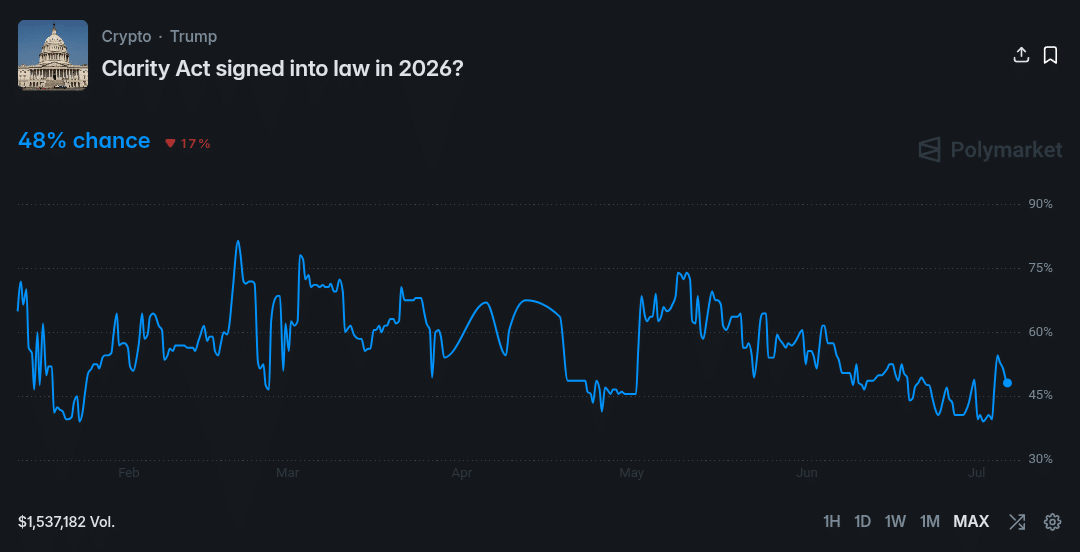
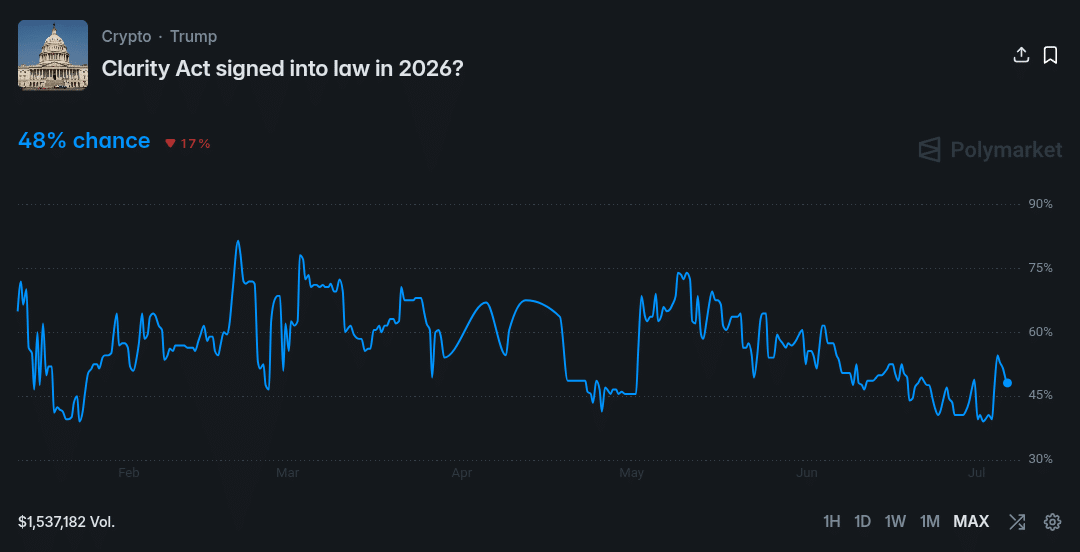
Nguồn: Polymarket

Tuy nhiên, với 41,6% người tham gia bày tỏ triển vọng lạc quan trong 24 giờ qua, tâm lý thị trường đối với Đạo luật CLARITY vẫn thận trọng lạc quan.
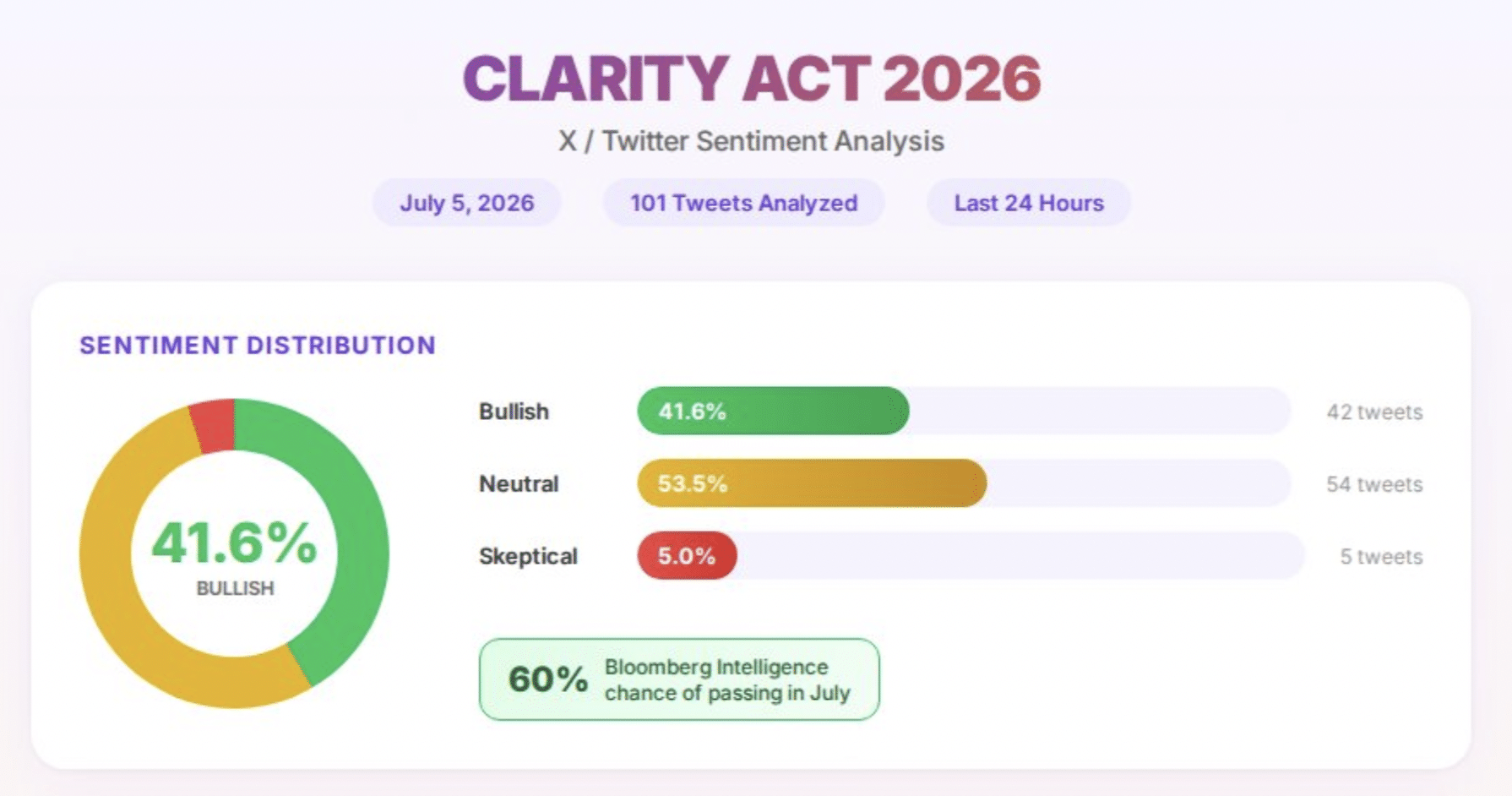
Nguồn: X

Lợi ích của việc phê duyệt

Trên thực tế, một nhà phân tích nhấn mạnh rằng nhiều dự án tiền điện tử đang chờ đợi sự chấp thuận lập pháp cho Đạo luật CLARITY. Ví dụ, Abstract đang chờ sự thay đổi này trước khi giới thiệu Dự án Quantum. Người ta cũng dự đoán rằng Đạo luật CLARITY sẽ tiếp tục mở đường cho việc hình thành vốn, cho phép các doanh nghiệp huy động 50 triệu đô la mỗi năm.

Ngoài ra, nhiều tổ chức lớn cũng đang ủng hộ dự luật. Ví dụ, Tổ chức Quốc gia của Các Giám đốc Thực thi Pháp luật Người Mỹ gốc Phi (NOBLE) là nhóm thực thi pháp luật quan trọng đầu tiên ủng hộ dự luật.

Trong khi đó, gần đây, sau khi xem xét điều khoản, Hiệp hội Cảnh sát trưởng các Quận lớn của Mỹ (MCSA) gần đây đã thông báo cho Thượng viện trong một bức thư rằng họ đã thay đổi lập trường về dự luật thành "trung lập".

Cờ đỏ vẫn còn

Tuy nhiên, dự luật vẫn đang đối mặt với các trở ngại chính trị, vì Tổng thống Hoa Kỳ Donald Trump gần đây đã nói rằng ông sẽ "không ký các dự luật khác" cho đến khi đảng Cộng hòa trong Quốc hội thông qua Đạo luật SAVE America.

Do đó, dự luật đang trong thế cân bằng, như Trump nhấn mạnh lại,

Hội nghị Báo chí và Lễ Ký kết về Nhà ở Hôm nay do đó bị hủy cho đến khi chúng ta thông qua Đạo luật SAVE AMERICA rất cần thiết, mà tôi coi là Tình trạng Khẩn cấp Quốc gia.


Tóm tắt Cuối cùng

  • Thượng nghị sĩ Cynthia Lummis đang thúc giục thông qua Đạo luật CLARITY vì sự đổi mới và tự do của nước Mỹ.
  • Sự biến động trong tỷ lệ phê duyệt đang làm tăng thêm sự không chắc chắn cho việc dự luật được thông qua vào năm 2026.


Trending Cryptos

Related Questions

QĐạo luật CLARITY có ý nghĩa như thế nào đối với Tự do và Đổi mới của Hoa Kỳ theo lập trường của Thượng nghị sĩ Cynthia Lummis?

ATheo Thượng nghị sĩ Cynthia Lummis, Đạo luật CLARITY là đóng góp của thế hệ này cho di sản 250 năm về đổi mới, tự do và tinh thần kiên cường của người Mỹ. Bà kêu gọi 'Hãy hoàn thành công việc!' nhằm thúc đẩy thông qua đạo luật.

QCác mốc thời gian quan trọng cho việc thông qua Đạo luật CLARITY là gì và tại sao chúng lại bị trì hoãn?

AHạn chót ban đầu là ngày 4 tháng 7 đã bị lỡ. Hạn chót mới là ngày 7 tháng 8, phiên họp cuối cùng của Thượng viện trước kỳ nghỉ hè. Sự chậm trễ là do các nhà lập pháp chưa kịp thời thúc đẩy dự luật và hiện vẫn đang cố gắng hòa giải các khác biệt giữa phiên bản của Ủy ban Nông nghiệp và Ủy ban Ngân hàng.

QTỷ lệ cược và tâm lý thị trường về khả năng thông qua Đạo luật CLARITY hiện tại ra sao?

ATỷ lệ cược thông qua đã giảm xuống còn 48%, gây ra những lo ngại mới. Tuy nhiên, tâm lý thị trường vẫn thận trọng lạc quan với 41.6% người tham gia bày tỏ triển vọng tích cực trong 24 giờ qua.

QNhững lợi ích tiềm năng nào được kỳ vọng nếu Đạo luật CLARITY được thông qua?

AViệc thông qua kỳ vọng sẽ xóa bỏ sự mơ hồ về quy định lâu nay, khuyến khích các công ty tiền mã hóa giới thiệu sản phẩm mới và thu hút vốn đầu tư mới. Nó cũng mở đường cho việc hình thành vốn, cho phép doanh nghiệp huy động tới 50 triệu USD mỗi năm, và là điều kiện để các dự án như Project Quantum của Abstract được triển khai.

QNhững trở ngại chính trị nào đang đe dọa việc thông qua Đạo luật CLARITY?

ATrở ngại chính trị chính đến từ Tổng thống Donald Trump, người tuyên bố sẽ 'không ký bất kỳ dự luật nào khác' cho đến khi đảng Cộng hòa trong Quốc hội thông qua Đạo luật CỨU NƯỚC MỸ (SAVE AMERICA ACT), điều mà ông coi là tình trạng khẩn cấp quốc gia. Điều này khiến số phận của Đạo luật CLARITY trở nên bấp bênh.

Related Reads

MSTR Discloses Sale of 3,588 Bitcoins, Stock Price Drops Over 5% at One Point During Trading

MicroStrategy, the world's largest corporate holder of Bitcoin, has significantly shifted its business model. Between June 29 and July 5, the company sold 3,588 bitcoins for approximately $216 million to fund quarterly dividends for its preferred stock. This marks its largest-ever Bitcoin sale and signals a strategic pivot: Bitcoin is transitioning from a "buy-and-hold" reserve asset to a liquidity management tool for the company. This move follows a recent authorization allowing Bitcoin sales when equity fundraising is less attractive. The announcement contributed to a more than 5% intraday drop in MicroStrategy's stock price, while Bitcoin fell to around $61,800—below the company's average holding cost of roughly $75,700. The sale represents a major departure from MicroStrategy's long-standing "never sell" commitment, which saw its first minor breach in May with a $2.5 million sale. The latest, hundred-times-larger transaction underscores growing financial pressures. Analysts note the company faces about $1.5 billion in annual preferred dividend obligations, far exceeding cash flow from its software business. As of July 5, MicroStrategy holds 843,775 bitcoins. Its current operational logic involves buying Bitcoin during favorable financing conditions and selling portions to cover dividends when needed, creating a flexible capital management cycle amidst a challenging market environment.

华尔街日报3h ago

MSTR Discloses Sale of 3,588 Bitcoins, Stock Price Drops Over 5% at One Point During Trading

华尔街日报3h ago

Q-Day Countdown: Will Quantum Computing End Cryptocurrencies?

Quantum Computing's Threat to Cryptocurrency: A Countdown to Q-Day Quantum computing, specifically Shor's algorithm, poses a fundamental threat to the public-key cryptography (e.g., ECDSA, RSA) that secures blockchain networks like Bitcoin and Ethereum. This critical juncture, known as Q-Day, is estimated to occur potentially within the next 5-15 years. The core vulnerability stems from the public and immutable nature of blockchains. Assets in addresses where the public key is already exposed on-chain (e.g., spent outputs) are at direct risk, as a sufficiently powerful quantum computer could derive the private key. This threatens the very trust model of cryptocurrencies. The response lies in Post-Quantum Cryptography (PQC)—algorithms like lattice-based ML-DSA and hash-based SLH-DSA, which are resistant to quantum attacks. NIST has standardized key PQC algorithms (FIPS 203, 204, 205), providing a migration path. However, the primary challenge is not technical but socio-economic and involves complex governance: * **Bitcoin's** path is constrained by its conservative ethos. Migrating requires a soft-fork to new address types, facing hurdles like significantly larger signature sizes and, most critically, the divisive governance question of how to handle at-risk legacy UTXOs without violating core principles. * **Ethereum** is pursuing a "cryptographic agility" strategy, with a multi-layered roadmap. It leverages account abstraction for user accounts and is developing compressed hash-based signatures (e.g., leanXMSS) for its consensus layer, aiming for a full-stack upgrade over time. In conclusion, quantum computing does not spell an instant end for cryptocurrency but initiates a critical countdown. The industry has a limited "engineering comfort window" to orchestrate a coordinated, ecosystem-wide migration to PQC. The ultimate bottlenecks are the immense coordination efforts and governance decisions required for this foundational transition.

marsbit4h ago

Q-Day Countdown: Will Quantum Computing End Cryptocurrencies?

marsbit4h ago

Trump, the President Who Knows Best How to 'Trade Stocks'

Former US President Donald Trump reported a record-breaking $2.2 billion in personal income for 2025, the highest annual income ever disclosed by a sitting president. This figure, from a 927-page government ethics filing, represented a 3.5-fold increase from his $600 million income in 2024 and boosted his net worth to $6.5 billion. The primary drivers were cryptocurrency (64% of income, approximately $1.4 billion) and real estate (26%, approximately $575 million). His crypto earnings stemmed largely from the launch of his personal meme coin, $TRUMP, generating over $600 million in licensing fees, and substantial profits from the WLFI token and its parent company. Despite a sluggish property market, his Mar-a-Lago resort and associated golf clubs saw revenue surges of 50% and 27%, respectively, attributed to their use as venues for presidential events. Trump's financial disclosure also revealed an unprecedented level of stock market activity, with over 22,000 trades executed in 2025, averaging 87 trades per market day. Media analyses noted several instances where significant trading coincided with major policy announcements, such as proposed tariffs, raising questions about potential conflicts of interest. While the White House stated these trades were handled by a family-managed trust fund and not Trump directly, critics highlighted this as a departure from the blind trusts traditionally used by presidents post-Watergate. The report has intensified debate over the commercialization of the presidency. Supporters view it as a success story of a businessman-president, while critics argue it demonstrates an unprecedented conversion of public influence into private wealth, with policy decisions potentially linked to personal financial gains. The controversy centers on whether Trump's earnings represent innovative entrepreneurship or a fundamental conflict of interest, sparking renewed calls for stricter ethics reforms in US governance.

marsbit4h ago

Trump, the President Who Knows Best How to 'Trade Stocks'

marsbit4h ago

Countdown to Q-Day: Will Quantum Computing End Cryptocurrencies?

The article explores the existential threat quantum computing poses to cryptocurrencies and the urgent need for "post-quantum" migration. It outlines that quantum computers, through Shor's algorithm, could break the elliptic-curve cryptography (ECC) underlying blockchain security, potentially allowing private keys to be derived from public keys. The core challenge is not a lack of post-quantum cryptography (PQC) standards—like NIST's ML-KEM and ML-DSA—but the immense complexity of upgrading entire ecosystems before "Q-Day" (when quantum computers become capable of such attacks, estimated around 2035-2045). Key points include: * **Bitcoin's** risk is concentrated in legacy UTXOs with exposed public keys (e.g., early P2PK outputs). Migration faces massive hurdles: PQC signatures are much larger, increasing transaction size and cost, and the governance dilemma of handling un-migrated assets threatens its "code is law" ethos. * **Ethereum's** strategy focuses on "cryptographic agility," using Account Abstraction for user accounts and developing compressed hash-based signatures (like leanXMSS with SNARK aggregation) for consensus. Its migration is a complex, full-stack overhaul of execution, consensus, and data layers. * The "security debt" is enormous. The comfortable engineering window for a coordinated, ecosystem-wide upgrade is only 5-8 years. High-value infrastructure (exchanges, bridges) may face pressure before mainnet protocols. In conclusion, quantum computing is not an instant "doomsday" event but a forcing function for systemic change. Bitcoin's ultimate test is social consensus and property rights governance, while Ethereum's is technical complexity. Failure to migrate in time could lead to a fundamental re-pricing of crypto assets.

链捕手4h ago

Countdown to Q-Day: Will Quantum Computing End Cryptocurrencies?

链捕手4h ago

Trading

Spot

Hot Articles

How to Buy 4

Welcome to HTX.com! We've made purchasing 4 (4) simple and convenient. Follow our step-by-step guide to embark on your crypto journey.Step 1: Create Your HTX AccountUse your email or phone number to sign up for a free account on HTX. Experience a hassle-free registration journey and unlock all features.Get My AccountStep 2: Go to Buy Crypto and Choose Your Payment MethodCredit/Debit Card: Use your Visa or Mastercard to buy 4 (4) instantly.Balance: Use funds from your HTX account balance to trade seamlessly.Third Parties: We've added popular payment methods such as Google Pay and Apple Pay to enhance convenience.P2P: Trade directly with other users on HTX.Over-the-Counter (OTC): We offer tailor-made services and competitive exchange rates for traders.Step 3: Store Your 4 (4)After purchasing your 4 (4), store it in your HTX account. Alternatively, you can send it elsewhere via blockchain transfer or use it to trade other cryptocurrencies.Step 4: Trade 4 (4)Easily trade 4 (4) on HTX's spot market. Simply access your account, select your trading pair, execute your trades, and monitor in real-time. We offer a user-friendly experience for both beginners and seasoned traders.

4.5k Total ViewsPublished 2025.10.20Updated 2026.06.02

How to Buy 4

Discussions

Welcome to the HTX Community. Here, you can stay informed about the latest platform developments and gain access to professional market insights. Users' opinions on the price of 4 (4) are presented below.

活动图片