Grayscale: After Halving, BTC is Nearing the Bottom of This Cycle

marsbitPublished on 2026-07-01Last updated on 2026-07-01

Abstract

Grayscale Research suggests Bitcoin's recent decline below $60,000, a >50% drop from its October peak, represents a cyclical correction within a long-term uptrend rather than a trend reversal. Key factors behind the pullback include a shift in market expectations toward Federal Reserve rate hikes under new Chair Kevin Warsh, uncertainty around the CLARITY Act's Senate passage, pressure on leveraged entities like Strategy, and concerns over quantum computing risks. The path out of the current bear market hinges on upcoming catalysts. An optimistic scenario, where the CLARITY Act passes, leverage is contained, and the Fed refrains from hiking, could mean Bitcoin is nearing its cycle bottom. A pessimistic scenario, featuring legislative failure, further deleveraging, and Fed rate hikes, could lead to additional moderate downside. Grayscale does not expect a historically deep ~80% drawdown due to a more measured prior bull run and stickier institutional demand. Despite short-term headwinds, Grayscale remains highly optimistic about crypto's long-term structural prospects, driven by institutional adoption of public blockchains, unsustainable government debt, declining trust in intermediaries, and AI's potential demand for alternative systems. The report concludes that while the exact cycle low depends on near-term catalysts, current valuations present an attractive entry point for long-term investors betting on the decade-ahead growth of digital assets.

Author: Zach Pandl (Head of Research, Grayscale)

Compiled by: Deep Chao TechFlow

Deep Chao Guide: Bitcoin fell below $60,000 this week, hitting a new low for this cycle. From the October peak of $125,000, it has now halved. Grayscale's Head of Research Zach Pandl puts this pullback into historical context, viewing it as another cyclical correction within a long-term uptrend, not a trend reversal. He outlines two scenarios for exiting the bear market: under an optimistic scenario, Bitcoin may already be nearing its bottom; under a pessimistic scenario, it could fall further. The key variables in this judgment are whether the Fed raises interest rates and whether the CLARITY Act can pass the Senate. This is a research report perspective, intended to aid holders in their directional judgment.

This week, Bitcoin fell below $60,000, setting a new low for this cycle. From the October peak of $125,000, Bitcoin has now dropped over 50%. In our view, this pullback is another periodic correction within Bitcoin's long-term uptrend (Chart 1).
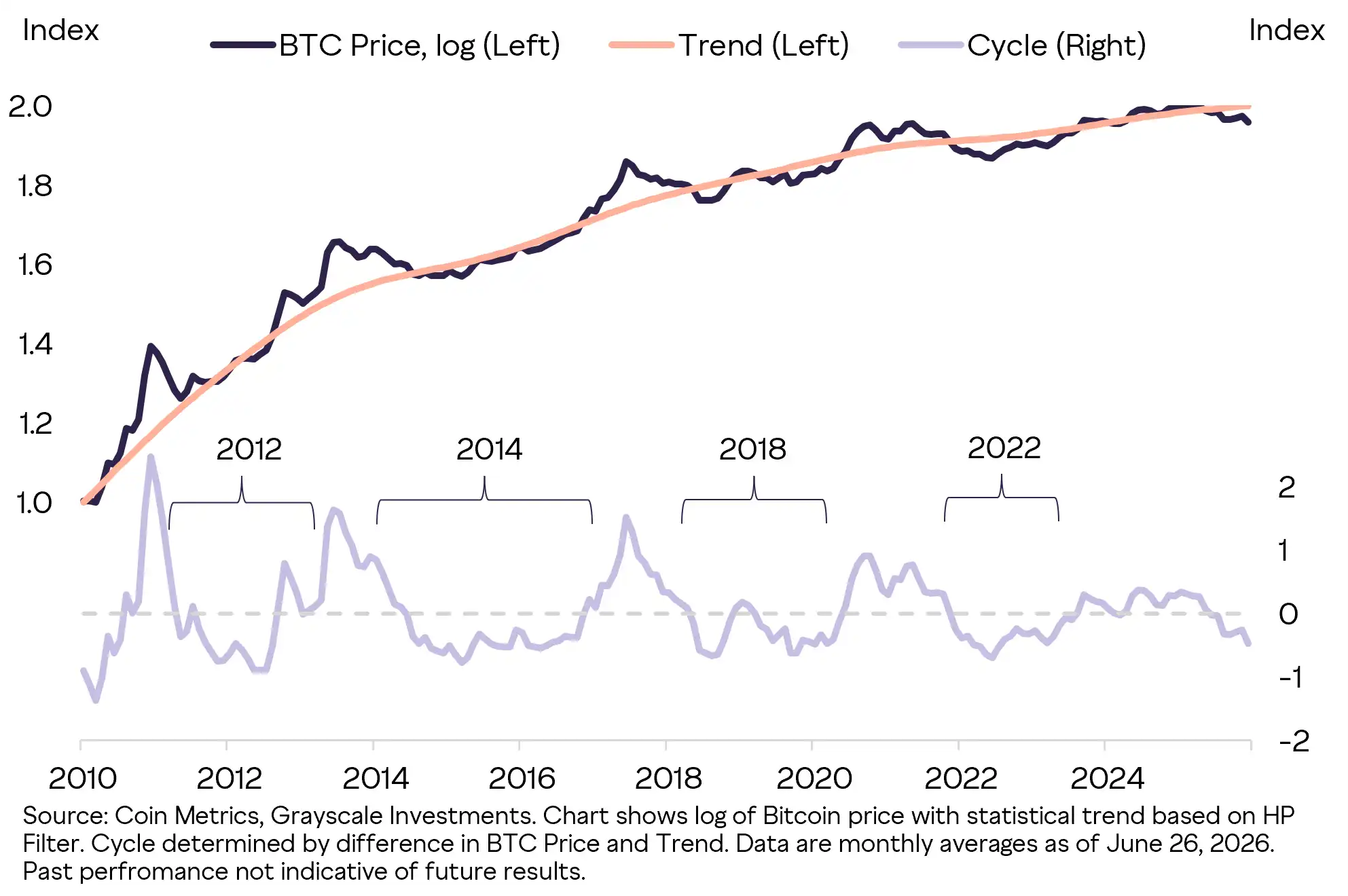
Chart 1: Bitcoin's pullback is just another cycle in the uptrend. The dark line is the Bitcoin price (logarithmic, left axis), the orange line is the statistical trend line based on an HP filter, and the light purple line is the cyclical deviation of the price from the trend (right axis). The cyclical lows from years 2012, 2014, 2018, and 2022 are marked, showing the current cyclical deviation has once again fallen below the zero line.

Source: Coin Metrics, Grayscale Investments, monthly averages through June 26, 2026. Past performance is not indicative of future results.

Several factors have suppressed Bitcoin's price in recent months. The most critical is the shift in market expectations for Fed policy, directly impacting the "money debasement trade" thesis. Late last year, prediction markets widely anticipated Trump would nominate the relatively dovish Kevin Hasset as Fed Chair. Instead, he nominated the relatively hawkish Kevin Warsh, who officially took office this month. Due to persistent inflation, markets now expect the Fed to hike rates this year, not cut (Chart 2). The spot price of gold, also competing with fiat currencies (like the US dollar), has fallen about 25% from its peak; after volatility adjustment, the decline is similar to Bitcoin's.1
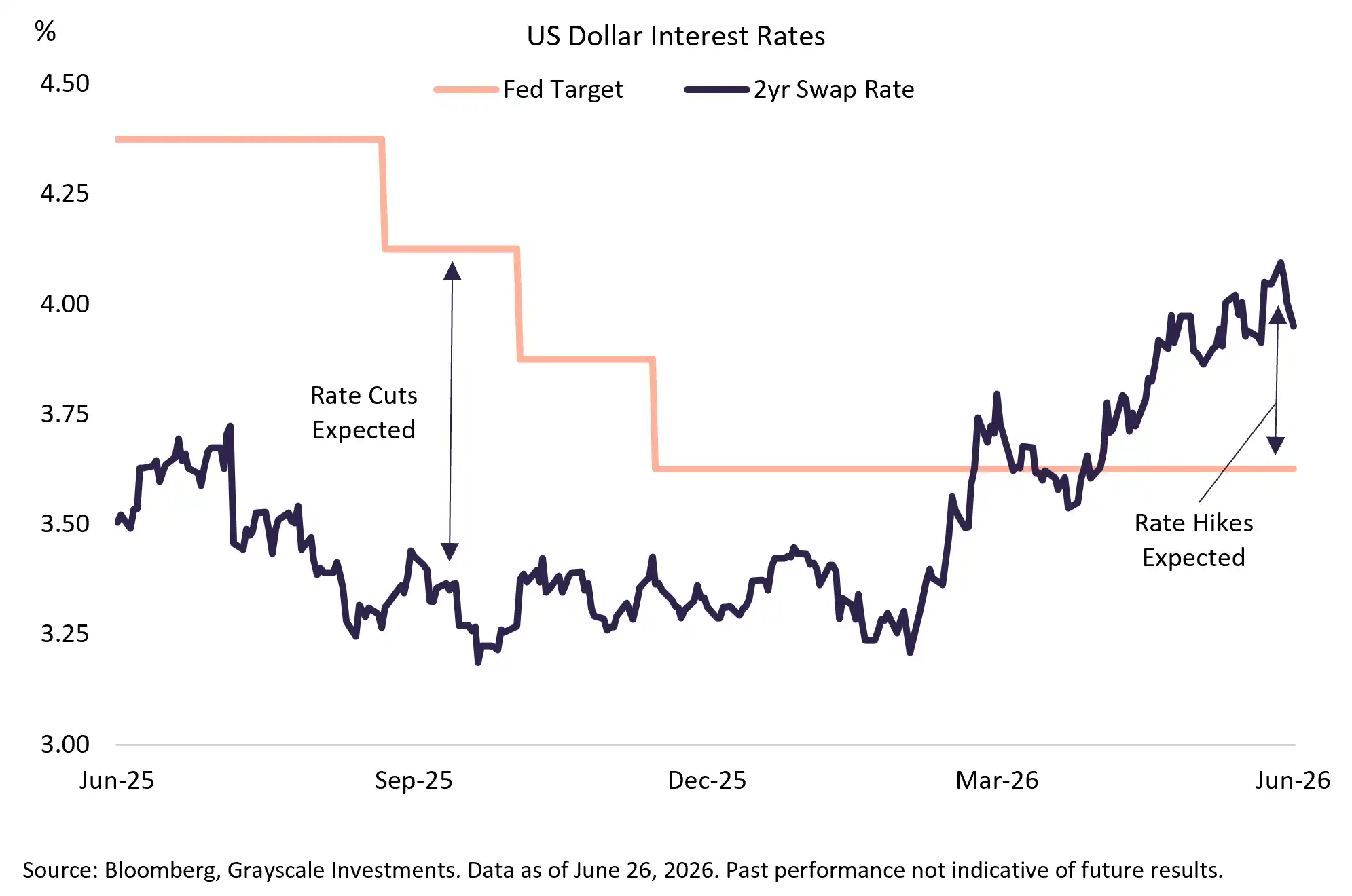
Chart 2: Markets now expect the Warsh-led Fed to hike rates. The orange line is the Fed target rate, the dark line is the 2-year swap rate. In the left half, swap rates were below the target rate (markets expecting cuts); after March 2026, swap rates surpassed the target rate and continued rising (markets expecting hikes).

Source: Bloomberg, Grayscale Investments, through June 26, 2026. Past performance is not indicative of future results.

Beyond the Fed's pivot, the crypto market is currently grappling with three other issues: uncertainty around the passage of the CLARITY Act; pressure on Strategy's leveraged balance sheet; and investor concerns about digital asset security risks from quantum computing.

Meanwhile, improving regulatory conditions continue to drive institutional adoption of public blockchain technology. We believe this is the most important structural trend for the digital asset market. Just this month, the CFTC approved the first perpetual futures contracts in the US, and the growth of stablecoins and tokenized assets will support many leading public chains. The broader social and political underpinnings for crypto assets also remain: unchecked expansion of government debt, declining public trust in intermediaries, and the rise of AI. AI may spur demand for alternative payment systems and technologies that safeguard human sovereignty.

Broadly, we see two paths for Bitcoin to exit this bear market (Chart 3). The base case scenario is: the CLARITY Act passes the Senate, Strategy takes measures to shore up its balance sheet, and the Fed refrains from raising rates. If upcoming developments move in this direction, Bitcoin's price may already be near a bottom. The downside scenario is: the CLARITY Act fails to pass this year, Strategy and other DATs (Digital Asset Treasury companies) further deleverage, and the Fed is forced to hike due to persistent inflation. If downside risks materialize, Bitcoin could still see a moderate decline. Historically, Bitcoin has fallen about 80% in several cycles, but we do not expect such a deep drawdown from peak to trough this cycle, due to the relatively restrained nature of this bull run and stickier institutional demand for digital assets.
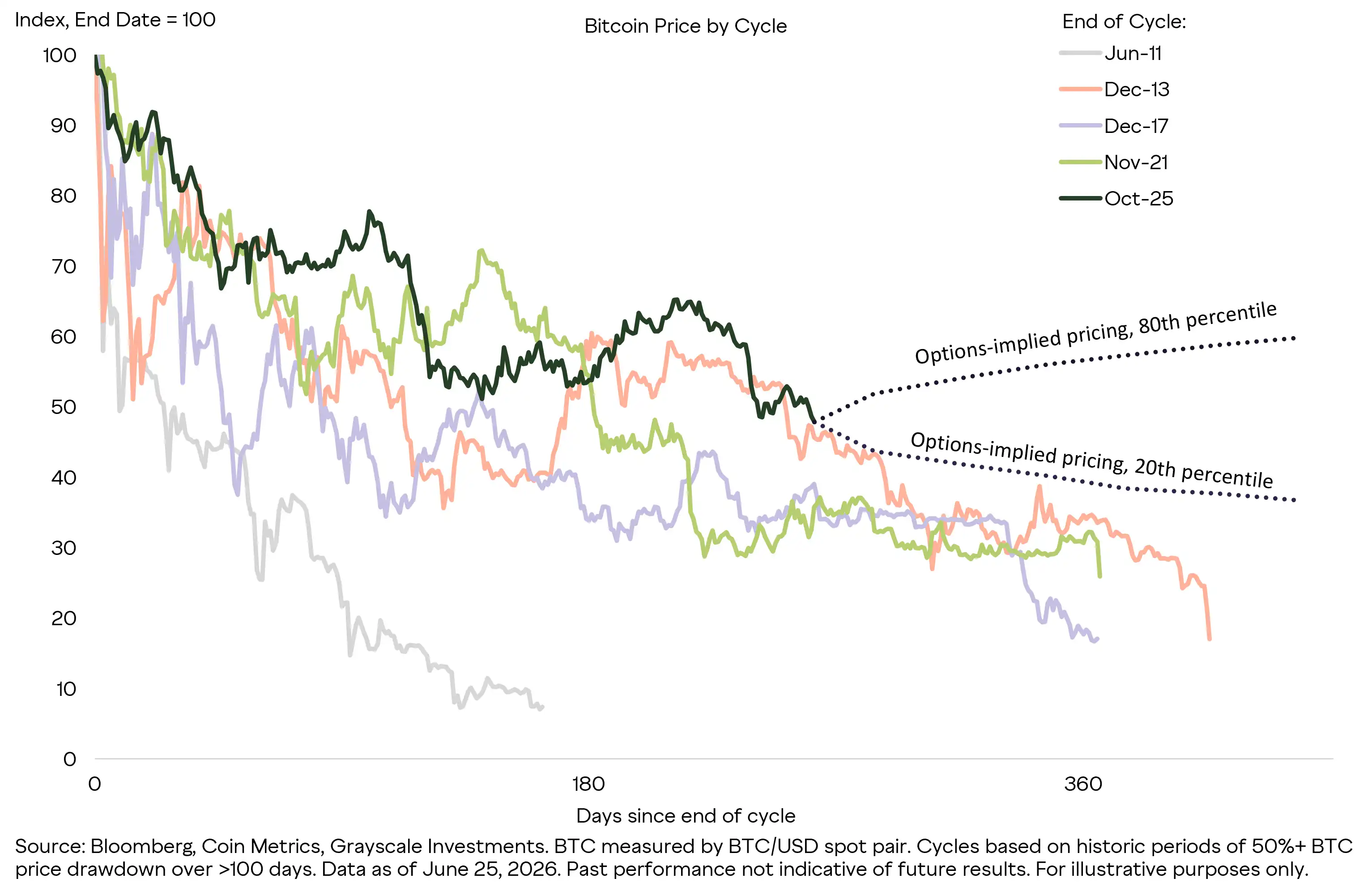
Chart 3: Two scenarios for Bitcoin exiting the latest bear market. The chart aligns historical cycle price movements to the same starting point (Cycle End Day = 100), with the x-axis being days after the cycle end. Gray is Jun-11, orange is Dec-13, purple is Dec-17, green is Nov-21, dark green is this cycle Oct-25. The two dashed lines on the right are the 80th and 20th percentile paths implied by options pricing, corresponding to the optimistic and downside scenarios mentioned above. The worst historical cycles (e.g., Jun-11, Dec-17) fell to levels of 10-20.

Source: Bloomberg, Coin Metrics, Grayscale Investments. Bitcoin priced in BTC/USD spot. Cycles defined as historical periods lasting over 100 days with declines exceeding 50%. Through June 25, 2026. Past performance is not indicative of future results, for illustrative purposes only.

The Grayscale Research team remains extremely bullish on the medium- to long-term prospects for crypto assets. It has been the best-performing asset class over the past decade2, and we believe it will remain so over the next decade. Investors will manage portfolio risk around short-term catalysts according to their individual needs. In our view, the current bear market offers long-term investors an excellent opportunity to position early, betting on the structural growth of public blockchain technology and digital asset valuations over the next decade.

Key Conclusion: Whether Bitcoin's price has seen the low for this cycle depends on upcoming catalysts, including the Fed's rate decisions and the progress of the CLARITY Act in the US Senate. We see many structural tailwinds for crypto assets and believe current valuations represent an attractive entry point for long-term investors.

1 Considering the difference in relative volatility between the two (22% for gold vs. 47% for Bitcoin over the past two years), gold's 25% decline roughly corresponds to a 40-50% decline for Bitcoin.

2 Asset classes represented by the following indices: S&P 500 Total Return Index (US Equities), Dow Jones US Real Estate Total Return Index (Real Estate), S&P/GSCI Total Return Index (Commodities), Bloomberg US Aggregate Bond Index (US Bonds), MSCI Emerging Markets Total Return Index (EM Equities), Bloomberg US Treasury Index (US Treasuries).


Trending Cryptos

Related Questions

QAccording to the article, what does Grayscale's research director believe the recent Bitcoin price decline represents in the context of its long-term trend?

AHe believes the recent decline is another periodic pullback within Bitcoin's long-term upward trend, not a trend reversal.

QWhat are the two key variables mentioned that are crucial for determining if Bitcoin has reached its cycle bottom?

AThe two key variables are the Federal Reserve's decision on interest rates (whether to hike) and the progress of the CLARITY Act in the U.S. Senate.

QWhat are the two primary scenarios outlined in the article for Bitcoin to exit the current bear market?

AThe optimistic scenario (Bitcoin may be near the bottom) involves the CLARITY Act passing the Senate, Strategy shoring up its balance sheet, and the Fed refraining from hiking rates. The pessimistic scenario (further moderate decline) involves the CLARITY Act failing, further deleveraging by Strategy and other DATs, and the Fed being forced to hike rates due to persistent inflation.

QWhy does the author argue that the potential drawdown in this cycle might not be as severe as the historical ~80% declines?

AThe author argues this because the preceding bull market was more restrained and institutional demand for digital assets is now more sticky, providing underlying support.

QDespite short-term headwinds, what major structural trend is cited as still positively driving institutional adoption and supporting digital assets?

AThe major structural trend cited is the continued improvement in the regulatory environment, which is driving institutional adoption of public blockchain technology, including recent CFTC approvals for perpetual futures and growth in stablecoins and tokenized assets.

Related Reads

A Former ByteDance Employee's Account: How I Started with Two Pinduoduo Hard Drives and Made a 600% Profit with Seagate to Achieve Financial Freedom?

Summary: A former ByteDance employee describes how a personal observation led to a highly profitable investment in Seagate Technology ($STX). Needing hard drives for a personal data project in August, he noticed their prices on Pinduoduo were rising consistently. Investigating further using price-tracking tools, he confirmed a broader, sustained price increase for high-capacity HDDs. He traced this to surging AI demand, as data centers require massive, cost-effective storage for model training and data, favoring high-capacity enterprise HDDs like those from Seagate. This demand was squeezing consumer supply. After initial research and a small purchase, he waited for confirmation from institutional 13F filings. Seeing a clear multi-quarter trend of increasing institutional ownership in Seagate, he significantly increased his position. From an entry around $150, Seagate's stock price rose over sixfold to approximately $965. He attributes the success to a methodology of identifying anomalies in everyday life (e.g., product shortages/price hikes), researching the underlying structural cause, identifying the publicly-traded beneficiary, and using 13F data to confirm institutional interest over multiple quarters. He cautions that this was one successful case among others that failed and is not offering investment advice.

链捕手3m ago

A Former ByteDance Employee's Account: How I Started with Two Pinduoduo Hard Drives and Made a 600% Profit with Seagate to Achieve Financial Freedom?

链捕手3m ago

BTC Hits Its Lowest Point Since 2024, But Is It Still Not the Right Time to Buy the Dip?

**Summary:** Bitcoin (BTC) has plunged to new lows in 2024, dropping over 50% from its all-time high to around $57,800, while Ethereum and Solana also show significant weakness. The market sentiment is at "extreme fear." The primary headwinds are identified as massive and sustained net outflows from US spot Bitcoin ETFs since May 2026, creating significant selling pressure, and the evaporation of expectations for a US Federal Reserve interest rate cut in 2026, which makes holding cash and bonds more attractive than risk assets like crypto. Analysts are actively debating the potential bottom. Key predictions include: * **glassnode's Rafael:** Suggests a bottom between $46,000 and $54,000, based on on-chain metrics like Realized Price and CVDD. He notes that institutional demand (via ETFs) is currently a net seller, not a buyer. * **BIT Analysis:** Argues the bear market is in its final stage, with a potential bottoming zone between $50,000 and $55,000, possibly aligning with the 2026 FIFA World Cup period (June-July). * **Wintermute:** Believes the market is in the late stages of a bear market but cautions the true bottom may not arrive until September-October 2026, contingent on renewed capital inflows. * **Liquid Capital's JackYi:** Posits that July-August 2026 could be the final capitulation and the best accumulation window, with potential bottom prices ranging from $51,000 to $43,000. * **Jiang Zhuo'er (BTC.TOP):** Predicts a bottom between $42,000 and $44,000 in October-December 2026, based on cycle analysis and MSTR's mNAV metric. * **Prediction Markets:** Polymarket data indicates a 79% chance BTC falls below $55,000 in 2026, a 65% chance below $50,000, and a 30% chance below $40,000. The consensus is that while bearish conditions are severe, the exact timing and price level of the ultimate bottom remain uncertain and depend on factors like ETF flows, macroeconomic policy, and potential market shocks.

Foresight News4m ago

BTC Hits Its Lowest Point Since 2024, But Is It Still Not the Right Time to Buy the Dip?

Foresight News4m ago

YouTube Crypto Channel Views Drop 70% by 2026, Retail Attention Crisis Reshaping Next Cycle

Major cryptocurrency YouTube channels are experiencing a severe decline in viewership, signaling a potential crisis in retail investor attention for the next market cycle. Analysis of six top channels shows monthly view counts have plummeted 27% to 79% compared to January 2025, with four channels down approximately 75%. While subscriber counts remain high (e.g., Coin Bureau with 2.72M, Altcoin Daily with 1.65M), current engagement tells a different story. Recent 30-day view counts are significantly lower: Coin Bureau at 1.24M views, Crypto Banter at 1.06M, with Altcoin Daily and Benjamin Cowen performing relatively better at 1.79M and 1.8M respectively. The core issue is that subscriber numbers are cumulative and reflect past interest, while views measure current demand. The dramatic drop indicates a fragmented and more selective retail audience. This contrasts sharply with the 2021 bull market, where channels reportedly garnered 3-4 million daily views. Now, daily views for major channels range from roughly 35,000 to 60,000. This divergence suggests a new type of market cycle. Bitcoin's price can be sustained by ETFs and institutional activity, but without strong retail engagement via content channels, the dynamics of the next bull run will be fundamentally different. The real signal for a retail resurgence will be a sustained increase in daily and monthly view counts, not subscriber growth. If viewership fails to recover, long-form YouTube content may become a lagging indicator, with retail attention shifting to other, faster formats.

marsbit1h ago

YouTube Crypto Channel Views Drop 70% by 2026, Retail Attention Crisis Reshaping Next Cycle

marsbit1h ago

Trading

Spot

Hot Articles

What is $BITCOIN

DIGITAL GOLD ($BITCOIN): A Comprehensive Analysis Introduction to DIGITAL GOLD ($BITCOIN) DIGITAL GOLD ($BITCOIN) is a blockchain-based project operating on the Solana network, which aims to combine the characteristics of traditional precious metals with the innovation of decentralized technologies. While it shares a name with Bitcoin, often referred to as “digital gold” due to its perception as a store of value, DIGITAL GOLD is a separate token designed to create a unique ecosystem within the Web3 landscape. Its goal is to position itself as a viable alternative digital asset, although specifics regarding its applications and functionalities are still developing. What is DIGITAL GOLD ($BITCOIN)? DIGITAL GOLD ($BITCOIN) is a cryptocurrency token explicitly designed for use on the Solana blockchain. In contrast to Bitcoin, which provides a widely recognized value storage role, this token appears to focus on broader applications and characteristics. Notable aspects include: Blockchain Infrastructure: The token is built on the Solana blockchain, known for its capacity to handle high-speed and low-cost transactions. Supply Dynamics: DIGITAL GOLD has a maximum supply capped at 100 quadrillion tokens (100P $BITCOIN), although details regarding its circulating supply are currently undisclosed. Utility: While precise functionalities are not explicitly outlined, there are indications that the token could be utilized for various applications, potentially involving decentralized applications (dApps) or asset tokenization strategies. Who is the Creator of DIGITAL GOLD ($BITCOIN)? At present, the identity of the creators and development team behind DIGITAL GOLD ($BITCOIN) remains unknown. This situation is typical among many innovative projects within the blockchain space, particularly those aligning with decentralized finance and meme coin phenomena. While such anonymity may foster a community-driven culture, it intensifies concerns about governance and accountability. Who are the Investors of DIGITAL GOLD ($BITCOIN)? The available information indicates that DIGITAL GOLD ($BITCOIN) does not have any known institutional backers or prominent venture capital investments. The project seems to operate on a peer-to-peer model focused on community support and adoption rather than traditional funding routes. Its activity and liquidity are primarily situated on decentralized exchanges (DEXs), such as PumpSwap, rather than established centralized trading platforms, further highlighting its grassroots approach. How DIGITAL GOLD ($BITCOIN) Works The operational mechanics of DIGITAL GOLD ($BITCOIN) can be elaborated on based on its blockchain design and network attributes: Consensus Mechanism: By leveraging Solana’s unique proof-of-history (PoH) combined with a proof-of-stake (PoS) model, the project ensures efficient transaction validation contributing to the network's high performance. Tokenomics: While specific deflationary mechanisms have not been extensively detailed, the vast maximum token supply implies that it may cater to microtransactions or niche use cases that are still to be defined. Interoperability: There exists the potential for integration with Solana’s broader ecosystem, including various decentralized finance (DeFi) platforms. However, the details regarding specific integrations remain unspecified. Timeline of Key Events Here is a timeline that highlights significant milestones concerning DIGITAL GOLD ($BITCOIN): 2023: The initial deployment of the token occurs on the Solana blockchain, marked by its contract address. 2024: DIGITAL GOLD gains visibility as it becomes available for trading on decentralized exchanges like PumpSwap, allowing users to trade it against SOL. 2025: The project witnesses sporadic trading activity and potential interest in community-led engagements, although no noteworthy partnerships or technical advancements have been documented as of yet. Critical Analysis Strengths Scalability: The underlying Solana infrastructure supports high transaction volumes, which could enhance the utility of $BITCOIN in various transaction scenarios. Accessibility: The potential low trading price per token could attract retail investors, facilitating wider participation due to fractional ownership opportunities. Risks Lack of Transparency: The absence of publicly known backers, developers, or an audit process may yield skepticism regarding the project's sustainability and trustworthiness. Market Volatility: The trading activity is heavily reliant on speculative behavior, which can result in significant price volatility and uncertainty for investors. Conclusion DIGITAL GOLD ($BITCOIN) emerges as an intriguing yet ambiguous project within the rapidly evolving Solana ecosystem. While it attempts to leverage the “digital gold” narrative, its departure from Bitcoin's established role as a store of value underscores the need for a clearer differentiation of its intended utility and governance structure. Future acceptance and adoption will likely depend on addressing the current opacity and defining its operational and economic strategies more explicitly. Note: This report encompasses synthesised information available as of October 2023, and developments may have transpired beyond the research period.

536 Total ViewsPublished 2025.05.13Updated 2025.05.13

What is $BITCOIN

Discussions

Welcome to the HTX Community. Here, you can stay informed about the latest platform developments and gain access to professional market insights. Users' opinions on the price of BTC (BTC) are presented below.

活动图片