YouTube Crypto Channel Views Drop 70% by 2026, Retail Attention Crisis Reshaping Next Cycle

marsbitPublished on 2026-07-01Last updated on 2026-07-01

Abstract

Major cryptocurrency YouTube channels are experiencing a severe decline in viewership, signaling a potential crisis in retail investor attention for the next market cycle. Analysis of six top channels shows monthly view counts have plummeted 27% to 79% compared to January 2025, with four channels down approximately 75%. While subscriber counts remain high (e.g., Coin Bureau with 2.72M, Altcoin Daily with 1.65M), current engagement tells a different story. Recent 30-day view counts are significantly lower: Coin Bureau at 1.24M views, Crypto Banter at 1.06M, with Altcoin Daily and Benjamin Cowen performing relatively better at 1.79M and 1.8M respectively. The core issue is that subscriber numbers are cumulative and reflect past interest, while views measure current demand. The dramatic drop indicates a fragmented and more selective retail audience. This contrasts sharply with the 2021 bull market, where channels reportedly garnered 3-4 million daily views. Now, daily views for major channels range from roughly 35,000 to 60,000. This divergence suggests a new type of market cycle. Bitcoin's price can be sustained by ETFs and institutional activity, but without strong retail engagement via content channels, the dynamics of the next bull run will be fundamentally different. The real signal for a retail resurgence will be a sustained increase in daily and monthly view counts, not subscriber growth. If viewership fails to recover, long-form YouTube content may become a lagging in...

Author: Liam 'Akiba' Wright

Compiled by: TechFlow Deep Tides

Deep Tides Introduction: Subscriber numbers appear to hold steady, but view counts have plummeted. Monthly views for six leading crypto YouTube channels have plunged by 27% to 79% compared to January 2025, with four experiencing drops around 75%. This isn't an issue with individual channels; retail attention is collectively receding from the content layer. Bitcoin can maintain its price with ETFs and institutional support, but a cycle without retail return will be an entirely different script.

The next cryptocurrency retail cycle might be foreshadowed by an increase in YouTube viewing velocity before subscriber numbers begin to shift.

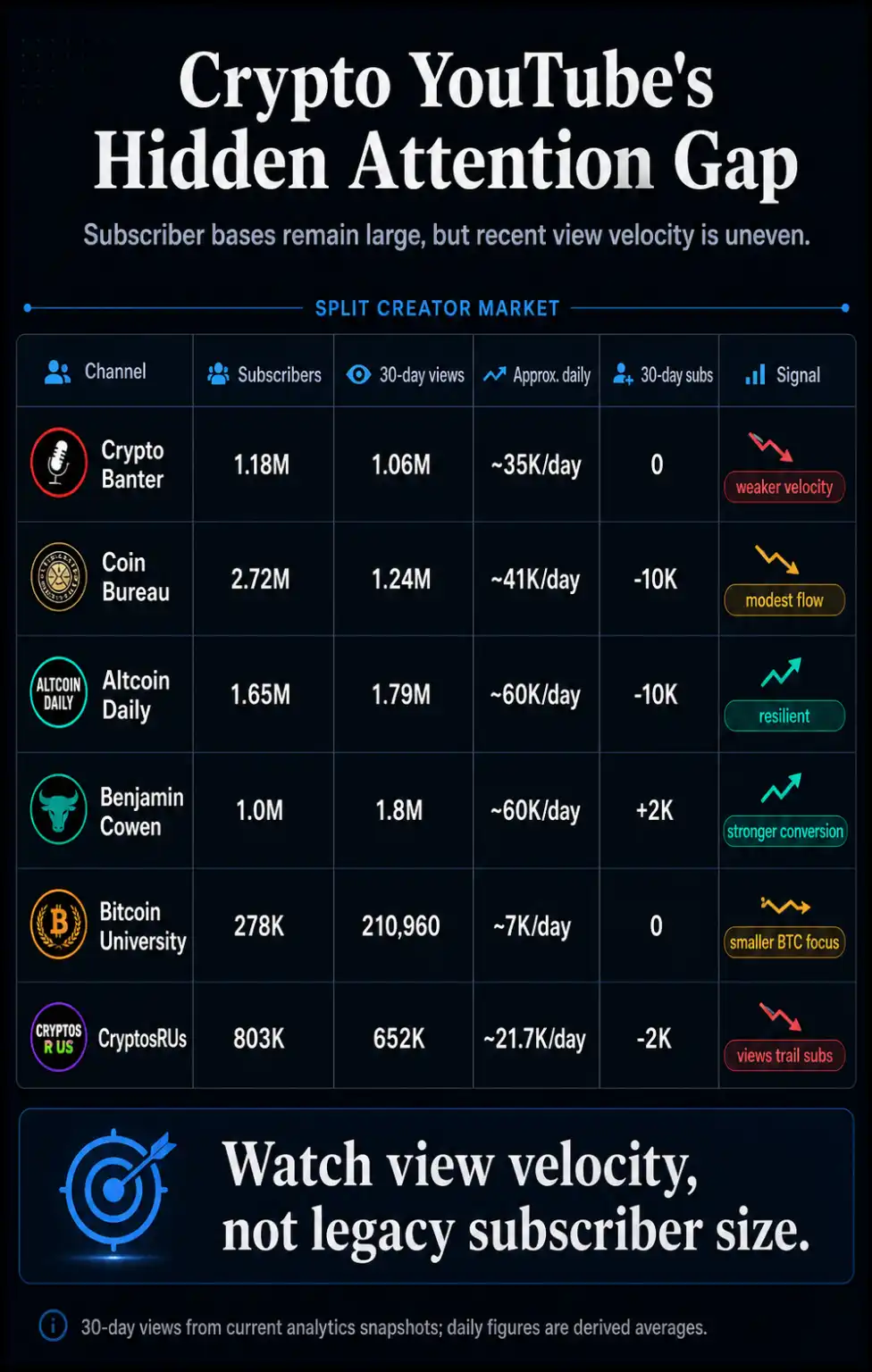
The old user base remains large. Among the biggest channels, Coin Bureau has 2.72 million subscribers, Altcoin Daily has 1.65 million, Crypto Banter has 1.18 million, and Benjamin Cowen has about 1 million.

Latest analysis shows Coin Bureau garnered 1.24 million views in the past 30 days, while Crypto Banter got 1.06 million. Altcoin Daily and Benjamin Cowen performed better, with 1.79 million and 1.8 million views in the same period respectively.

The result is a fragmented market—traditional user groups are still substantial, but current engagement is far lower and more uneven than surface data suggests.

Total subscriber count reflects past attention. Daily and monthly viewing velocity indicates whether active user interest is returning, fragmenting, or completely bypassing YouTube long-form content.
Subscriber Count Is Not the Right Metric for Performance

The core issue is that subscriber count is cumulative, reflecting past attention. Views measure current demand.

Latest data shows Coin Bureau attracted 1.24 million views in the past 30 days, Crypto Banter 1.06 million. Altcoin Daily and Benjamin Cowen performed stronger with 1.79 million and 1.8 million views respectively.

When converted to daily averages, the gap becomes more apparent. Crypto Banter's 1.06 million over 30 days equals about 35,000 daily views. Coin Bureau's 1.24 million equals about 41,000 daily. Altcoin Daily and Benjamin Cowen are near 60,000 daily.

This comparison isn't perfect because YouTube pages mix long videos, livestreams, Shorts, and channel interfaces, and the 30-day window is influenced by upload frequency.

However, comparing against January 2025 data reveals how much attention has declined.

In the sample, current 30-day views dropped by 26.9% to 78.7% compared to January 2025 levels, with Benjamin Cowen being a clear outlier, while CryptosRUs, Crypto Banter, Coin Bureau, and Bitcoin University saw drops around three-quarters.

Sampled channels still have large audiences, but active viewer numbers are lower and more discerning than subscriber totals suggest.

The January baseline makes the drop clearer: four of six channels saw view levels drop about 75% from Jan 2025, Altcoin Daily dropped 62.4%, Benjamin Cowen dropped 26.9%.

A channel may still appear large in the sidebar, but its current viewing traffic behaves like a much smaller market.

Some channels still convert attention. Altcoin Daily is a clear counterexample to the narrative of universal decline. Its current snapshot shows 1.79 million views in the past 30 days; the channel stated on X in January that it generated over 38 million YouTube views in 2025.

Its recent public YouTube videos also show stronger recent performance than several peers, with about 30k views 11 hours after upload, 55k after a day, 39k after two days.

These numbers are below 2021-style frenzy, even below viewership 18 months ago. But they show some analytical channels can still convert audience into current views. The creator market is more selective, attention concentrated on fewer channels and formats.

The resulting picture is one of uneven retail attention, not uniform disappearance.

The 2021 Comparison Still Haunts the Market

Cowen's own public statements sharpen this tension. In May, he wrote on X that crypto YouTube channels averaged 3-4 million daily views in 2021; 2026 levels are nearly an order of magnitude lower. He linked this decline to significantly weaker retail interest.

Current channel comparisons are based on vidIQ and public YouTube pages. But Cowen's comment captures the sentiment behind the data: crypto has professionalized via ETFs, public company financial strategies, and policy battles, while the creator layer targeting retail looks far less potent than in the last full retail cycle.

Similar pressures are visible beyond YouTube. CryptoSlate recently reported users on X are blocking crypto content as Bitcoin tries pulling retail attention back to the market. Social fatigue on X is a separate signal, but both channels now point to the same tension: crypto can retain financial importance while everyday users grow more selective about how much crypto content they want in their feeds.

This fragmentation matters more with Bitcoin dominating the market at about 57.8%, trading near $59,276, still over 50% below its Oct 6, 2025 all-time high of $126,000. Even as retail-facing attention looks more scattered, the market remains large, liquid, and relevant at the institutional level.

In prior cycles, long-form YouTube, X topics, exchange apps, search trends, and price momentum often reinforced each other. A viral video could drive new users to search a coin. A price breakout could bring viewers back to influencers. A token narrative could become a full-feed event.

The current setup looks less automatic. Bitcoin can trade as a macro and ETF-linked asset while altcoin and influencer attention focuses on smaller groups. This is a different type of cycle.

Crypto Banter Highlights Measurement Caveats

Crypto Banter exemplifies both the trend in available evidence and its limits. Its current viewing velocity is far lower than its subscriber count suggests, and historical Social Blade comparison data is less reliable as the page is blocked during normal visits.

This limits precise portrayal of earlier monthly viewing peaks. Current numbers remain meaningful.

VidIQ data shows the channel has 1.18 million subscribers, 190.98 million total views, ~$5,460 monthly AdSense revenue, no subscriber growth in the last 30 days, and 1.06 million views. Current growth velocity is far lower than its subscriber count might lead a casual reader to expect.

Discussions around crypto highlight broader measurement issues. A channel can maintain brand recognition and subscriber scale even as current focus shifts. If the next retail impulse is real, it should show up first at the current engagement layer before subscriber totals reflect it.

The next test is whether viewing volume for these channels recovers before other retail channels come alive. If 30-day view counts rise sharply while subscriber counts barely move, it would signal dormant audiences re-engaging.

If daily upload performance across multiple channels improves simultaneously, it would indicate broadening retail curiosity, not concentration on a few resilient creators. If the opposite occurs, long-form YouTube may be a lagging signal in the next retail cycle.

Exchanges, token teams, media brands, and analysis platforms still rely on retail attention flowing through channels users trust enough to visit repeatedly. A market driven primarily by ETFs, public company balance sheets, and policy headlines can push up Bitcoin without necessarily recreating the same retail media cycles that defined 2017 or 2021.

For now, evidence points to a milder conclusion. Crypto YouTube still has a large audience and some resilient channels. But the true retail attention signal is hidden in current viewing velocity, not legacy audience size.

The next cycle may begin when monthly and daily view counts start growing while subscriber numbers do not.


Related Questions

QWhat is the main trend observed regarding the viewership of major cryptocurrency YouTube channels?

AThe monthly view counts of six top crypto YouTube channels have fallen dramatically by 27% to 79% compared to January 2025, with four experiencing declines around 75%. This indicates a collective retreat of retail investor attention from long-form content.

QWhy does the article suggest that subscriber count is an inadequate metric for measuring a channel's current success?

ASubscriber count is a cumulative metric reflecting past interest, while view count measures current demand. Data shows current monthly views are far lower than what the large subscriber bases would suggest, revealing a smaller and more selective active audience.

QWhich channel is highlighted as an exception to the sharp decline in viewership, and what evidence is provided?

ABenjamin Cowen is highlighted as an exception, with a 30-day view count decline of only 26.9% compared to January 2025. His channel's recent performance is notably stronger than most peers in the sample.

QAccording to the article, what is a potential leading indicator for the next retail cryptocurrency cycle?

AA potential leading indicator is an increase in the daily and monthly view speeds (watch velocity) on crypto YouTube channels, which would signal the re-engagement of a dormant audience, likely before any significant change in total subscriber counts.

QHow does the current market dynamic differ from previous crypto cycles according to the analysis?

AUnlike previous cycles where price action, social media buzz, and influencer content reinforced each other, the current market can be driven by institutional factors like Bitcoin ETFs and corporate strategies without a corresponding surge in broad-based retail attention on platforms like YouTube, creating a more fragmented and selective landscape.

Related Reads

$2 Trillion: Countdown to AI's Largest IPO in History

The countdown for the largest IPO in AI history, a potential $2 trillion listing for Anthropic, is underway for October. The staggering valuation, reportedly projected by several investors, contrasts with the company's own internal restraint on setting a public target. Founded five years ago by former OpenAI core members, Anthropic's growth has been meteoric. Annual recurring revenue (ARR) surged from ~$9B in late 2025 to $47B by May 2026, with Q2 2026 revenue of $11.5B marking a 14x year-over-year increase. Bank valuations are even based on internal 2028 revenue forecasts of $190-200B. A key growth driver is Claude Code, its AI coding assistant. Its ARR quintupled in five months to $2.5B by February 2026, now constituting nearly 20% of total revenue. Surveys indicate Anthropic commands roughly 40% of enterprise LLM spending, doubling OpenAI's share in programming-specific use. However, alongside this explosive growth, reports detail significant internal cultural strife. Critics describe a divisive "priesthood" of PhD executives, led by CEO Dario Amodei, who promote a "save humanity" narrative that some employees find cult-like and alienating. This has reportedly created a demoralized workforce and a covert "underground network" of dissent among engineers torn between lucrative pre-IPO equity and a toxic work environment. Anthropic now faces a pivotal paradox: pursuing its mission of "safe" AI requires immense capital for compute, yet that capital demands relentless commercial growth. As it approaches its historic IPO, the company must navigate intense regulatory scrutiny, soaring operational costs, and internal tensions—any of which could destabilize its post-listing trajectory, much like SpaceX's significant post-IPO stock drop. The stage is set for a defining moment in tech history.

marsbit1h ago

$2 Trillion: Countdown to AI's Largest IPO in History

marsbit1h ago

AI Boosting Efficiency and Cutting Costs Makes VC Increasingly Expensive

"AI for Cost Reduction Makes VC Funding More Expensive" Despite the "cost-reduction and efficiency" narrative of AI, venture capital (VC) investment in the AI sector is becoming increasingly costly. While AI tools lower the initial costs for many startups—with team sizes shrinking across funding stages—the market is polarizing. For top-tier AI teams, especially those from leading companies like Google and OpenAI, funding rounds are now larger and valuations are higher than ever at the seed and early stages. For example, new ventures by prominent researchers are securing billions in funding with valuations reaching tens of billions before having a mature product. This creates a "barbell" market: lightweight startups need less capital, while elite AI firms attract massive investments early on. This dynamic raises the cost for VCs to acquire and maintain meaningful ownership stakes. As valuations soar early, securing the same equity percentage requires significantly larger capital commitments. VCs must now invest more upfront and reserve substantial funds for follow-on rounds to avoid dilution, prompting large firms like Accel and a16z to raise massive new funds. Consequently, capital is concentrating intensely in a few perceived winners like OpenAI and Anthropic, widening the gap between large and small VC funds. While high valuations bake in future growth expectations, they also compress potential returns, demanding that portfolio companies achieve unprecedented scale. For major VCs, the core strategy is clear: secure early positions in potential winners and maintain the capital to keep investing as valuations rapidly escalate.

marsbit1h ago

AI Boosting Efficiency and Cutting Costs Makes VC Increasingly Expensive

marsbit1h ago

An Eight-Year Investment Takes a Sharp Turn: Why Did Ethereum Suddenly Abandon Poseidon?

On August 13, Ethereum researcher Justin Drake announced a significant shift in Ethereum's Layer-1 cryptographic roadmap: abandoning the SNARK-friendly hash function Poseidon in favor of traditional functions like SHA2 or BLAKE2. This decision ends eight years of research and investment, marking a major revision to the post-quantum security strategy. Poseidon, introduced in 2019, was highly efficient for zkRollups and zkVMs within SNARK circuits. However, its need for prolonged cryptanalysis and the pressing timeline for quantum resistance revealed limitations. Recent breakthroughs in SNARK design, specifically using binary fields, now enable traditional, battle-tested hash functions to perform as efficiently as Poseidon within SNARKs. Benchmarks show modern laptops can now verify over a million traditional hash calls per second. This change is partly driven by accelerated concerns over quantum computing threats. Reports warn that "Cryptographically Relevant Quantum Computers" could break current blockchain signatures like ECDSA by the early 2030s, risking trillions in assets. Ethereum's response focuses on hash-based post-quantum signature schemes, deemed more quantum-resistant than some lattice-based alternatives under pressure from AI cryptanalysis. Ethereum's updated post-quantum roadmap targets a production-ready "leanVM" for signature aggregation by 2027, with full deployment across consensus, execution, and data layers by 2028. The shift to mature hash functions like SHA2 reduces reliance on newer algorithms and aligns with the goal of using widely analyzed cryptographic primitives. Other major blockchains are also preparing. Solana's core teams have independently chosen the NIST-standardized Falcon signature scheme for its compact size. Starknet plans a phased migration, starting with replacing its Pedersen hash with BLAKE2. Ethereum's move signifies a strategic pivot towards proven security foundations for the quantum era.

marsbit2h ago

An Eight-Year Investment Takes a Sharp Turn: Why Did Ethereum Suddenly Abandon Poseidon?

marsbit2h ago

Programmers Worldwide Are Wasting Money on Anthropic! The Company Can't Stand It Anymore

Anthropic recently published guidelines to help developers using Claude Code reduce unnecessary token costs. The key recommendations include: 1) Clear (/clear) conversations after completing a task to avoid carrying irrelevant file reads and command outputs into the next task. 2) Set the model and reasoning effort level at the start of a session, as switching mid-session invalidates the prompt cache, requiring a full-price recalculation of the entire dialog history. 3) Attach files using @ references instead of typing paths manually to avoid extra tool calls and searches that bloat the context. 4) Add quiet flags to verbose commands (e.g., in CLAUDE.md) to minimize lengthy output in the dialog history. 5) Use /compact while the session cache is still warm (before breaks) to compress the dialog at one-tenth the cost. 6) Offload large-output tasks to a sub-agent, which runs in an isolated context and only returns conclusions, preventing intermediate outputs from polluting the main dialog. The article explains token pricing: input tokens (prefill) are processed in parallel, while output tokens (decode) are generated serially, making output tokens five times more expensive. Caching is crucial for savings—if a request's prefix (system prompt, CLAUDE.md, dialog history) matches the previous one byte-for-byte, reading it costs only 10% of the standard input price. However, cache invalidation occurs when changing models, effort levels, fast mode, compressing dialogs, after cache expiration, or when resuming old sessions. Dialog history also grows quadratically (O(n²)) as file contents and command outputs accumulate, increasing costs per round. Proactive context management—like isolating noisy tasks, using /rewind to trim unproductive turns, and task-based session clearing—is becoming an essential skill for cost-effective AI-assisted development.

marsbit4h ago

Programmers Worldwide Are Wasting Money on Anthropic! The Company Can't Stand It Anymore

marsbit4h ago

Pax Silica vs. WAICO: The US Wants to Prohibit Europe from Using Chinese Artificial Intelligence

The United States is preparing to demand that European and other partners abandon Chinese artificial intelligence initiatives, threatening exclusion from the American-led "Pax Silica" coalition, according to a leaked U.S. State Department document. This ultimatum forces signatories of the "AI Opportunity Statement" to choose between the Western technological ecosystem and alternative frameworks, with China not explicitly named but clearly targeted. Pax Silica is a U.S. strategy for AI and semiconductor hegemony, launched in late 2025. Its European presence expanded significantly in mid-2026. Concurrently, China, Russia, and 27 other nations established the World AI Cooperation Organization (WAICO) in July 2026 as an independent intergovernmental platform promoting AI governance based on UN principles. This situation creates a difficult choice, especially for European nations balancing strategic autonomy with dependence on U.S. tech and security. It also pressures Global South countries with pragmatic ties to both Washington and Beijing. The formation of competing blocks risks fragmenting the global tech landscape, forcing companies to split supply chains, increasing costs, and potentially leading to incompatible standards and protocols. The era of open globalization in AI may be ending, replaced by geopolitical confrontation where technological sovereignty trumps economic efficiency. The decisions made will shape the global digital economy for decades.

cryptonews.ru6h ago

Pax Silica vs. WAICO: The US Wants to Prohibit Europe from Using Chinese Artificial Intelligence

cryptonews.ru6h ago

Trading

Spot
活动图片