Diálogo con Jens de la Fundación IOTA: De Kenia al Reino Unido, TWIN impulsa el comercio global hacia la era de los «5 minutos»

marsbitPublished on 2026-06-30Last updated on 2026-06-30

Abstract

En el corazón del comercio global aún persisten procesos lentos y fragmentados, con documentos que tardan semanas en procesarse. Jens Munch Lund-Nielsen, líder de Comercio Global en la Fundación IOTA, explica cómo TWIN, una infraestructura digital neutral construida sobre IOTA, está revolucionando este panorama. TWIN actúa como una capa de coordinación digital que conecta gobiernos, empresas y puertos, permitiendo el intercambio de datos verificados y en tiempo real sin una autoridad central. Esto resuelve un problema histórico: la falta de una base común y confiable para todos los actores. Ejemplos tangibles demuestran su impacto: en África Oriental, el proyecto TLIP redujo el tiempo de recuperación de documentos de horas a minutos, ahorrando costes significativos. En el Reino Unido, pruebas con carnes permitieron a las aduanas obtener visibilidad con 20 horas de antelación. La elección de IOTA como base se debe a su escalabilidad, coste casi nulo y neutralidad, cruciales para la adopción global. Jens ve el futuro con optimismo: en 5-10 años, infraestructuras descentralizadas como TWIN conectarán los 'aislamientos digitales' actuales, facilitando el acceso a financiación y haciendo el comercio más ágil, transparente y accesible para todos.

Autor: Shenchao TechFlow

Ya en 2015, varias instituciones como el Foro Económico Mundial (WEF) y Barclays Bank habían pronosticado:

En el sistema comercial global de alta fricción, blockchain posee un gran potencial transformador.

Antes, una transacción comercial transfronteriza solía involucrar a 30 partes interesadas, 36 documentos y 240 copias en papel que circulaban durante semanas; ahora, las flores de Kenia exportadas a Europa pueden tener sus documentos comerciales disponibles en menos de 5 minutos.

Esta es la eficiencia que el proyecto de protocolo de capa base blockchain IOTA está logrando continuamente a través de la infraestructura de colaboración digital para el comercio global, TWIN.

Desde su lanzamiento en mayo de 2025, TWIN ha logrado avances revolucionarios en tres continentes: en África, a través de TLIP, ha procesado más de 184,000 facturas; ha realizado pruebas piloto en la infraestructura fronteriza del Reino Unido; y está en negociaciones con gobiernos y empresas asiáticas para lanzar proyectos piloto.

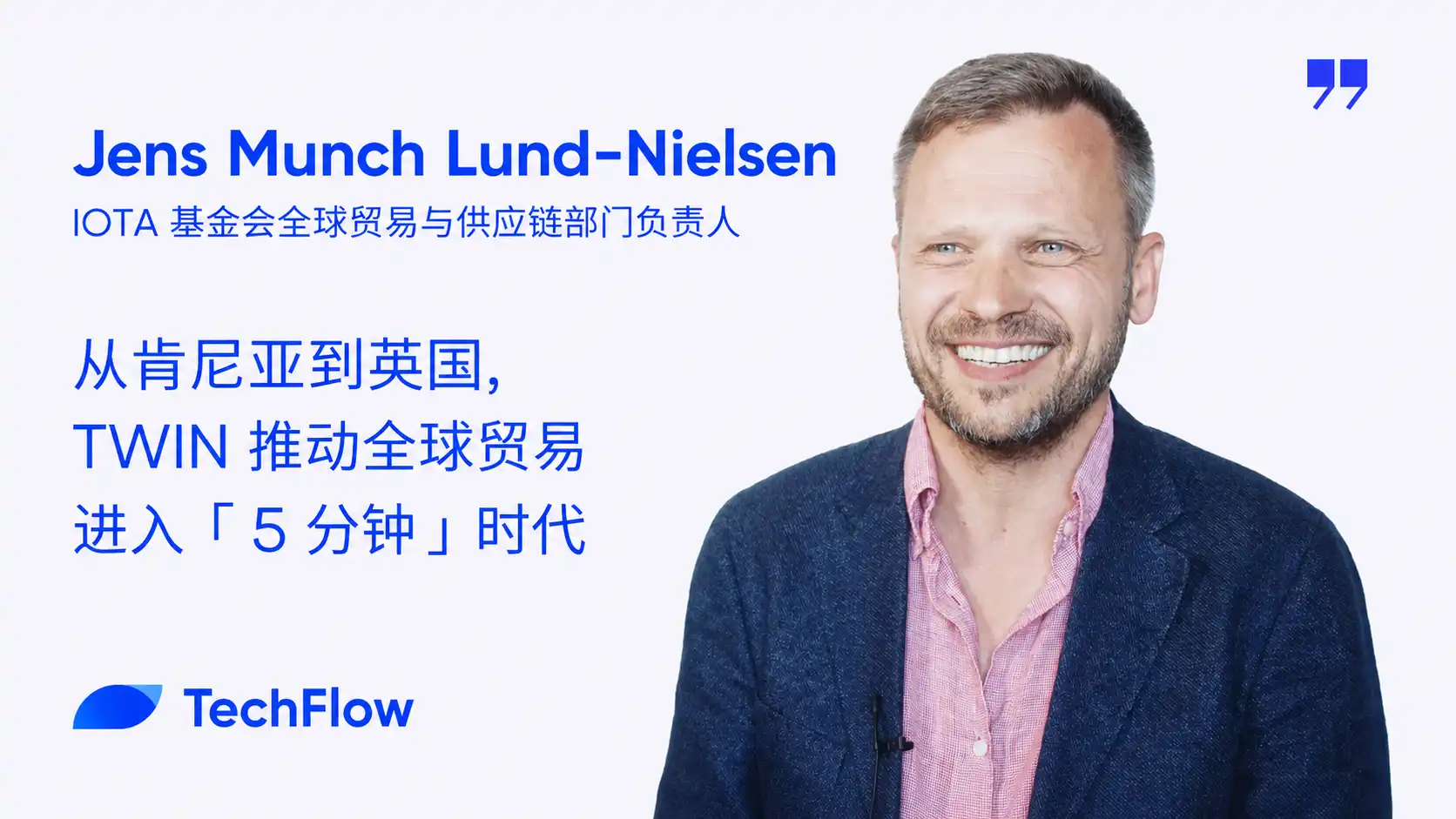
Con motivo del primer aniversario de TWIN, mantuvimos una conversación en profundidad con Jens Munch Lund-Nielsen, Director del Departamento de Comercio Global y Cadena de Suministro de la Fundación IOTA.

Antes de unirse a la Fundación IOTA, Jens trabajó en la oficina de estrategia de Maersk, una de las compañías navieras más grandes del mundo, centrándose en el comercio digital y las asociaciones público-privadas. Allí, presenció de cerca cómo funciona realmente el sistema de comercio global: enorme pero ineficiente, de alta fricción y fragmentado, sin que ninguna parte pueda coordinar verdaderamente a todos.

Esta experiencia hizo que Jens comprendiera más claramente: el comercio global necesita una infraestructura abierta, neutral y descentralizada que permita a gobiernos, empresas, puertos y múltiples participantes intercambiar datos confiables en tiempo real dentro del mismo sistema. Esta también se convirtió en la razón central por la que Jens eligió unirse a la Fundación IOTA:

Impulsar el desarrollo de TWIN para que el comercio global pase de ser en papel y aislado a flujos de trabajo de colaboración digital en tiempo real, confiables e interconectados.

En este contenido, sigamos las ideas compartidas por Jens para ver, desde la perspectiva de este veterano del comercio, cuál es la verdadera respuesta que ha estado esperando la digitalización del comercio global durante más de una década.
Del papel a la cadena: Construyendo la infraestructura de colaboración digital para el comercio global

Shenchao TechFlow: Antes de profundizar en TWIN, ¿podría presentarse brevemente, incluido su historial en el campo del comercio global y cuál fue la oportunidad que le llevó a participar en el proyecto TWIN?

Jens:

Hola a todos, soy Jens Munch Lund-Nielsen, actualmente Director del Departamento de Comercio Global y Cadena de Suministro de la Fundación IOTA.

Mi experiencia se centra principalmente en tecnología, facilitación del comercio y comercio digital, enfocándome especialmente en construir productos digitales y apoyar su implementación y expansión global.

Antes de unirme a IOTA, trabajé en la oficina de estrategia de Maersk como Director de Comercio Digital, centrándome en integrar la facilitación del comercio, las asociaciones público-privadas y soluciones digitales en las cadenas de suministro globales.

La oportunidad de unirme a TWIN surgió porque vi aquí una oportunidad única para abordar las ineficiencias estructurales de larga data en el comercio global a través de sistemas digitales confiables y tecnologías interoperables.

Shenchao TechFlow: Para alguien que no esté familiarizado con el proyecto, ¿cómo describiría TWIN? ¿Cuál es su esencia central?

Jens:

En esencia, TWIN es una infraestructura digital neutral para el comercio global.

El sistema comercial actual funciona sobre sistemas fragmentados y procesos en papel, porque ninguna parte puede coordinar a todos los participantes.

TWIN cambia esta situación: proporciona una capa base común que permite a empresas, gobiernos y diversas instituciones intercambiar datos, documentos y activos en tiempo real y de manera segura.

TWIN es una red abierta e interoperable que conecta sistemas existentes, fortalece la confianza a través de datos verificables y permite el cumplimiento normativo transfronterizo sin depender de un propietario centralizado.

TWIN está construido sobre IOTA, combinando tecnología de libro mayor distribuido (DLT) con sistemas de identidad descentralizados, asegurando que cada participante mantenga el control de sus propios datos mientras colabora a nivel global.

En resumen:

TWIN es la infraestructura que permite que el comercio global pase de ser en papel y aislado a flujos de trabajo de colaboración digital en tiempo real, confiables e interconectados.

Shenchao TechFlow: ¿Qué problema del comercio global busca resolver TWIN? ¿Por qué este problema no se ha resuelto durante tanto tiempo?

Jens:

Fundamentalmente, TWIN aborda un problema central de coordinación en el comercio global: actualmente no existe una infraestructura común en la que todas las partes puedan confiar para intercambiar datos de manera fluida.

Hoy en día, el comercio sigue dependiendo en gran medida de documentos en papel y sistemas fragmentados. La información se introduce repetidamente, se retrasa y a menudo es inconsistente entre exportadores, importadores, bancos, puertos y autoridades aduaneras. Esto genera ineficiencias, aumenta riesgos y limita la transparencia de la cadena de suministro.

Este problema no se ha resuelto durante tanto tiempo, no por falta de tecnología, sino por falta de «neutralidad».

La mayoría de los intentos anteriores de digitalización comercial eran esencialmente plataformas con restricciones de acceso, a menudo impulsadas por empresas, regiones específicas o grupos de interés particulares. Estas soluciones podían ser técnicamente viables, pero enfrentaban un problema estructural:

Otras partes a menudo se negaban a adoptar infraestructuras percibidas como «controladas por otros». Debido a la falta de confianza y adopción generalizadas, estos sistemas nunca lograron alcanzar la escala de efecto de red necesaria para el comercio global.

TWIN toma un camino diferente. Ofrece una infraestructura abierta, neutral y descentralizada, donde ninguna parte única posee o controla todo el sistema. Esto permite que todas las partes compartan datos manteniendo su soberanía y cumpliendo con sus propios requisitos regulatorios.

Escalable, de bajo costo, descentralizado: la capa base IOTA sostiene la arquitectura TWIN

Shenchao TechFlow: ¿Por qué se eligió IOTA como la infraestructura subyacente para TWIN?

Jens:

La elección de IOTA como infraestructura subyacente para TWIN se debe a que cumple con los requisitos centrales del sistema de comercio global: escalabilidad, eficiencia de costos y neutralidad.

IOTA, construido sobre una arquitectura DAG, ofrece una gran escalabilidad, permitiendo procesar en paralelo un gran volumen de transacciones e intercambios de datos, lo cual es crucial para el comercio global, donde millones de eventos, documentos y actualizaciones ocurren constantemente a lo largo de toda la cadena de suministro.

También proporciona costos de transacción extremadamente bajos, lo cual es vital en escenarios comerciales debido a la alta frecuencia de interacciones en estos procesos. Si cada actualización de documento, verificación o intercambio de datos conllevara un costo significativo, los gastos se volverían rápidamente insostenibles a escala.

Además de la tecnología en sí, IOTA cuenta con más de una década de experiencia construyendo infraestructura para el mundo real y un sólido historial de cumplimiento a través de la colaboración con gobiernos, empresas y organismos de normalización.

Otra razón importante es que IOTA está diseñado como una infraestructura abierta y neutral que no está controlada por una única entidad corporativa. Esto se alinea perfectamente con la necesidad fundamental del comercio global: la confianza y la soberanía son premisas clave para que diferentes partes interesadas estén dispuestas a adoptarlo.

Shenchao TechFlow: ¿Cómo se debe entender la relación entre TWIN e IOTA? ¿Es TWIN una capa de aplicación, un ecosistema o algo más macro?

Jens:

La forma más apropiada de entender TWIN es verlo como una infraestructura pública digital para el comercio global, una capa compartida de datos y coordinación que conecta a gobiernos, empresas y plataformas existentes.

En resumen, TWIN permite a las partes intercambiar datos verificados e inmutables de manera transfronteriza y en tiempo real, sin renunciar al control autónomo de sus datos.

IOTA se encuentra debajo, funcionando como la capa de infraestructura subyacente. Proporciona la capa de confianza descentralizada que garantiza la integridad de los datos, la auditabilidad y la interoperabilidad a gran escala.

De las flores africanas a la carne de ave europea: TWIN se implementa en escenarios comerciales reales globales

Shenchao TechFlow: ¿Cuáles son actualmente los casos de uso prácticos más concretos que se están explorando o implementando a través de TWIN?

Jens:

TWIN ya se ha desplegado en múltiples escenarios comerciales reales, demostrando claramente cómo una infraestructura digital compartida puede reducir la fricción, aumentar la transparencia y mejorar la eficiencia de las cadenas de suministro globales.

El proyecto Canal de Información de Comercio y Logística (TLIP) conecta a exportadores, proveedores de servicios logísticos y agencias gubernamentales de África Oriental en un canal de datos compartido. En proyectos piloto que cubren exportaciones de flores, café y té, el tiempo para recuperar documentos para inspección se redujo de 6-7 horas a unos 30 minutos, la carga administrativa disminuyó entre un 50% y un 60%, y los exportadores ahorraron aproximadamente 400 dólares mensuales en costos de procesamiento documental.

TWIN también fue probado en los «Ensayos del Ecosistema de Confianza (Ecosystem of Trust Trials)» del gobierno británico, que involucraron alrededor de 2000 envíos de carne de ave refrigerada de Polonia al Reino Unido. Las agencias fronterizas obtuvieron visibilidad anticipada de los bienes que llegaban (los oficiales de sanidad portuaria accedieron a los datos hasta más de 20 horas antes que en el proceso estándar), permitiendo una asignación de recursos más efectiva.

La «Plataforma de Prueba de Comercio Digital (Digital Trade Testbed)» del Reino Unido también probará TWIN para respaldar el intercambio de información comercial internacional digitalizada entre los puertos británicos y las principales agencias fronterizas.

Otros casos de implementación incluyen:

El proyecto RESULD (Diligencia Debida en Cadenas de Suministro y Logística Responsable) integró TWIN para rastrear cadenas de suministro de frutas y verduras entre Kenia, Países Bajos y el Reino Unido;

El proyecto MISSION (Optimización Marítima Instantánea) está probando TWIN para mejorar la eficiencia operativa portuaria;

Salus utiliza TWIN para aportar trazabilidad a las cadenas de suministro de minerales críticos, transformando documentos de carga y comercio en activos digitales verificables para que instituciones financieras los utilicen en evaluación de riesgos y otorgamiento de financiamiento comercial;

Además, el proyecto ADAPT, liderado por la Secretaría de la Zona de Libre Comercio Continental Africana (AfCFTA) y que cuenta con la participación de la Fundación IOTA, el Instituto Tony Blair para el Cambio Global y el Foro Económico Mundial, está avanzando en la construcción de una red troncal para el comercio digital en África, aprovechando la arquitectura de IOTA y la experiencia de TWIN.

Shenchao TechFlow: ¿Cuál es la reacción típica de gobiernos y empresas cuando conocen TWIN? ¿En qué áreas considera que la aceptación es mayor actualmente?

Jens:

Tras conocer TWIN, gobiernos y empresas generalmente reconocen su valor evidente.

A nivel gubernamental, los departamentos más directamente relacionados con el comercio, como Ministerios de Comercio y Departamentos de Aduanas bajo Ministerios de Hacienda, pueden percibir claramente el gran potencial de TWIN para mejorar los procesos internos de despacho de aduana, fortalecer los controles fronterizos y obtener mejor acceso a datos confiables para prevenir la entrada de mercancías no autorizadas o no conformes.

En el sector privado, los participantes más activos actualmente son los proveedores de servicios de transporte y los agentes de carga, ya que ellos mismos manejan una gran cantidad de procesos fronterizos y documentales en nombre de productores y agricultores. Toda la industria muestra un nivel similar de expectativa e interés en el valor que TWIN puede crear.

Al mismo tiempo, es muy importante destacar que el verdadero valor de TWIN proviene de la propia red. Cuantas más partes se conecten a TWIN, mayor será el valor que el sistema creará para todos los participantes.

Shenchao TechFlow: El comercio está altamente fragmentado entre diferentes jurisdicciones. ¿Cómo maneja TWIN la interoperabilidad entre distintos sistemas, estándares y entornos regulatorios?

Jens:

La interoperabilidad internacional es uno de los factores de valor más críticos de TWIN y opera en múltiples niveles, siendo una parte importante garantizar que los sistemas «hablen el mismo idioma».

Para ello, adoptamos estándares reconocidos globalmente, como los modelos de datos del Centro de las Naciones Unidas para la Facilitación del Comercio y los Negocios Electrónicos (UN/CEFACT) y de la Organización Mundial de Aduanas (OMA), y respaldamos y perfeccionamos estos estándares a través de la Iniciativa de Estándares Digitales de la Cámara de Comercio Internacional (ICC DSI).

En cuanto a identificación, la interoperabilidad se promueve principalmente a través de los sistemas nacionales de registro de identidad de cada país. Mediante TWIN ID, podemos conectar las identidades digitales empresariales a nivel nacional con estándares internacionales, como el Identificador de Entidad Legal (LEI) emitido por la Fundación de Identificador de Entidad Legal Global (GLEIF), que también es socio en este proyecto.

Desde una perspectiva técnica, también observamos una creciente convergencia en torno a estándares como los Identificadores Descentralizados (DID) y las Credenciales Verificables, según las definiciones del Consorcio World Wide Web (W3C).

Finalmente, la interoperabilidad legal es igualmente importante. El marco de la Ley Modelo de la CNUDMI sobre Registros Transmisibles Electrónicos (MLETR) está impulsando el reconocimiento legal de los documentos comerciales digitales, aunque su implementación depende aún de la ratificación por parte de los gobiernos nacionales.

Nuestra experiencia es que el trabajo puede comenzar incluso en países que aún no han adoptado la MLETR; en esos casos, también ayudamos a los gobiernos locales a avanzar en este proceso, especialmente considerando la creciente importancia de este marco para los escenarios de financiamiento comercial.

Conectando islas digitales, cerrando la brecha de 2,5 billones de dólares en financiamiento comercial

Shenchao TechFlow: ¿Cómo ve la evolución del comercio global en los próximos 5 a 10 años? ¿Qué papel desempeñará la infraestructura descentralizada en esta transformación?

Jens:

La industria del comercio internacional es enorme y ha estado en un proceso de transformación digital durante los últimos 10 a 15 años, con gobiernos y empresas actualizando sus sistemas en torno a modelos de datos estandarizados y el uso de API REST. El eslabón perdido actual es conectar estas «islas digitales» de una manera que equilibre la soberanía de los datos, su integridad y el intercambio controlado de información.

Actualmente estamos avanzando con proyectos en más de ocho países, colaborando estrechamente con gobiernos y viendo un interés sólido y continuo en esta área. Por lo tanto, soy optimista:

En los próximos años, una «capa de conexión» confiable que conecte estos sistemas se implementará y escalará realmente. Su impacto potencial en el comercio global, las finanzas y los acuerdos comerciales internacionales será profundo, lo que la convierte en un área particularmente interesante para observar.

Shenchao TechFlow: Si TWIN logra un éxito a gran escala, ¿cómo cree que será su «estado final»? ¿De qué manera diferente funcionará el comercio global en comparación con hoy?

Jens:

En resumen, a medida que el comercio global avanza hacia una colaboración completamente digital, muchos procesos obsoletos serán reemplazados. Áreas clave, como el descubrimiento de nuevos socios comerciales o el acceso a financiamiento, serán radicalmente diferentes a como son hoy.

Actualmente existe una brecha de financiamiento comercial de aproximadamente 2,5 billones de dólares a nivel global, lo que impide que muchas empresas obtengan el capital necesario para participar de manera eficiente en el comercio global.

Con soluciones de infraestructura digital como TWIN, los datos confiables y los procesos digitalizados verificables ayudarán a liberar el acceso al capital a gran escala, lo que potencialmente podría remodelar todo el panorama de la industria y mejorar la situación de los comerciantes globales.

Trending Cryptos

Related Questions

Q¿Qué es TWIN y cuál es su propósito principal en el comercio global?

ATWIN es una infraestructura digital neutral para el comercio global. Su propósito principal es resolver la ineficiencia estructural del comercio, proporcionando una capa base compartida donde empresas, gobiernos y otras instituciones puedan intercambiar datos, documentos y activos en tiempo real y de manera segura, pasando de procesos en papel y aislados a un flujo de colaboración digital en tiempo real, confiable e interconectado.

Q¿Por qué se eligió IOTA como la infraestructura subyacente para TWIN?

ASe eligió IOTA debido a que satisface los requisitos centrales del comercio global: escalabilidad, eficiencia de costos y neutralidad. Su arquitectura basada en DAG permite alta escalabilidad y bajo costo por transacción, crucial para interacciones de alta frecuencia. Además, IOTA es una infraestructura abierta y neutral, sin control de una única entidad, lo que genera confianza y soberanía, claves para su adopción por múltiples partes interesadas.

Q¿Cuáles son algunos ejemplos concretos de aplicación de TWIN en escenarios reales de comercio?

ATWIN se ha desplegado en varios escenarios reales. En África Oriental, el proyecto TLIP conecta exportadores, proveedores logísticos y agencias gubernamentales, reduciendo el tiempo de recuperación de documentos de 6-7 horas a unos 30 minutos y ahorrando costos. En el Reino Unido, se probó en los 'Ecosystem of Trust Trials' para envíos de carne de ave, mejorando la visibilidad de la carga para las autoridades fronterizas. También se utiliza en proyectos como RESULD para trazabilidad de frutas y verduras, MISSION para eficiencia portuaria, Salus para financiamiento comercial y ADAPT para la red troncal de comercio digital en África.

Q¿Cómo maneja TWIN la interoperabilidad entre diferentes jurisdicciones, sistemas y regulaciones?

ATWIN maneja la interoperabilidad internacional en varios niveles. Utiliza estándares globales como los modelos de datos de UN/CEFACT y la OMA. Para identidad, vincula identidades digitales nacionales con estándares internacionales como el LEI a través de TWIN ID. Técnicamente, se alinea con estándares como los Identificadores Descentralizados (DID) y Credenciales Verificables del W3C. Legalmente, apoya marcos como la Ley Modelo de la CNUDMI sobre Registros Electrónicos Transferibles (MLETR) para el reconocimiento de documentos digitales, incluso ayudando a los gobiernos en su implementación.

QSegún Jens, ¿cuál podría ser el estado final o el mayor impacto de TWIN si tiene éxito a gran escala?

AEl estado final de TWIN sería un comercio global completamente digitalizado y colaborativo. Reemplazaría procesos obsoletos y transformaría áreas clave como la búsqueda de socios comerciales y el acceso a financiamiento. Un impacto significativo sería ayudar a cerrar la brecha de financiamiento comercial global, estimada en 2.5 billones de dólares. Al proporcionar datos confiables y procesos digitales verificables, TWIN podría facilitar el acceso a capital a gran escala, mejorando las condiciones para los comerciantes globales y remodelando potencialmente todo el sector.

Related Reads

YouTube Crypto Channel Views Drop 70% by 2026, Retail Attention Crisis Reshaping Next Cycle

Major cryptocurrency YouTube channels are experiencing a severe decline in viewership, signaling a potential crisis in retail investor attention for the next market cycle. Analysis of six top channels shows monthly view counts have plummeted 27% to 79% compared to January 2025, with four channels down approximately 75%. While subscriber counts remain high (e.g., Coin Bureau with 2.72M, Altcoin Daily with 1.65M), current engagement tells a different story. Recent 30-day view counts are significantly lower: Coin Bureau at 1.24M views, Crypto Banter at 1.06M, with Altcoin Daily and Benjamin Cowen performing relatively better at 1.79M and 1.8M respectively. The core issue is that subscriber numbers are cumulative and reflect past interest, while views measure current demand. The dramatic drop indicates a fragmented and more selective retail audience. This contrasts sharply with the 2021 bull market, where channels reportedly garnered 3-4 million daily views. Now, daily views for major channels range from roughly 35,000 to 60,000. This divergence suggests a new type of market cycle. Bitcoin's price can be sustained by ETFs and institutional activity, but without strong retail engagement via content channels, the dynamics of the next bull run will be fundamentally different. The real signal for a retail resurgence will be a sustained increase in daily and monthly view counts, not subscriber growth. If viewership fails to recover, long-form YouTube content may become a lagging indicator, with retail attention shifting to other, faster formats.

marsbit43m ago

YouTube Crypto Channel Views Drop 70% by 2026, Retail Attention Crisis Reshaping Next Cycle

marsbit43m ago

Confirmed: Claude Code Secretly Inspects Users, Time Zone and Chinese AI Labs Are Key Factors

Today was a significant day for Anthropic. The company announced the launch of Claude Sonnet 5, described as its most agentic model yet, and separately confirmed that the U.S. Department of Commerce has lifted export controls on its Claude Fable 5 and Mythos 5 models, allowing their distribution to resume. However, a separate controversy has emerged regarding its coding assistant, Claude Code. Developers have exposed that certain versions of the tool allegedly contain hidden code designed to detect specific user data. This code reportedly checks for the use of Chinese time zones (like Asia/Shanghai), the presence of custom API proxy URLs, and connections to domains associated with Chinese tech companies and AI labs. If triggered, this information is said to be encoded into the system prompt sent to the AI cloud, using subtle, nearly indistinguishable variations in characters (like different Unicode apostrophes in the "Today's date" line) as a form of steganography. The core issue is the covert nature of this data collection. While telemetry for security and abuse prevention is common, implementing it through hidden channels within the prompt—without user awareness or documented disclosure—fundamentally breaches trust. This is particularly sensitive for a coding assistant that operates with access to source code and system commands. Following the exposure, an Anthropic engineer acknowledged the code's existence and stated it would be removed in an upcoming release. The incident raises serious questions about transparency and the boundaries of data collection in AI developer tools.

marsbit1h ago

Confirmed: Claude Code Secretly Inspects Users, Time Zone and Chinese AI Labs Are Key Factors

marsbit1h ago

Grayscale: After Halving, BTC is Nearing the Bottom of This Cycle

Grayscale Research suggests Bitcoin's recent decline below $60,000, a >50% drop from its October peak, represents a cyclical correction within a long-term uptrend rather than a trend reversal. Key factors behind the pullback include a shift in market expectations toward Federal Reserve rate hikes under new Chair Kevin Warsh, uncertainty around the CLARITY Act's Senate passage, pressure on leveraged entities like Strategy, and concerns over quantum computing risks. The path out of the current bear market hinges on upcoming catalysts. An optimistic scenario, where the CLARITY Act passes, leverage is contained, and the Fed refrains from hiking, could mean Bitcoin is nearing its cycle bottom. A pessimistic scenario, featuring legislative failure, further deleveraging, and Fed rate hikes, could lead to additional moderate downside. Grayscale does not expect a historically deep ~80% drawdown due to a more measured prior bull run and stickier institutional demand. Despite short-term headwinds, Grayscale remains highly optimistic about crypto's long-term structural prospects, driven by institutional adoption of public blockchains, unsustainable government debt, declining trust in intermediaries, and AI's potential demand for alternative systems. The report concludes that while the exact cycle low depends on near-term catalysts, current valuations present an attractive entry point for long-term investors betting on the decade-ahead growth of digital assets.

marsbit1h ago

Grayscale: After Halving, BTC is Nearing the Bottom of This Cycle

marsbit1h ago

Web3 Bear Market Survival Guide: Ten Great Books to Help You Navigate the Cycles

"Web3 Bear Market Survival Guide: Ten Books to Help You Navigate the Cycle" This article presents a curated book list aimed at helping Web3 enthusiasts and professionals endure and grow during crypto market downturns. It argues that bear markets are not just periods of waiting but crucial times for deepening one's foundational understanding beyond technical whitepapers and price charts. The ten recommended books offer perspectives on technology, economics, philosophy, and strategy to build resilience and long-term vision. The list includes: 1. **"The Inevitable" by Kevin Kelly:** For using a long-term technological lens to combat uncertainty about the future, including the role of crypto and AI. 2. **"Human Action" by Ludwig von Mises:** To upgrade one's economic and philosophical framework, understanding action, speculation, and calculation in a bear market context. 3. **"The Nature of Technology" by W. Brian Arthur:** For viewing blockchain and crypto as combinatorial evolutions of existing technologies, understanding their modular and economic development. 4. **"The Distant Savior" (Chinese novel):** Explores the cultural attributes of self-reliance ("strong culture") versus dependency ("weak culture"), crucial for surviving industry cycles. 5. **"The Sovereign Individual" by James Dale Davidson & Lord William Rees-Mogg:** A prophetic 1997 work on how technology empowers individuals and challenges nation-states, foreshadowing Bitcoin's emergence. 6. **"Japanization: What the World Can Learn from Japan's Lost Decades" (Adapted title):** Uses Japan's economic history as a case study to identify structural opportunities that persist even during broader recessions. 7. **"Denationalisation of Money" by F.A. Hayek:** The ideological blueprint for Bitcoin, arguing for competitive currency issuance beyond state monopoly. 8. **"Duan Yongping Investment Q&A" (Chinese compilation):** Emphasizes the simple discipline of "doing the right things and doing things right," focusing on fundamentals and maintaining a "stop doing list." 9. **"The Network State: How To Start a New Country" by Balaji Srinivasan:** A visionary text from a crypto insider outlining bold predictions and concrete ideas for a blockchain-based future across media, governance, and identity. 10. **"Selected Works of Mao Zedong" (Vol. 1):** Analyzed as a strategic playbook for a weak force challenging a powerful establishment, offering lessons on strategy, alliance-building, and perseverance for the crypto movement. The conclusion states that bear markets filter out those with weak conviction, not weak skills. Survival depends on cognitive depth and mental fortitude, which these books aim to provide.

Foresight News2h ago

Web3 Bear Market Survival Guide: Ten Great Books to Help You Navigate the Cycles

Foresight News2h ago

Trading

Spot

Hot Articles

What is SONIC

Sonic: Pioneering the Future of Gaming in Web3 Introduction to Sonic In the ever-evolving landscape of Web3, the gaming industry stands out as one of the most dynamic and promising sectors. At the forefront of this revolution is Sonic, a project designed to amplify the gaming ecosystem on the Solana blockchain. Leveraging cutting-edge technology, Sonic aims to deliver an unparalleled gaming experience by efficiently processing millions of requests per second, ensuring that players enjoy seamless gameplay while maintaining low transaction costs. This article delves into the intricate details of Sonic, exploring its creators, funding sources, operational mechanics, and the timeline of significant events that have shaped its journey. What is Sonic? Sonic is an innovative layer-2 network that operates atop the Solana blockchain, specifically tailored to enhance the existing Solana gaming ecosystem. It accomplishes this through a customised, VM-agnostic game engine paired with a HyperGrid interpreter, facilitating sovereign game economies that roll up back to the Solana platform. The primary goals of Sonic include: Enhanced Gaming Experiences: Sonic is committed to offering lightning-fast on-chain gameplay, allowing players and developers to engage with games at previously unattainable speeds. Atomic Interoperability: This feature enables transactions to be executed within Sonic without the need to redeploy Solana programmes and accounts. This makes the process more efficient and directly benefits from Solana Layer1 services and liquidity. Seamless Deployment: Sonic allows developers to write for Ethereum Virtual Machine (EVM) based systems and execute them on Solana’s SVM infrastructure. This interoperability is crucial for attracting a broader range of dApps and decentralised applications to the platform. Support for Developers: By offering native composable gaming primitives and extensible data types - dining within the Entity-Component-System (ECS) framework - game creators can craft intricate business logic with ease. Overall, Sonic's unique approach not only caters to players but also provides an accessible and low-cost environment for developers to innovate and thrive. Creator of Sonic The information regarding the creator of Sonic is somewhat ambiguous. However, it is known that Sonic's SVM is owned by the company Mirror World. The absence of detailed information about the individuals behind Sonic reflects a common trend in several Web3 projects, where collective efforts and partnerships often overshadow individual contributions. Investors of Sonic Sonic has garnered considerable attention and support from various investors within the crypto and gaming sectors. Notably, the project raised an impressive $12 million during its Series A funding round. The round was led by BITKRAFT Ventures, with other notable investors including Galaxy, Okx Ventures, Interactive, Big Brain Holdings, and Mirana. This financial backing signifies the confidence that investment foundations have in Sonic’s potential to revolutionise the Web3 gaming landscape, further validating its innovative approaches and technologies. How Does Sonic Work? Sonic utilises the HyperGrid framework, a sophisticated parallel processing mechanism that enhances its scalability and customisability. Here are the core features that set Sonic apart: Lightning Speed at Low Costs: Sonic offers one of the fastest on-chain gaming experiences compared to other Layer-1 solutions, powered by the scalability of Solana’s virtual machine (SVM). Atomic Interoperability: Sonic enables transaction execution without redeployment of Solana programmes and accounts, effectively streamlining the interaction between users and the blockchain. EVM Compatibility: Developers can effortlessly migrate decentralised applications from EVM chains to the Solana environment using Sonic’s HyperGrid interpreter, increasing the accessibility and integration of various dApps. Ecosystem Support for Developers: By exposing native composable gaming primitives, Sonic facilitates a sandbox-like environment where developers can experiment and implement business logic, greatly enhancing the overall development experience. Monetisation Infrastructure: Sonic natively supports growth and monetisation efforts, providing frameworks for traffic generation, payments, and settlements, thereby ensuring that gaming projects are not only viable but also sustainable financially. Timeline of Sonic The evolution of Sonic has been marked by several key milestones. Below is a brief timeline highlighting critical events in the project's history: 2022: The Sonic cryptocurrency was officially launched, marking the beginning of its journey in the Web3 gaming arena. 2024: June: Sonic SVM successfully raised $12 million in a Series A funding round. This investment allowed Sonic to further develop its platform and expand its offerings. August: The launch of the Sonic Odyssey testnet provided users with the first opportunity to engage with the platform, offering interactive activities such as collecting rings—a nod to gaming nostalgia. October: SonicX, an innovative crypto game integrated with Solana, made its debut on TikTok, capturing the attention of over 120,000 users within a short span. This integration illustrated Sonic’s commitment to reaching a broader, global audience and showcased the potential of blockchain gaming. Key Points Sonic SVM is a revolutionary layer-2 network on Solana explicitly designed to enhance the GameFi landscape, demonstrating great potential for future development. HyperGrid Framework empowers Sonic by introducing horizontal scaling capabilities, ensuring that the network can handle the demands of Web3 gaming. Integration with Social Platforms: The successful launch of SonicX on TikTok displays Sonic’s strategy to leverage social media platforms to engage users, exponentially increasing the exposure and reach of its projects. Investment Confidence: The substantial funding from BITKRAFT Ventures, among others, emphasizes the robust backing Sonic has, paving the way for its ambitious future. In conclusion, Sonic encapsulates the essence of Web3 gaming innovation, striking a balance between cutting-edge technology, developer-centric tools, and community engagement. As the project continues to evolve, it is poised to redefine the gaming landscape, making it a notable entity for gamers and developers alike. As Sonic moves forward, it will undoubtedly attract greater interest and participation, solidifying its place within the broader narrative of blockchain gaming.

1.7k Total ViewsPublished 2024.04.04Updated 2024.12.03

What is SONIC

What is $S$

Understanding SPERO: A Comprehensive Overview Introduction to SPERO As the landscape of innovation continues to evolve, the emergence of web3 technologies and cryptocurrency projects plays a pivotal role in shaping the digital future. One project that has garnered attention in this dynamic field is SPERO, denoted as SPERO,$$s$. This article aims to gather and present detailed information about SPERO, to help enthusiasts and investors understand its foundations, objectives, and innovations within the web3 and crypto domains. What is SPERO,$$s$? SPERO,$$s$ is a unique project within the crypto space that seeks to leverage the principles of decentralisation and blockchain technology to create an ecosystem that promotes engagement, utility, and financial inclusion. The project is tailored to facilitate peer-to-peer interactions in new ways, providing users with innovative financial solutions and services. At its core, SPERO,$$s$ aims to empower individuals by providing tools and platforms that enhance user experience in the cryptocurrency space. This includes enabling more flexible transaction methods, fostering community-driven initiatives, and creating pathways for financial opportunities through decentralised applications (dApps). The underlying vision of SPERO,$$s$ revolves around inclusiveness, aiming to bridge gaps within traditional finance while harnessing the benefits of blockchain technology. Who is the Creator of SPERO,$$s$? The identity of the creator of SPERO,$$s$ remains somewhat obscure, as there are limited publicly available resources providing detailed background information on its founder(s). This lack of transparency can stem from the project's commitment to decentralisation—an ethos that many web3 projects share, prioritising collective contributions over individual recognition. By centring discussions around the community and its collective goals, SPERO,$$s$ embodies the essence of empowerment without singling out specific individuals. As such, understanding the ethos and mission of SPERO remains more important than identifying a singular creator. Who are the Investors of SPERO,$$s$? SPERO,$$s$ is supported by a diverse array of investors ranging from venture capitalists to angel investors dedicated to fostering innovation in the crypto sector. The focus of these investors generally aligns with SPERO's mission—prioritising projects that promise societal technological advancement, financial inclusivity, and decentralised governance. These investor foundations are typically interested in projects that not only offer innovative products but also contribute positively to the blockchain community and its ecosystems. The backing from these investors reinforces SPERO,$$s$ as a noteworthy contender in the rapidly evolving domain of crypto projects. How Does SPERO,$$s$ Work? SPERO,$$s$ employs a multi-faceted framework that distinguishes it from conventional cryptocurrency projects. Here are some of the key features that underline its uniqueness and innovation: Decentralised Governance: SPERO,$$s$ integrates decentralised governance models, empowering users to participate actively in decision-making processes regarding the project’s future. This approach fosters a sense of ownership and accountability among community members. Token Utility: SPERO,$$s$ utilises its own cryptocurrency token, designed to serve various functions within the ecosystem. These tokens enable transactions, rewards, and the facilitation of services offered on the platform, enhancing overall engagement and utility. Layered Architecture: The technical architecture of SPERO,$$s$ supports modularity and scalability, allowing for seamless integration of additional features and applications as the project evolves. This adaptability is paramount for sustaining relevance in the ever-changing crypto landscape. Community Engagement: The project emphasises community-driven initiatives, employing mechanisms that incentivise collaboration and feedback. By nurturing a strong community, SPERO,$$s$ can better address user needs and adapt to market trends. Focus on Inclusion: By offering low transaction fees and user-friendly interfaces, SPERO,$$s$ aims to attract a diverse user base, including individuals who may not previously have engaged in the crypto space. This commitment to inclusion aligns with its overarching mission of empowerment through accessibility. Timeline of SPERO,$$s$ Understanding a project's history provides crucial insights into its development trajectory and milestones. Below is a suggested timeline mapping significant events in the evolution of SPERO,$$s$: Conceptualisation and Ideation Phase: The initial ideas forming the basis of SPERO,$$s$ were conceived, aligning closely with the principles of decentralisation and community focus within the blockchain industry. Launch of Project Whitepaper: Following the conceptual phase, a comprehensive whitepaper detailing the vision, goals, and technological infrastructure of SPERO,$$s$ was released to garner community interest and feedback. Community Building and Early Engagements: Active outreach efforts were made to build a community of early adopters and potential investors, facilitating discussions around the project’s goals and garnering support. Token Generation Event: SPERO,$$s$ conducted a token generation event (TGE) to distribute its native tokens to early supporters and establish initial liquidity within the ecosystem. Launch of Initial dApp: The first decentralised application (dApp) associated with SPERO,$$s$ went live, allowing users to engage with the platform's core functionalities. Ongoing Development and Partnerships: Continuous updates and enhancements to the project's offerings, including strategic partnerships with other players in the blockchain space, have shaped SPERO,$$s$ into a competitive and evolving player in the crypto market. Conclusion SPERO,$$s$ stands as a testament to the potential of web3 and cryptocurrency to revolutionise financial systems and empower individuals. With a commitment to decentralised governance, community engagement, and innovatively designed functionalities, it paves the way toward a more inclusive financial landscape. As with any investment in the rapidly evolving crypto space, potential investors and users are encouraged to research thoroughly and engage thoughtfully with the ongoing developments within SPERO,$$s$. The project showcases the innovative spirit of the crypto industry, inviting further exploration into its myriad possibilities. While the journey of SPERO,$$s$ is still unfolding, its foundational principles may indeed influence the future of how we interact with technology, finance, and each other in interconnected digital ecosystems.

75 Total ViewsPublished 2024.12.17Updated 2024.12.17

What is $S$

What is AGENT S

Agent S: The Future of Autonomous Interaction in Web3 Introduction In the ever-evolving landscape of Web3 and cryptocurrency, innovations are constantly redefining how individuals interact with digital platforms. One such pioneering project, Agent S, promises to revolutionise human-computer interaction through its open agentic framework. By paving the way for autonomous interactions, Agent S aims to simplify complex tasks, offering transformative applications in artificial intelligence (AI). This detailed exploration will delve into the project's intricacies, its unique features, and the implications for the cryptocurrency domain. What is Agent S? Agent S stands as a groundbreaking open agentic framework, specifically designed to tackle three fundamental challenges in the automation of computer tasks: Acquiring Domain-Specific Knowledge: The framework intelligently learns from various external knowledge sources and internal experiences. This dual approach empowers it to build a rich repository of domain-specific knowledge, enhancing its performance in task execution. Planning Over Long Task Horizons: Agent S employs experience-augmented hierarchical planning, a strategic approach that facilitates efficient breakdown and execution of intricate tasks. This feature significantly enhances its ability to manage multiple subtasks efficiently and effectively. Handling Dynamic, Non-Uniform Interfaces: The project introduces the Agent-Computer Interface (ACI), an innovative solution that enhances the interaction between agents and users. Utilizing Multimodal Large Language Models (MLLMs), Agent S can navigate and manipulate diverse graphical user interfaces seamlessly. Through these pioneering features, Agent S provides a robust framework that addresses the complexities involved in automating human interaction with machines, setting the stage for myriad applications in AI and beyond. Who is the Creator of Agent S? While the concept of Agent S is fundamentally innovative, specific information about its creator remains elusive. The creator is currently unknown, which highlights either the nascent stage of the project or the strategic choice to keep founding members under wraps. Regardless of anonymity, the focus remains on the framework's capabilities and potential. Who are the Investors of Agent S? As Agent S is relatively new in the cryptographic ecosystem, detailed information regarding its investors and financial backers is not explicitly documented. The lack of publicly available insights into the investment foundations or organisations supporting the project raises questions about its funding structure and development roadmap. Understanding the backing is crucial for gauging the project's sustainability and potential market impact. How Does Agent S Work? At the core of Agent S lies cutting-edge technology that enables it to function effectively in diverse settings. Its operational model is built around several key features: Human-like Computer Interaction: The framework offers advanced AI planning, striving to make interactions with computers more intuitive. By mimicking human behaviour in tasks execution, it promises to elevate user experiences. Narrative Memory: Employed to leverage high-level experiences, Agent S utilises narrative memory to keep track of task histories, thereby enhancing its decision-making processes. Episodic Memory: This feature provides users with step-by-step guidance, allowing the framework to offer contextual support as tasks unfold. Support for OpenACI: With the ability to run locally, Agent S allows users to maintain control over their interactions and workflows, aligning with the decentralised ethos of Web3. Easy Integration with External APIs: Its versatility and compatibility with various AI platforms ensure that Agent S can fit seamlessly into existing technological ecosystems, making it an appealing choice for developers and organisations. These functionalities collectively contribute to Agent S's unique position within the crypto space, as it automates complex, multi-step tasks with minimal human intervention. As the project evolves, its potential applications in Web3 could redefine how digital interactions unfold. Timeline of Agent S The development and milestones of Agent S can be encapsulated in a timeline that highlights its significant events: September 27, 2024: The concept of Agent S was launched in a comprehensive research paper titled “An Open Agentic Framework that Uses Computers Like a Human,” showcasing the groundwork for the project. October 10, 2024: The research paper was made publicly available on arXiv, offering an in-depth exploration of the framework and its performance evaluation based on the OSWorld benchmark. October 12, 2024: A video presentation was released, providing a visual insight into the capabilities and features of Agent S, further engaging potential users and investors. These markers in the timeline not only illustrate the progress of Agent S but also indicate its commitment to transparency and community engagement. Key Points About Agent S As the Agent S framework continues to evolve, several key attributes stand out, underscoring its innovative nature and potential: Innovative Framework: Designed to provide an intuitive use of computers akin to human interaction, Agent S brings a novel approach to task automation. Autonomous Interaction: The ability to interact autonomously with computers through GUI signifies a leap towards more intelligent and efficient computing solutions. Complex Task Automation: With its robust methodology, it can automate complex, multi-step tasks, making processes faster and less error-prone. Continuous Improvement: The learning mechanisms enable Agent S to improve from past experiences, continually enhancing its performance and efficacy. Versatility: Its adaptability across different operating environments like OSWorld and WindowsAgentArena ensures that it can serve a broad range of applications. As Agent S positions itself in the Web3 and crypto landscape, its potential to enhance interaction capabilities and automate processes signifies a significant advancement in AI technologies. Through its innovative framework, Agent S exemplifies the future of digital interactions, promising a more seamless and efficient experience for users across various industries. Conclusion Agent S represents a bold leap forward in the marriage of AI and Web3, with the capacity to redefine how we interact with technology. While still in its early stages, the possibilities for its application are vast and compelling. Through its comprehensive framework addressing critical challenges, Agent S aims to bring autonomous interactions to the forefront of the digital experience. As we move deeper into the realms of cryptocurrency and decentralisation, projects like Agent S will undoubtedly play a crucial role in shaping the future of technology and human-computer collaboration.

753 Total ViewsPublished 2025.01.14Updated 2025.01.14

What is AGENT S

Discussions

Welcome to the HTX Community. Here, you can stay informed about the latest platform developments and gain access to professional market insights. Users' opinions on the price of S (S) are presented below.

活动图片