Reddit Retail Traders 'Save' U.S. Fast Food Giant WEN, Sending Stock Price Soaring 42% in One Day Before Spreading to On-Chain Meme

marsbitPublished on 2026-06-25Last updated on 2026-06-25

Abstract

US fast-food chain Wendy's (WEN) saw its stock surge 42% intraday and close over 25% higher on June 24 after a Reddit WallStreetBets post titled "We need to save Wendy's" went viral. Trading volume exploded to over 200 million shares, nearly 20 times its average, driven by retail buying. The rally was fueled by a high short interest of around 34%, creating conditions for a short squeeze. Beyond the meme frenzy, the appointment of a new CFO and rumors of a potential privatization led by major investor Nelson Peltz provided a fundamental narrative. The momentum spread to the crypto market, where a Solana-based meme coin named WEN, unrelated to the company, soared over 1450% in 24 hours.

Author: Claude, TechFlow DeepTide

DeepTide Introduction: U.S. fast-food chain Wendy's (WEN) surged 42% and closed up about 26% on Wednesday. A "Save Wendy's" post on the Reddit forum WallStreetBets ignited a surge of retail investors, with trading volume exceeding 200 million shares, more than 20 times the daily average. A crowded short position with a short interest ratio as high as 34% created conditions for a short squeeze. Meanwhile, a meme coin of the same name on the Solana blockchain saw its market cap soar to $439,000 within 24 hours, an increase of over 1450%.
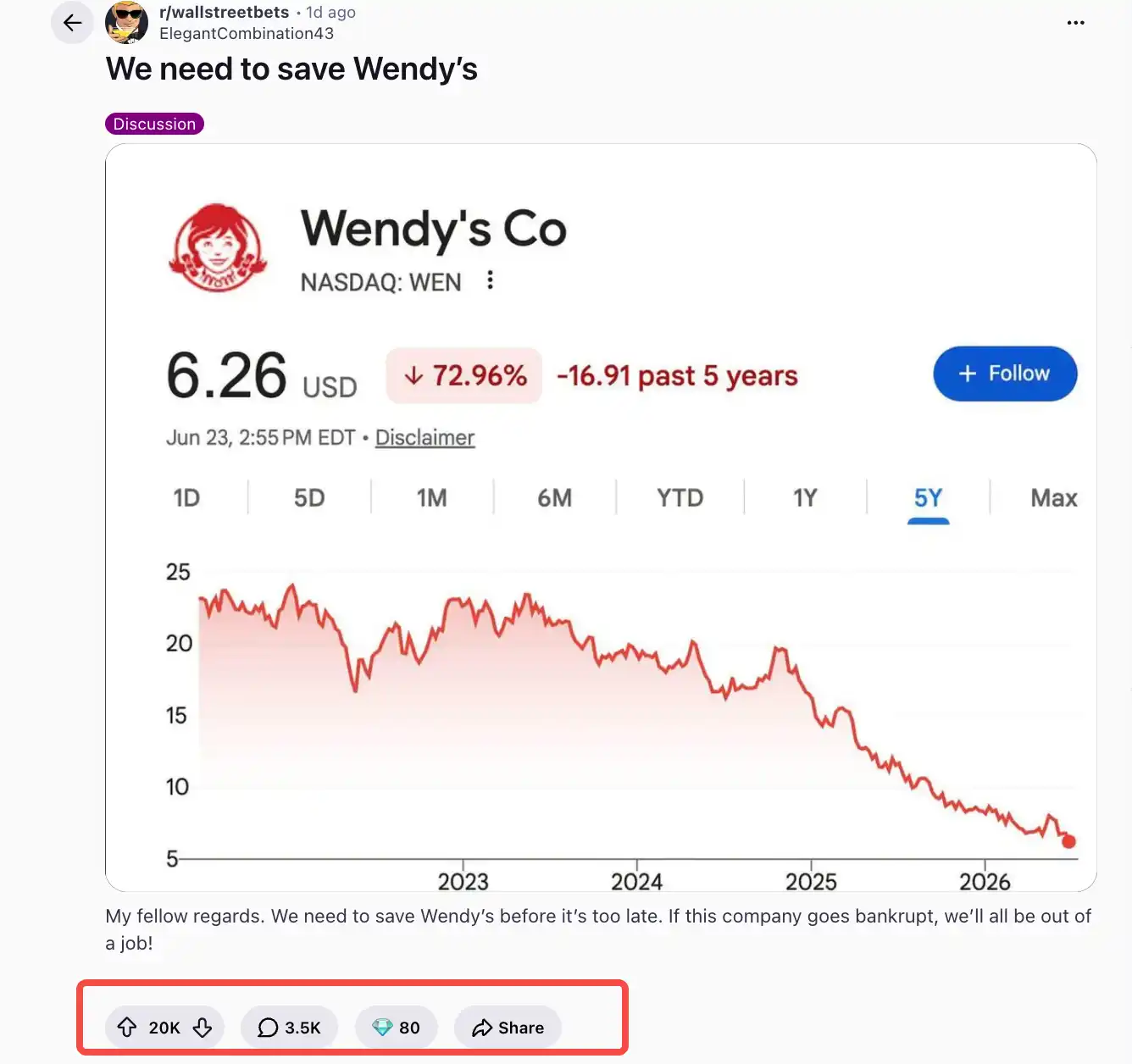
The Reddit forum has sparked another retail trader movement, this time targeting the fast-food giant Wendy's.

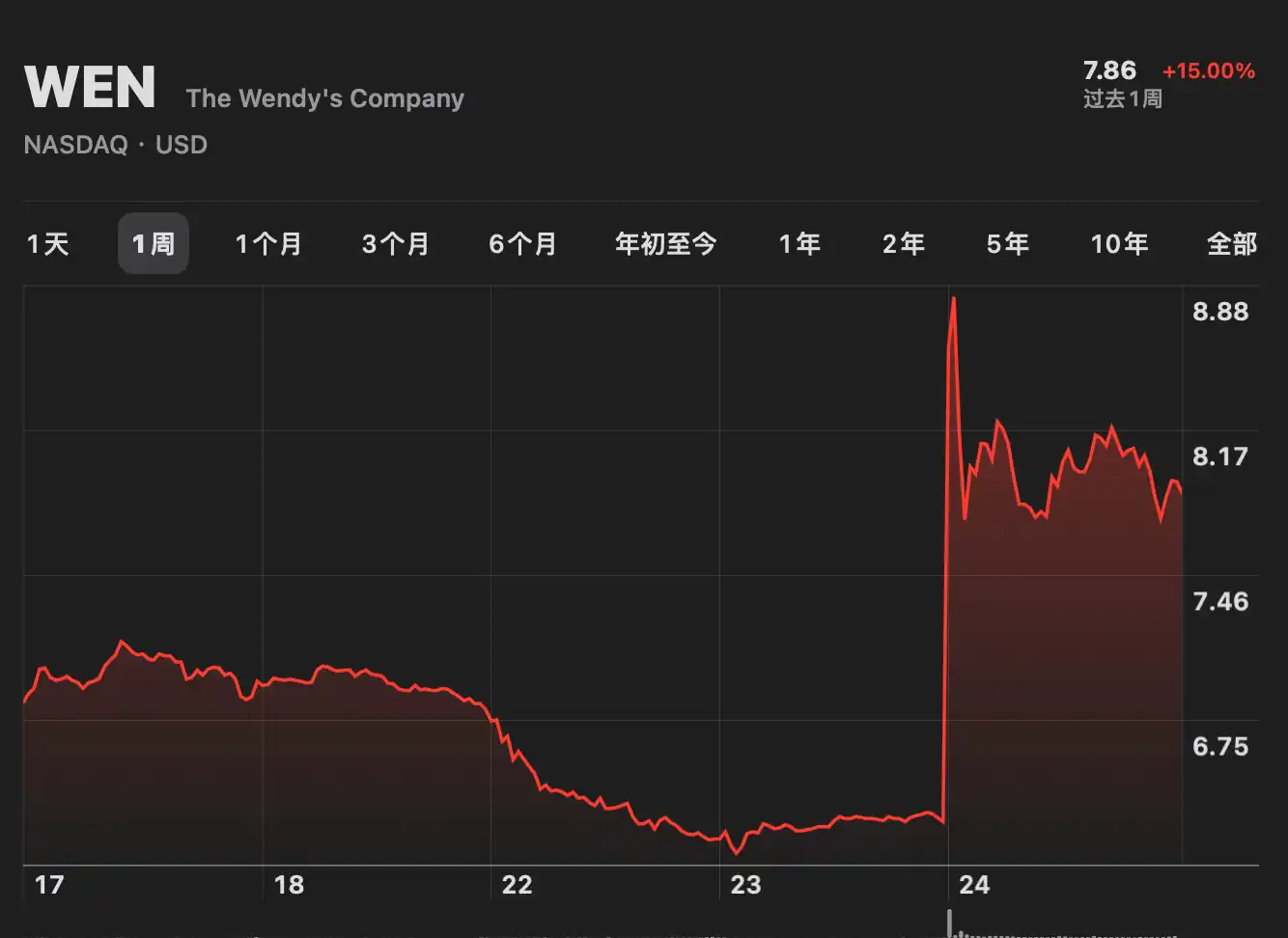
On Wednesday, June 24, Wendy's Company (NASDAQ: WEN) stock price surged as much as 42% intraday, hitting a high of around $8.89, and closed at $7.86, still posting a single-day gain of over 25%. The stock continued to climb in after-hours trading. Just a day earlier, WEN had fallen to a nearly 20-year low of $6.07.

The catalyst for this surge was a post on the Reddit community r/WallStreetBets titled "We need to save Wendy's," which received over 20,000 upvotes.

The poster listed Wendy's steep stock price decline in recent years and half-jokingly wrote, "If this company goes bankrupt, we'll all be out of jobs!" (WallStreetBets users often joke about working at Wendy's).

Volume Soars 20x, High Short Interest Provides Squeeze Conditions

The explosion in trading volume was staggering. According to Yahoo Finance data, WEN traded approximately 203 million shares by the close, compared to an average daily volume of less than 10 million shares—an increase of 1970%. Vanda Research data showed retail traders net purchased about $2.3 million worth of WEN stock in the early session alone.
More critical was the short position.

According to Benzinga Pro data, WEN's short interest as a percentage of free float is as high as 37%. ORTEX estimated the short interest was around 34% on Monday and Tuesday, roughly in line with FINRA data from late May showing just over 30%. This crowded short position is a classic breeding ground for a short squeeze: once the stock price breaks upward, short sellers are forced to cover their positions, creating a buying chain reaction that pushes the price higher, triggering multiple volatility halts intraday.

Even after Wednesday's surge, WEN is still down about 36% over the past year and has fallen 66% cumulatively over the past five years.

More Than a Meme: New Management and Privatization Rumors Provide Fundamental Narrative

Retail enthusiasm isn't entirely built on sentiment.

On Tuesday, WEN announced the appointment of Steve Cirulis as the new CFO and Chief Strategy Officer. He previously worked under CEO Bob Wright at sandwich chain Potbelly. Wright became Wendy's CEO in May of this year. During their partnership, Potbelly's stock rose about 500%. Traders quickly viewed this combination as a turnaround signal.

Another clue is activist investor Nelson Peltz. According to a May report by the Financial Times, Peltz's Trian Fund Management holds about 16% of Wendy's shares, making it the largest shareholder with over 30 million shares, and is seeking external funding, including from Middle Eastern investors, to push for Wendy's privatization. Trian partner Peter May and Peltz's son, Bradley Peltz, both serve on Wendy's board. May recently increased his stake in WEN at prices below Wednesday's opening price.

According to Proactive Investors, Wendy's still faces significant fundamental pressure. In Q1 2026, U.S. same-store sales fell 7.8%, global same-store sales fell 6.8%, and net profit fell 42% year-over-year. High beef costs and weak consumer spending continue to drag on performance.

Fast-Food Sector Ripple: Jack in the Box Rides the Wave with 15% Gain

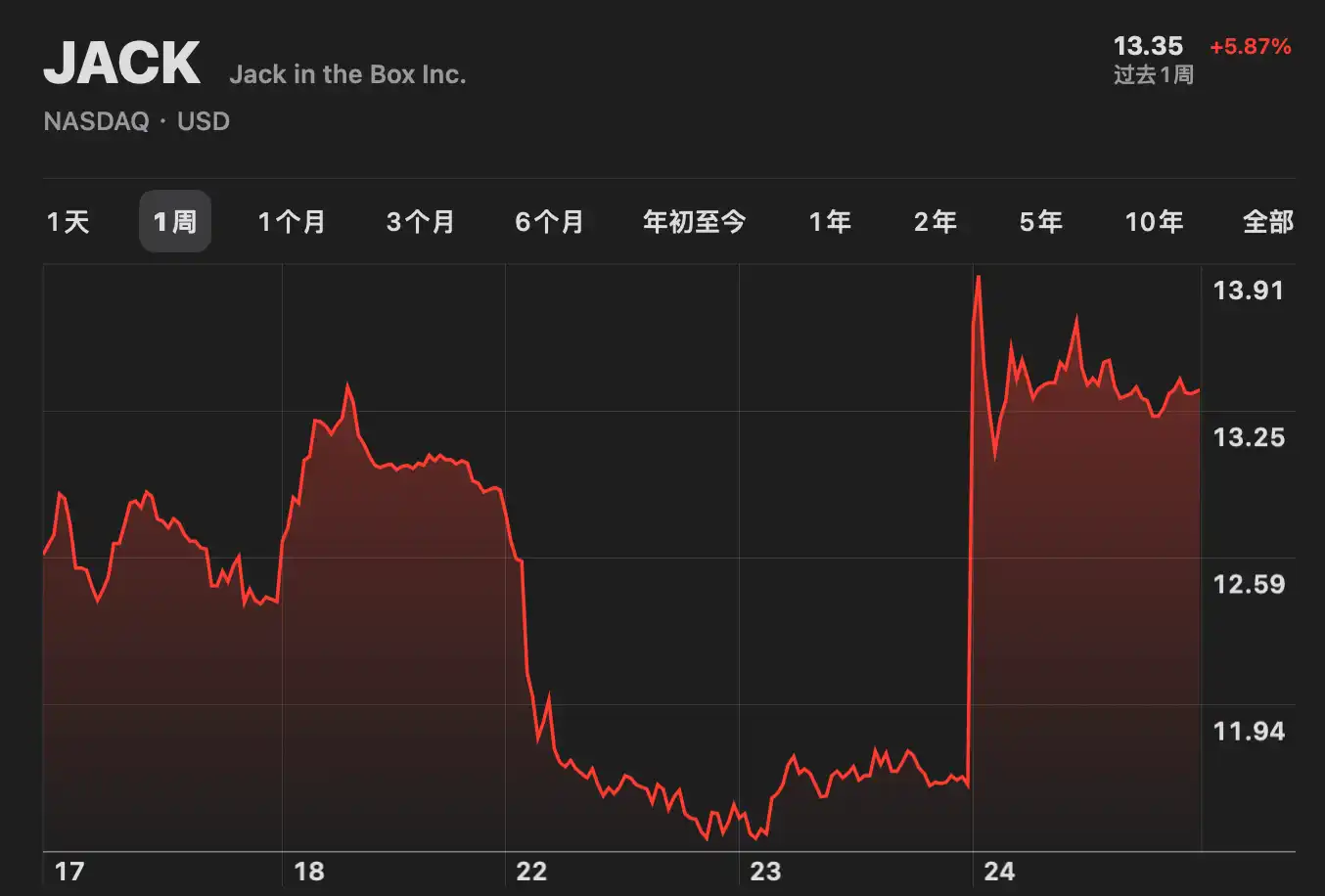
Wendy's surge triggered a broader sector rally. According to Seeking Alpha, Jack in the Box (NASDAQ: JACK) recorded its best single-day performance in nearly five years on Wednesday, gaining over 15%. Approximately one-third of JACK's free float is shorted, and the influx of meme retail traders triggered massive short covering.
This phenomenon mirrors the 2021 GameStop event: the WallStreetBets community is targeting not just individual stocks, but a category of stocks with high short interest, high brand recognition, and long-term depressed prices. Stocks previously pushed by this community include AMC, Bed Bath & Beyond, and Carvana. Wendy's has now topped the trending list on the financial social platform StockTwits.

Crypto Market Follows Suit, Solana-Based WEN Token Soars Over 1450% in 24 Hours

Retail enthusiasm quickly spread to the crypto space. According to Decrypt, a meme coin named "WEN" (with no affiliation to Wendy's Company) was created on Pump.fun, a token launch platform on the Solana blockchain. Its market capitalization skyrocketed to $439,000 within 24 hours, an increase of over 1450%.

The original Reddit post promoter advertised this token (Solana address starting with "Eav7v") in their profile, directly grafting the stock meme narrative onto the crypto market.

This transmission path from traditional market meme stocks to on-chain meme coins also occurred during the previous GameStop event and has become a standard feature of retail trader movements.


Trending Cryptos

Related Questions

QWhat was the direct cause of Wendy's (WEN) stock price surge on June 24th?

AA post titled "We need to save Wendy's" on the Reddit forum r/WallStreetBets, which garnered over 20,000 upvotes, directly ignited the surge. It rallied retail investors to buy the stock.

QWhat key market condition, highlighted in the article, contributed to the dramatic price increase of WEN stock?

AThe high short interest in WEN stock, estimated at around 34-37% of the free float, created conditions for a short squeeze. This forced short sellers to buy back shares to cover their positions, amplifying the upward price movement.

QApart from the meme-fueled rally, what two fundamental factors provided a supportive narrative for Wendy's?

AFirst, the appointment of a new management team (CEO Bob Wright and new CFO Steve Cirulis) who had previously driven significant growth at Potbelly. Second, reports that activist investor Nelson Peltz, the largest shareholder, was exploring a potential privatization deal for the company.

QHow did the 'meme stock' activity surrounding Wendy's (WEN) impact the broader market according to the article?

AIt triggered a sector-wide rally in fast-food stocks. Specifically, Jack in the Box (JACK), which also had high short interest, saw its best single-day performance in nearly five years, rising over 15% due to similar meme-driven buying and short covering.

QHow did the event extend into the cryptocurrency market?

AA memecoin named "WEN" with no official connection to the company was created on the Solana blockchain via Pump.fun. Its market capitalization surged over 1450% to $439,000 within 24 hours, as the stock meme narrative spilled over into the crypto space.

Related Reads

New ChatGPT Feature: AI Begins Monitoring Users

OpenAI has launched "Computer History," a new feature for its ChatGPT desktop app on macOS, designed to track user activity across applications and websites. This allows the AI model to use this data to provide more accurate and personalized responses in subsequent conversations. The feature, released on August 13th, is available to Pro, Business, and Enterprise subscribers. However, its rollout in the European Economic Area, the UK, and Switzerland is delayed as OpenAI works to align the tool with local data processing regulations. Computer History operates in the background, logging user activity into a temporary timeline. Users can review, manage, or delete this history via the app's interface or macOS menu bar. The feature is opt-in and requires explicit user activation in the settings. This release replaces and expands upon an earlier experimental project called Chronicle. OpenAI states the new version is more computationally efficient and offers improved privacy controls. The launch coincides with other AI advancements from the company, including a high-speed GPT-5.6 model. The article notes potential technical risks associated with the predecessor, Chronicle, such as prompt injection vulnerabilities and unencrypted local data storage. It also highlights the competitive landscape, where similar memory features are being developed by rivals like Anthropic's Claude and Google's Gemini. The delayed European rollout underscores the ongoing challenge of balancing deep personalization with stringent data protection laws.

cryptonews.ru52m ago

New ChatGPT Feature: AI Begins Monitoring Users

cryptonews.ru52m ago

GPT-5 Also Has Tip-of-the-Tongue Moments, Google Tested 4.5 Million Times: The Keys Are Lost

Google researchers have discovered that advanced AI models like GPT-5 and Gemini 3 experience a phenomenon akin to the human "tip-of-the-tongue" state, where they possess knowledge but fail to retrieve it. Their study, "Empty Shelves or Lost Keys?" (ICML 2026), introduces the "Knowledge Portrait" framework to analyze factual knowledge in models, distinguishing between failure to encode a fact versus failure to recall it. Testing on 13 models across 2.15 million queries from the WikiProfile benchmark revealed that state-of-the-art models successfully encode 95-98% of facts into their parameters. However, when asked directly, they fail to recall 26-34% of these known facts. Enabling chain-of-thought ("thinking") reasoning reduces this recall failure to 11-12%, recovering 40-65% of the previously unrecalled but encoded facts. The research identifies two key bottlenecks: recalling obscure ("long-tail") facts and answering reversed queries (e.g., "Who is Tom Cruise's mother?" vs. "Whose son is Tom Cruise?"). While scaling model size effectively reduces encoding failures, it does little to improve recall rates. In larger models, recall failure becomes the dominant source of factual errors, accounting for over 70% of mistakes in GPT-5.2. The findings suggest that for top models, the primary challenge is no longer storing knowledge but accessing it efficiently. Future accuracy gains may depend more on improved inference-time methods and "meta-cognitive" abilities, enabling models to recognize when they need to engage in deeper reasoning to retrieve information they already know.

marsbit1h ago

GPT-5 Also Has Tip-of-the-Tongue Moments, Google Tested 4.5 Million Times: The Keys Are Lost

marsbit1h ago

Trading

Spot

Hot Articles

Discussions

Welcome to the HTX Community. Here, you can stay informed about the latest platform developments and gain access to professional market insights. Users' opinions on the price of MEME (MEME) are presented below.

活动图片