XRP Fracasa Ante Su Rival XLM: Por Qué Los Pequeños Inversores Están Cambiando Uno Por El Otro

bitcoinistPublished on 2026-06-03Last updated on 2026-06-03

Abstract

La rivalidad entre XRP y Stellar (XLM) continúa, pero un cambio reciente en Corea del Sur muestra a los traders minoristas vendiendo XRP para comprar XLM. En el principal exchange del país, Upbit, el volumen de XLM superó por primera vez al de XRP, registrando 252,3 millones de dólares frente a 125,7 millones. Este giro se atribuye al creciente interés en el papel de Stellar en las finanzas tokenizadas, impulsado por noticias sobre su colaboración con el DTCC. Mientras XLM subió más del 55% la semana pasada, XRP cayó por debajo de 1,3 dólares. No obstante, algunos analistas sugieren que XRP, tras el rally de XLM, podría estar preparado para su propio movimiento alcista, con proyecciones especulativas que apuntan a máximos históricos significativos.

La rivalidad entre XRP y Stellar (XLM) ha durado años, con los inversores comparando a menudo las dos criptomonedas centradas en pagos debido a sus orígenes compartidos y casos de uso similares. Si bien XRP ha mantenido durante mucho tiempo una mayor presencia en el mercado, XLM parece estar ganando ventaja en algunas regiones. Un nuevo informe muestra que los pequeños inversores en Corea del Sur ahora están vendiendo XRP para comprar XLM, impulsando un aumento en el valor de mercado de Stellar mientras el precio de XRP sigue bajando.

XLM Supera A XRP En Volumen De Negociación En Corea Del Sur

El token nativo de Stellar, XLM, se ha adelantado a XRP en un cambio importante en el mayor exchange de criptomonedas de Corea del Sur, Upbit. Este desarrollo se produce a medida que los pequeños inversores acuden en masa a XLM, impulsando su actividad de negociación por encima de uno de los activos digitales más populares del país.

Los datos compartidos por el analista de mercado Xaif Crypto muestran que XLM registró aproximadamente 252,3 millones de dólares en volumen de negociación de 24 horas en Upbit. XRP, en comparación, registró alrededor de 125,7 millones de dólares durante el mismo período, menos de la mitad del volumen visto en XLM. Esta brecha asombrosa marca la primera vez que XLM supera a XRP en volumen de negociación, situándose ahora en el número uno en Upbit.
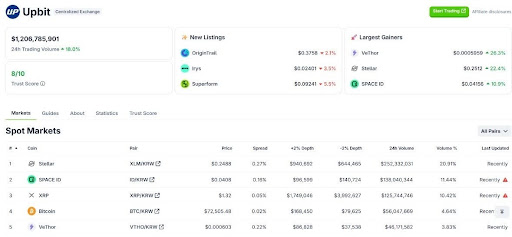
Fuente: CoinCodex

El último repunte se produce después de que aumentara el interés por el papel de Stellar en las finanzas tokenizadas en Corea del Sur. Los operadores reaccionaron positivamente a los planes recientes que vinculan la red blockchain con los esfuerzos de tokenización que involucran al Depository Trust & Clearing Corporation (DTCC) de EE. UU., una de las mayores empresas de infraestructura de mercado financiero del mundo.

Las noticias del DTCC ayudaron a impulsar una nueva demanda de XLM entre los inversores surcoreanos, que suelen preferir negociar XRP. En particular, XLM también ha registrado fuertes ganancias de precio junto con el aumento en la actividad de negociación. Los informes muestran que el token subió más del 55% hasta los 11 dólares durante la semana pasada, mientras el impulso continuaba construyéndose en todo el mercado. XRP, mientras tanto, ha tenido dificultades para igualar el rally, incluso cayendo por debajo de 1,3 dólares, a pesar de su larga popularidad entre los operadores surcoreanos.

Este cambio en el interés y la demanda es notable porque XRP ha sido históricamente una de las criptomonedas más negociadas en mercados asiáticos como Corea del Sur, Japón y Tailandia. Hace solo semanas, XRP lideraba el volumen de negociación en Upbit de Corea del Sur por delante de Bitcoin y Ethereum. Sin embargo, las últimas cifras sugieren que la atención minorista ahora se ha desplazado hacia XLM a medida que los operadores persiguen el impulso más fuerte en el mercado.

Un Analista Predice Un Rally Alcista Para XRP Tras El De XLM

En un análisis separado, el analista de criptomonedas CW cree que XRP podría ser el próximo gran ganador tras el reciente avance de Stellar. En una publicación compartida en X, el analista dijo que el rally alcista de XLM ya ha comenzado y sugirió que XRP ahora está en una posición similar antes de su propio movimiento al alza.

Según CW, XRP está esperando una "señal de inicio" y actualmente se negocia alrededor del mismo nivel en el que estaba XLM antes de su reciente rally de precios del 57%. El analista argumentó que XRP podría seguir el camino alcista de XLM si el impulso continúa creciendo.
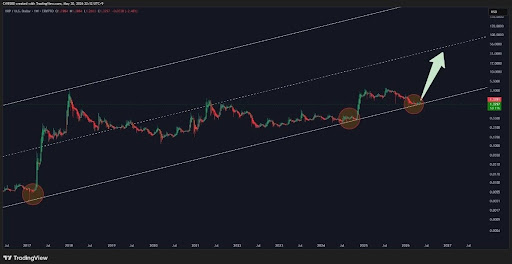
Fuente: X

Sin embargo, el gráfico de CW proyecta un movimiento mucho mayor para XRP, apuntando a posibles nuevos máximos históricos cerca de 56 dólares. Si bien la predicción sigue siendo altamente especulativa y ambiciosa dado el bajo precio actual de la criptomoneda, refleja un creciente optimismo entre algunos participantes del mercado que creen que XRP aún tiene que realizar su mayor movimiento en el ciclo actual.

El precio sigue la trayectoria bajista del mercado | Fuente: XRPUSDT en Tradingview.com

Related Questions

Q¿Qué está sucediendo actualmente con los traders minoristas de Corea del Sur en relación con XRP y XLM?

ALos traders minoristas en Corea del Sur están vendiendo XRP y comprando XLM, lo que está impulsando un aumento en el valor de mercado de Stellar mientras el precio de XRP continúa cayendo.

Q¿En qué intercambio de Corea del Sur XLM ha superado a XRP en volumen de negociación?

AXLM ha superado a XRP en volumen de negociación en Upbit, el intercambio de criptomonedas más grande de Corea del Sur.

QSegún el artículo, ¿qué noticia específica ha impulsado la nueva demanda de XLM entre los inversores surcoreanos?

ALa demanda de XLM entre los inversores surcoreanos se ha visto impulsada por los planes recientes que vinculan la red blockchain de Stellar con los esfuerzos de tokenización que involucran al Depository Trust & Clearing Corporation (DTCC) de EE. UU.

Q¿Qué pronostica el analista CW para XRP después del repunte de XLM?

AEl analista CW cree que XRP podría ser el próximo gran ganador y podría seguir el camino alcista de XLM, proyectando incluso un movimiento potencial hacia máximos históricos cercanos a los $56, aunque reconoce que esta predicción es altamente especulativa.

Q¿Por qué es significativo el cambio en el interés de los traders minoristas de Corea del Sur hacia XLM?

AEste cambio es significativo porque XRP históricamente ha sido una de las criptomonedas más negociadas en mercados asiáticos como Corea del Sur. Hace solo unas semanas, XRP lideraba el volumen de negociación en Upbit, por delante de Bitcoin y Ethereum, lo que demuestra un cambio notable en la atención de los traders minoristas.

Related Reads

Focus: Five Leading AI Stocks on Nasdaq

The report analyzes five Nasdaq-listed AI infrastructure stocks—Micron (MU), MaxLinear (MXL), AMD, Lumentum (LITE), and Vicor (VICR)—as distinct plays within the AI capital expenditure chain, rather than a single "AI trade." While all benefit from AI data center spending, they differ in their specific roles (e.g., memory, computing, optics, power, connectivity), financial resilience, and risk profiles. The author argues that the key question is not whether the AI narrative remains intact, but whether capital expenditure translates into real orders, earnings justify valuations, and portfolios can withstand high volatility. Historical data shows these stocks have significantly outperformed benchmarks but also experienced deeper drawdowns (~28% to -32%), highlighting their high-beta, high-volatility nature. An investment framework is proposed: core positions (e.g., MU, AMD) for stocks with stronger fundamental evidence; satellite positions (e.g., LITE, VICR) for high-potential, high-volatility names; and cautious observation (e.g., MXL) for smaller-cap ideas with unproven financials. The emphasis is on disciplined, phased buying during pullbacks—only when price corrections align with intact fundamentals and available risk budget—rather than emotional "buy-the-dip" strategies. Overall, AI infrastructure offers long-term potential, but success requires strict position sizing, role definition for each holding, and preparedness for significant volatility.

marsbit16m ago

Focus: Five Leading AI Stocks on Nasdaq

marsbit16m ago

Will UNI Reach $100 in Four Years? Will Standard Chartered's Prediction Come True?

TL;DR: - According to reports, Standard Chartered Bank has published a research report on Uniswap, setting a 2030 price target of $100 for the UNI token. - The bank's core logic is that the tokenization of assets will drive demand for open DeFi liquidity, and Uniswap could capture significant trading volume and fee revenue. - However, most institutional-grade tokenized products are permissioned, and the example of BlackRock's BUIDL shows that DeFi still faces significant access barriers. Standard Chartered's $100 target for UNI by 2030 is based on the hypothesis that tokenized assets will grow massively and a significant portion will flow into open DeFi markets, requiring decentralized exchange platforms like Uniswap for liquidity. The bank forecasts tokenized assets could reach $4 trillion by 2028, with up to 30% in DeFi by 2030. The key question is whether tokenized assets like treasuries and funds will trade in open, decentralized markets or remain within closed, permissioned institutional systems. This directly impacts Uniswap's potential growth. A real-world example is BlackRock's BUIDL fund, which, while using UniswapX for trading, is strictly limited to pre-approved, whitelisted institutional participants. This highlights the current trend: institutions may leverage DeFi infrastructure but maintain strict control over access and transfers. Furthermore, for UNI's value to rise significantly, Uniswap must establish a clear value-capture mechanism, such as the approved fee switch and token burn proposal. Regulatory and interoperability hurdles also persist, as noted by bodies like the Financial Stability Board. In summary, Standard Chartered's bold prediction hinges on the future flow of tokenized asset liquidity. While it signals institutional recognition of DeFi's potential, the path to $100 depends on overcoming current permissioned models and enabling truly open, cross-asset liquidity pools on platforms like Uniswap.

Foresight News20m ago

Will UNI Reach $100 in Four Years? Will Standard Chartered's Prediction Come True?

Foresight News20m ago

Odaily Editorial Team Tea Talk (June 17)

Odaily Editorial Team Casual Chat (June 17) This is an informal column sharing real-time thoughts from Odaily's editorial team on industry news, data, and events. The content is based on actual investment and observations, does not constitute investment advice, and aims to expand perspectives. Azuma shared recent operations: small-scale buys in crypto (mainly BTC) at relatively high levels, a small addition to HOOD stock, and participation in World Cup prediction markets. He also discussed Hyperliquid, noting that while its token HYPE has performed well, its high price may hinder the expansion of its HIP-3 ecosystem by making market creation cost-prohibitive, potentially limiting the platform to just one major market (trade.xyz). Suzz emphasized the importance of a calm mindset in investing, stating that markets offer perpetual opportunities. He warned against "hindsight bias," where past opportunities seem obvious, and stressed that the present always holds new chances for those with the right knowledge and temperament. Golem analyzed SpaceX's acquisition of AI tool Cursor's parent company, Anysphere, for $60 billion paid entirely in SpaceX stock. He speculated whether Musk's interests might work to keep SpaceX's trading volume and market cap high in the short term to reduce the actual equity cost of the deal, noting current high retail investor enthusiasm. Wenser shared a market outlook: cautiously bullish on BTC, monitoring SpaceX stock post-IPO for a potential rise, observing World Cup trends favoring strong teams, and noting the continued strength of Japanese and Korean stocks. He highlighted Anthropic's potential for a massive future IPO and the defensive investment logic in "picks and shovels" AI infrastructure. Qin Xiaofeng discussed trading HYPE around $56-$70, viewing the $50-$60 range as long-term support due to Hyperliquid's dominance in on-chain traditional asset trading and its substantial fee revenue used to buy back HYPE. On ETH, he noted a divide between disappointed crypto natives and bullish traditional investors like Tom Lee, personally viewing current ETH prices as undervalued.

Odaily星球日报31m ago

Odaily Editorial Team Tea Talk (June 17)

Odaily星球日报31m ago

Under the Shock of Oil Prices and Inflation, Which Country Will Be the First to Sell Off Its Gold Reserves?

The article draws a parallel between the 2003 North American blackout and the potential collapse of the global financial system, framing the US dollar and Treasury market as the world's economic "power grid." It argues that the closure of the Strait of Hormuz is creating a shockwave, starting with oil-importing emerging markets like Turkey, India, and Indonesia. As oil prices rise, these nations are forced to sell dollar-denominated assets—first US Treasuries, then potentially their gold reserves—to afford fuel. Turkey is highlighted as a key case, having sold nearly 90% of its Treasuries and begun tapping gold reserves when oil was between $70-$105/barrel. The article warns that if prices spike to $150-$160/barrel, global buffers like oil inventories and strategic reserves will be depleted. This could trigger a cascade: vulnerable nations, having exhausted assets, could face economic and political collapse (like Sri Lanka in 2022). Their forced asset sales would drive US Treasury yields higher, potentially past a critical threshold (around 5%), forcing the US to choose between a bond market crash or hyperinflation through massive money printing. Ultimately, the piece posits that the dollar's long-term decline is inevitable. The first domino to fall will likely be a fragile emerging market, signaling the start of a chain reaction that eventually threatens the core of the dollar system. The conclusion advises holding tangible assets like gold and energy, which cannot be printed, as a hedge against currency devaluation.

marsbit56m ago

Under the Shock of Oil Prices and Inflation, Which Country Will Be the First to Sell Off Its Gold Reserves?

marsbit56m ago

Trading

Spot
Futures

Hot Articles

What is XRP 2.0

XRP 2.0: A New Frontier in the Cryptocurrency Landscape Introduction to XRP 2.0 In the ever-evolving realm of cryptocurrency, new projects continuously emerge, vying for attention and adoption. One such promising initiative is XRP 2.0, a novel cryptocurrency project designed to leverage advanced blockchain technology and robust encryption methodologies. While the name draws parallels with Ripple’s XRP, it’s crucial to note that XRP 2.0 operates independently, focusing on enhancing transaction security, privacy, and scalability. As the digital financial landscape increasingly embraces decentralized solutions, XRP 2.0 aims to contribute meaningfully to web3 and the overall expansion of crypto projects. What is XRP 2.0? At its core, XRP 2.0 is a cryptocurrency project that aims to create a secure and decentralized digital currency ecosystem. Its foundational technology integrates sophisticated blockchain principles with cutting-edge encryption techniques. The overarching goal of XRP 2.0 is to establish itself as a reliable and efficient platform enabling swift transaction execution while prioritizing enhanced privacy protections for its users. The project is promoted as a solution to many limitations faced by existing cryptocurrencies, proposing a system that can handle a higher volume of transactions with improved speed and privacy. This versatility positions XRP 2.0 as a significant contender in a marketplace riddled with various digital currencies. Who is the Creator of XRP 2.0? The identity of the creator behind XRP 2.0 has been flagged as ‘Wilbur.’ However, comprehensive details regarding Wilbur or their associated entity remain elusive. The anonymity of many cryptocurrency creators is not an uncommon phenomenon in the industry, often designed to maintain a degree of privacy and security. Who are the Investors of XRP 2.0? As of now, specific information related to the investment foundations or organizations supporting XRP 2.0 is not publicly available. In the cryptocurrency sector, the backing by reputed investors can significantly influence a project's credibility and success, yet the transparency regarding the financial supporters of XRP 2.0 has not been established. How Does XRP 2.0 Work? XRP 2.0 stands out by employing a combination of blockchain technology and advanced encryption algorithms that ensures secure and decentralized transactions. Its innovative structure includes unique features designed to foster user engagement and broaden functionalities beyond conventional cryptocurrency transactions. Among these features, XRP 2.0 incorporates AI-powered capabilities, such as text-to-image and text-to-speech functionalities. These additions are designed to enhance the interactive experience for users, promoting broader applicability across various sectors. By bridging technological advancements with user-centered design, XRP 2.0 aims to capture the attention of a diverse range of individuals and enterprises looking to integrate cryptocurrency solutions into their operational frameworks. Timeline of XRP 2.0 Understanding XRP 2.0 requires examining the milestones that have defined its journey thus far: July 23, 2023: XRP 2.0 is introduced as a novel cryptocurrency project, aiming to revolutionize secure and decentralized transaction capabilities in the blockchain domain. September 8, 2023: The launching of another project, XRP20, occurs, marking the emergence of an ERC-20 token on the Ethereum blockchain that remains unrelated to XRP 2.0. November 13, 2023: The XRP Ledger undergoes a significant update with the release of rippled server software version 2.0.0. It is essential to note that this development is disconnected from the XRP 2.0 cryptocurrency project. Key Points About XRP 2.0 To distill the essence of XRP 2.0, several critical factors emerge: Unique Features: The inclusion of features like AI-powered text-to-image and text-to-speech further diversifies the potential applications of XRP 2.0. Blockchain Technology: The framework utilizes advanced blockchain mechanisms and encryption protocols, ensuring a secure and decentralized environment for transactions. Scalability and Privacy: XRP 2.0 prioritizes enhanced privacy protections in transaction processes and the scalability necessary to accommodate a growing user base. No Affiliation with Ripple: Importantly, despite its name, XRP 2.0 does not have any allegiance or collaboration with Ripple’s XRP, distinguishing its operational framework and objectives within the cryptocurrency ecosystem. Conclusion XRP 2.0 represents an ambitious venture into the cryptocurrency sphere, aiming to offer a combination of security, privacy, and efficiency in digital transactions. By integrating sophisticated technologies and user-friendly features, the project sets out to broaden the horizons of what cryptocurrency can achieve in today's digital economy. While the anonymity of its creator and lack of disclosed investors might raise questions for some, XRP 2.0's focus on advanced functionalities and decentralisation enhances its appeal amidst an increasingly crowded crypto market. As the cryptocurrency landscape continues to evolve, XRP 2.0 may yet emerge as a pivotal player in the expansion of secure and scalable blockchain solutions.

956 Total ViewsPublished 2024.04.01Updated 2024.12.03

What is XRP 2.0

Discussions

Welcome to the HTX Community. Here, you can stay informed about the latest platform developments and gain access to professional market insights. Users' opinions on the price of XRP (XRP) are presented below.

活动图片















