Les Alliés De La Crypto Gagnent Du Terrain Au Congrès Après Une Victoire Primaire Dans L'Indiana

bitcoinistPublished on 2026-05-08Last updated on 2026-05-08

Abstract

La puissante organisation de financement politique Fairshake, soutenue par des géants de la cryptomonnaie comme Coinbase et Ripple, a dépensé environ 514 000 $ pour soutenir la victoire primaire du républicain James Baird dans l'Indiana. Baird, un défenseur reconnu de l'industrie, a appuyé des projets de loi clés sur les stablecoins et la structure du marché. Cette victoire intervient alors que le projet de loi CLARITY, incluant désormais un compromis sur les rendements des stablecoins, prend de l'ampleur au Sénat. Fairshake, qui dispose d'un trésor de guerre de 193 millions de dollars, a déjà dépensé des millions pour influencer les élections de 2024 et 2026, soulignant la pression croissante du secteur pour une régulation favorable.

Un trésor de guerre de 193 millions de dollars. C'est ce que Fairshake, le comité d'action politique le plus puissant de l'industrie de la crypto, déclarait détenir en janvier — et il dépense cet argent rapidement.

L'Argent Derrière La Victoire

Le républicain de l'Indiana James Baird a remporté facilement la victoire mardi lors de la primaire de son parti pour le 4ème district congressionnel de l'État, recueillant plus de 60 % des voix face à son challenger Craig Haggard et à quelques autres.

Baird avait également le soutien du président américain Donald Trump. Mais une autre force était en sa faveur : Defend American Jobs, un Super PAC lié à Fairshake, a investi environ 514 000 dollars dans des achats médiatiques pour le soutenir avant le vote, selon les déclarations auprès de la Commission électorale fédérale.

Fairshake lui-même est financé par certains des noms les plus importants de la crypto, dont Coinbase et Ripple Labs. Le comité a dépensé plus de 130 millions de dollars pour tenter d'influencer le résultat des élections de 2024. En 2026, il est déjà de nouveau à l'œuvre — environ 10 millions de dollars ont été dirigés vers des courses en Illinois et au Texas jusqu'à présent.
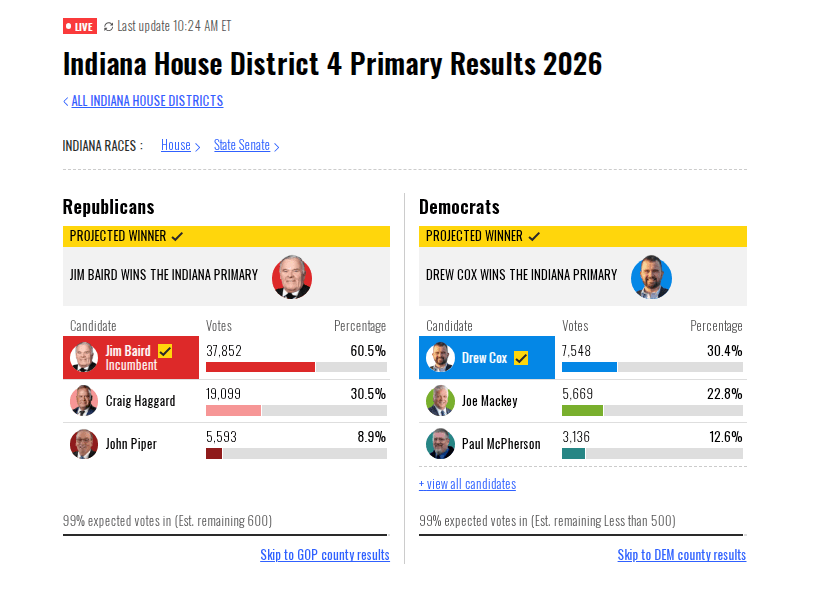
Source : NBC News

Un Vote Fiable Pour L'Industrie

Baird est au Congrès depuis janvier 2019 et a établi un bilan que les défenseurs de la crypto considèrent comme fiable. Il a soutenu le GENIUS Act, qui traite de la régulation des stablecoins, et le CLARITY Act, un projet de loi axé sur la structure du marché de la crypto. Pour Fairshake, il valait la peine d'être protégé.

« Le Représentant Baird a fait ses preuves en tant que leader pour des politiques pro-emploi, pro-consommateur et pro-innovation au Congrès », a déclaré un porte-parole de Fairshake.

« Nous sommes fiers de soutenir des dirigeants engagés en faveur d'une régulation responsable qui garantit que les États-Unis restent le leader mondial de l'innovation. »

Baird aurait publiquement remercié Trump après sa victoire.

Le BTCUSD s'échange à 80 137 $ sur le graphique 24h : TradingView

La Législation Avance

Le résultat dans l'Indiana intervient alors que la législation liée à la crypto prend de l'élan à Washington. La semaine dernière, les sénateurs Thom Tillis et Angela Alsobrooks ont annoncé qu'ils avaient finalisé le texte du CLARITY Act pour inclure un compromis sur le rendement des stablecoins — un point de friction qui avait bloqué le projet de loi pendant des mois.

La Commission bancaire du Sénat n'avait pas encore programmé d'examen en commission (« markup ») mercredi, mais de nombreux observateurs s'attendent à ce que l'accord sur les stablecoins fasse avancer la législation plus large sur la structure du marché.

La relation de Trump avec l'industrie de la crypto a attiré l'attention parallèlement à ces développements. Plusieurs sénateurs ont déclaré qu'ils ne soutiendraient pas le CLARITY Act sans des dispositions éthiques qui y soient attachées.

Le sénateur Tillis faisait partie de ceux qui ont déclaré publiquement qu'il ne soutiendrait pas le projet de loi sans de telles mesures de protection en place.

Image mise en avant de MetaAI, graphique de TradingView

Related Questions

QQuel est le montant déclaré par le comité d'action politique Fairshake au mois de janvier, et comment est-il utilisé ?

ALe comité d'action politique Fairshake a déclaré détenir 193 millions de dollars en janvier. Il dépense cet argent rapidement, ayant déjà dépensé plus de 130 millions de dollars pour tenter d'influencer les élections de 2024, et environ 10 millions de dollars supplémentaires pour des élections en Illinois et au Texas en 2026.

QComment le Super PAC Defend American Jobs a-t-il soutenu la candidature de James Baird en Indiana ?

ALe Super PAC Defend American Jobs, lié à Fairshake, a investi environ 514 000 dollars dans des achats de médias pour soutenir James Baird avant la primaire républicaine du 4e district du Congrès de l'Indiana.

QQuels sont les projets de loi soutenus par le représentant James Baird qui sont favorables à l'industrie des cryptomonnaies ?

ALe représentant James Baird a soutenu le GENIUS Act, qui concerne la réglementation des stablecoins, et le CLARITY Act, un projet de loi axé sur la structure du marché des cryptomonnaies.

QQuel est l'état d'avancement du CLARITY Act au Sénat américain, selon l'article ?

ALes sénateurs Thom Tillis et Angela Alsobrooks ont finalisé la rédaction du CLARITY Act pour inclure un compromis sur le rendement des stablecoins, un point de friction qui bloquait le projet de loi depuis des mois. Le Comité bancaire du Sénat n'avait pas encore programmé d'examen officiel au moment de la rédaction, mais un accord sur les stablecoins pourrait faire avancer la législation globale sur la structure du marché.

QPourquoi certains sénateurs refusent-ils de soutenir le CLARITY Act sans modifications supplémentaires ?

APlusieurs sénateurs, dont Thom Tillis, ont déclaré qu'ils ne soutiendraient pas le CLARITY Act sans y ajouter des dispositions éthiques, exprimant des préoccupations liées notamment aux relations de l'ancien président Donald Trump avec l'industrie des cryptomonnaies.

Related Reads

M&A Deals Are Exceptionally Active in the Crypto Market

Mergers and acquisitions (M&A) activity in the cryptocurrency primary market has reached a historic high, accounting for approximately 42% of total deals in the current month, nearly matching the number of financing rounds. This shift does not signal a new boom cycle but rather reflects a severe contraction in the venture capital funding environment. As financing dwindles, established industry giants—including major exchanges, payment firms, and infrastructure providers—are seizing the opportunity to acquire strategic assets at lower valuations. Key drivers behind the surge in M&A include depressed project valuations, the need to quickly acquire talent and technology to capture short market windows, the pursuit of crucial regulatory licenses, and the strategic expansion into adjacent business verticals such as derivatives, payments, stablecoins, and real-world asset (RWA) issuance. Major acquisitions, like Coinbase's purchase of Deribit and Kraken's acquisition of NinjaTrader, exemplify the push to expand into high-margin areas like derivatives and multi-asset trading. This trend is reshaping the industry's exit landscape, offering an alternative to token-based exits and incentivizing startups to build tangible products and revenue streams with inherent strategic value for acquisition. However, it also points toward increasing centralization, as critical functions—trading, custody, payments, compliance—become concentrated within a few large, well-capitalized platforms, potentially raising barriers to entry for new ventures.

marsbit2m ago

M&A Deals Are Exceptionally Active in the Crypto Market

marsbit2m ago

Solana Privacy Ecosystem Panorama: A Complete Privacy Stack from Compute to AI

**Title: The Solana Privacy Ecosystem: A Full-Stack View from Compute to AI** **Summary:** This article provides a comprehensive overview of the emerging privacy landscape on the Solana blockchain, characterizing it as still in early development. It identifies two primary verticals—Neobanks and Private DeFi—as key drivers, while noting gaps in tooling and user experience. The discussion centers on two main approaches to private computation: Arcium, which utilizes Multi-Party Computation (MPC) networks (Multi-Party eXecution Environments) to process encrypted data with final settlement on Solana; and Magic Block, which leverages Trusted Execution Environments (TEEs) via its Private Ephemeral Rollup (PER). Both enable confidential applications like dark pools and private DeFi with minimal code changes. Building on this infrastructure, projects are creating privacy-focused applications. Umbra, built on Arcium, offers Encrypted Token Accounts (ETAs) for private balances, transfers, and selective disclosure for compliance. Other wallets like Privacy Cash and Hush provide mixer-like functionality for SOL. For private trading, encifherio uses TEEs to encrypt swap details routed through Jupiter, while VanishTrade and Darklake focus on shielding transaction intent and liquidity routing, with Darklake introducing a "blind slippage pool" to prevent front-running. Further applications include private prediction markets (e.g., Melee Markets using Arcium's encrypted order books) and private AI. Loyal exemplifies the latter, using both Magic Block and Arcium to enable decentralized AI agents that store user data, conversations, and transactions confidentially on-chain. The article concludes by framing privacy not as a single technology but as an evolving "ultimate privacy stack," with experts like Helius's Mert envisioning a future combination of Fully Homomorphic Encryption (FHE) and Zero-Knowledge proofs (ZK). Helius Privacy itself is developing a ZK-based UTXO privacy layer for Solana.

Foresight News7m ago

Solana Privacy Ecosystem Panorama: A Complete Privacy Stack from Compute to AI

Foresight News7m ago

7 Key Questions Regarding 'DeepSeek Completes Over 50 Billion Yuan in Financing'

DeepSeek, the prominent Chinese AI company, has reportedly completed its first external funding round, raising over 50 billion RMB (approximately $6.9 billion USD), according to foreign media reports. This financing values the company at over $50 billion USD, a significant increase from a $10 billion valuation when the round began in April 2026. Founder Liang Wenfeng personally contributed 20 billion RMB, with other investors including Tencent, CATL (Contemporary Amperex Technology), JD.com, NetEase, and IDG Capital. Notably, the National Artificial Intelligence Industry Investment Fund also participated with a direct investment of 1 billion RMB. The funding round is distinctive for its structure. Most investors' capital is channeled into a limited partnership controlled by CEO Liang Wenfeng, rather than directly into DeepSeek. These investors face a five-year lock-up period, have no voting rights, but receive priority financial information and future investment rights. This arrangement is seen as a measure to ensure Liang's absolute control over the company's direction, aligning with its stated principles of prioritizing groundbreaking AGI (Artificial General Intelligence) research over short-term profitability. The report highlights strategic reasons for key investors. Tencent's involvement is viewed as a strategic alignment, building on existing collaborations. CATL's investment is linked to the critical energy and power infrastructure needed for AI data centers, a key growth area for the battery giant. The participation of a state-backed fund underscores the national strategic importance of AI development. Post-funding, DeepSeek is expected to accelerate infrastructure development, including building its own data centers, hire more talent, and release new model versions with enhanced capabilities like image and audio support. While this marks a major step, the company's long-term journey towards AGI remains a challenging path that will require balancing its foundational ideals with the expectations of its new investors.

marsbit53m ago

7 Key Questions Regarding 'DeepSeek Completes Over 50 Billion Yuan in Financing'

marsbit53m ago

The World Cup is Here: The Battle for Entry into Prediction Markets Has Begun

The 2026 FIFA World Cup has begun, and alongside the on-field competition, a new off-field battleground is emerging: prediction markets. These blockchain-based platforms, which convert crowd wisdom into tradable probabilities, are gaining significant traction. However, their complexity—involving wallets, gas fees, and smart contracts—has historically limited participation to crypto-native users. Centralized exchanges (CEXs), like Gate, are tackling this adoption barrier. By integrating with leading prediction market protocol Polymarket, Gate simplifies the user experience. Users can participate directly with their exchange account and USDT, bypassing complex Web3 steps. Gate offers a streamlined "Prediction Mode" for casual users and a professional "Trading Mode" with advanced tools. Key features include two-way trading (allowing users to buy or sell positions before event resolution), support for diverse markets (sports, crypto, macroeconomics), and a suite of information tools like a "Smart Money" leaderboard, wallet tracking, and AI-powered insights. For the World Cup, Gate launched a dedicated hub aggregating schedules, standings, and relevant markets. This allows fans to seamlessly follow games and trade on outcomes, transforming passive viewing into active participation where they can monetize their predictions and trade on shifting consensus throughout a match. The article argues that prediction markets have proven their value in event forecasting. The next challenge is mass adoption. The competition is shifting from building effective protocols to creating accessible user entry points. By lowering technical barriers and building a complete ecosystem for information and trading, platforms like Gate aim to transition prediction markets from a niche crypto tool to a mainstream platform for expressing and trading on collective intelligence.

Odaily星球日报1h ago

The World Cup is Here: The Battle for Entry into Prediction Markets Has Begun

Odaily星球日报1h ago

Trading

Spot
Futures

Hot Articles

How to Buy WIN

Welcome to HTX.com! We've made purchasing WINkLink (WIN) simple and convenient. Follow our step-by-step guide to embark on your crypto journey.Step 1: Create Your HTX AccountUse your email or phone number to sign up for a free account on HTX. Experience a hassle-free registration journey and unlock all features.Get My AccountStep 2: Go to Buy Crypto and Choose Your Payment MethodCredit/Debit Card: Use your Visa or Mastercard to buy WINkLink (WIN) instantly.Balance: Use funds from your HTX account balance to trade seamlessly.Third Parties: We've added popular payment methods such as Google Pay and Apple Pay to enhance convenience.P2P: Trade directly with other users on HTX.Over-the-Counter (OTC): We offer tailor-made services and competitive exchange rates for traders.Step 3: Store Your WINkLink (WIN)After purchasing your WINkLink (WIN), store it in your HTX account. Alternatively, you can send it elsewhere via blockchain transfer or use it to trade other cryptocurrencies.Step 4: Trade WINkLink (WIN)Easily trade WINkLink (WIN) on HTX's spot market. Simply access your account, select your trading pair, execute your trades, and monitor in real-time. We offer a user-friendly experience for both beginners and seasoned traders.

5.2k Total ViewsPublished 2024.03.29Updated 2026.06.02

How to Buy WIN

Discussions

Welcome to the HTX Community. Here, you can stay informed about the latest platform developments and gain access to professional market insights. Users' opinions on the price of WIN (WIN) are presented below.

活动图片