By Shan Shang, Author: I Xue Xingxing, Editor: I Jiang Jiao
While tech giants like Meta and Google face skepticism due to their ever-ballooning AI capital expenditures, Apple's unproductive AI efforts have ironically become a bright spot.
This week, Apple's market cap surpassed Nvidia's, reclaiming the top global spot, with its intraday market value briefly breaking through $3 trillion. Prior to the earnings release, Apple's stock price had accumulated a gain of over 24% this year, making it the only one among the "Magnificent Seven" to achieve double-digit growth.
This is somewhat ironic. Over the past two years, Apple has suffered repeated failures in the AI field. Apple Intelligence has been repeatedly delayed, core AI talent has been continuously lost, ultimately forcing the company to rely on Google's Gemini and Alibaba's Qianwen for implementation. As domestic automakers would say, this is handing over one's soul.
However, as peers' AI spending wars become increasingly extravagant and blind, investors are beginning to panic about whether these investments will ever see returns. Although Apple is behind in AI, it also hasn't burdened itself with heavy capital expenditures. People used to criticize Apple for its slow AI progress, but now they're praising its virtue of restraint.
——This is probably the so-called 'benefit from peer comparison'; standing still can also be a form of leading.
However, the market's enthusiasm didn't last long. In the early morning of July 31, Beijing time, Apple released its Q3 2026 fiscal year (calendar year Q2) earnings report. Revenues from iPhone, Mac, and other businesses significantly exceeded market expectations, driving quarterly revenue up 16% year-over-year, setting a new historical record for the period.
But after the report's release, Apple's stock price fell over 8% in after-hours trading. Meanwhile, Microsoft, Nvidia, and Amazon's stock prices saw noticeable recoveries. Microsoft surged 15.51% in a single day, and Amazon, which also reported earnings alongside Apple, rose over 10% in after-hours trading.
iPhone Saves Apple Once Again
Looking solely at the quarter's performance, Apple delivered a quite outstanding earnings report, with multiple metrics hitting historical highs for the period. The report shows Apple's quarterly revenue was $109.417 billion, up 16.4% year-over-year; net profit was $29.789 billion, up 27.1% year-over-year.
Cook proudly announced in a press release, "We delivered our strongest June quarter ever, with double-digit revenue growth in iPhone, Mac, Services, and across all geographic segments."
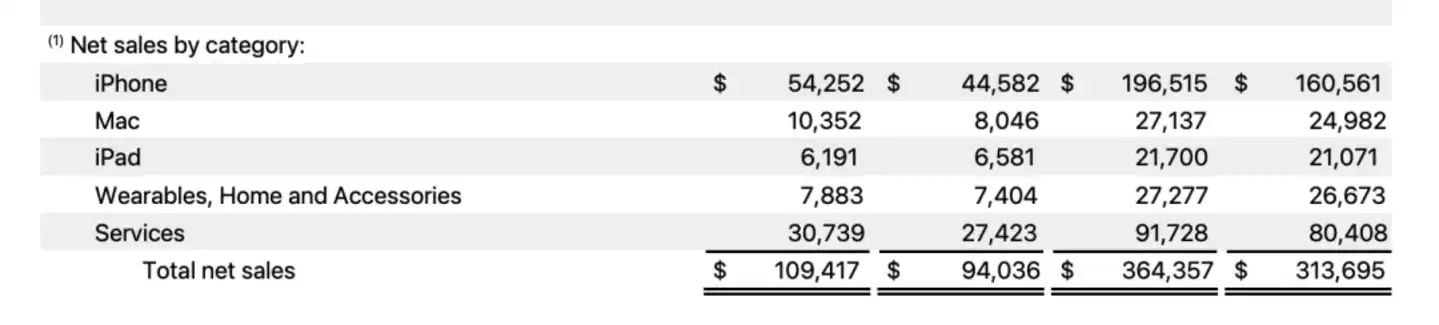
iPhone and Mac once again saved Apple, together contributing to about 78% of Apple's quarterly revenue increment, the biggest drivers of its revenue growth. iPhone revenue for the quarter grew 21.7% year-over-year to $54.252 billion, accounting for about 63% of Apple's revenue increment. iPhone's share of total company revenue also rose from 47.4% in the same period last year to 49.6%.
Apple Earnings Report
Omdia's previously released Q2 2026 global smartphone shipment data shows that while global smartphone shipments declined 6% year-over-year for the quarter, Apple achieved 23% year-over-year growth, ranking second globally, with shipment volume hitting a historical high for the period. In contrast, Samsung's market share only grew 5% for the quarter, while Xiaomi, OPPO, and Vivo all saw significant declines, with Xiaomi down 26% year-over-year.
The facts prove that although the marketing narrative of AI phones has been building wave after wave, at least from the current market perspective, what consumers are more willing to pay for is hardware performance and product design. The unintelligent Siri hasn't affected iPhone's popularity at all.
Although Mac's contribution to absolute revenue increment is not as high as iPhone's, its growth rate far exceeded market expectations. Quarterly Mac revenue grew 28.7% year-over-year to $10.352 billion, $1.84 billion higher than market expectations. This was achieved despite supply constraints for high-end chips and some Mac products being in short supply. Apple management previously stated that demand for the MacBook Neo far exceeded expectations, and products like the Mac mini and Mac Studio have also been selling well driven by AI development demand.
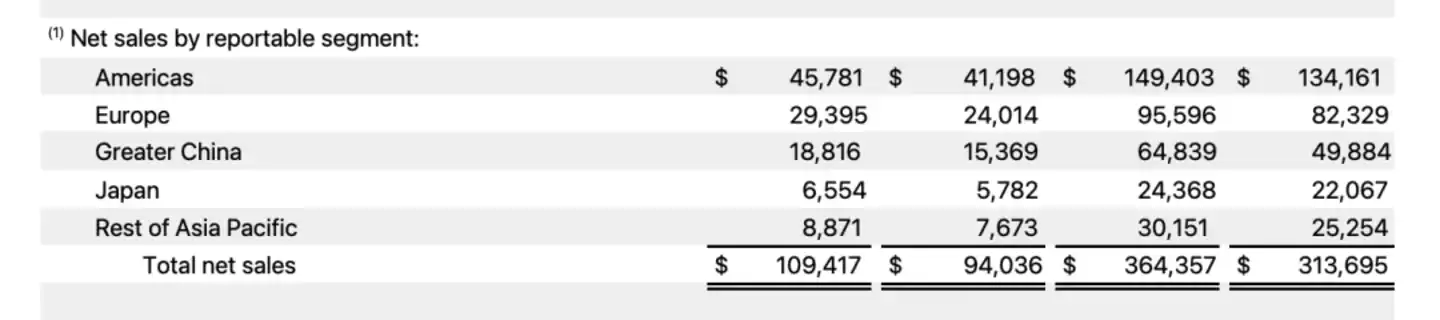
Apple achieved double-digit growth in nearly all global markets. Americas revenue grew 11.1%, Europe and Greater China both grew 22.4%, Japan grew 13.4%, and other Asia-Pacific markets grew 15.6%. However, this quarter's revenue growth rate in the Greater China region was slightly below market expectations and also lower than last quarter's 28% growth rate.
Apple Earnings Report
Apart from iPhone and Mac, Apple's other businesses performed relatively flat. iPad revenue fell 5.9% year-over-year to $6.191 billion, the only product line to decline year-over-year. Cook attributed this to a high base from last year's cheaper iPad. Wearables, Home, and Accessories revenue grew 6.5% year-over-year to $7.883 billion.
Against the favorable backdrop of product revenue growing 18.1% year-over-year, Apple's quarterly Services revenue was $30.739 billion, growing only 12.1% year-over-year, both lower than the company's overall growth rate and below market expectations. In comparison, Apple's Services revenue growth last quarter was 16.3%.
The slowdown in Services growth is partly due to the "Apple Tax" beginning to loosen. In recent years, more and more countries and regions have begun challenging the closed ecosystem of the App Store.
The EU has already required Apple to open up to third-party app stores, and the Epic Games lawsuit against Apple forced it to allow external payment links in the US. In March this year, under domestic regulatory pressure, Apple also lowered the commission rate for China's App Store.
The gross margin for the Services business reached 75.6%, far higher than the Products business's 40.1%. Its slowing growth has somewhat impacted Apple's profit performance. Apple's gross margin last quarter was 49.3%; this quarter, after deducting tariff refunds, the gross margin is approximately 48.1%, an actual sequential decline of about 1.2 percentage points.
However, Apple's Services revenue may see some growth with the landing of the new Siri. Apple's new AI-powered Siri and Apple Intelligence are set to launch next quarter. Cook hinted during the earnings call that due to rising computing costs, some AI features might require payment to use.
Avoided AI Spending Burn, But Not AI Price Hikes
Although Apple delivered a quarter of bright growth, the market generally held a pessimistic view. After the earnings release, Apple's after-hours stock price plunged over 8%.
The direct trigger was Apple's pessimistic guidance for the next quarter. Apple expects next quarter's revenue to grow only 9% to 11% year-over-year, below market expectations. Apple management stated during the earnings call that besides the impact of foreign exchange fluctuations, the negative effects of supply chain constraints will intensify quarter by quarter after Q3, adversely affecting the iPhone, Mac, and iPad business lines.
Cook stated that supply chain constraints are mainly concentrated in the Mac product line, with the root cause being extremely strong market demand that they don't have enough capacity to absorb. "In the coming quarter, we will face tremendous pressure on the supply chain side." Apple's M-series chips are mainly manufactured by TSMC, but TSMC's capacity is also increasingly being ceded to AI chips.
Prior to this, Apple has already had to significantly raise prices due to rising memory and chip costs, covering many product lines including Mac and iPad, with some product prices increasing by over 3,000 yuan at the highest. Cook described during the earnings call that the current rise in memory prices is equivalent to a once-in-a-century flood, showing exponential growth, forcing them to adjust prices.
But the last price increase did not include Apple's most important iPhone product line. The market expects Apple's new iPhone to be released this autumn to see significant price hikes, with the starting price of the foldable iPhone possibly as high as over $2,000. The hot sales of iPhone last quarter might partly be related to consumers' panic buying before the price adjustment—considering new models are about to be released, the past second quarter has typically been a slow sales season for iPhone.
Under the pressure of price hikes, market confidence in iPhone sales next quarter is insufficient. Apple management's guidance for iPhone revenue growth next quarter is only around 15%, below Wall Street's expectation of 17.6%.
Apple is already preparing for the increasingly severe supply chain constraints. This quarter, Apple's inventory rose from last quarter's $6.747 billion to $11.092 billion, a sequential increase of 64.4% and an 87.2% year-over-year increase from $5.925 billion in the same period last fiscal year, nearly doubling year-over-year.
According to Bloomberg, Apple is negotiating memory chip purchases with ChangXin Memory Technologies (CXMT) and Yangtze Memory Technologies Corp (YMTC). But this move faces opposition from the US government and Micron Technology. Cook said during the earnings call that the global DRAM market is currently controlled by three companies—Samsung, Micron, and SK Hynix—and adding suppliers would help improve supply and prices.
Not spending on AI doesn't allow Apple to stay out of this AI frenzy. The record-breaking AI data center construction by tech giants like Microsoft, Google, Amazon, and Meta will also directly impact Apple's memory and chip supply, subsequently hurting its revenue.
Currently, the full-year AI capital expenditures announced just by Microsoft, Google, Amazon, and Meta will exceed $720 billion, far surpassing last year's $455.8 billion. Massive AI investments directly caused Google and Amazon's free cash flow to turn negative this quarter, while Meta's free cash flow also plummeted 91%.
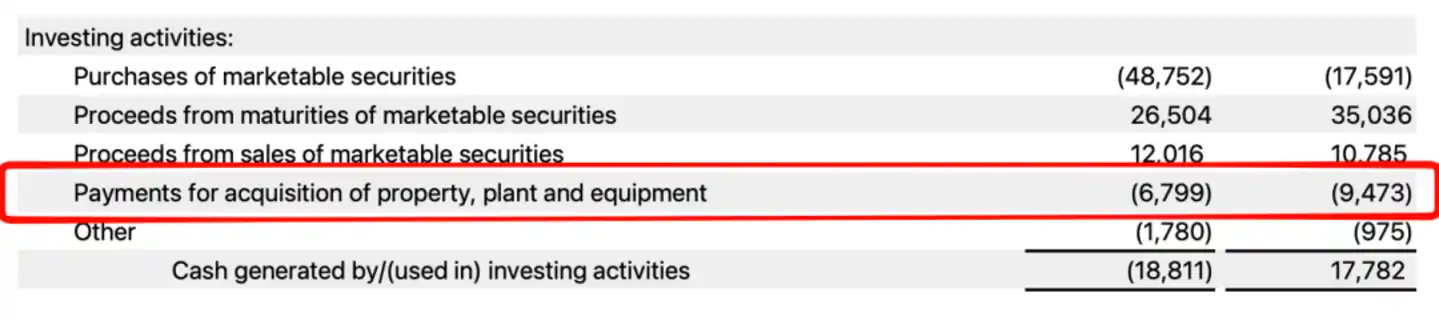
In comparison, Apple's capital expenditures this year have not only not grown but have even declined. In the first three quarters of fiscal 2026, Apple's expenditures on purchasing property, plant, and equipment were only $6.799 billion, down 28.2% year-over-year.
Apple Earnings Report
Restrained capital expenditures helped Apple's quarterly operating cash flow hit a historical high for the period. Operating cash flow for the first nine months of this fiscal year reached $117 billion, up 43.1% year-over-year. Cook is truly a master of capital management, helping the company save money even as he approaches retirement.
This is not to say Apple neglects AI investment. Compared to other manufacturers' greater enthusiasm for investing in AI computing power, Apple's investments seem to flow more into the R&D field.
This quarter, Apple's R&D expenses reached $11.729 billion, up 32.3% year-over-year, a growth rate approximately twice that of revenue. For the first three quarters of fiscal 2026, Apple's R&D expenses were $34.035 billion, up 32.5% year-over-year.
Just, such large-scale R&D investment has ultimately failed to yield many significant AI achievements, which is another level of "Only Apple can do."
This was Cook's last time participating in Apple's earnings call. This September, he will officially step down as Apple CEO. Cook specifically thanked the outside world during the earnings call, "Thank you to all our shareholders, especially the long-term shareholders who have trusted us over the years."
He said he has full confidence that Apple's future is bright.