DeFi协议过度依赖USDC,MakerDAO打响反抗的第一枪

PanewsPublished on 2022-08-13Last updated on 2022-08-13

Abstract

这是“DeFi史上的一个分水岭”,DeFi协议过于依赖中心化稳定币USDC,若不做出改进,DeFi协议已将自己的命运交给中心化机构。

8月8日,美国财政部外国资产控制办公室(OFAC)宣布制裁虚拟货币混币器Tornado Cash,OFAC称采用Tornado Cash进行洗钱的资金量超过70亿美元。之后,Circle CEO Jeremy Allaire表示,根据《银行保密法》的要求,遵守财政部对Tornado Cash的制裁,冻结了受制裁地址中的USDC。

虽然“区块链不是法外之地”,Circle积极配合财政部冻结用户资产的做法还是在加密社区中引起了“暴风式大讨论”。

“发家”史:DeFi应用推高USDC市值

回顾USDC的发展史,很大程度上得益于DeFi的高速发展。

在主要的借贷协议Compound和Aave中,USDT因为透明度和合规问题,并不能作为抵押品。而USDC因为合规性相对较好,能够获得支持,再加上借贷协议会根据抵押品的波动性设置对应的抵押因子,波动性极低的USDC成为借贷协议中的大赢家。

根据glassnode的数据,在2020年6月15日Compound带起流动性挖矿的DeFi Summer时,USDC的流通量仅有7.3亿,而USDT的流通量为91.9亿,是前者的12.5倍。一个月后的7月15日,USDC的流通量上升50%至11亿,而USDT的流通量并没有任何变化。时至今日,USDC的流通量为555亿,USDT为660亿,已经较为接近。
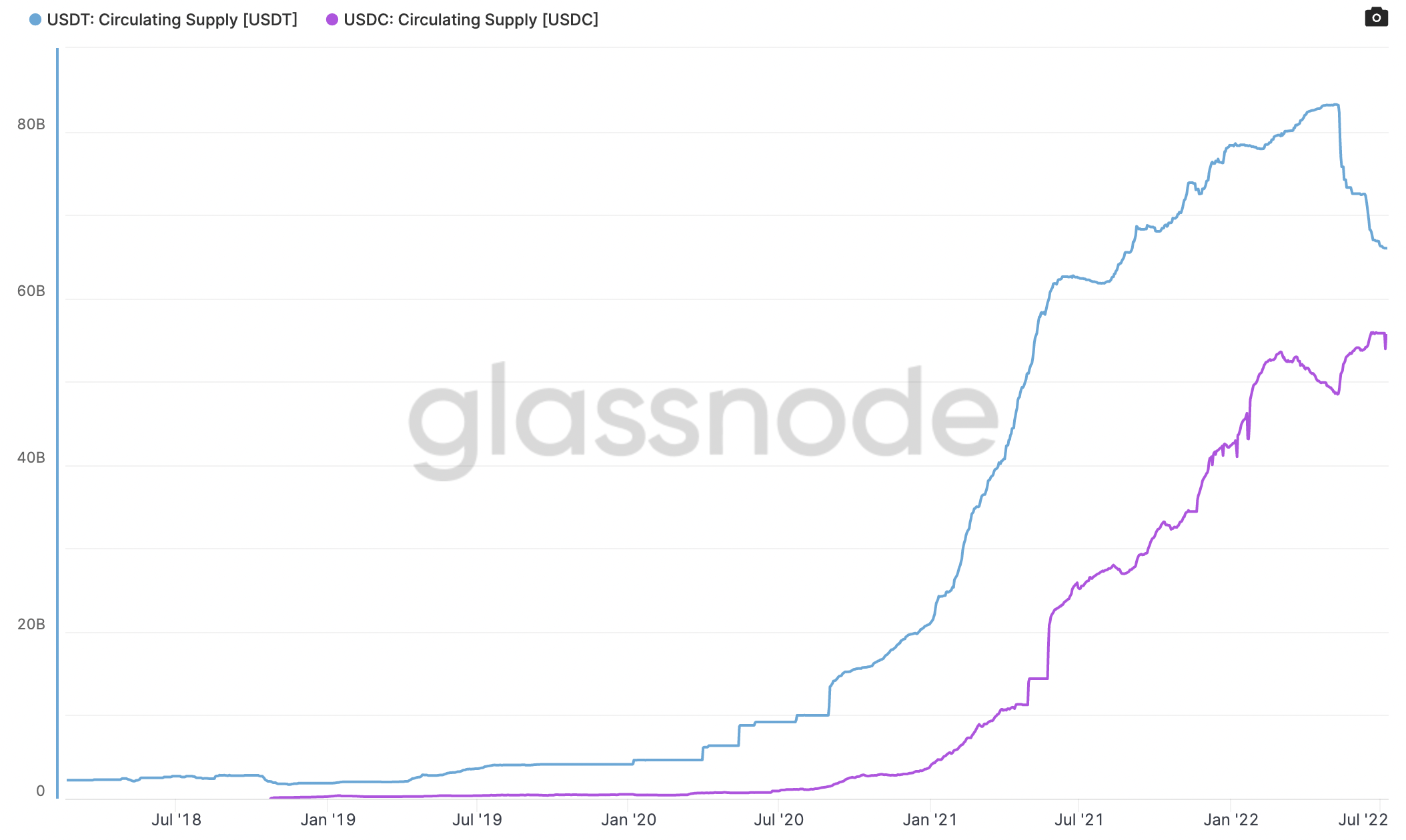
在今年5月份UST脱锚之后,USDT的风险再次受到关注,主打安全稳定币的USDC再次迎来发展的小高潮。大量用户将USDT兑换为风险更低的USDC。因为1 USDT也可以通过Tether官网赎回为1美元,套利者可以用低于1 USDC的价格买入USDT,赎回为美元,铸造USDC,如此循环。

但随着USDC与USDT的兑换比例再次跌至略低于1的位置,近期加密市场的回暖导致中心化交易所用户使用USDT交易的需求升高,USDC追赶USDT的脚步可能暂时放缓。

可以说,USDC因DeFi而崛起,也靠着加密用户的资金赚取高额的利息。随着美联储的加息缩表,美国2年期国债收益率涨破3.2%,Circle发布的截至6月30日的储备资产明细报告显示,流通的USDC总量为555.7亿,储备金包括135.8亿美元现金和421.2亿美元三个月期限的国债。Circle使用用户铸造USDC的储备金购买国债谋利,相比之下主要的去中心化借贷协议Aave中的USDC存款年化收益率仅为0.48%,可以说是用户变相的“牺牲”了自己的利息收益而让Circle赚取大量收益。

但现在Circle却主动冻结Tornado Cash用户地址中的USDC,这种做法无疑给了加密原生用户一记“背刺”,让一些加密原教旨主义者感到了不安。

USDC成DeFi协议的“隐雷”?

USDC已经成为区块链上最常用的稳定币。根据今年5月Bankless所做的链上分析,在前5大DEX(Curve、Uniswap、SushiSwap、Balancer、Bancor)中,USDC占稳定币总流动性的23.3%,USDT占15.9%;在Aave、Compound、Fuse、Euler这四个借贷协议中,USDC占稳定币存款的55%,USDC占21.6%。在DAO国库和其它稳定币的储备金中,USDC也是使用最多的稳定币。

既然Circle能够冻结Tornado Cash用户钱包中的USDC,那么存在于DeFi协议中的USDC理论上也有被冻结的可能。试想一下,如果黑客将非法获得的USDC存入Aave,从其中借出WBTC,再通过RenBridge兑换出BTC,转至交易所出售。那么黑钱就直接进入了Aave,Aave是否也有帮助黑客洗钱的嫌疑呢?如果此时美国财政部要求Circle冻结对应的USDC,Circle很有可能积极配合。此时的情况等于是黑客用“空气”(作废的USDC)为抵押品,借走了Aave中的资金,导致Aave中的存款不能完全赎回。站在用户的角度,能不能赎回自己的存款取决于是否足够快的进行了赎回操作,极有可能因为恐慌而摧毁一个顶尖的DeFi协议。

以USDC为抵押品的去中心化稳定币还能稳定吗?

无论是有储备金的MakerDAO,还是部分算法稳定币Frax,它们发行稳定币的储备金中都含有相当高比例的USDC。在USDT链上应用受限、UST暴雷的背景之下,此前,储备金中USDC的比例似乎越高越好。

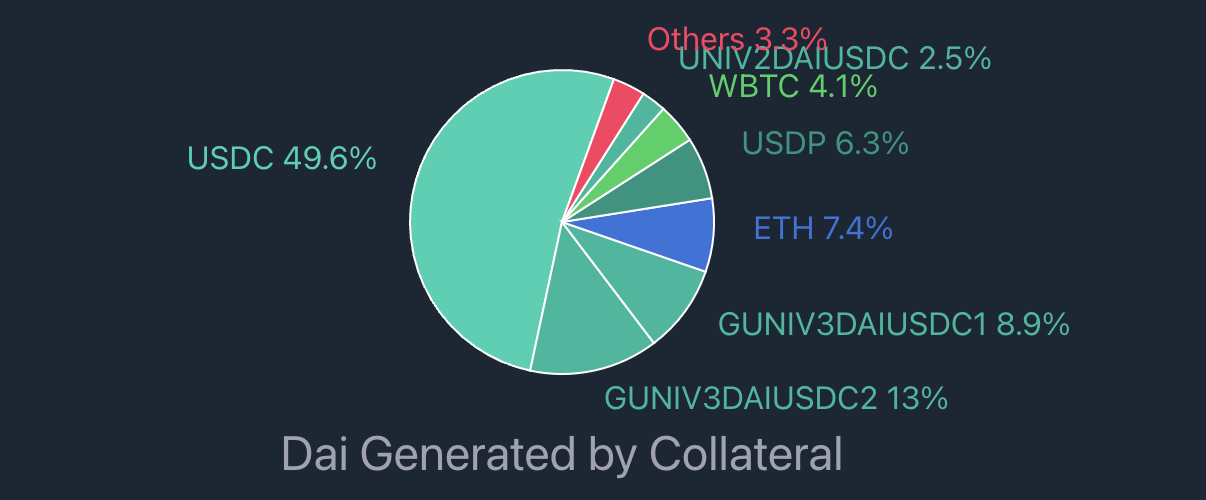
根据Dai Stats的数据,有49.6%的DAI是用USDC为抵押品生成的,如果再加上Uniswap DAI/USDC LP代币抵押品中的USDC,那么这一比例可能达到60%。
以抵押品超额抵押铸造的DAI这部分暂且不论,MakerDAO中更大的系统性风险在于通过锚定稳定模块(Peg Stability Modules,PSM)以USDC 1:1铸造的DAI。这种做法将DAI和USDC进行绑定,用户锁定1 USDC铸造1 DAI,同样也可以用1 DAI赎回为1 USDC。当该模块中有足够的USDC时,套利者的自由活动即可将DAI的价格稳定在1 USDC,也就是1美元。该做法此前已经被人诟病,DAI就像封装的WBTC一样,成为一种Wrapped USDC,这也脱离了DAI原本去中心化的初衷。

从Dai Stats中可知,有34.37亿的DAI通过PSM发行,模块中也锁定有同样数量的USDC。PSM发行的DAI没有稳定费,也不会被清算。一旦黑客使用黑钱用该模块铸造DAI,就为DAI埋下了风险。锁定的USDC可能因为Circle的一个操作而沦为“空气”,导致DAI因此归零。

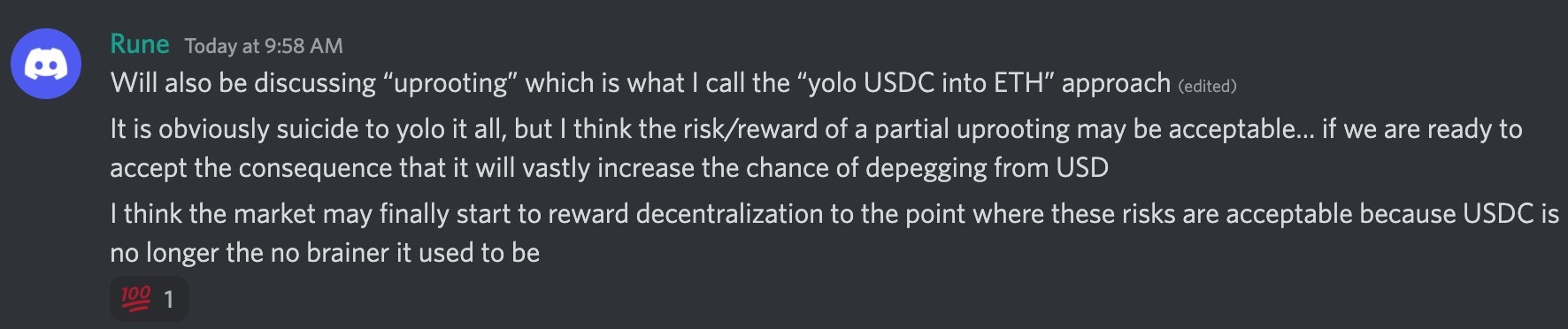
面对可能存在的风险,MakerDAO创始人Rune Christensen在Discord中表示,将对是否继续维持DAI和USDC的锚定进行讨论。

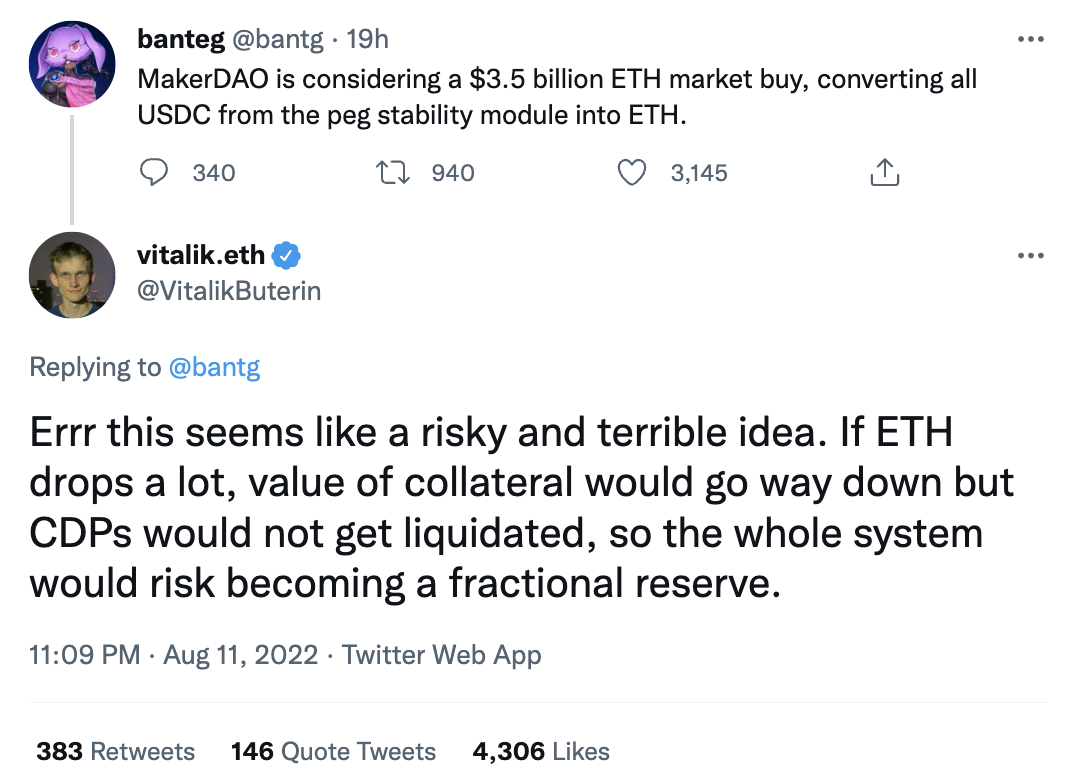
Rune Christensen还提出了一种非常激进的想法,即用一部分USDC购买ETH。若ETH下跌,DAI的价格可能会低于1美元。鉴于MakerDAO会在资不抵债时增发MKR,并通过拍卖进行还贷,此举还会为MKR引入极大风险。

Christensen在措辞中用到了“uprooting”(连根拔起)的说法。Christensen认为Tornado Cash被制裁的后果比他一开始想象的要严重得多,如果放弃USDC,DAI可能会与美元脱钩,但风险是“可以接受的”。
以太坊创始人Vitalik则称,Christensen的想法是“冒险且可怕的”,一旦ETH大幅下跌,抵押品的价值将下降,而不会被清算,系统将面临只有部分储备金的风险。
Christensen还称,“最好的选择是指望现在不会受到制裁,并为能够真正抵抗物理攻击而努力。我们应该接受这样的事实,如果他们想要关闭我们,结果是紧急关闭”。

正如Tornado Cash联合创始人Ameen Soleimani所说的那样,Circle遵守美国制裁的做法是“DeFi史上的一个分水岭”。虽然暂不清楚美国财务部的制裁措施是否会升级,但当下DeFi协议过于依赖中心化稳定币USDC,但若不做出改进,DeFi协议则将自己的命运交给中心化机构,历史也将继续轮回。


Trending Cryptos

Related Reads

Bitcoin Hits 20-Month Low as Largest Bull Suffers $15 Billion Paper Loss

Bitcoin Hits 20-Month Low as Major Bull Loses $15 Billion On June 25th, Bitcoin fell below $60,000, hitting a low of $58,030—its lowest level since October 2024. The sell-off triggered over $1 billion in leveraged liquidations in 24 hours, with longs accounting for $788 million. This marks a more than 53% decline from the October 2025 all-time high of $126,198. A critical factor in the downturn is the weakening position of MicroStrategy, the largest corporate Bitcoin holder. With 847,363 BTC at an average cost of $75,651, the company now faces over $14.6 billion in unrealized losses. Its core financing flywheel—raising capital to buy Bitcoin—is stalling. Its variable-rate preferred shares (STRC), a key fundraising tool, have fallen 25% below their $100 target. This raises doubts about its ability to continue providing steady institutional demand for Bitcoin. Simultaneously, U.S. spot Bitcoin ETFs are experiencing significant outflows, with a single-day net outflow of $469 million on June 24th. This represents the most severe sustained capital flight since their launch. The macroeconomic backdrop remains restrictive, with persistent inflation delaying expected Fed rate cuts. Analysts note a shift in capital allocation, with institutional funds moving away from crypto towards AI infrastructure stocks. Immediate pressure comes from approximately $10 billion worth of Bitcoin options expiring on June 26th, which could increase market volatility. The combined effect of these factors—eroding core demand pillars, macro headwinds, and capital rotation—has decisively broken the $60,000 support level.

Foresight News7m ago

Bitcoin Hits 20-Month Low as Largest Bull Suffers $15 Billion Paper Loss

Foresight News7m ago

STRC Falls Below $80, Can Conservative Investors Still Buy the Dip?

The article analyzes whether the STRC (a perpetual preferred stock issued by MicroStrategy) presents a buying opportunity after its price fell below its $100 par value to around $80, offering a seemingly high yield of 13-15%. The core argument is that STRC's discount reflects market skepticism about the sustainability of MicroStrategy's capital structure model, not just temporary panic. This model relies on issuing securities (like STRC) to raise funds to buy more Bitcoin, a "flywheel" that works in a bull market. The recent small sale of BTC to fund dividends, while minor, broke the psychological "never sell" anchor and signaled potential strain. Key risks identified are not a traditional Ponzi collapse but a potential breakdown in the financing narrative: 1) If Bitcoin enters a deep bear market, crushing MicroStrategy's stock premium (mNAV), its ability to raise cheap capital weakens. 2) If STRC remains deeply discounted, it signifies permanently higher funding costs. 3) The high cash dividend yield represents a significant ongoing expense. 4) If selling BTC to pay dividends becomes routine, the bullish narrative reverses. The conclusion is that STRC is not a risk-free high-yield asset. It is a high-coupon bet on whether MicroStrategy's BTC treasury financing model can withstand a bear market. Buying it is a wager that the market will continue to believe in and fund this structure at acceptable costs. The current price asks if this cycle's "casualty" might be a BTC treasury company's融资 model itself.

marsbit23m ago

STRC Falls Below $80, Can Conservative Investors Still Buy the Dip?

marsbit23m ago

Why Do Crypto Projects Keep Changing Their Names?

**Why Do Crypto Projects Keep Changing Names?** In the crypto world, changing a project's name is common—over 16% of projects have done so, including major ones like Polygon (formerly Matic Network). This contrasts sharply with traditional businesses, which fiercely protect brand equity. The core reason is that in crypto, brand loyalty is often weak. Users are frequently investors, airdrop hunters, or yield seekers, not traditional consumers. A name associated with price crashes, hacks, or failed narratives becomes a liability, not an asset. Renaming can be a strategic reset to shed this baggage. Name changes serve as a potent marketing tool. They can signal a genuine pivot in strategy or scope (e.g., EthSign dropping "Eth" as it expanded). However, they are often used to "narrative surf," rebranding to align with hot trends like AI, RWA, or the metaverse (e.g., Elrond → MultiversX). Critically, renaming is also a PR tactic to distance a project from past failures like security breaches (e.g., Anyswap → Multichain). The most significant risk emerges when a name change is coupled with a token migration or swap. This process can allow projects to reset exchange price charts, erase visible historical downtrends, and create an illusion of a fresh start. It often facilitates liquidity resets, where low float can be exploited for pumps. More alarmingly, migrations sometimes mask overhauls to tokenomics, introducing substantial new token supply through "ecosystem funds" or "node rewards," effectively diluting existing holders. The fundamental issue isn't renaming itself, which can be valid for strategic evolution. The problem is when it functions as an escape from history—a way to avoid accountability for past mistakes, failed promises, and poor performance. When a project announces a rebrand, the critical questions are: What tangible new capability or strategy does it represent? Has the tokenomics changed? And what part of its past is it most trying to make users forget?

marsbit29m ago

Why Do Crypto Projects Keep Changing Their Names?

marsbit29m ago

A Trillion-Dollar Entry Point for Pension Funds? Franklin's Bitcoin Dividend Reinvestment ETFs Come with a Built-In Selling Pressure Ceiling

Franklin Templeton filed for two ETFs on June 18 that embed a "default option" logic into Bitcoin investing. These funds—the Franklin US Equity Bitcoin Dividend Reinvestment Index ETF and the Franklin US Innovative Equity Bitcoin Dividend Reinvestment Index ETF—aim to automatically allocate a portion of investor dividends to Bitcoin, initially with a 95% stock and 5% Bitcoin allocation. The mechanism is designed for financial advisors, not retail investors. By packaging Bitcoin exposure within a standard equity fund label, advisors can bypass internal compliance restrictions against direct cryptocurrency allocation for their clients. Dividends from the stock holdings are automatically used to buy Bitcoin via spot ETFs, futures, or options. However, the structure imposes strict rebalancing rules: if Bitcoin's allocation exceeds 5%, it is trimmed back to 4.5% quarterly, with a hard cap of 20%. This means the fund becomes a systematic seller during Bitcoin price rallies. Realistically, the potential buying pressure is minimal. Based on dividend yields (approximately 1.05% for broad market, 0.52% for innovative equity), the annual inflow into Bitcoin would be a tiny fraction of the fund's assets. For comparison, Franklin's existing Bitcoin ETF ($359 million AUM) would generate only about $3.6 million in annual Bitcoin purchases—negligible against Bitcoin's daily trading volume. The innovative equity fund, heavily weighted in low-dividend stocks like Nvidia, would have even weaker buying power. The product utilizes an offshore Cayman subsidiary to hold Bitcoin, a common compliance tactic for commodity exposure in mutual funds. A key drawback for investors is the tax liability: they must pay taxes on dividends that are automatically converted into Bitcoin, requiring out-of-pocket cash for a gain they never directly receive. For the strategy to scale significantly, such funds would need to become a default or near-default option in retirement plans like 401(k)s. Recent regulatory moves, including a Trump executive order and a Department of Labor proposal offering fiduciary safe harbors for including crypto assets, could pave the way. However, widespread employer adoption likely awaits further legal clarity. Ultimately, the fund's model leverages investor inertia and automated systems, rather than convincing anyone to actively choose Bitcoin. While it creates a new, albeit small, structural buyer, its rebalancing rules also establish a built-in "selling ceiling" that could dampen price upside if similar products proliferate.

Foresight News31m ago

A Trillion-Dollar Entry Point for Pension Funds? Franklin's Bitcoin Dividend Reinvestment ETFs Come with a Built-In Selling Pressure Ceiling

Foresight News31m ago

Why Do Crypto Projects Always Love Changing Names?

This article explores why cryptocurrency projects frequently change their names, a practice uncommon in traditional businesses where brand equity is a core asset. Over 16% of crypto projects have reportedly rebranded, often for strategic, marketing, or defensive reasons. The primary explanation is the weak user loyalty in crypto; many users are investors, airdrop hunters, or narrative traders, not traditional consumers. When a project's token price falls, its narrative fades, or it faces scandals/hacks, its old name becomes a liability laden with negative history rather than brand value. Therefore, frequent rebranding aims to shed this historical baggage. Name changes can be a marketing strategy to align with new business directions (e.g., Matic to Polygon), capitalize on trending narratives (e.g., adding "AI" or "Multiverse"), or distance from past failures like security breaches (e.g., Anyswap to Multichain). However, the most concerning aspect often involves a simultaneous token migration or swap. This process can serve as a "liquidity reset": it wipes historical price charts, potentially eases market manipulation, and is sometimes used to introduce new tokenomics that dilute existing holders' value through hidden inflation. The article concludes that while legitimate strategic pivots can justify a rebrand, many crypto name changes are less about building a new future and more about escaping the past—erasing bad memories, failed narratives, and dissatisfied communities. The key questions for any rebranding project are: what genuine new value or strategy does it bring, how has the tokenomics changed, and what part of its history is it trying to make users forget?

链捕手38m ago

Why Do Crypto Projects Always Love Changing Names?

链捕手38m ago

Trading

Spot
Futures

Hot Articles

What is USDC(WORMHOLE)

USD Coin (Wormhole): A Comprehensive Overview Introduction In the rapidly evolving world of cryptocurrencies, USD Coin (Wormhole), referred to as $USDC(Wormhole), stands out as a pioneering solution within the DeFi (Decentralized Finance) landscape. Operating on several blockchain platforms, including Solana, USD Coin (Wormhole) is more than just a digital representation of the United States dollar. It embodies the innovative spirit of modern finance, enabling seamless cross-chain transactions and enhanced interoperability among diverse blockchain ecosystems through the advanced Wormhole protocol. What is USD Coin (Wormhole)? USD Coin (Wormhole) is a tokenized version of the US dollar designed to facilitate frictionless transactions across different blockchain networks. Its primary aim is to bolster liquidity and enhance the functionality of the DeFi ecosystem. By leveraging the Wormhole protocol, which establishes a robust cross-chain communication network, users can effortlessly transfer USDC tokens across various platforms. This cross-chain capability marks a significant advancement in cryptocurrency use, promoting a more interconnected and efficient ecosystem where assets can flow freely between different blockchains. The value proposition of USD Coin (Wormhole) lies not only in its stability, being pegged to the US dollar, but also in its ability to bridge gaps between disparate blockchain environments. This innovative approach fosters a greater level of participation among users and developers, paving the way for new and exciting applications within decentralized finance. Who is the creator of USD Coin (Wormhole)? The origins of USD Coin (Wormhole) are intricately tied to the Wormhole network, which was developed by Jump Crypto. While specific individual creators are not prominently documented, Jump Crypto is notable for its involvement in advancing blockchain technology and supporting its applications in finance. By creating the Wormhole network, Jump Crypto has played a vital role in promoting cross-chain asset transfers, enhancing the efficiency and diversity of cryptocurrency usage. Who are the investors of USD Coin (Wormhole)? The success of USD Coin (Wormhole) is supported by investments from several notable funds and organizations within the cryptocurrency realm. Key investors include: Coinbase Ventures: A prominent venture capital arm backed by one of the leading cryptocurrency exchanges in the industry, Coinbase Ventures provides essential capital and strategic support to promising blockchain projects. Arrington XRP Capital: Specializing in digital assets, Arrington XRP Capital recognizes the potential of innovative projects like USD Coin (Wormhole) and has invested accordingly to back its development. Jump Trading: As the parent organization of Jump Crypto, Jump Trading brings not only investment but a wealth of expertise in trading technology and market dynamics to bolster the Wormhole project. How Does USD Coin (Wormhole) Work? The operational framework of USD Coin (Wormhole) is intricately designed to facilitate effective cross-chain transactions, maximizing security and efficiency. Here’s a simplified overview of how it functions: Asset Locking: When a user wishes to transfer USDC from one blockchain to another, they first lock their tokens on the source blockchain. This process ensures that the assets are secure and are set to be either burned or moved later. Token Minting: After the tokens are locked, an equivalent amount of USDC is minted on the destination blockchain. This provides the user with access to their funds on a new platform, reflecting the flexibility that the Wormhole protocol enables. Cross-Chain Transfer: The Wormhole protocol efficiently facilitates the entire transfer process. It ensures that once the USDC is minted on the destination chain, the equivalent tokens are burned on the source chain. The result is a seamless transfer of value between two distinct blockchain environments. This cross-chain methodology ensures that transactions remain secure and transparent, significantly enhancing liquidity within the different DeFi ecosystems. Timeline of USD Coin (Wormhole) Understanding the evolution of USD Coin (Wormhole) provides vital context for its significance in the cryptocurrency arena. Here’s a timeline highlighting important milestones in the project’s history: 2021: The Wormhole project is launched, establishing a framework for cross-chain asset transfers and setting the stage for the development of USD Coin (Wormhole). 2022: The Wormhole network experiences a significant challenge with a security breach that results in a $325 million theft. However, the incident is later addressed and refunded by Jump Crypto, showcasing the project’s commitment to security and transparency. 2023: USD Coin (Wormhole) integrates with Circle’s Cross-Chain Transfer Protocol (CCTP), enhancing its capabilities for cross-chain transfers and further solidifying its place within the DeFi ecosystem. 2024: Ongoing development and expansion of the Wormhole network continue, aimed at increasing the utility and reach of USD Coin (Wormhole) as well as enhancing its operational framework. Key Features The success of USD Coin (Wormhole) can be attributed to several key features that differentiate it from other cryptocurrency offerings: Cross-Chain Interoperability At the core of USD Coin (Wormhole) is its ability to facilitate seamless transfers across multiple blockchain networks. This interoperability serves as a cornerstone for decentralized finance, allowing various platforms to interact with each other, thereby accelerating the evolution of financial services. Security Wormhole employs a well-designed Guardian Network comprised of node validators that ensure secure cross-chain transactions. This collective oversight minimizes the risk of fraud and provides users with confidence that their assets are protected during cross-chain transfers. Liquidity Enhancement By enabling USDC to circulate freely across different blockchains, USD Coin (Wormhole) enhances liquidity in the DeFi ecosystem. This increased liquidity can foster more efficient trading, contribute to better pricing strategies, and improve the overall market dynamics encompassing various digital assets. Conclusion USD Coin (Wormhole) is a pivotal innovation in the blockchain space, reinforcing the capabilities of decentralized finance (DeFi) and establishing a more connected financial ecosystem. With its robust framework for cross-chain transactions, security features, and strong backing from reputable investors, USD Coin (Wormhole) is positioned to play a key role in the future of cryptocurrency. As the digital finance landscape continues to evolve, USD Coin (Wormhole) not only embraces the future of interconnectivity among blockchain networks but also reaffirms the power of tokenization and blockchain technology in transforming how we perceive and utilize value in a digital world. By navigating the complexities of cross-chain functionality, it demonstrates a sophisticated approach to enabling financial inclusivity and innovation in the world of cryptocurrencies.

1.2k Total ViewsPublished 2024.04.01Updated 2024.12.03

What is USDC(WORMHOLE)

What is $USDC

Classic USDC: A Comprehensive Overview Introduction to Classic USDC In the rapidly evolving landscape of the cryptocurrency market, stablecoins have emerged as critical components, particularly in providing stability amid the volatility that characterizes digital assets. One such project is Classic USDC, a digital currency initiative that aims to deliver a stable and reliable medium of exchange. By maintaining a 1:1 peg with the US dollar, Classic USDC strives to offer users a dependable digital asset, equipped for various applications within the web3 and cryptocurrency ecosystems. What is Classic USDC? Classic USDC is fundamentally a stablecoin, which is a type of cryptocurrency designed to minimize the price volatility typically seen in the digital asset market. Specifically, Classic USDC aspires to represent the value of the US dollar closely, ensuring that users can leverage this digital currency for transactions, savings, and other financial activities without the fear of sudden price fluctuations that can otherwise plague many cryptocurrencies. The primary aim of Classic USDC is to provide a reliable and trustworthy digital equivalent of the US dollar, designed for seamless integration into a wide range of web3 applications, decentralized finance (DeFi) platforms, and other crypto-related financial systems. By delivering a stable digital currency, Classic USDC seeks to facilitate everyday commerce, make blockchain technology more user-friendly, and encourage the adoption of cryptocurrencies for mainstream usage. Creator of Classic USDC The identity of the creator or the development team behind Classic USDC remains largely unknown, and the lack of transparency has led to a degree of uncertainty regarding the project’s origins. While many cryptocurrency initiatives prominently showcase their founders and development teams, Classic USDC does not provide clear information about its creators, which poses challenges for potential users or investors weighing the project's credibility and reliability. Investors of Classic USDC Alongside the ambiguity surrounding its creators, Classic USDC also lacks specificity with regards to its investors. The financial backing of a project can often lend it credibility and stabilize its operations; however, the absence of documented investment foundations or organizations supporting Classic USDC raises questions about its funding structure. This lack of clarity could potentially hinder stakeholder confidence in the project. How Does Classic USDC Work? The operational mechanics of Classic USDC rely heavily on its reserve system, which is fundamental to the underpinnings of any stablecoin. Classic USDC undertakes to maintain a reserve of assets that directly correspond to the value of the digital currency in circulation. Specifically, for every Classic USDC token issued, an equivalent amount of backing assets is retained in reserve, whether in cash or near-cash equivalents. This strategy is designed to uphold the value of Classic USDC, offering reassurance to users that redeeming their tokens for US dollars is feasible at any time. This reserve structure aims to enhance the stability and reliability of Classic USDC, positioning it as a secure alternative in the cryptocurrency market. By ensuring that the value of Classic USDC is consistently correlated with the US dollar, the project aspires to engender trust among users who may be wary of the broader market dynamics. Timeline of Classic USDC The history of Classic USDC is marked by several key milestones that reflect its journey and evolution within the cryptocurrency ecosystem: 2021: The inception of Classic USDC is noted, introducing a new digital currency option designed for stability. During this year, the first records of the token’s activity surfaced and its initial price levels were established. 2024: Classic USDC begins to experience notable price fluctuations, as the crypto market overall grapples with various trends and user sentiment. Predictions regarding its future potential emerge, indicating a strong interest from market observers and analysts who foresee growth opportunities. Future Projections Experts speculate that Classic USDC may reach higher levels of adoption and stability in the years to come, with potential further developments anticipated around 2025 and 2026. However, these projections should be approached with cautious optimism, as the cryptocurrency market is inherently unpredictable, and various external factors may influence the trajectory of Classic USDC. Key Points About Classic USDC Stability: Classic USDC’s core proposition revolves around providing a digital currency that parallels the value of the US dollar, thereby ensuring stability in an often volatile marketplace. Reserve System: The project’s commitment to maintaining a reserve of assets to back its value underscores its reliability and operational soundness. Web3 and Crypto Integration: Classic USDC is engineered to facilitate easy integration within various applications, aiming to enhance the user experience and broaden the acceptance of cryptocurrency in everyday transactions. Future Growth Potential: While still emerging, Classic USDC holds prospective avenues for growth as awareness and utilization of stablecoins increases in the web3 and crypto contexts. Conclusion Classic USDC presents itself as a notable stablecoin initiative within the cryptocurrency sphere, striving to provide users with a reliable digital currency that embodies the stability of the US dollar. Despite uncertainties regarding its creators and financial backing, the underpinning principles of Classic USDC—centered on reserve-backed assurances—endeavour to position it as a trustworthy option for individuals and businesses navigating the digital economy. With an eye towards the future, market analysts are keen to observe how Classic USDC evolves in response to the shifting dynamics of the cryptocurrency landscape, potentially establishing itself as a significant player in the realm of stablecoins.

647 Total ViewsPublished 2024.05.01Updated 2024.12.03

What is $USDC

Discussions

Welcome to the HTX Community. Here, you can stay informed about the latest platform developments and gain access to professional market insights. Users' opinions on the price of USDC (USDC) are presented below.

活动图片