Why Do Crypto Projects Always Love Changing Names?

链捕手Published on 2026-06-26Last updated on 2026-06-26

Abstract

This article explores why cryptocurrency projects frequently change their names, a practice uncommon in traditional businesses where brand equity is a core asset. Over 16% of crypto projects have reportedly rebranded, often for strategic, marketing, or defensive reasons. The primary explanation is the weak user loyalty in crypto; many users are investors, airdrop hunters, or narrative traders, not traditional consumers. When a project's token price falls, its narrative fades, or it faces scandals/hacks, its old name becomes a liability laden with negative history rather than brand value. Therefore, frequent rebranding aims to shed this historical baggage. Name changes can be a marketing strategy to align with new business directions (e.g., Matic to Polygon), capitalize on trending narratives (e.g., adding "AI" or "Multiverse"), or distance from past failures like security breaches (e.g., Anyswap to Multichain). However, the most concerning aspect often involves a simultaneous token migration or swap. This process can serve as a "liquidity reset": it wipes historical price charts, potentially eases market manipulation, and is sometimes used to introduce new tokenomics that dilute existing holders' value through hidden inflation. The article concludes that while legitimate strategic pivots can justify a rebrand, many crypto name changes are less about building a new future and more about escaping the past—erasing bad memories, failed narratives, and dissatisfied communities. ...

Author: Yu Gu, ChainCatcher

In the traditional business world, brand equity is the lifeline of a company. Frequently changing a name is almost equivalent to actively destroying the moat.

NVIDIA wouldn't change its name every few years; Apple wouldn't abandon the name "Apple" because of a business pivot; Nike wouldn't tear down its brand and start over due to market downturns.

But in the world of cryptocurrency, the rules are often reversed. According to statistics from RootData, over 16% of crypto projects have changed their names at some point, with many top-tier well-known projects also exhibiting numerous name changes.

Just yesterday, the on-chain IP ecosystem Story Protocol announced a name change to DATA, with IP tokens migrating 1:1 to new DATA tokens. In the past few months, Xion renamed to Verona, Matrixport renamed to BIT, and the TON token symbol changed to GRAM. Earlier, a batch of well-known projects like Klaytn, EOS, Fantom, MakerDAO, Elrond, and Matic Network also changed their names.
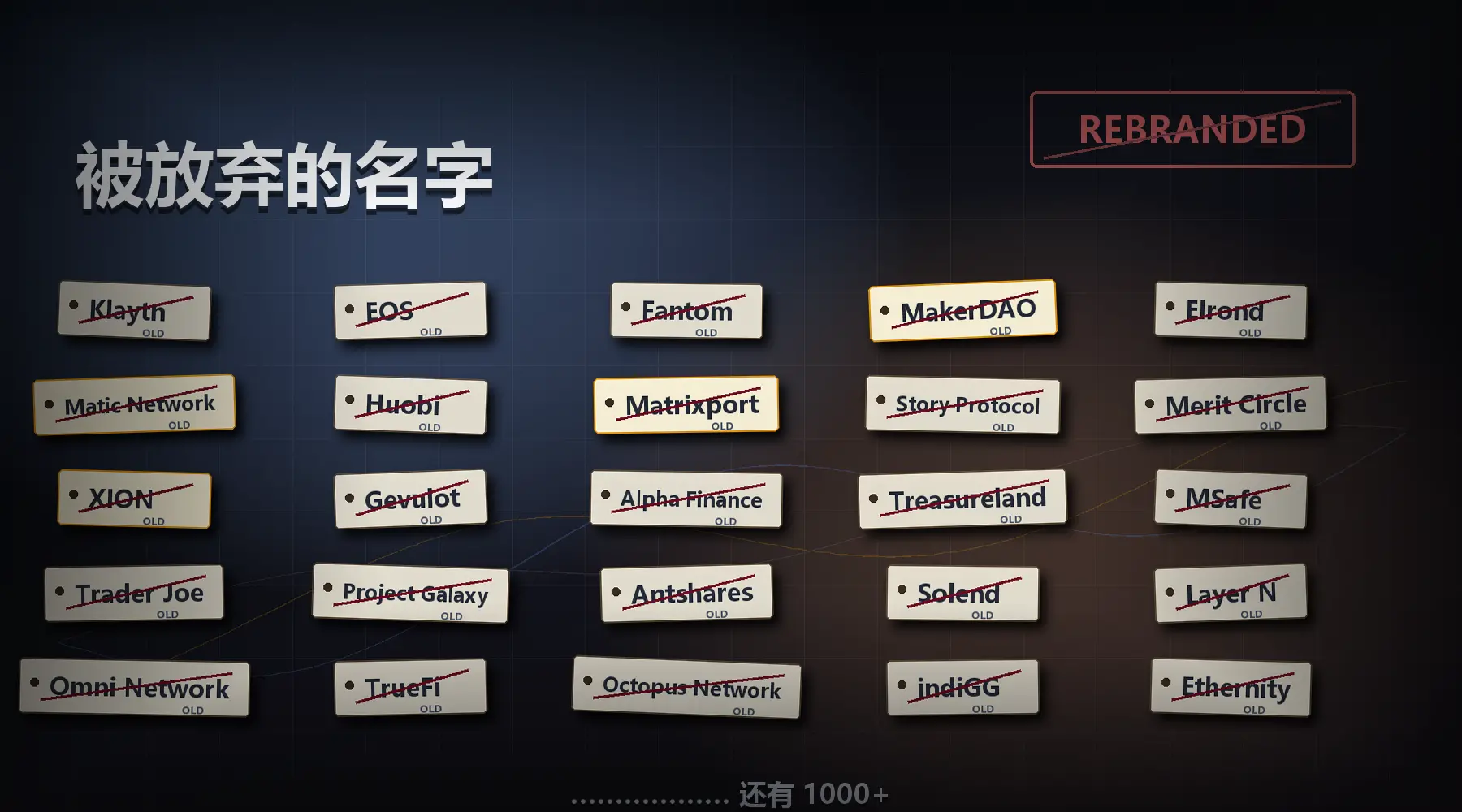
Some more extreme projects have even changed their names multiple times. For instance, MAITRIX had former names including CENTRAL, X Network, XLD Finance; BitSafe was formerly known as dlcBTC and DLC.Link; TaleX had former names Read2N and Metale Protocol; KGeN was formerly indiGG and Kratos Gaming Network. While names changed more and more, most projects didn't gain new life with the new name, but instead gradually faded into obscurity.

This leads to a question rarely seriously discussed in the crypto industry: Why do crypto projects always love changing names?

The answer might not be complicated: Because in the crypto industry, the brand is not the most important asset; attention, narrative, token price, and liquidity are.

I. Crypto Brand Loyalty Is Too Low

Traditional brands fear name changes because user loyalty comes from long-term consumption experiences. A user who has bought iPhones for years, drank Starbucks for years, or worn Nike for years forms a perception of the brand over time that doesn't change easily due to a single marketing campaign.

But the user structure of crypto projects is completely different.

Most early users are not consumers in the traditional sense, but investors, airdrop hunters, liquidity providers, node participants, and narrative traders. They use the product not necessarily because it's good, but because there might be an airdrop, potential earnings, or upside potential.

This means that brand loyalty for crypto projects is inherently weak.

In traditional industries, users ask, "Is this brand trustworthy?"; in the crypto industry, users more often ask, "Can this coin still go up?". As long as the price is chronically low, the narrative fails, and the ecosystem stagnates, the old name becomes a liability instead of an asset.

A name associated with a crash, being trapped in investments, hacking attacks, team controversies, or failed roadmaps struggles to inspire market imagination. It carries not brand equity, but the scars of a price chart and community grievances.

This is the fundamental reason why crypto projects dare to frequently change names: in many cases, the old name has no moat, only historical baggage.

II. Renaming as a Marketing Strategy

Not all name changes should simply be seen as "putting on a new shell." Some projects change names because the original name cannot accommodate the new strategic scope. As market hot concepts evolve, if the name includes outdated concepts like "Social" or "DAO," or if the name's meaning doesn't fit, a name change is an inevitable choice.

For example, the decentralized social protocol OpenSocial renamed to Eden after transitioning to AI; the decentralized e-signature platform EthSign chose to remove "Eth" from its name after business expansion; the Ethereum sidechain Matic Network renamed to Polygon (meaning polygon) after developing multiple scaling solutions.

When the project's business boundaries fundamentally change, the original brand may limit external perception. Renaming is a necessary strategic calibration at this point.

Of course, there are also many projects actively "jumping on the bandwagon." Adding hot concepts to a name can attract more attention. In the last metaverse craze, Elrond renamed to MultiversX, directly incorporating the "Multiverse" element, clearly hoping to ride the metaverse and multi-dimensional digital world narrative.

Similarly, as AI, RWA, and Perps become industry hotspots, many projects rename to quickly align with new concepts. For example, Vanilla Finance renamed to Superp, Function X renamed to Pundi AI, reshaping their own narratives.

After all, in the crypto industry, narrative itself is part of asset pricing. The closer the name is to the new narrative, the easier it is to be noticed again by exchanges, KOLs, retail investors, and market makers.

For many projects, the core reason for changing names is that the old brand has fallen into a deep trust deficit.

In crypto industry history, hacking attacks, contract vulnerabilities, cross-chain bridge thefts, team scandals can quickly destroy a project's brand credibility. Once users associate a name with "hacked," "crashed," "rug pull," or "poor compensation," continuing to use the old name means continuously bearing negative sentiment.

Therefore, renaming becomes the most direct PR tool for project teams, often euphemistically called "rebranding."

Anyswap renamed to Multichain after a hack; Alpha Finance renamed to Stella after a $37 million hack; both carry a similar undertone. On the surface, they are adjusting product lines and strategic positioning; but from a market perception standpoint, the name change also serves the function of "cutting off old memories" to some degree.

III. The Gray Space of Renaming and Token Swaps

If it were just a name change, the impact would be limited. What truly warrants vigilance is that many crypto projects often accompany name changes with token swaps.

A token swap means old tokens need to be migrated to new tokens; exchanges issue announcements; deposits and withdrawals are suspended; old trading pairs are delisted; new trading pairs are listed. For project teams, this is a rare opportunity for a secondary listing.

Many projects also perform token splits. For example, 1:100, 1:1000, splitting originally higher-priced tokens into more units, making each token appear cheaper. Projects like SKY and BEAM have adopted similar strategies. A stock split doesn't change company value, but lower unit prices often attract more attention from retail investors.

More critically, after renaming and token swapping, historical price charts on exchanges are often reset.

For many old tokens, the historical baggage is extremely heavy. Years of trapped investors, downtrends, negative news, and resistance levels are all frozen in the old price charts. After the new token launches, it ostensibly has a brand-new chart, free from historical highs, long-term downtrend shadows, and less vivid memories of being trapped.

This is highly advantageous for the project team and market makers. When old tokens migrate to new ones, many exchanges suspend deposits and withdrawals. At this point, the actual circulating supply in the secondary market may become very thin. On the few platforms allowing trading, market makers only need relatively little capital to potentially pump the new token's price, creating the market illusion of a "post-upgrade surge."

Subsequently, the project team, early participants, or market makers may take advantage of restored liquidity and user FOMO to unload holdings.

This is the most dangerous aspect of renaming and token swaps: On the surface, it's a brand upgrade; in essence, it could be a liquidity reset.

Furthermore, many projects redesign tokenomics during the token swap process. Ordinary users see a 1:1 migration and think their rights aren't harmed. But the project team might simultaneously add new validator rewards, ecosystem funds, team incentives, node subsidies, and strategic reserves, thereby creating a large number of new tokens out of thin air.

FRONT renaming to Self Chain and TVK renaming to Vanar Chain are classic cases. They both significantly increased token supply under the guise of node rewards, ecosystem building, etc., diluting user holdings' value.

IV. The Real Problem Isn't Renaming, It's Escaping History

Of course, crypto projects can change their names; that's not a serious issue in itself.

Changes in technical roadmap, expansion of product boundaries, shifts in market hotspots, or mitigating legal risks can all lead to reasonable rebranding. Cases like Matic renaming to Polygon show that a good name can indeed help a project accommodate a larger strategic scope.

But in more cases, crypto project name changes are not about building brand equity, but about fleeing from it.

Fleeing the old price chart, fleeing trapped investors, fleeing hacking attacks, fleeing failed narratives, fleeing user skepticism, fleeing a story that can no longer be sold.

This is perhaps the biggest difference between the crypto industry and the traditional business world: Traditional companies fear losing brand memory, while many crypto projects fear users remembering too much.

Therefore, when a project announces a name change, the market shouldn't only ask what its new name is, but should question three things:

What actual capabilities or strategy has it truly added? Has its tokenomics changed? What old history does it most want users to forget?

If behind the name change lies real products, real revenue, real users, and a clearer strategy, then it might be the start of a new phase. But if the name change is accompanied by token swaps, bandwagoning, supply increases, and chart resetting, then it's most likely just a repackaged version of an old game.


Related Questions

QWhy do many crypto projects choose to rename themselves, according to the article?

AAccording to the article, crypto projects frequently rename themselves primarily because, unlike traditional brands, brand equity is not their most important asset. Instead, attention, narrative, token price, and liquidity are. Users often have low loyalty and are motivated by incentives like airdrops and profits. Therefore, an old name associated with price crashes, hacks, or failed narratives can become a liability. Renaming allows projects to escape this negative history, realign with new hot narratives (like AI or RWA), and reset market perception and price charts.

QHow does the user loyalty in the crypto industry differ from traditional industries, and how does this relate to frequent name changes?

AIn traditional industries, user loyalty is built on long-term consumption experience and trust in the brand. In contrast, user loyalty in the crypto industry is often weak, as many early users are investors, airdrop hunters, or liquidity providers motivated by potential financial gains rather than product utility. They are more concerned with 'Can this token still go up?' than 'Is this brand trustworthy?' This weak attachment means old names offer little protective 'moat' but can carry heavy baggage from past failures, making projects less hesitant to change them to shed negative associations.

QWhat are some of the potential risks or manipulative practices associated with renaming and token migration?

AThe most significant risks occur when renaming is accompanied by token migration. This process can reset the trading history (K-line), erasing past price highs, downtrends, and visible resistance levels. This allows market makers to potentially manipulate the new token's price with less capital, creating an illusion of a 'fresh start' and price surge. Furthermore, projects may use the opportunity to redesign tokenomics, introducing new allocations for teams, ecosystems, or validators, which can dilute the value held by existing users. It can be a form of liquidity reset and a disguised opportunity for insiders to exit positions.

QBesides escaping negative history, what are some legitimate strategic reasons for a crypto project to rename itself?

ALegitimate strategic reasons for renaming include a fundamental shift in the project's scope or vision that the old name can no longer adequately represent. For example, a project might outgrow its initial niche (e.g., Matic Network expanding to become Polygon), pivot its core technology, or remove limiting elements from its name (like EthSign dropping 'Eth' as it broadens beyond Ethereum). Renaming in these cases is a form of strategic realignment to better communicate its expanded capabilities and future direction to the market.

QAccording to the article's conclusion, what three key questions should users ask when a crypto project announces a name change?

AWhen a crypto project announces a name change, users should ask: 1. What genuine new capabilities or strategic shifts does this change represent? 2. Has the tokenomics changed in the process (e.g., through inflation or new allocations)? 3. What specific past history is the project most trying to make users forget? The answers help distinguish between a genuine evolution and a rebranding that's merely a superficial attempt to escape past problems, reset price charts, or chase the latest market narrative without substantive change.

Related Reads

Domestic First Explosion-Proof Certification, World's First Fueling Brain Solution: How Did They Secure Two 'Firsts'?

China's embodied AI sector is booming, with over ¥37 billion in funding this year. The focus has shifted decisively to real-world application, particularly in hazardous, repetitive tasks humans should avoid. A key, often prohibitive, barrier to entry for robots in environments like gas stations and oil fields is obtaining explosion-proof certification, requiring meticulous hardware and circuit design from the ground up. The article explores three main application areas. At gas stations, the challenge lies in executing a long, precise sequence of actions (opening caps, handling the fuel nozzle) with millimeter accuracy across diverse car models. For facility inspections, robots need sustained autonomous patrols combined with real-time anomaly detection and response. Port scenarios introduce the complexity of multi-robot coordination. Addressing the core challenge of long-horizon tasks, the piece highlights a technical breakthrough: a "world model"-driven approach. This enables predictive planning, allowing the AI to visualize the desired end-state (e.g., nozzle returned, cap closed) and work backward to synthesize intermediate visual frames. This "imagination" of the task trajectory, as implemented in the H-GAR architecture, guides action generation, significantly reducing cumulative error in multi-step operations. The three-step H-GAR process involves generating a coarse action draft, synthesizing target-conditioned observation frames, and then refining actions based on visual context and a memory of past successful motions. The conclusion emphasizes that success in specialized, safety-critical fields requires long-term commitment and deep integration of the "embodied brain" (AI) with a purpose-built, certified physical "body." Mastering this brain-body-data闭环 (closed-loop) is positioned as a crucial competitive advantage for commercialization.

marsbit2m ago

Domestic First Explosion-Proof Certification, World's First Fueling Brain Solution: How Did They Secure Two 'Firsts'?

marsbit2m ago

Bitcoin Bear Market Triggers Crypto Layoffs, Yet Fuels Industry's Most Aggressive M&A Wave Ever

A prolonged Bitcoin downturn is forcing crypto companies to lay off employees and automate operations, but has simultaneously triggered the industry's most aggressive wave of mergers and acquisitions (M&A). In the first half of 2026, crypto M&A deal value reached $93.7 billion, 26 times higher than the same period last year. This activity is primarily driven by traditional financial institutions—banks, payment processors, and asset managers—who are acquiring compliant crypto infrastructure like custody solutions, payment rails, and regulatory licenses instead of building them internally. Examples include Mastercard's acquisition of stablecoin firm BVNK and Franklin Templeton's launch of a dedicated crypto division via acquisition. This consolidation contrasts sharply with a shrinking crypto labor market, where active job openings have plummeted. Companies like Coinbase are restructuring to become "AI-native," leading to a sharp increase in roles requiring AI skills, while engineering and compliance positions now dominate hiring. Financially pressured crypto firms, such as Messari which was acquired at a fraction of its prior valuation, are becoming prime targets. Capital remains available but is highly selective, flowing overwhelmingly into businesses that bridge digital assets with traditional finance, such as tokenization platforms and regulated trading venues. The trend indicates a market where capital is rewarding compliant, utility-focused infrastructure while weaker models consolidate or downsize.

marsbit3m ago

Bitcoin Bear Market Triggers Crypto Layoffs, Yet Fuels Industry's Most Aggressive M&A Wave Ever

marsbit3m ago

Trillion-Dollar Pension Fund Entry? Franklin Bitcoin Dividend Reinvestment ETF Comes with a Built-in Selling Pressure Ceiling

Franklin Templeton has filed to launch two ETFs that embed a "default configuration" logic into Bitcoin investment, aiming to tap into massive pension fund flows. These "Bitcoin Dividend Reinvestment Index ETFs" will initially hold 95% equities and 5% Bitcoin, automatically reinvesting stock dividends to buy Bitcoin. However, a quarterly rebalancing rule forces selling of Bitcoin if its allocation exceeds 5%, capping its maximum holding at 20%. While the product cleverly circumvents advisor reluctance and compliance hurdles by labeling itself as a U.S. equity product, its actual Bitcoin buying power is minimal. Given low dividend yields (e.g., ~1% for broad market indices), annual Bitcoin purchases from a fund the size of Franklin's existing Bitcoin ETF would be a mere $3.6 million—negligible against Bitcoin's daily trading volume. Crucially, during bull markets, the fund becomes a programmed, passive *seller* of Bitcoin, potentially creating sustained sell pressure if many similar funds emerge. The strategy leverages investor inertia and automatic enrollment, similar to the success of target-date funds in 401(k) plans. It also uses an offshore Cayman subsidiary for holding Bitcoin and raises a tax complication where investors must pay taxes on dividends they never receive as cash. Although recent U.S. regulatory changes allow crypto in retirement plans, widespread adoption as a default option faces legal hurdles. The core premise remains: the system doesn't need to convince anyone to buy Bitcoin actively; it simply relies on people doing nothing.

marsbit34m ago

Trillion-Dollar Pension Fund Entry? Franklin Bitcoin Dividend Reinvestment ETF Comes with a Built-in Selling Pressure Ceiling

marsbit34m ago

Bitcoin Hits 20-Month Low as Largest Bull Suffers $15 Billion Paper Loss

Bitcoin Hits 20-Month Low as Major Bull Loses $15 Billion On June 25th, Bitcoin fell below $60,000, hitting a low of $58,030—its lowest level since October 2024. The sell-off triggered over $1 billion in leveraged liquidations in 24 hours, with longs accounting for $788 million. This marks a more than 53% decline from the October 2025 all-time high of $126,198. A critical factor in the downturn is the weakening position of MicroStrategy, the largest corporate Bitcoin holder. With 847,363 BTC at an average cost of $75,651, the company now faces over $14.6 billion in unrealized losses. Its core financing flywheel—raising capital to buy Bitcoin—is stalling. Its variable-rate preferred shares (STRC), a key fundraising tool, have fallen 25% below their $100 target. This raises doubts about its ability to continue providing steady institutional demand for Bitcoin. Simultaneously, U.S. spot Bitcoin ETFs are experiencing significant outflows, with a single-day net outflow of $469 million on June 24th. This represents the most severe sustained capital flight since their launch. The macroeconomic backdrop remains restrictive, with persistent inflation delaying expected Fed rate cuts. Analysts note a shift in capital allocation, with institutional funds moving away from crypto towards AI infrastructure stocks. Immediate pressure comes from approximately $10 billion worth of Bitcoin options expiring on June 26th, which could increase market volatility. The combined effect of these factors—eroding core demand pillars, macro headwinds, and capital rotation—has decisively broken the $60,000 support level.

Foresight News40m ago

Bitcoin Hits 20-Month Low as Largest Bull Suffers $15 Billion Paper Loss

Foresight News40m ago

Trading

Spot
Futures
活动图片