Bitcoin Hits 20-Month Low as Largest Bull Suffers $15 Billion Paper Loss

Foresight NewsPublished on 2026-06-26Last updated on 2026-06-26

Abstract

Bitcoin Hits 20-Month Low as Major Bull Loses $15 Billion On June 25th, Bitcoin fell below $60,000, hitting a low of $58,030—its lowest level since October 2024. The sell-off triggered over $1 billion in leveraged liquidations in 24 hours, with longs accounting for $788 million. This marks a more than 53% decline from the October 2025 all-time high of $126,198. A critical factor in the downturn is the weakening position of MicroStrategy, the largest corporate Bitcoin holder. With 847,363 BTC at an average cost of $75,651, the company now faces over $14.6 billion in unrealized losses. Its core financing flywheel—raising capital to buy Bitcoin—is stalling. Its variable-rate preferred shares (STRC), a key fundraising tool, have fallen 25% below their $100 target. This raises doubts about its ability to continue providing steady institutional demand for Bitcoin. Simultaneously, U.S. spot Bitcoin ETFs are experiencing significant outflows, with a single-day net outflow of $469 million on June 24th. This represents the most severe sustained capital flight since their launch. The macroeconomic backdrop remains restrictive, with persistent inflation delaying expected Fed rate cuts. Analysts note a shift in capital allocation, with institutional funds moving away from crypto towards AI infrastructure stocks. Immediate pressure comes from approximately $10 billion worth of Bitcoin options expiring on June 26th, which could increase market volatility. The combined effect of these fa...


By: ChandlerZ, Foresight News


On June 25, Bitcoin officially broke below the $60,000 level, hitting an intraday low of $58,030, marking its lowest point since October 2024. ETH fell in sync to $1,519, SOL traded at $65.99, with major assets across the board under pressure.


Data from Coinglass shows that over $1 billion in leveraged positions were liquidated in the past 24 hours, with long positions accounting for $788 million. The Fear & Greed Index dropped to 15, entering the Extreme Fear zone.
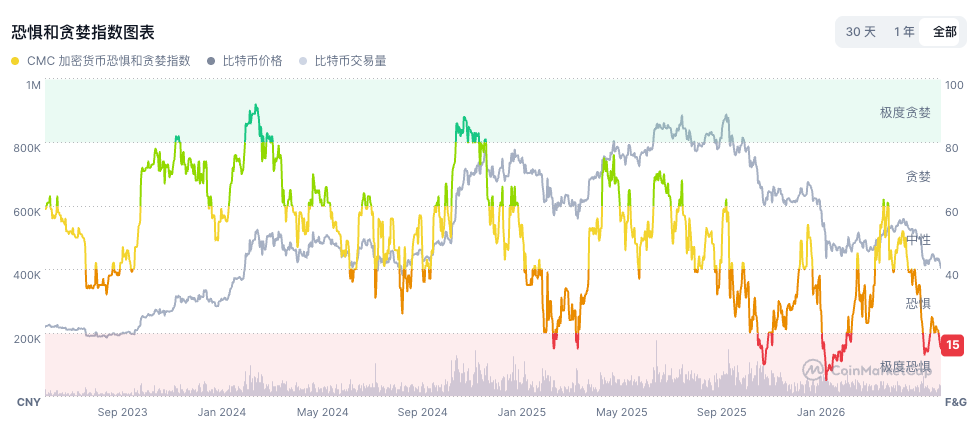


From its all-time high of $126,198 in October 2025, Bitcoin has now retreated more than 53%, with the bear market extending into its 8th month.


The bullish logic for Bitcoin over the past two years rested on two key pillars. First, the flywheel model represented by companies like Strategy continuously buying Bitcoin through securities financing. Second, the influx of large-scale institutional capital following the launch of US spot ETFs. These two channels together built the demand foundation for Bitcoin's last bull run. The current problem is that both pillars are simultaneously weakening.


Strategy's Financing Flywheel Continues to Lose Momentum


The most noteworthy variable in this decline is Strategy, the world's largest corporate holder of Bitcoin.


As of June 21, Strategy holds 847,363 bitcoins with an average cost basis of approximately $75,651, resulting in a paper loss exceeding $14.6 billion at current prices. Over the past few years, the company's core strategy has been to raise funds through issuing equity and preferred shares to continuously purchase Bitcoin. This cycle of "issuing securities, buying Bitcoin, pushing up the price, supporting the stock price, and issuing more securities" made it one of the most stable sources of institutional buying in the Bitcoin market and once propelled MSTR's stock price above $457 in 2024.


However, the key gears of this flywheel are slipping. In July 2025, Strategy completed a $2.5 billion IPO for a variable-rate preferred stock, STRC, designed to trade anchored to its $100 face value, with the company able to adjust the dividend rate monthly to maintain the peg. STRC was positioned as a financing product for the mass market, aiming to attract ordinary investors to participate indirectly in Bitcoin investment with lower volatility.


Since its debut, STRC has been consistently weak, falling to a historic low of about $75 on June 25, a 25% discount to its face value. According to its terms, if STRC falls below $95, it automatically triggers a 0.5% interest rate increase; its current annualized dividend yield has climbed to about 11.5%, increasing annual dividend expenses by approximately $53 million. The company's cash reserve is about $1.4 billion, sufficient to cover just over a year of dividend payments.


Andreja Cobeljic, Head of Derivatives Trading at Amina Bank, analyzed that while the direct cause of Bitcoin's current decline is a weakening market cycle, the deeper driver is the impact on the credibility of Strategy's strategy. If STRC continues to fail to return to its face value, Strategy's ability to raise funds through this channel to buy Bitcoin will be severely weakened, potentially cutting off what has been the most important incremental funding source for the Bitcoin market over the past two years.
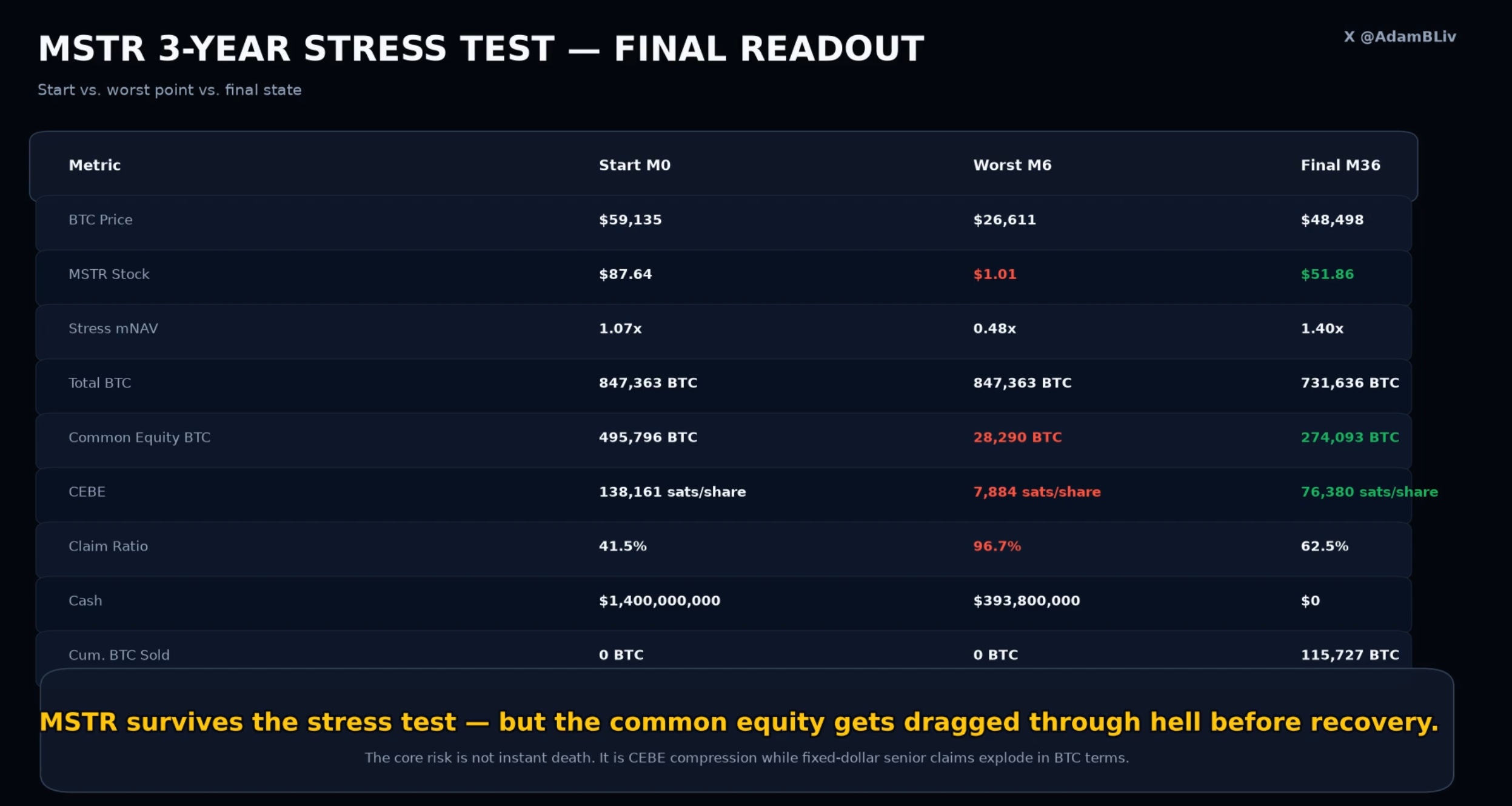


Analyst Adam Livingston conducted a three-year stress test on MSTR starting from current data, simulating an extreme scenario. The model assumes Bitcoin crashes 55% to $26,611 by month 6, while capital markets completely shut down, preventing Strategy from issuing new equity, new debt, or continuing to buy Bitcoin.


In this scenario, Strategy's priority debt structure quickly becomes perilous. Both preferred shares and bonds represent fixed-dollar claims; when the Bitcoin price collapses, their BTC-equivalent claims inflate dramatically. The model shows the BTC-equivalent claims of priority debt surging from 350,000 BTC to 819,000 BTC, accounting for 96.7% of total holdings and almost swallowing the entire Bitcoin inventory. The equity remaining for common shareholders collapses from 496,000 BTC to 28,000 BTC, with the MSTR stock price simulated to fall to $1.01. Meanwhile, monthly fixed expenses of $167.7 million (preferred dividends plus debt interest) continue to deplete cash. By month 9, cash runs out, forcing the company to start selling Bitcoin to service its debt obligations, cumulatively selling about 116,000 BTC over three years.


However, the model's conclusion is that Strategy survives. Assuming Bitcoin recovers to $48,498 in three years, the company would still hold 732,000 BTC, the MSTR stock price would return to $51.86, and the market-adjusted NAV (mNAV) ratio would recover to 1.40x. Livingston's assessment is that the real risk is not the "immediate bankruptcy" shouted by bears, but rather that priority debt, when measured in BTC, temporarily devours almost all common equity value during a price crash. Nevertheless, the model ultimately does not conclude with a "death spiral."


Institutional Retreat, Macro Tightening, Capital Shifts to AI


Strategy's issues are part of a larger picture of capital withdrawal.


US spot Bitcoin ETFs saw a single-day net outflow of $469 million on June 24, with BlackRock's IBIT accounting for $239 million, marking its fifth consecutive day of net outflows. Cumulative outflows for June total approximately $2.8 billion to $3.5 billion, constituting the most severe sustained capital flight since the products were approved in January 2024.


Bloomberg ETF analyst Eric Balchunas recently stated that Bitcoin's excessive reliance on the ETF and Strategy (MSTR) narratives should not be seen as the main value proposition for Bitcoin. He believes they should be the icing on the cake, not the whole cake. When Strategy's buying slows and the ETF channel simultaneously bleeds, Bitcoin's demand side loses its two most critical incremental sources.


Old money is leaving, and new money isn't coming in either, as the macro environment continues to tighten. The May PCE price index released on June 25 showed a year-over-year increase of 4.1%, the fastest pace in over three years. The Fed kept interest rates unchanged at 3.50%-3.75%, with expectations for a rate cut this year pushed further out. On the same day, US stocks initially rose but then fell. Apple announced global price hikes (up to $300) for multiple product lines due to memory chip shortages, causing its stock to plunge 5.1% and dragging the Nasdaq down from a 2.1% intraday gain to a loss of over 1%. Stubbornly high inflation implies persistently high funding costs, directly pressuring crypto assets that rely on liquidity expectations.


Deutsche Bank notes that a key difference in this downturn compared to previous cycles is the near absence of new retail buying, with institutional capital shifting en masse towards AI. On June 25, as Bitcoin fell below $60k and Apple tumbled, memory chip stocks rose across the board. Micron gained 8.6%, SanDisk rose 10.6%, and SK Hynix surged over 10% at one point on plans for a US listing. Capital made a directional choice between AI infrastructure and crypto assets.


Capital outflows, lack of new buy-side demand, and macro pressure all converged in the same week, culminating in a concentrated assault on the $60,000 support level.


~$10 Billion in Options Expire Today, Volatility May Persist


Beyond the aforementioned pressures, there is an immediate catalyst on June 26: Deribit will see approximately $10 billion in notional value of Bitcoin options expire, accounting for about 37% of current open interest. The put-to-call ratio is 0.83, indicating bullish bets still outnumber bearish ones. However, most call options are now out-of-the-money, while put options are concentrated in the $60,000-$65,000 and $70,000-$75,000 strike ranges, meaning bearish bets are more likely to be profitable.


Jean-David Pequignot, Chief Commercial Officer at Deribit, stated that this was an option structure positioned for mid-term higher prices and is now facing the test of declining spot prices.


Adam Haeems, Head of Asset Management at Tesseract Group, pointed out that quarter-end liquidity is typically thin, so prices might initially overshoot in either direction before mean-reverting after market makers hedge and close positions. However, a more significant test will arrive in the first week of July with quarterly contract settlements and leverage reductions.


Trending Cryptos

Related Questions

QAccording to the article, what were the two key pillars of Bitcoin's demand base during the last bull market, and why are they now considered to be weakening?

AThe two key pillars were: 1) The flywheel model of companies like MicroStrategy continuously buying Bitcoin through securities financing. 2) Large-scale institutional capital inflows following the launch of U.S. spot ETFs. They are now weakening because MicroStrategy's financing product (STRC) is trading significantly below its target price, threatening its ability to raise new funds for Bitcoin purchases, and U.S. spot Bitcoin ETFs are experiencing their worst sustained outflows since launch in January 2024.

QBased on the analyst's extreme stress test model, what is the main risk MicroStrategy faces in a deep Bitcoin price crash scenario, and what was the model's ultimate conclusion about the company's survival?

AThe main risk is that MicroStrategy's priority debt (fixed-dollar claims from bonds and preferred stock) would balloon in BTC-equivalent terms, temporarily swallowing almost all the equity value for common shareholders. However, the model's ultimate conclusion was that MicroStrategy would survive the scenario, not spiral into bankruptcy, and its share price could eventually recover if Bitcoin's price later rebounded.

QWhat three broader factors does the article identify as contributing to the current concentrated pressure on Bitcoin's price support at $60,000?

AThe three broader factors are: 1) Capital outflows (from ETFs and potential slowdown from MicroStrategy). 2) An absence of new retail buying. 3) Macroeconomic tightening (persistent high inflation leading to high funding costs and delayed Fed rate cuts).

QHow is the current market dynamic regarding capital allocation different from previous cycles, according to Deutsche Bank's analysis cited in the article?

ADeutsche Bank's analysis indicates a key difference: while new retail buying for crypto has almost dried up, institutional capital is now making a directional shift and moving on a large scale towards AI (Artificial Intelligence) infrastructure investments instead.

QWhat immediate market event is noted for June 26th, and what does the put/call ratio suggest about market positioning?

AThe immediate event is the expiry of approximately $100 billion in notional value of Bitcoin options on Deribit, representing about 37% of current open interest. The put/call ratio of 0.83 suggests bullish bets (calls) still slightly outnumber bearish ones (puts), but a significant portion of the call options are now out-of-the-money, while put options are concentrated at strike prices near or above the current spot price, indicating the bearish bets are more likely to be profitable.

Related Reads

Domestic First Explosion-Proof Certification, World's First Fueling Brain Solution: How Did They Secure Two 'Firsts'?

China's embodied AI sector is booming, with over ¥37 billion in funding this year. The focus has shifted decisively to real-world application, particularly in hazardous, repetitive tasks humans should avoid. A key, often prohibitive, barrier to entry for robots in environments like gas stations and oil fields is obtaining explosion-proof certification, requiring meticulous hardware and circuit design from the ground up. The article explores three main application areas. At gas stations, the challenge lies in executing a long, precise sequence of actions (opening caps, handling the fuel nozzle) with millimeter accuracy across diverse car models. For facility inspections, robots need sustained autonomous patrols combined with real-time anomaly detection and response. Port scenarios introduce the complexity of multi-robot coordination. Addressing the core challenge of long-horizon tasks, the piece highlights a technical breakthrough: a "world model"-driven approach. This enables predictive planning, allowing the AI to visualize the desired end-state (e.g., nozzle returned, cap closed) and work backward to synthesize intermediate visual frames. This "imagination" of the task trajectory, as implemented in the H-GAR architecture, guides action generation, significantly reducing cumulative error in multi-step operations. The three-step H-GAR process involves generating a coarse action draft, synthesizing target-conditioned observation frames, and then refining actions based on visual context and a memory of past successful motions. The conclusion emphasizes that success in specialized, safety-critical fields requires long-term commitment and deep integration of the "embodied brain" (AI) with a purpose-built, certified physical "body." Mastering this brain-body-data闭环 (closed-loop) is positioned as a crucial competitive advantage for commercialization.

marsbit35m ago

Domestic First Explosion-Proof Certification, World's First Fueling Brain Solution: How Did They Secure Two 'Firsts'?

marsbit35m ago

Bitcoin Bear Market Triggers Crypto Layoffs, Yet Fuels Industry's Most Aggressive M&A Wave Ever

A prolonged Bitcoin downturn is forcing crypto companies to lay off employees and automate operations, but has simultaneously triggered the industry's most aggressive wave of mergers and acquisitions (M&A). In the first half of 2026, crypto M&A deal value reached $93.7 billion, 26 times higher than the same period last year. This activity is primarily driven by traditional financial institutions—banks, payment processors, and asset managers—who are acquiring compliant crypto infrastructure like custody solutions, payment rails, and regulatory licenses instead of building them internally. Examples include Mastercard's acquisition of stablecoin firm BVNK and Franklin Templeton's launch of a dedicated crypto division via acquisition. This consolidation contrasts sharply with a shrinking crypto labor market, where active job openings have plummeted. Companies like Coinbase are restructuring to become "AI-native," leading to a sharp increase in roles requiring AI skills, while engineering and compliance positions now dominate hiring. Financially pressured crypto firms, such as Messari which was acquired at a fraction of its prior valuation, are becoming prime targets. Capital remains available but is highly selective, flowing overwhelmingly into businesses that bridge digital assets with traditional finance, such as tokenization platforms and regulated trading venues. The trend indicates a market where capital is rewarding compliant, utility-focused infrastructure while weaker models consolidate or downsize.

marsbit36m ago

Bitcoin Bear Market Triggers Crypto Layoffs, Yet Fuels Industry's Most Aggressive M&A Wave Ever

marsbit36m ago

Trillion-Dollar Pension Fund Entry? Franklin Bitcoin Dividend Reinvestment ETF Comes with a Built-in Selling Pressure Ceiling

Franklin Templeton has filed to launch two ETFs that embed a "default configuration" logic into Bitcoin investment, aiming to tap into massive pension fund flows. These "Bitcoin Dividend Reinvestment Index ETFs" will initially hold 95% equities and 5% Bitcoin, automatically reinvesting stock dividends to buy Bitcoin. However, a quarterly rebalancing rule forces selling of Bitcoin if its allocation exceeds 5%, capping its maximum holding at 20%. While the product cleverly circumvents advisor reluctance and compliance hurdles by labeling itself as a U.S. equity product, its actual Bitcoin buying power is minimal. Given low dividend yields (e.g., ~1% for broad market indices), annual Bitcoin purchases from a fund the size of Franklin's existing Bitcoin ETF would be a mere $3.6 million—negligible against Bitcoin's daily trading volume. Crucially, during bull markets, the fund becomes a programmed, passive *seller* of Bitcoin, potentially creating sustained sell pressure if many similar funds emerge. The strategy leverages investor inertia and automatic enrollment, similar to the success of target-date funds in 401(k) plans. It also uses an offshore Cayman subsidiary for holding Bitcoin and raises a tax complication where investors must pay taxes on dividends they never receive as cash. Although recent U.S. regulatory changes allow crypto in retirement plans, widespread adoption as a default option faces legal hurdles. The core premise remains: the system doesn't need to convince anyone to buy Bitcoin actively; it simply relies on people doing nothing.

marsbit1h ago

Trillion-Dollar Pension Fund Entry? Franklin Bitcoin Dividend Reinvestment ETF Comes with a Built-in Selling Pressure Ceiling

marsbit1h ago

Trading

Spot
Futures

Hot Articles

What is $BITCOIN

DIGITAL GOLD ($BITCOIN): A Comprehensive Analysis Introduction to DIGITAL GOLD ($BITCOIN) DIGITAL GOLD ($BITCOIN) is a blockchain-based project operating on the Solana network, which aims to combine the characteristics of traditional precious metals with the innovation of decentralized technologies. While it shares a name with Bitcoin, often referred to as “digital gold” due to its perception as a store of value, DIGITAL GOLD is a separate token designed to create a unique ecosystem within the Web3 landscape. Its goal is to position itself as a viable alternative digital asset, although specifics regarding its applications and functionalities are still developing. What is DIGITAL GOLD ($BITCOIN)? DIGITAL GOLD ($BITCOIN) is a cryptocurrency token explicitly designed for use on the Solana blockchain. In contrast to Bitcoin, which provides a widely recognized value storage role, this token appears to focus on broader applications and characteristics. Notable aspects include: Blockchain Infrastructure: The token is built on the Solana blockchain, known for its capacity to handle high-speed and low-cost transactions. Supply Dynamics: DIGITAL GOLD has a maximum supply capped at 100 quadrillion tokens (100P $BITCOIN), although details regarding its circulating supply are currently undisclosed. Utility: While precise functionalities are not explicitly outlined, there are indications that the token could be utilized for various applications, potentially involving decentralized applications (dApps) or asset tokenization strategies. Who is the Creator of DIGITAL GOLD ($BITCOIN)? At present, the identity of the creators and development team behind DIGITAL GOLD ($BITCOIN) remains unknown. This situation is typical among many innovative projects within the blockchain space, particularly those aligning with decentralized finance and meme coin phenomena. While such anonymity may foster a community-driven culture, it intensifies concerns about governance and accountability. Who are the Investors of DIGITAL GOLD ($BITCOIN)? The available information indicates that DIGITAL GOLD ($BITCOIN) does not have any known institutional backers or prominent venture capital investments. The project seems to operate on a peer-to-peer model focused on community support and adoption rather than traditional funding routes. Its activity and liquidity are primarily situated on decentralized exchanges (DEXs), such as PumpSwap, rather than established centralized trading platforms, further highlighting its grassroots approach. How DIGITAL GOLD ($BITCOIN) Works The operational mechanics of DIGITAL GOLD ($BITCOIN) can be elaborated on based on its blockchain design and network attributes: Consensus Mechanism: By leveraging Solana’s unique proof-of-history (PoH) combined with a proof-of-stake (PoS) model, the project ensures efficient transaction validation contributing to the network's high performance. Tokenomics: While specific deflationary mechanisms have not been extensively detailed, the vast maximum token supply implies that it may cater to microtransactions or niche use cases that are still to be defined. Interoperability: There exists the potential for integration with Solana’s broader ecosystem, including various decentralized finance (DeFi) platforms. However, the details regarding specific integrations remain unspecified. Timeline of Key Events Here is a timeline that highlights significant milestones concerning DIGITAL GOLD ($BITCOIN): 2023: The initial deployment of the token occurs on the Solana blockchain, marked by its contract address. 2024: DIGITAL GOLD gains visibility as it becomes available for trading on decentralized exchanges like PumpSwap, allowing users to trade it against SOL. 2025: The project witnesses sporadic trading activity and potential interest in community-led engagements, although no noteworthy partnerships or technical advancements have been documented as of yet. Critical Analysis Strengths Scalability: The underlying Solana infrastructure supports high transaction volumes, which could enhance the utility of $BITCOIN in various transaction scenarios. Accessibility: The potential low trading price per token could attract retail investors, facilitating wider participation due to fractional ownership opportunities. Risks Lack of Transparency: The absence of publicly known backers, developers, or an audit process may yield skepticism regarding the project's sustainability and trustworthiness. Market Volatility: The trading activity is heavily reliant on speculative behavior, which can result in significant price volatility and uncertainty for investors. Conclusion DIGITAL GOLD ($BITCOIN) emerges as an intriguing yet ambiguous project within the rapidly evolving Solana ecosystem. While it attempts to leverage the “digital gold” narrative, its departure from Bitcoin's established role as a store of value underscores the need for a clearer differentiation of its intended utility and governance structure. Future acceptance and adoption will likely depend on addressing the current opacity and defining its operational and economic strategies more explicitly. Note: This report encompasses synthesised information available as of October 2023, and developments may have transpired beyond the research period.

459 Total ViewsPublished 2025.05.13Updated 2025.05.13

What is $BITCOIN

Discussions

Welcome to the HTX Community. Here, you can stay informed about the latest platform developments and gain access to professional market insights. Users' opinions on the price of BTC (BTC) are presented below.

活动图片