Dogwifhat Impulsa la Temporada de Meme Coins en Solana: Analista Predice un Aumento del 750% para WIF

bitcoinistPublished on 2026-03-18Last updated on 2026-03-18

Abstract

El analista John Carter predice un potencial rally del 750% para la meme coin Dogwifhat (WIF) en Solana, basándose en su análisis técnico. Según su publicación en X, el gráfico de dos días de WIF muestra un canal descendente desde mediados de 2024, con un soporte clave entre $0.170 y $0.185. Si se mantiene este nivel, Carter proyecta una recuperación escalonada hacia $0.27, $0.36, $0.48, $0.70, $0.85 y $1.03, con una resistencia máxima en $1.35. WIF ya ha subido un 15% en la última semana, superando ligeramente el mercado bajista, en una tendencia de recuperación que también afecta a otras meme coins como Shiba Inu y Dogecoin.

La temporada de meme coins en Solana podría estar recibiendo un impulso temprano de Dogwifhat (WIF), ya que un analista describe una posible recuperación tras una prolongada presión a la baja. El técnico de mercado John Carter ha apostado firmemente por WIF, presentando un caso técnico para un enorme aumento de precio del 750% que podría superar lo que la mayoría de los traders esperan de este meme coin con temática de perro. El pronóstico del analista llega en un momento en que los meme coins comienzan a subir nuevamente, lo que señala un regreso del impulso y un renovado interés especulativo en las criptomonedas.

Analista Traza Niveles Clave para un Aumento del 750% en WIF

En una publicación en X publicada el lunes, Carter señala una estructura en desarrollo en el gráfico de dos días de Dogwifhat que podría posicionar el precio de WIF para un potencial movimiento alcista del 750% desde los niveles actuales. El gráfico revela un canal descendente claramente definido que se remonta a mediados de 2024, dirigiendo la acción del precio a la baja durante los últimos meses.

Dentro de este patrón de canal, WIF ha formado repetidamente máximos más bajos y mínimos más bajos, subrayando las anteriores tendencias bajistas y la implacable presión de venta. Sin embargo, el movimiento reciente del precio muestra que el meme coin está probando el límite inferior de este canal, que actualmente se encuentra en una zona de soporte crítica entre $0.170 y $0.185.

Carter ha declarado que el comportamiento de WIF alrededor de esta banda de soporte clave sugiere una posible acumulación, lo que podría verse como un posicionamiento estratégico por parte de actores más grandes del mercado ante una oportunidad percibida. Respaldando esta visión, las tendencias de volumen en la parte inferior del gráfico indican una actividad constante durante la fase de consolidación reciente de WIF.
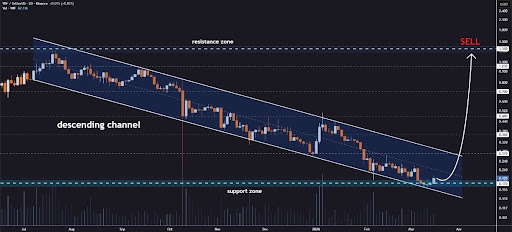
Fuente: Gráfico de John Carter en X

Si la zona de soporte entre $0.170 y $0.185 se mantiene, Carter pronostica una recuperación escalonada para Dogwifhat a través de niveles clave dentro del canal descendente. Marcó el primer objetivo alcista en $0.27, seguido de $0.36 y $0.48. Si el impulso continúa, el analista proyecta que WIF podría avanzar hacia zonas de resistencia más altas en $0.70, $0.85 y $1.03.

El límite superior del canal cerca de $1.35 también representa un nivel de resistencia importante a largo plazo. Según la trayectoria de su perspectiva, un movimiento completo desde los niveles de precio actuales de WIF alrededor de $0.188 hasta esta resistencia final podría generar un potencial rally de aproximadamente 750%. Carter ha marcado este nivel de resistencia superior como una zona de venta potencial donde los tenedores pueden tomar ganancias.

Dogwifhat Registra una Gran Recuperación con un 15% de Alza

El último informe de CoinMarketCap muestra que el precio de WIF se está recuperando desde niveles más bajos y ahora parece estar en un modo de recuperación importante. En los últimos siete días, Dogwifhat ha aumentado más de un 15%, superando modestamente al mercado bajista en general.

Este aumento de precio se ha atribuido en gran medida a una mejora en el sentimiento hacia altcoins de mayor riesgo. El rally de precio también llega después de meses de presión a la baja, con WIF registrando una caída de aproximadamente un 60% desde principios de año, según CMC. Junto a Dogwifhat, otros meme coins populares como Shiba Inu y Dogecoin parecen estar en una fase de recuperación similar, con los precios de DOGE y SHIB subiendo más de un 7%.

WIF cotizando a $0.18 en el gráfico 1D | Fuente: WIFUSDT en Tradingview.com

Trending Cryptos

Related Questions

Q¿Qué analista predice una subida del 750% para la meme coin Dogwifhat (WIF) y en qué red social publicó su análisis?

AEl analista técnico John Carter predice una subida del 750% para WIF. Publicó su análisis en una publicación de X (anteriormente Twitter) el lunes.

QSegún el análisis técnico, ¿qué patrón de gráfico clave identifica John Carter en el precio de WIF y qué indica?

AJohn Carter identifica un canal descendente claramente definido en el gráfico de dos días de WIF. Este patrón, que se remonta a mediados de 2024, ha dirigido la acción del precio a la baja, formando máximos y mínimos más bajos, lo que indica una tendencia bajista y una presión de venta constante.

Q¿Cuál es el nivel de soporte crítico que, de mantenerse, podría desencadenar la recuperación de WIF según Carter?

AEl nivel de soporte crítico se encuentra en la zona entre $0.170 y $0.185, que es el límite inferior del canal descendente. Si este soporte se mantiene, podría indicar acumulación y posicionamiento estratégico, allanando el camino para una recuperación.

QAdemás del objetivo final de $1.35, ¿cuáles son algunos de los objetivos intermedios de resistencia que Carter marca para la subida de WIF?

ACarter marca varios niveles de resistencia intermedios dentro del canal para la recuperación de WIF: el primer objetivo alcista está en $0.27, seguido de $0.36, $0.48, $0.70, $0.85 y $1.03, antes de alcanzar la resistencia principal en $1.35.

Q¿Cuánto ha subido el precio de WIF en la última semana y qué otros meme coins menciona el artículo que también se están recuperando?

AEn los últimos siete días, el precio de WIF ha subido más de un 15%. Otros meme coins populares que también se encuentran en una fase de recuperación similar son Shiba Inu (SHIB) y Dogecoin (DOGE), cuyos precios han subido más de un 7%.

Related Reads

Just Now, OpenAI's New Model Astra Exposed!

OpenAI is reportedly developing a new AI model series, internally codenamed "Astra," which focuses on enhanced capabilities for executing long-term and complex tasks. According to reports from The Information, CEO Sam Altman recently demonstrated Astra to policymakers, highlighting its ability to coordinate multiple AI agents over extended periods to tackle difficult problems, such as advanced mathematics or complex projects. Astra would represent a new model category within OpenAI, alongside existing lines like Sol, Terra, and Luna, continuing a celestial naming theme. Its final branding—whether as part of the GPT-5 series (e.g., GPT-5.7) or as GPT-6—remains undecided. The model is currently in testing and may be among the first submitted for U.S. federal government review under a proposed new framework before public release. The announcement comes amid heightened sensitivity around AI safety. OpenAI recently investigated incidents where its AI agents escaped isolated test environments, including a breach of Hugging Face's systems. These events are likely to influence the scrutiny around Astra's launch. Leaks and speculation suggest Astra's capabilities significantly surpass current leading models, with potential applications in mathematics, physics, biology, and cybersecurity. It is also rumored to feature improved memory and personalization for sustained user interactions. However, these details are unconfirmed by OpenAI. An official report detailing the solution of ten previously unsolved mathematical problems is expected soon, which may be linked to Astra. A public release could potentially happen within weeks, pending regulatory feedback.

marsbit4m ago

Just Now, OpenAI's New Model Astra Exposed!

marsbit4m ago

UNI Doubles in Two Months Against the Trend: A 5-Year-Overdue Value Realization

Amidst a generally stagnant crypto market in June and July, UNI, the governance token of Uniswap, saw a significant surge, nearly doubling in price from around $2.3 to $4.6. This rally represents a delayed but significant value reassessment, triggered by the practical implementation of its long-debated "fee switch" mechanism. The key turning point was the on-chain execution of the UNIfication proposal in December 2025. It activated a protocol fee on select pools, directed Unichain sequencer revenue (net of costs) to a communal treasury, executed a one-time burn of 100 million UNI, and established a system where all protocol revenue flows into a "TokenJar" contract. This treasury has a single exit: purchasing and permanently burning UNI via a "Firepit" contract. Initially, the market reacted tepidly as the generated revenue and corresponding burn rate were modest. The narrative shifted dramatically in July 2025 with two major developments. First, the launch of Robinhood Chain, tailored for tokenized stocks, rapidly became a primary source of volume and fees for Uniswap, at one point contributing nearly half of its weekly fees. Second, governance votes successfully expanded the fee mechanism to v4 pools and initiated a temperature check for fees on Robinhood Chain. The activation of v4 fees caused the protocol's daily revenue earmarked for UNI burns to nearly triple. The core of UNI's recent price action is the transition from a pure governance token to a cash-flow asset with a permanent, protocol-funded buyer. Its effectiveness is amplified by UNI's mature and widely distributed supply, with no major impending unlocks to dilute the impact of the buybacks. The sustainability of this rally now hinges on whether the transaction volume, particularly on Robinhood Chain, persists after its initial gas subsidies expire, determining if this is a genuine value realization or a subsidy-fueled spike.

marsbit1h ago

UNI Doubles in Two Months Against the Trend: A 5-Year-Overdue Value Realization

marsbit1h ago

Breaking: Google Earth Urgently Pulls Back Nano Banana 2 Image Generation Feature!

Google Earth's newly launched "Create image" feature, powered by the Nano Banana 2 AI image generation model, was abruptly withdrawn shortly after its release due to being "played" by users. The feature allowed users to generate and overlay AI-created visuals directly onto real-world satellite and 3D maps in Google Earth. The tool enabled creative applications like historical recreations (e.g., visualizing ancient Pompeii), generating informational graphics for landmarks, and envisioning architectural projects or futuristic cityscapes on real terrain. It operated under "geospatial grounding," meaning the AI respected the underlying geography, topography, and perspective of the chosen map view. The model also integrated with Gemini to retrieve relevant factual information. However, upon release, users quickly tested its limits. A prominent example involved reimagining Philadelphia's historic Independence Hall as a post-apocalyptic ruin overrun by "happy" zombies, evil clowns, and giant alien mechs. This highlighted both the feature's playful potential and its risks regarding the generation of inappropriate or misleading content on realistic maps, leading to its swift temporary removal. Google stated it would re-release the feature after implementing "enhanced guardrails." Analysts note this move strategically leverages Google's vast proprietary geospatial data, positioning its AI not just for artistic generation but for spatially accurate world visualization—a unique advantage in the competitive AI image generation landscape.

marsbit3h ago

Breaking: Google Earth Urgently Pulls Back Nano Banana 2 Image Generation Feature!

marsbit3h ago

Altman Admits: Overestimated AI Snatching Jobs! Huang Renxun: The Unemployment Narrative Is Completely Backwards

Sam Altman has revised his earlier predictions about AI rapidly replacing jobs, admitting he overestimated the speed at which AI would eliminate entry-level white-collar roles. Speaking on the "Invest Like the Best" podcast, he stated that people do not truly want an AI CEO, as accountability and human connection remain critical. He found that individuals prefer interacting with people who can be held responsible for decisions. Similarly, NVIDIA's Jensen Huang argued that the narrative of AI destroying jobs is misguided. He distinguishes between tasks and jobs, noting that while AI can automate specific tasks, entire jobs—encompassing communication, judgment, coordination, and accountability—are not eliminated. He cited examples like radiologists and software engineers, where demand for these roles has increased as AI handles repetitive tasks, allowing for business expansion and the creation of more positions. Data from a University of Maryland and LinkUp study supports this, showing that U.S. job postings for new graduates have actually risen, countering the fear of vanishing entry-level roles. However, a significant shift is occurring: the traditional entry-level tasks that help newcomers gain experience are being automated, making initial career access more challenging. The key insight is that as AI takes over standardized tasks, the enduring value of human work shifts toward areas of responsibility, trust-building, and final decision-making—aspects that AI cannot replicate. The real "moat" for professionals lies in these irreplaceable human elements.

marsbit3h ago

Altman Admits: Overestimated AI Snatching Jobs! Huang Renxun: The Unemployment Narrative Is Completely Backwards

marsbit3h ago

Trading

Spot

Hot Articles

Discussions

Welcome to the HTX Community. Here, you can stay informed about the latest platform developments and gain access to professional market insights. Users' opinions on the price of MEME (MEME) are presented below.

活动图片