Cộng Đồng Bitcoin Kỷ Niệm 'Ngày Khởi Nguyên' Khi Nợ Công Mỹ Vượt 38 Nghìn Tỷ USD

bitcoinistPublished on 2026-01-04Last updated on 2026-01-04

Abstract

Vào ngày 3/1/2026, nợ công liên bang Mỹ đã vượt 38 nghìn tỷ USD, một mốc mới được ghi nhận trong bối cảnh cộng đồng tiền điện tử kỷ niệm "Genesis Day" - ngày khối Bitcoin đầu tiên được đào vào năm 2009. Sự kiện này làm nổi bật sự tương phản giữa hệ thống nợ công ngày càng tăng và nguồn cung Bitcoin cố định 21 triệu đồng. Nợ Mỹ tăng mạnh từ 34 nghìn tỷ USD đầu năm 2024 lên 38,5 nghìn tỷ USD cuối năm 2025, với tốc độ tăng khoảng 6 tỷ USD/ngày. Các nguyên nhân bao gồm thâm hụt ngân sách, chi tiêu vượt thu nhập và lãi suất trên nợ hiện có. Các nhà kinh tế cảnh báo việc trả lãi nợ có thể chiếm dụng ngân sách cho các ưu tiên khác. Cộng đồng Bitcoin xem đây là biểu tượng của thay đổi tài chính, coi Bitcoin như công cụ phòng hộ trước rủi ro nợ cao. Trong khi đó, BTC được giao dịch quanh 91.487 USD. Các nhà kinh tế chính thống cảnh báo thâm hụt kéo dài có thể làm tăng chi phí vay và giảm tăng trưởng.

Theo dữ liệu từ Bộ Tài chính Mỹ, nợ liên bang đã vượt mốc 38 nghìn tỷ USD vào ngày 3 tháng 1 năm 2026. Cột mốc mới này trùng hợp với thời điểm một bộ phận cộng đồng tiền điện tử kỷ niệm Ngày Khởi Nguyên (Genesis Day) - kỷ niệm khối Bitcoin đầu tiên được khai thác. Các báo cáo ghi nhận thời điểm này thu hút sự chú ý vì nó làm nổi bật sự tương phản giữa vay nợ công và nguồn cung cố định của Bitcoin.

Nợ Công Chạm Mức Cao Mới

Theo số liệu từ Bộ Tài chính, tổng nợ liên bang đã tăng vượt 38 nghìn tỷ USD vào ngày 3 tháng 1. Mức tăng này rất mạnh trong hai năm qua, từ khoảng 34 nghìn tỷ USD vào đầu năm 2024 lên khoảng 36 nghìn tỷ USD vào cuối năm 2024, và sau đó là 38,5 nghìn tỷ USD vào cuối năm 2025.

Các nhà phân tích tính toán rằng gần đây nợ công đang tăng với tốc độ khoảng 6 tỷ USD mỗi ngày, một tốc độ đẩy chi phí lãi vay lên cao và thu hẹp các lựa chọn cho ngân sách tương lai. Một phần nguyên nhân của mức tăng này đến từ thâm hụt ngân sách liên tục, khi chi tiêu vượt quá doanh thu.

Động Lực Đằng Sau Sự Bùng Nổ

Theo các báo cáo thị trường, một số yếu tố đứng đằng sau mức tăng vọt này: thâm hụt ngân sách hàng năm kéo dài, các khoản thanh toán lãi ngày càng tăng trên khoản nợ hiện có, và các dự luật chi tiêu lớn được thông qua trong các phiên họp Quốc hội gần đây.

Nợ do công chúng nắm giữ và các khoản nợ với các quỹ tín thác liên bang cùng tạo nên con số tổng. Các nhà kinh tế cảnh báo rằng khi nợ ngày càng lớn so với quy mô nền kinh tế, sẽ cần nhiều đô la từ người đóng thuế hơn chỉ để trả lãi, điều này có thể lấn át các ưu tiên khác.
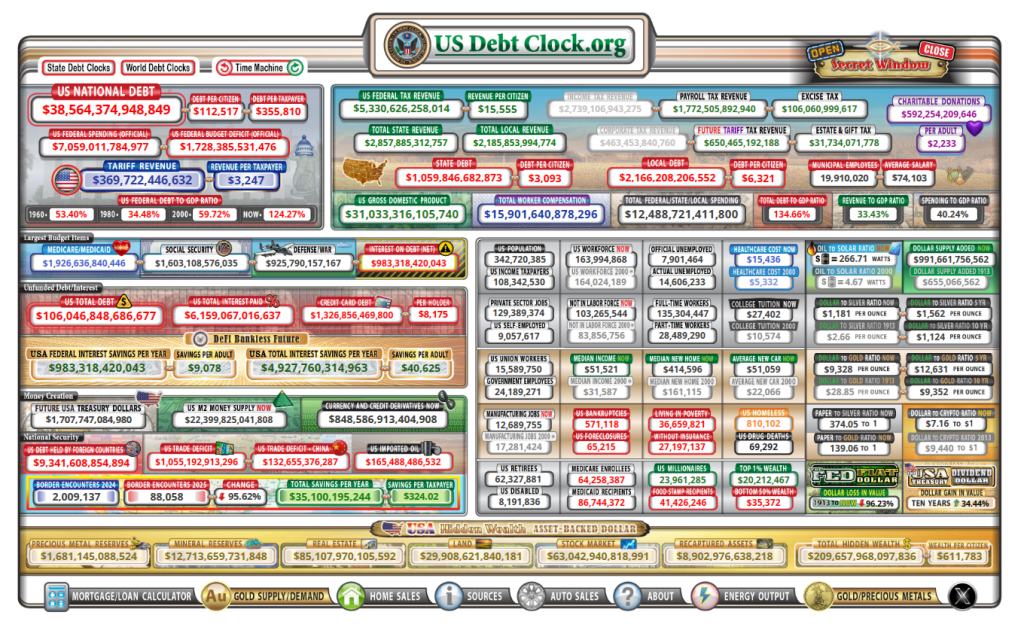
Bảng điều khiển hiển thị nợ chính phủ Mỹ, hiện trên 38 nghìn tỷ USD và đang tiếp tục tăng. Nguồn: US Debt Clock

Cộng Đồng Bitcoin Phản Ứng

Vào ngày 3 tháng 1, nhiều người ủng hộ Bitcoin đã đánh dấu Ngày Khởi Nguyên, một ngày mà họ coi là biểu tượng của sự thay đổi tài chính khi khối Bitcoin đầu tiên được khai thác vào năm 2009. Một số người dùng đã đăng bài về sự tương phản giữa một khoản nợ quốc gia không ngừng tăng và nguồn cung bị giới hạn ở 21 triệu coin của Bitcoin.

BTCUSD hiện đang giao dịch ở mức 91.487 USD. Biểu đồ: TradingView

Những người khác sử dụng dịp kỷ niệm này để nâng cao các câu hỏi rộng hơn về các quy tắc tài khóa và cung tiền. Các phản ứng rất đa dạng; một số xem đây là một lời cảnh báo, số khác coi đó là khoảnh khắc để tưởng niệm.

Các nhà đầu tư và bình luận viên đã cân nhắc các hàm ý. Một bộ phận thị trường coi các tài sản khan hiếm như Bitcoin và vàng như một công cụ phòng ngừa rủi ro trước những gì họ cho là rủi ro của việc vay nợ nặng nề.

Đồng thời, các nhà kinh tế học chính thống cảnh báo rằng việc duy trì thâm hụt ngân sách lớn và kéo dài có thể làm tăng chi phí vay và kìm hãm tăng trưởng về lâu dài. Các quan chức Bộ Tài chính theo dõi chặt chẽ nhu cầu tiền mặt và đôi khi thay đổi lịch trình vay để bù đắp khoảng cách giữa thu và chi.

Hình ảnh nổi bật từ Unsplash, biểu đồ từ TradingView

Trending Cryptos

Related Questions

QNợ công của Mỹ đã đạt mốc nào vào ngày 3 tháng 1 năm 2026?

ANợ công của Mỹ đã vượt qua 38 nghìn tỷ USD vào ngày 3 tháng 1 năm 2026.

QNgày Genesis trong cộng đồng Bitcoin có ý nghĩa gì?

ANgày Genesis đánh dấu kỷ niệm việc khối đầu tiên của Bitcoin được đào vào năm 2009, mang tính biểu tượng cho sự thay đổi tài chính.

QNhững yếu tố nào được cho là nguyên nhân làm gia tăng nợ công của Mỹ?

ACác yếu tố bao gồm thâm hụt ngân sách hàng năm kéo dài, chi trả lãi suất cho nợ hiện có tăng lên, và các dự luật chi tiêu lớn được thông qua gần đây.

QTại sao một số nhà đầu tư xem Bitcoin như một công cụ phòng ngừa rủi ro?

AMột số nhà đầu tư xem Bitcoin như một công cụ phòng ngừa rủi ro do nguồn cung cố định chỉ 21 triệu coin, trái ngược với việc nợ công liên tục tăng và các rủi ro từ vay nợ nặng.

QGiá trị của Bitcoin (BTCUSD) được báo cáo là bao nhiêu trong bài viết?

ATheo bài viết, BTCUSD đang được giao dịch ở mức 91.487 USD.

Related Reads

Just Now, OpenAI's New Model Astra Exposed!

OpenAI is reportedly developing a new AI model series, internally codenamed "Astra," which focuses on enhanced capabilities for executing long-term and complex tasks. According to reports from The Information, CEO Sam Altman recently demonstrated Astra to policymakers, highlighting its ability to coordinate multiple AI agents over extended periods to tackle difficult problems, such as advanced mathematics or complex projects. Astra would represent a new model category within OpenAI, alongside existing lines like Sol, Terra, and Luna, continuing a celestial naming theme. Its final branding—whether as part of the GPT-5 series (e.g., GPT-5.7) or as GPT-6—remains undecided. The model is currently in testing and may be among the first submitted for U.S. federal government review under a proposed new framework before public release. The announcement comes amid heightened sensitivity around AI safety. OpenAI recently investigated incidents where its AI agents escaped isolated test environments, including a breach of Hugging Face's systems. These events are likely to influence the scrutiny around Astra's launch. Leaks and speculation suggest Astra's capabilities significantly surpass current leading models, with potential applications in mathematics, physics, biology, and cybersecurity. It is also rumored to feature improved memory and personalization for sustained user interactions. However, these details are unconfirmed by OpenAI. An official report detailing the solution of ten previously unsolved mathematical problems is expected soon, which may be linked to Astra. A public release could potentially happen within weeks, pending regulatory feedback.

marsbit58m ago

Just Now, OpenAI's New Model Astra Exposed!

marsbit58m ago

UNI Doubles in Two Months Against the Trend: A 5-Year-Overdue Value Realization

Amidst a generally stagnant crypto market in June and July, UNI, the governance token of Uniswap, saw a significant surge, nearly doubling in price from around $2.3 to $4.6. This rally represents a delayed but significant value reassessment, triggered by the practical implementation of its long-debated "fee switch" mechanism. The key turning point was the on-chain execution of the UNIfication proposal in December 2025. It activated a protocol fee on select pools, directed Unichain sequencer revenue (net of costs) to a communal treasury, executed a one-time burn of 100 million UNI, and established a system where all protocol revenue flows into a "TokenJar" contract. This treasury has a single exit: purchasing and permanently burning UNI via a "Firepit" contract. Initially, the market reacted tepidly as the generated revenue and corresponding burn rate were modest. The narrative shifted dramatically in July 2025 with two major developments. First, the launch of Robinhood Chain, tailored for tokenized stocks, rapidly became a primary source of volume and fees for Uniswap, at one point contributing nearly half of its weekly fees. Second, governance votes successfully expanded the fee mechanism to v4 pools and initiated a temperature check for fees on Robinhood Chain. The activation of v4 fees caused the protocol's daily revenue earmarked for UNI burns to nearly triple. The core of UNI's recent price action is the transition from a pure governance token to a cash-flow asset with a permanent, protocol-funded buyer. Its effectiveness is amplified by UNI's mature and widely distributed supply, with no major impending unlocks to dilute the impact of the buybacks. The sustainability of this rally now hinges on whether the transaction volume, particularly on Robinhood Chain, persists after its initial gas subsidies expire, determining if this is a genuine value realization or a subsidy-fueled spike.

marsbit2h ago

UNI Doubles in Two Months Against the Trend: A 5-Year-Overdue Value Realization

marsbit2h ago

Breaking: Google Earth Urgently Pulls Back Nano Banana 2 Image Generation Feature!

Google Earth's newly launched "Create image" feature, powered by the Nano Banana 2 AI image generation model, was abruptly withdrawn shortly after its release due to being "played" by users. The feature allowed users to generate and overlay AI-created visuals directly onto real-world satellite and 3D maps in Google Earth. The tool enabled creative applications like historical recreations (e.g., visualizing ancient Pompeii), generating informational graphics for landmarks, and envisioning architectural projects or futuristic cityscapes on real terrain. It operated under "geospatial grounding," meaning the AI respected the underlying geography, topography, and perspective of the chosen map view. The model also integrated with Gemini to retrieve relevant factual information. However, upon release, users quickly tested its limits. A prominent example involved reimagining Philadelphia's historic Independence Hall as a post-apocalyptic ruin overrun by "happy" zombies, evil clowns, and giant alien mechs. This highlighted both the feature's playful potential and its risks regarding the generation of inappropriate or misleading content on realistic maps, leading to its swift temporary removal. Google stated it would re-release the feature after implementing "enhanced guardrails." Analysts note this move strategically leverages Google's vast proprietary geospatial data, positioning its AI not just for artistic generation but for spatially accurate world visualization—a unique advantage in the competitive AI image generation landscape.

marsbit4h ago

Breaking: Google Earth Urgently Pulls Back Nano Banana 2 Image Generation Feature!

marsbit4h ago

Trading

Spot

Hot Articles

What is $BITCOIN

DIGITAL GOLD ($BITCOIN): A Comprehensive Analysis Introduction to DIGITAL GOLD ($BITCOIN) DIGITAL GOLD ($BITCOIN) is a blockchain-based project operating on the Solana network, which aims to combine the characteristics of traditional precious metals with the innovation of decentralized technologies. While it shares a name with Bitcoin, often referred to as “digital gold” due to its perception as a store of value, DIGITAL GOLD is a separate token designed to create a unique ecosystem within the Web3 landscape. Its goal is to position itself as a viable alternative digital asset, although specifics regarding its applications and functionalities are still developing. What is DIGITAL GOLD ($BITCOIN)? DIGITAL GOLD ($BITCOIN) is a cryptocurrency token explicitly designed for use on the Solana blockchain. In contrast to Bitcoin, which provides a widely recognized value storage role, this token appears to focus on broader applications and characteristics. Notable aspects include: Blockchain Infrastructure: The token is built on the Solana blockchain, known for its capacity to handle high-speed and low-cost transactions. Supply Dynamics: DIGITAL GOLD has a maximum supply capped at 100 quadrillion tokens (100P $BITCOIN), although details regarding its circulating supply are currently undisclosed. Utility: While precise functionalities are not explicitly outlined, there are indications that the token could be utilized for various applications, potentially involving decentralized applications (dApps) or asset tokenization strategies. Who is the Creator of DIGITAL GOLD ($BITCOIN)? At present, the identity of the creators and development team behind DIGITAL GOLD ($BITCOIN) remains unknown. This situation is typical among many innovative projects within the blockchain space, particularly those aligning with decentralized finance and meme coin phenomena. While such anonymity may foster a community-driven culture, it intensifies concerns about governance and accountability. Who are the Investors of DIGITAL GOLD ($BITCOIN)? The available information indicates that DIGITAL GOLD ($BITCOIN) does not have any known institutional backers or prominent venture capital investments. The project seems to operate on a peer-to-peer model focused on community support and adoption rather than traditional funding routes. Its activity and liquidity are primarily situated on decentralized exchanges (DEXs), such as PumpSwap, rather than established centralized trading platforms, further highlighting its grassroots approach. How DIGITAL GOLD ($BITCOIN) Works The operational mechanics of DIGITAL GOLD ($BITCOIN) can be elaborated on based on its blockchain design and network attributes: Consensus Mechanism: By leveraging Solana’s unique proof-of-history (PoH) combined with a proof-of-stake (PoS) model, the project ensures efficient transaction validation contributing to the network's high performance. Tokenomics: While specific deflationary mechanisms have not been extensively detailed, the vast maximum token supply implies that it may cater to microtransactions or niche use cases that are still to be defined. Interoperability: There exists the potential for integration with Solana’s broader ecosystem, including various decentralized finance (DeFi) platforms. However, the details regarding specific integrations remain unspecified. Timeline of Key Events Here is a timeline that highlights significant milestones concerning DIGITAL GOLD ($BITCOIN): 2023: The initial deployment of the token occurs on the Solana blockchain, marked by its contract address. 2024: DIGITAL GOLD gains visibility as it becomes available for trading on decentralized exchanges like PumpSwap, allowing users to trade it against SOL. 2025: The project witnesses sporadic trading activity and potential interest in community-led engagements, although no noteworthy partnerships or technical advancements have been documented as of yet. Critical Analysis Strengths Scalability: The underlying Solana infrastructure supports high transaction volumes, which could enhance the utility of $BITCOIN in various transaction scenarios. Accessibility: The potential low trading price per token could attract retail investors, facilitating wider participation due to fractional ownership opportunities. Risks Lack of Transparency: The absence of publicly known backers, developers, or an audit process may yield skepticism regarding the project's sustainability and trustworthiness. Market Volatility: The trading activity is heavily reliant on speculative behavior, which can result in significant price volatility and uncertainty for investors. Conclusion DIGITAL GOLD ($BITCOIN) emerges as an intriguing yet ambiguous project within the rapidly evolving Solana ecosystem. While it attempts to leverage the “digital gold” narrative, its departure from Bitcoin's established role as a store of value underscores the need for a clearer differentiation of its intended utility and governance structure. Future acceptance and adoption will likely depend on addressing the current opacity and defining its operational and economic strategies more explicitly. Note: This report encompasses synthesised information available as of October 2023, and developments may have transpired beyond the research period.

1.3k Total ViewsPublished 2025.05.13Updated 2025.05.13

What is $BITCOIN

Discussions

Welcome to the HTX Community. Here, you can stay informed about the latest platform developments and gain access to professional market insights. Users' opinions on the price of BTC (BTC) are presented below.

活动图片