El interés abierto en perpetuos aumenta mientras los traders apuestan por un repunte de fin de año

cointelegraphPublished on 2025-12-23Last updated on 2025-12-23

Abstract

El interés abierto en futuros perpetuos de Bitcoin ha aumentado de 304.000 a 310.000 BTC, alcanzando un máximo de $90.000, según Glassnode. La tasa de financiación subió del 0.04% al 0.09%, indicando que los operadores apuestan por una subida a final de año mediante posiciones largas apalancadas. Sin embargo, Bitcoin retrocedió a $88.200, y las tasas elevadas podrían señalar sobrecalentamiento. El 26 de diciembre expirarán opciones por $23.000 millones, con calls concentradas en $100.000-$120.000 y puts en $85.000. El ratio put/call es 0.37, mostrando predominio de posiciones alcistas. El "max pain" está en $96.000, sugiriendo que muchos calls quedarán sin valor si el precio no sube.

Los mercados de derivados de criptomonedas se están calentando mientras Glassnode informa que el interés abierto en perpetuos ha aumentado en anticipación de un gran movimiento a finales de este año.

El interés abierto (OI) en perpetuos ha aumentado de 304,000 a 310,000 Bitcoin (BTC) mientras su precio tocó brevemente los $90,000 el lunes, dijo Glassnode el lunes.

La tasa de financiamiento también se ha "calentado" del 0.04% al 0.09%, lo que sugiere que los traders de derivados anticipan un posible movimiento del mercado para finales de año.

"Esta combinación señala una renovada acumulación de posiciones largas apalancadas, ya que los traders de perpetuos se posicionan para un potencial movimiento de fin de año", dijo Glassnode.

Los perpetuos de Bitcoin son contratos de futuros que no expiran y pueden mantenerse indefinidamente. Siguen el precio spot de Bitcoin a través de un mecanismo llamado tasa de financiamiento, que es un pago periódico entre traders que mantienen posiciones largas y cortas.

El aumento de la tasa de financiamiento señala optimismo

Cuando las tasas de financiamiento aumentan, normalmente significa que el precio del perpetuo está subiendo por encima del spot, y más traders son alcistas ya que están dispuestos a pagar primas para mantener posiciones largas.

Sin embargo, también puede señalar un posible sobrecalentamiento del mercado, ya que tasas extremadamente altas pueden indicar largos sobreapalancados y un posible riesgo de corrección.

Bitcoin no logró avanzar por encima de los $90,000 y había retrocedido a $88,200 al momento de escribir este artículo.
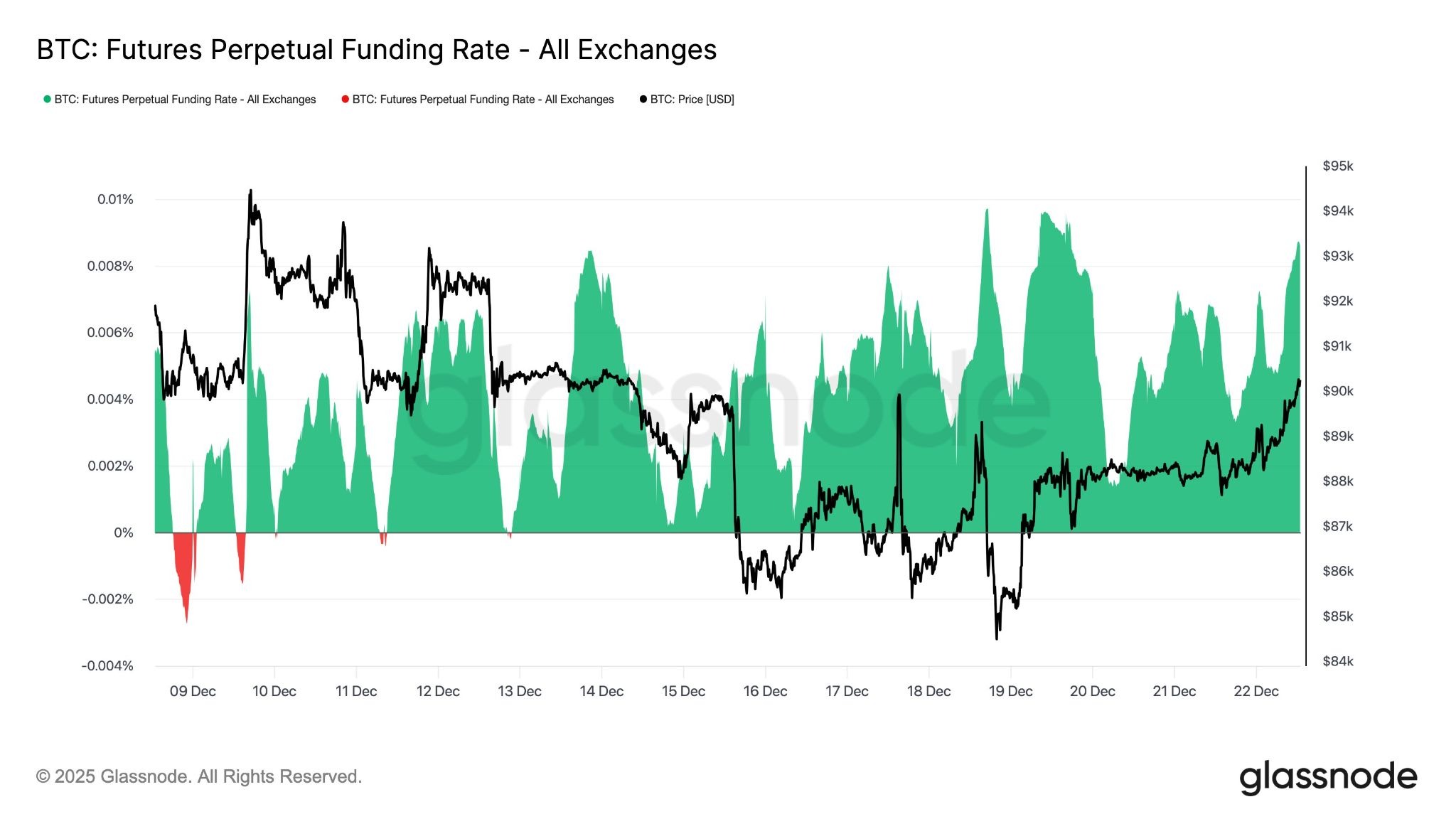
Las tasas de financiamiento de los perpetuos de Bitcoin han aumentado recientemente. Fuente: Glassnode

Gran vencimiento de opciones de fin de año

La volatilidad del mercado también podría amplificarse por el masivo evento de vencimiento de opciones de Bitcoin de fin de año el viernes 26 de diciembre.

Más de $23 mil millones en valor nominal de contratos de opciones de Bitcoin vencerán en uno de los eventos de vencimiento de opciones más grandes de todos los tiempos. Los vencimientos de fin de trimestre y fin de año son mucho más grandes que los eventos semanales o mensuales regulares.

Relacionado: Las criptomonedas tienen todo lo necesario para un mercado alcista, entonces ¿por qué está bajando el mercado?

Las calls, o contratos largos, se agrupan alrededor de los precios de ejercicio de $100,000 y $120,000, mientras que las puts, o contratos cortos, se concentran alrededor de $85,000, según Deribit.

El ratio put/call es actualmente 0.37, lo que significa que hay muchos más contratos largos por vencer que cortos. El máximo dolor, o el precio de ejercicio en el que se producirán la mayoría de las pérdidas, es actualmente de $96,000, según Coinglass.

Si los precios spot no suben, la mayoría de estos contratos no valdrán nada al vencimiento. Una brecha de $7,500 hasta el máximo dolor sugiere que las apuestas alcistas, o calls a strikes más altos, fueron demasiado optimistas y materializarán pérdidas.
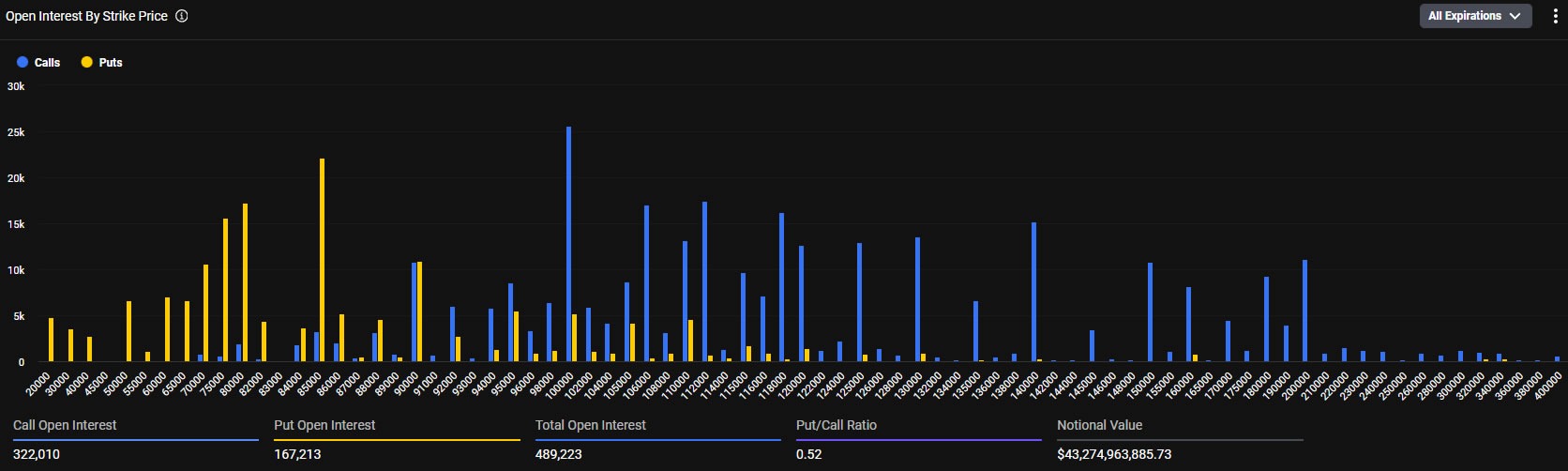
Hay mucho OI en precios de ejercicio más altos. Fuente: Deribit

Magazine: El nivel crítico de Bitcoin es $82.5K, Ethereum 'no ha terminado aún': Trade Secrets

Related Questions

Q¿Qué es el interés abierto en los contratos perpetuos de Bitcoin y por qué ha aumentado?

AEl interés abierto (OI) en contratos perpetuos de Bitcoin se refiere al valor total de las posiciones de futuros que permanecen abiertas y no han sido liquidadas. Según Glassnode, ha aumentado de 304,000 a 310,000 BTC, lo que indica que los operadores están apostando por un movimiento alcista a final de año.

Q¿Qué indica el aumento de la tasa de financiamiento en los mercados de derivados?

AUn aumento en la tasa de financiamiento (de 0.04% a 0.09%) sugiere que los operadores están adoptando posiciones largas apalancadas y están dispuestos a pagar primas, lo que refleja expectativas alcistas. Sin embargo, tasas muy altas pueden señalar sobrecalentamiento y riesgo de corrección.

Q¿Cómo podría afectar el vencimiento masivo de opciones de Bitcoin el 26 de diciembre?

AEl vencimiento de más de $23 mil millones en opciones de Bitcoin podría amplificar la volatilidad del mercado. Los contratos 'call' (alcistas) se concentran en precios de ejercicio de $100,000 y $120,000, mientras que los 'put' (bajistas) están alrededor de $85,000.

Q¿Qué es el 'max pain' en el contexto de opciones y cuál es su valor actual?

AEl 'max pain' es el precio de ejercicio al que la mayoría de los contratos de opciones expirarán sin valor, causando pérdidas máximas a los tenedores. Actualmente es de $96,000, lo que sugiere que las apuestas alcistas en strikes más altos podrían no materializarse.

Q¿Por qué los contratos perpetuos de Bitcoin son populares entre los traders?

ALos contratos perpetuos son futuros que no tienen fecha de vencimiento, permitiendo a los operadores mantener posiciones indefinidamente. Rastrean el precio spot de Bitcoin mediante la tasa de financiamiento, que equilibra las posiciones largas y cortas con pagos periódicos.

Related Reads

Fed's Internal Doves Flock to Hawkish Stance, Warsh's Debut "Between a Rock and a Hard Place"

U.S. Federal Reserve officials who previously advocated for rate cuts, including Governor Christopher Waller, have recently shifted their stance, with many now not ruling out the possibility of future rate hikes. This sets a challenging stage for new Fed Chair Kevin Warsh's first policy meeting. Appointed by President Trump based on his dovish views, Warsh now faces a committee where the debate has pivoted from "when to cut" to "whether to hike," driven by persistent inflation above 3%, a strong labor market, and supply-side pressures from AI infrastructure demands and geopolitical tensions. Key figures illustrate the shift. Governor Waller, once concerned about employment, now says data has pushed him toward considering rate increases. Even moderate voices like Governor Lisa Cook, while expecting inflation to ease, have indicated readiness to hike if it fails to do so. Long-time hawks such as regional Fed presidents Beth Hammack, Lorie Logan, and Neel Kashkari have grown more vocal, arguing that the real policy rate is effectively falling and that action may soon be needed. The upcoming Fed meeting is expected to keep rates steady but will likely remove the "easing bias" from its statement, signaling a neutral stance between cuts and hikes. The quarterly "dot plot" is anticipated to show most officials projecting no cuts this year, with some potentially indicating hikes. Chair Warsh, a critic of the Fed's reliance on forward guidance like the dot plot, must navigate communicating this pivot using tools he has questioned, all while steering policy in a direction counter to the preferences of the president who appointed him. The consensus suggests the Fed's next move could well be a rate increase.

marsbit32m ago

Fed's Internal Doves Flock to Hawkish Stance, Warsh's Debut "Between a Rock and a Hard Place"

marsbit32m ago

The Trillion-Yuan Market Cap 'Yi Zhong Tian': Who is the True Value King?

The article analyzes the three leading Chinese optical module companies, collectively nicknamed "Yi Zhong Tian": Xinyisheng, Zhongji Innolight, and TFC Optical Communication. It evaluates their "cost-performance" not by current stock price, but through three lenses: PEG ratio (growth vs. valuation), earnings quality, and premium/discount for certainty. Xinyisheng shows the most attractive PEG ratio and high profitability, but its valuation reflects discounts for risks like high customer concentration and reliance on overseas markets. Zhongji Innolight, the most expensive, commands a premium for its market leadership, dominant share in key products like 800G/1.6T modules, and higher earnings certainty, though it faces geopolitical risks. TFC Optical, as an upstream component supplier ("water seller"), has the highest gross margin and bets on the long-term CPO/NPO architecture trend, but trades at a high valuation with more stable, less explosive growth. The core argument is that while these companies dominate module assembly, the true profit pool and technological moat lie upstream in laser and switch chips, currently controlled by U.S. firms like Lumentum and Coherent. The long-term "cost-performance" for these Chinese leaders hinges on whether the domestic industry, exemplified by companies like Yuanjie Technology, can successfully move up the value chain into high-power laser chips. Otherwise, their high growth may remain confined to the lower-margin assembly segment.

marsbit42m ago

The Trillion-Yuan Market Cap 'Yi Zhong Tian': Who is the True Value King?

marsbit42m ago

Has the Crypto Market Bottomed? Here's What Institutions Think

The crypto market is in a period of significant debate, with leading institutions offering differing views on whether a bottom has been reached. Three prominent firms have published detailed analyses: * **Galaxy Digital** argues Bitcoin has **not yet bottomed**. Their analysis of 13 historical indicators across six dimensions (valuation, profit-taking, miner pressure, etc.) shows only four are fully met. They project a potential bottom range between $30k and $54k. * **NYDIG** states a bottom is **possible but not likely**. While metrics are close to historic bear market extremes, they note the absence of a classic panic-selling event. They also suggest increased institutional adoption may have structurally altered the market cycle, potentially leading to a shallower downturn. * **Standard Chartered Bank** asserts the **bottom has already occurred** at around $59k. They cite two key factors: potential US-Iran diplomatic progress and the anticipated SpaceX IPO, which they believe absorbed capital and caused ETF selling pressure that is now subsiding. They forecast a year-end price target of $100k. Despite the surface-level disagreement, the reports share critical common ground more valuable for long-term investors: 1. All three believe the market bottom will form **within this year**. 2. All agree the current price is **closer to the bottom than to previous highs**. 3. All maintain a **bullish long-term outlook** for Bitcoin and a new cycle. The core takeaway is that while the exact bottom price ($40k, $50k, or $60k) is debated, the consensus is that a bottom is imminent. For long-term holders, the primary focus should not be pinpointing the absolute low, but on the future potential for prices to reach $100k, $200k, or higher. The fundamental thesis for Bitcoin—sovereign debt accumulation, inflation, declining trust in centralized institutions, global digitization, and improved accessibility—remains intact and is arguably strengthening. The overall landscape is viewed as more favorable than in previous crypto winters.

marsbit52m ago

Has the Crypto Market Bottomed? Here's What Institutions Think

marsbit52m ago

The 'Chip' Challenge and Breakthroughs in China's Optical Industry Chain

China's Photonics Industry: Bottlenecks and Breakthroughs In the global AI race, computing chips dominate the narrative, but the underlying bottleneck increasingly defining the scale of AI clusters is light—or more specifically, optical connectivity. Optical modules, which translate electrical signals to light and vice versa, are crucial for connecting thousands of GPUs in AI data centers, preventing data congestion and ensuring efficient model training. High-speed modules (800G, 1.6T) are now standard, with performance hinging on advanced DSP (Digital Signal Processor) chips. This is where a critical dependency lies. Two US giants—Marvell and Broadcom—collectively dominate over 90% of the high-end DSP chip market. Chinese optical module leaders like Zhongji Innolight and Eoptolink rely on these chips to manufacture modules for overseas AI customers, primarily in North America. While this creates a supply chain vulnerability, complete decoupling is difficult. Marvell derives over half its revenue from Greater China, and the US firms depend on Chinese partners for chip packaging and optical components. The risk from laser chips (e.g., from Lumentum), another key component, is considered more manageable due to multiple global suppliers and faster progress in domestic alternatives from companies like YOFC and Accelink. To mitigate risks, China's industry is pursuing a multi-pronged strategy: diversifying supply chains and locking in long-term orders; fostering a domestic market ecosystem to adopt homegrown DSPs from firms like Huawei HiSilicon and CETC; accelerating R&D in high-speed DSPs and advanced packaging; and investing in next-gen technologies like silicon photonics and Co-Packaged Optics (CPO) to reduce reliance on discrete DSPs. The ultimate solution lies not in short-term博弈 but in persistent advancement of domestic high-end chip R&D and manufacturing. While challenges remain in performance, certification, and ecosystem building, China's vast domestic market and manufacturing base provide a crucial buffer, buying time for the industry to achieve greater technological independence.

marsbit1h ago

The 'Chip' Challenge and Breakthroughs in China's Optical Industry Chain

marsbit1h ago

Trading

Spot
Futures

Hot Articles

What is $BITCOIN

DIGITAL GOLD ($BITCOIN): A Comprehensive Analysis Introduction to DIGITAL GOLD ($BITCOIN) DIGITAL GOLD ($BITCOIN) is a blockchain-based project operating on the Solana network, which aims to combine the characteristics of traditional precious metals with the innovation of decentralized technologies. While it shares a name with Bitcoin, often referred to as “digital gold” due to its perception as a store of value, DIGITAL GOLD is a separate token designed to create a unique ecosystem within the Web3 landscape. Its goal is to position itself as a viable alternative digital asset, although specifics regarding its applications and functionalities are still developing. What is DIGITAL GOLD ($BITCOIN)? DIGITAL GOLD ($BITCOIN) is a cryptocurrency token explicitly designed for use on the Solana blockchain. In contrast to Bitcoin, which provides a widely recognized value storage role, this token appears to focus on broader applications and characteristics. Notable aspects include: Blockchain Infrastructure: The token is built on the Solana blockchain, known for its capacity to handle high-speed and low-cost transactions. Supply Dynamics: DIGITAL GOLD has a maximum supply capped at 100 quadrillion tokens (100P $BITCOIN), although details regarding its circulating supply are currently undisclosed. Utility: While precise functionalities are not explicitly outlined, there are indications that the token could be utilized for various applications, potentially involving decentralized applications (dApps) or asset tokenization strategies. Who is the Creator of DIGITAL GOLD ($BITCOIN)? At present, the identity of the creators and development team behind DIGITAL GOLD ($BITCOIN) remains unknown. This situation is typical among many innovative projects within the blockchain space, particularly those aligning with decentralized finance and meme coin phenomena. While such anonymity may foster a community-driven culture, it intensifies concerns about governance and accountability. Who are the Investors of DIGITAL GOLD ($BITCOIN)? The available information indicates that DIGITAL GOLD ($BITCOIN) does not have any known institutional backers or prominent venture capital investments. The project seems to operate on a peer-to-peer model focused on community support and adoption rather than traditional funding routes. Its activity and liquidity are primarily situated on decentralized exchanges (DEXs), such as PumpSwap, rather than established centralized trading platforms, further highlighting its grassroots approach. How DIGITAL GOLD ($BITCOIN) Works The operational mechanics of DIGITAL GOLD ($BITCOIN) can be elaborated on based on its blockchain design and network attributes: Consensus Mechanism: By leveraging Solana’s unique proof-of-history (PoH) combined with a proof-of-stake (PoS) model, the project ensures efficient transaction validation contributing to the network's high performance. Tokenomics: While specific deflationary mechanisms have not been extensively detailed, the vast maximum token supply implies that it may cater to microtransactions or niche use cases that are still to be defined. Interoperability: There exists the potential for integration with Solana’s broader ecosystem, including various decentralized finance (DeFi) platforms. However, the details regarding specific integrations remain unspecified. Timeline of Key Events Here is a timeline that highlights significant milestones concerning DIGITAL GOLD ($BITCOIN): 2023: The initial deployment of the token occurs on the Solana blockchain, marked by its contract address. 2024: DIGITAL GOLD gains visibility as it becomes available for trading on decentralized exchanges like PumpSwap, allowing users to trade it against SOL. 2025: The project witnesses sporadic trading activity and potential interest in community-led engagements, although no noteworthy partnerships or technical advancements have been documented as of yet. Critical Analysis Strengths Scalability: The underlying Solana infrastructure supports high transaction volumes, which could enhance the utility of $BITCOIN in various transaction scenarios. Accessibility: The potential low trading price per token could attract retail investors, facilitating wider participation due to fractional ownership opportunities. Risks Lack of Transparency: The absence of publicly known backers, developers, or an audit process may yield skepticism regarding the project's sustainability and trustworthiness. Market Volatility: The trading activity is heavily reliant on speculative behavior, which can result in significant price volatility and uncertainty for investors. Conclusion DIGITAL GOLD ($BITCOIN) emerges as an intriguing yet ambiguous project within the rapidly evolving Solana ecosystem. While it attempts to leverage the “digital gold” narrative, its departure from Bitcoin's established role as a store of value underscores the need for a clearer differentiation of its intended utility and governance structure. Future acceptance and adoption will likely depend on addressing the current opacity and defining its operational and economic strategies more explicitly. Note: This report encompasses synthesised information available as of October 2023, and developments may have transpired beyond the research period.

380 Total ViewsPublished 2025.05.13Updated 2025.05.13

What is $BITCOIN

Discussions

Welcome to the HTX Community. Here, you can stay informed about the latest platform developments and gain access to professional market insights. Users' opinions on the price of BTC (BTC) are presented below.

活动图片