Merlin Chain Melonjak – Apakah Penurunan Harga MERL Akan Menyusul Setelah Puncak OI $75 Juta?

ambcryptoPublished on 2025-12-13Last updated on 2025-12-13

Abstract

Merlin Chain (MERL), solusi lapisan-2 Bitcoin, mengalami kenaikan signifikan sebesar 16% didorong oleh peningkatan likuiditas di pasar derivatif. Open Interest (OI) mencapai rekor tertinggi $75,79 juta, menunjukkan sentimen bullish dengan dominasi posisi long. Volume perdagangan juga positif dengan rasio Beli/Jual sebesar 1,05. Investor spot terus mengakumulasi MERL, membatasi pasokan yang tersedia, meskipun arus keluar dari bursa masih relatif kecil. Indikator akumulasi/distribusi menguat, namun masih dalam wilayah negatif, menandakan tekanan jual belum sepenuhnya teratasi. Meski demikian, heatmap likuiditas menunjukkan risiko penurunan jangka pendek karena kluster likuiditas terkonsentrasi di bawah harga saat ini. Meski pullback mungkin terjadi, momentum bullish yang berkelanjutan dapat menahan koreksi tersebut.

Merlin Chain [MERL], solusi layer-2 Bitcoin [BTC], telah mencatat peningkatan signifikan dalam aktivitas on-chain selama satu hari terakhir, meskipun harga Bitcoin sebagian besar masih terbatas dalam kisaran tertentu.

Aset ini meroket tajam, naik 16%, pada saat berita ini ditulis, sementara jumlah pemegang token naik menjadi 173.800. Meskipun performa terlihat sangat bullish, tanda-tanda potensi penurunan harga masih membayangi dalam struktur pasar yang lebih luas.

Boom likuiditas mendongkrak harga

Lonjakan harga MERL baru-baru ini sebagian besar dapat dikaitkan dengan masuknya likuiditas yang tajam di seluruh pasar derivatif.

Open Interest (OI) perpetual MERL, metrik yang mencerminkan total nilai kontrak derivatif yang beredar dan likuiditas pasar keseluruhan, telah naik ke rekor tertinggi baru sebesar $75,79 juta, pada saat penulisan.

Perlu dicatat, lonjakan ini menyoroti sentimen bullish yang saat ini beredar di pasar. OI mencapai level ini setelah berkembang sekitar $27 juta dalam satu hari.

Arus masuk besar dalam satu hari seperti itu biasanya mencakup posisi dari trader long dan short. Dalam hal ini, data trading menunjukkan bahwa posisi long mendominasi aktivitas pasar.

Volume perdagangan juga telah berubah menjadi sangat positif, dengan Rasio Beli/Jual Taker mencapai 1,05. Pembacaan ini menunjukkan bahwa order beli taker memimpin volume kumulatif, memperkuat tekanan bullish jangka pendek.

Investor spot ikut serta

Peserta pasar spot juga terus mengakumulasi MERL, membantu membatasi pasokan yang tersedia.

Dalam konteks ini, arus keluar bursa tetap relatif moderat, dengan sekitar $700.000 MERL yang ditarik dari platform terpusat dalam satu hari terakhir.

Secara sendiri, level arus keluar ini tidak terlalu mengonfirmasi struktur pasar bullish, karena jumlahnya tetap relatif kecil.

Namun, akumulasi yang berkelanjutan bersama dengan arus keluar bersih yang konsisten meningkatkan kemungkinan bahwa MERL mempertahankan trajektori naiknya, karena investor bullish melihat level saat ini sebagai titik masuk yang menarik.

Perlu dicatat, indikator akumulasi/distribusi telah naik, menunjuk pada tekanan beli yang lebih kuat relatif terhadap penjualan. Meskipun demikian, indikator tersebut tetap berada di wilayah negatif.

Pembacaan negatif ini menunjukkan bahwa pembelian baru-baru ini belum sepenuhnya mengimbangi tekanan penjualan yang lebih berat yang diamati selama seminggu terakhir, yang berkontribusi pada penurunan sebelumnya.

Risiko penurunan?

Meskipun ada keuntungan baru-baru ini, MERL masih menunjukkan risiko penurunan, seperti yang ditunjukkan oleh heatmap likuidasi.

Alat ini menyoroti konsentrasi likuiditas di atas dan di bawah harga saat ini untuk menandakan pergerakan potensial. Likuiditas yang diposisikan di atas sering menarik harga ke atas, sementara kluster di bawah menunjukkan kemungkinan penurunan saat pasar bergerak untuk mengisi level-level tersebut.

Saat ini, rally MERL telah mendorong harga lebih tinggi, membersihkan zona likuiditas utama di atas. Akibatnya, sebagian besar kluster likuiditas sekarang berada di bawah kisaran trading saat ini.

Berdasarkan perilaku pasar klasik, pengaturan ini meningkatkan kemungkinan penurunan jangka pendek. Namun, hasil seperti itu tidak dijamin.

Satu pengecualian kunci muncul ketika momentum bullish terus menguat, memungkinkan harga untuk menentang retracement yang biasanya didorong oleh likuiditas.


Pemikiran Akhir

  • MERL telah mencatat arus masuk likuiditas besar-besaran dari pasar derivatif, sementara investor spot terus mengakumulasi.
  • Heatmap likuidasi menunjukkan kemungkinan volatilitas harga, dengan kluster likuiditas yang belum terisi berada di bawah level saat ini.


Trending Cryptos

Related Questions

QApa yang menyebabkan kenaikan harga Merlin Chain (MERL) baru-baru ini?

AKenaikan harga MERL terutama disebabkan oleh masuknya likuiditas yang besar di pasar derivatif, dengan Open Interest (OI) mencapai rekor tertinggi baru sebesar $75,79 juta, yang mencerminkan sentimen bullish di pasar.

QBagaimana aktivitas investor di pasar spot mempengaruhi harga MERL?

AInvestor di pasar spot terus mengakumulasi MERL, yang membantu membatasi pasokan yang tersedia. Meskipun arus keluar dari bursa relatif moderat, akumulasi yang berkelanjutan dan arus keluar bersih yang konsisten meningkatkan kemungkinan MERL mempertahankan tren kenaikannya.

QApa yang ditunjukkan oleh rasio Pembeli/Penjual (Buy/Sell Ratio) sebesar 1,05 untuk MERL?

ARasio Pembeli/Penjual sebesar 1,05 menunjukkan bahwa volume pembelian pembuat pasar (taker buy orders) memimpin volume kumulatif, yang memperkuat tekanan bullish jangka pendek.

QMenurut peta likuiditas (liquidation heatmap), apa risiko yang dihadapi harga MERL?

APeta likuiditas menunjukkan bahwa sebagian besar kluster likuiditas sekarang berada di bawah kisaran perdagangan saat ini, yang meningkatkan kemungkinan penurunan harga jangka pendek karena pasar mungkin bergerak untuk mengisi level-level tersebut.

QApa pengecualian yang memungkinkan MERL menghindari penurunan harga meskipun ada risiko dari peta likuiditas?

APengecualian utamanya adalah jika momentum bullish terus menguat, yang memungkinkan harga untuk menentang koreksi yang biasanya didorong oleh likuiditas.

Related Reads

Playing the "Decoupling" Card Again? Domestic Optical Modules Face a Stress Test

The U.S. Federal Communications Commission (FCC) is reportedly drafting a ban on importing new models of Chinese-made optical transceiver modules, with a potential implementation target of 2026. This "decoupling" move comes as Chinese firms, led by industry leaders like Zhongji Innolight and Eoptolink, dominate the global optical module market with over 60% share, and hold an even larger position in the high-speed 800G and 1.6T segments critical for AI data centers. Market reactions were mixed: U.S. optical module stocks initially rose, while Chinese A-shares opened lower but largely recovered by the close. Analysis suggests a complete U.S. decoupling from Chinese modules faces significant hurdles. North American cloud giants (Meta, Google, Microsoft, Amazon) and NVIDIA have massive demand for high-speed modules, estimated at around 40 million units in 2026. U.S. manufacturers' combined monthly production capacity for these modules is less than one-fifth that of a single major Chinese player like Zhongji Innolight, which reported production of 23.76 million units in 2025. Chinese companies are heavily reliant on the U.S. market, with over 90% of revenue for top firms coming from overseas, primarily the U.S. However, they have begun mitigating risks by establishing assembly plants in Southeast Asia and Mexico. Industry observers note the final impact depends on whether any potential U.S. restrictions target specific companies or products based on origin. Past U.S. sanctions on Chinese tech firms have often spurred increased domestic R&D and market diversification. Despite initial stock volatility, shares of major Chinese optical module companies pared losses, indicating market belief in the sector's resilience and the practical difficulties of abruptly replacing Chinese supply.

marsbit25m ago

Playing the "Decoupling" Card Again? Domestic Optical Modules Face a Stress Test

marsbit25m ago

When the Competition in Chip Manufacturing Equipment Stops Being Just About Who Is More Advanced

The competition in chip manufacturing equipment is no longer solely about who has the most advanced technology. While performance, yield, and cost remain key, U.S. export controls are adding a critical new dimension: long-term supply chain reliability. Major chipmakers like Samsung and SK Hynix, despite having mature supply chains with leading American and European vendors, are reportedly evaluating etching equipment from China's AMEC for their Chinese factories. This move is not primarily about immediate replacement or AMEC's current capabilities. Instead, it's a risk mitigation strategy. Companies are concerned that future U.S. policies could disrupt their access to spare parts, software updates, and maintenance for existing equipment over its decade-long lifespan. For chipmakers investing billions in fabs with long planning cycles, this policy-induced uncertainty is a significant new risk. The U.S., through its controls, is inadvertently eroding the very reliability and certainty that were foundational strengths of its equipment suppliers. This creates a pivotal shift for Chinese semiconductor equipment. Previously seen largely as a "domestic replacement" option when foreign gear was unavailable, they are now being assessed as potential "contingency suppliers" by global players—even before a supply disruption occurs. This provides a crucial entry point for validation in real production lines, which is essential for iterative improvement. Chinese equipment, particularly in areas like etching, has progressed from prototypes to participating in mass production within China, gaining valuable experience. However, this does not signify full global competitiveness. Gaps remain in advanced lithography, metrology, and other key tools. The current evaluations are largely confined to foreign firms' China-based fabs, not their global procurement networks. The core change is in the decision-making framework. Efficiency-driven globalization favored single, optimal suppliers. An era of heightened geopolitical risk is forcing companies to value "replaceability." While technical prowess remains paramount, supply chain certainty is now being factored into a device's competitive equation. Ultimately, U.S. policies have not made Chinese equipment more advanced, but they have given global customers a compelling reason to start testing it. The competition has expanded: it's no longer just about who is more advanced, but also about who can be relied upon to stay.

marsbit26m ago

When the Competition in Chip Manufacturing Equipment Stops Being Just About Who Is More Advanced

marsbit26m ago

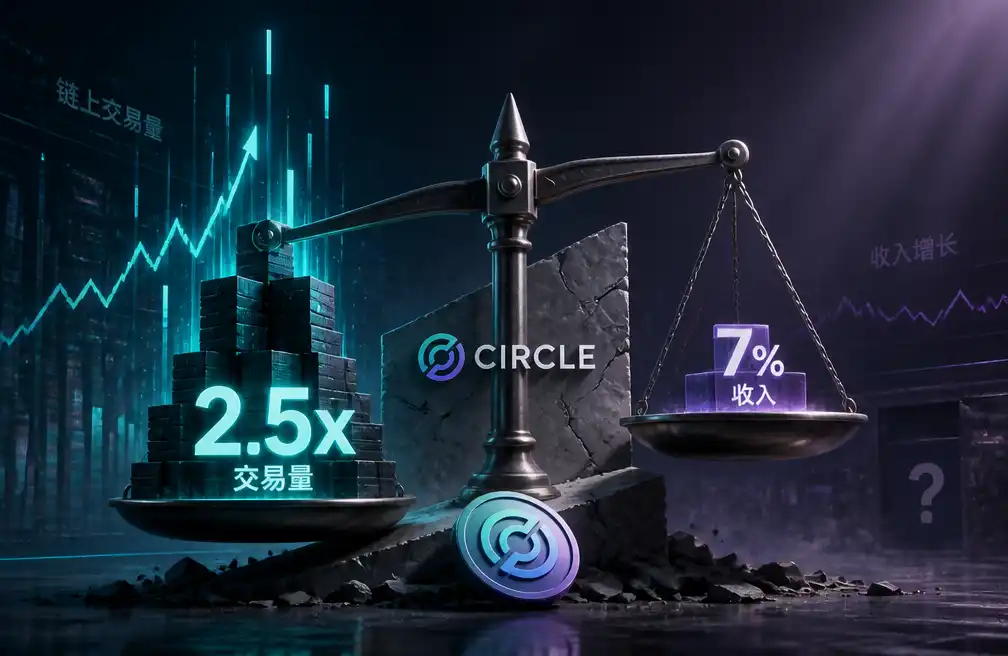
Trading Volume Increased by 2.5x, Why Did Circle's Revenue Only Grow by 7%?

Circle's Q2 performance presents a seemingly contradictory picture: the transaction volume of its stablecoin USDC surged 151% year-over-year to $14.8 trillion, while its "Total Revenue & Reserve Revenue" grew by only 7% to $701 million. This discrepancy highlights the core of Circle's business model. Revenue is primarily driven not by transaction volume, but by the average amount of USDC in circulation and the yield generated from its reserves. Key points: 1. **Revenue Drivers:** Over 90% of revenue comes from "reserve income," which is a function of average USDC circulation (up 25% YoY) and the reserve yield (which fell by 66 basis points). The net effect was a mere ~5% increase in reserve income. 2. **Transaction vs. Revenue:** High transaction volume indicates robust usage of USDC for payments and settlements, but does not translate directly to revenue. It must first convert into a sustained, average circulating balance. 3. **Cost Structure:** After accounting for distribution and other costs, the metric "Revenue Less Direct Costs" (RLDC) grew faster than total revenue, with its margin improving. However, rising operating expenses (up 23% YoY) meant that Adjusted EBITDA growth was limited to 8%. 4. **New Initiatives:** Circle reported progress on new networks like the Circle Payments Network and upcoming products (Arc, Agent Stack), but these are currently measured by adoption metrics (e.g., transaction run-rate, number of services) rather than material revenue contribution this quarter. In summary, the financial results are determined by the interplay of USDC circulation, reserve yields, and cost structures, while high transaction volume signals underlying network strength that has not yet fully flowed through to the income statement.

marsbit43m ago

Trading Volume Increased by 2.5x, Why Did Circle's Revenue Only Grow by 7%?

marsbit43m ago

Samsung China, Another Step Back

Samsung China Takes Another Step Back Samsung Electronics is further retreating from the Chinese consumer market. Following the exit of its home appliance business in May, its mobile phone division is now reportedly scaling down. Stores with monthly sales below 300,000 RMB are being closed in several cities. Data shows Samsung's smartphone market share in China has plummeted to 0.1% in Q2 2026, a stark contrast to its 22% global leadership. The decline is attributed to intense competition from domestic brands offering better value, higher specs (like faster charging), and superior localization in software and services. Samsung's premium pricing and less adapted One UI system have struggled against rivals like Huawei, Xiaomi, and Honor. This consumer electronics retreat coincides with Samsung's record-breaking semiconductor profits, driven by the AI boom. In Q2 2026, the chip division contributed nearly all operating profit, while the mobile and home appliance unit posted its first-ever operating loss. Internal dynamics, like the chip division charging market prices to the mobile unit, have increased cost pressures. Samsung's strategy now appears to be a focused retreat towards the ultra-premium segment in China, similar to its global push in high-end foldables like the Galaxy Z Fold8. The company is likely to retain only key stores in major cities to serve a niche, high-end clientele. While its deep semiconductor reserves offer a cushion, this shift away from mass-market consumer electronics reduces business diversification. The move is pragmatic but signifies a fundamental transformation; Samsung is ceding mass-market influence and betting heavily on its semiconductor strength and a narrowed premium product focus.

marsbit47m ago

Samsung China, Another Step Back

marsbit47m ago

Trading

Spot

Hot Articles

How to Buy MERL

Welcome to HTX.com! We've made purchasing Merlin chain (MERL) simple and convenient. Follow our step-by-step guide to embark on your crypto journey.Step 1: Create Your HTX AccountUse your email or phone number to sign up for a free account on HTX. Experience a hassle-free registration journey and unlock all features.Get My AccountStep 2: Go to Buy Crypto and Choose Your Payment MethodCredit/Debit Card: Use your Visa or Mastercard to buy Merlin chain (MERL) instantly.Balance: Use funds from your HTX account balance to trade seamlessly.Third Parties: We've added popular payment methods such as Google Pay and Apple Pay to enhance convenience.P2P: Trade directly with other users on HTX.Over-the-Counter (OTC): We offer tailor-made services and competitive exchange rates for traders.Step 3: Store Your Merlin chain (MERL)After purchasing your Merlin chain (MERL), store it in your HTX account. Alternatively, you can send it elsewhere via blockchain transfer or use it to trade other cryptocurrencies.Step 4: Trade Merlin chain (MERL)Easily trade Merlin chain (MERL) on HTX's spot market. Simply access your account, select your trading pair, execute your trades, and monitor in real-time. We offer a user-friendly experience for both beginners and seasoned traders.

5.4k Total ViewsPublished 2024.04.19Updated 2026.06.02

How to Buy MERL

Discussions

Welcome to the HTX Community. Here, you can stay informed about the latest platform developments and gain access to professional market insights. Users' opinions on the price of MERL (MERL) are presented below.

活动图片