Cardano Intègre les Oracles Pyth On-Chain dans la Première Intégration du Pentad

bitcoinistPublished on 2025-12-12Last updated on 2025-12-12

Abstract

Cardano annonce son intégration majeure via la nouvelle structure de gouvernance "Pentad" : l'oracle Pyth Lazer sera déployé sur sa blockchain début 2026. Cette décision du groupe de coordination (Input Output, Cardano Foundation, EMURGO, Midnight Foundation et Intersect) marque le début d'une stratégie d'intégrations critiques visant à renforcer l'infrastructure DeFi de Cardano. Charles Hoskinson a souligné l'importance des oracles pour relier Cardano à l'écosystème crypto élargi et a reconnu que les solutions internes n'avaient pas suffi. Pyth, avec ses milliers de flux de données financières institutionnelles à faible latence, est présenté comme une solution avancée déjà utilisée sur plus de 100 blockchains. Ce partenariat, qualifié "d'entrée" avant d'autres intégrations à venir, s'inscrit dans une volonté de faire de Cardano une plateforme crédible pour le développement d'applications DeFi. Le cours de l'ADA était de 0,4253 $ au moment de l'annonce.

Cardano s'attaque enfin au travail de plomberie peu glamour mais absolument nécessaire : intégrer sérieusement une infrastructure d'oracle externe, avec une enveloppe de gouvernance qui ressemble beaucoup plus à une « supervision adulte » qu'à l'ancien bricolage ad hoc de l'écosystème.

Lors d'un livestream le 11 décembre, Charles Hoskinson a déclaré que la nouvelle structure « Pentad » de l'écosystème – le bloc de coordination regroupant Input Output, la Fondation Cardano, EMURGO, la Fondation Midnight et Intersect – a approuvé sa première intégration majeure dans le cadre du programme des « intégrations critiques » : l'arrivée de l'oracle Lazer de Pyth sur Cardano, avec un déploiement ciblé pour début 2026.

L'Accord avec Pyth Lance la Poussée des Intégrations Critiques de Cardano

« C'est l'annonce apéritive », a déclaré Hoskinson, présentant Pyth comme la première d'une série plus large qu'il anticipe : des bridges, des stablecoins, des analytiques, des custodians – toutes ces choses qui transforment une blockchain en une place de DeFi sur laquelle les gens construisent réellement, et pas seulement en une communauté qui discute de roadmaps.

Hoskinson n'a pas vraiment édulcoré l'importance de cela. « Les oracles sont vraiment la première partie des intégrations majeures », a-t-il dit, car vous avez besoin de données fiables qui entrent et de voies crédibles vers le reste de l'industrie. Il a également admis que l'approche interne n'a pas porté ses fruits comme elle aurait dû : Cardano « a essayé de construire une solution oracle indigène et cela n'a pas fonctionné aussi bien que prévu. » Donc [...] Pyth. C'est le pivot.

Pyth, dans son propre marketing, a présenté Lazer comme un produit à ultra-faible latence conçu pour les cas d'usage de trading sensibles à la vitesse – essentiellement, des mises à jour de prix assez rapides pour que les perps et autres applications DeFi nerveuses n'aient pas l'impression de fonctionner avec les données du cycle précédent. Hoskinson a qualifié Pyth de « l'une des solutions oracle les plus avancées du marché », et a souligné l'angle pratique : de nombreux flux, de nombreux éditeurs et une large distribution sur plusieurs chaînes.

L'annonce d'Intersect (celle qu'Hoskinson a affichée en milieu de stream) sur X indique : « L'un des premiers résultats concrets du groupe de travail des Intégrations Critiques de Cardano est maintenant en place ! Le Comité de Pilotage [...] a approuvé la première intégration majeure dans ce cadre : l'arrivée de l'oracle Pyth Lazer sur Cardano. Pyth fournit des données de marché institutionnelles à faible latence sur des milliers de flux de prix couvrant la crypto, les actions, le forex, les matières premières et les ETF, déjà utilisées par des centaines d'applications DeFi sur plus de 100 blockchains pour alimenter le trading, le prêt et la gestion des risques. »

Hoskinson a argumenté : « [Pyth] attache effectivement Cardano aux réseaux d'information de l'espace cryptocurrency tout entier. » Il a déclaré que l'équipe explore déjà la possibilité de basculer des parties de l'écosystème – y compris Djed – vers Pyth, et il souhaite que les équipes de dapp Cardano évaluent sérieusement l'intégration une fois qu'elle sera disponible.

« Pyth n'est que l'apéritif des intégrations critiques de Cardano », a-t-il déclaré. « Beaucoup d'autres choses sont à venir. »

Le contexte plus large est que le nouveau « Pentad » de Cardano a positionné les « intégrations critiques » comme un effort coordonné, soutenu par le trésor, pour « préparer Cardano pour 2026 », incluant une proposition de budget liée à des facilitateurs à l'échelle de l'écosystème. Si Pyth est la première sortie concrète, c'est aussi un signal que le modèle Pentad sera jugé sur l'exécution, pas sur les vibes.

Hoskinson, pour conclure, l'a exprimé dans son langage de ralliement habituel : « Cardano n'est plus une île [...] la cavalerie est arrivée. » Le marché peut faire ce qu'il veut à court terme. Mais mettre en place des rails oracle crédibles est le genre de mise à niveau ennuyeuse qui a tendance à compter plus tard – lorsque les équipes décident où se déployer, et où la liquidité est prête à résider.

Au moment de la rédaction, l'ADA s'échangeait à 0,4253 $.
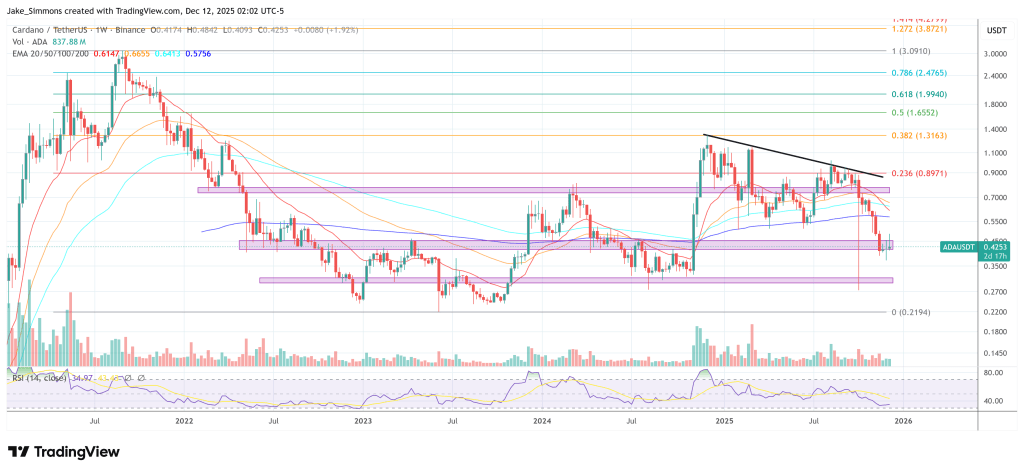
L'ADA rebondit depuis un support clé, graphique hebdomadaire | Source : ADAUSDT sur TradingView.com

Trending Cryptos

Related Questions

QQuelle est la première intégration majeure annoncée sous le cadre des 'intégrations critiques' de Cardano ?

ALa première intégration majeure est l'ajout de l'oracle Pyth Lazer sur Cardano.

QQuand le déploiement de Pyth sur Cardano est-il prévu ?

ALe déploiement est ciblé pour début 2026.

QQu'est-ce que le 'Pentad' dans l'écosystème Cardano ?

ALe 'Pentad' est la structure de coordination qui regroupe Input Output, la Fondation Cardano, EMURGO, la Fondation Midnight et Intersect.

QSelon Charles Hoskinson, pourquoi l'intégration d'un oracle comme Pyth est-elle si importante ?

AParce que les oracles sont essentiels pour avoir des données fiables et des voies crédibles vers le reste de l'industrie, transformant une blockchain en une véritable plateforme DeFi.

QQuel est l'avantage principal de Pyth Lazer selon son marketing ?

APyth Lazer est présenté comme un produit à ultra-faible latence conçu pour les cas d'utilisation de trading sensibles à la vitesse, avec des mises à jour de prix très rapides.

Related Reads

Breaking: Google Earth Urgently Pulls Back Nano Banana 2 Image Generation Feature!

Google Earth's newly launched "Create image" feature, powered by the Nano Banana 2 AI image generation model, was abruptly withdrawn shortly after its release due to being "played" by users. The feature allowed users to generate and overlay AI-created visuals directly onto real-world satellite and 3D maps in Google Earth. The tool enabled creative applications like historical recreations (e.g., visualizing ancient Pompeii), generating informational graphics for landmarks, and envisioning architectural projects or futuristic cityscapes on real terrain. It operated under "geospatial grounding," meaning the AI respected the underlying geography, topography, and perspective of the chosen map view. The model also integrated with Gemini to retrieve relevant factual information. However, upon release, users quickly tested its limits. A prominent example involved reimagining Philadelphia's historic Independence Hall as a post-apocalyptic ruin overrun by "happy" zombies, evil clowns, and giant alien mechs. This highlighted both the feature's playful potential and its risks regarding the generation of inappropriate or misleading content on realistic maps, leading to its swift temporary removal. Google stated it would re-release the feature after implementing "enhanced guardrails." Analysts note this move strategically leverages Google's vast proprietary geospatial data, positioning its AI not just for artistic generation but for spatially accurate world visualization—a unique advantage in the competitive AI image generation landscape.

marsbit38m ago

Breaking: Google Earth Urgently Pulls Back Nano Banana 2 Image Generation Feature!

marsbit38m ago

Altman Admits: Overestimated AI Snatching Jobs! Huang Renxun: The Unemployment Narrative Is Completely Backwards

Sam Altman has revised his earlier predictions about AI rapidly replacing jobs, admitting he overestimated the speed at which AI would eliminate entry-level white-collar roles. Speaking on the "Invest Like the Best" podcast, he stated that people do not truly want an AI CEO, as accountability and human connection remain critical. He found that individuals prefer interacting with people who can be held responsible for decisions. Similarly, NVIDIA's Jensen Huang argued that the narrative of AI destroying jobs is misguided. He distinguishes between tasks and jobs, noting that while AI can automate specific tasks, entire jobs—encompassing communication, judgment, coordination, and accountability—are not eliminated. He cited examples like radiologists and software engineers, where demand for these roles has increased as AI handles repetitive tasks, allowing for business expansion and the creation of more positions. Data from a University of Maryland and LinkUp study supports this, showing that U.S. job postings for new graduates have actually risen, countering the fear of vanishing entry-level roles. However, a significant shift is occurring: the traditional entry-level tasks that help newcomers gain experience are being automated, making initial career access more challenging. The key insight is that as AI takes over standardized tasks, the enduring value of human work shifts toward areas of responsibility, trust-building, and final decision-making—aspects that AI cannot replicate. The real "moat" for professionals lies in these irreplaceable human elements.

marsbit43m ago

Altman Admits: Overestimated AI Snatching Jobs! Huang Renxun: The Unemployment Narrative Is Completely Backwards

marsbit43m ago

Weekly Editor's Picks (0725-0731)

Weekly Editor's Picks (0725-0731) provides a curated selection of deep analysis, filtering out market noise. Key themes from this week include: **Macro & Policy:** The Federal Reserve's upcoming meeting is marked by high uncertainty, balancing cooling inflation data against persistent price pressures. Meanwhile, the U.S. crypto regulatory Clarity Act faces critical political hurdles, with its 2026 passage probability seen as low. **Investing & Crypto:** Analysis suggests long-term crypto success depends on conviction through volatile cycles, focusing on assets like Bitcoin and core smart contract platforms. A trend noted is the increasing similarity between global equity markets (especially tech) and crypto, driven by narrative and leverage. Several major crypto protocols show strong revenue growth, but this isn't always translating to token price appreciation due to sell pressure and structural factors. **AI & Semiconductors:** Nvidia's rising credit default swap rates signal market concern over AI infrastructure financing risks. The storage sector experienced volatility as markets began pricing in potential 2027 oversupply. Despite a record profitable quarter, SK Hynix's results were deemed "below expectations," reflecting heightened investor demands for future growth visibility. **Markets & DeFi:** TradeXYZ demonstrated remarkable accuracy in pre-market pricing for a major A股 listing. The token ONDO saw gains, linked to its growing role in the on-chain tokenized stock ecosystem. **Ethereum:** Post-Pectra upgrade, a major structural shift is underway as Lido begins migrating millions of ETH to new validator architectures designed for capital efficiency. **Also Highlighted:** Butian's bullish stock market move; OpenAI's Altman promising major advances; Samsung and SK Hynix securing large AI chip deals; Apple reaching a $5T market cap; and ongoing discussions around exchange security following Poolin's bankruptcy case.

marsbit1h ago

Weekly Editor's Picks (0725-0731)

marsbit1h ago

Low Investment Isn't Apple's Immunity Pass

While Meta and Google face investor scrutiny over ballooning AI capital expenditures, Apple's minimal AI investment has paradoxically become a strength. Its market cap recently reclaimed the global top spot, surpassing $5 trillion. The irony is deep: Apple's own AI efforts have lagged, with "Apple Intelligence" delayed and core talent lost, forcing reliance on partners like Google Gemini and Alibaba's Qianwen. Its Q3 FY2026 (Q2 CY) earnings initially seemed stellar. Revenue hit $109.4B (up 16% YoY), with iPhone and Mac sales, growing 22% and 29% respectively, driving most of the growth. However, the stock fell over 8% post-earnings. The primary concern was a weaker Q4 revenue growth forecast of 9-11%, below expectations, due to looming supply chain constraints. Apple is feeling the indirect cost of the AI boom. Soaring memory and chip prices, fueled by massive data center investments from Microsoft, Amazon, and others, are forcing Apple to raise Mac and iPad prices significantly. The upcoming iPhone launch is also expected to see substantial price hikes. Despite avoiding heavy AI infrastructure spending—its capital expenditures are actually down 28%—Apple cannot escape the industry-wide supply and cost pressures. While Apple's operating cash flow remains robust, its substantial R&D spending (up 32% YoY) has yet to yield major AI breakthroughs. As Tim Cook prepares to step down as CEO, Apple faces a challenging transition: balancing its premium hardware success against the strategic and cost pressures of the AI era it has so far cautiously navigated.

marsbit2h ago

Low Investment Isn't Apple's Immunity Pass

marsbit2h ago

Trading

Spot

Hot Articles

How to Buy PYTH

Welcome to HTX.com! We've made purchasing PYTH (Pyth) (PYTH) simple and convenient. Follow our step-by-step guide to embark on your crypto journey.Step 1: Create Your HTX AccountUse your email or phone number to sign up for a free account on HTX. Experience a hassle-free registration journey and unlock all features.Get My AccountStep 2: Go to Buy Crypto and Choose Your Payment MethodCredit/Debit Card: Use your Visa or Mastercard to buy PYTH (Pyth) (PYTH) instantly.Balance: Use funds from your HTX account balance to trade seamlessly.Third Parties: We've added popular payment methods such as Google Pay and Apple Pay to enhance convenience.P2P: Trade directly with other users on HTX.Over-the-Counter (OTC): We offer tailor-made services and competitive exchange rates for traders.Step 3: Store Your PYTH (Pyth) (PYTH)After purchasing your PYTH (Pyth) (PYTH), store it in your HTX account. Alternatively, you can send it elsewhere via blockchain transfer or use it to trade other cryptocurrencies.Step 4: Trade PYTH (Pyth) (PYTH)Easily trade PYTH (Pyth) (PYTH) on HTX's spot market. Simply access your account, select your trading pair, execute your trades, and monitor in real-time. We offer a user-friendly experience for both beginners and seasoned traders.

4.2k Total ViewsPublished 2024.03.29Updated 2026.06.02

How to Buy PYTH

Discussions

Welcome to the HTX Community. Here, you can stay informed about the latest platform developments and gain access to professional market insights. Users' opinions on the price of PYTH (PYTH) are presented below.

活动图片