YouTube bật tính năng thanh toán bằng stablecoin PYUSD cho người sáng tạo tại Mỹ: Báo cáo

cointelegraphPublished on 2025-12-12Last updated on 2025-12-12

Abstract

Theo báo cáo, YouTube hiện đã cho phép các nhà sáng tạo nội dung tại Hoa Kỳ nhận thanh toán bằng stablecoin PYUSD của PayPal. Tính năng này hiện chỉ khả dụng cho người dùng Mỹ, cho phép nhận tiền chi trả thông qua đồng ổn định này mà nền tảng không cần trực tiếp xử lý tiền mã hóa. PayPal và YouTube có quan hệ hợp tác lâu năm, việc tích hợp PYUSD được kỳ vọng thúc đẩy áp dụng stablecoin nhờ quy mô nền tảng lớn. PYUSD, ra mắt năm 2023, hiện có vốn hóa thị trường 3,9 tỷ USD và tăng trưởng mạnh từ đầu năm 2024, đặc biệt sau khi được tích hợp với các nền tảng cho vay và blockchain institutional vào tháng 9.

Gã khổng lồ chia sẻ video YouTube được báo cáo đã kích hoạt tính năng cho phép các nhà sáng tạo tại Mỹ nhận thanh toán bằng stablecoin PYUSD của PayPal.

Fortune đưa tin hôm thứ Năm rằng người đứng đầu mảng crypto của PayPal, May Zabaneh, cho biết tính năng này đã hoạt động, nhưng chỉ dành cho người dùng tại Mỹ. Công ty đã tích hợp khả năng cho người nhận chấp nhận thanh toán bằng PYUSD từ đầu năm nay, và cuối cùng YouTube đã chọn mở tùy chọn này cho các nhà sáng tạo của mình.

"Cái hay của những gì chúng tôi xây dựng là YouTube không cần phải động đến crypto và vì vậy chúng tôi có thể giúp loại bỏ sự phức tạp đó," bà nói.

PayPal có mối quan hệ lâu dài với YouTube, khi nền tảng này cho phép người dùng thanh toán thông qua các dịch vụ của mình trong nhiều năm, đồng thời sử dụng nó cho các khoản thanh toán AdSense của người sáng tạo.

YouTube có thể đang ấm lên với crypto, sau lịch sử cấm tiệt (shadowban) nội dung về crypto, khi các tài sản kỹ thuật số đang dần đi vào xu hướng chủ đạo. Động thái này cũng có thể là một lợi ích tiềm năng cho việc áp dụng stablecoin, xét theo quy mô nền tảng của YouTube.

Liên quan: Visa thí điểm chi trả bằng stablecoin được định giá bằng fiat cho các doanh nghiệp Mỹ

Thị trường stablecoin đã bùng nổ trong năm qua khi các doanh nghiệp, tổ chức và chính phủ chủ đạo chuyển sang tích hợp các tài sản này với tài chính truyền thống.

PYUSD được ra mắt vào giữa năm 2023 và hiện có vốn hóa thị trường là 3,9 tỷ USD theo dữ liệu từ CoinGecko. Giá trị thị trường của nó đã tăng vọt kể từ đầu năm, tăng từ khoảng 500 triệu USD vào tháng Một.
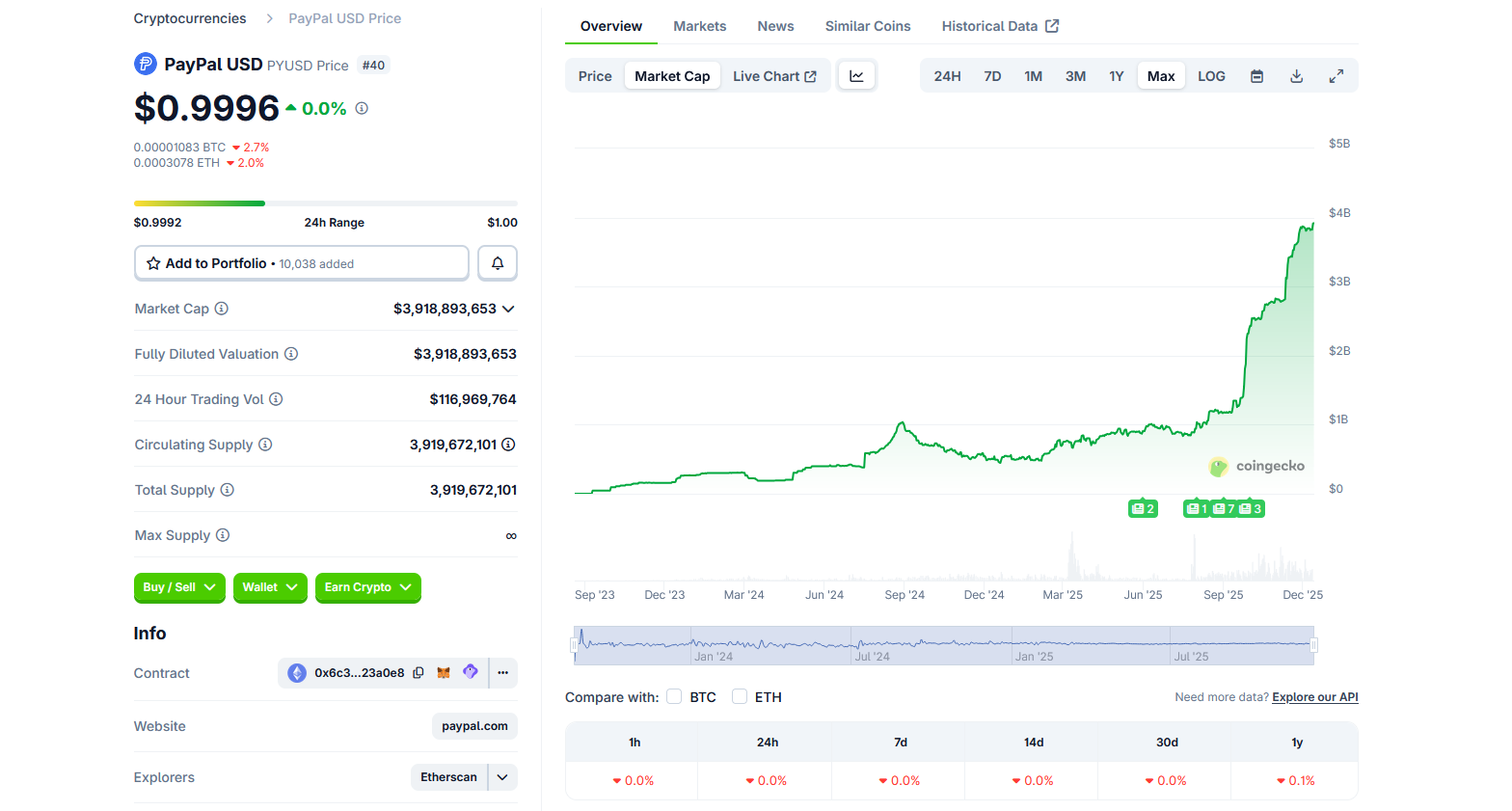
Vốn hóa thị trường PYUSD. Nguồn: CoinGecko

Một phần đáng kể trong sự tăng trưởng của PYUSD đến từ đầu tháng Chín, khi vốn hóa thị trường ở mức khoảng 1 tỷ USD. Trong tháng đó, PYUSD đã được tích hợp với thị trường cho vay của Spark và Stable của Bitfinex, một blockchain stablecoin cấp độ thể chế.
Tạp chí: Stablecoin sẽ chứng kiến sự tăng trưởng bùng nổ vào năm 2025 khi thế giới chấp nhận loại tài sản này


Related Questions

QYouTube đã bật tính năng thanh toán bằng stablecoin nào cho người sáng tạo nội dung tại Mỹ?

AYouTube đã bật tính năng thanh toán bằng stablecoin PYUSD của PayPal cho người sáng tạo nội dung tại Mỹ.

QAi là người đứng đầu bộ phận tiền mã hóa của PayPal đã xác nhận thông tin này?

AMay Zabaneh, người đứng đầu bộ phận tiền mã hóa của PayPal, là người đã xác nhận tính năng này đã được kích hoạt.

QLợi ích chính của việc tích hợp PYUSD theo đại diện PayPal là gì?

ATheo đại diện PayPal, lợi ích chính là YouTube không cần phải trực tiếp xử lý tiền mã hóa, giúp loại bỏ sự phức tạp cho nền tảng.

QVốn hóa thị trường hiện tại của PYUSD là bao nhiêu theo dữ liệu từ CoinGecko?

ATheo dữ liệu từ CoinGecko, vốn hóa thị trường hiện tại của PYUSD là 3,9 tỷ USD.

QSự kiện nào vào tháng 9 đã góp phần vào sự tăng trưởng đáng kể của PYUSD?

ASự tăng trưởng đáng kể của PYUSD từ tháng 9 đến từ việc nó được tích hợp với thị trường cho vay của Spark và Stable của Bitfinex, một blockchain stablecoin cấp tổ chức.

Related Reads

Dalio's Latest Warning: Don't Get Carried Away by AI, Real Returns on US Stocks in the Next 5-10 Years Could Be -5% to -10%

Ray Dalio, founder of Bridgewater Associates, warns investors against excessive concentration in AI stocks. He argues the current market, dominated by a few AI giants, mirrors historical patterns where revolutionary new technologies lead to high risk, volatility, and uncertainty. While acknowledging AI's transformative potential, Dalio emphasizes that most investors fail at this stage of the cycle by over-concentrating in a handful of leading companies. He cites inherent risks: companies cannot accurately forecast investment needs or external shocks (e.g., monetary policy, geopolitics, taxes), face potential disruption from future technologies and international competition (notably from China), and experience significant price swings. Dalio's core advice is diversification, calling it his "Holy Grail of Investing." He presents a mathematical case that a well-diversified portfolio of 15-20 uncorrelated, good bets offers a superior risk-adjusted return compared to a concentrated position. Dalio also offers a cautious outlook, suggesting U.S. stocks may deliver real returns of -5% to -10% over the next 5-10 years based on valuation and bubble indicators. He concludes that in the face of high uncertainty, the prudent strategy is not to avoid betting entirely, but to avoid large, concentrated bets where one lacks sufficient informational edge. Instead, investors should build a strategically balanced, diversified portfolio.

marsbit59m ago

Dalio's Latest Warning: Don't Get Carried Away by AI, Real Returns on US Stocks in the Next 5-10 Years Could Be -5% to -10%

marsbit59m ago

Rain Valuation Approaches $20 Billion: The Battle for U-Cards Extends to Rewards Systems

Rain, a stablecoin payments infrastructure company, is shifting the competitive focus for U Cards from simple issuance to user retention and repeated usage. On June 15, Rain launched "Rain Rewards," an embedded loyalty program capability within its card-issuing infrastructure. This allows partner businesses—like fintech platforms and neobanks—to configure branded loyalty points, earning rules, redemptions, and merchant promotions directly within their card products. The system, built from the 2025 acquisition of Uptop, ensures points are only issued upon final transaction settlement, preventing liabilities from refunds. Trials, such as with Avalanche Card, reportedly boosted spending by 25% among enrolled users. Founded by Farooq Malik and Charles Yoo-Naut, Rain evolved from a tool for managing Web3 company expenses into a full-stack enterprise platform. It is a Principal Member of Visa and Mastercard, enabling partners to issue stablecoin-backed cards and wallets while leveraging traditional payment networks. Notably, the popular U Card Plasma One is issued by Rain under Visa's authority. Rain also integrates with Visa's stablecoin settlement pilot, using USDC for network settlement. Rain's rapid funding reflects growing institutional interest in stablecoin payment infrastructure. It raised a $245 million Series A in March 2025, a $58 million Series B in August 2025, and a $250 million Series C in January of this year, reaching a $19.5 billion valuation. Annualized transaction volume exceeds $3 billion, serving over 200 partners including Western Union and Nuvei. Beyond cards, Rain is expanding into programmable payments. Its June 2026 "Agent Control Layer" allows businesses to set spending rules—like merchant categories, amounts, and frequency—for AI agents before transactions occur. This positions Rain not as a single product but as an operating system for stablecoin payments, handling everything from card issuance and wallet management to rewards, on/off-ramps, and automated compliance. The goal is to enable seamless, often invisible, real-world spending of on-chain assets.

Foresight News1h ago

Rain Valuation Approaches $20 Billion: The Battle for U-Cards Extends to Rewards Systems

Foresight News1h ago

Google TPU Shipments Revised Up by 50%

Recent industry research indicates a significant upward revision in the shipments of Google's TPU (Tensor Processing Unit) chips. Previous expectations for 2027 were set at around 10 million units, but new estimates now point to 15 million units, a 50% increase. This substantial boost directly translates to higher demand across the entire supporting supply chain. Google's TPU clusters utilize a standardized all-optical interconnect architecture. Consequently, key hardware components are deeply integrated and scaled in fixed ratios with the chips. The 15 million TPU target will drive corresponding demand increases for NPO optical engines (roughly a 1:1 match), 1.6T optical modules, OCS optical switches, high-end server power supplies, fiber optics & MPO connectors, and liquid cooling solutions. Among these, liquid cooling is highlighted as the sector experiencing the most significant transformation and offering the most stable potential for excess returns. As next-generation TPU chips reach power levels where traditional air cooling is insufficient, liquid cooling becomes essential. 2026 is forecasted as the first year of substantial adoption for Google's liquid cooling solutions. This shift, coupled with delivery and capacity bottlenecks faced by incumbent overseas manufacturers, is creating a prime window for domestic Chinese suppliers to enter and secure Google's core supply chain. The market size for Google-specific liquid cooling is projected to potentially triple from a baseline of hundreds of billions to around 300 billion units by 2028. The logic for the fiber optic sector is also being rewritten. Once considered a cyclical commodity tied to telecom operator procurement, fiber is now a strategic and scarce resource for AI Data Centers (AIDC). A severe supply-demand imbalance, driven by the long lead time for preform production (18-24 months) and surging demand from cloud giants, is supporting strong performance. Chinese fiber manufacturers are well-positioned to capture a significant share of global AIDC demand, with exports potentially reaching 200-300 million core kilometers in 2026. Overall, the investment focus within the AI computing industry is shifting from pure "chip performance speculation" towards the more certain incremental growth in computing infrastructure and its supporting ecosystem. The upward revision in Google TPU shipments, along with the potential for further doubling by 2028, is seen as solidifying performance visibility for the entire supporting supply chain over the next two years.

marsbit2h ago

Google TPU Shipments Revised Up by 50%

marsbit2h ago

Trading

Spot
Futures

Hot Articles

How to Buy US

Welcome to HTX.com! We've made purchasing Talus Network (US) simple and convenient. Follow our step-by-step guide to embark on your crypto journey.Step 1: Create Your HTX AccountUse your email or phone number to sign up for a free account on HTX. Experience a hassle-free registration journey and unlock all features.Get My AccountStep 2: Go to Buy Crypto and Choose Your Payment MethodCredit/Debit Card: Use your Visa or Mastercard to buy Talus Network (US) instantly.Balance: Use funds from your HTX account balance to trade seamlessly.Third Parties: We've added popular payment methods such as Google Pay and Apple Pay to enhance convenience.P2P: Trade directly with other users on HTX.Over-the-Counter (OTC): We offer tailor-made services and competitive exchange rates for traders.Step 3: Store Your Talus Network (US)After purchasing your Talus Network (US), store it in your HTX account. Alternatively, you can send it elsewhere via blockchain transfer or use it to trade other cryptocurrencies.Step 4: Trade Talus Network (US)Easily trade Talus Network (US) on HTX's spot market. Simply access your account, select your trading pair, execute your trades, and monitor in real-time. We offer a user-friendly experience for both beginners and seasoned traders.

4.9k Total ViewsPublished 2025.12.11Updated 2026.06.02

How to Buy US

Discussions

Welcome to the HTX Community. Here, you can stay informed about the latest platform developments and gain access to professional market insights. Users' opinions on the price of US (US) are presented below.

活动图片