DOGE现在能买吗?横盘之后是爆发?关键指标揭示狗狗币2025年的走势关键

金色财经Published on 2025-12-04Last updated on 2025-12-04

图片

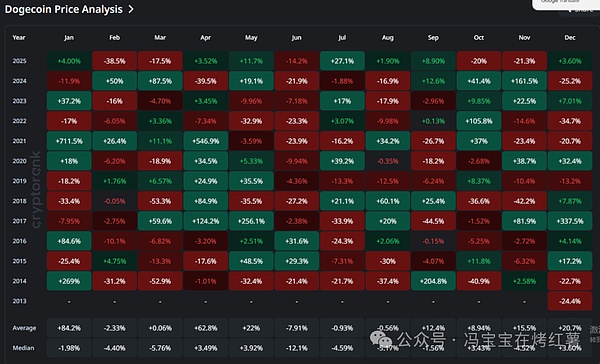
2014年诞生的狗狗币,价格总在“慢慢涨-突然暴涨-回调下跌”中循环。现在关键指标释放了新信号,帮我们看懂它2025年可能的走势。下面用大白话讲清它的周期规律、当前市场情况和未来机会风险。

一、历史规律:涨涨跌跌有套路

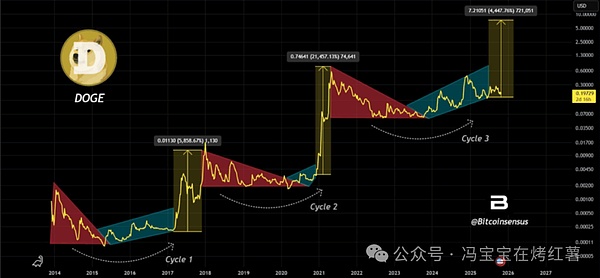
狗狗币的价格不是乱走的,从2014年到现在,已经走完两轮完整行情,每轮都分三步:先长时间横盘(积累阶段),然后突然暴涨,最后慢慢回调。每一轮,涨幅都特别惊人。

第一轮它涨了5800%,让大家看到“粉丝多力量大”。第二轮更夸张,靠网友在社交平台转发造势,直接涨了21000%,最高涨到0.74美元。这两轮都证明,狗狗币的粉丝群是推高价格的关键。

现在大家都觉得,狗狗币正在走第三轮的“积累阶段”——价格不怎么动,投资者在慢慢买。这种横盘通常是大涨前的准备,而且它的行情节奏,和整个加密货币市场的大趋势是同步的。
图片

二、当前信号:现在能买吗?看两个指标

想知道狗狗币短期会不会涨,看两个东西就够了:一个是RSI指标,一个是交易量。现在这两个指标,都给出了有意思的信号。

RSI是判断“买多了还是卖多了”的指标:

数值30以下叫“超卖”,意思是大家都在卖,快卖不动了,价格很可能稳住甚至反弹。现在狗狗币RSI就快到30了,过去出现这种情况时,它大多会涨一点。不过专家提醒,0.1383美元是个关键价位,没突破之前别着急下手。

再看交易量:

最近价格从0.15美元跌到0.137美元左右时,一天就交易了15.6亿枚,是平时的6倍,而且每天都有10亿美元以上的交易。这么大的交易量,不是散户慌着卖,更可能是机构在自动交易,说明大家对它的关注度没降,市场流动性很好。

要说明的是,现在狗狗币整体还是跌的,跌破0.1495美元后就一直往下走。但即便这样,它220亿美元的市值还是排加密货币第七,足见大家对它的认可。
图片

三、核心优势:粉丝多,才抗跌

很多加密货币靠技术吃饭,狗狗币靠的是“人多力量大”——它的草根粉丝群,是撑住它价格的关键,每一轮涨跌都离不开这群人。

狗狗币有个口号叫“每天只做好事”,这个理念圈了很多忠实粉,还成了社交平台上的热门话题。涨的时候,粉丝自发转发宣传,把价格推得更高;跌的时候,大家也不轻易放弃,市场信心不会垮。每天近10亿美元的交易量,就是粉丝活跃度最好的证明。

另外,狗狗币交易起来特别简单,不像有些加密货币门槛高,普通投资者很容易上手,这也是它粉丝多的重要原因。

四、2025年狗狗币能涨多少?有机会,但别盲目

好的方面是,历史规律能给点信心。

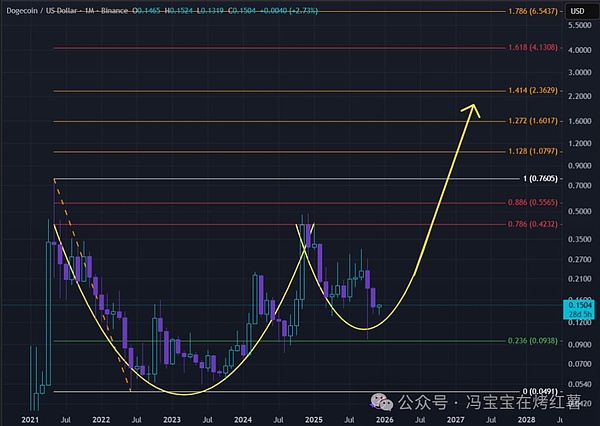
如果第三轮和前两轮一样涨,有人预测它能涨到7美元。而且现在RSI超卖,交易量又稳,短期稳住甚至涨一点是有可能的。按现在的情况,2025年它大概率还是市值前七的加密货币,市值维持在220亿美元左右。

但风险也不能忽视。

第一,历史不会完全重复,比如银行利率变了、加密货币监管严了,都可能打乱它的行情;

第二,现在机构交易越来越多,和以前全靠散户不一样,价格走势会更复杂;

第三,狗狗币没什么特别的技术和实际用途,价值全靠粉丝热情和市场情绪,碰到极端情况抗风险能力差。
图片

常见问题回答

1. 2025年狗狗币还能稳住地位吗?

能。现在它市值220亿美元排第七,每天交易10亿美元左右,粉丝又多,2025年大概率还是主流加密货币。

2. 为什么大家都看RSI指标?

RSI快到30,说明“卖盘”快耗尽了,价格要稳了。过去这指标很准,能帮交易者判断什么时候适合入场。

3. 粉丝怎么影响价格?

涨的时候粉丝帮着宣传,越涨越疯;跌的时候粉丝不轻易卖,稳住信心。这种草根力量,是其他加密货币比不了的。

核心要点

  • 规律明确:三轮行情都是“积累-暴涨-回调”,最高涨21000%。

  • 信号不错:RSI快超卖,每天交易10亿+,短期有稳住可能。

  • 粉丝是关键:草根支持让它抗跌,活跃度高。

  • 风险要记牢:监管、经济环境都可能打乱行情,别只看历史涨势。

现在狗狗币正处在“积累阶段”,加上RSI超卖,市场有稳住的迹象。220亿市值和庞大粉丝群是它的底气,但过去涨得多不代表未来一定涨。2025年想投它,得盯着行情信号,也得关注监管和经济变化,根据自己能承受的风险来决定,别盲目跟风。


Trending Cryptos

Related Reads

From 2 Million Monthly Active Users to Zero: Zapper's Demise in the "Maturation" of DeFi

From 2M MAU to Zero: The Demise of Zapper in a Maturing DeFi Landscape On July 8, 2026, Zapper co-founder Seb Audet announced the platform's full shutdown. Once a DeFi star with 2 million monthly active users, $13B in processed transactions, and $16.5M in funding, Zapper's journey ends. Born in 2020 from the merger of DeFiZap and DeFiSnap, Zapper rode the "DeFi Summer" wave. It became essential for users to track complex, multi-protocol yield farming positions across chains. At its peak, it supported 14 chains, 450+ protocols, and 7000+ tokens, with its signature "Zap" feature simplifying multi-step DeFi actions. However, sustainable revenue never materialized. Its primary model—taking small fees from DEX aggregation—faced fierce competition and squeezed margins. Meanwhile, maintaining its extensive, real-time data indexing system was costly. Crucially, the DeFi ecosystem matured, with activity and liquidity concentrating in fewer top protocols. The core demand for a complex, multi-protocol dashboard waned as user behavior simplified. Zapper attempted multiple pivots that failed to gain traction: an NFT-based points system (2021), a social app called Chainchat (2023), and plans for a ZAP token and open protocol (2024). These efforts reflected a persistent "blockchain-native" mindset focused on creating new C端 (consumer) needs rather than addressing existing pain points or bolstering its revenue-generating products. The article contrasts Zapper with DeBank, which successfully narrowed its asset-tracking focus while developing Rabby Wallet—a revenue-stabilizing, competitive product. Zapper's story serves as a cautionary tale for tooling projects: over-immersion in a purist vision, coupled with an inability to adapt business models to market shifts—like the consolidation of DeFi activity—can be fatal, even for once-dominant platforms.

marsbit23m ago

From 2 Million Monthly Active Users to Zero: Zapper's Demise in the "Maturation" of DeFi

marsbit23m ago

Goldman Sachs Bans It, Google Bans It Too: The Gray Zone of Prediction Markets Is Shrinking Fast

Goldman Sachs has updated its personal trading policy, prohibiting employees from trading event contracts on prediction markets involving specific companies (including whether Goldman itself might restructure or initiate acquisitions in a quarter), election outcomes, financial market performance (including Bitcoin prices), macroeconomic data, geopolitical events, and regulatory results for pending M&A deals. Sports and entertainment bets remain allowed. Violations can lead to dismissal or account closure, and the firm may reclaim profits over $200 or donate them to charity. This follows a CFTC case against a Google engineer who allegedly used non-public data to profit $1.2 million on Polymarket. Simultaneously, Google's Chrome Web Store updated its policy, banning extensions that facilitate real-money trading on prediction market outcomes, effective August 1, 2026. While not affecting platforms' websites or mobile apps directly, this restricts a key user access channel. These actions occur amid growing regulatory pressure on prediction markets. The CFTC is investigating Polymarket for alleged misconduct, and a consumer group has filed a lawsuit. Over 30 countries, including Argentina, have blocked access. Despite this, trading volume has hit record highs, and major investments continue, such as ICE's $2 billion stake in Polymarket. The core debate remains whether prediction markets are financial instruments or gambling. CFTC argues for federal oversight as derivatives, while some states seek to regulate them under gambling laws. Multiple fronts—federal probes, political pressure, internal corporate bans, and platform restrictions—are narrowing the operational space for these markets.

Foresight News30m ago

Goldman Sachs Bans It, Google Bans It Too: The Gray Zone of Prediction Markets Is Shrinking Fast

Foresight News30m ago

Tsinghua AI Mathematician Emerges: From Intuition to Theorem, Contributing to an 84-Page Quantum Algorithm Paper

Tsinghua University’s Intelligent Industry Research Institute (AIR) has developed an AI mathematician agent named AIM, designed not just to solve math problems but to actively participate in early-stage research. In a recent study, researchers collaborated with AIM to develop "Sign Embedding Quantum Algorithms," resulting in an 84-page paper on quantum algorithms for matrix equations and functions. The research began with a human researcher's intuition: can rational approximation serve as a design principle for quantum algorithms? AIM helped expand this idea into multiple candidate research directions. Human researchers then filtered and focused on the most promising path. AIM assisted in organizing theorems, generating proof drafts, and performing complexity analysis, while humans maintained oversight, auditing assumptions and refining derivations. This case illustrates a human-AI collaborative workflow: AI rapidly explores and expands research avenues, generates draft materials, and aids in checking derivations; human researchers provide critical judgment on direction, value, and validity. The process emphasizes "high-throughput candidate generation + human value gating + AI-assisted audit and repair + human final integration." The resulting quantum algorithm framework offers a unified approach to several matrix problems, advancing quantum linear algebra under more general conditions. This work suggests AI's role in theoretical research is evolving from task-specific assistance to supporting the entire research lifecycle—enhancing exploration and efficiency while keeping human expertise central to guiding inquiry and ensuring rigor. *Paper & System Links:* - AIM application report: https://arxiv.org/abs/2606.24899 - Quantum algorithm paper: https://arxiv.org/abs/2604.25333 - AIM repository: https://github.com/TheoryFoundry/AIMv2

marsbit1h ago

Tsinghua AI Mathematician Emerges: From Intuition to Theorem, Contributing to an 84-Page Quantum Algorithm Paper

marsbit1h ago

Trading

Spot

Hot Articles

What is DOGE M

Doge Matrix ($doge m): The New Breed of Community-Driven Cryptocurrency Introduction In the ever-evolving landscape of cryptocurrency, new projects constantly emerge, each aiming to capture the interest of investors and enthusiasts alike. One of the latest entrants to this domain is Doge Matrix, represented by the ticker symbol $doge m. This project has attracted attention thanks to its roots in the popular meme culture surrounding Dogecoin, establishing its place within the web3 space. This article aims to provide a comprehensive analysis of Doge Matrix, covering its overview, creator, investors, functionality, timeline, and notable aspects. What is Doge Matrix ($doge m)? Doge Matrix is a community-driven cryptocurrency project that seemingly builds upon the widespread appeal of Dogecoin, a digital currency known for its Shiba Inu mascot and its meme origins. While the overarching objectives of Doge Matrix are not extensively defined, it is characterized by a commitment to harnessing community involvement and support. Unlike traditional cryptocurrencies that often emphasize utility or intrinsic value through underlying technologies, Doge Matrix positions itself within a space that embraces the cultural phenomenon of cryptocurrencies, particularly appealing to those who resonate with the ethos of meme-based assets. Drawing on the strengths of the Dogecoin community, Doge Matrix operates as part of a broader ecosystem, inviting participation and engagement from users who share an interest in cryptocurrency and the digital landscape. Who is the Creator of Doge Matrix ($doge m)? The identity of the creator of Doge Matrix remains unknown. This lack of transparency is not an uncommon occurrence in the cryptocurrency space, where some projects are launched without revealing the identities of their founders. The absence of information regarding the founding team can raise questions among potential investors about the project’s accountability and direction. Who are the Investors of Doge Matrix ($doge m)? As it stands, there is no publicly available information detailing the investors or investment foundations that back Doge Matrix. The project appears to rely primarily on community support rather than institutional investment. This model aligns with the community-driven nature of the initiative, fostering an environment where the direction of the project is shaped by its participants rather than being dictated by a select few financial backers. How Does Doge Matrix ($doge m) Work? The specifics regarding the operational mechanisms of Doge Matrix are somewhat vague, reflecting a broader trend of projects in the meme coin space where innovative functionalities are not always clearly articulated. Nonetheless, Doge Matrix seems designed to tap into the existing cryptocurrency ecosystem by encouraging user participation while tapping into the familiar cultural references associated with Dogecoin. Its potentially unique characteristics derive from community interactions rather than technological advancements, emphasizing shared experiences and collaboration among token holders. While the exact innovations have not been explicitly outlined, the project appears to create a space where community members can engage, share ideas, and propel the project's potential forward. Timeline of Doge Matrix ($doge m) Reflecting on the project’s timeline reveals notable events that have defined its journey thus far: November 25, 2024: Doge Matrix reached its all-time high value, marking a significant milestone in its early history. January 1, 2025: Conversely, Doge Matrix hit its all-time low value, illustrating the volatility often associated with cryptocurrencies, especially in the early stages of a project's lifecycle. Ongoing: The project continues to be actively traded and supported by its community, although specific future milestones or objectives have yet to be disclosed. Key Points About Doge Matrix ($doge m) Community Focus At the heart of Doge Matrix is a commitment to community engagement. The project thrives on the premise of collaboration and shared objectives among its members, emphasizing the importance of collective effort. Unlike centralized projects that often have a defined leadership structure, Doge Matrix at present showcases a more fluid approach to governance, where every community member's voice matters. Volatility The cryptocurrency market is notorious for its volatility, and Doge Matrix is no exception. Its price history reflects significant fluctuations between high and low values, which is typical of many new cryptocurrencies but underscores the risks associated with investment in emerging tokens. Lack of Detailed Information One of the most striking features about Doge Matrix is the scarcity of detailed information regarding its technological underpinnings and operational mechanisms. This ambiguity necessitates that potential investors conduct thorough due diligence before engaging with the project. Conclusion In summary, Doge Matrix ($doge m) illustrates a new wave of cryptocurrency projects that lean heavily on community engagement and cultural relevance. While lacking in certain specifics—such as clear leadership, defined objectives, and detailed functionality—the project has managed to generate interest within the crypto community, leveraging the established appeal of meme culture. As with any investment in the cryptocurrency space, understanding the inherent risks and conducting comprehensive research is essential for potential participants. Doge Matrix stands as a reminder of the dynamic, sometimes unpredictable nature of the crypto industry, marked by constant evolution and enthusiasm for community-driven initiatives.

4.0k Total ViewsPublished 2025.02.03Updated 2025.02.03

What is DOGE M

Discussions

Welcome to the HTX Community. Here, you can stay informed about the latest platform developments and gain access to professional market insights. Users' opinions on the price of DOGE (DOGE) are presented below.

活动图片