Trump Hints at Kevin Hasset as the Next Fed Chair, Fueling Bitcoin Hyper’s $28.8M presale

bitcoinistPublished on 2025-12-03Last updated on 2025-12-03

Abstract

Quick Facts: ➡️ The market puts the odds of Kevin Hassett becoming the next Fed chair at 84% and waits...

Trusted Editorial content, reviewed by leading industry experts and seasoned editors. Ad Disclosure

Quick Facts:

  • ➡️ The market puts the odds of Kevin Hassett becoming the next Fed chair at 84% and waits for Trump to make the announcement.
  • ➡️ A crypto-friendly Hassett could revitalize the market and bring more investors in, effectively ending the current bear market.
  • ➡️ Bitcoin Hyper uses SVM-based execution to bring scalable smart contracts and DeFi to Bitcoin, offering a higher-octane way to ride a long-term $BTC bull thesis.
  • ➡️ $HYPER raised over $28.8M in presale so far and is positioned for a post-launch ROI of 1,396% in 2026 and 11,123% or higher by 2030.

Donald Trump floating former White House economist Kevin Hassett as a ‘potential Fed chair’ is more than a personnel rumor.

Kalshi’s prediction puts the odds at 84% and growing, while The Kobeissi Letter already sees it as a one-and-done, with the mention that ‘2026 is going to be a wild year.’

The Kobeissi Letter discussing the odds of Kevin Hassett as the next Fed Chair on X.

If confirmed, the arrival of Kevin Hassett at the helm would spell good news for crypto.

A more dovish, crypto-tolerant Federal Reserve would structurally lower the hurdle for risk assets.

Cheaper capital and less aggressive tightening historically favor high-beta trades, from tech equities to altcoins. If Bitcoin is the macro bellwether in this environment, Bitcoin-linked leverage plays could become the next logical step for conviction bulls.

But there’s a catch: Bitcoin’s base layer still processes roughly seven transactions per second, with fees that can spike into double digits during congestion and no native smart contracts.

That’s where Bitcoin Hyper ($HYPER) comes into focus. It positions itself as a Bitcoin Layer 2 with Solana Virtual Machine (SVM) integration, designed to give you Solana-style performance and programmable DeFi rails while still anchoring to Bitcoin’s settlement layer.

Read this to learn more about what Bitcoin Hyper is.

Why Looser Fed Policy Supercharges Bitcoin’s Infrastructure Race

A credible chance of a crypto-friendly Fed chair changes the calculus for builders and investors. If rate cuts or a softer stance are on the table, liquidity doesn’t just chase $BTC; it hunts yield, leverage, and new primitives that sit on top of Bitcoin and other base layers.

That’s why Bitcoin scalability and programmability are suddenly core macro trades, not just technical debates.

Lightning Network tackles payments but struggles with UX and liquidity routing at scale. Meanwhile, Bitcoin-adjacent ecosystems like Stacks, Rootstock, and Merlin Chain are racing to bolt smart contracts and DeFi onto Bitcoin without compromising security guarantees.

In this emerging Layer 2 stack, Bitcoin Hyper ($HYPER) is one contender, pitching a modular design where Bitcoin remains the settlement and security anchor while a high-throughput execution layer handles smart contracts.

You can buy $HYPER on the official presale page today.

How Bitcoin Hyper Turns Bitcoin Into a High-Beta DeFi Play

Zooming in, Bitcoin Hyper ($HYPER) markets itself as the first Bitcoin Layer 2 to integrate the Solana Virtual Machine, targeting real-world throughput that can exceed Solana’s own benchmarks while still anchoring state back to Bitcoin.

The core idea: keep Bitcoin as the trust layer, but move execution to an SVM-powered environment optimized for parallel processing and sub-second confirmation.

The result: a faster, cheaper, and more scalable Bitcoin network, attracting more institutional investors and tapping into the mainstream.

By combining a modular architecture – Bitcoin L1 for settlement, an SVM-based L2 for execution, and a decentralized Canonical Bridge for $BTC transfers – $HYPER sidesteps Bitcoin’s biggest constraints: slow base-layer confirmation times, volatile on-chain fees, and the absence of native smart contract logic.
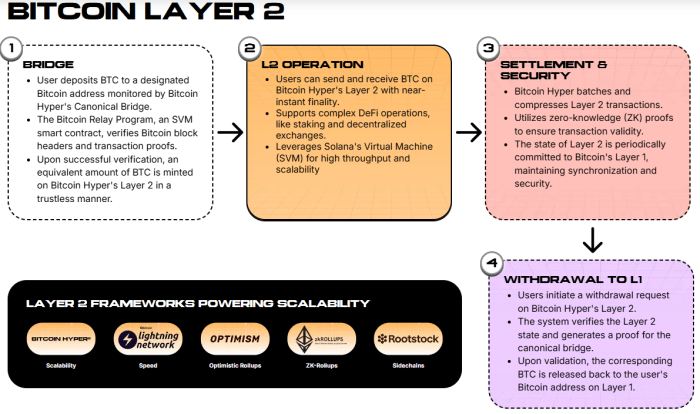
How Bitcoin Hyper’s Layer 2 works.

The goal is to enable swaps, lending, staking, NFTs, and gaming in wrapped $BTC with low latency and low cost.

From a market-structure angle, this turns $HYPER into a leveraged bet on Bitcoin’s upside and on-chain usage growth.

The presale has raised over $28.8M so far, with $HYPER sitting at $0.013365, suggesting investors are already positioning for a structurally looser policy backdrop and a richer Bitcoin DeFi stack.

Based on the presale’s performance and Bitcoin Hyper’s utility, we expect the token to hit the market hard.

A fair price prediction for $HYPER considers a potential target of $0.20 in 2026 and a high of $1.50 by 2030, once Bitcoin Hyper achieves its core developmental phases. Think 1,396% and 11,123% in terms of ROIs for one-year and five-year investment plans respectively.

From a pure numbers’ perspective, $HYPER could become one of the best altcoins to buy in 2026.

The presale targets a release window between Q4 2025 and Q1 2026, depending on market conditions and demand, with the latter already being high. So, if you want in, you should feel a sense of urgency right about now.

Make sure you read our guide on how to buy $HYPER first, though.

Go to the presale page and buy your $HYPER now.

This isn’t financial advice. DYOR and manage risks wisely before investing.

Authored by Bogdan Patru, Bitcoinist: https://bitcoinist.com/trump-kevin-hassett-fed-bitcoin-hyper-presale

Editorial Process for bitcoinist is centered on delivering thoroughly researched, accurate, and unbiased content. We uphold strict sourcing standards, and each page undergoes diligent review by our team of top technology experts and seasoned editors. This process ensures the integrity, relevance, and value of our content for our readers.

As a crypto writer, Bogdan’s responsibilities are split between researching and writing articles and entertaining the team with his humor bordering on the politically incorrect, an aspiring Bill Burr, if you will. Thanks to his 12+ years of writing experience in just as many fields, including tech, cybersecurity, modelling, fitness, crypto, and other topics-that-shall-not-be-named, he's become a genuine asset to the team. While his position as a senior writer at PrivacyAffairs thought him valuable lessons about the power of self-management, his entire writing career was and is an exercise in self-improvement. Now, he's ready to sink his teeth into crypto and teach people how to take control of their own money on the blockchain. With fiat as an eternally devaluing currency, Bitcoin and altcoins seem like the best-fitting alternative for Bogdan. Bogdan’s biggest professional accomplishment, aside from securing a position as a main writer for Bitcoinist, was his 5-year run as a writing manager at Blackwood Productions, where he coordinated a team of four writers. During that time, he learned the value of teamwork and that of creating a working environment that breeds efficiency, positivity, and friendship.

Trending Cryptos

Related Reads

Apple Sues OpenAI Sparking Feud, Musk Slams Altman for Fraud, Altman Retorts with 'Space Data Center' Boast

Apple Sues OpenAI as Musk-Altman Feud Escalates The public feud between Elon Musk and OpenAI CEO Sam Altman intensified, coinciding with their respective AI companies launching flagship models in the same week, highlighting fierce competition. On July 11, Musk posted on X, accusing Altman of taking "fraud to the next level" regarding OpenAI's commercial practices. Altman fired back, sarcastically suggesting Musk was the one selling "short-term space datacenter" concepts to public market investors. Musk countered with allegations that Altman "stole an open-source AI charity" and, amid Apple's recent lawsuit, "stole all of Apple's phone tech." He mockingly referenced Altman needing a "parole officer's" approval to travel. This exchange occurred against the backdrop of a significant legal development: Apple filed a lawsuit against OpenAI in a California federal court, alleging the AI company deliberately solicited Apple employees to leak confidential information on unreleased products to aid its own hardware plans. Apple demands OpenAI cease this activity, destroy proprietary materials, and redesign upcoming products. OpenAI responded, stating it has no interest in other companies' trade secrets and remains focused on innovation. This lawsuit could profoundly impact their two-year partnership where OpenAI provides key tech for Apple Intelligence and Siri. The rivalry extended to product releases. OpenAI launched GPT-5.6, while Musk's SpaceXAI unveiled Grok 4.5. Both are positioned as AI agents capable of multi-step tasks. GPT-5.6 is noted for strengths in broad reasoning, business workflows, and cybersecurity. Grok 4.5 is highlighted for higher efficiency in autonomous programming and developer workflows, with lower usage costs than GPT-5.6, though OpenAI's model reportedly still leads in areas like abstract reasoning. The differing strengths offer distinct choices for enterprises and developers based on their specific needs.

marsbit6h ago

Apple Sues OpenAI Sparking Feud, Musk Slams Altman for Fraud, Altman Retorts with 'Space Data Center' Boast

marsbit6h ago

Trading

Spot

Hot Articles

What is $BITCOIN

DIGITAL GOLD ($BITCOIN): A Comprehensive Analysis Introduction to DIGITAL GOLD ($BITCOIN) DIGITAL GOLD ($BITCOIN) is a blockchain-based project operating on the Solana network, which aims to combine the characteristics of traditional precious metals with the innovation of decentralized technologies. While it shares a name with Bitcoin, often referred to as “digital gold” due to its perception as a store of value, DIGITAL GOLD is a separate token designed to create a unique ecosystem within the Web3 landscape. Its goal is to position itself as a viable alternative digital asset, although specifics regarding its applications and functionalities are still developing. What is DIGITAL GOLD ($BITCOIN)? DIGITAL GOLD ($BITCOIN) is a cryptocurrency token explicitly designed for use on the Solana blockchain. In contrast to Bitcoin, which provides a widely recognized value storage role, this token appears to focus on broader applications and characteristics. Notable aspects include: Blockchain Infrastructure: The token is built on the Solana blockchain, known for its capacity to handle high-speed and low-cost transactions. Supply Dynamics: DIGITAL GOLD has a maximum supply capped at 100 quadrillion tokens (100P $BITCOIN), although details regarding its circulating supply are currently undisclosed. Utility: While precise functionalities are not explicitly outlined, there are indications that the token could be utilized for various applications, potentially involving decentralized applications (dApps) or asset tokenization strategies. Who is the Creator of DIGITAL GOLD ($BITCOIN)? At present, the identity of the creators and development team behind DIGITAL GOLD ($BITCOIN) remains unknown. This situation is typical among many innovative projects within the blockchain space, particularly those aligning with decentralized finance and meme coin phenomena. While such anonymity may foster a community-driven culture, it intensifies concerns about governance and accountability. Who are the Investors of DIGITAL GOLD ($BITCOIN)? The available information indicates that DIGITAL GOLD ($BITCOIN) does not have any known institutional backers or prominent venture capital investments. The project seems to operate on a peer-to-peer model focused on community support and adoption rather than traditional funding routes. Its activity and liquidity are primarily situated on decentralized exchanges (DEXs), such as PumpSwap, rather than established centralized trading platforms, further highlighting its grassroots approach. How DIGITAL GOLD ($BITCOIN) Works The operational mechanics of DIGITAL GOLD ($BITCOIN) can be elaborated on based on its blockchain design and network attributes: Consensus Mechanism: By leveraging Solana’s unique proof-of-history (PoH) combined with a proof-of-stake (PoS) model, the project ensures efficient transaction validation contributing to the network's high performance. Tokenomics: While specific deflationary mechanisms have not been extensively detailed, the vast maximum token supply implies that it may cater to microtransactions or niche use cases that are still to be defined. Interoperability: There exists the potential for integration with Solana’s broader ecosystem, including various decentralized finance (DeFi) platforms. However, the details regarding specific integrations remain unspecified. Timeline of Key Events Here is a timeline that highlights significant milestones concerning DIGITAL GOLD ($BITCOIN): 2023: The initial deployment of the token occurs on the Solana blockchain, marked by its contract address. 2024: DIGITAL GOLD gains visibility as it becomes available for trading on decentralized exchanges like PumpSwap, allowing users to trade it against SOL. 2025: The project witnesses sporadic trading activity and potential interest in community-led engagements, although no noteworthy partnerships or technical advancements have been documented as of yet. Critical Analysis Strengths Scalability: The underlying Solana infrastructure supports high transaction volumes, which could enhance the utility of $BITCOIN in various transaction scenarios. Accessibility: The potential low trading price per token could attract retail investors, facilitating wider participation due to fractional ownership opportunities. Risks Lack of Transparency: The absence of publicly known backers, developers, or an audit process may yield skepticism regarding the project's sustainability and trustworthiness. Market Volatility: The trading activity is heavily reliant on speculative behavior, which can result in significant price volatility and uncertainty for investors. Conclusion DIGITAL GOLD ($BITCOIN) emerges as an intriguing yet ambiguous project within the rapidly evolving Solana ecosystem. While it attempts to leverage the “digital gold” narrative, its departure from Bitcoin's established role as a store of value underscores the need for a clearer differentiation of its intended utility and governance structure. Future acceptance and adoption will likely depend on addressing the current opacity and defining its operational and economic strategies more explicitly. Note: This report encompasses synthesised information available as of October 2023, and developments may have transpired beyond the research period.

744 Total ViewsPublished 2025.05.13Updated 2025.05.13

What is $BITCOIN

Discussions

Welcome to the HTX Community. Here, you can stay informed about the latest platform developments and gain access to professional market insights. Users' opinions on the price of BTC (BTC) are presented below.

活动图片