Ethereum vs. Bitcoin: Is ETH’s 5% Q3 rally the start of a structural rotation?

ambcryptoPublished on 2026-07-12Last updated on 2026-07-12

Abstract

The article examines whether Ethereum's (ETH) recent 5% Q3 rally against Bitcoin (BTC) signals a lasting capital rotation or is merely another short-term move. Historically, ETH has struggled to sustain outperformance; a strong 2025 Q3 rally was largely reversed, suggesting temporary rotations as capital flowed back to Bitcoin. Currently, Bitcoin dominance is testing a key resistance level, hinting at a possible shift back toward BTC. However, on-chain and institutional data present a counter-narrative. Ethereum ETFs have attracted significant net inflows this month, outperforming Bitcoin ETFs. A key catalyst is Robinhood's new Layer 2 network, which uses ETH for gas and settlement. Data shows a nearly 10x weekly surge in ETH bridged to this chain, indicating growing ecosystem activity and ETH demand. While it's premature to confirm a structural shift, the rally appears increasingly supported by fundamentals—including institutional inflows, rising Layer 2 adoption, and stronger on-chain metrics—rather than just market rotation. If these trends persist, the current ETH/BTC breakout could signal the beginning of a broader capital move into Ethereum during Q3.

Ethereum [ETH] has historically struggled to sustain its outperformance against Bitcoin.

On the technical front, ETH/BTC last posted a strong quarterly rally in Q3 2025, surging 53%, marking its biggest quarterly gain since Q2 2021. However, sellers erased 50% of those gains as the rally lost momentum. This suggests the rotation was temporary, as capital continued to flow into Bitcoin.

Against this backdrop, the ratio’s 5% rally so far in Q3 appears too early to confirm a sustained rotation from Bitcoin into Ethereum. At the same time, Bitcoin dominance is once again pushing toward the key 60% resistance level, gaining 1.5% in July and signaling that capital may already be rotating back into Bitcoin.
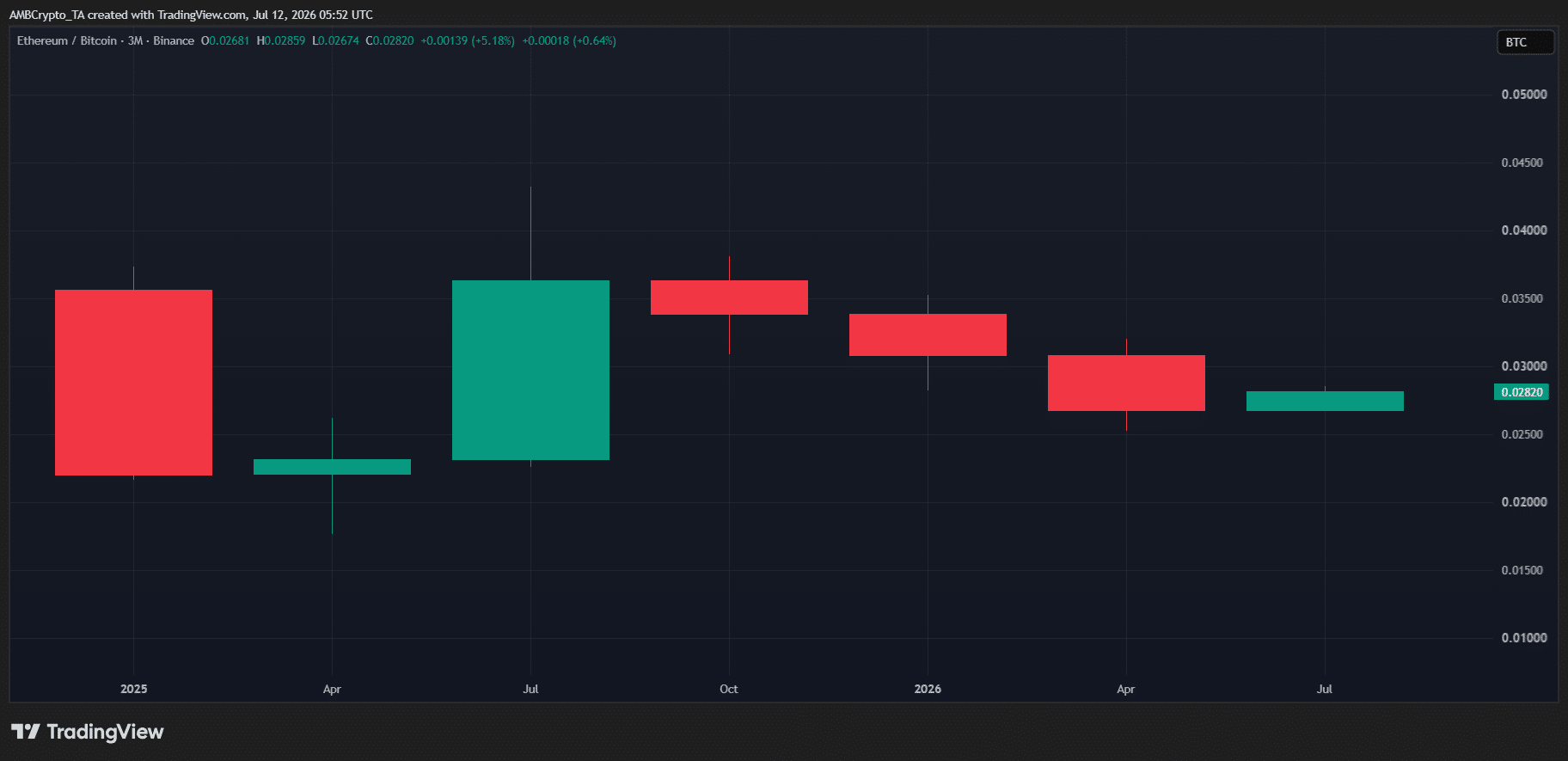
Source: TradingView (ETH/BTC)

That said, Eric Trump’s recent post on X points in the opposite direction, supporting Ethereum’s rally.

Meanwhile, the on-chain data tells a similar story. Ethereum’s outperformance against Bitcoin [BTC] isn’t happening in isolation. Institutional positioning continues to back the move, with Ethereum ETFs attracting over $128 million in net inflows so far this month, outperforming Bitcoin. Meanwhile, Ethereum’s DATs are recovering, adding further support to Ethereum’s recent strength.

With that said, it may be too early to write off the current ETH/BTC uptrend as just another short-term rotation. The bigger question is whether smart money is positioning ahead of a structural shift that the broader market has yet to price in.

Ethereum’s latest catalyst puts the ETH/BTC ratio in the spotlight

A key catalyst may be reinforcing the institutional rotation into Ethereum.

Tom Lee pointed to Robinhood’s recently unveiled Layer 2 chain as a major differentiator, calling it a breakout product that has already generated more volume than many established DEXs. More importantly, the network uses ETH as its native gas token, and settles on Ethereum Layer 1. As activity on the chain grows, each transaction feeds back into Ethereum’s ecosystem, strengthening the long-term demand case for ETH.

The on-chain data backs this up. As the chart below shows, the amount of ETH bridged from Ethereum Layer 1 to the Robinhood Chain has jumped nearly 10x over the past week, surpassing $100 million. That suggests users are actively moving liquidity into Robinhood’s Layer 2 ecosystem, with ETH emerging as the network’s core asset for gas, settlement, and on-chain activity.
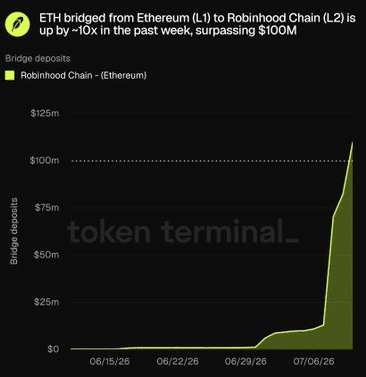
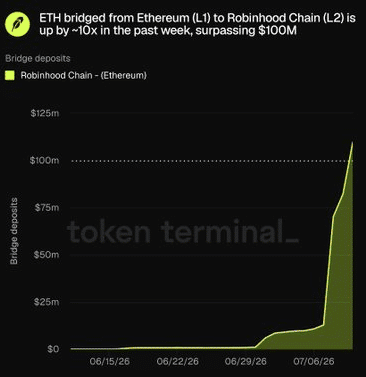
Source: Token Terminal

In this context, Ethereum’s outperformance against Bitcoin may be more than just another rotation.

Instead, the move looks increasingly driven by improving fundamentals, as institutional inflows, growing Layer 2 activity, and rising on-chain demand continue to strengthen Ethereum’s long-term investment case. If that trend holds, the ETH/BTC breakout could be the first sign of a broader capital rotation into Ethereum through Q3.


Final Summary

  • Ethereum’s rally against Bitcoin is backed by ETF inflows, stronger on-chain activity, and Robinhood’s Layer 2 ecosystem.
  • If these trends continue, the ETH/BTC breakout could signal a broader shift of capital into Ethereum in Q3.


Trending Cryptos

Related Questions

QBased on the article, what evidence suggests that Ethereum's recent outperformance against Bitcoin might be more than just a short-term rotation?

AThe evidence includes substantial institutional support with Ethereum ETFs attracting over $128 million in net inflows, strong growth in on-chain activity and fundamentals like the recovery of DATs, and a key catalyst in Robinhood's Layer 2 chain, which uses ETH as its native gas token and has seen a 10x increase in bridged ETH value. These factors point to improving fundamentals driving the move.

QWhat technical pattern in the ETH/BTC ratio from Q3 2025 does the article use as a cautionary example for the current rally?

AThe article notes that in Q3 2025, the ETH/BTC ratio surged 53%, its biggest quarterly gain since Q2 2021, but sellers later erased 50% of those gains as momentum faded. This historical example suggests such strong rallies can be temporary if capital flows back into Bitcoin.

QAccording to the on-chain data mentioned, what significant change occurred regarding ETH on the Robinhood Chain recently?

AThe amount of ETH bridged from Ethereum Layer 1 to the Robinhood Chain jumped nearly 10 times over the past week, surpassing $100 million. This indicates users are actively moving liquidity into Robinhood's Layer 2 ecosystem, establishing ETH as the core asset for gas, settlement, and activity on that network.

QWhat conflicting signal does the article present that might challenge the idea of a sustained capital rotation from Bitcoin to Ethereum?

AThe article points out that Bitcoin dominance is pushing toward the key 60% resistance level, having gained 1.5% in July. This signals that capital may already be rotating back into Bitcoin, which contradicts the narrative of a sustained shift towards Ethereum.

QWhat does Tom Lee, cited in the article, identify as a major differentiator and catalyst for Ethereum?

ATom Lee identifies Robinhood's recently unveiled Layer 2 chain as a major differentiator, calling it a breakout product that has already generated more volume than many established DEXs. Crucially, it uses ETH as its native gas token and settles on Ethereum Layer 1, strengthening ETH's long-term demand case as activity grows.

Related Reads

Blockchain Capital Partner: Tokenization Will Reshape the Underlying Structure of Capital Markets

"Blockchain Capital partner Aleks Larsen argues that tokenization will fundamentally restructure capital markets by solving a costly 'packaging' problem in finance. Currently, assets like mortgages, private equity, and stocks exist in fragmented, incompatible systems, creating huge friction and slowing capital flow. Tokenization introduces a standardized, machine-readable interface for assets—akin to shipping containers for finance. Just as containerization standardized global trade, enabling massive efficiency gains and economic growth, tokens standardize financial rights. This allows platforms, lenders, and custodians to interact with assets directly on a shared network without rebuilding infrastructure for each one. Stablecoins demonstrate this potential, processing volumes rivaling Visa with far lower cost and faster settlement. Beyond payments, tokenization is expanding to assets like U.S. Treasuries, commodities, and private credit, now totaling nearly $400 billion on-chain. This shift changes financial service access: instead of depending on relationships with institutions, services become accessible based on the asset's tokenized properties themselves. DeFi protocols like Aave exemplify this, where assets meeting criteria can be used as collateral programmatically. Ultimately, tokenization will reorganize capital markets around open networks of specialized services, lowering barriers to entry and reducing costs. This could unlock global capital for currently underserved assets—small receivables, regional infrastructure, emerging market credit—integrating them into a seamless, programmable financial system. Combined with AI, tokenization promises to make capital allocation more efficient, transparent, and globally accessible, reshaping how economic value is created and distributed."

marsbit3m ago

Blockchain Capital Partner: Tokenization Will Reshape the Underlying Structure of Capital Markets

marsbit3m ago

Trading

Spot

Hot Articles

What is $BITCOIN

DIGITAL GOLD ($BITCOIN): A Comprehensive Analysis Introduction to DIGITAL GOLD ($BITCOIN) DIGITAL GOLD ($BITCOIN) is a blockchain-based project operating on the Solana network, which aims to combine the characteristics of traditional precious metals with the innovation of decentralized technologies. While it shares a name with Bitcoin, often referred to as “digital gold” due to its perception as a store of value, DIGITAL GOLD is a separate token designed to create a unique ecosystem within the Web3 landscape. Its goal is to position itself as a viable alternative digital asset, although specifics regarding its applications and functionalities are still developing. What is DIGITAL GOLD ($BITCOIN)? DIGITAL GOLD ($BITCOIN) is a cryptocurrency token explicitly designed for use on the Solana blockchain. In contrast to Bitcoin, which provides a widely recognized value storage role, this token appears to focus on broader applications and characteristics. Notable aspects include: Blockchain Infrastructure: The token is built on the Solana blockchain, known for its capacity to handle high-speed and low-cost transactions. Supply Dynamics: DIGITAL GOLD has a maximum supply capped at 100 quadrillion tokens (100P $BITCOIN), although details regarding its circulating supply are currently undisclosed. Utility: While precise functionalities are not explicitly outlined, there are indications that the token could be utilized for various applications, potentially involving decentralized applications (dApps) or asset tokenization strategies. Who is the Creator of DIGITAL GOLD ($BITCOIN)? At present, the identity of the creators and development team behind DIGITAL GOLD ($BITCOIN) remains unknown. This situation is typical among many innovative projects within the blockchain space, particularly those aligning with decentralized finance and meme coin phenomena. While such anonymity may foster a community-driven culture, it intensifies concerns about governance and accountability. Who are the Investors of DIGITAL GOLD ($BITCOIN)? The available information indicates that DIGITAL GOLD ($BITCOIN) does not have any known institutional backers or prominent venture capital investments. The project seems to operate on a peer-to-peer model focused on community support and adoption rather than traditional funding routes. Its activity and liquidity are primarily situated on decentralized exchanges (DEXs), such as PumpSwap, rather than established centralized trading platforms, further highlighting its grassroots approach. How DIGITAL GOLD ($BITCOIN) Works The operational mechanics of DIGITAL GOLD ($BITCOIN) can be elaborated on based on its blockchain design and network attributes: Consensus Mechanism: By leveraging Solana’s unique proof-of-history (PoH) combined with a proof-of-stake (PoS) model, the project ensures efficient transaction validation contributing to the network's high performance. Tokenomics: While specific deflationary mechanisms have not been extensively detailed, the vast maximum token supply implies that it may cater to microtransactions or niche use cases that are still to be defined. Interoperability: There exists the potential for integration with Solana’s broader ecosystem, including various decentralized finance (DeFi) platforms. However, the details regarding specific integrations remain unspecified. Timeline of Key Events Here is a timeline that highlights significant milestones concerning DIGITAL GOLD ($BITCOIN): 2023: The initial deployment of the token occurs on the Solana blockchain, marked by its contract address. 2024: DIGITAL GOLD gains visibility as it becomes available for trading on decentralized exchanges like PumpSwap, allowing users to trade it against SOL. 2025: The project witnesses sporadic trading activity and potential interest in community-led engagements, although no noteworthy partnerships or technical advancements have been documented as of yet. Critical Analysis Strengths Scalability: The underlying Solana infrastructure supports high transaction volumes, which could enhance the utility of $BITCOIN in various transaction scenarios. Accessibility: The potential low trading price per token could attract retail investors, facilitating wider participation due to fractional ownership opportunities. Risks Lack of Transparency: The absence of publicly known backers, developers, or an audit process may yield skepticism regarding the project's sustainability and trustworthiness. Market Volatility: The trading activity is heavily reliant on speculative behavior, which can result in significant price volatility and uncertainty for investors. Conclusion DIGITAL GOLD ($BITCOIN) emerges as an intriguing yet ambiguous project within the rapidly evolving Solana ecosystem. While it attempts to leverage the “digital gold” narrative, its departure from Bitcoin's established role as a store of value underscores the need for a clearer differentiation of its intended utility and governance structure. Future acceptance and adoption will likely depend on addressing the current opacity and defining its operational and economic strategies more explicitly. Note: This report encompasses synthesised information available as of October 2023, and developments may have transpired beyond the research period.

2.1k Total ViewsPublished 2025.05.13Updated 2025.05.13

What is $BITCOIN

Discussions

Welcome to the HTX Community. Here, you can stay informed about the latest platform developments and gain access to professional market insights. Users' opinions on the price of BTC (BTC) are presented below.

活动图片