Cardano Founder Reveals Midnight Launch Roadmap

bitcoinistPublished on 2025-11-21Last updated on 2025-11-22

Abstract

At the Midnight Summit, Cardano founder and Input Output Global CEO Charles Hoskinson set out a staged rollout for Midnight,...

Trusted Editorial content, reviewed by leading industry experts and seasoned editors. Ad Disclosure

At the Midnight Summit, Cardano founder and Input Output Global CEO Charles Hoskinson set out a staged rollout for Midnight, a privacy-and-identity network he describes as crypto’s next generational layer. In a Dapp Central interview, he positioned Midnight as an extender of existing ecosystems rather than a competitor: “We’re here to make your life easier and allow you to do new things your network doesn’t do… and you can pay in that network’s token,” pointing to interoperability with major chains such as Ethereum, Solana, Bitcoin and XRP.

Cardano Sidechain Launches In Four Stages

Hoskinson’s deployment plan is a four-gate launch intended to move from distribution to full decentralization through sequential upgrades. The first gate is liquidity and token delivery. The Cardano founder said NIGHT claims and initial market trading begin on December 8, 2025, the point at which Midnight becomes price-discoverable: “They get the tokens, they can trade them on exchanges and DEXes… it creates a price signal […] it’s on CoinMarketCap, it’s a real thing.” He tied this to the Glacier Drop and Scavenger Mine funnels, estimating participation at “well more than a million users,” while acknowledging wallet counts don’t map cleanly to individuals.

The second gate is a federated mainnet targeted for Q1 2026. Hoskinson described a production environment with mixed operators—some nodes run by IOG and some by external enterprises, including a Fortune 500 participant—so Midnight’s builder base can deploy applications with real users before final decentralization. He cited more than 100 partners already building for Midnight, and summit materials likewise list federated mainnet as the next milestone after NIGHT liquidity.

The third gate is an incentivized testnet to onboard stake pool operators and validate Midnight’s final consensus protocol. Hoskinson said the protocol has formal liveness and safety proofs and targets roughly 5,000 transactions per second with sub-second blocks, but has never been deployed on Substrate. “It would be irresponsible just to kind of launch that out,” he said, arguing that both the algorithm and operator tooling must be proven under incentives before mainnet adoption.

The fourth gate follows once the incentivized testnet is stable: a hard fork into the final mainnet consensus and a completed end-to-end network. The Cardano founder expects this phase to coincide with broad exchange access and a transition from Cardano-adjacent rollout to general cross-chain privacy services: “Midnight wakes up… to a Midnight-Ethereum, Midnight-Solana, Midnight-Bitcoin […] Midnight-XRP.” In his framing, this is when Midnight becomes a neutral privacy layer that other ecosystems consume rather than a single-community product.

Midnight’s adoption strategy hinges on dual-token economics. NIGHT holders generate DUST, a consumable fuel for computation. Through a “capacity exchange,” DUST can be sold for other chains’ tokens or delegated by DApp builders so users can interact without first buying crypto.

Hoskinson framed this as importing Web2’s frictionless payment expectation into Web3: “If you have NIGHT […] your users […] can use your DApp for free without having a token […] That’s an entirely new thing in the cryptocurrency space.”

Hoskinson also argued that AI makes privacy economically existential. He said models are “hoovering up… your likeness and your output,” enabling uncompensated digital replicas and accelerating job displacement: “People realize this is existential now […] it’s I no longer have a job.”

In response, Midnight’s selective-disclosure stack is meant to let users reclaim data ownership and use zero-knowledge proofs to verify properties—such as humanity or eligibility—without revealing identity, countering what he described as bot-heavy online participation.

Governance is presented as a correction to Cardano’s institutional friction. Hoskinson said Midnight’s code governance will be housed at the Linux Foundation and executed by a KPI-driven Midnight Foundation, aiming for clearer accountability and faster delivery.

Hoskinson summarized the endpoint as a “crypto triumvirate”: “Bitcoin is the trust and value layer […] Cardano the computation layer […] Midnight the privacy and identity layer.” If the four gates land as described—December 8 liquidity, Q1 2026 federated mainnet, Q2 2026 incentivized testnet, then a final mainnet hard fork—Midnight’s cross-ecosystem privacy thesis will move from roadmap to live infrastructure through 2026.

At press time, the Cardano (ADA) token traded at $0.3898.
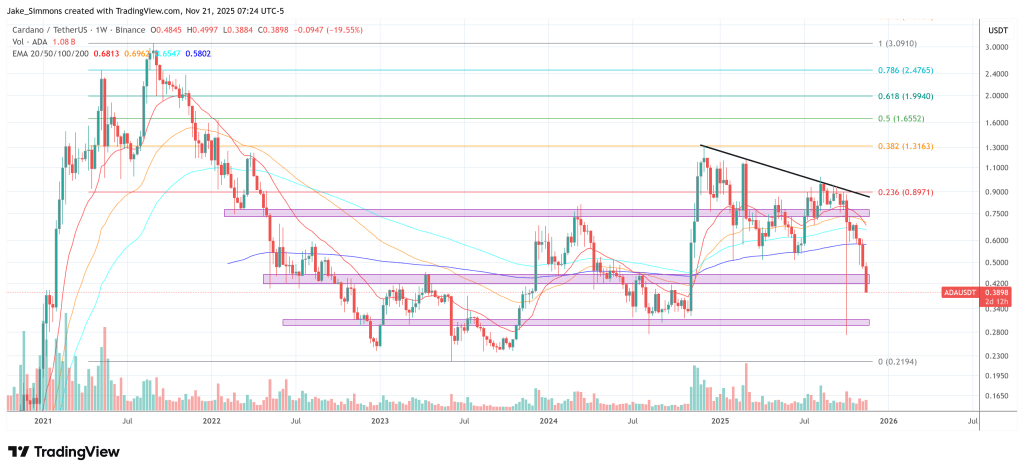
Cardano price
Cardano breaks below another key support zone, 1-week chart | Source: ADAUSDT on TradingView.com
Featured image created with DALL.E, chart from TradingView.com
Editorial Process for bitcoinist is centered on delivering thoroughly researched, accurate, and unbiased content. We uphold strict sourcing standards, and each page undergoes diligent review by our team of top technology experts and seasoned editors. This process ensures the integrity, relevance, and value of our content for our readers.

Jake Simmons has been a Bitcoin enthusiast since 2016. Ever since he heard about Bitcoin, he has been studying the topic every day and trying to share his knowledge with others. His goal is to contribute to Bitcoin's financial revolution, which will replace the fiat money system. Besides BTC and crypto, Jake studied Business Informatics at a university. After graduation in 2017, he has been working in the blockchain and crypto sector. You can follow Jake on Twitter at @realJakeSimmons.

Trending Cryptos

Related Reads

Media: Anthropic Aims for Revenue Up to $200 Billion by 2028 Ahead of IPO

Anthropic, the AI company behind Claude, is reportedly projecting its revenue could reach between $190 billion and $200 billion by 2028, according to sources cited by Reuters. This forecast, significantly higher than its reported $47 billion annual run-rate in May 2026, is being used by investors and bankers to value the company ahead of a potential IPO. Anthropic has confidentially filed with the SEC, with listing details dependent on market conditions and regulatory approval. The valuation reportedly applies a revenue multiple (EV/Revenue) to these future 2028 figures, an approach common for high-growth tech firms but unusual for a forecast two years ahead of an IPO. This reflects confidence in Anthropic's rapid scaling; its annual run-rate grew tenfold yearly for three years leading into 2026, jumping from ~$9B in late 2025 to over $47B by May 2026. Investors are betting the company's massive spending on GPUs, model training, and infrastructure will eventually outpace costs, leading to expanding margins. Public companies like Palantir, Cloudflare, and SpaceX, valued at high multiples of their forward revenue, serve as benchmarks. While this forward-looking method has precedents, some analysts question the sustainability of such valuations and the actual productivity gains from AI. Despite these concerns, earlier reports suggested Anthropic could be valued at over $1 trillion for its IPO.

cryptonews.ru12m ago

Media: Anthropic Aims for Revenue Up to $200 Billion by 2028 Ahead of IPO

cryptonews.ru12m ago

Open Blockchain Business: Who Gets the Fees and Why a Foundation is Needed

Business of Open Blockchain: Who Gets the Fees and Why a Foundation is Needed In public blockchains, user transaction fees do not simply become "revenue" for a single entity. The flow of money is complex and protocol-dependent. In Ethereum, fees consist of a base fee (burned, permanently removing ETH from circulation) and a priority tip (paid to the validator). In Solana, half the base fee is burned and half goes to the validator, while priority fees go entirely to validators. Thus, "fees" are not synonymous with "project revenue"; they may go to network operators or be destroyed. Foundations like the Ethereum Foundation do not take a cut of user fees. They are funded by their own treasuries, which can generate income (e.g., from staking rewards) and finance ecosystem development, research, and security. Their role is to fund public goods that are hard to monetize directly. Developers of open-source blockchain code can monetize through services, not the code itself. For example, Optimism provides its technology freely but sells enterprise support and managed services (OP Enterprise). Additionally, networks built on Optimism's tech, like Coinbase's Base, share a portion of their revenue with the Optimism ecosystem via agreements, creating an economic link. Token holders do not automatically receive fees as dividends. In Optimism, a portion of protocol revenue is now used to buy back and treasury-lock OP tokens, creating an indirect link between network usage and token economics. In Ethereum, fee burning reduces ETH supply but doesn't distribute funds to all holders; stakers and validators receive direct rewards. For evaluation, analysts should look beyond total fee figures. Key questions are: Who paid and for what? Where did the money go (to validators, operators, treasury, or burning)? What were the recipient's costs? Is there a mechanism linking this income to the token? The same fee amount impacts different blockchain economies in vastly different ways depending on these factors.

cryptonews.ru13m ago

Open Blockchain Business: Who Gets the Fees and Why a Foundation is Needed

cryptonews.ru13m ago

Trading

Spot

Hot Articles

Discussions

Welcome to the HTX Community. Here, you can stay informed about the latest platform developments and gain access to professional market insights. Users' opinions on the price of ADA (ADA) are presented below.

活动图片