Solana Just Solved Its Biggest Data Problem, Says Helius CEO

bitcoinistPublished on 2025-10-29Last updated on 2025-10-29

Abstract

Helius says it has re-engineered how Solana’s historical data is stored and retrieved, introducing a new archival backend and an...

Trusted Editorial content, reviewed by leading industry experts and seasoned editors. Ad Disclosure

Helius says it has re-engineered how Solana’s historical data is stored and retrieved, introducing a new archival backend and an RPC method that collapses today’s multi-call workflows into a single request.

CEO Mert Mumtaz framed the change in sweeping terms: “today, Solana changes forever… we’ve solved the biggest data/RPC problem that exists,” he wrote, arguing that the status quo—historical queries hitting Google Bigtable—has been “slow,” “expensive,” and “inflexible.”

What This Means For Solana

Mumtaz highlighted the practical pain point every Solana indexer or wallet developer knows: getting the “first tx for a Solana address without looping back endlessly” and pulling the “most recent 100 txs for an address” both require chaining calls and traversals that can balloon into “thousands of RPC calls.” “Not anymore,” Mumtaz said.

At the heart of the release is a Helius-exclusive RPC method, getTransactionsForAddress, backed by a distributed archival storage layer that the company claims is “1,000x faster, more flexible, and more scalable.” Functionally, the method merges today’s common two-step pattern—getSignaturesForAddress to enumerate signatures, then getTransaction to hydrate details—into one call that can return fully decoded transactions, with bidirectional time ordering and range filters by slot or timestamp.

Helius’ documentation spells out that it enables reverse search without back-traversal and supports pagination tuned for large, active accounts. The company also emphasizes that this is not a core Solana RPC addition; it’s a proprietary extension available on Helius nodes, priced at 100 credits per request on Developer plans and above.
Performance claims span both the new method and legacy endpoints, with Helius saying getBlock, getTransaction, and getSignaturesForAddress are now “10x faster,” while the archival system under the hood delivers the headline throughput improvements for historical queries.

The framing is squarely aimed at eliminating Bigtable-bound latency spikes and reducing call counts by “100x” alongside “10x lower latency” and “1000x less code.” Those assertions track with common developer complaints documented across Solana forums about slow historical hydration on busy addresses, but the hard numbers here are Helius’ own benchmarks.

The strategic context matters. Solana’s on-chain activity continues to skew toward high-throughput consumer and payments use cases, which punish inefficient data access patterns.

The launch landed the same day the first US spot Solana ETF went live on the NYSE—Bitwise’s BSOL. According to Bloomberg’s senior ETF analyst Eric Balchunas, BSOL recorded a volume of $56 million on day one. “BSOL’s $56m is the MOST of any launch this year.. More than XRPR, SSK, Ives and $MNU. And what’s amazing is it seeded with $220m. It could have invested seed on Day One, which would have resulted in $280m-ish, would be even more than ETHA’s debut. Strong start either way,” Balchunas wrote.

Another macro backdrop piece: Western Union announced plans to introduce a dollar-backed stablecoin, USDPT, on Solana, issued by Anchorage Digital Bank, with availability targeted for the first half of 2026.

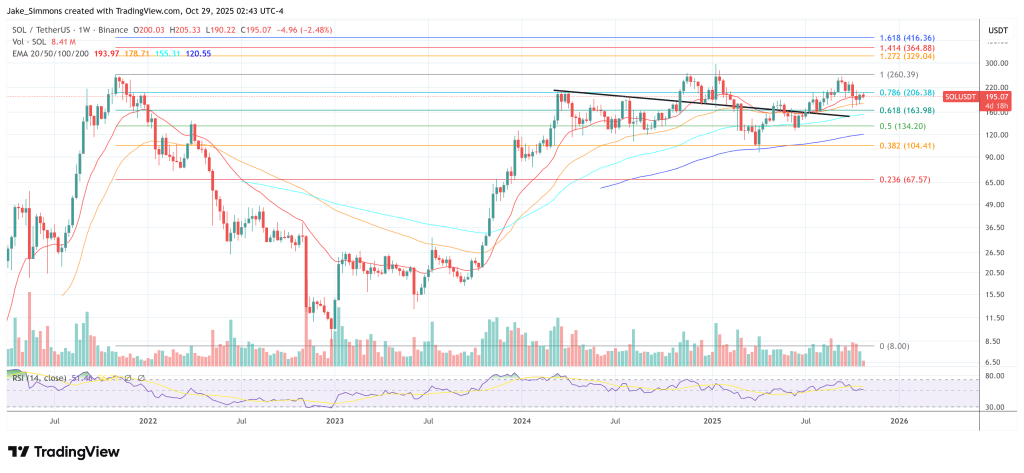
At press time, SOL traded at $195.
Solana price
Solana price remains below the 0.786 Fib, 1-week chart | Source: SOLUSDT on TradingView.com
Featured image created with DALL.E, chart from TradingView.com
Editorial Process for bitcoinist is centered on delivering thoroughly researched, accurate, and unbiased content. We uphold strict sourcing standards, and each page undergoes diligent review by our team of top technology experts and seasoned editors. This process ensures the integrity, relevance, and value of our content for our readers.

Jake Simmons has been a Bitcoin enthusiast since 2016. Ever since he heard about Bitcoin, he has been studying the topic every day and trying to share his knowledge with others. His goal is to contribute to Bitcoin's financial revolution, which will replace the fiat money system. Besides BTC and crypto, Jake studied Business Informatics at a university. After graduation in 2017, he has been working in the blockchain and crypto sector. You can follow Jake on Twitter at @realJakeSimmons.

Trending Cryptos

Related Reads

Panic Over $1.8 Trillion Deficit Heats Up, Bond Yield Surge Could Trigger 30% Bitcoin Volatility

The article discusses Bitcoin's current stagnation within a narrow trading range despite positive signals like BlackRock's ETF holdings and net inflows into U.S. spot Bitcoin ETFs. Market anxiety is growing due to conflicting macro forces. On one hand, the soaring U.S. budget deficit—projected at $1.8 trillion—fuels expectations of monetary expansion, which long-term proponents believe will benefit assets like Bitcoin. On the other hand, a sharp surge in global bond yields, with U.S. 30-year yields hitting multi-decade highs, poses a significant risk to high-valuation assets by raising real financing costs. Analysts note Bitcoin's 30-day realized volatility is at historic lows. Historical patterns suggest such periods are typically followed by a median absolute price swing of around 30% within 60 days, though the direction is uncertain. This could push Bitcoin to roughly $83,200 or down to about $44,800 from its current ~$64,000 level. The market's focus has shifted from Fed policy to the trajectory of long-term Treasury yields and geopolitical risks. While the fiscal deficit narrative supports long-term bullishness, the immediate threat of rising yields creates a precarious balance. Traders are warned to prepare for significant volatility and potential deep corrections, with some experts suggesting a washout of leveraged positions may be needed before a sustainable bottom forms.

marsbit8m ago

Panic Over $1.8 Trillion Deficit Heats Up, Bond Yield Surge Could Trigger 30% Bitcoin Volatility

marsbit8m ago

"AI Burning Books" Is Actually a Misunderstanding

"AI Book-Burning" Is Actually a Misunderstanding Recent reports about AI companies purchasing used books, scanning them, and then destroying the physical copies have sparked widespread outrage. Terms like "AI is devouring human knowledge" have become common, fueled by dramatic visuals of books being cut and shredded. However, the actual facts reveal a more nuanced story. While companies like Anthropic have indeed spent millions to buy and "destructively scan" several million books for AI training, this volume is a small fraction of the global second-hand book market. The core act—digitizing content and then discarding the physical object—is the opposite of historical book-burning, which aimed to erase knowledge. A key point of contention is the purchase of rare or out-of-print books. Yet, if these books were legally for sale on the open market, the buyer (whether an AI firm or an individual) has the right to do with them as they wish. The real question is whether society has adequate systems to protect books of genuine cultural heritage *before* they are sold. Expecting profit-driven companies to self-regulate on this is unreliable; the solution lies in establishing public rules, such as protected lists for rare editions or granting libraries priority purchase rights. Much of the intense public reaction stems not from the scale of actual harm, but from the powerful symbolism. The image of books being fed into machines taps into deeper anxieties about AI: fears of job displacement, mistrust of tech giants, and the unsettling feeling that humanity is feeding its own cultural past to the systems that might replace it. The outrage over "AI book-burning" is thus less about the physical books and more a proxy for broader societal tensions surrounding artificial intelligence.

marsbit18m ago

"AI Burning Books" Is Actually a Misunderstanding

marsbit18m ago

Trading

Spot

Hot Articles

Discussions

Welcome to the HTX Community. Here, you can stay informed about the latest platform developments and gain access to professional market insights. Users' opinions on the price of SOL (SOL) are presented below.

活动图片